The Cellardyke Echo – 1/11/2017

1920

GIFT TO CELLARDYKE POOR FROM THE U.S.A. The poor people of Cellardyke received a pleasant surprise this week in the form of a gift of a sum of money from Mr George Fowler, of Binghamton, U.S.A. Mr Fowler a native of the burgh, and it was while a visit to the town in the summer that he resolved to hand over £100 for the benefit the poor. The money was distributed by Provost Black and William Birrell, Sen. In addition Mr Fowler has, at his own expense, carried out several very necessary repairs to the harbour.

1922

Miss Annie Wallace, daughter of Mrs Robert Wallace, James Street. Cellardyke, lies in a critical condition as the result a serious accident. It appears that the girl, who is about 15 years of age, and who was employed as a potato gatherer with Mr Dickie, farmer, Caiplie, had been resting with other girls by the roadside after dinner, when they took the chance of a “joy ride” on a motor bus which was proceeding towards Crail.  Fearing that she would not be able to return to her work in time _ Miss Wallace jumped from the bus while it was in motion, and was thrown to the ground and rendered unconscious.

She was taken to Crail, where Dr Dow found that the base of her skull had been fractured. Later she was conveyed home, and is being attended by Dr Wilson and Nurse Smith.

1925

The East Neuk of Fife Horticultural Society, with its headquarters Anstruther, is to be resuscitated. This decision was unanimously agreed to at a well-attended meeting in the Council Chamber, Anstruther-Easter, last night. The Society was first instituted in 1849, and the outbreak of war prevented their show being held on August 12, 1914. Mr C H Maxwell, town clerk, presided, and, after explaining the object of the meeting, the financial report was submitted by Mr James Butters, Cellardyke who was treasurer, who said that in 1914 the Society had on deposit receipt £63 7s 3d, and with interest to date—£2o 6s 4d—the sum on hand now amounted to £83 13s 7d.

1926

Kilrenny W.R I. and their friends held an enjoyable whist drive in the Schoolroom, 13 tables being occupied. First prize (ladies) was won by Mrs Anderson, Kilrenny, and booby by Miss Thomson, Balhouffie. Gentlemen first prize was won by Mr Wallace, Cellardyke, and booby by Mr Taylor, London. Hidden prize went to Mr G. Williamson. Songs were sung by Mrs Hosie, and Mr Taylor gave two pianoforte solos.

1927

Recognition of lad’s gallantry was made the Council meeting, when Philip Anderson, the hero of a gallant rescue from drowning the Craigs, was presented, with the Royal Humane Society’s medal and certificate. The Provost, in making the presentation, commended the lad on his heroism. This was the third occasion during his term Provost that had been called upon to make such a presentation, but never before to so young boy.

300 YEARS OLD FIFE SECRET – KILRENNY COUNCIL’s FIRST RECORDS FOUND

What a Cellardyke Safe has revealed,

 In the Town Council Chambers at Cellardyke Town Hall there is an old safe that has for too many years baffled all attempts to open it but the other day it was flung open and a remarkable discovery made. The safe contained the first minute of Kilrenny Town Council and so far as can be ascertained, the volume is almost  300 years old, the earliest legible date is 1628. The book has no covers and the first????  or so pages are in shreds, but nearly ??? are in quite a good state of perseverance and the records of the council business 300 years ago can still be read.

The safe which hid the valuable volume had apparently been painted over both the outside and inside and while the paint was still wet, closed and locked. the outside and inside

Safely Stowed Away

The old minute book lay inside and presumably there arose no necessity for opening the safe, and the book was safely stored away, and probably forgotten.

Curious to know what contained yet baffled by inability to open it .Provost? Mitchell put one of his mechanics on the job.

 Under his skilled hands the safe gave up its long and closely guarded secret and Kilrenny town council are now proud to be in possession of their first minute book.

 The book will be put in a glass case and no doubt an opportunity will be afforded to those who are interested to view this  ????? of the Kilrenny and Cellardyke of long ago.

1929

A shipwright named Alexander Dick, 19 Exeter Drive, Partick, Glasgow, was fatally injured yesterday in the Meadowside shipyard of Messrs D. & W. Henderson, Partick.

He was standing on the scaffolding attached to a ship under construction, when he overbalanced and fell a considerable distance into the hold. He died almost immediately.

Mr Dick, who was 51 years of age, was a native of Cellardyke, Fife, and was the third son of the late Mr James Dick, missionary, Campbeltown. He had been engaged Meadowside Shipyard for many years. He is survived by his wife and four sons, the eldest of whom is a well-known organist in Partick.

BRAVERY RECOGNISED. Among those who have received parchments from the Royal Humane Society in connection with lifesaving from drowning is James L McLeod  (23), bootmaker, 1 George Street, Cellardyke, Kilrenny, who on August 22nd  Saved John Fleming (9). 57 George Street, who had fallen into Cellardyke Harbour.

At the Board of Trade examination for mates and masters, held last week in Dundee, the following candidates were successful in obtaining the Extra Master’s Certificate:

Mr John Miller Cumming. Tayport.

Mr Charles Owen, formerly of Rattray, Blairgowrie.

Mr Thomas Watson, 15 Dove Street, Cellardyke.

It is unusual for three candidates pass this examination at the same time as very few attempt it. The Extra Master’s Certificate is the highest award the Board of Trade.

The examination involves a knowledge of nautical astronomy, naval architecture, magnetism and deviation, general information (which includes science), signalling at high speeds (Morse and semaphore). There is also an oral test. Before the candidate can pass he must obtain 85 per cent in written, oral and signalling subjects. Failure in one subject entails complete failure.

The successful candidates are students the School of Navigation, Dundee Technical College, and were prepared for the examination Captain Stewart.

Subjects at No 6. Dove Street, CELLARDYKE, FOR SALE.

For Sale, by Public Roup, by Warrant the Sheriff Application for Division and Sale within the COUNCIL CHAMBER, Anstruther Easter, WEDNESDAY, the 18th day December 1929, at 2 o’clock Afternoon.

That TENEMENT of DWELLING-HOUSES with pertinents situated at No. 6 DOVE STREET CELLARDYKE, and occupied by Mary Gourlay! Alexander McRuvie, and George Gardner.

Rental, £16 15s. Feu-Duty Nominal

UPSET PRICE, £150 further particulars may be obtained from

A. COOK Solicitors Anstruther who hold the Title and Articles Roup.

 W S BONTHRON. Auctioneer Anstruther. 28th November 1929 Auctioneer

The Cellardyke Echo – 25/10/2017

1900

Yesterday afternoon, Mr Angus Sutherland, the chairman of the Fishery Board, arrived at Anstruther by the steamer Brenda and had an interview with Provost Thomson and other members of Kilrenny Town Council in regards the position of Cellardyke harbour.  Mr Sutherland intimated that Provost Welch, St Andrews, who held an enquiry about the harbour some time ago, had sent in a favourable report, and the Fishery Board had practically agreed to give grant of £1000, if the other money necessary for the proper repair of  harbour was raised locally, and that the Town Council obtained a provisional order in the next session of Parliament and got Legal power to extract shore and harbour dues from the fishermen using the harbour after restoration, and thus provide a revenue for its upkeep in the future. Provost Thomson and the Council willingly consented to the conditions, and Mr Sutherland promised the council to let them have official notification from the board at their next meeting. Provost Thomson Thanked Mr Sutherland and the Fishery board for the interest they had displayed in Cellardyke and its harbour

1901

James Peterson Wallace, a Cellardyke fisherman belonging to the Fife boat Morning Star, effected a most gallant recent from drowning of a boy in Yarmouth Harbour. The Morning Star was moored opposite the Fish Wharf when the alarm was raised. The boy had fallen over the quay, passed beneath the keel of a steamer, and rose to the surface again some eighty yards down the harbour. Wallace, hearing shouts from the crowded fish market, though wearing sea boots and heavy clothing, unhesitatingly plunged into the water and saved the boy, who seemed dead. The Morning Star’s crew took the lad below, and after prolonged exertions restored him to consciousness. Representations are being made to the Royal Humane Society to recognise Wallace’s heroic act. He was cheered by hundreds of admiring spectators.

1903

Grocer and Wine Merchant’s business for sale

The SUBSCRIBERS invite OFFERS for the GOODWILL of that LICENSED GROCER’S BUSINESS, JAMES STREET, CELLARDYKE, presently carried by ALEXANDER CATHRO.

Offerers will require, in tendering for the Goodwill, to Offer for the Heritable Property in which the Business is carried on. The Subjects consist of a Shop, assessed at £18, and Two Dwelling-Houses, assessed £8 and £5 respectively.

Fair Business has been done in the Premises by MR CATHRO. The Turnover Spirituous Liquors has been about 330 Proof Gallons per Annum. The Turnover in Beer is about One Barrel per week.

The Stock, which is Light and Fresh, will require be taken over by the Purchaser at Mutual Valuation.

For further particulars either to Messrs MACINTOSH, WATSON, & MURRAY, Solicitors, Anstruther, the SUBSCRIBERS, with either of whom Offers should lodged forthwith.

ROMANES & MUNRO, C.A. 50 Frederick Street, Edinburgh.

1905

The South Fishing

Last week the local boats and liners fished fairly well, the liners Nancy Hunham and Vanguard 3, having 100 and 90 crans respectively. Two boats the Pride of Fife and Morning Star of Cellardyke landed good shots, the former 80 and the latter 70 crans, On Friday the motor boat Pioneer landed a shot 74 cran Several other had good shots.

1907

The Rev. Peter T Thomson, Leicester, who has suffered seven days imprisonment as a passive resister to the education rate, is a son of Peter Thomson, draper, Cellardyke.

1909

An old woman named Mrs Sutherland, Cellardyke, applied for an old age pension to Kilrenny Town Council. Her claim was approved, but was refused by the pension officer on the ground that her husband received parochial relief, and that she participated in it. The Local Government Board upheld the officer’s contention, and the claim was refused. Questions were put in Parliament, and representations made to the board on the subject, with the result that another pension officer was sent Cellardyke to investigate. He has now admitted the claim, finding out that she did not participate in the relief granted her husband, and the Board have decided that she is to be paid the pension of 5s weekly from the 1st of August last..

Scottish Coast Mission, Berwick Branch

During the fishing season, nine open air services were conducted at Tweed Dock on Sunday afternoons. Some of the Cockenzie and Cellardyke fishermen gave short addresses and solos and quartettes

1912

Feared Loss of Ship’s Fireman.- Information was received at Cellardyke on Sunday that John Watson, fireman on board the steam drifter Guerdon of Cellardyke, had not been seen since Friday evening, and grave fears are entertained that he has met his death by drowning in the dock Yarmouth, where craft is at present engaged at the fishing. Watson, who is about 26 years of age, is unmarried, and is the sole support of his widowed mother, to whom much sympathy is extended.

1915

THREE CELLARDYKE SOLDIERS WOUNDED. Information has come to Cellardyke that the three local lads wounded in the recent fighting are all making good progress. They are Sergeant George Moncrieff, 4th Black Watch; Lance-Corporal Wm. Thomson, 8th Black Watch; and Private Thomas Martin, 2d Black Watch. Moncrieff was hit near the spine by two pieces of shrapnel, Thomson was wounded in the thigh and wrist, while Martin was “gassed.”

Fifeshire properties for sale

Dwellinghouse and shop situated at 21 John Street, Cellardyke occupied by John Deas (McRuvie) rental , £5, feu Duty Nominal

1916

CELLARDYKE. Put Not Your Trust Motor Cars.— Owing to a breakdown of the motor car in which he was travelling from St Andrew’s to conduct the services in Cellardyke Parish Church on Sunday, the Rev. Principal Galloway, D.D., did not arrive till about an hour after the prescribed time for the service to begin. This put the congregation in a very awkward predicament. Ultimately one of the elders, Mr David Smith, appeared, and, stating the cause of the minister’s non-appearance, gave out the first hymn, which was sung by the congregation. It was about twelve o’ clook before the Professor arrived in another motor car that had been requisitioned, and the usual service was then gone through. One of the hymns sung—“ Come unto Me, ye weary,”—had a special significance.

1917

Gunner James Burd, R.F.A., eldest son of Bailie Burd, Anstruther, and Private Andrew Dick, Black Watch, Forth Street, Cellardyke, are reported wounded.

Lieut. W. F. Wood, R.M., eldest son of the late Mr Andrew Wood, Anstruther, and nephew of Bailie Gay, Elie, has just been promoted to the rank of Captain. In civil life Captain Wood was on the staff of Messrs Gibson & Son, ship owners, Leith, where his home is. He is an old Waid pupil. He has been nearly three years on active service, and received his commission this year for meritorious work.

1918

THE INFLUENZA EPIDEMIC. The ‘flu is very prevalent in Cellardyke, mainly among the older people. Four of the teachers in the Public School have been prostrated with it, and the school has had to be closed.

Miss L. J. Smith, who for the past ten years has been a teacher at Moffat School, and has recently resigned, has been appointed assistant infant mistress at Cellardyke Public School.

Seaman Robert Thomson, son of the late Mr Alexander Thomson, fisherman, Cellardyke, has died in Plymouth Hospital of influenza. Seaman Thomson, who was only home on leave a fortnight ago, was a recorder in the Admiralty service when broke out, and at once joined up as a seaman in an auxiliary cruiser. He was 35 years or age, and leaves a widow and one child. The remains of Seaman Thomson were brought to Cellardyke, and were on Tuesday interred in Kilrenny Churchyard. The funeral was of a naval and military character. Large detachments of naval men and the local volunteers formed a feature of the cortege.

The Cellardyke Echo – 18/10/2017

1880

Cellardyke Police Commission.—This Board, meeting the other day, agreed to accept the contract of Thomas Christie to cart the street dung, as swept by the scavenger, to the depot for the year the sum of £55. They also preferred, out of several candidates, William Dewar to be the , “town’s man” in Upper Kilrenny at the wage of 18s a week.

Yesterday morning the fishing boat Venus Star, hailing from Cellardyke, Scotland, arrived Whitby, and captain, Peter Murray, reports that on the previous night, while or seven miles off that port, homeward bound, one of crew, William Anderson, of Cellardyke, fell overboard, and was drowned. Deceased was at the time fixing one of the lights, when the stanchion which was holding gave way, and both foil into the sea. The boat was ‘sailing great rate, and it was impossible to rescue the unfortunate fisherman. He was about 40 years of age, and leaves wife and four children.

1881

We understand that the East most of the handsome block of houses in West Forth Street, Cellardyke, just being finished our townsman, Mr Wallace, builder, has been sold to Mr Alex. Keay (Watson) for the sum of £485. The fine site James Street also included, so that a more desirable property has rarely changed hands amongst us. In the house itself every regard has been had not only for the comfort the family, but, also, for that important consideration, the stowage gear, and thus taken along with the magnificent view, it admittedly claims like the rest the block—a model fisher home.

The Bailie Court of Kilrenny on Friday— Provost Watson presiding—four coopers employed in Cellardyke –  George Lawson, David Dun, John McLeod, and William Blyth charged with assaulting Mr David Muir, fisherman, at the harbour head on the evening of Saturday week, and also with a breach the peace at the same time and place. All the panels appeared except Blyth who is in the meantime at Yarmouth. They pleaded not guilty, but the evidence of several of the neighbours brought home the charge in the opinion of the court, and they were each fined 7s 6d, or ten days in jail.

1882

GREAT YARMOUTH HERRING FISHING

GEO. W GILES,  

FISH SALESMAN, GREAT YARMOUTH,

Can offer superior ACCOMMODATION to SCOTCH FISHERMEN who intend fishing at YARMOUTH for Storage Nets, &e., and gives the most personal attention to the Sale of their Fish. Has been a Salesman for many years for large number of boats hailing from St Monance, Cellardyke, Buckhaven, Eyemouth, Ferryden, Peter- Banff, Buckie &c.  Address No1. Fish Wharf, Great Yarmouth.

Fine Art Exhibition Dundee…..We now proceed take a brief glance at the pictures. That versatile and eccentric genius, the late Sam Bough, is well represented in the present Exhibition. No fewer than seven pictures appear under his name; and three these—.No. 1200, “Cornfield” No 1241, “Cellardyke Harbour;” and 1308, “Naworth Castle—Wind and Rain,” are admirable specimens of the master.

Hairbreadth Escape of a Fife Crew. —One of the most remarkable instances of special Providence, to use a favourite phrase of the coast, occurred last week to the Cellardyke boat, Ivanhoe, Geo. Fowler, master, while on the voyage from Scarborough. Their errand over on the herring sea, the crew had put to sea on Tuesday night, and were bowling along, with jib and foresail boomed out, as the sailors say, before the south-west wind, when, about two next morning, those on deck saw red light within bow shot bearing right upon them. The night, by reason of the fog, was as black as the grave, and thus the stranger—a big barque, under full sail—was all unperceived upon them. A vigilant hand, David Meldrum, held the tiller, but not an instant was left to act, or even consider what to do, when her head gear was entangled with the boat. The foremast brushed clear by a hand breadth, but the mizzen was caught by the big bowsprit, and was next moment hurled into the sea. It so far, however, averted the collision, though the winch and part of the rail was wrenched away, but otherwise the boat was safe —delivered as by a miracle from the very jaws of destruction. The escape of three of the crew was exceptionally so. The boat-hook, acting boom, was thrown like a spear from the hand of a giant against the shoulder of a veteran fisher, George Smith, while, as the mizzen mast crashed over the gunwale, it struck full on the steersman, who also received a severe blow in the fall of the winch. A landsman, named John Ramsay, was also thrown into the sea, and his escape was, perhaps, the most providential of all, for, unable to save himself, he must have become the prey of the hungry waves, but as he rose to the surface, the broken mast floated to his arm, and on this he rested like a life buoy till he was sometime after casually seen in the “water burn,” when he was dragged into the boat. In the meantime it was the impression on board that the shoulder of their comrade was dislocated or broken, and that David Meldrum had received a mortal hurt; but for while their every outcry and effort was to obtain assistance from the barque. It was all in vain, however, for deaf to every call, and with that heartless barbarity which unfortunately has only too many parallels in the story of the sea, the stranger never once changed his course, but held under full sail as before. In the darkness and agitation of the hour our fishermen failed to identify the barque, but, so far as could be made out, she seemed to be a foreigner, making probably for English coal port. The Ivanhoe reached Anstruther harbour some thirty six hours after the collision, when no time was lost in obtaining assistance for the injured men. Fortunately, in neither case was there any bones broken, and David Meldrum, for whose condition so much uneasiness was felt, is, we are glad to say from latest accounts, doing as well as can be hoped for. We understand that the authorities are investigating the matter with view of bringing the sea miscreant to justice.

1883

Mr James Henderson is giving the finishing touch to the Eastern Section of Rodger Street, Cellardyke, in a handsome corner block which has been rented to that rising practitioner Dr Flaxman.

1886

The Magistrates met in the several burghs, so far as there was any applications, on Tuesday. Phillis Carstairs, the widow of Alexander Gardine, who held a grocer’s license for premises in John Street, Cellardyke, asked for a transfer her own name, which was granted by Bailies and Smith, the Magistrates on the bench.—Walter Miles and Widow George Shelley, within a few doors of her, applied for a table beer license. Bailie Martin opposed the application on the ground that it would increase the number of licensed houses to six—a number out of all proportion in one street. Bailie Smith was more sympathetic—the one was a blind man laid aside by the infirmity of heaven from ordinary work, and the other was a “widow indeed ” if only by the frailty of years ; but on being referred to, Constable Martin said that these houses were often the most mischievous of all in the neighbourhood, when both were refused.

1887

New Patents

William Duncan and Alexander Black, Cellardyke, for “Improvements to Boots”

1890

Mr Archibald Guillan, Anstruther, having completed his hundredth year six o’clock on Saturday evening, the neighbours, to the number of 220 1 celebrated the event by a soiree in Anstruther Town Hall. The meeting began in the afternoon. The tables, &c., were tastefully decked with flowers and evergreens. The centenarian ascended the platform with an agility to be envied three score and ten to take his seat with the Chairman, Provost J. T. Darsie, ex-Provost Halson Anderson, the Rev. T. Murray, &c. The company were then served with tea and cake in way that would have done honour to drawing room by Mr M’Connell. ….. The proceedings were also enlivened with fine selection of songs by Councillor Melville, Mr Alexander Watson, the Misses Melville and Watson, Cellardyke; the Misses Wilson and M. A. Brown, Anstruther, &c. and charming violin music by Miss M. Cook, with the pianoforte accompaniments by Miss A. Oliphant. In moving a vote of thanks to the Chairman, Mr Cook made one of the most interesting contributions to the night reading from the columns of one of the Edinburgh newspapers published in the autumn 1790. Singular to say, it contained notice of the death of two of the apocryphal centenarians, in which the serials the period so delighted to indulge. …

1892

Yarmouth

The BF 372 Glad Tidings, hailing from Buckie, collided with Yarmouth boat on Monday night, with the result that her stern was stove in and considerable amount damage done. She is now in dock, but will ready for sea in a few days. The KY boat Hawarden Castle, from Cellardyke, had a collision with another Yarmouth vessel in the harbour, and she is also in dock.

Early Sunday morning the joists of a house in James Street, Cellardyke, were found to fire. The brigade was called out, and the flames extinguished without difficulty. A neighbouring chimney had been on fire the preceding night, and the flames had smouldered till the smoke alarmed tire inmates. Little damage was done.

1893

At Cellardyke Court, William Leslie applied for grocer’s license for premises in the village of Kilrenny. The application was refused, Provost Martin stating that there was no demand for license there, which had been without one for 40 years. John Pitt was granted renewal of public-house certificate for premises in George Street.

1895

The Maggie Scott, of Cellardyke, while lying at the wharf at Yarmouth, had been run into by the Glengarry, St Monance, which was tacking up the river. She was severely injured, and had to be beached. T

The liners, with the exception of the East Neuk, had to rest content with one shot, the details of which we gave last week. Judging from the great gathering of all kinds of craft to the lee of Elie Ness a heavy sea was raging outside the Firth, and the Bonito, which tried to face it, had to turn back. The Pioneer** which has been hired Skipper Adam Reid, was telegraphed from Shields on Wednesday with £104 for the first shot., but was unable to get bait for a second shot. A number of townsmen were in the Tyne on the same day, the details being:—Glenogil £89; Tennant, £31; Fair, £13; and Edith, £13; while the Maggie was at Newhaven with £50. The reports from Islay are far from cheering; little has been done by the Fife yawls, but it is hoped that change for the better will set in by another week-

**The Pioneer was owned by the Peterhead Steam Line Company and was not doing well under the previous crew, so they hired it out to Adam Reid who in the first few weeks of this new arrangement was doing very well.

1896

These are stirring times in the history of the Cellardyke men. Every eye is turned on the efforts of the liners, and the crews in their turn are devoting every energy to the management of their vessels. Sunshine and storm come alike. So long as there is a possibility of working the boats are at sea, and last week they had a baptism of storm which only the splendid qualities of the crafts and the seamanship of the men brought them through.

They did not leave the deep without forcing tribute from her bountiful store, as the following record of the earnings testifies — East Neuk £101; Tennant, £97; Isle of May, £52; County of Fife, £40; Copley, £25; Fair, £24; Maggie and Edith, -£22; Glenogil, £15, &c. This was the reverse side of the picture. The Kittiwake returned with all her lines carried away, and one of the crew of the County was badly cut about the face by the glass of the window of the wheelhouse, which was shivered by a sea. Other steamers lost lines and all bore traces of the fury of the gale which they had come through.

Only one week previously

…. the Fife boats the highest fishing which has ever been coupled with that of any fleet of vessels from one port. The County of Fife had pride of place with a coveted total of £179. Skipper Henderson in doing this has only capped a series of splendid hauls during the past five weeks, the average earnings of the liners being £103.

1897

The summer fishing proved the lowest for many years back. The average earning generally amounts to from to £150, but this year it was considered that £80 would cover it. The boats have now all left for the south coast, Scarborough, Lowestoft, and Yarmouth. The steam liners during the quarter have mostly been engaged at the herring fishing as well, and did very fairly, the average weekly gross earnings ranging from £50 to £45. An addition has been made to the fleet by the launch at Anstruther of the Rothesay Bay. This makes 20 steam liners manned Cellardyke fishermen.

1898

In the East of Fife the storm was most disastrous and caused great destruction to property. The east wall of Cellardyke Harbour was knocked over in several places, and the stones swept into the harbour, making it entirely useless. The walls of the houses fronting the sea in Cellardyke were torn down and boiler and washing-houses destroyed. The saw mill and fish manure factory at Cellardyke belonging to Mr Cormack, was completely wrecked, and the machinery twisted. Part of the coping at the east pier of Anstruther was swept into the harbour, while different places of the west pier were much shaken and torn. The wall of west Anstruther is covered with sea ware, and, and the churchyard walls which faces the sea has been swept away. Breaches have also been made in other properties. The west end of Shore Street. Anstruther, is covered with sea ware, sand, and large stones, while the causeway blocks in Castle Street have been lifted by the force of the waves and thrown about. It is impossible to estimate the damage, but it must amount to thousands of pounds.

Another report of the same storm

..it was Cellardyke that the greatest amount of havoc and destruction was wrought. The garden walls of the houses skirting the sea got the full fury of the storm, with the result was that on Tuesday morning scarcely a wall escaped right along from Anstruther to the end of Cellardyke—more than a mile in length. The breaches made an inlet to the sea to reach bark, boiler, and wash houses, many of which were knocked over, and the bricks and stones scattered over the beach. Cellardyke Harbour, which belongs Mr Bethune of Balfour, was also rendered useless by the east wall being broken in several places and the harbour blocked by the debris. The roadway the North Pier was torn and heavy stones misplaced. The saw mill and fish guano manure factory the east end Cellardyke, which stood in a very exposed position, were completely wrecked and the machinery twisted into every conceivable shape. The Anstruther lifeboat was called out Monday night, but the crew found it impossible take it outside the harbour, and the boat was wheeled to Methil. a distance of  15 miles, only find that the services of the captain and his crew were not required, the vessel had been taken tow and the crew rescued.

Two days later

About eight o’clock this morning the body of a Norwegian sailor was found on the beach at Cellardyke. He had only been few hours’ dead, and wore a lifebelt and cork jacket. There was nothing to lead to his identification.

Then a public appeal goes out in a letter to the papers

Sir,-The recent storm struck Cellardyke very hard. The sea-wall at the east end of the burgh is -its only protection-is almost demolished, and there is great risk of further damage to property if it be not restored. Another storm would wreck the place and invade the streets: Many private persons have suffered loss by the inroad of the sea, while the damage to public property amounts to at least £2000. The Town Council is quite unable to make this good; the community is a poor one, consisting almost entirely of fisher people, and on their behalf, through your courtesy, I appeal to all who know and love v the coast of Fife to come to their aid. Provost Thomson, Cellardyke, by Anstruther, will gladly receive and acknowledge any contribution.. H.T. Anstruther Gillingshill

1899

…an engineer was also to be in the town to make inquiries about starting linoleum industry, but he was afraid the old water supply would not be found sufficient, and inquiries would have to be made of premises in Cellardyke to see if they would be suitable for the purpose. He hoped these industries would yet be started in the locality and turn out success.

The Cellardyke Echo – 11/10/2017

1870

Free Church Bazaar –  about ten years ago the members of the Free Church in Cellardyke erected a large hall for religious meetings, but that building having been found inconvenient and incommodious, a movement was set on foot  in the spring for an improved edifice and this effort was so spiritedly carried out, that a new Free Church hall of ornate design and suitable dimensions has just been completed in a fine situation in that enterprising fishing town The hall has cost £640, the fund for which was so far provided for by the £200 paid for the old hall, and £200 of donations, that there was thus a debt upon the building of £240, which  the committee proposed to liquidate by means of a bazaar….. there naturally was a lively interest excited in the bazaar which was held in the new hall on Friday last, Some anxiety we hear, was felt owing to the very unfortunate close of the herring fishing season; but all fears were soon dissipated in the brilliant success which from first to last distinguished the opening day…. Throughout the whole day the hall was crowded the number of visitors being estimated at 700. Nothing could be more interesting than the picture which was thus presented – the handsome, airy hall, flooded with light, and garlanded all about with green leaves and choice flowers, the stalls heaped with their glittering richly tinted treasure loads – the hundreds of elegantly attired ladies, full of the spirit of animation of the hour, gave equal brilliancy and grace to the fascinating scene which received a charm all their own from the pianoforte music so sweetly rendered by Mrs McDonald, nor should we forget the Tennyson Hymns given with no less pathos and expression by Miss martin and other accomplished young ladies of the neighbourhood.  The total raise was about £170 9s… we understand that the substantial aid the will leave little more than £35 on the building and encouraged by their recent success the committee contemplate making an effort to discharge this balance at once..

1872

After some days of anxious waiting for favourable change of weather, our fishermen, whose hopes are with the herring fishing on the Suffolk: coast, were enabled to make a start, with flowing sheet, on Monday morning. Within the last few years the fishing has become of great, may say of paramount, importance our Fife crews, most of them now betake themselves thither; preferring the chances of the season at Lowestoft or Yarmouth over the stormy voyages and fluctuating prices which are only too characteristic of the white fishing at home. The number of Fife boats which will be engaged at these English stations may be estimated as follows : — Cellardyke, which ranks as a kind of metropolis amongst her fishing neighbours in enterprise as in population, sends out 40 boats, which is one less than last year; Pittenweem, where the old spirit is once again pleasingly showing itself, has fitted out 9 crews; while the hardy sons of grey old St Monance have 16 boats so employed ; there are also two or three boats from Largo, and we hear of 14 or 15 crews from Buckhaven, so that about 90 boats, manned by nearly 940 fishermen, will, after this date, be nightly abroad on these English seas, some 400 miles away, where they will remain till about the beginning of December, when, with the close of the season, they will, if all goes well, once more hoist the sail on the voyage for home.

There is a twofold reason why our hardy fishers should prefer to seek their bread thus far from their own firesides. “We are sick of the haddock fishing,” the gallant fellows will tell you ; and no wonder that it should be so if we only take a thought of the winter squalls, and what is still more discouraging, the miserable markets which they may daily experience. Brighter prospects, however, invite them southward, where, unless the storm is all the more sudden, they have time to find secure shelter under the lee of the great sandbanks which stretch, like a vast breakwater, along the land, and effectually shield the harbours from those winds which every mariner has so much reason to dread on a tempest-beaten shore. “We escape many blast, and can sleep soundly there, when we could only look for wet jacket at the lines,” said the mate of the “Anna” to us the other day. But, besides this greater security and comfort the south-going crews have also the prospect of better returns at the herring fishing, which, since it was commenced has steadily proved an inexhaustible gold mine, though last year its very success so affected the markets as to make it very indifferently remunerative to most of our crews, though, with few exceptions, they are all willing to make another venture. The system of fishing is curiously enough, widely different on the Scottish and English coasts.  At home the nets hang from the head rope, which in turn is kept up by the floats some four or five fathoms under water, by which the ships can sail over the nets without doing any damage; but on the south coast the nets float at the very surface, with rope or messenger along their foot or sole of the drift, but most singular of all, the moonlight, which is reckoned a misfortune for the Scottish fisher, is, on the contrary, the chief hope and delight—welcome, in fact, as the harvest moon—to the sons of St Peter in English waters. Our fishermen, however, are in a position to prosecute the south fishing with Cc of success. At Yarmouth and Lowestoft the herring luggers—which, by the way, by no means possess the fine sailing and weatherly qualities of our fife boats—are, together with the outfit of sea gear and stores, the property of shore owners, who merely embark in the speculation for the sake of its profit, while the crews or the fishermen are simply in the position hirelings or of the half dealsmen who leave their work on shore to lend helping hand to our fishermen during the herring season. There is a broad contrast between these English fishers or beachmen, without any other stake than that of mere labouring men, and our Fife fishermen, who have a share every case in the nets, if not in the boat; and when this difference of relative position is understood, it can be easily inferred that the superiority of our Fife crews in industry and enterprise, as well as in the social virtues, are nowhere more conspicuous than while they sojourn in early winter on the English coast.

 A few days later

From telegrams received from England we learn that on Wednesday the Cellardyke boats landed from one to two lasts of herrings, which sold at from £8 to £12 a last. The report that appeared in Monday’s Scotsman stating that a memorial was to be forwarded to the Lord Advocate, asking hi  to grant permission to use scotch fir in the manufacture of white herring barrels, has excited some discussion among the fishcurers in Anstruther and Cellardyke, the opinions expressed are decidedly against the request being granted as the allege that the porous nature of scotch fir would allow the brine to escape from the barrels and render the herrings useless. The price of Norwegian larch delivered at Anstruther is at present 105s per thousand feet, and billet wood is 1s to 1s2d per cubic foot. Last year the prices were from 70 to 72s for the same larch and 8d for billet wood.

1873

The Cellardyke boats at present prosecuting the herring fishing on the English coast have so far been very successful, some of the crews having netted over £100 during the first fortnight . From telegrams received on Saturday it appears that the whole of the Cellardyke boats fishing- at Lowestoft had been out in the storm of that morning, but up to four o ‘ clock in the afternoon all but three had been telegraphed as in safety.

1874

Two brothers, residing in Kilrenny, David Kinnear, shoemaker, and Andrew Kinnear, miner, were charged with assaulting David Keith, jun., carter, Cellardyke, by striking and kicking him to the effusion of blood, near the Commercial Inn on Saturday night, and also with having committed a breach of the peace at the same time and place , The Panels pleaded not guilty …. Evidence being adduced for the indictment, David Keith, the complainer, whose face was frightfully bruised,  after evidence was heard the provost stated that the charge was clearly established and the brothers were sentenced to 21s or 20 days in prison.

1876

Boat Insurance Club. — This new institution, which was established shortly after the great destruction of fishing property during the severe storm of last autumn, promises to be successful. For the current year upwards of 50 boats are insured with the Club, and others are expected to be added to the number. As yet, with the exception of two from St Andrews and one from Fraserburgh, the majority belong to Cellardyke; but it is hoped that the fishermen in the other villages along the coast will avail themselves of the benefits of the Club.

1877

ANSTRUTHER. Departure of Fishing Boats fob the South. the course of last week than 70 of our fishing boats left for Lowestoft and Yarmouth, engaged in the autumn herring fishing there during the next two months. Each boat manned by seven men, and including the representatives of the carers, there will fully 500 persons from Anstruther and Cellardyke prosecuting the enterprise at these fishing ports.

1878

Cellardyke. Unexpected Abatement.—ln the Small Debt Court, Cupar, on Thursday, Thomas M. Rae, family grocer, Aberdeen, sued Alex. Tarvet, skipper, Cellardyke, for an account for groceries, amounting to £10 6d. Defender said the account was quite just, but he required time to pay it. Sheriff Bell pointed out that there were several items for rum and whisky that he was not bound to pay for under the Tippling Act. Defender, not understanding the Sheriff’s remarks, still insisted that the account was just. On the point being again explained to him by gentleman at the bar, and the question repeated from the bench, Tarvet created considerable amusement by saying, “Oh! I ken naething aboot the whusky. The amount for rum and whisky—£1 3s 11d —was accordingly deducted, and decree granted for £8 18s 7d, with 5s of expenses.

NB the Tippling act in Scotland 1836 prevented traders selling small amounts of alcohol on credit, so this could not be part of any debt recovery process.

The Cellardyke Echo – 3/10/2017

1802

For sale by Public Roup

That SHADE on the Shore of Cellardyke presently possessed by James and Peter Davidson, and used by them for curing herrings and white fish.

1828

Crail- A fishing boat belonging to Cellardyke from Eden to Cellardyke, deeply laden with shell fish for bait, swamped within a quarter of a mile from the harbour here, and, melancholy to relate, six men were drowned, and only one saved. The man saved, named Davidson, has to lament the loss of two sons, a brother, and a brother’s son. (The boat was the Olive, part of a fleet of Cellardyke boats collecting mussels for line bait)

1842

Anstruther – A large specimen of the short sun fish, Orthagoriscus inula, was brought on shore here last week, by one of the Cellardyke fishing It measured upwards of four feet in length, six feet depth between the extremities of the dorsal and anal fins; its weight was from twenty-five to thirty stones. When first observed, its dorsal fin was only seen, and it was moving through the water very slowly. Though occurring but occasionally, it may be said to have been taken from John o’Groats to the Land’s End. Previous to present year, seven or eight examples have been known to occur in the Frith of Forth, and this is the fourth specimen which has been caught this year. Another is said to have been observed at the mouth of the Frith by our fishermen Saturday last. It is a dull, stupid fish, and when once seen may be easily caught. This fish has been considered general to live on sea-weeds and shell fish, but a large haddock was found half-digested in the stomach of the specimen under consideration. The fish was purchased by Messrs Goodsir, surgeons, here, who are preparing it scientifically for a place in their already well-stocked museum.

1849

Cellardyke. – Saturday, while the crew of one of the boats belonging to the above place were pursuing their usual avocation on the mighty deep, one of their number suddenly took ill, and being asked by his comrades what his aliment was, answered that he thought it was cholera. This announcement made them to cease shooting their lines, which they were then in the act of doing, and prepare immediately to haul those they had already shot. But finding him still getting worse, and the cramp (that sure forerunner of cholera being in its last stage) having attacked him violently in the breast, they immediately cut their lines and went home; but, before they could arrive there, his whole body was so stiffened with the cramp that he was like a marble statue. Having reached the harbour, a cart was immediately procured, which drove him to his own home, where he received that heat and comfort which his stiffened limbs most greatly needed, but which also came too late. He died the same evening at about nine o’clock. It is impossible for us not to sympathise with the wretched man in the circumstances in which he was placed, while he was attacked with the disease. In an open boat on the open sea, no comfort could be procured to alleviate the dreadful pain which he suffered, no medicine to allay the fierce effects of the disease, and no consolation from the partner of his life to soothe and assuage his sufferings, and to calm his grieved and troubled mind with cheering and consolatory words.

1851

Time was, says the Pittenweem Register in doleful treble, when “the fiddle and the bow,’ would have been heard in all quarters—in every town on the East Coast at the end of the fishing, but the failure of the present drave has cast a gloom over the spirits of our fishermen; and the inspiring notes of “the fiddle and the bow” are nowhere to be heard. Last year at this time five couples were proclaimed in one day at St. Monance—the wrights in Cellardyke were at work night and day making furniture tor those who were entering the happy state—but, this season, there is not the sound of a hammer. The tailors and dress-makers had likewise to work extra hours; and, though last, not least, the session-clerks will feel the scarcity of many a dainty half-sovereign in payment of their customary dues. The women, who are always the best informed in such matters, calculate that there are from forty to forty-five marriages postponed for the present, in consequence of the unfortunate failure in tile herring fishing.

1856

George Sutherland, cooper, Cellardyke, charged with assault there, was fined 10s or 10 days imprisonment.

1861

In Cellardyke, two houses were sold a few days since which rented £3 and £4 respectively, the former for £100 and the later for £153

Cellardyke, it is gratifying to state that there is no stagnation, especially in those matters which best indicate the prosperity and well-being of a community: we allude to the numerous marriages there in course of celebration. The other Sunday no fewer than five couple were proclaimed in the Parish Church; and as these occasions are marked with no little festivity and display, the town frequently presents gay and animated appearance. Strangers in the locality have often been surprised at the early age at which these unions take place, and certainly there is no class where the opinions of Malthus are so little regarded as amongst fishermen; the nature of their calling renders it necessary; but it may also be stated that a due regard is generally had to a proper provision for an event of which the weal and comfort of life so much depend.

The fishermen of Cellardyke, Pittenweem, and St Monance, enrolled in this naval force the number of 80 or 90, left this port on Tuesday by the Leith and Anstruther steamer Forth for Leith, to undergo month’s drill on board H.M.S. Edinburgh, lying in Queensferry Roads.

The White fishing —A partial commencement of the haddock fishing was made by two Cellardyke boats on Tuesday, when they returned with about forty-five dozen each—one-fourth of which were full -sized marketable fish. The boats of the neighbouring towns seem to content themselves with trawling the herring fishing ground off the port, to the detriment of future fishing seasons.

1862

On Saturday last, the Coast Volunteers belonging to the fishing towns of the East of Fife, embarked here for Leith on their way to join the training ship Menai, now lying off Queensferry. By the terms of enrolment, month’s attendance is required at drill the course of the year; and as the present is the least productive period of the fishing, it has been preferred for this purpose. They numbered about seventy altogether— forty being from Cellardyke, and the remainder from Pittenweem and Monance. Their appearance was highly creditable to their respective communities, they were all active, spirited young men.

1864

CELLARDYKE. Concert.—On Friday evening, a concert of vocal and instrumental music, under the patronage of the officers of the 3d Fifeshire Rifles, was given in the Female schoolroom here, by and for the benefit of the brass band of that corps. Besides the band, who acquitted themselves in admirable style, in a number of popular tunes, Mr Alexander Hay, and other amateurs also took part in the proceedings. Mr Hay sung with his usual taste and spirit several patriotic and sentimental songs, while the humorous element of the entertainment was contributed by Mr Gr. Thomson, who ably sustained, on this occasion, his wide repute as a comic singer and ventriloquist. Mr G. Butters also gave in a creditable style a number of select recitations. The various pieces were, all cases, much enjoyed and applauded by the audience, which, however, was less numerous than the merits of tie entertainment deserved.

The line fishing has now been actively commenced for the season, and when the weather has proved favourable, the boats have made daily trips to the fishing ground. The takes have ranged from forty to sixty dozen of haddocks; but in point of quality the fish have been generally inferior and small in size. The demand has been active, and the price may be quoted at 1s per dozen, for large and small indiscriminately counted. This season there are thirty-nine large boats belonging to Cellardyke engaged the white fishing, besides several yawls, manned principally by old men and boys, who confine their labours to the Firth.

1866

This season there will be thirty-nine Cellardyke boats engaged in the deep sea fishing; but, besides these, there are five yawls the line fishing the coast. In addition to this goodly fleet, six Cellardyke boats, besides the Pioneer, have proceeded the Yarmouth herring fishing, where they will be stationed until the approach of the New Year.

1867

On Saturday last, two dwelling-houses, situated near the harbour of Cellardyke, the one belonging to the late James Brown, and the other Mr Charles Carstairs, were exposed for sale in the Town Hall there. This the third time that these properties bad been publicly offered, but, notwithstanding, the eligibility of their situation, no sale could be effected. The upset price this occasion was reduced to £180 and £130 respectively, but in neither case was an offer made. It would appear from the comparatively greater demand for, and the higher prices which are being realised for houses in the west end the town, that this locality is being preferred by the fishermen, owing, of course, to its proximity to the Union Harbour. We hear of an old property situated in that part the town, for which no sale could be effected when offered a fortnight ago at public roup, having changed hands the other day for £13O.

The Cooper Trade.-—A few years ago coopering held a very respectable place as the staple trade of the locality; but since the failure of the herring fishing it has declined so far that instead of about 150 coopers being employed Anstruther and Cellardyke during the busy part of the season, as was then the case, there has been this year less than forty journeymen at work. Of course this number has been still further reduced now that the herring fishing is at an end, and according to the present prospects of the trade, there will fewer hands employed for some months to come than for any similar period since the fishing was resumed in the Firth. A dispute seems also exist amongst the fishcurers and their men as the rate of wages for the ensuing season, and this has caused a number of men to be thrown out of work for the time being. The coopers are demanding 18s, which is an allowance of 1s for making barrel “out the rough” as it is technically called. In some cases, however, the men are known to be working for 16s a-week, and so employers generally are disposed resist the higher demands of the unemployed workmen, who, on the other hand, contend that they have right at least to labourers’ wages, which now run at 3s per day. Under those circumstances, many of the local coopers are to proceed Yarmouth take employment under the fish buyers there. As the number of curers in Anstruther and Cellardyke who are about to engage in the haddock fishing is to be two or three less this winter than for the last two three seasons, it is not improbable that only about fifteen coopers will be working here during that period, at a rate of wages ranging from 16s to £l.

George Smith, Fisherman, Cellardyke was charged with having assaulted Charles Cook, on the 20th September. He pleaded not guilty, but was found guilty and was sentenced to pay a fine of 25s or suffer 20 days imprisonment.

The Great Ocean Race.—Captain Keay, the commander of the Ariel, the winner of the great tea ship race, is a native of Anstruther, and Captain Rodger, of Glasgow, the owner of the Taeping, the great rival of the Ariel, is a native of the adjoining town of Cellardyke.

1868

Stonehaven – On Sabbath morning last, we were visited with a violent sea storm, accompanied by strong gale wind from the southeast, and a heavy fall of rain. Between ten and eleven in the forenoon, considerable commotion was caused by a report that a fishing boat was trying to make the harbour. Vast numbers flocked down to the shore, and preparations were made for launching the life-boat, but happily its services were not required. Notwithstanding the heavy sea running, the boat was ultimately safely landed within the harbour and proved to be the “Splendid” of Cellardyke, which had left Peterhead on the previous evening, when she was overtaken the heavy gale which rose towards morning. The crew were much exhausted, and they deserve great praise for the way in which they managed their boat in the tempestuous sea and strong gale blowing. Praise is also due to those in charge of the life-boat for the promptitude displayed in getting it out, and preparing for emergency which fortunately did not arise.

Anstruther

On Tuesday last, while the Cellardyke deep sea going boat of which Mr John Birrel is skipper, was out at the fishing ground, the crew observed a vessel floating bottom up about six miles distant in east south-east direction from the Bell Rock. When the fishermen observed the wreck they were busy working their fishing lines, but the waves were breaking white over her it was impossible to ascertain any particulars respecting the ill-fated ship. Nothing further therefore can be told of the disaster, or the fate of the unfortunate men who had formed the crew.

1869

For sale~ A YAWL, just finished, 19 Feet long, well adapted for the Clyde fishing. Also, a Ship’s boat (new), 15ft. 6in. long. Apply to JOHN Miller, Boatbuilder, Cellardyke.

The poor success of the white fishing is inducing many more crews to try their fortunes at the herring fishing in the Clyde, and some four or five more Cellardyke boats are being fitted out this week. These departures, with the boats that left in the beginning of the week for Yarmouth, will reduce white fishing fleet to about twenty boats, and this number would be further lessened if the herrings were to set in as they did last season in the west. From recent reports, however, comparatively little is being done in Clyde, and prospects are said to no means encouraging. At Yarmouth, also, the fishing is as yet a blank —the takes being light, and wretched quality.

The Cellardyke Echo – 26/9/2017

1930

An accident which occurred on the road between Pittenweem and St Monance on Thursday last has had a fatal termination. William Wood, James Street, Cellardyke, died St Andrews Cottage Hospital yesterday as the result of his injuries. Wood was motor cycling in the direction of Pittenweem, and at the fork-roads Tofthill on the main highway between Pittenweem and St Monance, his machine skidded in front of an oncoming car, driven by Andrew Simpson, Randerston Farm, Kingsbarns. Wood was injured about the head, face, and one leg, and was removed St Andrews Cottage Hospital.

1932

Cellardyke Improvements Committee, Ratepayers’ Association, and Putting Green Committee are to co-operate in an endeavour to finish the construction of the new bathing pond. Bailie Carstairs and Councillor Mitchell have been elected presidents of the new body, and the other officials are the joint secretary and treasurer, Messrs Butters and Bowman. It has been resolved to proceed with the construction of the west retaining wall. When completed the pond will be one of the largest in Fife.

CELLARDYKE PUTTING WINNERS. In the weekly competition at Cellardyke putting green last night the winners of the prizes gifted by Mrs Guillan, baker, Cellardyke, were:—Ladies —Miss Nina Corstorphine, 45, after tie with Miss Kate Leslie. Boys—W. Jack, 44, after a tie with Alex. Smith. Senior Gentlemen—W. Watson. 47.

1933

There was keen competition for the purchase of the dwelling-house 17-19 Roger Street, Cellardyke, lately occupied by Mrs Janet Brown, which was exposed for sale by public roup in Anstruther Council Chamber. The upset price was £100, and there was a keen duel between Provost Carstairs, representing the Town Council, and Mr James Stewart, attendance officer to Anstruther District S.M.C Provost Carstair’s bid of £160 saw the property being knocked down to the Town Council. The Council intend to recondition the dwelling house, thus making it suitable for slum clearance tenants. There was also exposed for sale the property at the top of Rodger Street, Anstruther, occupied partly as a shop by Mr John S Leslie, and partly as dwelling houses by Mr Thomas Miller and Miss E. J. Anderson, the upset price being £250; also the property Nos. 23 and 24 George Terrace, St Monance, at an upset price of £500. No offers were made for these properties. Mr W. S. Bonthron was auctioneer, and the clerks of the roup were Messrs D. & A. Cook, solicitors.

A competition over three rounds took place at Cellardyke putting green. In the gentlemen’s section W. Gardner won the first prize, gifted by Mrs Rowlands, with the following score-37. 37, 42 —116; second prize, gifted by Messrs Bowman, Cellardyke, went to J. Christie, 34. 40, 43—117. In the senior gentlemen’s section the winner of a prize given by Councillor Laing was W. Lothian, 46, 42, 38 —126.

CELLARDYKE TORCHLIGHT PROCESSION. The unique fancy-dress torchlight procession held aid of the funds of the Cardinal Step Bathing Pond. Cellardyke, proved a great success, the sum of £14 being collected in the Anstruther and Cellardyke districts. To this gratifying result was added the proceeds of the carnival dance which followed. Over a hundred took part in the procession, which was accompanied on its tour by the Anstruther Boy Scout Pipe Band. Many original costumes were seen, and the spectacle illuminated in the dark by numerous blazing torches was weird in the extreme. The prize-winners were best dressed lady, Miss Muir, John Street; most original. Miss Cunningham, Crail; best dressed gent, Mr A. C. Bett; most original, Father Neptune; group prizes- Mrs Quiripel and Mrs Deas; Mrs Martin Gardner Mrs Hosie and Miss Anderson: special prize, Zulu (Leven). Over 200 couples attended the dance which was held later in Cellardyke Town Hall. Music was supplied by the Rialto Follies Lundin Links.

1934

CELLARDYKE GUILD CONCERT Under the auspices of the junior guild Cellardyke Church, a variety concert was given to a large audience in the church hall last night. The principal items on the programme were two sketches, in which the following acquitted themselves with credit: ” The Matrimonial Agent ” —Miss Martha Boyter, Mrs Hosie, Mr Melville Hodge, Miss Rena Smith, Mr Tom Wood, Mr David Jack, and Miss Aggie Boyter. ” Uncle Joseph “—Mr Tom Wood, Miss Aggie Boyter, Miss Annie Wallace, Miss Margaret Murray, Messrs Willie Muir and David Jack. Several choruses were given the choir, and solos were contributed by Mrs Doig, Miss Jessie Doig, Messrs W. Riddell, J. McLeod, and David Jack. Mrs Hosie and Mr McLeod sang duets, while a trio was rendered by Miss Rena Smith, Miss Mary Boyter, and Mr Melville Hodge. Dances were given by Miss Zandra Taylor, Miss Nessie Wallace, and Miss Elsie Wallace. A repeat performance is to be given tonight.

A Cellardyke drifter, Bene Vertat, was damaged in Anstruther Harbour yesterday morning. The drifter Norman Wilson returned from the great line fishing with the morning tide, and was berthed between the Bene Vertat and the middle pier. With the ebbing tide she listed over, with the result that the Bene Vertat’s deck rail was broken and some of her bunker plates burst. The Bene Vertat was lying readiness to proceed to the East Anglian fishing on Monday morning. She is expected to be laid up some days for repairs.

1935

A stained-glass memorial window was unveiled and dedicated at the forenoon service in Cellardyke Parish Church yesterday, in memory of the Rev. James Ray M.A, minister of the church from 1883 to 1916, and his two sons. Lieutenant Philip O. Ray, R. F. C., and Mr James F. Ray, both natives of Cellardyke. The window was unveiled by Mrs Ray; and the dedication ceremony was performed by the Rev. Dr W. L. Levack, of Belmont Church. Glasgow, and formerly of Leuchars. The Rev. James R. Lee, B. D., minister of Cellardyke, also took part in the service.

The late Rev. James Ray was also minister of St James’s, Portobello, for seven years. The window is the gift of his wife and his son Robert. The subject of the window, is “The Light of the World,” Christ being depicted in the form of the Cross. The Holy Spirit is shown shedding its beneficent rays upon the earth, supported by four figures o £ the seasons in appropriate hues. The colour of the window is in a light scheme of amber, yellow ranging to rose, on a background of cool tints of blue and pale greens. The window is the work of Mr James Ballantine, F. S. A, Edinburgh.

ANY Solicitor able to give information as a Will by the late Miss ELIZABETH WATSON CALDER, Teacher, Cellardyke School, and who resided at “Dunalican,” Williamson Street, Cellardyke, requested to communicate with MACKINTOSH & MASTERTON, Solicitors. Anstruther, Fife

1936

Royal Sovereign’s Final Tests

A fishing boat which may do much to revolutionise the industry in Scotland and which is a tribute to East Fife enterprise underwent her final tests on Tuesday from Kirkcaldy Pier. She is the Royal Sovereign, and has been built to the design of Provost Carstairs, Anstruther, at his yard at Cellardyke.

Mr J. Henderson Stewart, M.P. for East Fife, and Mr George Hogarth, chairman of the Fishery Board for Scotland, were on board the vessel.

Provost Carstairs’ concern for the welfare and comfort of fishermen is well known. He has introduced the remarkable advance for a vessel of this type of providing deck-house through which the crew can pass from their living quarters to the wheel house in absolute comfort and safety in the wildest weather.

SPEED AND EFFICIENCY.

The Royal Sovereign is built for speed and efficiency. She has a specially-designed Blackstone engine, with remote control, and she is the only vessel of her kind with an electrically-driven capstan. Site is also lit by electricity.

Mr Henderson Stewart displayed great interest in the performance of the vessel and took a turn at the wheel.

 At an informal meeting of the official party at the end of the trials complete satisfaction was expressed at her all-round performance.

MR STEWART’S TRIBUTE.

Mr Henderson Stewart paid high tribute the attention which had been devoted to the comfort of the crew, and compared It with the dingy and sometimes nauseating conditions he had seen other drifter’s.

Referring to the critical situation of the herring industry, Mr Stewart said that the policy of the Herring Board was undoubtedly to cut down the fleet, policy which was going to mean throwing many men out of employment. He much preferred the viewpoint of Provost Carstairs, who advocated steps being taken to cut down the expense of catching.

“SOLUTION TO DIFFICULTY.”

In the Royal Sovereign he had that end in view. It was confidently hoped that she would reduce tire catching expenditure to provide a distinct improvement from the point of view of earnings of the crew. He hoped that with the multiplication that type of vessel there would be found the solution to a very difficult problem.

Mr Stewart hoped that the Herring Board would take note of the venture being made by Provost Carstairs and keep in touch with the performances of the Royal Sovereign.

Provost Carstairs said that, in his opinion, the day of the steam drifter, no matter what improvements were made, was past. Last season the steam drifter Breadwinner had a £445 crop, and the crew’s share was £l6 a-piece. The Diesel oil – engine drifter Greenaway had a £438 crop, yet the share was £33 5s each. The fishermen’s earnings in the future must come from a saving in expenditure rather than from an increased market, he maintained.

Mr Hogarth commended the effort embodied in the construction of the Royal Sovereign to find a solution to the problem by the reduction of costs.

1937

FIFE HOUSES OF PRESERVATION.  A list of the houses in Anstruther Easter, Anstruther Wester, and Kilrenny, which the National Trust for Scotland consider to worthy of preservation, has been forwarded to the Anstruther Town Council by the Department of Health for Scotland. There are five properties in the Kilrenny list, but so far Cellardyke is concerned there are no old properties worthy preservation in the opinion the Trust.

1939

Flying-Officer William S. Pryde, third son of the Rev. J. Marshall Pryde and Mrs Pryde, The Manse, Kilrenny, who died in England, was a former pupil of Waid Academy, Anstruther, and was in his 23rd year. He was well-known throughout the district, where he was very popular. Much sympathy has been extended to Mr and Mrs Pryde in their bereavement. The funeral took place on Thursday from the Manse to the New Cemetery, Anstruther, and was of a full military nature. Mourners included members of St Andrews Presbytery and a large number of townsmen from Anstruther, Cellardyke, Kilrenny, and district. The coffin, draped with the Union Jack and bearing a wreath in the form of aeroplane wings (a tribute from the brothers of deceased, George, Jack, and Dave), was borne a distance of mile to the cemetery on a lorry. The services at the manse and graveside were conducted by the Rev. Win. Borthwick. The pall-bearers were:—The Rev. J. Marshall Pryde (father), Pilot-Officer John Marshall Pryde (brother), Mr W. Crow, Haddington (brother-in-law); Dr Robertson, Crail: Mr W. Wishart Thomson, rector of Waid Academy; Mr Wm. Ferrier, classical master at Waid Academy; Flying-Officer Moule, and Flying-Officer Wallace.

The Cellardyke Echo – 20/9/2017

1912

A wine bottle, tightly corked, with a paper inside, has been washed up from the sea and found on the beach at Mapleton by Mr T. Whvlie during the week. The paper is in good state of preservation, and contained the following: list of names Peter Murray. Peter Carstairs, William Smith, Tom Tarvitt, George Tarvitt, James Barclay. Angus McRay James Murray, Harry Seely. James Smith. 41, James, Street, Cellardyke, Fifeshire, Scotland; the crew of the Venus. August 16th

1916

A sudden death occurred in Cellardyke yesterday morning. Mr David Keith, fish merchant, James Street, was going about on the previous evening apparently in his usual health, but on going home he became ill, and passed away in the morning, death being due to heart failure.  He was 63 years of age, unmarried, and was well known throughout -a wide area.

Reported Wounded

Black Watch, Wood, 2559, R, Cellardyke

Mr William Smith, skipper the steam drifter Olive Leaf, Cellardyke, received telegram stating that his son, Second -Lieutenant Thomas Smith, Royal Scots, was missing. This was followed shortly afterwards another telegram stating that it had been ascertained that he had been wounded in action, and was now in a Red Cross hospital. Second-Lieutenant Smith is only 19 years of age, and an old Waid pupil. He was attending classes at St Andrews University when he enlisted into the Royal Scots and obtained a commission. It is only about a month since he went to the front.

1918

Killed

Pte Alex Bissett, (21) RH third son of Mr Alex Bissett, cabinet maker, Kilrenny, formerly a grocer with Mr Fowler, Cellardyke.

This Afternoon. The Rev. Dr Ogilvy, moderator of the Church of Scotland, opening a bazaar at Anstruther this afternoon aid of the endowment of Cellardyke Parish Church, said in these war days it required a courageous people and a courageous minister to hold such bazaar. During the time he had been Moderator he had only once before opened a bazaar for purely Church objects. They were trying to raise the endowment from £120 to £160. There were a good many different ideas about what a minister’s stipend ought to be. It was a marvellously moderate request that was being made by the people of Cellardyke. The endowment should not be so large as to make a minister altogether independent, and it should not be so small to make him entirely dependent upon his people—a sort of modified independence and a qualified dependence.

That being what the people of Cellardyke were rightly trying to secure, he thought a sale of that kind had got a vast deal to do with the war, because they were trying to secure for all future time, however Cellardyke may progress material things, that they should also progress in the things that were spiritual.

Local Patriotism.

Dr Ogilvy paid high tribute to the patriotism of the people of Cellardyke and Anstruther, and to the progress made by that marvellously progressive congregation and church.

Mr Harry Watson, solicitor, honorary treasurer of the bazaar, announced that he had received £10 from Sir Ralph Anstruther, the convener of the county, and £5 from Sir Joseph Mac Lay, the Shipping Controller.

The sums in hand at the opening of the bazaar amounted to- £250. The congregation is promised £250 from the Baird Trust on condition that they raise £500 before the end of this year.

1922

The sad intelligence of the accidental death of Mr John Brown, marine engineer, was received in Cellardyke’ during the weekend, and cast a gloom over the community.

Deceased was third engineer on the steamer Onega, belonging to a Leith firm. This vessel left Hull recently for America, and from the meagre details supplied in letter from Newhaven, Connecticut, it appears that the young engineer met his death 0n the high seas as a result of a valve in the engine-room bursting.

A bright young man of only 27 years of age, Mr Brown was well-known as an enthusiastic member of Cellardyke Y.M.C.A. and also of the Temperance Association. He was an engineer of much promise. A native of Cellardyke, he was the son of the late Mr Leslie Brown (Smith) and of Mrs Brown, Fowler Street.

Much sympathy has been expressed to the widowed mother of deceased, his brother, and to his fiancée, to whom he was about to be married.

1923

CELLARDYKE HONOURS THE DOMINIE. LITTLE GIRL MAKES PRESENTATION Cellardyke School staff and scholars honoured their Mr R. M. Munro, yesterday by presenting him with a handsome travelling-case on the occasion of his leaving to take up the headmastership of Aberhill Public School.

Rev. J. R. Lee, convener of the School Sub-Committee, presided, and referred to Mr Munro’s worth as a headmaster, and also to the big interest he took in matters outside the school.  He was a member of the Parish Council, the Town Council, and took a keen interest in the Literary Society. He had also been a great help in the work of the Church. (Applause.)

Mr J. Gardiner voiced the regret of the staff at Mr Munro’s departure.

In a happy little speech, Miss Aggie Gardner, the senior scholar, handed over the gift to the headmaster. We regret very much, she said, that you are leaving us, “but at the same time we wish you all success. As a token of the appreciation for what you have done both for the school and for Cellardyke, ask you to accept this gift. (Applause.)

Mr Munro, in returning thanks, spoke of the happy years he had spent in Cellardyke. The boys and girls had, he said, always played the game, and he counselled them to continue to take pride in their school, and always to look on their school as the best school in Scotland.

Provost Mitchell also spoke, and the proceedings terminated with three hearty cheers for the headmaster.

1925

A distressing accident occurred at Cellardyke yesterday, when John Jack, second youngest of the family of four of Mr and Mrs John Jack, James Street, was severely injured. The boy, who is about four years of age, had been playing in the street during the morning, and had apparently endeavoured to cling to the rear of a coal lorry belonging to Mr J. Marshall, coal merchant, Anstruther, and driven by his son.

The driver, who was travelling along the street slowly, ringing his bell to announce the sale of bags of coal, was quite unaware that the boy had become entangled amongst the spokes of the wheel. The noise of the bell drowned the lad’s cries, and the lorry had gone about 100 yards before the incident was noticed Mrs Queripel, George Street. The lorry was stopped at once, and an endeavour was made to extricate the boy but first without result. Realising the need for prompt action, Mr William Woodward, John Street, secured a saw and assisted by Mr George Gardner and others, cut away the spokes, and the unconscious child was carried into his grandmother’s house in John Street.

Although the lad’s head, legs, and body had been entwined in the spokes of the wheel, Dr Wilson, on examination, found that no bones had been broken. The boy’s head, however, had apparently been crushed. The boy was making good progress last night.

While playing the vicinity of Cellardyke harbour yesterday, John McLeod, the four-year-old son of John McLeod, Dove Street, toppled over the pier into deep water.  The boy’s playmates recognised the danger he was in, and once informed his uncle, James McLeod shoemaker, Shore Street, who immediately rushed to the scene, plunged in, and succeeded bringing his nephew to safety. . , This is the second occasion on which McLeod has been instrumental in saving life.

1926

Complaint to be sent to Air Ministry

“Anstruther seems to be specially favoured with visits from aeroplanes, and I think that there must be some air pockets hero that attract them,” said Mr Mclvor at a meeting of No. 7 Anstruther district school management committee last night.

The committee was asked by the Kilrenny, Cellardyke, and Anstruther sub-committee to take into consideration the annoyance to the pupils of the public school caused aeroplanes flying over the district and making evolutions over the town.

Rev. James A. Paterson, who presided, said he thought it was a public nuisance and considered that something should be done to put a stop to the practice. Edie, Cornceres, Kilrenny, asked if they were supposed to know where the airmen came from.

Could the committee object to any particular aerodrome?

A Breach of the Peace.

The chairman said it was well known where the airmen came from. They did not know when one of the planes might fall and damage to any the houses in the town.

Ex-Provost Ferguson —It is not the duty of the police to report it? It is breach of the peace.

Mr Lee thought the airmen could easily select the open country for their practice.

Ex-Provost Ferguson—over their own aerodrome, in fact. There is plenty ot room there.

The Chairman said it was a nuisance, and only those who lived in the district knew that.

Miss Mitchell, teacher Cellardyke School and a member of the committee said that on one occasion when Mr Burt, the Fife Education Authority physical teacher, endeavoured to give tuition to the children Cellardyke, he could not be heard because of the noise made by aeroplanes. On that particular day, he said, aeroplanes flew about from nine o’clock in the morning until four o’clock in the afternoon. It was agreed, on the motion of the chairman, seconded Mr Ivor that a complaint sent to the Air Ministry.

1927

Erring Motorists in Fife

For exceeding the twenty miles per hour limit on the St Andrews-Anstruther Road, the following appeared:—John Murray, plumber, 5 Rodger Street, Cellardyke (31 miles per hour), 25/-; John McKenzie Horsburgh, plumber. 1 East Shore, Pittenweem (38 miles per hour), 30/-; Robert Williamson, joiner, 25 East Forth Street, Cellardyke (29 miles), 20/-.

Alexander Hodge, bus driver, 35 Shore Street, Cellardyke, was at Cupar Sheriff Court to-day fined 30s on a charge driving his motor bus backwards in a negligent manner at the junction Park Place and Bank Street, Elie. The Procurator said that in backing his bus accused collided with and damaged motor cycle combination which was stationary. The cycle belonged Robert Simpson, 5 Cowley Street, Denbeath, Methil. It was accused’s duty to look where he was going.

Hon. Sheriff Stark said that the case looked to him to be one of carelessness.

1928

Valuation Appeals Dismissed. Kilrenny Valuation Appeal Court dealt with two appeals. Mr W. Myles appealed against the valuation of £39 on his factory, including shop and house James Street, Cellardyke; the appeal was dismissed. The appeal of Mr A. W. Myles against the valuation on his house at Windmill Road was also dismissed.

1929

The Boat Tavern, Cellardyke, for long occupied by Mr Joseph Downey, and at present owned by Mr George Duncan, has been sold to Thomas Kinnear, Cellardyke. Mr Kinnear was formerly proprietor of the Masonic Arms, Anstruther.

Property for Sale. CELLARDYKE, Very Desirable business premises, at 34 James Street. For Sale, Private Bargain, the Premises which, for many years, good business has been carried on by Mr Robert Cormack, boot and shoe merchant.

John Duncan, publican, Boat Tavern. Cellardyke, was charged, before Provost Mitchell and Bailie Carstairs yesterday, with having supplied a glass of beer to two fishermen outwith the regulation hours. After evidence had been led, the Magistrates returned a verdict of not proven.

Extras for Alex

Breadwinner

17 June 1910

Aberdeen Morning

Guerdon 90 Crans

Violet and Pride o Fife 30 crans each

Afternoon

Carmi III 90 Crans

Lilly and Maggie 85 Crans

Breadwinner and Eva 80 Crans Each

Olive Leaf 70 Crans

Scots Greys 60 Crans

29th June 1910

Anstruther

Eva and Nancy Hunham 100 crans each

Maggies 80 Crans

Breadwinner 50 Crans

Herring caught about 40 miles SE

23 Feb 1911

Anstruther

 Breadwinner 70 Crans

Refuge 50 Crans

8th July 1912

Wick

Tuesday

Dreel Castle 55 Crans

Carmi III 35 Crans

William Tennant 25 Crans

Wednesday Carmi III 35 Crans

Glenogil 20 Crans

Breadwinner 20 crans

19th Aug 1912

Best fished boats

Anstruther – record catch Plough – Martin Gardner Skipper 165 Crans, previous best Violet 140 Crans

Wick

Breadwinner 50 Crans

Scott 40 Crans

6 march 1914

Jessie Hughes 130 Crans

Families Pride 110 crans

Breadwinner 55 Crans

24 Feb 1915

Majestic 60 Crans

Breadwinner 45 Crans

Snowflight 30 crans

Torpedo boat Destroyer Is Damaged Forth by coming in contact with nets of fishermen

Wholesale Prosecutions at Cupar. Seventeen Fife fishermen appeared before Sheriff Armour Hannay at Cupar to-day charged with contravening the Defence of the Realm Regulations by fishing within the prohibited area in the Firth of Forth, &c. The accused were: —Martin- Gardner, skipper of the steam drifter Vanguard 111, residing at 18 Fowler Street, Cellardyke; John Muir (Keay), skipper of the steam drifter Camperdown, 29 Shore Street, Cellardyke; ! David Reekie, skipper of the motor boat Bounteous Sea, George’s Terrace, St Monans; David Smith, 20 Miller’s Terrace, Monans, owner and skipper of the motor boat Vesper; John Allan, jun., George’s Terrace, St Monans, skipper of the sail boat Johan; Wm. Davidson, East Shore, St Monans, skipper of the motor boat Mary Duncan; Robert Aitken, Braehead, St Monans, skipper of the steam drifter Camelia; Thos. Bett, Fowler Street, skipper of the steam drifter Scot; Henry Bett, Fowler Street, skipper the steam drifter Breadwinner ; Robert Anderson, Burnside Terrace, Cellardyke, skipper of the motor boat Sunbeam; George Davidson, 3 Backdate, St Monans, skipper of the motor boat Ebenezer; Thos. Guthrie, 38 Miller’s Terrace, St Monans, skipper of the sail boat Good Design ; Wm. Wood, 13 George’s Terrace, St Monans, skipper of the sail boat Barbara Wood; Wm. Mayes, Broad Wynd, St Monans, skipper of the motor yawl Sceptic; James Hughes Wood, Pittenweem, skipper of the sail boat Never Can Tell; Thos. Colville, fisherman, South Street, Dysart; and David Colville fisherman, 40 Fitzroy Street, Dysart; David Anderson (Muir), residing at Mid shore, Pittenweem.

Threat to Stop Fishing.

Martin Gardner, who was the first to enter the dock, and who tendered a plea of guilty, said it was not done intentionally. The tides were big. They shot their nets at two clock in the morning. They could not get their bearings at the May Island, seeing the light was not on it.

The Fiscal (Mr Geo. Brander), said that that was a large boat. There had been a great many complaints from the Fishery Board, and the Admiral in charge of Rosyth was urging that a stop should be put to that. About a week ago one of the torpedo boat destroyers was very much injured through coming in contact with the fishermen’s’ nets, and the consequences to that boat were very serious. Intimation had been received that unless the regulations were obeyed the whole fishing in the Forth would be at once stopped. There had been other forty cases reported _ within the last few days.

Sheriff Armour Hannay—l understand they just take in the case of a large boat the skipper?

The Fiscal—Only the skipper. The matter getting very serious, and the Fishery Board and the Admiralty wish severe penalties in order that the thing may be stopped.

The Sheriff—Where did you shoot nets?

Accused—The May Island was bearing about south-west by south. They pulled up foul of another boat at one o’clock in the morning, and they shot away again and ran down a little, as they thought, cast of the May Island, and shot thirty -two nets.

The Sheriff—What was the length of nets you shot ?

Accused-About three-quarters of a mile. .

The Sheriff—You recognise this is very serious and dangerous in inshore water where patrol boats are constantly passing to and fro

Accused—We never got any bearings from the May. When we pulled up the flood tide took us west. We did not see the position we were in when we did shoot.

Regulations Must be Enforced.

The Sheriff said apparently it was not done wilfully, but more by misadventure, and he must take that into account in fixing the penalty. It was very unpleasant to have to impose penalties in these cases. He took it the accused was what he appeared to be, a very respectable fisherman, the skipper of one of those large boats. Owing to the darkness and lack of usual coast lights he had lost his bearings, and the breach of the regulations was unintentional. But at the same time it was quite evident that these regulations must strictly enforced, and apparently the Admiralty and the local naval authority were satisfied they were not being sufficiently strictly enforced, and that some considerable risk was caused thereby both to patrol boats and otherwise, and that if the regulations could not enforced more strictly, then the end would be the fishing would be stopped. It was his duty to have these regulations strictly enforced, but in the circumstances he did not think he would be justified in imposing an exemplary penalty. The penalty, however, would be a substantial one, and accordingly he would have to pay a fine of £3, with the alternative of fifteen days’ imprisonment.

John Muir (Keay) and David Reekie were each mulcted in a similar penalty.

Other Penalties. David Smith and thirteen others, who admitted being within the prohibited area, but not fishing, were each fined £1 or five days. Mr T. W. Davidson, Cupar, who appeared on their behalf, said they had been fishing outside the prohibited area, and were coming in, but in consequence of the state of the tide they had to wait in the prohibited area until after sunrise, so that they could make the harbour. The Colvilles, who lifted their lines off Dysart on a Sunday morning, were each fined 3s, or three days. The Sheriff pointed out that the penalty for a breach of the regulations was £100, and that further cases would be dealt with in a different manner from those which had been before the Court that day.

23rd April 1923

Cellardyke Victim of Storm. During the stormy weather which raged in the North Sea on Saturday morning George Jack, fisherman, member of the crew of the steam drifter Breadwinner (KY 253), fell overboard and was lost. The occurrence was reported by the skipper on the arrival of the vessel at Anstruther on Saturday. The Breadwinner left North Shields for home on Friday evening, and when approaching St Abbs Head, about 12.30 a.m., very stormy weather was encountered.

A heavy sea caught the vessel, and Jack, who was on deck, clutched a lifebuoy to save himself. Unfortunately, the lifebuoy camo away in his hand, and in the next plunge the drifter made Jack was thrown into the raging seas.

Endeavours the skipper to locate the man was impossible owing to the darkness, and after cruising about in vicinity for a time the vessel was headed for home, and arrived at Anstruther about 5 a.m. Deceased, who was the eldest son of Mr and Mrs W. Jack (Doig), Burnside Place, Cellardyke, was 36 years age, and leaves a widow and three young children to mourn his loss.

13 August 1925

Lerwick Highest shot Breadwinner (Cellardyke) 80 Crans

27 July 1927

Oban

Best catches, Lucrative (Burghead) Breadwinner (Cellardyke) 90 Crans

Wednesday 16th Sept 1936

Launch of the Motor Drifter Royal Sovereign at Cellardyke, replacement for the Gleanaway

Provost Carstairs said that, in his opinion, the day of the steam drifter, no matter what improvements were made, was past. Last season the steam drifter Breadwinner had a £445 crop, and the crew’s share was £16 a-piece. The Diesel oil-engine drifter Greenaway had £438 crop, yet the share was £33 5s each. The fishermen’s earnings in the future must come from a saving in expenditure rather than from an increased market, he maintained.

20th Sept 1950

Old folks and Bairns meet the queen

….The siren of the lifeboat, Nellie and Charlie, sounded a greeting at Anstruther. The crew (Hugh Gourlay, cox) lined the deck. On the quay, at The Folly, Provost W. W. Carstairs was presented. A bouquet was given to the Queen by Miss Chrissie Smith, the Provost’s niece.

The fisherwife’s shawl of Mrs Margaret Dunbar, Cellardyke, aged 71, attracted the Queen s attention. She stopped and exchanged a few words.

Fishing fleet pennants—Pride o’ Fife, White Queen, Breadwinner, &c.—were strung from the rooftops.
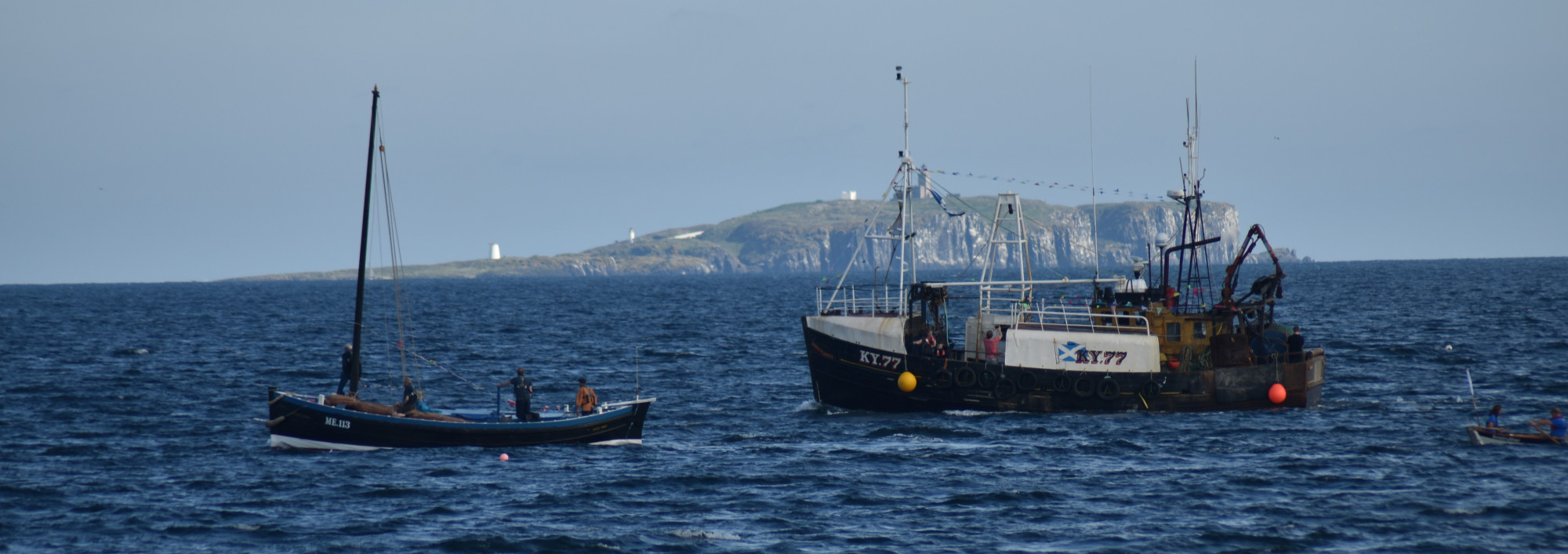

The Cellardyke Echo – 13/9/2017

1896

Mr John Adamson, Pittenweem, has been appointed inspector of work in connection with the additions to the Public School, Cellardyke.

It is proposed to start a shoe factory in Cellardyke, Mr Smith, Colinsburgh, and Mr Mackintosh, Dundee, being the chief movers. A number of local tradesmen and other gentlemen have subscribed. The capital is nearly all gathered.

The steam line fishing, which was started only six years ago, has developed so rapidly that at present there are over 20 crews of Cellardyke fishermen engaged in these crafts. A dozen these belong to Anstruther companies the remainder being owned by Shields and Aberdeen companies.

Launch of a fishing boat – Mr Jarvis launched a new fishing boat built to the order of Skipper Gardiner, Cellardyke. She was christened the Margarets, she is a fine model and is 66ft in length and 20 feet wide. She is being fitted with steam to hoist the sails and haul the gear.

1898

The steamer Ugie, which arrived at Leith on Saturday. 3rd inst., from Peterhead with herrings, reports having struck what appears to be a sunken wreck on the 2nd inst., half a mile- S.S.W., of Cellardyke. The wreck was dangerous to navigation. The steamer did not sustain any apparent damage.

1900

On Saturday afternoon there was launched from Mr Fulton’s yard at Pittenweem one of these large sailing Liners now being adopted by our East Coast Fishermen. The craft which is 68 feet in length and attractive in design and finish, has been built to the order of Skipper Thomas Bett, Cellardyke, and was christened “Cornucopia” by his daughter Miss Maggie Bett. After being fitted up with patent steam capstan, for hauling gear &c. the craft proceeds to the herring fishing at Yarmouth.

1901

Montrose

On Saturday afternoon Messrs A & JF Scott, boatbuilders, launched a fishing boat for Mr Robert Davidson, Cellardyke. The craft is 69 feet long, 20 feet broad and 11 feet deep and will be fitted up with all the most modern appliances, including steam capstan. The christening ceremony was performed by Miss Davidson, daughter of the owner and skipper in presence of quite a crowd, such a function as naming a fishing boat being somewhat unusual here. The Guide Me, as the vessel was called, was the second which the Messrs Scott have launched with such ceremonial. The first being the Challenger last spring.

On Saturday afternoon, Mr Fulton launched from his building yard a large sailing liner to the order of Skipper William Brown (Reid), Cellardyke, which was named the Vineyard, by Miss Brown daughter of the owner. The craft, which is similar in design and dimensions to the other seven which the builder has executed for district owners during the course of the past year is to be fitted up with all the latest fishing appliances, and starts shortly on her maiden voyage to the Scarborough and other south herring fishings

The fleet of ten steam herring drifters belonging to the Smith Docks Trust Company, North Shields, which have been working the herring fishing at Shetland and subsequently at Fraserburgh and Aberdeen, and other east coast stations, under the management of Mr Alex. Keay, have had fairly successful for their 12 weeks’ business. The gross earnings of the ten steamers is £7300 or fully £7OO per boat, and only four nets have been lost the season. The steamers have been crewed mostly Yarmouth men, and as the shares seven to the crew and nine to the owners, the wages of the fishermen must have been very good. Mr Keay, who is a native of Cellardyke, has high opinion of the quality of the steamers under his charge, and the Scottish fishermen who examined them are mostly of the opinion that the trust steamers are particularly well adapted for herring fishing.

1902

The Anstruther fishing fleet, which encountered the full force of last Wednesday’s gale, all successfully weathered the storm but two. One of them, however, turned up on Friday evening, and relieved considerably the anxiety that was being felt. The other not having arrived by Saturday afternoon, five of the steam liners left Anstruther to make a complete search of the fishing grounds near the spot where the boat was last seen on Wednesday afternoon, about 45 miles off Aberdeen. In the fishing community very slender hopes were on Saturday entertained of her safety, and the belief was pretty general that she had foundered, and that the crew had all been drowned. The boat was named The Brothers, and was owned by Skipper William Watson, who was accompanied by his two sons, Adam and Alexander Watson, unmarried; David Muir, fisherman, Cellardyke, unmarried; William Peat, fisherman, Cellardyke, unmarried; and two hired hands from Broughty Ferry, one of whom was named Charles Norrie, and the other David Ferrier.

The following new Joint-Stock Companies were registered in Edinburgh this week: The United Fishing Boat Insurance Company, Limited, Anstruther, to insure against total or partial loss and damage at sea or elsewhere of boats and fishing vessels. Capital, £10 000 in £1 shares, for which the public are not invited to subscribe. Subscribers—Martin Gardiner, fisherman, James Street, Cellardyke, Anstruther; James Hughes, fisherman, Mid Street, Pittenweem; James Ogilvie, fish merchant, High Street, Pittenweem; Adam Reid, fisherman, Dove Street, Cellardyke; John Wood, fisherman, John Street, Cellardyke; Andrew Henderson, fisherman, George Street, Cellardyke, Thomas Cunningham, ship chandler, Harbour Head, Anstruther.

1903

As considerable speculation has arisen to the number fisherman voters that will away before the polling day in the St Andrews Burghs on Thursday, it has been definitely ascertained that yesterday and to-day 13 Cellardyke boats left Anstruther Harbour for the south fishing at Scarborough with 90 voters, and to-morrow others are to sail, making altogether 130 fishermen voters, the great majority whom are said to be Unionists.

At a meeting in Pittenweem Captain Ellice, Liberal Candidate, standing against William Anstruther Thomson, Liberal Unionist candidate answer many questions … he was to go on to win the St Andrews Burghs Westminster Seat, which we were then in by 36 votes.. out of a total of 2612 votes cast and was elected MP for this area.

Passing from the food tax. Captain Ellice got on the question of herrings. He had, he said opened with “herrings ” at Crail, and did not regret it. The more he studied the more he was convinced that the herrings industry would be affected by Mr Chamberlain’s proposals. He was aware that herrings were already taxed, but there were a great number of herrings which were admitted to Germany free. He put to them that for those who were engaged in the fishing trade, the question was—Would they sell their herrings dear and have cheap bread or would they have dear bread and sell their herrings cheap If ran the election on those lines the Captain believed he would win. He hoped he would win, and be asked then to put the cross opposite his name on the ballot-paper. We’ll pit twa crosses to spoil yer paper,” drawled Pittenweemite from the back of the hall.

Heckling being invited, Mr W. Lindsay, fishcurer, handed to the Captain a brief catechism. The first question was – is it not time that the country was waking up, seeing that the House of Commons did not know that for every barrel that went into Germany taxed, five go in free, which is a blessing to this locality.’’ The Captain agreed it was a blessing, and believed that if they were taxed it would be a great curse. The next question was – Do you think it right that when the fishermen are from home they cannot vote by proxy?” Captain Ellice replied that he had suggested to the fishermen of Cellardyke that a steamer with polling station on board might be sent out. The difficulty was that the fishermen might be 200 miles from home, and the ballot boxes would not get back in time.

1904

Forthcoming Wedding. A marriage is to take place Chalmers’ Memorial Church, Anstruther, on Wednesday first, the contracting parties being Mr John A. Mackenzie, consulting solicitor, Helensburgh, and Miss Margaret Helen McLeod, second daughter of Mr J. McLeod, Forth View, Cellardyke.

The bride to be attended by three bridesmaids—Miss Bella McLeod, sister of the bride, and the Misses Mackenzie, the daughters of the bridegroom, while the best man is Mr Fred Mackenzie, nephew of the bridegroom. The marriage is to take place 1.30 p.m.

NEW LIFEBOAT FOR ANSTRUTHER. INTERESTING PRESENTATION CEREMONY. The Shore Street and Middle Pier of Anstruther on Saturday afternoon presented an unusually animated appearance. The stir was caused the launching of a new lifeboat. The streets were gaily hung with flags and bunting, while from every boat’s mast in the harbour flew streamers of all descriptions. The proceedings started at half-past one, when largo crowds lined the piers. An enclosure and platform had been erected at the west end of the new lifeboat house, and among those present were:—Sir Ralph and Lady Anstruther of Balcaskie; Mrs Walker, of West Calder, the donor of the boat; Major and Mrs Anstruther Thomson of Kilmany; Colonel and Mrs Aitken, Innergellie; Lieutenant Basil Hall, National Lifeboat Institution, London; Mr W. Bertram, hon. secretary, North Berwick Lifeboat; the municipal bodies of Anstruther Easter, Anstruther Wester, and Kilrenny; the parish ministers and teachers the three burghs; and others.

HOW THE LIFEBOAT IS APPRECIATED. Provost Dalziel, of Anstruther Easter, occupied the chair, he had no doubt that the beautiful boat now presented by Mrs Walker would fulfil all that was expected of it. It was extremely gratifying that this boat was the gift of a lady who had done them the further honour of being present that day. (Loud applause.) Having drawn attention to the handsome new lifeboat house, built the generosity the London Institution, every detail and furnishing which was the best of its kind, concluded by calling upon Lady Anstruther of Balcaskie to open the lifeboat house. (Applause.) Lady Anstruther, amid loud cheers, gracefully performed the ceremony, and the vessel was pulled to the water’s edge and manned by the crew.

ACCEPTING THE GIFT. Lieutenant Basil Hall, the parent institution, in accepting the gift, said the last time he appeared in public in the town he was the audience and the fishermen the speakers, and the first of their remarks was to ask him to use his influence with the Institution to get them new boat. By the great generosity of Mrs Walker the beautiful boat before them was shortly to become one a fleet of nearly 750 lifeboats that ling the coast, ready to go forth day or night their errands of mercy.

The earlier boats were much of the same type, mainly propelled by oars, but times had changed, and the Institution had changed with them, and there were now several types of boats on their coasts. When the Institution were to give a new boat it was the custom for three representatives the crew to round the different stations and choose which style of boat would most suitable for their coast. In this three of the crew, along with another gentleman, went round several stations, going as far away as Denby, in Wales, where they saw this type of boat they considered would be most suitable for their coast, and that boat was now before them. (Applause.) She was all that modern lifeboat should be. She was built of two diagonal layers of mahogany, had two drop keels, twelve oars, and was fully rigged with lug and jib sails, and, indeed, had all the attributes a lifeboat should have. (Applause.) There was one point—the most important —that was the crew. The most beautiful lifeboat ever built was a useless log in the water without good crew, but in Anstruther and Cellardyke they had fishermen of stout hearts and strong backs, second to none in the country. (Loud applause.) He had, in conclusion, to call Sir Ralph Anstruther of Balcaskie to accept the lifeboat and house on behalf of the local Institution. Sir Ralph, who is president of the Anstruther branch, said was fortunate, in so far that his first duty as president had been to accept of these gifts, not only because it was tribute to the generosity of Mrs Walker, but because it and others were the best specimens their kind the coast. (Applause.) Mr Hall had been kind enough to say flattering things about the people (of the place in regard to lifeboat matters, and was sure the fishermen would their best to deserve these re- and that they would make good use of the lifeboat. (Applause.) The boat was then christened the John and Mary Walker, (Newspaper Mistake) and slid into the water to the accompaniment of the loud and continued cheering of those assembled. The 2nd Paraphrase and the dedication hymn was sung by the united choirs of Anstruther and Cellardyke, after which short prayer was offered by the Rev. J. Woodside Robinson, expressing the hope that the boat would long be spared to useful work in the district.

During the launching ceremony the pipe band of E (Anstruther) Company of the 6th V.B.R.H. paraded and down the middle quay playing selections, while body of collectors, with miniature lifeboats collecting boxes, and wearing red pilot cars, assailed the pockets of those present for subscriptions. It is pleasing to state that their efforts met with liberal response.

1905

The Shields trawler Reaper put back to Shields yesterday morning. While 29 miles from the Tyne the vessel was in collision with the Methil-bound steamer Bengal. The Reaper was extensively damaged the stem, and gave such alarming indications of foundering that the crew scrambled aboard the Bengal. Some hours afterwards they returned aboard, finding the trawler still afloat, and succeeded in placing canvas over the damaged part to prevent the inrush of water. The Bengal towed the Reaper Shields, and afterwards conveyed four the crew, who belonged Cellardyke, Methil, where they were landed last night.

The Cellardyke Echo 30/8/2017

1936

Thomas Chater, butcher, 15 Dove Street, Cellardyke, admitted that 2.45 a.m. on 24th July, allowed a motor car to stand without rear light in Main Street, Kingsbarns. For this he was fined 15s, and for having failed to have an efficient, reflecting mirror had to pay another 10s.

1937

DEATH OF A HAWICK POET. A painful shock was felt in Hawick last week when it became known a gifted and respected townsman James Y. Hunter, M.A., headmaster Cellardyke, Anstruther, had died suddenly at Crieff, where he had been on holiday.

CELLARDYKE SCHOOL APPOINTMENT Mr Alexander Kelso, first assistant of Denbeath Public School, Buckhaven, and headmaster of Buckhaven High School Continuation Classes, has been appointed interim headmaster of Cellardyke Public School

1938

THREE HURT IN FIFE CRASH MOTOR CYCLIST IN SERIOUS CONDITION Two Fife motor cyclists, the driver and a pillion passenger, were injured in collision with a car at the junction of High Street and Park Place. Elie, late last night. They are two men named Henien, thought to belong to Cellardyke, the elder of whom is believed to have sustained a fractured skull. The younger man suffered from cuts and bruises. They were taken to St Andrews Hospital. The driver of the car, Mr D. C. M. Thomson, Gowanlea, Earlsferry, secretary of Earlsferry Thistle Golf Club, escaped with slight injuries.

1940

Compensation of £275 has been awarded the widow of a Fife fisherman who is said to have been driven insane and taken his own life through fear of losing his sight.

The claimant was Mrs Ann Keay or Tarvit, 29 Rodger Street, Cellardyke, Anstruther, and she claimed as compensation for the death of her husband, Alexander Tarvit, from owners of the motor boat Taeping (Miss Elizabeth Bett, Fowler Street, Cellardyke; Mrs Annie Smith, Fowler Street, Cellardyke; Mrs Elizabeth Bett, 2 Burnside Place, Cellardyke. Anstruther; and John S. Bowman, butcher, Shore Street, Anstruther

Alexander Tarvit, was employed as a fisherman on board the motor boat Taeping during the summer fishing of 1939 in the Shetland Island waters. On 27th June, while assisting in hauling the nets aboard the boat he was struck on the right eye by a herring and received an injury which was sufficiently serious at the time to cause him to stop work and make for his home at Cellardyke after having his eye attended to at Lerwick. He reached his home on 2nd July, where he at once received medical attention and his eye was found to be very inflamed and painful, but in the opinion of his family doctor no permanent injury had been done to his sight and it was only a question of time till complete recovery would established. Deceased was seen daily by Dr Wilson until 13th July, on which date he committed suicide by hanging himself. These, he thought, were the undisputed facts of the case. There was no evidence as to the manner in which deceased reacted to the injury before he reached home, but there was abundant evidence, which he thought must accepted, that he was a changed man on that date and continued so until he met his death.

Claimant averred that his death was a direct and material result of the injury.

Sheriff-Substitute J. More found that when Tarvit committed suicide he was suffering from mental derangement, and that such derangement resulted from the injury which he received in the course his employment. His lordship found for the claimant with expenses, and assessed compensation at £275.

1941

Mrs Robert Gay, 81 George Street, Cellardyke, has been notified her son, James Gay, Royal Navy, has been ‘killed action at Tobruk. Aged 21, he was born at Methil and educated at Anstruther. He was a fisherman when war broke out, and volunteered for service with the Navy.

Five East Fife fishermen lost all their belongings when the St Monance motor fishing boat, Annie Mathers, was destroyed by fire in the Pentland Firth. The crew returned home on Saturday with a grim story of their fight for life when the vessel caught fire and they were forced to take to the small boat.

They had to row four miles before reaching land, and they took turns at rowing and bailing the water out.

The skipper was William Mathers, Sea View House, St Monance, and his crew were all Cellardyke men —James Boyter, 32 George Street; Martin and Robert Tarvit, brothers, 50 James Street; and Tom Murray, 57 John Street. They were on their way back from the herring fishing at Stornoway. The engine suddenly burst into flames, and the men were forced to take to the small boat. They had no time to collect any of their belongings, and all their clothing and money were lost. After rowing for an hour and a half they reached Crosskirk. The blazing boat drifted ashore at Crosskirk. All the gear aboard had been destroyed, and only the hulk was left.

Six years ago to a day Martin Tarvit was shipwrecked off South Shields when the fishing boat Venus was in collision with another boat.

1943

CELLARDYKE TEACHER’S DEATH The death has occurred St Michael’s Hospital, Leuchars, of Miss Christina Dowie Murrie, eldest daughter of the late ex- Provost John Murrie, fish salesman, Bellvue, St Monance. Miss Murrie, who was a school teacher, was only transferred to Elie from Cellardyke three months ago. She formerly held appointments at Stirling and Berwick-on- Tweed. She was a devoted member of Braehead Church, St Monance.

1948

Mr J. Butters, Cellardyke grows grapes at his back door on a vine which is frequently washed by high waves. He had a bumper crop this season.

1953

When Mr Corson, South Queensferry, and Miss Euphemia Muir, Cellardyke, were married in Cellardyke Parish Church, the service and the reception were recorded. The bride is a member of the well-known family of fishing boat owners.

 (another article)

WEDDING INNOVATION. At a wedding ceremony in Cellardyke Church tape recording of the proceedings was taken by a well-known East Fife firm of television and radio engineers. On being played back, the reproduction was perfect, even to the responses of the contracting parties. The recording will now be transferred to gramophone record, which, along with the photographs, will form a lasting memorial of the occasion. From enquiries already being made, it seems likely that the innovation will be largely followed at future weddings.

6/9/2017

1831

Found by a Cellardyke fishing boat crossing the Moray Firth betwixt Helmsdale and Fraserburgh, on Thursday last, a very large and valuable salmon net, perfectly entirely with its appendages. Whoever has lost it will have it returned to them, by applying to George Smith, Fisherman Cellardyke upon paying all expenses.

On Thursday night last, betwixt 11 and 12 o’clock, as one of the Cellardyke boats, returning from the north country fishing, was off Peterhead, a passenger the name of Wilkie, a flesher, belonging to St Andrews, while reaching forward with boat hook to some part of the tackling of the sail, unfortunately lost his balance and fell overboard. From the darkness of the night, and the boat being then under of sail, no assistance could be rendered him, and he was not seen after. Wilkie had been Helmsdale following his profession there during the fishing season, and is probable he would have some money; at any rate he had papers upon him, so that when his corpse is found he will be easily recognised.

1837

Anstruther – The herring fishing has been highly successful. The herrings have hitherto been, upon the whole, of the finest quality; the prices for them would, at the northern stations, have been reckoned extravagant, the average for the last five weeks being about 14 shillings per cran, and the quantity taken has been great, each boat averaging upwards of 200 barrels. One boat belonging Cellardyke after completing her compliment of 250 barrels at Helmsdale, delivered here no fewer than 103 barrels taken at the Old Haikes off Kingsbarns, a place from time to time frequented by immense shoals of fish.

1847

John O groats Journal-  Gale-

During the evening the gale moderated and ere morning the wind had changed to the NW and was by nine O Clock blowing a pleasant breeze eleven boats from Buckhaven and Cellardyke, which had been prosecuting the fishing here, taking advantage of the wind and tide left for home.

Anstruther – Several boats came in with good shots of Haikes herring, but on Saturday it was obvious the fish had left the ground as many of the boats were clean. Several boats, on Saturday were late in getting up, and their fish having been caught the day before, injured them so much that one or two curers refused the fish from their agreed boats. One of these refused 6s 6d in the harbour, and set sail for a French Lugger lying off the harbour, but the quality being so bad, they returned with them to Cellardyke where the fishermen cured them themselves. On Monday, all the boats were out, nigh off here, but got no fish. On the 26th, with the exception of 16 lazy crews, who remained in the harbour, all went to Dunbar, most of whom returned tolerably well fished.

1890

ACCIDENT TO A FISHERMAN AT ABERDEEN, Late last night Charles Hay (32), fisherman on board the boat Florence of Cellardyke (Robert Brown, skipper), got his right arm fractured by falling from the Florence to deck of another boat. He was removed to the Infirmary.

1891

Fully 40 of the Cellardyke boats have returned home from the Northern Stations. A few having done very well, having netted between £400 and £500 for the season, while other have made barely sufficient to pay expenses.

1892

On Sunday the body of John Muir (19) son of David Muir, Cellardyke, skipper of the Reindeer KY 46 was found floating in the South harbour. He was last seen in Broad Street at on o clock on Sunday Morning and it is supposed that in attempting to board his boat he had fallen into the water.

GOOD NEWS FOR THE EAST COAST FISHERMEN. BOARD OF TRADE EXAMINATIONS. Mr George Watson, Cellardyke, bas passed his examination second mate this week before the Local Marine Hoard Dundee. Mr Watson had not nearly completed the four years’ sea which the Board of Trade require from candidate for examination for certificate competency as second mate, hut his service in deep-sea fishing vessels was allowed to count instead of the time he was short of the four years. This passing of Watson will show to fishermen on the East Coast that their service is of use, that is allowed count to qualify them to pass a Board of Trade examination for a certificate, and that they have not to serve much time to qualify for passing as a boy leaving home for the first time. It also serves to prove the statement of Mr Swanston, assistant secretary, Marine Department, Board of Trade, that “service in bona-fide deep-sea fishing vessel*, irrespective of the mode fishing, is accepted qualifying towards examination for a certificate of competency.”

1893

The Cellardyke boats which have been fishing at the northern ports returned home mostly on Friday and Saturday. The season has been a good one, the average over the 160 boats being estimated ab £130. The “king-fisher,” Skipper Adam Reid, of the Reliance, has £ 530, and the lowest £ 30. The great majority have -close on £ 180 to £200, although there are a few with £300 to their credit. Generally, the boats which were at Peterhead were the best fished. Crews are now being made up for the south fishing at Yarmouth and Lowestoft, while a few are to proceed to the Islay fishing.

Fraserburgh Police court

For failing to appear in answer to a charge of being drunk and incapable, George Moncrieff, fisherman Cellardyke, forfeited bail of 7s 6d.

Peterhead bails forfeited

Peter Boyter, fisherman Cellardyke, 10s

1894

The Cellardyke boats have all returned home from the North the highest being the Reliance with £420

Yesterday forenoon telegram from announced the sad tidings that Thomas Pringle, Cellardyke, had been drowned off Leven. The unfortunate young man was one of the crew of the Onyx, Skipper Robert Meldrum, and left Anstruther about 3 a.m., with the intention of beaching the Onyx in Leven Dock for the winter.  He was about thirty years of age, and engaged to be married in a fortnight.

1895

The captain the fishing boat Mizpah, of Kirkcaldy, KY 398 reported, on arrival Aberdeen on Tuesday afternoon, the loss of one of his crew, young man of the name George Watson, belonging to Cellardyke, and twenty four years of age. Watson was assisting, along with others of the crew, adjusting the boat’s sail, when about 10 miles east by north of Aberdeen, when, some means, he was knocked overboard. The boat was making considerable way through the water at that time, and the only immediate measure that could be adopted towards saving the unfortunate fellow was the throwing of oar his direction. He sank, however, and did not appear again during the time the Mizpah remained the vicinity. Watson resided 8 Rodger Street, Cellardyke, and intelligence of the sad accident was once despatched to his friends by the skipper of the Mizpah on its arrival Point Law. The accident will doubt form the subject of an official inquiry.

The Cellardyke Echo – 23/8/2017

1921

The sad intelligence of the death by drowning of Mr William Smith, Cellardyke, at Hartlepool was received in Anstruther yesterday. Mr Smith was the only son of Mr James Smith (Ritchie), Burnside Terrace, Cellardyke, and was employed as fireman in the steam drifter Scot, belonging to Anstruther. Particulars of the fatality are at present very vague, merely giving the fact of the drowning accident, but it is added that the body has been recovered.

Rev. James A. Paterson, Anstruther Wester, who is the only minister at present resident in the burgh—the others being on holiday—made the sad news known to deceased’s parents. Deceased was in his 21st year.

1924

Hartlepool

There was a marked decrease in arrivals yesterday, 26 herring boats landed an average of 9 crans. The best Scottish catch was one of 30 crans by Home Finder of Cellardyke. There was a good market prices being better at from 37s down to 29s per cran.

1925

David Pattie, ploughman, Balhouffie Cottar Houses, Anstruther, or 5 Shore Street, Cellardyke, admitted before Hon. Sheriff Osborne at Cupar to-day a charge of having, on 11th May, on the public highway, opposite the dwelling-house occupied by John Douglas, ploughman, Balhouffie Cottar Houses, Anstruther, assaulted Clifford McHugh, ploughman, 12 Shore Street, Cellardyke, by striking him severe blow on the right jaw with his clenched fist, causing it to bleed freely, and loosened several of his teeth.

Sentence of a fine of £1, or ten days’ imprisonment, was passed.

For the fourth year in succession the championship of Anstruther Bowling Green has been won by John Birrell.

A gallery of about 100 witnessed the final tie, Birrell’s opponent being James Smith, Cellardyke. Smith is a promising young player, and this season has figured in many of the principal competitions.

The game opened with 2 for Birrell, and at the fifth head he led by 7-1. Smith came away, and by the eighteenth head the match stood 14-11 Birrell’s favour. The champion was hard put to it to find an opening at the next head, where Smith lay 2, but with a cleverly executed bowl broke the end to lie the shot, and eventually scored 3. The next two heads saw Birrell in his best form, and ran out winner 21-11.

 Mr Birrell a member of well-known East Fife sporting family. His brother, Tom Birrell, was a footballer of note with Kirkcaldy United and Edinburgh Hibs, while a nephew, late of Raith Rovers, now foots it with Middlesbrough.

1926

Anstruther – Several steam drifters which left on Monday returned yesterday afternoon well fished. Highest shots from the Cellardyke boats —Bene Vertat, 100; St Ayles, 100; Carmi, 40; Violet, 35. Early arrivals secured top price, 20s per cran. Herring good quality, and caught in the vicinity the ‘ Long Bank,” between 30 and miles east of the May Island.

2 days later

OnIy one arrival, the Cellardyke steam drifter Ayles discharging 90 crans, which realised 14r per cran.

3 days after that

North Shields – Fifty drifters landed 640 crans. Best shot 45 crans by Cellardyke steamer Acorn. Demand weak; prices, 14s to per cran. Total supply for week, 9725 crans, representing heaviest week’s fishing at the port since 1913. Total catch for season to date just under 45,000 crans. which is bigger than any full season’s catch since 1920.

1931

There was breath-taking thrill the North Shields Fish Quay to-day, when a barring drifter escaped by a few inches from being crushed against the quay wall by a collier.

The steamer was the Sheaf Arrow, and was proceeding up-stream from sea when was forced to turn starboard to avoid a vessel backing into the stream. The turn developed into a steer, which caused the steamer to move toward the long line of drifters moored in parallel line with stems against the quay wall.

Tremendous excitement was caused by the appearance of the collier gliding toward the drifters, the crews of which literally held their breath.

The anchor of the Sheaf Arrow was then let down with roar and a plunge in order check the vessel, and this succeeded in bringing it to a complete stop when the colliers stem was only few inches from the stern of the Kirkcaldy drifter Daisy. The Sheaf Arrow was then able to move away up the river again without the slightest damage having been done. The Daisy, which is owned in Cellardyke, had all ten men of the crew hoard. Mr Alex. Reid, the skipper, told a “Shields Daily News” reporter that when the steamer was brought to & standstill: “You could not get a plate between our stern and her stem.” “A narrow escape,” he observed, opinion which was endorsed all the crew.

In close proximity were the drifters Fifeness, Aspiration, and Forethought.

The crew of a Port Seton steam trawler, Choice, had narrow escape when their vessel foundered about 20 miles off St Abb’s Head.

The men, who were taken on board the Anstruther steam drifter Copious, captained by Skipper Joseph Wilson, Cellardyke, arrived safely at Anstruther Harbour yesterday.

The first sign of trouble aboard the Choice was observed by the chief engineer. While the vessel was busily engaged fishing about 9.30 on Thursday night he reported that water was coming into the engine-room. It is believed that the trawl board or some other under-water object had damaged plate.

From the first the skipper realised that the position was dangerous, and orders were given for signals be put up. These were answered the Copious, which tried first tow the vessel to land. After struggling for two hours the task had to be abandoned, and the ship sank.

On landing at Anstruther yesterday the men were cared for by the local branch of the Shipwrecked Mariners’ Society. The names of the crew are:—.John Home, skipper and owner, Port Seton; Peter Allan, mate, Port Seton: William McKechnie, chief engineer, Rosyth; James Thomson, second engineer. Port Seton; John Ross, fireman, Port Seton; Thomas Blackie and Robert Barber, deck hands, Port Seton; Charles Black, cook, Port Seton.

1933

CELLARDYKE WANTS MORE TELEPHONES

Town “Cut Off” When Post Office Closes

Residents in Cellardyke have a complaint against the Post Office regarding the inadequate public telephone facilities.

While Anstruther can boast of several public ‘phones in its Post Office, and a callbox in Shore Street which is available at all times, Cellardyke folks have to be content with one public telephone. This is situated in the local Post Office, and when the office is closed the telephone is not available.

In cases of illness during the night, “when it is desired to summon a doctor, the residents must either seek the use of some subscriber’s telephone or travel to Anstruther where all the local practitioners reside.

Should one require the services of a taxicab after Cellardyke Post Office has closed for the night it is necessary, should one fail to obtain the use of some subscriber’s ‘phone, to walk to Anstruther to order the taxi. Surely a remarkable state affairs.

Call Box Suggested.

Much inconvenience would be avoided if the telephone authorities placed a call-box in one of the main streets of Cellardyke.

Or the problem could be solved merely by removing the instrument from Cellardyke Post Office, which is in James Street, and erecting it a call-box on the opposite side of the thoroughfare. An alcove formed by a building there would meet the purpose admirably.

Anstruther, although having better facilities for public ‘phoning than its neighbour Cellardyke, also has a grumble.

The telephone in the call-box on Shore Street appears to be a relic of the old National Telephone Company days, and to put through a trunk call is almost a test of physical endurance. The coin box will accept only pennies, and at the entry of each penny a knob has to be turned.