

1906
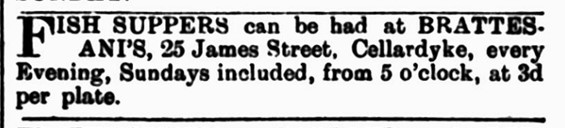
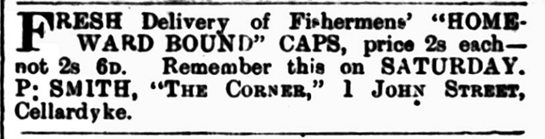
CELLARDYKE SCHOOL BOARD.—A meeting of the Board was held on Wednesday evening, Mr Lawson presiding. The attendance was submitted, also the census of the schools, showing that the number at Cellardyke School was 611 and at Kilrenny 89. Mr Lawson said that one of the political parties had asked to be allowed the use of the school for the night preceding the poll, as the other party had engaged both the Town and Forth Street Halls. As they allowed the other party to have Kilrenny School, he thought the request should be granted. All the other members except Mr Melville demurred, and the request was refused
The Gold Chain for the Provost—Messrs Elkington and Co., Ltd, of Regent Street., London, supplied the fine example of the goldsmith’s art in the shape of the gold chain for the Burgh of Anstruther Easter- The chain is made of 13 small and 3 large escutcheon links, the centre link charged with the shield of Archibald Williamson, Esqr,—the donor. The pendant badge is a skilful piece of wrought work, containing the arms of the Burgh. The chain shows excellent feeling for simplicity and beauty of design, and while it has been exhibited in Bailie Burd’s window it has been much admired .
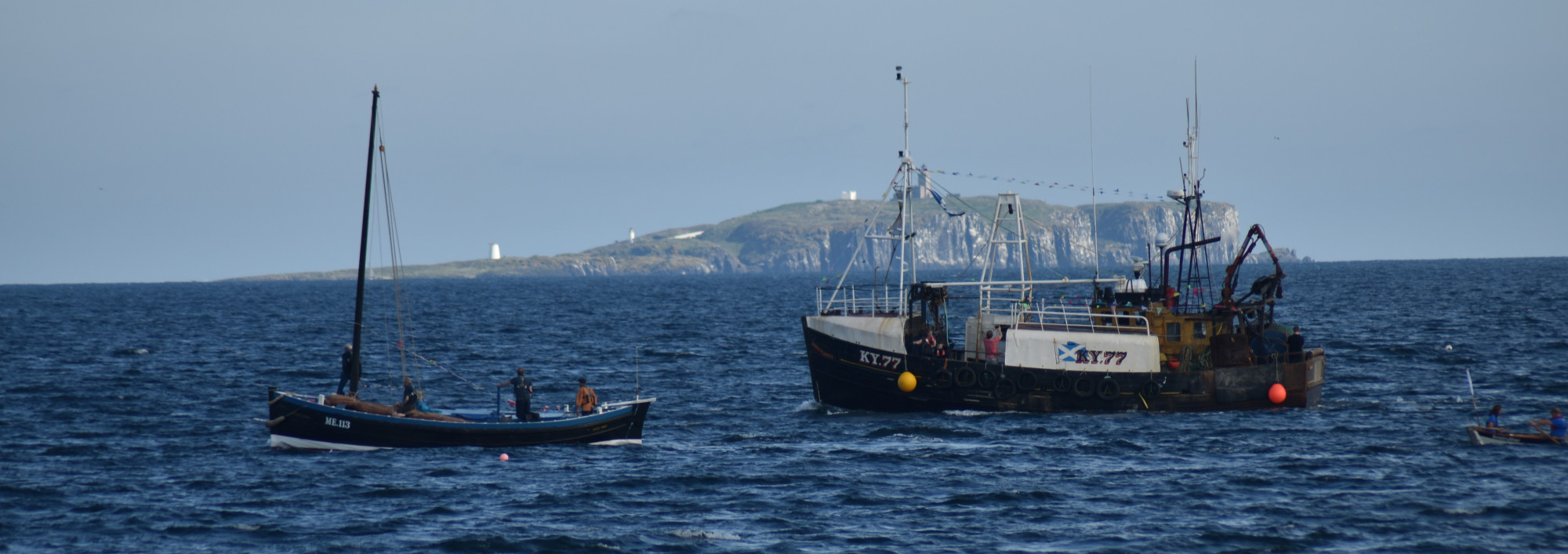
LIFEBOAT CALLED OUT EXCITING SCENES AT THE HARBOUR About seven o’clock on Wednesday evening, a telegram was received from the Coastguard at St Monans, stating that a ketch was lying within 100 yards of the rocks there, and was being driven ashore. On receipt of this message, the Hon. Secretary of the Lifeboat Institution telephoned at once to Mr Melville, Cellardyke, who in turn communicated with the coxswain of the Lifeboat. William Sutherland. The latter immediately raced along to the lifeboat house, and quickly summoned the crew. Sutherland, besides being an excellent seaman, must be something of a runner also, as by the time the secretary got down to the boathouse Sutherland was already there, super intending operations. The boat was immediately got out, and launched, there being an abundance of willing helpers all the boats being in the harbour. By an unlucky chance it happened to be dead low water, and the carriage had to be pulled almost to the very mouth of the harbour. The crowd at the ropes dashed willingly into the heavy seas which came sweeping into the cut mouth, some of them being almost up to the necks in water, and when it could not be hauled any further out by these means the carriage was pulled back and the lifeboat slipped into the water. In going off the carriage, however, some of the rods of the steering gear struck and got bent, and some little delay was occasioned by this unfortunate occurrence. Up to the waste in water, willing helpers eagerly worked to remedy this and in a very short time the helm was properly shipped. The lifeboat was still striking on the ground, and could not be got off, but by the aid of a rope to the east pier, pulled by lusty arms, she was got afloat. The wind was blowing a perfect hurricane right in the mouth of the harbour, and this added to the difficulty of getting the boat to sea. Gradually however, she fought her way round the pier head, and to the back of the harbour, where, after striking once or twice on the rocks, she managed to make headway. Her successful attempt was greeted with hearty cheers by the large crowds who lined the east and west piers. Rapidly the vessel sailed up to St Monans, behaving splendidly, but on arriving there no signs of the distressed vessel could be discovered and a search was made along the shore. By torch a signal was made from St Monans to proceed eastwards, and the boats head was turned in that direction. Nothing, however, could be discovered of the whereabouts of the ketch, and after an hour’s search, the lifeboat was put about, and went out into the Firth, where, although they cruised about till nearly eleven o’clock, no trace of the vessel could be found, and the lifeboat then returned to Anstruther.
Only two of the crew had oilskins on, and the rest were sitting soaked the whole time the vessel was out.
Too much praise cannot be given to the fishermen for the eager way in which everyone assisted in getting the boat launched, local and strangers vying with one another in their efforts to help, dashing into the surf without any thought as to their own comfort. Those at the extreme end of the rope, must at times have been up to the neck, as the waves came sweeping in. The lifeboat too, has justified the faith placed in her as a trustworthy sea boat, as during the whole time out she behaved in a splendid manner, answering to the slightest touch of the helm, and amply proving her beating qualities.
1907
New Harbour Commissioner. — ln room of Mr John Carstairs (deceased), Andrew Pratt, Cellardyke, has been appointed a member of the Union Harbour Commissioner.
1908
81 George Street – THE LABELLING OF MARGARINE. Cellardyke Grocer’s Offence. James Scott, grocer, Cellardyke, admitted before Sheriff Armour at Cupar to-day having exhibited for sale margarine which was not labelled as such. In extenuation Mr Alf. E. Grosset said the barrel was quite distinctly labelled “margarine,” all that was a wanting was the label on the margarine itself. A year ago the Inspector called for 1 lb. of margarine, and when he got it wrapped up in paper on which was margarine printed, he handed it back, saying had bought it for the purpose of seeing if he had the proper wrapping. At that time the Inspector said nothing about the absence of the label on the margarine. It was difficult to see why all this carefulness should applied towards margarine, when much was distinctly superior to quantities of butter. Sentence of fine of 10s was passed.
THE LATE MR JAMES M. DUNCAN, ANSTRUTHER. A painful sensation was created in the district on Saturday night when the sad news became known that Mr James M. Duncan, draper, High Street, Anstruther, had died at seven o’clock. Tho shock was all the greater in that very few had been aware that he had been unwell, and it seemed incredible to many that one who was so full of bright and energetic life should have been so suddenly called away. A week previous Mr Duncan had contracted a chill, and in the first of the week it had developed into pleurisy, and afterwards into pneumonia, resulting in his death on Saturday evening. The event aroused very widespread feelings of regret and sympathy with his site and family, and on Sunday in the most of the Churches very sympathetic allusions were made in the prayers and sermons.
Mr Duncan was a native of Cellardyke, where he was born 72 years ago, his father being the late Mr Andrew Duncan, builder. He served his apprenticeship to the drapery trade with the late Mr Fowler, Cellardyke, in the shop at the east end of Cellardyke, now occupied by Messrs Scott. On Mr Fowler retiring from business, Mr Duncan got employment from the late Provost Murray in Anstruther, and early in the year 1861, he, along with Mr George White, took over Mr Murray’s business. The partnership of White & Duncan lasted till July 1869, when Mr White left for America, and ever since it has been conducted by Mr Duncan. The business one of the oldest established in the district, and among the most successful. Its traditions were weal preserved by Mr Duncan through his long period of occupancy, and the slight check of a few years ago was successfully grappled with, the business still remaining a most, remunerative one. Mr Duncan was a general favourite with all with whom he was brought into contact. His buoyant spirit and genial nature made him well-known to all, and enlarged the circle of his acquaintanceship among all classes. From the first he was induced to enter the Town Council, and had the unique record of having acted as treasurer of the burgh for the lone period of 21 years. He made a very efficient local Chancellor of the Exchequer, his books always being carefully and neatly kept. His work in this respect was much appreciated, and he never had any difficulty in retaining his seat at the Council during an election, his name being generally at the top of the poll. He was also a member of the Parochial Board, and when the Parish Councils came into vogue he held office in it for a term. In religious matters he was a staunch Voluntary, and was connected with the United Presbyterian Church in Anstruther in the early fifties of last century, when the congregation worshipped in the East Green. When the Erskine Church was opened in 1853 he was one of its active members, and continued until it was merged in 1904 in union with the Chalmers Church. He was for many years the treasurer of the Church, and also an elder. He took a keen interest in all matters affecting his Church, and always showed an intimate knowledge of the ecclesiastical world. In other ways, Mr Duncan took his share of public work, and was one of the promoters of the Bowling Club. His enjoyment of the game of bowls was always keen, and as treasurer and President for one year he did much to contribute to its prosperity as a successful source of recreation in the summer season. The departure of so well-known and highly respected a citizen induced a very large number to attend the funeral on Tuesday afternoon to pay their last tribute of respect. The flags on the Townhouse and Bowling Green were suspended half-mast, while the Town Council, headed by Provost Morris, met in the Council Chamber at a quarter past one o’clock and took part in the procession. A short religious service in the house was conducted by the Rev. Mr Mair, who also officiated at the grave. The pall-bearers were John and James Duncan, sons; Mr Alexander Duncan, and Mr John Duncan, Edinburgh, brothers; two nephews, Edinburgh; Mr A. C. Mackintosh, and Mr H. Watson, Anstruther. The coffin was covered with a number of beautiful wreaths, including One from the Merchants’ Association, while the shops were closed for an hour during the funeral. Mr Duncan is survived by a widow and a comparatively young family. ….
1909
The case of J. Brunton, J. Gen, W. Brown, and Watson Smith, fishermen, Cellardyke, against James Hodge, fisherman, Cellardyke, aroused great interest and the courtroom was packed. Mr T. D. Murray, solicitor, appeared for pursuers, while defendant was represented by Mr C. H. Maxwell. Pursuers held that the sum of £2 18s 9d fell to be divided among them as part of the earnings for the English fishing, and took exception to several items of the accounts presented by defendant. For the defence Mr Maxwell submitted the accounts of the proceeds of the Lowest and Yarmouth fishing. The vessel’s gross earnings had been £272 6d, out of which there had to be taken £135 2s 1d, as working expenses, leaving £136 19s 5d, out of that sum £54 16s 9d was paid to the owners, and left £82 3s 8d to be divided among the crew, out of that sum the living expenses of the crew had to be taken, and the amount for division among the seven members of the crew was £41 17s 10 ½ d. Four shares of that were due the pursuers £23 18s 9d, and there had been paid to account £21. That was admitted by pursuers, and he would bring figures to prove that defendant was not due the balance. ( the newspaper reports the whole case word for word and takes up another two complete columns)