

1860
ESTIMATES WANTED, FOR ERECTING a CHAPEL and VESTRY at East Green, according to Plans and Specifications which will be shewn James Fowler, Cellardyke ; by whom Offers will be received to the 20th inst. Information will also be furnished by Mr J. Hall, Architect, St Andrews. Anstruther.
The next article appeared in Local Papers, The Scotsman and this version was extracted from “The Star of Gwent” Cellardyke hits the news in Wales.
Some excitement is at present occasioned in the small town of Cellardyke, in the East Neuk of Fife, by the breaking out of the revival movement. Meetings are held every night, which are protracted to late hours, and at which all the signs of the revival movement are exhibited. At these meetings there have been various instances of prostration, and wailings and moanings are heard proceeding from the audiences, who assemble in small groups in the various corners of the room, each group engaging separately in devotional exercises, which are in instances conducted by mere boys and girls who have been suddenly “converted.” One or two of the clergymen in Anstruther, the adjoining town, are encouraging the movement; but others are trying to put down all exciting meetings. While an improvement is admitted to have taken place in the habits of a portion of the population by the movement, it has been apparently attended by the same painful effects as have been observed in other quarters. One girl is said to be permanently affected in her mind, and scenes have occurred on the streets which are by no of a creditable character, such as small groups of girls going about the street telling those persons they met that they had “found peace noo,” and ethers singing with great vehemence matches of hymns
A few days later
The Revival Movement. – The religious awakening in this place, which we noticed last week, still continues, though in a somewhat subdued degree. Meetings still continue to be held every night in every available place, and during the day clergy and some others go through the different houses to impart religious knowledge. The evening meetings are all presided over by some of the ministers, and the greatest caution has been taken to keep down all undue excitement, though we question the policy of the plan adopted at some of the meetings of allowing some of the “new converts,” as they are called, to address the audience and relate their religious experiences. The readiness and zeal with which these individuals step forward to address their fellow sinners is somewhat remarkable, as also the prayers they will offer up in the presence of some hundreds. New-born zeal is always impetuous, however, and we only sincerely hope that the light they confess has been imparted to them will be of abiding nature, and bring forth fruit. It cannot be denied that much good has been done, and there is a great apparent reformation in the lives and conduct of some who formerly held quite different character. Since the movement began, there has been marked increase in the attendance at all the churches, and apparent attention to the teachings of the ministers. Another pleasing feature in it is its catholicity, for in the same meeting were to be found Established. Free, U.P., Baptist, and E.U. ministers and elders, all labouring for the same end, and each in turn taking part in the proceedings. We are sorry to learn, however, that a schism, or rather inclination to inculcate sectarian views and doctrines, has arisen among the clergy themselves, to the grief of those who looked upon the movement favourably. It is a pity that such should be the case, when so much apparent good was beginning to appear. During the first of this week, a great number of strangers have paid the place a visit, to witness for themselves the working of a religious revival; and some of the fishermen themselves have gone as deputations to other towns, far and near, with a view of exciting them to a similar demonstration. One practical proof of the good that has been done, we cannot help relating. A certain man, now in business on his own account, has, since the revival-commenced, paid the employer with whom he learned his trade a visit, and refunded the sum of 30s which he said, he had appropriated in small sums to his own use while an apprentice, and the reason given for this “confession of the conscience” was, that could not now remain a Christian until he had it off his conscience.
1861
The Herring Fishery.— The following letter has been addressed by Mr Methuen to the Secretary of the Board of Fisheries: Leith, 13th March, 1861. Sir, —The illegal destruction of herring fry is as great this morning at Newhaven as usual, since illegal nets have been permitted by the Hon. Board of Fisheries Regulation of 3d Jan., 1861, whereby millions of young herring fry have been, and are being, destroyed. I find it is of no use requesting the members of the hon. Board to go to Newhaven any morning to see the destruction of young herring fry and herrings of all sizes in myriads, this illegal destruction still continues under the cognisance of yourself, the hon. Secretary of the Board, and of your two commanders and forty armed men. With twenty-six officers of the Fishery at your beck, and with all this force, which you keep lying snugly in Granton Harbour, or cruising without orders, instead of enforcing the Acts of Parliament, our valuable fisheries are being destroyed. If you, the appointed secretary and protector of the herring spawn and fry, and seizer of all illegal nets, give liberty to fish contrary to the Acts of Parliament, I ask you and the hon. Board how the fisheries can be expected to produce full-grown herrings to Crown brand at 4d per barrel, to pay your expenditure of about £14,000 per annum? And, the branding system is expected to be self-supporting, by 4d per barrel charged on full-grown herrings, I ask it can be expected to do so when you make regulations to destroy the young herrings (and by this you scatter and disperse all other fish) ? This morning, I am told, an Edinburgh fishmonger has bought all the cod brought into Newhaven at 5s to each. I recollect, when no garvie herring fry fishing was allowed, I cured thousands of cod at 3d and 4d each, caught between Burntisland and Kincardine, on which ground not a cod is now to be got; and at the great cod emporium of Cellardyke, the cod fishing, instead of three score for a boat’s fishing, has dwindled down to about half a dozen cod; and as to haddocks, your permissive destruction has driven the haddocks from their usual haunts —insomuch that the patience of the fishermen from Berwick-on-Tweed to Caithness put to the severest test by poverty and want that ever existed (exclusive of the towns in the Forth, who are benefited by illegal fishing, and the large herrings also having been driven from their usual haunts.) I do not wonder at your being still to learn, as it appears— by your going in the cutter trawling for herring spawn, instead of seizing Illegal nets, by which myriads of young herrings have been daily destroyed under your very eyes—you have forgot the lesson you ought to have learned years ago, by trawling spawn off Ballantrae ; so that you seem never to have got practical knowledge of our fisheries. We have the highest authority for stating that any house thus divided against itself cannot stand, I am, &c., James Methuen. Hon. B. F. Primrose, Secretary, Board of Fisheries, Edinburgh,
1862
On the evening of Saturday last a concert of vocal and instrumental music, under the patronage of the officers of the Third Fifeshire Volunteers, was given in the Infant Schoolroom, Cellardyke, by the brass band of that corps and other local amateurs. Shortly before the proceedings commenced the band promenaded the town, playing a number of lively airs, which excited quite a sensation, and added in no small measure to the interest of the occasion. The programme consisted of a judicious selection of humorous and sentimental songs and popular tunes of the day; and its several pieces were given with much taste and spirit, and appeared to be very gratifying to the very numerous auditory, which, of course, was mostly composed of the seafaring portion of the community. It were invidious to particularise where all were entitled to the warmest commendation, both on account of the disinterestedness of the performers and the excellence of their performance. We may mention, however, that the duet of ” Row well, my boatie,” by the Messrs Williamson, was received with marked favour, and encored. Several songs Messrs Hay, Thomson, and Bertie, were also greeted with hearty approbation.
1863
On Friday last week, Cellardyke boat landed here a shark, which they had caught on their great line. It measured nine and a-half feet in length, and was nearly five feet in girth. It was purchased by Mr Todd, fishcurer, for 10s—being only valuable for its liver. On the previous day, another Cellardyke boat captured one much larger. It also had become entangled in the lines, and was brought to the surface of the water and secured with considerable difficulty. The crew, however, were unable to take it on board of their boat; and after extracting two basketfuls of the liver, the carcase was abandoned. They were both of the blue species, rarely found in the Firth; but which, at the distant fishing ground now resorted to by our boats are not unfrequently met with.
1864
As one of the Cellardyke boats, of which Mr George Barclay is skipper, was prosecuting the great line fishing last week, large shark of the blue species was captured on the hooks. With some difficulty the “scourge of the seas” was taken on board the boat and landed our harbour on Saturday last, when it excited very general curiosity. It measured 9 feet inches in extreme length, and weighed 5 ½ cwts. The fishermen received 15s for it from Thomas Cormack, fish-curer, Cellardyke, who purchased it for the liver, which yields oil of considerable value.
1865
James Christie, carter, from Cellardyke, was charged with having, on the 10th February, assaulted Andrew Anderson, flesher, near Anstruther Easter, with a walking stick, to the effusion of his blood, and serious injury his person. The accused pled not guilty, but after proof had been led he was found guilty, and sentenced to pay a fine of 30s, or prison for twenty days.
Cheap Loaves.—An extraordinary spirit of competition present exists amongst the bakers here and Cellardyke, in consequence of which the fine 4lb. loaf was reduced Wednesday week from 5d to 4½d, and the following day from the latter rate to 4d. We understand the object of the party who was the first to move in the matter, is to suppress the retail trade, and bring the baker into direct connection with the consumer of his bread. With the lowest quotations of flour at 31s 6d per sack, it is not, however, to be presumed that the public will long enjoy the benefit with which they are in the meantime being privileged.
The Anstruther Harbour Commissioners Clerk reported that Lieutenant Bainbridge, of the Coastguard, had had an interview with the Cellardyke fishermen in reference to procuring a life-preserving or Manby’s Apparatus at this harbour, but that the Board of Trade, in answer to their application, had intimated that, these apparatuses being supplied at Elie, Fifeness, and St Andrews, they deemed the supply sufficient for the coast. The Lieutenant advised the fishermen keep on board their boats a sufficient number of life buoys and cork jackets, as being most serviceable in cases of danger, and being more use them than Manby’s rockets, which, in the case of fishing boats, might turn out lather disadvantageous than otherwise to them. The fishermen appeared concur the recommendations made them.
1866
FIFE. IN CONSEQUENCE of the Short Hour Movement, and the rise in Journeymen’s Wages, the Master Tailors of Elie, Monance, Pittenweem, Anstruther, and Cellardyke, have agreed to Raise and Equalise the Price of Garments they make up from ten to twelve per cent., on and after the First Day of March, 1866.
WANTED, a few JOURNEYMEN SHOEMAKERS to Rivet and do Pegged Work Apply to John Gilchrist Cellardyke, Fife.
TO WOODCUTTERS. WANTED, ESTIMATES for Cutting Down and Dressing a few Acres of Wood at Lochty in the Parish of Carnbee. Fifeshire. The Wood may be seen on Monday, April 2nd, on application to Mr David Gibb, Farmer, Over- Carnbee; and Offers must be sent in not later than Friday, April 6th, to Thomas Cormack, Anstruther. Cellardyke Saw Mills,
1867
At Burgh Criminal Court held here on Monday—Provost Todd and Bailie Brown on the bench -James Gardiner, boat skipper, Cellardyke, was charged with having caused, along with Michael Trainer, an Irish labourer, and James Dick, fisherman, Cellardyke, disturbance in Mrs Forrester’s inn on the evening of Saturday. the 23d ult. The panel pleaded not guilty. When evidence was called for the prosecution, Mrs Forrester, the keeper of the inn, deponed that at the time and place in question, James Gardiner entered her house and caused a disturbance with Trainer, who had been previously sitting perfectly quiet. William Pattie, carter, and John Driver, mason, gave evidence that a brawl had taken place between Trainer and Dick, the former saying that all the Cellardyke fishermen were “rogues;”’ but that Jas. Gardiner no way conducted himself in improper manner. Other two witnesses were called, but they failed to make an appearance. The bench, therefore, held that the indictment was not proved, and the panel was accordingly dismissed from the bar. The result of the trial appeared to give great satisfaction the large audience, as it called forth a general burst of applause, which, of course, was immediately suppressed.
The Late French Fishing Exhibition.—ln compliance with the general invitation which was issued to the fishing interests in this country by the promoters the International Fishery Exhibition Boulogne-sur-Mer in 1866, for specimens of British cured fish, fishing implements, gear, 4c., Messrs .Sharp & Murray, general merchants and manufacturers, Cellardyke, sent thither samples their fishing lines and cotton nets. In the course of the last few days this enterprising local firm have had the satisfaction of receiving an official communication from M. Paillard, the president of the commission, announcing that articles transmitted them to the Exhibition had obtained honourable mention, and at the same time paying handsome compliment to the superior quality and make up both the lines and netting. This flattering recognition and acknowledgment of the excellence of the Cellardyke specimens is the more gratifying from the fact that those specimens were not, as is usually the case, specially made for the Exhibition, but were simply fair average sample of the fishing gear commonly supplied Messrs Sharp & Murray, and which is so deservedly in the highest requisition the leading stations on the east coast.
Daring Cases of Burglary.—On Tuesday morning two places of business in Cellardyke—the one the shop of Mr John Gilchrist, shoemaker, the other being the extensive mercantile premises of Messrs , Sharp & Murray—were discovered have been broken into during the night some party or parties in most daring and deliberate manner. In both cases a similar method was adopted to obtain entrance, from which, with other circumstances, it would appear that the same individuals, or it might be the same gang, had been the perpetrators. Mr Gilchrist’s shop, which contained a large and miscellaneous stock of groceries well as of boots and shoes, is on the middle flat of the building, but is level with the street in front. The burglars, however, had without much difficulty climbed up the windows of an apartment communicating with the shop, when they had obtained an entrance by lifting the under sash, the bolt or fastening of which they had removed by smashing in pane of glass. Once inside the thieves appeared to have made a deliberate survey of the premises, of course, with the view of obtaining money, but fortunately, with the exception of three or four shillings worth of coppers, in the till all the money had been removed when the shop was closed on Monday evening. The burglars, however, were resolved not go away empty handed, for besides emptying the till they also carried of about six pounds of tobacco and three pairs of women’s boots, least so far as Mr Gilchrist or his employees are aware. In breaking the pane of glass one of the thieves would appear to have cut his hand severely, as marks of bloody hand were left on various parts of the shop-fittings and floor. The fact that the shop had been broken into was first discovered about six o’clock in the morning by Peter Campbell, the foreman of Mr Gilchrist’s shoemaking establishment, who gave the earliest notice of the occurrence, for although Mr Gilchrist resides above the shop, on either side of which there are also dwelling houses, nothing whatever was seen or heard of the thieves. One thing however is certain, and that is they must have been familiar with the locale of the premises, for their first attempt to enter the shop was made forcing open the insecure door of a cellar, which communicates with the flat above by trap door, but which they found impossible to open from some casks being piled upon it.
In the case of Messrs Sharp and Murray’s premises the thieves obtained entrance, as we have said, in a precisely similar manner. They likewise showed here familiar knowledge with the neighbourhood, by selecting part the building where they were least likely to be detected. Their point of ingress was one of the west windows of the large southern wing, which runs parallel with the west pier of the harbour, and which they found easy ascent from the roof of adjoining outhouse. To still a greater extent than in the former case the thieves were disappointed in carrying off money booty, for as the door leading to the front shop was firmly fastened up, they were unable to find their way beyond the store. Their attention appears to have been drawn to some bottles of vinegar, which they had no doubt eagerly seized at first, in the belief that they were brandy, but in finding out their true contents they left them behind. Three or more large cheese, however, proved more tempting, and these, with a tin of marmalade, were carried off. The cheese would seem to have been sufficient burthen for the thieves, for after consuming about two pounds of the jelly, they cast the tin away about two hundred yards from Messrs Sharp and Murray’s door. The police constable was communicated with as soon possible both cases, but notwithstanding the most careful inquiries no clue can found as to who are the guilty parties. Indeed, beyond the marks the blood in Mr Gilchrist’s shop, and tracks of heavy boot, with hob nails in the sole, in the neighbouring ground, no other trace would seem to exist of the burglars, except the loss they have occasioned.
1868
Industrial Exhibition – Wick
Fisheries …. Mr Charles Bruce showsthe only samples of oil clothing manufactured in Wick. Messrs J. Ireland & Son, Buekhaven, Fife have forwarded some of their nets for exhibition, and Mr John Martin, Cellardyke, shows a large number of lines, twines and samples of oil clothing
The Board of Trade Barometer.—We understand that an official notification has been received, to the effect that the barometer which was supplied to this place some years ago by the Board of Trade through the Board of Fishery, will be removed soon as the barometer which has been presented to the Cellardyke fishermen by the lady donor of the lifeboat is erected in the gable of the lifeboat-house. The intimation giving the notice of the removal of the barometer states that these instruments are simply given “loans.” and not as gifts, by the Government, and that they fall to be removed as soon any locality in possession of them comes to have another by private donation or otherwise, the object of the authorities in removing the barometer in such case being that it may be fitted in a locality not as yet provided with them, in order that meteorological observations may be as extensive and complete over the coast possible. As this barometer is acknowledged to be one of the best of its class, it is much to be regretted that the locality should lose the benefit of it, and this is more especially the case when it is considered that if a site had been selected for the new barometer accordance with the wishes of its benevolent donor and the feelings of the Cellardyke fishermen, to whom the gift was made, no such unfortunate issue would have taken place. It only remains to be hoped that effort will yet be made by our fishermen to have the barometer placed, in Cellardyke, and so retain the present one in Anstruther.
1869
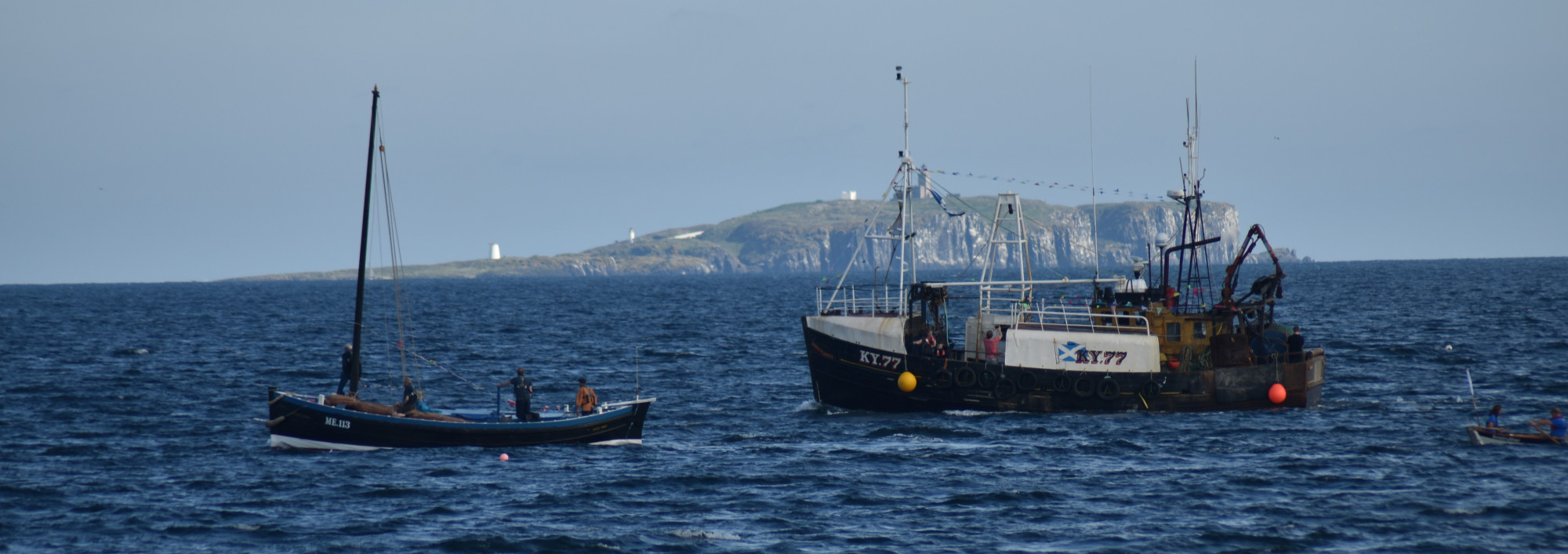
Registering of Fishing Boats. – During the week the fishermen of Cellardyke have made considerable progress in registering and numbering their fishing boats, as required by the recent order of the Board of Trade. In this novel and therefore embarrassing duty, the fishermen have found a valuable friend in William Gillis, Esq., fishery officer, who has most kindly given his experience and help in filling up the forms required by law. The changes caused by the new system are somewhat curious, as instead of beginning at Buckhaven, as was the case before, the first numbers have been issued for Cellardyke boats, when K.Y. No. 1 is to appear on the boat of Skipper John Gardiner, and where advanced number like 651 is to be replaced by a primary 5. About 100 Cellardyke boats have been already numbered, and we trust that no time will be lost by the fishermen in complying with the order, as no boats in the case of neglect will be allowed to sea after April.