

Before Provost Anderson on Friday, Alexander Doeg, fisherman, Cellardyke, pleaded guilty to committing a breach of the peace in Shore Street on Thursday the 27th May. The Provost, in passing sentence of a fine of 7s 6d remarked that he was sorry to see a lad of his appearance there. To come before the Magistrates might seem a small affair, but it was putting his foot on the wrong step of the ladder, and he hoped he would endeavour to behave himself in future.
CAUGHT AT LAST.—At a Burgh Court held on Friday last—Provost Anderson on the bench Robert Trail, carter, Cellardyke, pleaded guilty to committing a breach of the peace by fighting with William Collins, tilemaker, and conducting himself in a riotous manner in Shore Street on the evening of Saturday, 30th August 1879. The Fiscal (Mr George Peebles) explained that the case was called on the 9th September last, but panel failed to appear, having left the town. The other party was convicted, and it came out in the evidence that Trail was the principal aggressor. He also stated that a great many people, although cited, only came when it suited them, and thus treated the court with contempt. In reply to questions, panel said he left the district in order to seek work, which he got, and because he never thought he had done much wrong. He had resolved to abstain from drink, and had not tasted it for some time. The Provost pointed out that there were two previous convictions against hint within a month, and said the most lenient sentence was a fine of 10s 6d. Fine paid.
THE HERRING FLEET OF 1880.—The herring drave is once more the absorbing topic of the coast. This season the preparations are on a scale second to none but rather in advance of all that have gone before it. Beginning at Buckhaven, the western edge of the Anstruther district, we find that about A hundred boats will be afloat, including the eighty now fishing from Shields. Largo has gathered in her mantle, as the little fleet now only counts fourteen, which is two fewer than last year. Elie is represented by a single crew; but St Monance will round the hundred and share in the venture both at the doors and on the Buchan coast with the finest squadron ever launched by her on the Lammas Sea. Pittenweem is likely to boast this year of five and fifty boats but Cellardyke as usual outdistances all competitors with her splendid flotilla of over a hundred and seventy first-class craft. We ought, however, to take the register of the Union Harbour, in which case it will verge on one hundred and eighty haste, from the tidy little yacht of our spirited townsman, Mr David Donaldson, up to the dashing clipper which the present week gave as the latest trophy to Cellardyke. At Crail “the last rose of summer is still blooming alone,” but old St Rule is to send some ten or twelve crews to the fishing ground, so that our Fifeshire fleet may be assumed at over four hundred and fifty boats which, in respect of equipment, will take the first place on the Scottish shore
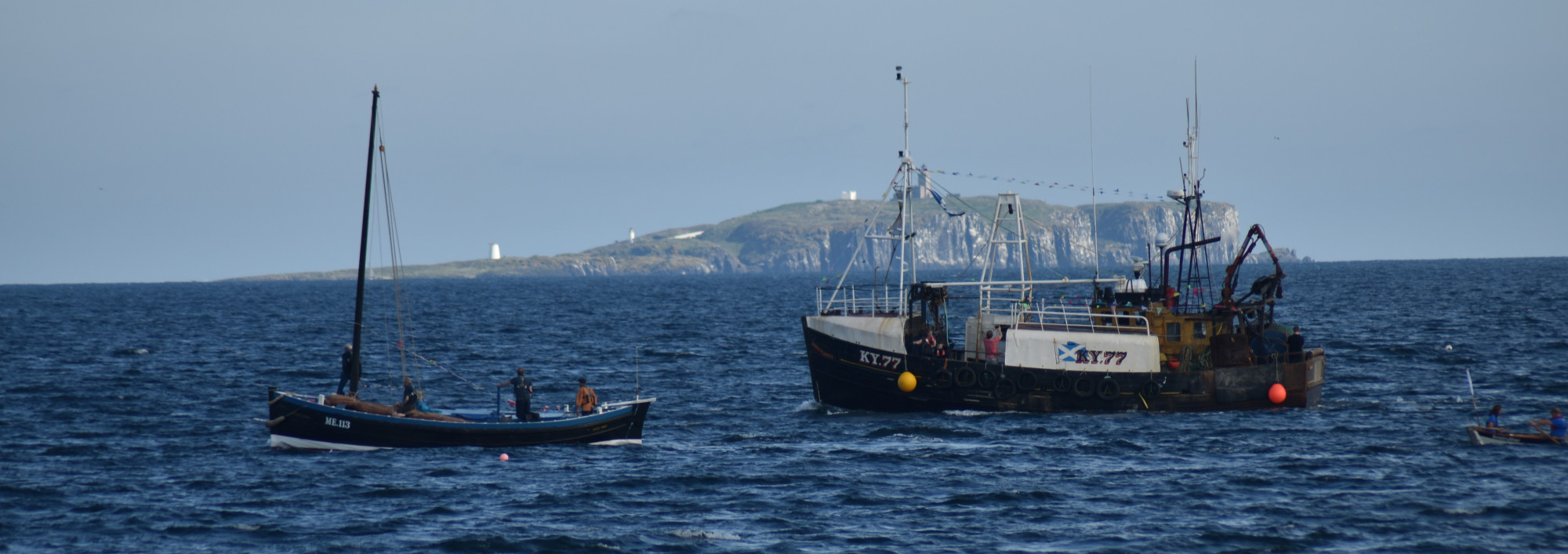
New Fishing Lugger for Cellardyke, There is no event at the seaport like the arrival of a new craft, and so on Wednesday our shore was all interest and excitement as the “Young Alexander” of Cellardyke rounded to from Fraserburgh. We have more than once referred to the bold but graceful sheer, the long and eye-sweet lines of the fishing craft turned out by Mr Alexander Weatierhead, who has evidently studied both the theory and practice of his useful art. Her maiden run was made in the teeth of the northeast gale, but she behaved in a way to fill those on board with confidence and pride in her qualities; and more than one old salt shaded his eyes to take another look at the little witch which danced past saucy traders with royals set as if at anchor in the river. She is all but forty-nine feet long, and scarcely less than thirty-six tons builders’ measurement—being specially designed, es you infer from her deep keel and great breadth of beam, to encounter the shifting winds and dangerous squalls of the German sea. We turn with more than ordinary satisfaction to her fittings, which include steerage and cabin – both being as tastefully finished in moulding and wainscot as in a first- class saloon—every regard being had at the same time for the comfort and convenience of the crew. She has been built to the order of Mr Alexander Keay, Cellardyke, and we are much mistaken if the “Young Alexander” is not the favourite of the station this Lammas on the coast of Aberdeen. We observe that her enterprising owner has returned to the old plan of his fathers by way of ballast. In his other boat the “Comfort” concrete was tried between the timber, but as we anticipated at the time, it has had to be broken ap and removed, so as to give place to stones or pig iron. It is an interesting fact as showing the changes wrought by time that the stringent order was published along the Fife coast prohibiting all drave boats from using stones for ballast, but instead to have bags of sand or gravel. The opinion of the authorities was that stones destroyed the fishing ground at Dunbar, and, as we find from the ancient records, special care was taken at Anstruther to have the proclamation observed to the letter.
LET OF CURING STATIONS. —Springing out of the new hopes awakened by the return of the herrings to the coast the foreshore of Anstruther was exposed for set as curing stations on Tuesday afternoon. Viewed as it was in this light, the event seemed to excite general interest, or rather we should say public curiosity. In the palmy days of the trade we have seen the prime station on the east quay realise more than fifty guineas, but on Tuesday this and a companion one were secured by Messrs Sharp a Murray for ten guineas. No. 3 was carried by Mr William Millar, farmer, Falside, who still continues his old connection with the coast, for £6 5s; and No. 4 also on the east quay was taken for 15s by Mr Finlay, so well-known in the herring circles of Aberdeen. James Methven, the once famous herring king, has been lying for years in his grave, but his name is still a power in the trade, and the new Leith firm that has adopted it, united the woodyard at £22, and another veteran merchant from Deeside, Mr Lawrence Tulloech, has done the same with the old building yard at £9 5s, the aggregate since of the nine stations being only a crown piece less than £34, which so far restores a lost branch of harbour revenue at the very time it is most urgently called for in view of the new and interesting responsibilities of the Board.
Do you enjoy and follow the Cellardyke Echo and the work of the Cellardyke Trust?
There are costs behind everything we do, such as, Web hosting fees for this website which provides the weekly Cellardyke Echo and all the other info and research. Public Liability Insurance for our events such as the Sea Queen and the Phone Boxes. These are general operating costs which we cannot avoid.
If you are able to support the work of the Cellardyke Trust – Donations of any size would be gratefully received.
Our Account is called “The Cellardyke Trust (SCIO)”, Sort Code 83-15-08 – Acc No 00128815
Many Thanks