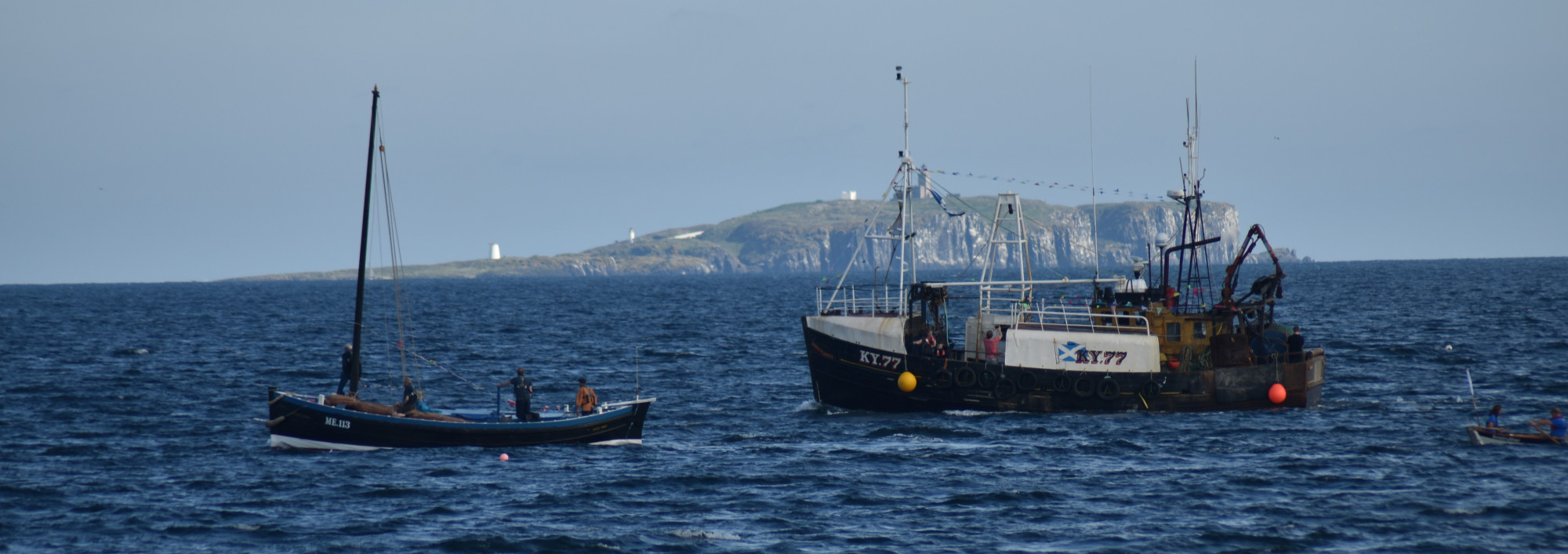
Mr Jarvis,( the boatbuilding yard next to the lifeboat shed) we may also observe, is busy with a singular experiment – that is, in recasting an old clinker boat into a carvel one, it is being executed on Cellardyke Green, and is at the instance of Mr James Dick. We hear with unqualified pleasure of certain long-term improvements about to be fulfilled in an order entrusted to Mr Alexander Cunningham. This boat we hear will be the largest of her class, being three and fifty feet in length, and is to be rigged not at a lugger but as a ketch or dandy, so as to obviate the deadly hazard, as tearful eyes will tell you in Cellardyke, of dipping the sails in the midnight storm.
CURIOUS ACCIDENT IN THE HARBOUR. — AS the steamer Diamond, trading between this port and Leith, was edging her berth in the ebb of Monday, her propeller struck so violently on a piece timber fixed in the mud as to snap the shaft. A steam tug bad to be telegraphed for Leith to tow the disabled vessel thither for repair. The stray log, the cause of so much mischief, was part of a raft consigned many weeks ago to Mr Cormack, of the Steam Mills, Cellardyke, but the question damages over the accident will all probability be discussed early meeting of the Harbour Board.
1881
UNRULY COOPERS at the Bailie Court of Kilrenny on Friday— Provost Watson presiding—four coopers employed in Cellardyke, George Lawson, David Dun, John McLeod, and William Blyth, were charged with assaulting Mr David Muir, fisherman, at the harbourhead on the evening of Saturday week, and also with a breach the peace on the same time and place. All the panels appeared except Blyth, who is in the meantime at Yarmouth. They pleaded not guilty, but the evidence of several of the neighbours brought home the charge in the opinion of the court, and they were each fined 7s 6d, or ten days in jail.
Eyemouth Disaster
We understand that the Cellardyke Magistrates have held a conference with a view to raise a relief fund for the widows and children rendered destitute in consequence of the lamentable loss of life on the Berwickshire coast. As all the fishermen are at present absent on the Norfolk coast, it was deemed advisable to postpone the calling of a public meeting until next month.
1882
Agnes Lindsay or Moir, widow, residing in Cellardyke, sued Peter Montidore, fisherman, there, for the aliment of an illegitimate child. The pursuer’s mother explained that he was absent at his calling in Yarmouth; but she also took exception to the summons on the ground that the child had been born two years ago, and yet this was the first time the claim had been raised. Here the Sheriff quashed the case, as one, he said, not for the Small Debt, but for the ordinary roll, seeing that the paternity of the child was still undetermined in court.
WRECKAGE ON THE FIFE COAST. At daybreak yesterday a large quantity of stores, American provision casks, with several bags flour, were cast ashore in the East of Fife. At such points as the currents set at Crail, Cellardyke, and Anstruther the stores were gathered by hundreds. Several pieces of timber supposed to be part of a ship’s bulwarks were also picked up, and the waifs at Cellardyke include a hat, almost new. Various miscellaneous articles are likewise reported, and this circumstance has led to the opinion that the wreckage was cast overboard, or has floated away from the Hartlepool steamer Preston, which went ashore on Friday night on the Goswick Sands, near Berwick, while on the voyage from New York to Newcastle. Yesterday the gale and sea continued, with the result of adding largely to the quantity of wreckage cast the shore.
1883
HERRING-CURING YARD TO BE LET AT SANDHAVEN, With entry at Martinmas, 1893. That Large CURING YARD, with Cooperage, Salt Cellars. Smoke Houses, Cutting Shed, and extensive storage, presently occupied by Messrs Sharp & Murray, Cellardyke. Apply to Mr Shives. Bank Agent, New Pitsligo.
THE TRAWLING COMMISSION. (To the Editor of the East of Fife Record.)
Sir, —The enquiry going on about trawlers has brought to my mind what a respectable old fishermen of Cellardyke told me about 40 years ago. He had used a trawl for a year or two, but gave it up, as he saw that although very profitable for a short time, he was ruining the herring harvest to which he and most of his class looked forward to pay old scores. He told me that he had pulled to the surface in the Traith about two tons of herring spawn at one haul. Of course this would stop a small sailing boat, and he would be obliged to bring the net to the surface to empty it, but the power of a steam trawler is so great that she could go ahead with more than that, and smash it so small that it would be always escaping from the net as he went on, to make room for more, and being thus let loose would be tossed up and down with the strong tides in the Firth and never could come to life, and he would in a day or two destroy more herrings than are caught on the whole Scottish coast in a season.
Our townsman, James Henderson, is likewise giving the finishing touch to the eastern section Rodger Street, Cellardyke, in handsome block which has been by that practitioner, Dr Flaxman.
1884
It gives a pleasing idea of the unslackened energy in the herring trade that Messrs Duncan & Black’s net factory in Cellardyke is busy, in the meantime, by night as well as by day. There are at present 16 machines in motion, hitherto, as elsewhere, by the fair sisters of the coast; but in the course of the week a party of young men arrived by rail to work the night shift, so as to enable the spirited firm to overtake the orders thus early in hand.
1885
SHOP TO LET., that CORNER SHOP in Rodger Street, Cellardyke, recently occupied by Dr Flaxman. Apply James Henderson Anstruther;
The ENCLOSURE OF CELLARDYKE PUBLIC SCHOOL PLAYGROUND. Mr Clark reported that Mr Sharp and he had conferred as to the enclosing of the playground at Cellardyke School, and came to the conclusion that it would be best to enclose the ground with an iron railing. He had made some enquiries as to the cost, and that it could be done for £72. The present wall and the coping were not suitable, and would have to be taken down to the bottom, as it was much too light. The cost included that, two iron gates, and a wooden gate at the top for the entrance of carts. The estimate included exactly a similar railing to that round Cellardyke Church. Mr Sharp said he would have some dubiety as to a wooden gate at the top, as the Cellardyke boys had a confounded practice of cutting and carving at doors, and he was afraid they would soon cut at it. Mr Clark replied that an iron gate would cost £10. If the wall and the coping had been suitable the cost would have been a great deal less, but it was not heavy enough to carry any weight. Mr Thomson thought the railing would be an improvement so far as looks were concerned, but the question was would it be effective in keeping their property from being destroyed. It was a very expensive matter to carry out. Mr Clark—if the boys get over the railing they will be easier caught. The railing itself only coat £28 with the gates. The height is to be 6 feet 3 inches over all, including 3 feet of a stone wall. I think it is not possible to go into the matter just now without more consideration, as the expense was serious. The Chairman suggested that the Committee should make out specifications, and submit them to next meeting, which after some discussion was agreed to.
THE OVER-ATTENDANCE AT CELLARDYKE PUBLIC SCHOOL The Chairman called attention to the large attendance at Cellardyke School, and said the teacher had stated that he was not to admit any more pupils. The accommodation in the school was for 225, and he thought the Board should see that the average attendance did not exceed that this year. They could not expect to get off as easily as before. The number on the roll was now 275, and the average attendance 250. The question was whether the teacher had not already taken in too many pupils. Mr Clark—l thought there was an understanding that he was not to exceed a certain number at the conference we had with him last year. The Chairman—There was nothing definite agreed to. Mr Clark— Well he should be at once instructed to take in no more. The Chairman—l would be disposed to have stopped short with 20 lees than he has. I think he has too many. Mr Clark—it appears to me that we are in the same mess as last year. It is most unsatisfactory that this matter should crop up again after the discussion we had about it last year. How are we to weed them out Mr Sharp—Leave it to Mr Barbour. I don’t think he will run the risk of getting something taken off his grant. On the suggestion of the Chairman the Clerk was instructed to write Mr Barbour, asking him not to take in more pupils or new names without the consent of the Board
THE BREAKING OF THE WINDOWS IN CELLARDYKE SCHOOL. It was reported by Mr Clark that 21 panes of the windows in Cellardyke School had been broken, and an account was presented amounting to £2 for putting them in again. Mr Clark thought it was absurd that two panes should have been mended only two days before the school closed to be broken shortly after the schools vacated. He refused to initial the account for payment. The account was ordered to be paid, as were some others. The Clerk stated that he had received no reply from the father of the boy who was known to have broken a number of the windows, in answer to his request to pay the damage, but that as soon as he came home from the south fishing he would be again requested to pay.
Mr Sharp mentioned that a part of the zinc of the roof of Cellardyke School had been displaced, and the rain had been coming in to the school, causing great discomfort. He suggested that it should be looked after at once. Mr Clark —That roof has been a perfect humbug to us and a great expense. It is a pity that it was not set fire too, and us to get the insurance. (Laughter.) The Committee were instructed to have the roof repaired. After a long discussion on the question of cleaning the schools and offices, it was agreed to engage, if possible, a suitable man to do the work at a salary of £l2 10s per annum. The Board then adjourned.
1886
ACCIDENT TO AN APPRENTICE BAKER. –On Wednesday morning, while George Fleming, a young apprentice baker with Mr Black, Cellardyke, was loading straw in a cart at Anstruther farm, the horse shied at some object and suddenly ran off, causing Fleming to fall out. When picked up it was found that his left arm bad been broken and severely bruised by the fall. The injured limb was attended to by Dr Craig, and he is recovering as well as could be expected.
THE FEVER EPIDEMIC. Scarlet fever and diphtheria have been very prevalent in the East of Fife during the past two or three weeks. Precautions were adopted to isolate the disease by the Local Authorities and the School Boards, but the number of cases continues on the increase. Dr Craig, the Medical Officer of Health, has at the request of the Board of Supervision prepared a report, in which he attributes the cause of the disease to overcrowding and the want of a proper drainage system and water supply. The cases have mostly been of a mild type, and there have been 103 cases of scarlatina, 21 of diphtheria, and of measles in Cellardyke. He recommends the closing of all the schools, but from the varied nature of the cases hospital isolation would, he finds, be impracticable. The Local Authority are resolved to reply to the Board of Supervision that they have been prevented by a proprietor interested not coming to terms with them from carrying out a drainage system which they had begun. Anstruther have unanimously refused to agree to the recommendation to close the schools, maintaining that there is no necessity for it.
According to the information received from the south, the fishing has this week been a blank owing to the stormy weather. The boats left for sea on Monday, but were forced to return by the severity of the gale. One Cellardyke boat had her mast broken, but fortunately none of the crew were injured. Similar news came from Scarborough, and a number of the boats there will leave for home next week.
1888
THE CELLARDYKE URQUHART WYND WELL. (To the Editor of the Record.) Cellardyke, October 11th, 1888
Dear Sir,—ln finding the report of the meeting of the Kilrenny Town Council, in your last issue, I was amused at the charming simplicity shown by the members of Council in acceding so tamely to the proposal of Bailie Smith, to retain the old Urquhart Wynd well, merely because 3 boilers in that district are supplied therefrom. while all the other fishermen get supply either from their own wells, or from the new water supply, He seems to argue that the new water is unsuitable for barking purposes, while ” ony auld wife ” could tell him that the softer the water the better for that purpose He is also reported, in another paper, to have said, in answer to a question by Councillor Melville, that the fishermen, when in Aberdeen, largely use salt water. (I presume he means because of the softness of the Town’s water.) This is contrary to fact. However, this may be, are the members of the Town Council aware that for every gallon of water drawn from that old well for barking purposes 100 gallons are used for domestic purposes? This is a serious affair, after the Board of Supervision have condemned the water, the Council would do wisely to shut it up altogether. – I am, yours truly, A B
LATE Mr James Murray. —The death is announced of Mr James Murray, Cellardyke, after a short illness of a fortnight’s duration. Skipper Murray was the pioneer of the south fishing, having upwards of 30 years ago been the first skipper who ventured to go to the fishing in Yarmouth and Lowestoft. Having been successful, his example was soon followed by many of the crews in Cellardyke, and has been continued ever since.
STEAM CAPSTAN ‘AND PROPELLOR FOR FISHING BOATS. We have much pleasure in calling attention to MACDONALD’S – IMPROVED STEAM CAPSTAN, and to their New and Highly Satisfactory PORTABLE PROPELLOR for FISHING BOATS. The Propellors, which can be fitted into any boat, have surpassed all expectations, and are capable of driving a boat at six knots without interfering with her as a sailing craft. We shall be glad to give particulars to interested parties regarding this most important invention to Fishermen. JOHN MARTIN & Co., CELLARDYKE
NB it is a Macdonald’s capstan that is aboard the Fisheries Museum’s Reaper
THE UNIVERSITY, ST ANDREWS. —ln the results of the examinations for the M. A. degree held recently at the above, we note the name of W. S. Birrell, Cellardyke, passed in Greek.
1904
THE FISHING AT SCARBOROUGH. —At Scarborough on Wednesday night last week a storm of great severity raged. Seven boats belonging to Cellardyke were at sea. Two of their number arrived at Bridlington, one pulled his nets and came in on Thursday afternoon, but the other four were riding at their nets. These all received great damage and loss of the gear. They had shots ranging from ten up to 30 crans price 19s per cran. One BF. boat broke his chain and parted from his whole drift, which meant a big loss of messenger ropes, nets, buoys, &c. It was one of the severest gales that has been experienced by fishermen for a long time.
FATAL ACCIDENT INQUIRIES CUPAR. Cellardyke Brothers Drowned. Before Sheriff Armour and jury at Cupar to-day two public inquiries were down for hearing in connection with fatal accidents which took place the county recently. The first case had reference to deaths of John Deas, fisherman, and Alexander Gilmour Deas, assistant fisherman, who resided Rodger Street, Cellardyke. They were following their usual employment on the forenoon of Monday, 25th July, in the service of their father, James Deas. on board the Thistle, and after leaving Anstruther Harbour, Alexander Deas -was accidentally struck by the main sail and knocked into the water. His brother John leapt into the water his assistance, but both were drowned. The witnesses in this case did not appear, and the inquiry was adjourned.
1905
Sam, Bough RSA – a biography
One of the best known etchings of Cellardyke Harbour after a Sam Bough painting
… a few years before his death (Bough) painted a picture in water colours for the benefit of the Cellardyke Fisherman’s disaster fund. The subject was “Fishing Boats putting out to Sea” – a stormy effect. The picture bore an inscription to the effect that it was presented for the benefit of the sufferers of the Cellardyke disaster by Sam Bough.
Upwards of 80 females from Cellardyke, Pittenweem, and ST Monans have left for Yarmouth and Lowestoft to employed gutters during the next two months.
RESIGNATION OF TOWN OFFICER. —The resignation of Mr John Mitchell, town officer of Cellardyke, will no doubt be heard with deep regret by his many friends and acquaintances. Mr Mitchell has held the post of town officer for the long period of 22 years, during which time he has been a familiar figure to all who had occasion to meet him, privately or officially. Always cheery and having a greeting for all, John wag universally liked and respected. For a long number of years he led a seafaring life, having been nearly twenty years on Messrs Currie’s boats in the Leith and Hamburg trade He sailed on the ” Forth,” the old paddle steamer engaged in the Anstruther and Leith trade, and afterwards on the “new” screw steamers on the same line of sailings. The Anstruther and Leith steamers claimed his services for nearly 20 years, and he also acted as their porter on shore, for a long time collecting the money due to the steamship company, in which capacity he was well known along the mast from Elie to Crail. He commenced his duties as town officer 22 years ago under the late Provost Watson, who only held office for a fortnight after Mr Mitchell’s-appointment. During these 22 years, he has served under no less than five Provosts, via., Provosts Watson, Skinner, Martin, Thomson, and Black, the former three having long since joined the great majority. John has, in his official capacity, attended no less than 789 funerals, including those of several local personages. Between 50 and 60 marriage suppers have been held in the Hall during his term of office, and for soirees, well—” he couldna say, there’s been that mony, it wisna easy mindin’ them a’.” John never got anything but praise for his services, and he never heard anyone say anything against him. All who know him will heartily concur in this and wish him and his worthy spouse quiet and comfort in their well-earned retirement.
After the appearance of the Anstruther and Cellardyke Gospel Temperance Band at the recent opening of the Williamson Memorial Fountain in Shore Steet, the Committee of the union decided to approach Mr Archibald Williamson and solicit a subscription in aid of the funds of the Bind. Their appeal has met with a ready response, as on Monday, the secretary received a letter from Mr Williamson, enclosing a cheque for two guineas.
1906
Skipper M, Gardner’s Bravery.—We have been favoured with a look at the watch presented to Skipper Martin Gardiner for his brave action in going to the rescue of the crew belonging to the St Monans boat Puritan while at Lerwick on July. The watch and guard is an exceedingly handsome specimen of the watchmaker’s craft, bearing the skipper’s initials in cleverly embossed work on the front, while under the cover the following inscription is to be seen: — “Presented by the Fish Trade to Martin Gardiner, mater of the SS. Vanguard 111 for bravery in rescuing the crew of the boat Puritan, wrecked on Green Holm, Lerwick. 19th July 1909.” The chain is also a handsome one, and has a masonic pendant attached.
Mr George Smith, son of Skipper William Smith (Black), Cellardyke, has passed the Board of Trade examination as second mate at Victoria, British Columbia.
1907
Last night a contingent of some 120 fish workers, drawn from Cellardyke, Pittenweem, St Monance left by special train composed of corridor carriages for Edinburgh direct, where they were to be joined on to the south-going trains for Lowestoft, Yarmouth, &c.
OFF TO YARMOUTH. DEPARTURE OF FIFE FISHER LASSIES. The female fish-workers East Fife who had been previously engaged, both local and North Country fishcuring firms work the herring curing stations at Lowestoft and Yarmouth, were called upon to leave on Friday evening. There being over sixty all told, arrangements were made on this occasion whereby the lot were conveyed by special train composed of three corridor carriages, which left Anstruther after the last ordinary west-going train with a contingent of workers from Cellardyke, picking those from Pittenweem and St Monans en route, and thereafter proceeding direct for Edinburgh, where the carriages were coupled to the south-going English train. The contingents had a hearty send-off from a large following of their comrades at the respective stations.
The Rev. Peter T. Thomson, Leicester, who has suffered seven days’ imprisonment as passive resister the education rate, son of ex-Provost Peter Thomson, draper, Cellardyke.
1908
A telegram was received this forenoon in Anstruther announcing the fact that the local drifter, the Scots Greys, Skipper James Dick, Cellardyke, had . gone ashore in foggy weather early in the morning, at Happesburgh, about 20 miles north of Yarmouth. The telegram added that the expectation was that the drifter would be floated off next tide.
On Monday morning, twenty-four drifters and an Inverness sailer, left for the south. Seldom indeed if ever before have so great a crowd lined the piers, and it looked as if the whole inhabitants of Cellardyke had turned out to bid farewell to the fishers. All the vessels got away in good time, the only drifter left being the Vanguard 111, which had come home after being repaired. She sailed on Tuesday for the south.
THE SOUTH HERRING FISHING. —Not much has been done yet by the local drifters and boats at the south. On Tuesday at Scarborough, the SS Breadwinner had 12 crans at 27s per cran, while at Shields the same day, the Craignoon and Pride of Fife had £10 each, the Daisy £9, the Eva £6, and the Edith £2. At Grimsby on Tuesday, herrings were sold at a penny each, the scarcity sending up the price to 65s per cran. The Venus had £33 and the Evening Star £12 also at Shields on Tuesday. On Wednesday, the following drifters had shots at Shields :—Pride o’ Fife £24, Violet £23, Morning Star £21, Unity £18, Edith £15, Alices £13, and Daisy £11.
CARGO OF BARRELS FOR YARMOUTH.—On Tuesday, the SS. Kilburne of Whitehaven entered Anstruther harbour and took on board a cargo of 2000 barrels from Messrs Melville & Sons, for Yarmouth. The steamer smiled with the evening tide. The captain of the steamer was informed by the harbour-master that he entered and lay at the head of the east pier on his own risk, and Mr Melville had to accept the risk before the captain would consent to remain. Nothing happened. however, and the Kilburne sailed in the evening.
THE RETURN OF THE DRIFTER VANGUARD. — The steam drifter Vanguard 111., Skipper Martin Gardner, jnr., arrived at Anstruther harbour on Saturday morning. It will be remembered that this drifter stranded on the sands at Saltburn on the English Coast on the 10th of September, and after a few days was success fully floated, and towed to Shields where she underwent a thorough overhaul and repair. The expense was borne by the Herring Drifter Insurance Company. Peterhead, and no cost has been spared by them to deliver the drifter to the owners in a first class condition. Besides having all her machinery overhauled and the hull put in order, she has been painted outside and in, all at the cost of the Insurance Company, who willingly offered to see that all was made right. The owners are satisfied that the Company have treated them very generously. The vessel was inspected by numbers of the fishermen during the weekend, and all were loud in their praise of the insurance company having done the work of repair so well and without any loss of time.
1909
A series of meetings, under the auspices of the Scottish Branch of the Free Trade Union is being held in East Fife during the present week. On Monday night a meeting was held in the Public Hall, Upper Largo, when the Rev. Ian Bruce presided, and Messrs J. C. Haig and R. B. Ditch spoke on the question of Free Trade. Ur Haig, illustrating the benefits of Free Trade, gave a striking local example. He told how some 60 years ago two brothers left the little Fifeshire village of Cellardyke, where their father kept a miscellaneous store in which he sold “treacle, tar, and testaments,” to quote his own description. The brothers went to Adelaide, South Australia, which was then a small township, and while there the sons thought there were certain goods which their father sold which would fetch very much higher prices in Adelaide than in Cellardyke, and that on the other hand there were certain goods which could be bought cheaply in Adelaide which would fetch good prices in Fifeshire. So they sent out a small consignment of Australian goods and received a small consignment in exchange, and was the beginning of a profitable intercolonial trade, and the two brothers founded the great firm of D. & J. Fowler, Ltd., the largest in S. Australia. Free Trade tended to foster international trade, whilst so-called “Tariff Reform” tended to check. it. Several questions were put and answered. Other meetings will be addressed by the same speakers this week at Leuchars, Tayport, Newport., and Ladybank.
Considerable anxiety was felt in Cellardyke last Saturday and Sunday in consequence of no word having been received of the whereabouts of six boats belonging to Cellardyke, which bad been fishing from Yarmouth. Frequent telegrams were passed between the South and Anstruther, and on Sunday morning word came that three bad come in all safe. The others turned up at night, the crews having ridden out the storm and gale at’ their nets. The satisfactory news of the safety of the boats gave much relief to the anxious ones at home
The fishing boat Alaska, Skipper Peter Muir, left Anstruther on Monday for Yarmouth, and arrived there after a remarkable quick passage of 30 hours, the lowest on record.
Mr Daniel Cormack, Cellardyke Public School, has passed the recent July examination for admission into the Training College, Moray House, Edinburgh, and gained a scholarship of £230.
The Lammas herring fishing at Anstruther has been the poorest on record, but the Cellardyke boats which were engaged at Fraserburgh, Peterhead, and Aberdeen have done well. Some 120 of these boats are now prosecuting the fishing off Scarborough, Yarmouth, and Lowestoft, with every prospect of success, and is hoped this will neutralise the poor returns obtained at home.
1891
About six o’clock yesterday morning, as Charles Tulloch, labourer, residing in Lodge Walk, was walking along the south bank of the River Dee, discovered the dead body of a man lying in a foot of water about fifty yards south the Victoria Bridge. The body was at once removed to the Police Office, Torry, here was identified as that of David Corstorphine (50), fisherman belonging to Cellardyke. On the previous night the unfortunate man had been in town along with some companions, and is supposed he had been returning to his lodgings along the river bank, when owing to the slippery nature of the ground had missed his footing and fallen in, and had been unable to extricate himself from the mud. The deceased came to town about fortnight ago, and had been engaged as fisherman on board steam fishing boat. Dr Robertson, examining the body, found that life had been extinct for some hours.
NB – Note from Harry Watson – The age of David Corstorphine was incorrectly reported he was only 19
1892
On Saturday, while some children were playing on board the boats in the inner harbour, one of them, a boy of seven years, son of Mr Alex. Fraser, shoemaker, Cellardyke, fell into the water. His companions gave the alarm, and fisherman, named George Anderson, West Anstruther, immediately leaped in after him. With some trouble, caused by the struggles of the child, he swam to the side of the boats, where others relieved him of his charge. Fraser was unconscious, but was speedily brought round. Anderson was none the worse, but he deserves great praise for his promptitude, and it to be hoped the affair will not be allowed to rest here and suitable recognition made for his gallant conduct, this is the seventh life he has saved within four years.
Burgh Court. —On Thursday—before Provost Martin and Bailie Thomson, Cellardyke–James McGee, vagrant, was charged with breach of the peace and breaking two panes of glass in a dwelling house in James Strut. He pled guilty, and was fined 7s 6d or 7 days. He went north. (Dundee Jail)
Yarmouth fishing – …….The KY boat Hawarden Castle, from Cellardyke, had a collision with another Yarmouth vessel in the harbour, and she also in dock. The herrings caught by the Scotch boats are still small and ordinary quality.
Early on Sunday morning the joists of a house in James Street, Cellardyke, were found to be on fire. The brigade was called out, and the flames extinguished without difficulty, A neighbouring chimney had been on fire the preceding night, and the flames had smouldered till the smoke alarmed the inmates. Little damage was done.
1894
There was still very little done at Islay last week. The weather being fine all the boats were et sea every night. The takes on Thursday were a little more encouraging than the former part of the week. Some of the Cellardyke boats had a few crans, one had as high as 30 baskets, and on Saturday another one had 36 baskets. The prices ranged from 4s to 4s 6d per basket.
1895
The Train Service. —Mr Conacher, the Manager of the North British Railway, has replied to the petition sent to him by the merchants of Anstruther and Cellardyke asking for a continuance of the present morning train service in order secure an expeditious letter delivery in the East of Fife. Mr Conacher regrets that the amount of traffic will not allow the present morning service to be continued. Mr Marr, on behalf of the memorialists, has written to Mr Conacher to state definitely whether the 6.15 and 7.40 a.m. trains are to be withdrawn in November and one substituted at 7.25. No further reply has been received, but the Town Clerk has written to the Post Office authorities to send down an official to make inquiries into the unsuitable and inconvenient arrangements of last winter, by which a letter took nearly 24 hours before it was delivered to towns a few miles away.
1897
On Wednesday last a woman went into a public-house in Cellardyke and drank half a gill of whisky, which being done she discovered that she had no money, and offered the key of her door as a pledge, until she would go home and get it. (How was she to get into her house?)
1898
Sudden death in Castle Street. On Wednesday evening, a very sudden death occurred in Castle Street. Mr Thomas Moncrieff, fireman aboard the Anster Fair, arrived in the afternoon with the liner. He was then in his ordinary health, and continued at his work until the evening. Shortly after nine o clock he went to bed and lay talking with a member of his family. About half past nine, his wife heard him breathing heavily with a curious sound in his throat, and at once called in her neighbours, one of whom ran to Dr Wilson. Before the Doctor reached the house Moncrieff had expired. Moncrieff was 41 years of age and left a widow and several of a family. He belonged to Cellardyke, and served his time as a cooper with Mr Bonthron. Until lately he resided on the English coast. He was well known and greatly respected in the district. The Anster Fair did not proceed to sea yesterday morning but her flag was flying half mast all day out of respect for the fireman.
On the 70th Anniversary of the death of Provost Willam Carstairs
Dundee Courier – Tuesday 30 September 1952
EAST FIFE BURGHS LOSE PROVOST Provost W. W. Carstairs, civic head of the united royal burghs of Anstruther and Kilrenny for the past 20 years, died yesterday after a long illness. Provost Carstairs was highly successful business man, a public benefactor and an authority on Scottish fishing affairs. A native of the burgh, he went to sea as a boy, but gave up to train with a Glasgow accountant. He returned to his home town to enter the business of Messrs J. Martin & Co., woollen goods and oil skin manufacturers, and eventually became head of the business. He was also managing director of Messrs Gray & Pringle, ironmongers. Provost Carstairs maintained a keen interest in the sea and fishing. He owned several fishing boats, and was frequently consulted by the Government on fishing problems. He had the finest collection of model fishing boats in Scotland. For his national service to fishing Provost Carstairs received the O.B. E. He started his Civic service on Kilrenny Town Council, and was Provost in 1929 when the neighbouring burghs were amalgamated. He became magistrate of the new Town Council in 1929, and in 1932 was appointed Provost, office he held until his death. He had many other local appointments. keen church worker, Provost Carstairs was an elder of Chalmers Memorial Church. A fine baritone, he took a leading part in the promotion of music in the burgh, and appeared on concert platforms many parts of East Fife. There was hardly a local organisation which did not benefit from Provost Carstairs’ generosity. At his own expense he built a bridge across the burn at Kilrenny Mill; he presented the local football club with a pavilion; and he bought ground and presented it to the local bowling and tennis clubs. Provost Carstairs was unmarried.
St. Andrews Citizen – Saturday 04 October 1952
Well-known in St Andrews as managing director of Messrs Gray & Pringle, Ltd., South Street, and as a prominent East Neuk business man, Provost W. W. Carstairs, civic head of Anstruther for the past 20 years, died on Monday after a long illness. A fine baritone singer, he often appeared on St Andrews platforms. A native of Anstruther, he went to sea as a boy, but gave up to train with a Glasgow accountant. He returned to his home town to enter the business of Messrs J. Martin & Co., woollen goods and oil skin manufacturers, and eventually became head of the business. Provost Carstairs maintained a keen interest in the sea and fishing. He owned several fishing boats, and was frequently consulted by the Government on fishing problems. He had the finest collection of model fishing boats in Scotland. For his national service to fishing. Provost Carstairs received the 0.B. E. He started his civic service on Kilrenny Town Council, and was Provost in 1929 when the neighbouring burghs were amalgamated. He became a Magistrate of the new Town Council in 1929, and in 1932 was appointed Provost, an office he held until his death. He had many other local appointments.
Dundee Courier – Saturday 01 November 1952
FIFE PROVOST LEFT £92,170 Provost William Watson Carstairs, 0.8.E.. J.P., manufacturer, of 18 West Forth Street, Cellardyke. who died on September 29, left £92,170 4s. In his will, lodged with the Sheriff Clerk Fife at Cupar yesterday, he bequeathed to the Town Council of Kilrenny, Anstruther Easter, and Anstruther Wester, over which he presided for 20 years, portrait himself in oils and a picture, “The Tea Clipper Race,” in view of its historical connection with both Anstruther and Cellardyke. His only other public bequest is £250 to Chalmers’ Memorial Church, Anstruther.
Dundee Courier – Thursday 04 May 1922
OVER £10,000 DAMAGE BIG FIRE AT CELLARDYKE WORKS. The big blaze which raged at the oilskin works of Martin & Co., Cellardyke, on Tuesday night and yesterday morning was successfully overcome about five o’clock. Throughout yesterday the workers (over one hundred) were engaged returning the large stocks of oilskins, pallets, silk, cloth, &c-., to the stores which were preserved from the flames. The damage is considerable and cannot yet be estimated. A rough calculation places it between £10,000 and £15,000. Only two stores, the offices, the stitching machine room, and the cutting-room were saved. The factory was proper completely gutted, involving the loss of valuable machinery. . The cause of the fire outbreak is unknown. A similar fire occurred at the factory twenty years ago, but during the intervening years the firm had made extensive additions.
Dundee Courier – Wednesday 03 May 1922
BIG BLAZE IN FIFE CELLARDYKE WORKS GUTTED Heavy Damage One of the most disastrous fires that has occurred in the East of Fife for many years broke out last night in the oilskin works of Messrs Martin & Co., Cellardyke. Fed on the highly inflammable contents of the factory, the flames spread with amazing rapidity, and although St Andrews Fire Brigade was early on the scene, so fierce already was the blaze that for a time they could do little to check its progress. The fire originated in the new wing of the factory which was erected during the war, but soon the greater part of the works was involved. The blaze lit up the sky with a ruddy glow that was seen for many miles around, and the scene of the fire a great crowd collected, watching with awe the progress 61 the flames. About midnight the Buckhaven Fire Brigade arrived and added their efforts to those of the St Andrews brigade. The fire fighters worked with feverish zeal, but for long time little progress could be made against the roaring flames. Householders in the vicinity of the blaze worked with frantic energy to remove their belongings to places of safety, and in this they were aided by many willing hands. An old church standing next to the factory, which was used as a store, was cleared of its contents. Strenuous efforts were made to remove as great quantity of the oilskins and pallets from the stores as possible, and lorries were requisitioned to carry the salvaged goods to safety. The machine-room and the store to the east of the factory have been saved, but the rest of the factory has been practically gutted. The fire was still raging in the early hours of this morning, and the damage will amount to several thousands of pounds.
Dundee Courier – Saturday 11 January 1930
NEW TYPE OF SCOTS FISHING BOAT
FIFE MAN’S SUCCESSFUL EXPERIMENTS
MR WM. ADAMSON INTERESTED
Refinements for Crew ; Electric Light, Radio and Searchlight Comparisons with Drifter Earnings By a Special Correspondent. Realising how serious is the situation confronting the Scottish herring industry, a Cellardyke man, Bailie W. W. Carstairs, set himself the problem of finding a solution. That he has in large measure succeeded is obvious from the return he receives from two special motor bauldies he has had built to his own specifications. These two bauldies, named the and the Winaway, are arousing considerable interest in Scottish fishing circles. They are the forerunners an entirely new type of fishing boat.
CHIEF OBJECT building these two bauldies Mr Carstairs’ chief object was to construct vessel which would be within the reach of owner fishermen so far as capital outlay was concerned, and would at the time bring in reasonable remuneration for the other fishermen. Although Mr Carstairs has scored an economic success in the building of those boats, he has, with commendable foresight, given careful study to the requirements of the crew. The men’s quarters on each vessel are the last word in comfort. The fo’c’sle, which is extremely large, beautifully panelled with mahogany. beds are cosy and comfortable, and ample provision is made in the way of lockers, &c., for the storing of clothes. Each boat is fitted with wireless, is provided with a small boat, and is lit throughout by electricity. Another novel feature is a high-power electric searchlight.
CREW PROTECTED Instead of the usual steam boiler and capstan. there has been a new type of motor capstan installed in the fore-hold and takes up little space. Each vessel, also, is fitted with very latest type of semi-Diesel crude oil engine of four cylinders and 48 h.p. While setting up their nets the crews are protected from spray and cold by means of canvas, which is stretched over special safety rails. Each boat has magnificent wheel-house, surrounded with glass and with spars of pitch pine. The engine room, which is aft, is also beautifully fitted up. Each vessel has speed of eight knots per hour.
OBSOLETE BOATS In an interview I had with him, Mr Carstairs described how he conceived the idea of building the Onaway and the Winaway. ” It has been announced,” he began, “that 47 per cent, of the Scottish herring fleet is obsolete, and there is no doubt that that proportion is a correct one. ” I can give you instance of a skipper who spent £20 on his boat so that it might go to Yarmouth, and then the insurance. surveyor came along and would not allow that boat to go to sea. The consequence was that the skipper had to find a berth for himself another boat. There are many more cases like that. ” At. Yarmouth recently one of our own big drifters had to go twice into dock for repairs, and, taking these things into consideration, it is an accepted fact that a great crisis in the herring fishing industry is looming up before us.
DIFFERENT SYSTEMS ” I am referring to the Scottish industry. The English and Scottish systems arc entirely different. In England it is almost wholly capitalistic system, whereas in Scotland the system is individualistic. ” Many of the drifters are years old or more, and it, is absolutely impossible for ordinary fisherman —from the point of view of capital—to get a new steam drifter. I know from experience that the present steam drifter is a very expensive craft to keep running. For a steel drifter, for instance, the expenses over the year total as much £1500.
A COMPARISON ” The cost of a pre-war drifter and its post-war equivalent shows tremendous difference price. ” Before the war, drifter would cost about £2500. To-day that boat, without slightest alteration, would cost somewhere the region of £4500. Such drifters were wooden ones. “A steel drifter nowadays would cost between £6500 and £6700. “It is, therefore, almost an impossibility for the fishermen to obtain capital order to replace a drifter, mainly because of increase in the initial cost as compared with the pre-war period and also owing to tremendous running costs.
COST £1600 ” I reasoned that, as the cost of a drifter was so prohibitive, some kind of boat must be got which would cost less and yet would just as efficient as drifter. The ultimate result has been the building of the Onaway and Winaway. ” Each of these motor boats, which contains everything of the very best, costs £1600. You will see, therefore, that practically three of these motor boats can be obtained for one wooden drifter to-day. ” The men on these new boats have three geographical chances of getting good shots. A drifter has to stay in the one place, but three motor boats can be miles apart. The fleet of drifter is about 80 nets. The Onaway carries 67 nets. “That means that a craft costing £4500 has about 80 nets, and for the same sum one can have three motor boats, with about 200 nets, and three different chances of getting fish.
SAME EARNINGS ” Admittedly has been proved that the steel drifter is the best type of craft that has yet been put at the disposal of the herring fishing industry, on account of the fact that she may take weather which another type of boat could not take, but against that is the fact that for the same initial cost you can take a bigger proportion of nets with the motor boats. ” A steam drifter went from Anstruther to Fraserburgh on the same day as the Onaway and the Winaway. They fished for the same time, and came back in the same week. The steam drifter had £860 gross earnings, and divided £36 per man. ” The Onaway had £480 gross, and divided £36 per man. showing that the crew of the motor boat had the same earnings the men on the drifter, and yet the motor boat had only half the gross earnings. ” In another case a successful steam drifter had £4084 gross, and divided £190 per man; Winaway had £1770 gross, and divided £152 per man. The motor boat’s individual earnings, therefore, were only £38 short a very successful drifter with £1770 gross compared with the drifter’s £4084 gross.
RUNNING COSTS, The running costs both these motor boats are really very remarkable. They can cover 100 miles comfortably for £1. ” The all-in cost of running the engine, including crude oil, lubricating oil, and paraffin oil, for the year is slightly over £80, and that, with a large amount of steaming. The average works out at under 2 ¼d per mile. ” One of these boats can go out at the shortest notice, sail 50 miles out to sea, sail back 50 miles, and, if she can get two crans (four baskets) of herrings and sell them at 10/- per cran, she is not in debt.
AT YARMOUTH “The Onaway was at Yarmouth when so much gear was lost, and proved herself a most seaworthy boat. She came ashore drier than any drifter, and had it not been for the special electric searchlight she might have lost her whole fleet of nets. ‘ Then men were hauling in when some of the nets broke adrift. The searchlight, however, was trained on a buoy to which was attached the remaining nets, and after half hour’s steaming they were able to get hold of the buoy and “bring the remainder of the nets on board. ” I believe,” he went on, “that these two motor boats are just on the small side and could do with perhaps an additional eight or ten feet in length, thus giving room for a bigger engine. ” Each of these boats is about 53 feet long, and I am of the opinion that a boat 65 feet long with a 75 h.p. engine could be built for £2000, and that boat could carry a fleet of 80 nets, equal to an ordinary drifter, and would only cost one-quarter of the sum to run, with a bigger proportion of earnings divisible among the men. ” Among other things which might be mentioned is the fact that a motor boat can started up within five minutes, while a drifter has always to have steam up before she can get away. ” In addition to the steam engine on a drifter there is the steam boiler, which cuts off from 15 to 20 feet of the length of the boat.
CREW OF SIX ” A drifter has 10 men of a crew, seven fishermen, a fireman, engineer, and cook, whereas a motor boat has six men of a crew when fishing from Anstruther and seven men when at the other fishings.” In concluding, Mr Carstairs said that the only way out was for the Government to develop some scheme whereby the fishermen could get a cheaper capital than by going direct to the bank. ” Surely of all industries,” said, ” the fishing industry is most deserving to be kept up and taken in hand by the Government. as the miners have been. ” The fisherman is a fine type of man who did his duty during war in the most hazardous form of warfare —mine-sweeping ” It would great pity to allow the fishing industry to get into such serious financial position that it was practically crippled.
EASY REPAIRS ” Something must be done to preserve a port such Anstruther from going into decay, and I think these motor boats will help solve the problem. If anything goes wrong with a steel drifter it has to be sent to Aberdeen, Leith, or North Shields. A motor boat, other hand, can be dry docked by being pulled on to the beach at Anstruther, and can there be attended local sailmaker, engineer, or carpenter, as the case may be.” Mr Carstairs told me that he would soon be seeing Mr Adamson, Secretary of State for Scotland, who was greatly interested in his motor boat experiments. The Onaway was built Mr Walter Reekie, of St Monance and Anstruther, exactly a year ago, and the Winaway was built at the same time by Mr Alexander Aitken, Anstruther. Each boat is 53 ½ feet over stems, 16 feet 3 inches of beam, with a tonnage of about 26.75 gross.
HIGHLY ESTEEMED Carstairs is a well-known and a highly esteemed figure in public life in Anstruther district. He was for 17 years a member the now defunct Kilrenny Town Council, and was magistrate of that burgh for ten years. At last month’s historic election of the united burghs
of Kilrenny, Anstruther Easter, and Anstruther Wester, took fourth place out of total of 25 candidates. A few days later had the honour to appointed one of ‘the Bailies of the new united council. Mr Carstairs belongs Cellardyke, and his life-story reads like a romance. Born son of a poor fisherman, he was sent to sea a tender age as fisher boy. By dogged perseverance and attention to his studies was successful in securing bursary which enabled him to attend Waid Academy. His school days over, entered office a local solicitor and bank agent. From there went to the offices of a shipping company in Glasgow.
SOLE PARTNER By sheer ability gradually worked his way up the ladder of success. After few years in Glasgow, he returned his native town and became joint partner in the firm of John Martin & Co., oilskin and buoy manufacturers, Cellardyke. At that time there were three partners, and some 25 hands were employed. To-day is sole partner in the firm, which now has 230 employees. He is also chairman of directors of the Bon-Accord Ship Stores. Ltd., and of the Ship Repairing Co., Ltd., Aberdeen.
Aberdeen Press and Journal – Wednesday 10 September 1930
GREATEST NEED OF FISHING INDUSTRY. Cheaper Boats and Diminished Working Costs. SCOTS SECRETARY ON NEW TYPE OF DRIFTER.
Gleanaway on Sea Trials from Anstruther
Speaking at a launch at Sandhaven, Aberdeenshire, yesterday, Mr Adamson, Secretary for Scotland, said the great desideratum in connection with the herring fishing industry was the cutting down of capital and running costs in order to secure a larger margin between earnings and expenses. Reducing Cost of Drifters, At present, owing to the heavy cost of drifters, it was impossible to set aside adequate reserves for replacement, but he was assured that vessels of the oil-driven type that had been launched could be built at about half the cost of steel drifters and that the running expenses would he much less.
What Has Been Done.
Mr Adamson mentioned that since the Government assumed office they had provided for the relief of the industry, by way of grants, loans, remissions of debt and new services, approximately £350,000. Mr Adamson, Secretary for Scotland, christened the new vessel, which has been built by Messrs J. & G. Forbes & Go., Sandhaven, to the order of Mr Wm. W. Carstairs, Anstruther, the Gleanaway, and at banquet which followed dwelt on the crisis through which the herring fishing industry is passing.
Last summer, he said, he had spent a considerable time in personally acquainting himself with the conditions at the great Scottish herring fishing ports, because he realised that the importance of this industry to Scotland, and the problems with which it was faced, demanded that he should be fully acquainted with the position and equipped with first-hand knowledge. (Applause.) Everywhere he went he was met with the same cordiality, but also with the same urgent pleas for a policy which would assist the industry and the harbours from which it was carried on. He took back with him to London a resolve to bring before the Government the need for something to be done. (Applause.) Amongst the problems was that of restoring the fishing fleet to a condition that would enable it, in the altered economic circumstances, to restore the industry to the prosperity which it once enjoyed, and so richly deserved. (Applause.) With that question to-day’s events there were closely associated. Government Inquiry.
As regarded all those problems and difficulties of the future organisation and development of the industry, the Government felt that there should be a comprehensive inquiry. Accordingly, a subcommittee of the Economic Advisory Council was set up, and had for several months been carefully collecting and sifting the views of representatives of and branches of the fishing industry. He sincerely hoped and believed that these inquiries would fruitful of good guidance for future policy. (Applause.) Since the present Government took office, grants or loans had been authorised for harbour schemes a total of no less than £185,538, which had enabled a large number of schemes, costing less than £268,211, to gone with. The amount grants or loans authorised for Fraserburgh alone was £25,890. (Applause.) .Further schemes, at a total estimated cost of nearly £200,000, were under consideration for assistance. This record spoke for itself, especially when he added that during the last Government’s term of office the total amount of grants or loans given for these purposes was only £34,540.
Harbour Debts. Another big question which they turned their attention was that of the debts which were weighing down so many of the herring fishing harbours, and none more so that Fraserburgh. The result of the examination that was made was that the Development Commission remitted debts to an amount of about £127,000, of which Fraserburgh’s share was £23,501. The debts due the Public Works Loan Board were on a somewhat different footing, but he was glad to be of such assistance as he could in facilitating the settlement which was reached to their satisfaction with that Board, and which resulted in the very substantial wiping off of Fraserburgh Harbour debts by the Public Works Loans Act of last session to the extent of £67,000, (Applause.)
Of a different character was the assistance offered to fishermen who lost their gear in the great storm off East Anglia last November, by way of loan to assist them to replace their losses. Loans to a total of £19,810 bad been made for this purpose. It might be taken that the sums made available since June last year by way of the grants, loans, remissions (not including those of the Public Works Loans Board), and new services, amounted approximately to £350,000. large part of this expenditure was attributable to works which, apart from their value to the industry, would productive of considerable direct and indirect employment. (Applause.)
The Great Desideratum. The great desideratum in the herring fishing industry was the cutting down of capital and running costs in order to secure a larger margin between earnings and expenses. He had been examining the question of boats very closely, and in his opinion the securing of a type of boat, the capital cost and the running costs of which should be much less than that of the old types of boat, was of vital importance. The capital cost of a steel steam drifter the present time was in the region of £5600, and of a wooden drifter £4500. But the average annual earnings of steam drifters nowadays amounted to only about £2300, and of this sum about half was swallowed by running expenses. Under the share system in vogue in the herring fishing industry, only one third of the residue, or about £400, was consequently available to meet the cost of maintenance, insurance, depreciation, interest on capital, etc., which together averaged about £550, so that loss was inevitable, and it was impossible to set aside adequate reserves for replacement. Similarly, only one-third of the residue was available for the fishermen’s labour share, so that their average earnings for a year’s work were only about £74.
Devising a Cheaper Boat. Mr Carstairs had already made valuable experiments with the object of bettering this state affairs, and they were very much indebted to him for the interest he had taken in trying to devise cheaper boat, and a boat less costly to run. He had built two medium sized motor-boats—the Winaway and the Onaway—at about one-third of the cost of steam drifter. These vessels had already proved themselves, but they were only 50 feet long, they were handicapped as compared with the steam drifter in carrying on fishing in the open sea in rough weather. Notwithstanding these limitations in this respect, however, the earnings of their crews compared very favourably with those of the larger vessels, and an adequate return on the capital cost had been secured.
Earnings of the Vessel. Mr Carstairs has felt, however, that even better results were to be expected from a vessel more closely approaching the steam drifter in size and power, and the results of his study of this question were to be seen in the Gleanaway. This vessel was equipped with extra powerful engine to give a speed of about 12 miles per hour, and her cost had consequently been higher than would have been the case had a less powerful engine been installed. But a similar vessel engined to give a speed of 9n miles, could be built at cost of from £2750 to £2800 or approximately half the cost of a steel drifter, and the advantage thus conferred from the outset was obvious. The earnings of such a vessel might be expected at least to equal those of the average steam drifter, but he was assured that the running expenses would be only about 30 per cent, of the gross earnings, as compared with 50 per cent, in the case of steam drifters, and if this was so. an adequate return on the capital cost was assured and the vessel represented an attractive investment. (Applause.)
High Average Age.
Provost Walker, Fraserburgh, who presided, in proposing the toast of their guest, the Secretary for Scotland, said Mr Carstairs, the owner of the new vessel, might prove to be a pioneer in the development of the fishing industry. (Applause.) Those interested in the industry knew the difficulties that were facing it. A great problem at present was the high average age of the steam drifters, which necessitated a very extensive overhaul before insurance companies considered them worthy of risk. If the Gleanaway was to fulfil what was expected of it as an economic proposition, then their problem would be largely solved. (Applause) R- Gordon Nicol, harbour engineer, Aberdeen, proposed Continued Prosperity to Mr Carstairs,” who, had great hopes, would lead the fishermen back to prosperity with boats that would be an ideal as regards speed, efficiency, and economy. (Applause.) Mr W. M. Carstairs, responding, said felt that he had made an effort contribute the solution of the difficulties that were threatening the fishing industry. John Dunbar, fishcurer. Fraserburgh, proposed The Builders,” and Mr George Forbes replied. Other toasts followed. The Launch. The Fraserburgh lifeboat conveyed Adamson and a Email party to the launch at Sandhaven, the company including Provost Walker, Mr R. Gordon Nicol. Aberdeen; Mr H. R. Barr, Aberdeen, Baillie Peterkin, Baillie Brown, John Dunbar, Mr Tarras, harbour clerk; and others. As the Gleanaway was cut from her moorings, Mr Adamson performed the christening ceremony by breaking bottle of wine on her bow, and a large crowd the quay and the beach raised a lusty cheer. The vessel is different from the ordinary type drifter in respect that she is driven by Diesel engine of 140 h.p.. and using crude oil will be able to stay longer at sea than a steam vessel, and at about a third the cost. Her fuel consumption is calculated at 3s 6d an hour all in, whereas a steam drifter takes much as £400 for coal for the herring season. There will be a crew of eight in place of nine. The length of the vessel is 76 feet, her breadth 18 feet 9 inches, and her draught 8 feet.
Willie Carstairs aboard the Gleanaway
Dundee Evening Telegraph – Thursday 11 December 1930
CELLARDYKE FISHING BOAT’S RECORD JOURNEY. The motor fishing boat, Gleanaway, belonging to Bailie W. VV. Carstairs, Cellardyke, earned reputation for speed which she well sustained on the return journey from Yarmouth. With fair weather almost all the way, the Gleanaway did the journey to Anstruther in a little over twenty-four hours, the fastest of standard drifter taking upwards ‘of thirty-three hours for the journey. The Gleanaway’s maximum speed is rated at a steady eleven knot s per hour.
Gleanaway when she was working in South Africa 1936 +
Dundee Evening Telegraph – Tuesday 23 June 1931
The Modern Way of Making Our Fishermen’s Gear
HOW FIFE LASSIES OBTAIN THEIR GRACE: THE WONDERS OF “CARSTAIRSES’ FACTORY.”
By Mrs A. R. Rowlands, Cellardyke.
“WHAT big balloons, mummy !” shrieks the city child as he points an excited finger at the huge globes crowning a lorry load of fishing gear which was being driven down to the boats in preparation for the “drave,” or summer herring fishing.
Those gaily painted spheres which often cause much speculation among towns folk paying their first visit to a fishing port, are the “pallets” floats, buoys, or ” cows,” as they are called in some districts, used for supporting the drift nets, and also for indicating the location of the nets in the water.
To our grandfathers, those well finished, easily handled, and indispensable items of a fisherman’s equipment were unknown. The pallets of a past generation were made not of foiled canvas, like those of to-day, but of sheepskins.
The wool having been first removed, the pelts were soaked in lime water for period of fourteen days, being thus thoroughly cleansed. The hides were then dried the sun before subjection to a further few days’ ” steeping” in strong solution of salt and water.
After a second drying in the sun, the skins were cut in circular shape in readiness to receive a good coating of tar on both outer and inner surfaces. This operation rendered them strictly water and air tight.
The Old Way
After a visit to one of the best equipped and most modern of our pallet making factories, I not unnaturally inquired from an experienced old fisherman, “How did you fill the ‘ bows ‘ before the invention of compressed air machines?”
“Blew them up wi’ oor breath,” was the laconic rejoinder.
“You would need- good pair of lungs,” I retorted, sensing fun at my expense.
“Weel, ye see!” continued the pawky old salt, tilting his cap, while he scratched his “pow ” reflectively. “If ye didna hae enough wind, ye taen the bellowses.”
The pioneer of the canvas pallet was the late Provost Black, Cellardyke, whose factory “wast the toon” has, within recent years, been acquired by Messrs A. & W. Myles.
The large modern erection of John Martin & Co., Ltd., in Cellardyke is known throughout the East Neuk o’ Fife as “Carstairses’ Factory.”
The large and extensive premises erected within recent years at the top of the Urquhart Wynd are devoted not only to the manufacture of fishing gear, such as pallets, but, also to the making of fishermen’s oilskins; that is, their heavy coats, “sou-westers,” and frocks.” The last-mentioned are these chemise-shaped garments which cover their wearers from the neck to well below the knee.
Let it not be supposed that only useful, unromantic “oilskins ” are made in this factory. In the warehouses and showrooms hang hundreds of the daintiest and most delicately coloured silk oilskin coats, fit wear for the fairest ladies in the land.
When Tar Was Scarce
Near the huge- entrance gates the hum and babble of many girlish voices greet us. Entering the large yard, we pass wide open doors through which the summer air enters.
On our way we catch glimpse of youthful forms swaying, and busy arms moving to and fro. as their owners tend to their machines. There is no need to wonder whence Anstruther lassies obtain their graceful figures and erect carriage. Our observation tells us that their day’s work provides all the necessary figure forming and “slimming exercises.
Two or three pairs of bright eyes smile at us, and several rows of white teeth flash a greeting as their possessors revert once more to their tasks.
The modern pallets have been for many years made of oiled canvas. The divisions, shaped like a quarter of an orange, are firmly sewn together with strong thread before the article is handed over to the oilers.
Before the war, oiling of “pallets” was unknown, tarring being the uniform process. During the war-time, owing to the scarcity of tar, oiling was adopted, and this method having proved more satisfactory has been retained.
The pallets are first turned wrong side out and completely and carefully oiled inside, after which they are hung in the drying shed to dry. After a further coating of oil and a second they are turned to their right side ready for the broding machine.
Coloured Buoys
The “brod or board is that circular piece of wood which fits like a lid exactly into the opening of the pallet. The rim of the “brod” is firmly lashed to the pallet with strong twine by the broding machine.
On the “brod” is a strong handle through which passes the hole for the rope which binds the float of the net and bored through the ” brod ” is also a small round aperture for the insertion of the air-plug.
The finished or “broded” pallet, having now been removed from the broding machine, a coating of oil is given to the outer surface. A further time is spent the drying-room before final coat is bestowed.
The pallet is now ready to receive its “top-dressing” of paint; a special group of girls being detailed off for this branch of the work. Many years ago Scottish fishermen preferred an all-black buoy; English buyers were the first to use the pure white pallet, which, since its introduction, has become first favourite in the fishing world. Preference for the white buoy is due to its visibility in the pitch blackness of a starless night.
It is quite common, however, to see gaily painted pallets—red, blue, and even green—clustered like huge balloons beside fishermen’s gear.
Buoys in olden times were uniformly round in shape. With the development of the canvas float, they became orangeshaped. Recently, however, the pearshaped pallet has been copied from those used by Dutch and German fishermen.
The Air Plugs
The buoys, all painted and ready for sale pendant in a very flabby condition in the factory stock room, present quite different appearance from those inflated globes which will in due time float the nets.
We have’ already noticed in the “brod” or lid that tiny round hole for the reception of the air plug, which forms a small but indispensable part of the pallet.
A tiny cone-shaped article is this plug, made of stout white cord wrapped with tow. While examining the neat little accessory, our attention is drawn to the machine used in its manufacture.
We are shown a cord drawn taut between two clamps of a machine beside which is a bundle of tow and a jar of tar. The girl in charge seats herself and sets the machine in motion; taking a few strands of the tow, she weaves them deftly at the right hand end of the cord, which is now revolving rapidly, at the same time coating them liberally with the tar, which is used not only to bind the strands together, but also render the plugs strictly waterproof.
By means of a few strokes of a peculiarly shaped knife, the machinist forms the plug, drawing the thickness from right to left, thus obtaining the cone shape.
When the exact shape and size is obtained, the worker immediately adds further strands of tow for the formation of another plug, and so on until the complete length of cord has been used.
The line of plugs is then detached from the machine and is neatly clipped asunder into its several sections ready for use.
The Hot Plate
We now turn aside to where at long tables, and with hard brushes, girls are oiling pieces of canvas which, by their shape, we know to be fisher men’s overalls.
Later we notice the finished garments hanging in the store room; we have seen others like them covered with herring scales, enveloping their owners as they trudged up the pier on a cold morning during the “winter herring.”
In another department, a long steel topped table arrests our attention; we touch it gingerly amid amused smiles from the onlookers; it is hot, in fact, too hot for our comfort.
This, we are informed, is the hot plate; its use is presently explained to us.
A web of. crimson-hued oiled silk is lying near, and close at hand are buckets containing a mixture; we are told that a coating of this liquid is first applied to the oiled silk before the latter is rolled over the hot plate. In this way all stickiness is removed from the oilskin used in coat making.
Having passed through ” kilns ” or drying rooms, and visited stock rooms, wherein hang rows upon rows of pallets, fishermen’s oilskin frocks, coats, and “sou-westers,” we come to a little room in which is a line of porcelain basins with bright nickel taps, each bearing the well-known letters ” H ” and ” C.”
Opposite the basins is row of presses or wardrobes, where the girls hang their outdoor garments.
We have seen these girls at work, wearing heavy oilskin, aprons, their fingers coated and sticky with tar. We notice them later going to meals with all traces of toil removed. Here, the workers have both the means and the opportunity of making themselves clean and smart before appearing in public.
D’ye Want a Dook?
The Broding Machine
Within the nearest shed a large tank of paraffin is making its presence felt; its purpose is doubtless to remove all superfluous tar from the plugs before they are fitted into the pallet brods.
“D’ye want a dook?” queried the damsel in charge, waving her hand suggestively towards the tank and its oily and uninviting contents.
There is another, and as yet unexplored territory, where woollies of every shade, size, and design are made. Many golfer on our classic Scottish links wears .pullover of intricate pattern knitted by Cellardyke lassies in “Carstairses’ Factory.”
Dundee Evening Telegraph – Monday 06 July 1936
THE BIRTH OF A BOAT
By Mrs A. R. ROWLANDS, CELLARDYKE
“A boat’s gaun tae be built in Cellardyke.” Animated groups at the fit o’ the Wynd,” ” the Corner,” and ” The Rockery” recalled in regretful tones the palmy days of the town, speculated as to the prospects of the coming venture, or argued good-naturedly regarding the precise date of the launching of the last boat built in the auld shipyard east the toon.
“Aye ! An’ she’s gaun tae come oot o’ the same yaird,” was the reflective remark, as signs of preparation. became evident; sheds appeared, and engines and circular saws were installed in the long-disused enclosure. More than half a century has elapsed since the last boat left the auld yaird. The builder, Mr Thomson, has long since passed away, but his widow, a hale and hearty old lady over eighty, still survives. Recently she visited the new boat, and at the same time renewed acquaintance with the workshop and yard so long associated with her husband. In those days, so the old folks relate, Cellardyke Harbour presented a busy spectacle, with its incoming yawls unloading their cargoes on the rough, stone quay. Long lines of cadgers’ carts, drawn up close to the harbour wall, awaited the return of the cadgers, whose shrill voices mingled with the deeper tones of the fishermen as they argie-bargied over the prices of the ” catches on sale that morning. The deal amicably completed, and the scaly mass tilted into the capacious hold of the cairt,” the bargain was finally sealed by the exchange of ” pints in one of the many porter and ale shops which then did a roaring trade in the vicinity of the harbour.
One bright spring morning, about Eastertide, we gazed down upon long plank of wood, curving at both ends, stretched lengthwise along the Bulwark,” – which forms the northern boundary of the ancient harbour of Cellardyke. Doubtfully, critically, thoughtfully, we gazed, marvelling that from such a humble foundation a thing so brave and daring a boat should arise. So that’s the keel laid,” we silently commented, at the same time observing with interest the varied expressions on the faces of the old fishermen standing by—some speculative, others uncertain, all wholly absorbed in the new venture. Day by day watched her grow under the skilled fingers of her builders. Little by little the keel took shape and form and curved outward to bear the ribs which were securely dovetailed into their fittings.
Mysterious things are now being done with foot-rules and spirit-levels and planes; measurements are chalked up her bow, her stern, and her ribs; while hours are spent in smoothing away every shred of superfluous wood and in slimming her until her form becomes the emblem of grace and beauty. The period of silent workmanship soon passes. One by one, planks, specially prepared in the shipyard, are laid over her bulging ribs. The whirr of the electric drill is now heard, as holes are bored for the reception of the huge nails which rivet the wooden walls of the elegantly-curved hull. Intermingled with the clanging of hammers and the whirring of machinery, we distinguish the “couthy ” accents of the Norlanders,”for the boat-builders, on whom rests the responsibility of creating our boat, hail from the northern waters of the Moray Firth. Co-operating with them are the jolly skipper and crew of the Gleanaway, that intrepid Diesel drifter which lately left Anstruther Harbour on her venturesome voyage to Africa. The ” prentice loon ” is also very much in evidence, and his humorous quips and sallies provoke many a laugh from his preoccupied and somewhat serious seniors. Now follows what we consider the most interesting part of the boat-building programme—” calking the ship.” We have read about calking,” and heard of from various sources but we confess to having “entertained very hazy idea about the operation itself. It is with some wonder, therefore, that we watch each boat-builder appear equipped with a coil of ” tow,” a flatheaded hammer, and a tool which is cross between a huge nail and a wedge. We attend eagerly while the workmen insert the tow between the planks, and, using the wedge a medium, hammer the lengthy coil into the seams of both hull and deck. “So that’s calking,” we observe with interest. Why do you calk boat?” “To make it watertight,” rejoins the skipper, as he deftly slaps a knifeful of putty over the sunken nail heads, thus making smooth surface for the initial daubing of pitch which precedes the first coat paint. Uneven shafts of wood still remain two or three feet above the now completed hull, and, in our ignorance, we inquire whether these must now be sawn off uniform with the deck. We wonder, too, how, in event of this, the crew would retain their precarious footing on deck.
Na, na!’ ‘is the laughing response to our query. These are sawn to an even length, and then boarded in to form the gunwale.”
Round the hull, just below the base of the gunwale, is now clamped a strong iron band. The whirring electric drill soon bores the rivet holes. few swift, sure taps from the hammer and the securing belt is firmly fixed.
Are you clearing the decks for action?’
“Yes,” is the laconic retort, as a plank of wood narrowly misses a member of the crew standing on the roadway. The skipper, armed with broom and shovel and busily engaged in scooping up shavin’s,” grins slyly as he plies his task. We wait until the various missiles have been heaved overboard, then view with interest the rigging of the capstan.” until now only associated with a famous brand of cigarette.
For nearly three months our friendly boat has been our neighbour; we shall miss her when she launches out on unknown waters. It is more than half a century since her ancestors glided into the same tiny harbour; therefore are the ‘Dykers both proud and pleased that the enterprise of Provost Carstairs has made it possible for an ancient industry to be revived.
Our Diesel drifter, made on our shores, built within our view, goes out on her first voyage with many hopes that her successors may, ere long, occupy her cradle on the ” Bulwark. “
As Eve was made of a rib from Adam’s side, so was this bonny boat formed from a rib of wood laid on the rude quayside. By patient and kindly fingers was she fashioned, ” till she grew a noble lady, and the people loved her well.”
A boat built by Provost Carstairs is being launched to-day (or to-morrow, depending upon the depth the water) Cellardyke. The name of the boat, ” Royal Sovereign,” was kept a close secret till it was painted up on Friday.
Mrs Rowland’s shop can be seen just to the right of the Manx Fairy’s wheelhouse. Helen Deas wife of John, can be seen leaning out of their window.
The Scotsman – Wednesday 16 September 1936
FISHING INDUSTRY
Reduction in Running Expenses Essential
“PRAISE FOR NEW DRIFTER”
There is a limit to the possible extension of the herring market; if the industry is saved, it will be by means of a reduction in running expenses, and this type of boat is most certainly pointing the way to the salvation of the industry, ” said Mr George Hogarth, chairman of the Fishery Board for Scotland, following the final trials of the Diesel-engined drifter Royal Sovereign in the Firth of Forth yesterday.
The Royal Sovereign, built to the order of Provost W- W- Carstairs, Anstruther, a well-known figure in the fishing industry, incorporates many innovations, and the accommodation for the crew of nine is far in advance of usual drifter practice. One of the most important innovations, however, is the deckhouse, which communicates with the wheelhouse and the saloon. No longer need the fisherman risk life and limb on a pitching deck when on his way to take his turn at the wheel. Instead, aboard the Royal Sovereign, he merely walks through the deckhouse.
ENGINEROOM IMPROVEMENTS In the engine room many marked improvements have been made. A new type of four-cylinder Diesel engine has been installed which is totally enclosed, and is controlled directly from the wheelhouse. The engine made ” by Messrs Blackstone & Company. Stamford, works on the four-stroke Diesel cycle, with clutch and reversing gear, and develops 160 b.h.p. at 600 r.p.m. Every part of the engine and reversing gear is lubricated from a central dry sump force-feed system, a sea-water cooler being incorporated, maintaining the oil at an efficient working temperature. The clutch and reversing gear unit is a new development of the Blackstone engine, and consists of a metal-to-plate clutch and helical epicyclic reversing gears operated by oil pressure. The oil control valve is operated by a small lever in the wheelhouse, mounted with the engine speed-control lever. A bronze propeller is fitted, and runs on rubber bearings while the fuel storage tanks on each side of the engine room carry five tons of Diesel oil. In addition to the main engine room there is a small auxiliary engine room forward, containing the auxiliary engine, bilge pump, and a small dynamo for driving the electrically-driven Capstan, another feature of the vessel. Among those who boarded the vessel for her final trials, which were from Kirkcaldy Harbour, were Mr Hogarth, chairman of the Fishery Board, and Mr J. Henderson Stewart, M. P. for East Fife. The skipper, John Watson, Anstruther, was in command.
VALUE OF OIL-DRIVEN CRAFT
The trials were a complete success, an unexpected feature of the trip being an inspection of the Fishery Beard cruiser Fidra. which the Royal Sovereign hailed in mid-Forth. The cruiser went alongside the Royal Sovereign, and an invitation was extended to those on board the new vessel to inspect the cruiser, the opportunity being gladly taken advantage of.
The Royal Sovereign is built for a service speed of ten knots and is much faster than the majority of drifters. On returning to port, those who had been on board the vessel during her trials were entertained by Provost Carstairs.
Dealing with the advantages of a Diesel engined drifter over that propelled by steam. Provost Carstairs said that to begin with, the cost of an oil-driven drifter was less than half of that of a steam drifter. As an illustration, he said that in one particular case last year a steam drifter with gross receipts of £445 had been able to pay the members of the crew only £16 each, while a Diesel-engined drifter with cross receipts of £433 had been able to pay the men £32 5s each. The future of the industry lay in the employment of oil-driven craft, he said.
Dundee Evening Telegraph – Tuesday 25 March 1947
ANSTRUTHER MUSICAL REVIVAL People In The News Anstruther Philharmonic Society have 1 chosen Mendelssohn’s oratorio, ” Elijah,” to inaugurate their second post-war revival. Formed in 1892, the Society has given a concert every year except during the periods of the two great wars. This year’s concert takes place to-morrow in Anstruther Town Hall. Indefatigable in her efforts to get the Society off smooth start again is Mrs Agnes Gardner, wife of Bailie Thomas Gardner, area traffic manager of Messrs Alexander. A native of Blairgowrie, Mrs Gardner is a former secretary and principal of Blairgowrie Operatic Society. In addition bearing the brunt of the organisational work, she is member of the chorus. ** * * Of the three life members, two are still active supporters of the Society, and the other, Mr T. Brownlie, Paisley, maintains his interest in practical form. Provost W. W. Carstairs has been president of the Society for many years, and his connection with it extends over 48 years. A singer of more than local repute, the Provost still freely gives his services at local functions. Proprietor of the firm of John Martin & Company, Cellardyke, oilskin and woollen manufacturers, he was member the old Cellardyke Town Council and has been Provost of Anstruther United Burghs since shortly after the amalgamation in 1929.
WALKS IN FIFE; , The Travels of Timothy Tramp …………. Nether Kilrenny, is situated on the shore, and is the largest and most populous village in the parish of Kilrenny. Besides other schools there is an infant school there. The name of Cellardyke is said to derived from the cellars built there for the storing and preserving of fish. Like most fishing villages, the houses are closely packed together, and, it is not remarkable for cleanliness. The fishing population are a hardy, adventurous, and industrious race, often exposed to storms and tempests while engaged prosecuting their calling on the world of waters, and dexterous in the management of their little vessels. In some years the take of herrings has amounted to 25,000 barrels, besides large quantities of cod, haddocks, and other kinds of fish, which are cured and exported to London, Liverpool, and other large towns. The value of boats, fishing-tackle, &c., belonging to the village, has been estimated exceed £12,000. The harbour, however, is small for such an important fishing station, and not very safe during storms from the cast, but is now to be” improved, which will be of great advantage to the village. A successful herring fishing to the fisherman what an abundant corn harvest to the farmer, but this season it has been very unfavourable.
Cellardyke, East Anstruther, and West Anstruther, form one long town, divided from one another by two small streams. The Burgh of Kilrenny consists of two villages, namely Upper Kilrenny and Cellardyke. At one time it sent a member to the Scottish Parliament. From the Union to the time the passing of the Reform Bill it joined with four of the neighbouring burghs sending a member to the British Parliament, and since then is conjoined with six other burghs for this purpose. Kilrenny was disfranchised in 1828, and now governed by three managers appointed the Court of Session. At the census taken this year the burgh contained inhabited and 4 uninhabited houses, and one house building, and had 435 separate occupiers; while the population amounted to 1860 persons, 878 being males, and 982 females.
………. Behind me, lay the little village of Kilrenny, with its church and spire, its woods and beauteous fields of ripening grain; on my right, a school-house stood the most prominent object on the brow of the bank; while below lay Cellardyke, with its long narrow street and fish-smelling lanes, seldom disturbed by the broom of the scavenger. The harbour was crowded with boats.; while on the street that stretches from a dirty-looking runnel which divides the village from Anstruther on the west, to the haven on the east, numbers of fishermen, with scaly jackets, loose flowing trousers, and glazed hats, or Kilmarnock night-caps, were gathered together in groups, talking of the failing fishery, while their dames, with creel-bearing backs that need bran-filled bustles to bulk and bunch out their healthy frames to fashionable prominence, or increase their embonpoint, gave full scope their loquacious propensity, so that their tongues may not fail for want of use. Before me lay the deep blue sea, calm and beautiful, whose little wavelets rippled and murmured among the rocks, while, a little distance from the shore, some French vessels lay gently rocking their watery cradle. At length the sun sunk beneath the horizon, and the beacon light of the May appeared like a ruddy planet, guiding the watchful mariner how he might eschew the rocks, shoals, and dangers of the deep. The moon, too, rose red and round, and shed its luminous effulgence on the tremulous bosom of the sea, and made the waves gleam, as it were, with a fiery glow. How bright and beautiful was the scene! and as slowly wended my way along the brow of the brae, seek a resting-place for the night among the houses, lanes, and streets that stretch along the shore from the harbour of Cellardyke to the dark rocks of Billow-Ness….
1852
One day last week, while a number boys were amusing themselves angling for small fishes in the harbour of St Monance, one of them fell over the pier, and sank to the bottom. As the water was deep when the accident happened, the little active fisher must have infallibly perished but for the intrepid conduct of lad named Tarvit, belonging to Cellardyke, who, perceiving the imminent danger in which the boy was placed, instantly plunged into the water, and, having dived to the bottom, he succeeded in catching hold of the unconscious sufferer, and holding him with his teeth while he plied his physical energies swimming, till he landed his captive safety on terra firma. This disinterested manifestation of intrepid humanity is highly commendable, and justly entitled to the approbation of the humane public, as well as the sincere gratitude of those parents whose son was thus rescued from premature death.
1854
ELlE.—About ten o’clock on the dark stormy night of Wednesday last week, the inhabitants of South Street were alarmed by cries of distress, which proceeded from the crew of a Cellardyke boat, laden with coal, who, trying gain the harbour, had got among the breakers. The boat having filled and settled down, left the poor creatures clinging to a small portion above water, while the waves made a fair passage over them. They remained a considerable time in this perilous situation, but were ultimately landed in safety. The boat has become total wreck.
1855
Anstruther – The fishing now ended for a season is the heaviest on record this district Total catch, 75,132 crans, from 338 boats, fishing at the following places, viz. : —Anstruther and Cellardyke, 115 ; Pittenweem, 50 ; St Monance, 56 ; Buckhaven, Methil, Largo, Crail, &c., 117.
1856
The total produce on the Fife seaboard (exclusive of the winter catch) may be roughly estimated amounting to 17,700 crans, against 75,132 last season, showing a deficiency this year of 57,432 crans. The following is the average of crans per boat at the four principal stations, compared with 1855
1855:-
Anstruther and Cellardyke, 319
Pittenweem, 293
St Monance, 200 ½
1856:-
Anstruther and Cellardyke, 55 ¼
Pittenweem, 82
St Monance, 80
1857
CELLARDYKE. Theft. —On Wednesday last, Mr Robert Watson, fisherman, discovered that £2 had been abstracted from a sum of money which he had by him locked up inn drawer. His suspicions rested upon a young woman named Christian Dingwall, who had been in his employ as a house servant for a few weeks past. Although destitute of any evidence of her guilt, or even grounds for his suspicions, except unaccountable irregularities in her conduct lately, he nevertheless gave information of his loss to the police constable, who, with a decision and acuteness for which we think he deserves a more substantial acknowledgement than mere empty commendation took up the complaint, and traced her movements in such a manner as to lead to a conviction of her guilt, and had forthwith lodged in Cupar Jail to await her rial. This is the third case within a short period while the guilty parties would have escaped detection had it not been for the energy and promptitude of the constable at present stationed in this district.
1858
CELLARDYKE. MARK OF RESPECT.—Miss Grieve, the teacher of the Female School here—and who has conducted that seminary with great efficiency, and to the satisfaction of all classes for the last ten years—having been removed from her situation, a number of the inhabitants of Cellardyke, entertaining feelings of the deepest sympathy for Miss Grieve on account of this treatment, and as a small mark of their respect and esteem, subscribed and presented her with nine sovereigns before she had left the district; and this donation was accompanied with a sincere expression of regret that the community should have been deprived of the services of one who has always conducted herself with the most exemplary propriety, and whose qualifications and attainments as a teacher have been so long known and established.
1859
Alexander Martin, fisherman, Cellardyke, pled guilty to stealing a hen, and was sentenced to IS days imprisonment
On Friday last, a foreign vessel having entered the nth, put up a signal for a pilot. A boat put off from Cellardyke for the vessel, but before it reached her, one of the crew, Andrew Robertson, fell overboard, and rose again at a considerable distance; oars, &c. were thrown out to him, but he was unable to catch hold of them. The boat drifted to a distance, and was unable to reach the drowning man before he sunk to rise no more. He has left a widow and four children to lament his loss.
1828
At three o’clock afternoon on the 24th current, while a fleet of Cellardyke boats were returning from Eden-water with mussels for bait, one of them, the Olive, Davidson master, went down between the Carr Rock Beacon and the Isle of May, when the boat and six of the crew were unfortunately lost. One of the boats in company succeeded in saving the seventh, or only other man onboard. The man saved, named Davidson, has to lament the loss of two sons, a brother, and a brother’s son.
1829
Wick
It is painful to be obliged to state, that this season a dangerous, and fatal distemper, broke out among the Cellardyke fishermen in Pultney. One man is seized by a fever; his friends and relations visited him of course, the disease spread, and besides those who were sent home sick, three men belonging to Cellardyke, and one man belonging to Crail, have died. Our informants attribute the origin of the disease to the great quantity of cod heads, fish guts and fulzie of every description, which according to their statement, lie in health destring, wasteful, and disgraceful profusion in that quarter.
1832
The Cholera – At Cellardyke we understand, two cases occurred on Sunday which have both terminated fatally, and another individual it has been said has taken ill.
1834
On the 24th Inst, a boat’s mainsail was picked up at sea opposite Slaines Castle, near Peterhead. The owner will receive it back by applying to James Anderson, boatskipper, Cellardyke Fifeshire.
1837
Anstruther…The herring fishing at this port this year has been highly successful, and bears out our former statements that this is decidedly an excellent station. The herrings have hitherto been, upon the whole, of the finest quality; the prices given for them would, at the northern stations, have been reckoned extravagant, the average for the last five weeks being about fourteen shillings per cran, and the quantity taken has been great, each boat verging upwards of two hundred barrels. One boat belonging to Cellardyke, after completing her compliment of 250 barrels at Helmsdale, delivered here previous to the 30th ult., no fewer than 103 barrels taken at the Old Haiks, off Kingsbarns, a place from time to time frequented by immense shoals of fish. The herrings continued at it three or four days without shifting ground, and were taken at all times day and night, in great numbers. The demand by the cadgers, who have come from all quarters occasionally kept pace with the supply, and the prices were accordingly high, varying from 12s. per cran to 20s per Cran The lowest price given by the curers has been about 8s.
1838
SCOTCH HERRING FISHERY. CELLARDYKE, —The take of herrings yesterday and to-day is quite unprecedented here; nothing like it has occurred in the memory of the oldest inhabitant. Some of the larger boats have gone off to the fishing ground, distant about half a mile from Anstruther harbour, twice within the last twenty-four hours, and have returned with between sixty and seventy cran each trip. The boats, numbering ninety, now average 350 crans each; and the price, owing to the small number of curers here, is uncommonly low; yesterday it was 4s., and to-day it is only 3s. per cran.
Toll gates and Toll Dues –
…. Notice is also given, that authority will be applied for at the said Meeting to place a CHECK-BAR upon the Road leading from Kilrenny Bridge put the Manse of Kilrenny to Cellardyke. HENRY BERWICK, CLK. St Andrews
1839
ANSTRUTHER. The Take of Herrings at this station is quite unprecedented, nothing like it being remembered by the oldest fisherman. The average for the season is now 360 crans per boat, and there is no appearance of any falling off. Today the fishing was general, and the boats were well loaded; the price was 9s, per cran. The regular and proper mode of net-floating is again resorted to, and the fishing ground is between Crail and Cellardyke at no great distance from the shore ,
Thursday. This morning the boats have come in well fished, having upwards of 50 crans. Several boats have returned from the north country drave, and, after making up their compliment of 200 trans there by six weeks’ labour, have come to a fresh harvest at their own doors. One of these, after pulling ashore his chests and baggage, went and and set his nets near Crail, and returned next morning with 70 crans. Several vessels have arrived with salt and barrels, and more, we understand, are on their passage for Anstruther; the price is still 9s. One boat has now killed the amazing quantity of 600 barrels, and many are above 500.
Friday morning. – At the time we write., none of the boats have come in to Anstruther harbour for want of water; but some have arrived at Cellardyke with 30 and 35 barrels. Many of the boats are observed working up deeply laden.
1844
Wick – Seldom has there been such an irregular fishing as this year, for while some boats do not exceed 20 cran.
The Brothers of Cellardyke, James Murray, Master, has this year been the most successful boat employed in the herring fishery on the Wick station- having reached, on the 22nd (Aug) , the amount of 349 crans, procured in 14 shots.
There is a week of the season yet to run, and it is to be hoped a full fishing may be made here. At no other station, except Stronsay, in Orkney, is there anything like the same quantity caught as last year; and it is much feared that a considerable falling off will be the result at many places this year. “
1849
Marriage
On the 7th ult., Bailie James Tosh, grocer, Pittenweem, to Miss Euphemia Young, Cellardyke.
CELLARDYKE. Herring Fishing.—For two days in the of this past week, a few of our boats attempted the now neglected herring fishing, and were, so to speak. wholly unsuccessful; ten crans the one night and three the other being the highest catches. the fishermen may now count their costs, as this successful Lammas drave may now said have come to a conclusion. Well may it, when a boat load of herrings could scarcely repay the toil and labour of the crew, from the extreme cheapness at which they were sold. At the commencement of the herring fishing this year, lowering prospects were entertained by those who were connected with it, that it would come to a very unsuccessful termination. But about the beginning of August the prospect began to brighten and to assume a more pleasing aspect. Then it was that the hearts of the fishermen, and all the herd of nameless scavengers who are connected with, and who gain benefit from a prosperous fishing, rejoiced. Then it was their hopes and expectations expanded with the pleasing. prosperous circumstances of the times, and they longingly looked forward to a complete realisation of their most sanguine expectations. But, unfortunately, one of the portions of this strange, and complicated piece of machinery, the horizon of their prosperity began to darken and grow misty, in the shape of a monstrous decrease in the price of the herrings. The fishermen who the first and chief procurer of this “general good,” as it has been termed, had to moil and toil with the sweat of his brow, in bringing ashore the treasures of the deep and selling them at infinitely reduced prices to the fishcurers, who are very backward in purchasing them until there has been reduction in the price; while their hirelings, and all others connected with this heterogeneous composition of humanity striving to earn daily bread, suffer diminution of their wages; neither will the fish curers make one sacrifice beyond common, to share little profit with the hard wrought fisherman. No, selfishness is an ingredient too firmly fixed in the nature of man to expect such a boon. We allow that the large quantities of fish that were caught might, in some measure, help to make a large reduction in the price; but not to that enormous extent which it fell, namely to 2s 6d„ 2s., and in one instance to 1s. 3d. per cran. We have ourselves seen as successful if not more successful fishings; and we can safely say, the cran of herrings reached not such a shamefully low price. However, notwithstanding the extreme cheapness at which their herrings were latterly sold, the most of our fishermen can boast their having procured good draves; and they are now making the usual preparations for again commencing the white or haddock fishing.
Cholera.—This fearful malady has at length made its appearance within our town. Situated as Cellardyke is in a low nook on the shores of Fife, with its close narrow street, and densely populated houses, and, moreover, judging from the fatal fierceness this disease, when it first made its appearance within this town, in the ever memorable year 1832, we feel justified in supposing that its ravages will be more fierce here than any of the towns in the vicinity, that are at this moment under its malignant influence. Hoping that such predictions will prove false and altogether illusory, we would take the liberty to warn the managers to use that magisterial power which they possess with firmness, in keeping the streets clean and quelling violent brawlers who are opposed to such overcleanness merely because it is a novelty. And we would also hope that the inhabitants will cordially join with the managers in doing all in their power to avert the impending danger. There have been four cases since Thursday last, two of have been fatal. The other two are in a fair way of recovery.
One week later
CHOLERA. This awful scourge has broken out with great virulence in the fishing village of Cellardyke. The deaths during the last fourteen days have been 17. Taking the small population of the place into account (about 1500.) it is very serious. Among those who died this week was a stout able woman, mother of Willie Thomson, who is well known in the locality. This woman earned a living by working among and selling fish, and to all appearance was in poverty, but did not owe a penny to anyone. When dying, she told her son that there was money in an old chest, which on being searched was found to contain, in gold, silver, bank notes and copper, the sum of £152 5s. 6d., rolled up among clothes, and concealed in different parts of the chest. The money has been placed in the bank for her son’s maintenance. (this could be the equivalent of £7 400 today)
About twenty of the Cellardyke crews have already returned from the stations on the north-east coast, and have given up the Lammas fishing for the season. The whole of these have fished the compliment of 200 crans, and many have landed considerably over that quantity. So far as can be learned, the great majority of the Cellardyke boats have grossed £200, and while others only require a few crans to complete their complement, a few are mentioned as having only caught about 100 crans. Skipper Andrew Henderson, who returned home on Wednesday, will almost to a certainty be the ‘ King of the Fishers’ this summer, the sum realised by him and his crew amounting to the handsome figure of about £400. Next to a successful fishing at home, the success of the fishermen elsewhere is the most gratifying news for the people in this district, and it is to be hoped that those crews who have not yet fished their complement may yet do so before the close of the season. The fishermen who have returned will be occupied during the next fortnight in preparing for the herring fishing at Yarmouth and Lowestoft, whither nearly all the crews speak of going this autumn.
SUPPOSED LOSS OF THE CREW OF BANFFSHIRE BOAT. —Last night the Cellardyke fishing boat Janet, Mr John Salter, skipper, arrived here from the north, and the crew reported that between four and five o’clock on Wednesday afternoon, and while about 14 miles off Buchanness Light, they passed a fishing boat with masts gone and full of water. The nets were on board, but no person could be seen. The boat was marked B.F., No. 773, and there is every reason to fear that the crew have been drowned during the storm which raged in the beginning of this week. The weather was so boisterous that Mr Salter did not deem it prudent to risk going alongside the damaged boat, or the nets would have been recovered.
Suicide of a Young Man.— On Friday afternoon a young man named James Imrie, residing at 34 James Street, Cellardyke, committed suicide by hanging himself in a stable. He was 24 years of age, and for some time has been the sole support of his parents. No cause can be assigned for the rash act
1876
Only one boat has entered the harbour in the end of last week. It was that of Skipper John Dickson, Cellardyke, who landed 45½ crans on Friday last. Yesterday forenoon, the first Cellardyke boat to reach home from the fishing arrived in the harbour. Skipper James Wilson and his crew were engaged to fish at Aberdeen, but were unfortunate in the early part of the season in losing the greater portion of their nets. After new ones had been got, however, they met with fair success, and up to Wednesday had landed about 260 crans. The crew now intend to prosecute the fishing from this port, and as there was a good fishing at Dunbar this week, they will probably be joined by other boats as they arrive from the north. Another boat, that of Skipper William Brown, arrived in the afternoon with 20 crans of herrings.
1877
FISHERMEN. JOHNSTON’S FLOATS are best Quality, Shape, and Size, are Edged and Nicked ready to put on Nets. Sold only by WATSON & Co., and A. MARR. Cellardyke, who also supply LIFE BUOYS and CORK JACKETS, &c., without which Fishermen should never hazard the tempestuous South Fishing. Largo Cork Factory, September 1877
Burgh Court – At a sitting this court on Friday last, Lilias Reid or Dick with committing a breach of the peace the 13th August, but after hearing the evidence the Magistrates found the complaint not proven.
1878
Two versions of the tragic accident.
Fatal Accident. —Anstruther shore was the scene of melancholy accident about five o’clock on Friday afternoon. At that time a number of children were amusing themselves about some travelling booths in the woodyard, when they suddenly sprang out on the street, on which were several passing vehicles. Unfortunately, however, one little foot slipped—that of a fine girl verging on five summers, the daughter of James White, master of the screw lighter Retriever, and unable to recover herself she fell in front of a bread van. Mr Bayne, baker, Cellardyke was himself the driver, but before he could draw up or even observe the prostrate child one of the wheels had passed over her head, causing death almost on the instant, so that it was only left for Mr Bayne, the innocent cause of the unhappy tragedy, to bear home as a melancholy burthen the bright young existence, singing and dancing but a few seconds before in the beautiful sunshine. The afflicted mother had arrived from Dundee but a few hours before to find the family full of the joy of her coming, but thus soon and darkly to see the scene reversed in suffering and death, for which, we need scarcely say, the profoundest sympathy has been excited throughout the neighbourhood.
FATAL ACCIDENT. —Last Friday evening an accident occurred in Shore Street whereby a girl named Jessie White, aged 5 years, daughter of James White, muter of the S.S. Retriever, lost her life. It appears that a number of children were playing in front of a caravan stationed on the Folly ground, when a young man of weak intellect belonging to Cellardyke, who had been annoyed by someone crying names, commenced to throw stones. To escape from these, the girl White ran across the street right in front of a bread van driven by Mr William Bayne, baker, and after either falling or being knocked down the wheel went over her head. The poor girl died almost instantaneously.
Yesterday – Before Provost Watson and Bailies Brown and Sharp, John Harrow, fishcurer, Crail, was Charged with having committed a breach of the peace in Tolbooth Road on the previous evening, with having kicked Police-constable Black while he was being taken to the lock up. He pleaded guilty, and was fined 15s, with the alternative, of fifteen days’ imprisonment. Fine paid.
OPENING OF THE NEW SCHOOL -The new school erected in Cellardyke was opened without any formality on Monday, when Mr Barbour, the head teacher, was introduced by Bailie Sharp, chairman of the School Board. The building, which was designed by Mr Currie, architect, Elie, has been erected according to plans approved of by the Education Department, and will accommodate about 240 scholars This week the pupils who have been enrolled number upwards of 140, which is regarded as highly satisfactory for the first week of the session.
1879
THE GALE. A VESSEL IN DANGER. GALLANT RESCUE OF THE CREW. At daybreak on Tuesday a small smack rigged vessel was observed at anchor flying a flag of distress, between the Isle of May and the mainland. The gale was blowing hard, but as craft of all kinds were bearing about in every direction, and more especially as one of the big Aberdeen steamers and a Leith tug boat were seen to hail the smack, no attempt was made to reach her from the shore till about two o’clock, when a Cellardyke boat, with a volunteer crew, went out, under close-reefed sails, to her assistance. On coming alongside Pilot Cunningham sprung on board, and shipped the chain and cable, thus leaving nothing to be done but another dexterous stroke of seamanship, to take the smack in tow, by which means she was safely run into Crail harbour. She proved to be the coasting smack Trader, of Buckie, bound in ballast to the Forth, where she had been overtaken, as we have seen, by the heavy gale from the westward. Nor was the rescue too soon, her crew, consisting of two men and a boy, were all but overcome with anxiety and fatigue, while the rickety old craft, which was leaking badly, seemed ready founder in every recurring wave.
Rescue from Drowning. —With the instinct so natural to the shore—several urchins were busy with their little fishing lines on board an outlying boat in Cellardyke harbour on Monday afternoon, one of their number, a lad about seven years old, the son of Skipper James Watson (Coull) tumbled into the water. It was full tide, and the poor child seemed to drop like lead to the bottom, thus intensifying the excitement of his little playmates who could only give vent to their terror in cries of despair which almost on the instant filled the shore with a distracted crowd of women and children, who with the men at the fishing ground could only swell the tumult and confusion the scene. At this critical moment or rather by a striking providence, it so happened that Trinity pilot, Alexander Cunningham, was within bearing of the cry for help, and only waiting to divest himself of his jacket, he plunged in to the rescue, and happily succeeded in tearing the helpless and all but lifeless boy from the bottom. Restored, however, to his mother’s arms, and with the usual kindly appliances he soon recovered from his long and dangerous immersion. We understand that this the third time that Captain Cunninghame has saved life at the hazard of his own at Cellardyke harbour. On three occasions also his services were no less heroic at St Monance, and he was also the happy instrument of deliverance, in some fifteen or twenty cases of shipwreck in various parts of the world to which duty has from time to time led him; yet strange to say in the face of all that he has suffered and sacrificed in the cause of humanity, his services have never once been recognised by a vote of thanks, not to speak the gold or silver medal which has been seldom bestowed on one so worthy of the award.
We understand that our townsman, Captain Alexander Cunningham, has just obtained a certificate as deep-sea pilot from the Trinity House, Leith. In referring to this gallant sailor, we may not inappropriately give an extract from the letter of an old sea captain at Fraserburgh with regard to the exploit in which he and his fisher friend took part last week. It is as follows: —” That was a noble act done by that veteran skipper, James Murray. I am proud to hear of such a man. I would have willingly enlisted under his command (although I have spent 41 years of my life at sea.) I might have shared in Cunningham’s honours. It was nobly done, and the warmest wish of an old tar is, that the whole crew may be long spared to be Murray’s and Cunningham’s, on such errands of mercy.
Yesterday afternoon, two men from Cellardyke found a boat bottom upwards drifting up the Firth with the tide. As it was too large for them to take in tow, they informed Mr Keay, the Custom House officer, of the matter, at whose instance Mr William Parker, along with several others, went out in a boat fur the purpose of endeavouring to bring it ashore. On reaching it they took it in tow, but slow progress was made, until it was found that an anchor was hanging down from the submerged boat, which frequently caught the bottom. After some time occupied in sweeping for it, they succeeded in getting up the anchor, and after a hard pull brought the boat into the harbour. It seems to have been a pilot boat, and has, painted on it “Wide-awake” on the one side, and ” BO. No. 24″ on the other. The stern has been knocked in either by striking against some rocks, or being run into by some vessel.
1872
What the Good Templars Have Done and are Doing.—As it is now year ago since the Good Templar movement was introduced into the eastern district Fifeshire, we, as outsiders, have so far opportunity of judging of what it has done, and thereby of what it may possibly achieve in the future. When the Total Abstinence Society was instituted in 1840, its first year was one singular triumph and promise; but subsequently, with an occasional flaring up,” it did not realise the sanguine hopes its friends, and with this fact before them many people predicted just such another future for Good Templar enthusiasm. Curiously enough, the principle on which the first temperance crusade was carried on was exactly similar to that of to-day. There were the same regular meetings the same heartfelt brotherly sympathy, mutual fellowship, and earnest striving to reclaim the outcasts; and so long as these were the mottoes on their noble flags, the sons of temperance really achieved wonders ; but there came time of change, when, as other individuals came the front, like army under unskilful generals, the organisation fell to pieces. All this progressive and expansive force, however, was only the outcome of accidental policy; but in the case of the Good Templars it appears to as it were the basis and key keystone of the movement; and as the world is stranger to the strength these sterling motives, it can scarcely be doubted that so long as the Good Templars are true to themselves they must continue to make themselves more and more felt as a power for good amongst their neighbours. The Good Templars, like the Free Masons, keep a strict guard over the proceedings which take place the Lodge, but though we are not at liberty to estimate what is said or done within the mystic precincts, yet at public meetings the most abandoned and debauched—the very pariahs society, so to speak, men and women whose salvation was thought impossible-” have stood up respectably clad and in all respects seemingly quite reclaimed and have borne testimony to the happy agency, which, in the good providence of God, has been instrumental in plucking them verily, as brands from inevitable destruction. These trophies in the way of Good Templar triumphs, must claim from every benevolent mind the best wishes for its onward progress as one of the best recognised influences for the amelioration of the crying evil of intemperance. Though not forming, strictly speaking, a constituent element of the movement, we hear that the Good Templar Lodge of Cellardyke have, with enlightened and exemplary regard for the benefit the community, organised a special committee, whose avowed business it is to arrange for the amusement and instruction of its members, with the ulterior view of providing such approved means of popular entertainments as penny readings, lectures, concerts, &c. This idea, so praiseworthy to those with whom it has originated, has also been adopted in the Anstruther Lodge, and in the same happy spirit it is proposed,we hear, to obtain the able services of the best and kindest of music teachers, Mr Wm. B. Watterston, so organise and instruct a choir in connection with each lodge between Crail and Elie ; and as the beautiful hymns form one of the most distinguishing, and the same time one of the most attractive features their ordinary meetings, this arrangement bids fair to command the support and co-operation of all concerned.
1873
On Thursday evening ten boats arrived here with takes ranging from five to fifty-one crans, which had been netted the “White Spat.” The most fortunate crew was Skipper Duncan McRuvie, but his townsman, Skipper George Corstorphine, was only one cran behind him —the total quantity landed the ten crews being 300 crans. The first herrings, with the exception two takes which sold at 12s, realised from 18s to 19s a cran. This was the best fished day of the season, and great hopes are entertained of a good yield in the ensuing week.
A few days later
About fifty Cellardyke boats returned this week from the stations on the north east coast at which they have been fishing during the season. These have all completed their complements of 200 crans, and many of them have considerably exceeded that quantity. Skipper Peter Murray and his crew have landed about 400 crans, and is the best fished boat that we have heard of this season. A good many of the crews were settling up their accounts and dividing the proceeds of their labour yesterday, and several of the half-dealsmen have already left for their homes. One or two cases of drunkenness were observed yesterday, but we are glad that this method of getting quit of their hard-won earnings appear to be much less resorted to than in former years.
1874
ENORMOUS TAKES OF HERRING OFF MONTROSE. Our Montrose correspondent writes –
The shoal herrings which the boats struck on Tuesday had been something enormous. William Mearns who is so well known as an experienced and enterprising fisherman, declares that he “never saw the like of it'” His boat had 42 nets. He hauled 22, and threw 30 crans overboard, and brought 55 crans ashore. He hailed James Watson, Cellardyke, No 68 and gave him 20 nets’ fishing, with probably fifty crans in them. Altogether this would give a great total of 135 crans, which in other words, out of single shot, would give high a season’s average. The saving of the nets is a matter of vital importance, and James Watson of Cellardyke is highly to be commended in at once telegraphing that he had saved his brother fisherman’s nets, and would restore them to him. This unbought police of the sea, it is to be hoped, will continue to regulate the conduct of all our fishermen.
(KY 68 may be the “Integrity” which was registered in 1869, but by the 1880s the number belonged to Fergie Hughes’ “Magdalene Hughes”)
LAMMAS HERRING FISHING. Another week of the season has gone, and by the time of our next weekly issue the Lammas fishing of 1874 will be at an end. In the end of last and beginning of this week, thirty of the Cellardyke boats returned from the stations on the north-east coast. The whole of these had completed their complements, and as a number of the crews had caught considerably more than the 200 crans engaged for, the average sum realised by the thirty crews will be upwards of £200. As a rule, the Cellardyke fishermen have been very successful, and although there are this as in every season one or two instances where the sum realised will not much more than clear expenses, yet the average over the fleet will be considerably higher than for some years past, and will at least reach the sum of £150. ( N.B Cellardyke had over 170 boats fishing this season)
A casualty of a serious nature was reported at Aberdeen on Friday, in which it is feared seven lives have been lost. The boat 1480 KY., left Aberdeen on Wednesday afternoon for the fishing ground. She was last seen at sea when the gale sprang up by a boat belonging to Torry, and she was at that time very heavily fished. having upwards of ninety crans of herrings. She was then about sixty miles off the coast, and a neighbouring Torry boat relieved her by taking charge of four of her nets, it was then believed that she made for the port, but as no further accounts were heard of her, hopes for the safety of the craft were given up. On Saturday afternoon a water cask belonging to the ill-fated boat was picked by a Cellardyke boat. The boat had a crew of seven including a boy.
Anstruther – It was on Tuesday evening that the largest quantify was brought in. No less than 35 boats, mostly belonging to Cellardyke, arrived with big shots. Which were readily purchased by the local curers, whose energies were taxed to the utmost to get them cured. The boats were all engaged, and had been prevented by the wind from going to the northern ports. With such heavy shots the prices naturally fell, and were as low as 5s per cran. The skipper of a boat with 50 or 60 crans declined to take the price, and sailed to St Monance. The 35 boats landed 986 crans.
T. THOMSON & SON, Boot and Shoe Manufacturers,
HAVE always a Largo Stock of BOOTS. SHOES, and SLIPPERS, At Very Low Prices.
Ploughmen’s Strong, Water-tight, Tacketty Boots from 9s 6d to 14s.
Gent’s, Lorne and Lacing Shoes from 6s 6d to 13s 64.
Ladies’ Boots, Shoes, and Slippers in the newest Styles.
Boys’ and Girls’ School and Dress Boots in great variety.
T. T. & Son have always a Large Stock of SEA BOOTS, KNEE BOOTS, WELLINGTONS, and BLUCHERS, at their Warehouses, 34 James Street, Cellardyke, AND 14 and 16 Shore Street, Anstruther. All Repairs done on the Shortest Notice. whether sold by us or not. Every inducement given for ready cash.
1886
The intelligence from the Cellardyke boats at Shetland shows that the fishing there has been very poor, and some of the crews have done little or nothing. One boat is stated to have taken only five crans for the season, while another has landed ten, and so on. There are a number that have done fairly well, but not what was anticipated. Several of the boats have now left Shetland for the north stations, where the fishing has been moderately successful.
CELLARDYKE. WATER SUPPLY – A special meeting of the Police Board was held on Friday evening to consider the complaint of Provost Skinner, in reference to the drain in course of construction at the Culdee burn. Alterations, he said, could not be avoided in the nature of the work; but scavenger Roes, who was in charge, refused to obey his (the Provost’s) orders: so that he wished the Board to relieve him of the duty which he had imposed upon himself in the absence from home of the rest of the committee. He also held it was bad policy, especially at a time like the present, when every care ought to be had of the public health, to take the scavenger away from his proper duties. As an instance in point, he referred to the filthy or unsatisfactory state of more than one part of the town. Bailie Martin declined to bear the complaint unless it was made in such a way as to allow the scavenger to be heard in his defence. Councillor Morris said that, if only from his experience Ross ought to be continued at the drain. After some further remarks in a like tone it was agreed to appoint Councillor Williamson inspector of the drain. Beyond all question, however, the most interesting episode of the night was in reference to the water supply. Bailie Martin, as convenor of the committee, reported that the arrangements were still in the same deadlock with the agents of Mr Irvine of Grangemuir. Councillor Sharp observed that to him the one way for Cellardyke, as well as for Anstruther, to escape from their present dilemma was to unite in a joint scheme to take the Lochty supply by way of a grand reservoir at Balmonth to the coast. That remark found an approving echo at more than one side of the table.
1887
In the course of the week no fewer than forty poor householders in Cellardyke had a ton of coals put down at their door by their townsman, Mr Peter Murray, now on a visit to the old home, Mr Murray, who is the son of the late Bailie Thomas Murray, emigrated some thirty years ago to Australia, where he has since developed one of the meet extensive stores in Williamston. “Whatever ye gie, gie weel “is an old Fife saving, and one that imparts special value to Mr Murray’s considerate gift.
1888
The Anstruther and Cellardyke Homing Pigeon Society flew a race from Glasgow. Distance 80 Miles, open to fanciers within 4 miles. 27 birds were liberated by the station-master, who wired. Birds up at 10.18 a.m. The first bird to arrive home was that of Robert. Fowler, Cellardyke. It winged the distance in 2 hours 37 mins. The following is the result: —1 R. A. Fowler, Cellardyke, velocity per min., 890 yds. ; 2 D. Gullan, Cellardyke, velocity, 891 yds. ; 3 J. Woodward, Pittenweem, velocity, yds. ; 4 D. Gullan, Cellardyke, velocity, 809 yds; 5 G. M. Black. Cellardyke, velocity, 804 yds 6 J. Lindsay, Pittenweem, velocity, 759 yds.
Peterhead – A football match under Association Rules was played on the Links, on Friday night between eleven of the Peterhead Rugby Football Club and a like number of the Bluejackets, Cellardyke, who are at present engaged in the herring fishing here. There was a large crowd of spectators chiefly composed of fishermen who evinced the liveliest interest in the game. At the very outset the Bluejackets proved themselves to be the superior club, and very early in the game secured a goal, which was followed by a second just before the end of the first half. On changing sides, however, the Peterhead men showed some dashing play, and repeatedly carried the ball into their opponents’ territory, but only managed to get the hall once between the posts. The game thus ended in a win for the fishermen by two goals to one. A return match will be played soon.
1889
THE FIFE BOATS AND THE HERRING FISHING.
“It’s use, there’s naething in the sea,’ growled the veteran as he left the pier on Thursday night. He was not alone, but there was another light the scene when the bulwark rang next day with the cry ” The herrin’s in the mill bay.” It appears that the little fleet, including the Expert, of Crail, the Reliance, of Cellardyke, &c., had been induced to set to in the kindly bit of sea known as “Kellie ower the kirks.” By and by the lint was siller white, so much so that the Reliance fished 13 crans with twelve nets, but the Expert had 24 with this number. Being gunwale deep the skipper gave the remainder of his drift, viz., seven nets, to the crew of the Helena, of Buckhaven, who drew 16 crans out of five, but the other two sank, as of old, with the multitude of fishes. How the garret was ransacked to east to west for net and raip, but the gale so rose that most of the yawls, if they shot at all, returned by midnight. In meantime the shoal shifted to the east. Maggie, of Newhaven fished 300 on Monday, but the Beaulah, of Crail, had 15 crans this night near the Hirst, but the weather has more or less interfered with the success of the week- Some fine hauls have also been, landed from the reefs. The same tale comes to from the north- The telegram was every lip how this and that crew had £100 at a shot, while scores who had shared in the toils and perils of the night “didna always see coin,” as they say at the Granary End. This was conspicuously the case at Aberdeen. It’s the lucky chiel that gets them,” says the old skipper as the Express crossed the bar with 90 per crans, worth as many guineas, and the Amanda as gunwale deep to sell at 19s per cran. The cry, “Eh, sic bonnie herrin’,” also drew quite a crowd round the tidy Dawn of Cellardyke. The telegrams from the Dee are in a hopeful tone about the chances of the “Bennie hie ground,” as the famous bank is called some three or four leagues to seaward of the river- The Fife boats were caught in the gale on the Buchan coast, but luckily one and all escaped to land. Several of the Aberdeen fleet, and others fishing at the white spat, also bore away to the fine shelter in the Forth. The old fishers are of opinion, from the porpoises playing about, that a considerable shoal is on this side of the Hirst. It was while fishing here that the eccentric old minister of Crail, Peter Glass, prayed one Sabbath that the herring net might be so blessed as to load the boats over the “thole pins,” when James King, afraid that the good man might be taken by Heaven his word, cried from his seat in the weavers’ loft, ” Na, sir, no jist sae mony, or ye ken we’ll be whomilt.” Peter, or Patrick, Glass, died in spring of 1787, in the 43d year of his ministry.
The ensuing week will be a busy one in the East of Fife, with the return of the wives and families from the north. The crews will follow on an early day, though, perhaps, a rule they will be at sea in the event of any encouragement over the first, not the second, week of September. Several, however, are to proceed at once to Scarborough; but, as usual, the month will be devoted by most of the neighbours to the outfit for Yarmouth- Every period of the year has its own share bereavement and sorrow, but this season it has been exceptionally so. Thus, the relatives summoned from the north on the last errand to fewer than three open graves on the one day in churchyard of St Monance. Cellardyke has also had its own share in the death roll in the course the last eight days, the toiler on the sea being called home for the little blossom and the aged pilgrim, all but at the end of her journey of threescore and ten.
In consequence of the gale the fishing was all in the Forth on Wednesday, but as it began to lull twenty to thirty boats set to in the offing. Let the Newhaven veteran tell his own tale. ” The Wilsons and we sailed in and out hopes of seeing indications of the shoals, but all to no purpose. The skipper of the Maggie, however, shot as of old, as a mere peradventure, and got nine crans ; so like’ wise did James Logie for four crans. Ay,’ continued the veteran, ‘ it’s queer puzzle to the best of us.” The takes in question sold in the one case at 21s, and in the other at 27s 6d per cran. In the course of the afternoon the horizon was dotted with sails from the Stonehaven, if not from the- fishing grounds. Skipper Watson says that he sailed from the first named bay about noon on the previous day. There was a light northerly wind. gradually freshened into gale at midnight, when, though not without an arduous pull some five-and twenty miles sea, they saved their gear and bore away to land. There were only a few crans amongst the wind bound fleet. As some of the Fife boats are to continue the net fishing at Scarborough, they are expected home on early day, unless the prospect is all the brighter in the north. The families are also expected to return in the course of the ensuing week, but many, if not most of the crews, will hold to the chances of the first week in September.
GREAT LOSS OF FISHING NETS—The heavy hauls of herring this season have frequently involved the fishermen in loss by the breakage of nets. On Thursday the boat 337 KY., of Cellardyke, fishing at Stonehaven, had almost its whole stock sunk. The nets were very heavily laden with herrings, and when the crew commenced to haul them in the float ropes parted from the net, leaving them with their heavy shot of fish to go to the bottom. Forty-five nets were thus lost, only five having been recovered.
THE MISSION CHURCH CELLARDYKE —The contractors are proceeding so well with their several engagements for this handsome church, that opening service is expected to take place by the of the boats from the Yarmouth fishery. The last stages of the plaster work are present having the benefit sunshine and breeze; but, even at this point, the tasteful proportions of the church can be seen to telling effect, and fully sustains the estimate of the finest addition of recent years to the architecture of the coast. The friends of the Mission will be interested to hear that the trusteeship now includes the well-known name of Philip Oliphant, Esq., who was elected by his colleagues, Messrs Brodie, Nicholson, and Martin Gardiner, and in whose zeal and devotion there is doubtless one of the best auguries of the ultimate success of the scheme. This, in fact, is already apparent in the very hopeful prospects of the early endowment of the church. We hear of one venerable native who was born almost under the shadow of the brave old Saxon steeple of Kilrenny, that is to give handsome instalment—of another, also allied to the parish, who is to be still more liberal, while others are so acting the good precept to “go and do likewise,” to bear out the wise forecast of the Rev. Christie, and that, too, when the Mission Scheme of Cellardyke was all but overwhelmed in doubts and difficulties that endowment would be an easy and short step compared to the erection of the church. As we have already stated it is a cruciform structure the early Scottish style, capable of holding congregation of over 300, and with the scheme fully matured is to new parish of Cellardyke, formed by separating the town to the westward of Urquhart Wynd with the contiguous fields and barony lands of Anstruther from the old parochial division of Kilrenny.
1881
WRECK OF A VESSEL ON THE FIFESHIRE COAST. Yesterday the Marie, of Sandyford, bound to Bo’ness with pit props, went ashore about a furlong to the eastward of Cellardyke harbour. It occurred at an early hour, when the coast was shrouded in mist and rain. The crew had espied the Bell Rock, but failed to see or distinguish the May lights, and the first intimation that they had of their whereabouts was the tremendous crash with which the vessel went upon the rocks. It was a stiff east wind with a chopping surf, but being about high water the crew were comparatively safe until their vessel was left dry by the receding tide. Her berth was then seen to be an eminently precarious one, as the crazy old hulk lay between two high rocks, which in the case of the stern had destroyed the rudder and steering gear. The craw landed their chests, as the incoming tide was more than likely to complete the work of destruction. The brigantine is about two hundred tons burthen, and is said to be insured. Treasurer Doeg, of Crail, Lloyd’s agent for the district, was I on the spot.
1882
Sudden Death. —Mr Thomas Fowler, merchant, Forth Street, Cellardyke, died very suddenly on Monday night. He was in ordinary health, and watched during the day with natural interest the fitting up of fine new shop for his growing trade; but towards eight o’clock he was seized with a violent haemorrhage, which was almost instantly followed by the closing scene. He leaves a widow and family to mourn his loss.
The Storm – The Fife boats by of their great offing were amongst the heaviest sufferers by the gale. One Cellardyke boat, the Medium, lost as many as 40 nets, and another, the Goldie, lost 23. Great anxiety was felt in Cellardyke for the safety of the Floral Star, which was known to be out in the storm, until a telegram from Aberdeen stated that she had arrived there.
FISHING BOAT RUN DOWN-RESCUE OF THE CREW
An accident of a most alarming character, but , fortunately unattended with loss of life, occurred on the Aberdeenshire coast yesterday afternoon. About three o’clock, as the herring fishing fleet was proceeding to Aberdeen against a light wind, the Cellardyke boat KY. No. 841 (Watson, master), came into collision with a north country boat, and sustained serious damage, filling almost entirely and nearly disappearing under the surface of the water. The other boat at once hove to, and with a considerable difficulty the crew of the disabled craft was got on board safely. The accident, which occurred about five miles south east of Aberdeen, was observed by the crew of the boat Village Maid, KY. 1699 (Warrender, skipper) who soon afterwards ran alongside, and, having ascertained the nature of the incident, proceeded to the port of Aberdeen, where the intelligence occasioned considerable excitement and alarm. One of the harbour tugs steamed out to render assistance to the two boats which still lay alongside, and to endeavour, if possible, to save the damaged vessel, together with the nets and gearing, but up to an- early hour this morning no further tidings were obtainable, the vessels at that time not having put in an appearance. The boat which sustained the damaged through -the-collision was engaged fishing at the port of Aberdeen by Mr George Watson, fishcurer, Point Law.
1883
On Thursday Cellardyke boat No.1249, William Smith, skipper, fishing for Messrs Sharp and Murray, curers of that place, arrived at Aberdeen harbour with her sails split. The crew report having experienced very heavy weather, and about one o clock Wednesday afternoon, when they were about four miles off the Isle of May a sudden gust tore down foresail into shreds.
Police Court Peterhead
David Parker, fisherman, from Fifeshire, failed to appear for striking a labourer, opposite the Commercial Inn several blows on the face and head, and forfeited bail of 7s 6d
DRUNK Thomas Stewart, ” Goss,” fisherman, from Cellardyke, failed to appear for being drunk and incapable, and forfeited bail of 5s
ACCIDENT TO A HERRING FISHING BOAT. This afternoon an accident occurred to one of the Kirkcaldy herring fishing boats while making for the harbour, but fortunately no one was injured. The boat to which the accident happened was the Margaret Morris, belonging to Cellardyke. she had full sail set, and was coming in the bay towards the harbour at a rapid rate, there being a strong breeze blowing from the north. When a short distance out from the Gridleness a squall suddenly struck the boat, causing it to stagger and breaking the main mast at five or six feet from the top. The broken portion of the mast with the sail attached fell into the sea. There was six of a crew on board, and several them were in the vicinity of the mast when the accident occurred, it is a fortunate circumstance that the gale carried the sheet with the piece wood attached overboard. A flag was at once hoisted as a signal that assistance was required, and the crew set about getting the tackle hauled in. In a short time, the steam tug Britannia arrived on the scene, and a tow rope having been made fast to the craft, it was brought safely into the harbour.
1884
Thunder storm,
The belfry of Cellardyke Church was struck at the cope, as if ball of fire, which, after stripping a double row of slates and blackening the timber, escaped the apex, doing no further damage than this way opening the gallery to the rain. Here, also, Mr David Bruce of the Post Office had a marvellous escape. He was sitting the opposite side of the office, when a loud explosion proclaimed the wreck of the telegraph machine, but this was not all, for the fire bolt melting the pipe kindled the gas, which thus-added a new and potent ally to the terrors of the hour. Mr Bruce, with singular presence of mind, and heedless of all risk to himself, succeeded in quenching the flames, and happily so—for, looking to the neighbourhood, the consequences would inevitably have been most serious.
FISHERMAN DROWNED ABERDEEN. Last night, about eleven o’clock accident occurred at Point Law, Aberdeen, which resulted in the death by drowning of a young man engaged in the herring fishing at the port. The unfortunate fisherman, who was named John Muir, and was a native of Cellardyke Fifeshire, had been standing on the deck of a boat at the time mentioned, conversing with some men on the quay, and, while in the act of stepping to another craft slipped and fell into the water. The splash was heard those on shore, but it being very dark at the time, Muir could not be seen. Several attempts, however, were made to save him, by throwing ropes and buoys into the water at the spot where he was supposed to have gone down. Unfortunately, none of these means of rescue could be taken advantage of by Muir, whose body was not recovered till a considerable time afterwards, when life was found to be extinct. The drowned man, who was 26 years of age, was one the crew the Snowdrop, KY 1568, and was unmarried. It is believed that the heavy sea boots which he wore had the effect of keeping him from making much effort to save himself. The corpse was taken to the Cunnigarhill Deadhouse this morning.
Mr William Smith, harbour engineer, Aberdeen. Has received instructions to fence the portion, of the wharf facing old bed of the river Dee on the reclaimed Land and at Point Law at the places where it is recognised that danger life exists. The body of John Muir, the unfortunate fisherman who lost hie life there on Friday night was conveyed yesterday by train to his native place Cellardyke, Fifeshire. The Cortege that followed the coffin to the railway station consisted of upwards of 100 fishermen.
The report that John Muir was crew of the Snowdrop was incorrect he was skipper of the Conqueror