
The Cellardyke Echo – 20/12/2020 – Issue 267

1880

CELLARDYKE – Presents to the Scholars of the Infant School 

Through the liberality of several friends interested in education, including the members of the School Board, the children attending the Cellardyke Infant School have been treated to various gifts during this festive season. On dismissing on Christmas Eve each of those present received a packet of confections, yesterday oranges were distributed, and today (“cake-day”) another packet of confections will be served out.

We understand that the pupil teachers in connection with the Infant School Cellardyke, waited on their former teacher on Christmas day, and presented her with a nicer salver and jug bearing the simple but gratifying inscription :—” Presented to Miss England by her scholars. Cellardyke, 1880.’ The presentation was made in the name of the scholars by Miss Mary Ann Brown, who discharged the duty entrusted to her by her sister pupil teachers in the most graceful manner. The recipient who was highly delighted at this expression of esteem, made a suitable reply. Both the salver and jug were of chaste design and exhibited fine workmanship, and were supplied by Mr D. Lumsden”, Anstruther.

1881

The Police Board of Cellardyke have just resolved to accept the offer of Mr Clark, the factor on the Kilrenny lands, for the street manure of the burgh, at the rate of 2s 63 the cubic yard. —

SCHOOL PROSECUTION. At a meeting this week of the Kilrenny School Board, instructions were given to the Clerk to take the usual steps in order to prosecute a Cellardyke parent before the Anstruther Justices for neglect of duty in regard to education.

THR HERRING FISHING. – Nightly trials are now being made at the mouth of the Firth at the net fishing. Some twenty boats are occasionally afloat front one or other of the harbours of the coast, but as yet, the highest take does not exceed a few hundreds.

28th Dec Wick

Already about score of boats are fitted out in Pulteney Harbour, and Cellardyke boat has arrived to fish on this coast. (This was Skipper James Brunton and the “Jessies” to prosecute the cod and ling fishery)

KID SKIN REEFING JACKETS, Scarlet Wool Lined, at JOHN MARTIN & CO.’S, CELLARDYKE.

WANTED, as an APPRENTICE, a Smart Youth about 14. Apply to SHARP & MURRAY, merchants, Cellardyke.

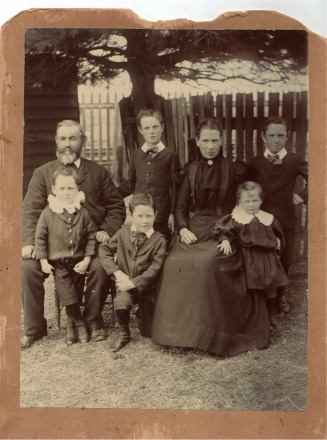
Alexander Cunningham with his family in New Zealand

……….One of the prize men ( Fishing boat builders, Prize winners at the 1880 Norwich Fishing Exhibition, ) – Mr Alexander Cunningham – sailed the other week for the Scottish Settlement of Otago, in New Zealand. A sea fishery, of much promise, is carried out in Port Chalmers, chiefly under the superintendence of an old son of Maggie Lauder, Mr William Innes, Fish Merchant. There are several Cellardyke and other trained fishermen in his employment. Fishing gear of all kinds is obtained to order from Scotland, but, notwithstanding every effort, it has been found impossible to provide suitable vessels, but this interesting task could not be entrusted to better hands than our ingenious townsman, Mr Cunningham, who will grapple with it on the spot. The Seas of New Zealand, we may observe, teem with fish, but there, as elsewhere, the harvest is not to be gathered unless with a thorough equipment – the chief of which would seem to be a class of hardy smacks of a somewhat larger and stronger build than the boats of the East of Fife.

Article about Alexander Cunningham’s Grandson’s achievements as a 50knt yacht designer, Lindsay Cunningham, famous catamaran designer – here

A Bailie Court was held in Cellardyke on Saturday, which, owing to the demolition of the Town House, took place in the Free Church Hall. —William Blyth, one of the four coopers charged with assaulting a fisherman on a Saturday night in October last, but who escaped trial with his fellows by being at Yarmouth, now appeared to answer to the complaint, for which he was convicted of evidence and fined 7s 6d. – Mrs Barbara Robertson or Montidare was charged with assault in what seems to have been a kind of family quarrel, but failing to appear, a warrant was issued for her apprehension.

1882

The youngest of our local associations—the Anstruther and Cellardyke Glee Club —made its debut in a grand concert in the Town Hall on Friday night., when a most flattering welcome was accorded by a large and appreciative audience.

FOR SALE, a BLACK RETRIEVER DOG, aged 20 months. Apply to Robert Ritchie 2 Rodger Street, Cellardyke.

1883

An Interesting Union – The half yearly meeting of the Cellardyke Fishermen’s Unions was held in the Town Hall on Saturday night. Skipper John Carstairs took his post at the tiller. Treasurer Meldrum and Secretary Pratt submitted report of the doings of the last six months. It showed that over five hundred men in the town have their names on the roll. The state of the funds was equally eloquent. The “tuppence a week” has grown to a capital of over £1200. It was agreed that the salary of the Treasurer should be £12, and that of the Secretary £5. In view of the Shetland summer fishing, it was agreed to shift the date of the annual meeting from June to December.

No little indignation has been excited by the wholesome destruction of herring nets by steam trawlers on Monday night. The boats were watching their drift, when trawlers came sweeping down. Mesh and headrope were shorn away. The “Dayspring,” the “Taeping,” the “Useful,” and the “W. E. Gladstone,” are the chief sufferers among the Cellardyke boats. The trawlers hid or cancelled their numbers, in order to escape the consequences of the outrage, which in some cases has entailed the loss of twenty nets.

1884

We understand that the dashing North Sea clipper, “Rob the Ranter,”  KY 154 of Cellardyke, launched so lately as the spring, has just sold in the interest of her owners to Skipper James Jack for about 270 guineas.

A public meeting of fishermen was held in the Town Hall, Cellardyke, on Friday evening last week—Skipper R Montador presiding—for the purpose of considering the teind fund. There was a large attendance. The yearly rental, it seems, was now £50, but it being understood that Colonel Bethune, the superior, is now willing to sell his rights for the slump sum of £1100, the meeting was called to consider what action should be taken by the fishermen regarding the proposal. A long discussion ensued regarding the matter, but ultimately skippers Martin Gardiner, James Brunton, Michael Doig, Alex. Watson, and Wm. Thomson, and the Chairman were appointed to wait upon the factor to the superior and ask him to continue the tack for another three years or otherwise in the interests of the community.

A movement being on foot to replace the pulpit and reading desk in the Free Church, with a platform (as being more in accordance with the taste of the times), the choir gave a recital (in aid of the funds) of Longbottoms “David” in the Forth Street Hall on Saturday evening. The Rev. Mr McAlpine presided. The attendance was disappointing.

Remembering the Poor. —In these weary days it is pleasant to note the thoughtful kindness, which in doing so, help to brighten many a lonely hearth. As for so many years past Mr Williamson, M.P., is continuing his distribution of coals among his old neighbours in the Anstruthers and Cellardyke. We also hear tea and sugar, and such seasonable gifts being sent in Christmas cheer to our aged householders by friends both at home and in faraway lands.

The Cellardyke Echo – 24/12/2020

1866

A very serious accident occurred on Friday morning at Stonehaven station, which will surely proves a slight warning to adventurous travellers not accustomed to jump off trains whilst in motion. It seems that a sailor belonging to Cellardyke had arrived at the station with the midnight or morning mail. Anxious to get off his journey, apparently, he leaped bolt off the train, but of course fell back and rolled along the platform towards the train. The train was scarcely stopped. so the van which was next to the carriage in which the man had been traveling came slowly up, and the consequence was that the body got firmly wedged in betwixt the foot-board and the platform, the head fortunately being clear. To remove him was found to be a difficulty, since the haunches could not be liberated. Necessity, however, led to a novel idea, that of cutting the man out. The foot-board was accordingly smashed, and the cleared. The poor fellow was pretty severely injured; and it is to be hoped the caution of the passengers will now be such as to put a stop to this class of accidents, now getting so common.

1868

SAVING LIFE FROM SHIPWRECK. From statistical records it appears that daring the past twelve months the boats of the Royal National Lifeboat Institution have been instrumental in saving, during boisterous weather the crews of the following distressed vessels on the coasts of the British Isles

(the list included) fishing-boat Active, of Cellardyke, assisted to save vessel and crew, 4

Beneficence —In the course of the past week, many poor householders in the parishes Kilrenny, Anstruther Easter and Wester, have been supplied through the liberality Stephen Williamson, Esq., of Liverpool, who is a native of Cellardyke, with the following appropriate gifts for the Christmas season, viz half a pound of tea, two pounds of sugar, and money, the gifts being in some cases supplemented with supply of coals These seasonable alms were distributed by Mrs Williamson the respected mother of the princely hearted donor

Friendly Help- During the severe storm of Thursday the deep-sea going boat Jean Wallace, of Cellardyke skipper William Smith, was brought to anchor in the offing of North Berwick. The poor crew were wet and weary with their long conflict with the storm, and stood mightily in need of rest and refreshment; but being afraid to make for the harbour, owing the many dangerous rocks that beset the fairway, there was no prospect of obtaining either, when to their great relief a boat came off from the shore with several of the local fishermen, by whose help and direction the Cellardyke boat was safely taken into the harbour. The storm beaten fishermen were assisted in the kindest way, but this was not all. Fishermen, of course, do not carry money with them on an ordinary fishing trip, and the Fife crew thus landed in a strange place without any resources but no sooner was their case known than one of the North Berwick fishermen, in the frankest and most delicate way, slipped a pound note into skipper Smith s hand, which timeous help the men were enabled to telegraph their whereabouts to their anxious families, and also procure the comforts of which they themselves stood much in need. We have been requested to publish the foregoing, that the generous and brotherly conduct of the North Berwick men may be known, and in now doing so, beg to add the earnest hope that in any similar emergency the gallant fellows may ever receive the hospitality which they on this occasion gave.

1869

CELLARDYKE.

Wreck Picked up.

During these few days past fragments of wreck have been found floating out at sea. The crew of an Elie fishing boat have picked up a large log of timber, while a crew belonging to Cellardyke have found a large box, with hinges and lid, measuring sixteen feet long. No brandings or markings are observable on them

At a public meeting to discuss the adoption of the Police Act—

Before the meeting separated a resolution was submitted, and unanimously carried, that the thanks of the community, ‘and especially of the fishermen, were due to Captain Rodger of Glasgow (a native of Cellardyke), for his disinterested kindness in removing from the fairway of Cellardyke Harbour several rocks and obstructions to the traffic there, and also for the free grant of a plot of ground at the east end of the town whereon to beach the boats during winter.

The Cellardyke Echo – 17/12/2020

1860

ANSTRUTHER. HARBOUR COMMISSION. This lately constituted body are proceeding with exemplary zeal in their preparatory labours for the erection of the new harbour, and the new regulations connected therewith. Certain properties at the entrance to the new pier are either already bought up, or are in the course of purchase, in order to the works being commenced in the spring, and we may expect to see a busy time of it this summer. At the same time, other parties, as if by anticipation, have feued a lot of ground on the landward sole of the town, and have commenced the work of town extension, a species of accommodation very much wanted here, which we hope to see imitated with energy. Whilst in these respects things seem prosperous as could be wished, the Commissioners are not finding the Cellardyke fishermen so very manageable as they had hoped. The Harbour Act authorises them to levy 1d for shore-dues on each barrel of fish landed, but does not name the paying party. Of course, reason would at once decide that the owner of the fish is entitled to pay all legal burdens upon them; but the merchant generally buys them in the boat when she comes in, and willing to evade the tax, would hold the fisherman as the owner until he receives them into his cart. The fisherman, on the other hand, equally willing to evade the tax, holds that the collector has no claim until they are landed, when they are the merchant’s, thus making the collector’s claim begin at the time the merchant receives delivery of goods already purchased. Each party has its own characteristic mode of advocating its views. There are four curers in the Commission, and only one fisherman. We do not know how far this fact may influence its decisions, but a few days ago, part, of a minute was conveyed to the fishermen, intimating that they were to be held liable for the dues. On Wednesday last, a meeting of fishermen was held, when extreme measures were adopted, amidst much expression of indignation at the decision of the Commissioners, which measures were afterwards abandoned, and a remonstrance against their decision sent in to the Commissioners. On Monday last a meeting was held, and a prolonged discussion took place upon the subject, when the Commissioners, with somewhat modified views of their own wisdom, resolved to take opinion of counsel on the point. We understand, also, that the fishermen have been consulting the legal faculty on the subject; so that unless some prudence is exercised, expenses may arise that have not been contemplated.

1861

Musical.—ln the East of Fife a very general interest has of late been manifested in music. In the different towns spirited efforts have been made in the organisation of instrumental bands. Within the last week or two such bands have been formed in Cellardyke and Crail. As yet their members perform only on the flute; but there is little doubt, from the zeal and attention they are evincing, that they will ere long qualified for the using of more effective and powerful instruments. In the former place, were the interest of the fishermen to continue, such movement is most likely succeed, as they are not affected by those fluctuations in trade, nor the other inducements to removal, which have been the cause the up-breaking of most of the bands in this district.

1852

Sale of Property.—On Saturday last, an old tenement, with garden attached, situated at the back Cellardyke, was exposed for sale in the Town Hall here. Being well adapted for building stances, for which in the crowded state of that town there is great demand, a considerable degree of general interest was evinced on the occasion. The competition, however, was rather dull, and after few offers had been made, the property was knocked down to George Sharp, at the upset price of £220. We may here mention, that in Cellardyke, where the want of adequate house accommodation has been long and loudly complained of, a scheme being carried out which will to a great extent ameliorate the evil. In the course of the present year, a number of public spirited gentlemen in the locality, who were mainly induced to move in the matter from philanthropic motives, formed themselves into a building society. They shortly afterwards purchased a small field at the back of town, on which they are now to erect number commodious dwelling-houses, according to plans specially prepared by experienced architect.

1863

Anstruther Harbour Commissioners – A complaint was lodged by the Collector against two Cellardyke skippers—David Keay and Robert Dickson —for non-payment on specified days of their boat rates, and also against the former for not signing the weekly reports of the quantity of fish landed by him. The Clerk was instructed to write these parties, and make intimation that the Board was resolved to allow of no evasion of the regulation being made.

Mr  Forbes here proposed that portable ladder of about twenty-four feet in length should be provided, and placed on the East Pier, for the convenience of the fishermen going on board their boats, which, after some discussion, it was agreed to grant.

A Justice of Peace Small Debt Court was held in Anstruther Town-hall— Provost Greig and William Murray, Esq , on the bench —John Smith, Esq., acting as assessor. There was the unusual large number of twenty-seven cases on the roll, but six of these were not called. The majority of the remaining cases were for the recovery of the price of growing potatoes, sold in drills in the end of the past summer, and in most cases the defenders, Cellardyke fishermen, appeared. They admitted the claim, but pleaded their inability to pay, from the poor state of the fishing.

MELANCHOLY ACCIDENT AT SEA – Early on Monday morning, one of our fishing boats was proceeding the fishing ground, being a long way out sea, when, preparatory to casting their lines, the fishermen proceeded trim the sails. One of them, named Gellatly, a promising and exemplary young man, had hold of the rope which was attached to the top the mast, and was the act of tightening it, when some piece of wood on which he stood the time slipped from under him, and he fell backwards into the sea, at the same time losing hold the rope. Every effort was made by his fellow fishermen to give aid, but he never again rose the surface of the water, and no trace of his body could be found, though the boat remained near the spot for a considerable time. The boat then set sail for Crail without casting their lines, and the fishermen proceeded to Cellardyke to convey the melancholy tidings to Gellatly’s parents.

1864

The Cellardyke fishermen have subscribed £37  3s towards the fund for relieving those of their own class at Buckie who were sufferers by the late storm.

The Cellardyke Echo – 10/12/2020

1920

Fisherman’s Association at Cellardyke

A branch of the Scottish Drift net and Line Fishermen’s Association has been formed in Cellardyke and the following committee has been appointed

President, Mr Philip Gardner, hon presidents, Messrs T. S Laverock and Mr W.W. Carstairs. Secretary and Treasurer Mr Alex Cunningham; Messrs Martin Gardner, Robert Anderson (Watson), Alex Gardner (Thomson) Thomas Reid (Gilchrist), W Bett (Reid) David Wood (Wallace) John Martin (Ritchie) It was also decided to add the following names Provost Cunningham, Mr W.S Bonthron, Anstruther and Mr George Melville, Cellardyke.

1922

SHOWER OF GIFTS FOR THE PASTOR. Anstruther’s Tribute To Way-Going Minister.

Rev. P. N. Buchan, who during the past twenty years has been pastor of Anstruther Baptist Church, and who has been appointed pastor of Ayr Baptist Church, was, along with Mrs Buchan, made the recipient of handsome presents at a farewell social meeting held in the church. There was large congregation representative of the district.

Mr James Jack, senior deacon, presided, and was accompanied on the platform by Rev. Thomas Stewart, secretary the Baptist Union of Scotland; Rev. S. Hirst, St Andrews; local ministers, and others. After tea tributes were paid to the work and worth of Mr Buchan and the great help had received in his church work from Mrs Buchan.

Mr John Watson, secretary of the church, on behalf of the members and adherents of the church, presented to Mr Buchan a wallet of Treasury notes and a set of volumes of Dickens’ works, while also on behalf of members Mrs Black, wife of Provost Black, Cellardyke, presented to Mrs Buchan a case of silver fish knives and forks.

Provost Cunningham and Bailie Readdie, representing Anstruther and district, each referred in glowing terms to Mr Buchan’s influence on the life of the people and to his work on the various public Boards. The Provost then presented Buchan with a silver rose bowl and wallet of notes, subscribed throughout the district.

Mr Buchan, in reply, thanked all for the great demonstration of their love and esteem and for the kind gifts, the very generous gifts, they had presented to Mrs Buchan and himself. Mr W. W. Carstairs, Cellardyke, representing “outside associations,” conveyed to Mr Buchan the best wishes of the Anstruther Literary Society, the local Gospel Temperance Society, Cellardyke Y.M.C.A., and Kilrenny Parish Council. Revs. J. A. Paterson, T. Smith, and J. M. Macnaughton, Anstruther; J. R. Lee, Cellardyke; J. M. Pryde. Kilrenny; and Messrs Id. Watson and James Jack each added a quota of appreciation of Buchan’s service to the district.

Buchan was also the recipient of eight volumes of Stevenson’s works (library edition) from the Gospel Temperance Society, while Mrs Buchan was presented with a silver cakestand from the Women’s Work Party. The Misses Margaret and Betty Buchan each received a Bible as gift from the teachers and scholars of the Sunday school.

1924

The sum £75 was realised at a sale of work organised by the Cellardyke Y.M. and Y.W.C.A.

1926

PROPOSED GOLF COURSE AT Anstruther

James Braid, the eminent golfer, is preparing a report on the suitability or otherwise of 18-hole golf course for the three burghs of Anstruther-Easter, Anstruther-Wester, and Cellardyke. The ground over which Mr Braid was conducted is bounded one side by the sea, and the other by the Anstruther-Crail main road. A considerable part of the ground is meantime under cultivation H. Edie, Cornceres, and Mr J. W. Clement, Pitkierie.

1929

CELLARDYKE MAN FINED £5

Alexander Reid, 79 George Street, Cellardyke, was fined £5, with the option of twenty days’ imprisonment, at Kilrenny Police Court for failing to comply with an Order by the Town Council calling upon him to connect the drainage of his dwelling with the main sewer. He was allowed thirty days which to pay the fine.

Mrs Ann Scott, of 77 George Street, was charged with a similar contravention, but on her giving her assurance that she would now have the work carried out the Magistrates dismissed her with an admonition.

THREE ROYAL FIFE BURGHS BECOME ONE. 10th Dec

To-Day’s Polling For 12 Councillors.

To-day is red-letter day in the history of Anstruther, as the electors are asked to decide who are to be the twelve members of the new united Burgh Council.

For many centuries the royal burghs of Kilrenny, Anstruther-Easter, and Anstruther-Wester have conducted municipal matters as individual units, and, although amalgamation has been suggested in the past, it has been left to the Local Government ‘Scotland) Act, 1929, to bring matters to a head in this connection.

The new order of things has consequently aroused the keenest enthusiasm in the district, and one of the most remarkable features of the situation the fact that no fewer than 25 candidates have come forward for the 12 vacancies.

It is safe to say that never in the whole history of this district have the electors been faced with such a large ballot paper.

During the past week the candidates have addressed election meetings, and these culminated last night in united meeting in the Cellardyke Town Hall.

To-day matters are left in the hands of the voters. Polling is taking place in Cellardyke Town Hall and in Anstruther Easter Town Hall.

Steady Polling.

A “Telegraph and Post ” representative visited both places this afternoon and found that although voting was slow it was very steady, and it is anticipated that there will be an extremely large poll. The returning officer is Mr C. H. Maxwell and the presiding officer at Anstruther Easter J. Gordon Dow, and the presiding officer at Cellardyke Town Hall Mr James Wood. During the day the candidates visited the polling booths.

Voting in the forenoon was quiet, but there is no doubt that in the late afternoon and during the evening the polling clerks will kept very busy.

Owing to the large size of the ballot paper expected that the result will not be known until shortly after midnight.

The Candidates.

Wilson Allan, 24 Shore Street, Cellardyke.

Thomas Murray Anderson. Cunzie Street, Anstruther Easter.

James Bett, 24 George Street, Cellardyke.

George Morris Birrell. 19 Shore Street. Anstruther.

John Bowman, 35 High Street. Anstruther Easter.

Alexander Bruce, High Street, Anstruther Wester.

Roy A. Budd. 5 Shore Street, Anstruther Easter.

Alexander Burd, 15 Roper Street, Anstruther Easter.

William W. Carstairs, 18 West Forth Street, Cellardyke.

David Cook, St Andrews Road, Anstruther Easter.

James C. Dick, High Street, Anstruther Wester.

William Fleming, Rennyhill, Anstruther.

Hugh Gourley, 22 West Forth Street, Cellardyke.

John G. Gray, Pittenweem Road, Anstruther Wester.

David Harrow, Rossleigh, Anstruther Wester.

 James Ure Laing, School Road, Cellardyke.

George H. Melville, Croma, Cellardyke. David Mitchell, Crail Road, Anstruther Easter.

David Moncrieff, High Street, Anstruther Wester.

William G. Readdie, 8 Melville Terrace, Anstruther Easter.

William Riddle, Bankwell Road, Anstruther Wester.

William S. Seath, 4 St Ayles Crescent, Anstruther Easter.

John Thomson, 10 West Forth Street, Cellardyke.

Henry Watson, High Street, Anstruther Easter.

John J. Wilson, East Back Dykes, Anstruther Easter.

ANSTRUTHER BURGH ELECTION. 11th Dec

CROWD WAITS IN RAIN FOR RESULTS.

Great excitement prevailed in Anstruther this morning, when the result of The United Burgh election was announced. Polling took place all day yesterday, and shortly after 8 p.m. the enumerators commenced their formidable task of counting up the votes.

It took them almost six hours to complete the job. Towards midnight crowds began gather in front of Anstruther Easter Town Hall, and although it commenced to rain shortly afterwards, they remained where they were.

When C. H. Maxwell appeared the door of the hall shortly after 2 o’clock this morning he was confronted by an enormous gathering.

He announced the results of the election as follows:—

Successful.

Wm. S. Seath,                   770

David Cook                       707

Wm. G. Readdie               686

W. W. Carstairs                607

Wm Fleming                     595

J. J. Wilson                        512

David Mitchell                  488

John Thomson                465

Roy A. Budd                      464

Alex. Burd                         371

Jas. Bett                             348

John Bowman                 345

Unsuccessful.

J. V. Laing                          317

G. H. Melville                    314

D Moncrieff                       310

T. M. Anderson                303

H. Gourlay.                        291

H. Watson                         277

D. Harrow                          254

W. Riddle                           213

Wilson Allan                      195

G. M. Birrell                       178

J. G. Gray                          150

J. C. Dick                            103

A, Bruce                             43

There were about 50 per cent, polled, and there were 12 spoiled papers.

A vote of thinks was given to the returning officer, and after expressions of opinion on the result had been exchanged the large crowd broke up, and the men and women wended their way homewards.

A feature of the result is that Mr Seath, who tops the poll, is new candidate for municipal honours, as was not a member of any of the previous individual councils. Messrs Roy. Budd, and John Bowman are in a similar position. Of the remainder, five were members of the previous Kilrenny Council, and four were members of the previous Anstruther Easter Council.

The Cellardyke Echo – 3/13/2020

1885

GREAT TERM SALE OF BOOTS AND SHOES

T. THOMSON & SON, 34 James Street, Cellardyke, and 14.15, and I6 Shore Street, Anstruther.

THEIR Whole Stock of all kinds of BOOTS and SHOES are now offered at GREATLY REDUCED PRICES. AN EARLY CALL SOLICITED. Every inducement given for Ready Cash

GREENOCK MERINO MILL YARN STORES.

KNITTING WORSTEDS AT MILL PRICES, GUARANTEED ALL LONG FINE WOOL

3-PLY FINGERING,            3d per Cut

 4-PLY FINGERING            4d per cut

5-PLY FINGERING             5d per cut

DOUBLE KNITTING           7d per cut

PETTICOAT YARN             8d per cut

Heather Mixtures and Fancy Colours 1/2d per Cut extra.

TERMS—CASH.

These Yarns are unrivalled for cheapness and durability, and may be had in ANSTRUTHER from THOMSON & CO, General Drapers, High Street.

1886

THANKSGIVING MEETING. The meeting for thanksgiving, which it has been for number of years the custom to hold on the return of the fishermen from the South, was held in the Hall, Cellardyke—the Rev. G. Macalpine presiding. The hall was filled, and the meeting was taken part in by Messrs Thomas Smith, Robt. Montador, Wm. Watson John Birrell, and Wm. Watson (Smith).

At the bar of East Anstruther Police Court on Saturday, an itinerant, said to be a blacksmith, but lurking about for some time as a mender of umbrellas, and giving the name of John Robertson, was accused of breach of the peace at the shop of Lizzie Harrow, greengrocer, Cunzie Street. Being convicted, he was sent for seven days to jail. At the same court on Monday—all the magistrates on the bench—the young Cellardyke fisherman, James Walker, was accused of assault, in so far that he struck his townsman, William Watson, a blow on the mouth to the effusion of blood, on Monday, the 20th September. Pleading guilty, he was fined 7s 6d. Another fisherman, William Fleming or Flemingston, was charged with a breach of the peace by cursing and swearing near the Cross two days later. Being convicted on the evidence of the constables, he was fined 7s 6d.

On Wednesday morning while the crew of the St Monance fishing yawl, “Favourite,” were working their lines, the mast suddenly gave way, falling on the skipper Robert Allan (Coul). Fortunately the accident was observed by the crew of a Cellardyke boat, owned by skipper Robert Meldrum, who towed the yawl to the harbour here. Doctors Flaxman and Thomson were speedily in attendance on the injured man, when it was found that his injuries though severe were not likely to prove fatal.

BIBLE CLASS SOIREE–A soiree was held in the Free Church Hall, Cellardyke, on Tuesday evening, in connection with the Bible Class conducted in the Hall by Provost Martin. There was a large attendance, about 200 being present. Rev. Mr Macalpine presided, and after tea delivered a short address. A large number of different views were exhibited by means of the magic lantern, the explanations being given by the Chairman. The proceedings throughout were very enjoyable, and at the close the usual votes of thanks were accorded.

1887

CELLARDYKE AND KILRENNY WATER WORKS.

Those wishing to take the WATER into their HOUSES or other PREMISES are requested to make Application not later than 10th December next to Councillor Butters, who will also Furnish Key for the Public Wells.

Lecture – On Tuesday evening the Rev. Mr Turnbull, of Glasgow, gave the first of a course of lectures, to be held during the winter in Cellardyke Town Hall. The subject was “Jacobite Poetry,” which was treated in a graphic manner by the lecturer. Musical illustrations were supplied during the evening by Mr Hepburn and his choir, assisted by Miss Innes, and greatly enhanced the interest of the lecture.

FRESH ARRIVAL OF BOATS—On Saturday and Monday a number of the boats which had left Yarmouth and Lowestoft on Thursday and Friday of last week, and had been forced into ports by stress of weather, arrived in Anstruther. The “Jessie,” bringing the body of the skipper, James Brunton, arrived on Saturday at midnight. On Tuesday the funeral took place, the last token of respect to the departed being shown by a large concourse of mourners.

DEATH OF AN OLD RESIDENTER – A familiar form has been removed from our midst by the death, on Tuesday afternoon, of Capt. Gellatley. Born in Cellardyke about the beginning of the century, be grew up absorbed by one passion – the sea. The life of a sailor suited his daring spirit, and he worked himself rapidly up the scale until he enjoyed the reputation of being the crack captain sailing from Dundee. He held the office of harbourmaster here until within a short time since, when he retired with a pension. Heart disease is supposed to have been the cause of death.

Sudden death – On Tuesday morning Cellardyke was startled by the news that a young woman, Mrs John Dickson, had been found dead in her home. Mrs Dickson had been in delicate health for some time past, but recently and up till the Tuesday morning had not been worse than usual. She had, indeed, been out on the Monday night. Her little son, who had been sent downstairs by his grandmother to tell his mother to come up, discovered her lying on the floor. When help was brought she was found to be dead. It would seem that she had dropped down when in the act of dressing. A letter which she had written to a brother, Mr D. R. Cunningham, lately of Cellardyke, in the far West was lying ready to post. Her husband, unfortunately, was at sea when death overtook her, and his home-coming to a blank fireside must have been a painful one.

AMATEUR CONCERT. – A concert, given by Cellardyke Parish Church choir, assisted by a few friends, was held in Cellardyke Town Hall on Friday evening, and was, in all respects, an unqualified success. The hall was literally crammed with an audience, the programme was large and varied, and all the performers acquitted themselves most creditably. The choir rendered “Wha will o’er the Downs,” “Will ye no back again,” “Let the hills resound,” and “Mild May”, in perfect harmony, and with precision and taste, which reflected great credit on their painstaking conductor, Mr Hepburn. The manager of the concert were peculiarly fortunate in securing the services of Miss Innes, a lady who, in years, was well known in this district ass vocalist of a very high order; but who, for some years,  has been residing in New Zealand. At present she is on a visit to the old country, and cheerfully put her services at the disposal of the managers of Friday evening’s concert. She had a most enthusiastic reception, and in all her songs she more than sustained her old reputation as a vocalist. She gave “The Scottish Blue “Last May a braw wooer,” and “Jock o’ Hazeldean.” real artistic style, and for every one of those songs she received a rapturous encore. One of the great treats of the evening was the singing of Miss Brown of east Anstruther. She possesses a rich, mellow, contralto voice, which she knows well how to use, and in “Willie o’ the Ferry” and Smith’s pathetic song, ” Burd Aille,” she proved herself to be possessed of high musical talent. Her whole soul seemed to be in her song, and In ” Burd Allie” she sang with genuine pathos and musical taste. Miss Melville gave, in a happy, tripping manner. “Comin’ thro’ the rye” and “Up in the morning early,” both of which took remarkably well. An “American jig” on the pianoforte, by Miss Anderson to which a card-board figure, by some ingenious mechanical contrivance, was made to dance, was in capital tune. Mr Hepburn had every scope to show off his fine baritone voice In “Simon the Cellarer,” and his rendering of this song was very effective, Mr Melville sang in his usual happy style, “Jenny dang the weaver,” “Afton Water,” and took part in the duet, “The Crookit Bawbee,” with his daughter, all of which took immensely. “I’m afloat” was rendered with care and taste by Mr Donaldson, while Mr Hutton in “Jack’s Yarn” showed real musical talent. The song should have been sung by another gentleman, who, however, was unavoidably and at the last moment Mr Hutton, who never had appeared in public as a solo singer, was asked to take his place: it is not too much to say, that after his appearance on Friday evening Mr Hutton need have no scruples in future about appearing on a platform as a solo singer. His voice is a clear, well-rounded baritone, and he keeps it thoroughly under command. Mr Fraser Scott, as a tenor, distinguished himself in the “Slave Chase;” whilst of Miss Anderson, who presided at the piano as accompanist, it is no more than justice to say that her services were in every way worthy of one of the best concerts ever held in Cellardyke.  In a word, she proved herself to be an intelligent and skilful pianist. Altogether it is seldom that an amateur concert turns out to be such a complete success, and the managers are to be heartily congratulated on the success which attended their efforts to provide for Cellardyke a thoroughly enjoyable entertainment. After the concert the performers had a dance, which was kept up with spirit till two o’clock.

1888

TO FARMERS AND OTHERS.

HORSE QUARTER COVERS,

THOROUGHLY WATERPROOF,

From 3s 9d and upwards.

MEN’S WATERPROOF LEGGINGS

From 1s 10d and upwards.

Note t h e Address— BLACK & Co. THE CELLARDYKE OILSKIN FACTORY. 33 & 35 JAMES ST., CELLARDYKE.

FOR SALE, the BOAT “Day Star,” 44 feet long, with all appurtenances belonging to her, at present lying in Anstruther Harbour. Apply to Robert Watson, Cellardyke.

 FOR SALE, DEEP SEA FISHING BOAT. “Star of Bethlehem,” KV. 1111. 55 ½ feet long. First class condition Apply JAME’S and WILLIAM MAcKENZIE, PITTENWEEM

1889

Married

At 1 Lilybank Place Glasgow, (the residence of the Bride’s uncle), on the 5th inst, by the Rev F H Roberts, of Hillhead Baptist Church. Wm Wilson, Cellardyke, to Barbara, second daughter of the late James Brunton of Cellardyke.

At 8 West Ibrox terrace, Govan, on the 28th ult, by the Rev D McKenzie, assisted by the Rev J.A Harvie, brother-in-law of the bride. James Pirie, St Andrews to Annie, eldest daughter of David Black, Cellardyke

CELLARDYKE. BANK.—The forty-first anniversary of this Institution, which was originated by the late Mr David Fowler, was hold in the Town Hall on Saturday evening. After a pointed appeal by the chairman, Treasurer Thomson, the report was cordially adopted. Its terms show that during the year depositors have paid in £833 4s 1d, and have withdrawn £720 7s 3d, and the balance now due to them, including interest, is £2616 17s 91 As compared with last year there is an increase of £211 11s 8d. It is a source of much gratification to the directors to be able to report an increase in the deposits, when from the depressed state of the fishing industry, a decrease might have been expected. The outgoing directors were cordially re-appointed.

The Cellardyke Echo – 26/11/2020

This week – the Obituary of David Fowler who gifted money for the building of Cellardyke Town hall but died before it’s completion – and – The Pioneer – an attempt to encourage the fishermen to use a safer sailing rig,- according to the article and the fact the boat was in high demand and sold to a Lowestoft Skipper this seemed a very successful experiment. However even Robert Cunningham the Cellardyke skipper when replacing this vessel the following year returned to the more dangerous lug rig.

1880

The handsome block of houses built by Mr Thomas Brown in James Street, just opposite the property of the late Treasurer Davidson, have now been all sold. The houses are of two storeys with attics, and are fitted up so as to give every possible convenience. Mr James Pratt is the proprietor of the outmost house, Mr Alex. Thomson (Pratt) of the centre one, and Mr Alex. Birrell of the west most. The price of each has been somewhere about £400 Treasurer Brown has, we hear, taken other feus in Rodger Street, where he has already built nine houses, all sold and occupied.

1881

Return of the Boats. —By yesterday afternoon, with the exception of eight or nine wind bound on the Yorkshire coast, the East of Fife boats had returned from the Yarmouth fishing. They have had splendid luck, the earnings of the hundred crews so being estimated at average of nothing less than which would give the magnificent whole of £30,000. The crowning success is in the case of the Cellardyke boat Confidence, John Pratt master, who has fished the hitherto unapproached figure of £710.

The Wreck of the Fifeshire Boats.—The Cellardyke boat Useful has become total wreck at Boulmer, but the effects of the crew and most of the fishing gear were saved. The St Monans boat James Innes is also a total loss, while the Crew saved nothing but the clothes they stood in. Both crews reached home on Tuesday night, and all speak in the warmest praise of the kindness and sympathy shown to them by the fishermen of Northumberland. The boats are fortunately insured in the Fraserburgh Club, the one for £200 and the other for £150.

DEATH A LEADING NATIVE OF CELLARDYKE. —No little surprise and regret was excited in a wide circle here that David Fowler, Esquire, of the leading firm of Messrs Fowler, general merchants, Adelaide, had died suddenly at his villa in Norwood, near London. Mr Fowler was sprung from a stock that has given many a sea captain to the old port of Anstruther; but by his mother’s side, as well as by birth, was allied to Cellardyke, where we find one his James Miller ancestors, for full sixty years the trusted mandatory of the lairds of Kilrenny. Like his townsman, Mr Stephen Williamson, M.P., he was indebted for his education the burgh school of East Anstruther, which, if no longer under the prestige of the renowned dominie, Martin, was then doing good work, in the branches, under Mr Walker Brodie. His next minary was not the academy or the college, but his uncle’s curing yard, in order to fit him for the practical oversight of a branch trade which had sprung into the first consequence through the return the herring to the Forth. He, at the same time, took an active interest in his father’s shop, which, as a fishing warehouse, was already like a household word on the coast. His father, Mr James Fowler was a man of extraordinary foresight and energy, and it was not long being seen that the son had his own share of those splendid qualities. This was no less true of his public spirit, and we find him one of the leaders in the little band who instituted the local Savings Bank and the Literary Society, while those who knew his many alms deeds- blessing like dew in the night- can well understand the kindly feeling cherished for him by the community.

He married, when quite a young man, Miss Kerr the accomplished teacher of the Infant School, but his domestic life was not passed in Cellardyke. The magnificent gold discoveries of Australia filled the world drunk, as it has been said, with excitement and wonder; but amongst the few who could see and foresee were the Messrs Fowler, who opened a mercantile house in the city of Adelaide. Its personal superintendence was assumed by Mr Fowler, who soon developed one of the largest and most influential establishments in the province. The beautiful sympathies which had animated him in the old land also found new and wider issues, but, suffice to say, that these were so well recognised by the citizens that he was called again and again to the Legislative chamber. He returned some years ago to preside over the London house; but that his native town has been ever near to his heart may be gathered from the fact that he and Mr Williamson, M.P., had concluded arrangements for the erection of new public buildings in Cellardyke, to include a commodious Town Hall, with recreation and refreshment-rooms, at a cost of about £3000.

Opinions may differ to the utility the scheme, but the gift in Mr Fowler’s case, at least, was altogether disinterested, and can only have emanated from a heartful wish for the welfare of the community. The donor, let us also remember, was in delicate health, which often, we see, comes like a curtain between the invalid and the world. Mr Fowler is survived by his amiable partner and a family of several children. One of his daughters was married some months ago, and is now settled in Germany; and his oldest son embarked for the benefit his health on a voyage to Adelaide, it sad to think, little more than week before this melancholy event. The grave of this lamented benefactor is side by side with that of beloved daughter in the picturesque cemetery of Norwood. He has fallen as one in the noonday of life, being little more than fifty four years of age.

1882

A meeting of the Parochial Board of Kilrenny was held in Cellardyke on Saturday—Baillie Sharp presiding. A resolution regarding the Ward’s sense of the loss sustained by the death of Mr Thomas Brown, who had acted as registrar of births, &c., during the past seventeen years, having been adopted, four applications for the vacant office were submitted. Three of the candidates were duly nominated, and the result was found to be as follows :—David Ritchie, inspector of poor, 17 ; Thomas Brown , quarry master, 9; D Bruce, postmaster, Cellardyke, 7. Mr Ritchie, having a clear majority, was then declared elected.

1883

NOTICE. NOTICE. NOTICE.

DAVID R CUNNINGHAM,

GENERAL DRAPER AND CLOTHIER,

54 JAMES STREET, CELLARDYKE.

D. R. CUNNINGHAM begs to announce that he has received a Large and General Stock of DRAPERY GOODS, consisting of —

FURNISHING DEPARTMENT. Damasks. Blankets, Bed and Table Covers, Table Cloths, Ticks, Sheetings, Towellings, Rugs, Waxcloth for Table and Floor, Mattinge, &c.

LADIES’ DEPARTMENT. Dress Stuffs, Merinos, Tweeds, Winceys, Tartanss, Skirtings, Skirts (Frilled, Quilted, and Striped), Tartan Handkerchiefs, Jacketings, Stays, Fur Capes, Umbrella’, Gloves, Squares and Scarfs, &c.

GENT.’S DEPARTMIINT. Pilots. Duffles, Venetians, Doeskins, Tweeds, Cords, Moles, Velveteens, Shirts, Drawers, Hats, Caps, Braces, Scarfs. Fronts, Collars. Umbrellas, &c

GENERA L DEPARTMENT. Flannels (Scarlet, White, and Blue), Plaidings, Segathys, Cottons, Linens, Prints, Shirtings, Small Wares, &c. All the above Goods are fresh from the Market, and marked at very low prices. Note the address 54 JAMES STREET. CELLARDYKE.

TEMPERANCE DEMONSTRATION IN ANSTRUTHER. A temperance and public soiree under the auspices of the Concord Lodge of Good Templars, was held in the Town Hall, Anstruther, on Tuesday evening. The Rev. W. Macintosh, of the Baptist Church, occupied the chair, and was supported on the platform by the Rev. Mr Ray, Cellardyke ; Rev. James H. Paterson, Dumbarton, formerly of Anstruther ; Mr Gilbert Archer, Leith, Grand Worthy Chief Templar of Scotland ;Mr James Brown, Cunzie House ; and deputations from the Good Templar Lodges in Anstruther, Cellardyke, Pittenweem, St Monance, Crail, &c. There was a good attendance, the large hall being nearly filled…..    A choir under the leadership of Mr D. Bruce, Cellardyke, rendered a number of temperance melodies in a very efficient style at intervals during the evening, and the proceedings terminated with the usual votes of thanks.

The Rig of a Fishing Craft. —Fully more than a twelvemonth ago the interesting experiment was made in the Cellardyke fleet to substitute what is known as the ketch or dandy rig for the lugsail. The Pioneer—the boat in question—has fished two seasons Lowestoft and one at the Shetland Isles, &c. She has thus been tested, so to speak, in all waters, and far it would seem with the most unqualified success. There were occasions, it is true, when she was no match with the wing like lugger, as for example in the long tack in the rising gale; but as a set off to this the crew were saved from the most anxious and trying of all tasks—viz., the dipping of the sails—in which (how sadly we all remember it) the best and bravest have found watery grave. But although the rig is so far a novelty on the Scottish coast, it is by means so in the south, where, in fact, as in the Irish Seas, it is now all but universally adopted. The Cellardyke boat, however, proved herself the queen of the race, the other week she came dancing in under easy sail in the teeth of wind and tide; while the prize smack was ” smothering gunwale,” as Jack says, in the vain attempt to hold the honours of the river. These remarks are due those who take interest the comfort and safety of our fishermen, especially when it is known that, yielding the pressing offer of one of the Lowestoft skippers, her owner”, Mr Robert Cunningham, has sold the little favourite for the sum of £275, he and his crew arriving home by rail in the end of the week. Satisfied, however, with the superiority of the rig, several of our leading skippers are to adopt it, we are told, -on the earliest opportunity.

1884

The Naming of the Streets—Mr Martin said the Streets Committee had had under consideration the advisability of renewing the naming of the streets. The names were painted at first, and the lettering was now almost obliterated. The Anstruther people had now got enamel plates put up, and the Committee recommended that similar plates should be fitted up in Cellardyke. The expense would be comparatively small, and would only cost about 30s including the fitting up. He thought it would be a great improvement to have this done. Mr Morris – It is what we have much need of in Cellardyke. Mr Martin —Of course some of the streets would not require the plates, such as East and West Forth Streets. As to the new houses up the Tolbooth Road built by Mr Williamson, I think that a new name should be given to them, as it was very likely more houses might be built there. Perhaps Williamson Street might do if it is not thought too long. Mr Morris— In that case the Bailie would be at the expense of the enamel plate. (Laughter.) The recommendation of the Committee was unanimously adopted, and it was agreed to proceed with the improvement.

Pittenweem – On Wednesday evening, while a cart belonging to Mr Keith, fishcurer, Cellardyke, was being driven from the shore laden with haddocks, and while in the act of turning the corner at the top of the Abbey Road, it was intercepted by another cart coming from the eastward. While attempting to pass the wheel of the cart entered the gutter, whereby the driver was jerked from his seat and fell heavily on the ground—the cart passing over his legs. Assistance being at hand, he was assisted up and put into the cart and taken to Cellardyke. If carters were only more cautious in driving few accidents of such a nature would happen.

The Cellardyke Echo – 19/11/2020

1859

 Part 3 ( the conclusion of the story)

THE ANST’ER LAUNCH. BY J. B CELLARDYKE

A few minutes elapsed before he could disentangle himself during which the suspense of the vast multitudes was unsupportable. In a little he rose to the surface with her gently upborne with one of his hands. Upon this a burst of acclamation brought relief to the pent up feelings of the whole assembly, amidst which the two were taken on board the boat. Miss Clifton was speedily conveyed to the Inn In lifeless state but by judicious treatment was soon restored to hopeful consciousness, and in the evening was removed to Kellie castle, their temporary residence.

The launch bell was kept with unabated hilarity; perhaps, with all the more fervour, that the stirring of the day had produced no fatal catastrophe; but Strang  retired to his home, oppressed with his exertions, and though, to himself unacknowledged, under a tumult of conflicting emotions – the image of the fair creature whom he had rescued from an untimely fate had rested upon him like a spell in the early part of the day, and would not leave him and its unearthly loveliness in the hues of death while in his arms, absorbed his entire being. The hopelessness and apparent absurdity of any tender sentiments regarding her, the disparity of their circumstances, combined with the doubt and obscurity of his origins, filled his mind with torturing suspense and despondency, from which he vainly sought an asylum in rest and repose.

Meanwhile, the observation of Captain Clifton had not omitted a single incident connected with him throughout the whole day;  his unassuming attentions to his daughter were noticed with secret, undefined satisfaction; his easy, respectful deportment with his superiors, and his family features, not to mention his native activity and promptitude, all confirmed him in an idea he had long entertained, though not disclosed, but now the favourable opportunity appeared to have arrived for its investigation.

Accordingly, next day, the carpenter who had saved the life of Miss Clifton was sent for to the inn, to receive the acknowledgements of her father. When brought into his presence, he entertained into easy, familiar conversation with him, questioned him as to his circumstances, education, and prospects, and commending him for his activity and forethought – expatiating upon the signal service he had done to him, in the presence of his daughter, and presenting him with a purse of money, promising that he would be happy to forward his interests, upon application, when his indenture was expired.

In reply, Strang thanked him for his proffered assistance, but respectfully declined the purse, hinting that a donation was the easiest of all acknowledgements on the part of wealth towards those in a humble condition, and that he had no immediate need of it.

Struck with his spirit and independence, the Captain dismissed him saying that he would see his father, and find out a more congenial method of testifying his sense of obligation.

A night’s repose restored Miss Clinton to her wonted strength, but she awoke only to think of the noble carpenter, who had saved her life, and who had been as a guardian angel to her throughout the day. Her father’s recital of their interview, glowing with enthusiasm and admiration, heightened her already feverish desire to see her deliverer, and to thank him personally.

On the following day. Captain Clifton, udder pretence of gratitude for his daughter’s preservation, visited Strang’s foster father while he was at work, and obtained from him an account of his wonderful exposure and escape twenty years ago, together with an outline history of the 20 years since.

The Captain seemed intensely interested in the recital, with ill-concealed emotion, whether there were no marks on his clothing when found by him, or on any of the things found with him, that could lead to his identification, since it seems likely been the child must have been of some important personages.

Reid replied that he had never examined them; for he found that the secrecy he was anxious to maintain, prevented him from entrusting himself to any other witness to whatever might be revealed in the two casks; that from the transactions he had been engaged in with the master of the vessel, whence the gin, as he supposed was thrown away, he had no doubt that he would cast up, in some way or other, and clear up the mystery if in life; but if not his foster son, at the age of twenty one, would be the first witness to his integrity, although that it might, at the same time, turn out that he had been a sufferer by his too rigid abherence to his not lightly formed resolution.

Captain Clifton then enquired, ‘What was the Master’s name? would you know him again, at this distance of time, if you saw him?’

Reid replied, ‘ His name was Charles Chassuers; I think I should know him; He had the initials .C. C. C.’ neatly stained on the beck of his hand, in sea fashion, with an intertwining wreath chastely stained encircling them, and (taking a broader look of his visitant), he added, hesitatingly, making allowance for the effect of years, I have never since seen a person who in stature, manner, and appearance, so much resembles him as yourself.’

Upon receiving this description, the Captain pulled off his glove, and presenting the back of his hand to Reid, asked him whether the marks he described resembled those on his hand. This immediately led to a recognition, and the Captain proceeded-

 ‘My old friend and shipmate, your long tried faithfulness entitles you to an explanation which, from want of time, I confine to the following outline:—

‘I am a younger branch of the family of Clifton, in Devonshire, who, from an early attachment to worth and beauty, in humble life, forfeited the wealth and influence of my connections. Disowned by them, I selected the sea as a profession, and to save their aristocratic feelings, changed my name, in order to escape notice. For a time I engaged in privateering with a considerable degree of success, but abandoned it, partly from the risk of being discovered by the exploits into which we were perpetually falling, but more from the constant terror of my angel of a wife, at the dangers to which I was exposed. I next commenced the smuggling, in which you accompanied me so long, and which you know was then looked upon as an as an honest though unlawful pursuit. Previous to the trip in question, so fruitful of anxiety to me these many years back. I had met with my elder brother, then Lieutenant now Admiral Clifton, in the Dutch seas, and was reconciled to him. He had fallen into nearly the same error as myself, only with a lady of rank, though poor as my own. The fruit of this attachment was your foster son, whom, with his mother, my brother wished secretly conveyed to England. This enterprise I took in hand, first with the child and its nurse, and then if successful, was to return for the mother.

‘In the interval, my brother hoped to secure for me a situation in the British navy, becoming my rank and abilities, upon which I was to retire from the somewhat discreditable employment of smuggling.

 ‘In the pursuance of this agreement, I had come as far as the Firth of Forth, and was dodging under the cover of the Isle of May until, as you are aware, our cargo was to be landed; but what was our surprise, at perceiving a ship of war to windward, bearing down upon us with all sail spread, rendering escape apparently impossible. We lost not a moment in getting under weigh, gave the enemy a wide berth; but our craft was not in trim for a run, so there was no alternative but to throw away our cargo. Even when was done, if we were taken with the child – an account of whom I dare not give – it were better for us all to perish. You know the stratagem I adopted for its preservation, not doubting his ultimate safety if only observed. The tempest came on; we dashed down into St Andrews Bay, where we knew the enemy dare not follow us in such a storm, and thus escaped.

‘The mother was conveyed to England by other means, and in due time I entered the navy under my true name.

‘Although his parents have long despaired of ever again seeing their son, I never could relinquish the hope of discovering him somewhere about this coast. My periods of liberty were of short duration, and allowed no time for personal inquiry.

‘I, however, obtained leave of absence some time ago and traversed the whole eastern coast in the disguise of a piper, travailing on a wager, and, learning something of your adopted son that appeared to constitute a clue to my long cherished hope, It was managed to get that vessel built here, which does honour your district, and has brought long years of perplexity to a successful termination.

‘ The two parcels of clothing were then produced almost useless from mildew, but containing full proof of Strang’s identity, as the son of Lieutenant Clifton, besides the means of providing for him amply, should his parents never be discovered. It was agreed to conceal this discovery from Strang as well as from the young lady, until such time as the parents were apprised and prepared for the cheering intelligence. In the meantime his indenture to Bailie Paton was cancelled, and an invitation left him to attend at Kettle Castle on the following day.

He arrived at the appointed hour, neatly clad in his suit of holiday blue, so admirably becoming on the back of the true ‘British Sailor,’ the very personification of masculine beauty and calm self-respect, and was cordially greeted by the Captain, who drew him into a disclosure of his knowledge, acquirements, and capabilities, and told him that since he had declined a pecuniary acknowledgement for the invaluable services he had rendered him, which he supposed might be of use to a poor young man about to enter the world, he hoped that he would not be so sensitive regarding the only other way left him of expressing his gratitude for the preservation of an only child. That way was to promote his views in the profession be had chosen, and with that object in view, he requested him, as he was to leave for England to-morrow, to prepare for embarkation in his new ship, to meet him in Plymouth ten days hence, informing him at the same time, that he would find his way clear with Mr Paton, and that as his daughter wished to thank him personally before his departure for the life he had at each eminent risk preserved, he would retire in the confidence that a person of so much integrity would not take undue advantage of the ascendency with which Providence had invested him.

The sudden transition from hopeless despair to an interview with the cause of all his emotion – an emotion which he felt he must crush for ever – nearly overwhelmed him, but by a desperate effort he mastered his agitation, and awaited the approach of his fair enslaver with well-affected composure, while a sense of womanly propriety, and peerless worth with which she invested him, alone prevented her from rushing into his arms.

They met as love – But we are no eaves dropper and we would not, though we could reveal how the irrepressible emotions that agitated to suffocation the bosoms of each burst like a liberated fountain, to find a reservoir in the sensibilities of the other, and at the same time with what hopeless decision Strang stated and enforced the impossibility of their further intercourse. They separated under the impression that it was for ever – she to be carried insensible to her chamber, he in stupefaction to find his way home he never knew how.

The captain drove off next day with his stricken flower. Hearing that the effects of her exposure were only beginning to appear, he posted direct for Plymouth, and placed her under the care of her aunt, who nursed her with the greatest tenderness, with but little beneficial results.

On the tenth day after their departure from Scotland, she had retired to her own room in the afternoon to ruminate without interruption over her secret sorrows. While her father was at ceaseless task, describing to his brother and his lady the appearance, features and complexion of their long lost son, a card was handed in by the servant with the name Andrew Strang chastely written upon it. Both the brothers looked at it, and then significantly at each other. Lady Clifton, true to a woman’s instinct, rushed past them to the door, and when she met Andrew, and rushed to his arms exclaiming, ‘Oh! My son, why have you been so long away?’

He replied ‘I beg your pardon, Madam, I am Andrew Strang, come’- ‘You are not Strang, you are Chasseur Clifton, my son, I know those eyes, and that mouth, and that brow, and that whole countenance. It is was these, and the noble truthfulness which I see in every lineament, to which I gave my young heart 20 years ago’

Here the father and uncle arrived to the rescue of poor Andrew Strang, who in a tumult of amazement was brought into the room.

Miss Clifton had come down during the scene at the door, having been aroused from her reverie by the unusual commotion. The captain, seeing her,excliaimed. Come, Maria, I am truly delighted to Introduce year late preserver to you, as your cousin, Chasseur Clifton.’

Restraint was impossible. While clasping her to his bosom, he whispered in her ear, ‘And more than a cousin,’ to which she murmured in reply, ‘Yee, more than a cousin.’

It required many days to confirm all the parties respectively in the reality of their new-found happiness, and to reconcile Andrew Reid with his bereavement, and it required some years of stern service in the heat of the French war, before young Clifton could, upon his own principles, claim either his epaulets or his bride. These were patiently and heroically discharged, when both were frankly awarded to him, and he thereafter had ample time to wonder at the results of the Anst’er Launch.

The Cellardyke Echo – 12/11/2020

Just one article this week the second part of the Andrew Strang story as everyone seemed to enjoy part one. It seems to end very abruptly with no indication that there may be a part three – further investigation is required.

1859

THE ANST’ER LAUNCH. BY J. B CELLARDYKE (Continued.)

As a matter of course, the child grew up in the possession of all those astonishing faculties and endowments, both mental and physical, that seem specially to belong to such peculiar favourites of fortune, and which so remarkable a preservation would indicate as designed for him, at least such was often the expressed opinion of old Mrs Reid; and, to tell the truth, the most dotting or ambitious parent could not desire a larger degree of beauty and intelligence in childhood; a more ample development or richer promise  in early youth than he exhibited. Still, for much of this he was the indebted to the solicitude and judicious training of his foster parents, aiding and encouraging his natural aptitude, with which he was blessed in no ordinary degree.

In one particular, however, young Strang sorely disappointed the hopes and expectations of his foster father, and that was his predilection for the sea as a profession.

Reid had strong suspicions that the child of some elevated personage was providentially committed to his, care, and having the means he earnestly wished to have him qualified by educational cultivation and refinement, to acquit himself with credit and comfort in the new sphere, when his suspicions should be verified; but instead of a classical education, he was obliged to content himself with securing for him a thorough knowledge of all the branches essential to marine architecture, to which was added nautical mathematics, as taught by Mr Moncrieff, Cellardyke, a distinguished teacher of the period, in preparation for entering upon an apprenticeship to the shipbuilding, as a compromise of their difference on that point to which he had consented.

At this time, the now almost deserted beach of Anstruther Harbour was the scene of extraordinary bustle and activity, the whole available space was occupied with the accessories to an extensive shipbuilding, all along the front street, including the folly, was filled with piles of wood, in logs, deals, oak timber, &c steaming houses, saw pits, store houses and workshops. A number of vessels of various tonnage, and in different states of progress were rapidly advancing to completion, under the industry of some hundreds of workmen, guided by the well-known skill of Bailie Paton, and practical energy of his foreman George Bruce.

Here Andrew Strang gladly started as an apprentice, and was earning golden opinions from the indomitable George Bruce for activity, intelligence and exemplary conduct. The consequence was, that by the time he had reached the middle of his fourth year of his service being then a young man of about twenty summers – tall, powerful and energetic, his eye sparkling with manly vigour, and decision depicted upon every feature, while by his obliging disposition, and his acknowledged superiority, he had acquired an influence unquestioned and universal, though tacitly accorded, inferior only to the foreman himself.

Among the number of less notable vessels on the stocks at Paton’s building-yard, was one ordered by the government for a war gunboat, somewhat of the description of our modern ships of that name. It was one of the class that was being urged forward with all the speed in many of the building-yards of Britain, intended to counteract the projected Flotilla of Bonaparte, that created so much alarm on this side of the channel. While this whip of war was progressing, she excited the admiration of all seafaring men for beauty of design, combined with the strength of architectural conformation that was concentrated upon her construction, and people knew not whom most to extol, Bailie Paton the contractor, or Captain Henderson, who was appointed by the Admiralty to superintend the work.

Multitudes had come from all quarters to see and admire her during the few months she was on the stocks, and when it was announced that she was to be full rigged out before being launched into her native element, the desire to witness the novel spectacle became universal.

When the day of the launch at length arrived, thousands crowded to the shore of Anstruther. To prevent accident or confusion, the entire work was railed in, and a select party of the Fife local volunteers stationed within the enclosure, while the remainder of that military body belonging to the district was drawn up in double file along the front street, from the town hall eastward to the Forth. Their Commander, Colonel Anstruther, took his station on the end of the west pier facing them, who by a signal from him, were instructed to fire off a simultaneous volley, as an intimation to the congregated multitudes, the moment that the ship was set free from her fastenings, to move into her watery sphere; and farther, the Cellardyke fishermen, long trained to the use of a defensive weapon for guarding the coast, denominated ‘Pikes,’  and they from that description of weapon denominated ‘Pikemen’ were ranged in regular order from the Forth, where the volunteers terminated, to the end of the east pier, and with Lieutenant Cameron at their head, and were at the same instant to ground their pikes decorated with flags, bearing numberless loyal devices. The usual ‘Launch Bell’ was arranged in a style never before known in Anstruther. Female beauty and expectation were at their pitch, and not a few aristocratic beaus and belles had sought and obtained tickets of admission to the festivity. Clusters of people crowded upon every available space where a view could by any possibility be obtained, so that by three o’clock P.M, windows, roofs of houses, vessels rigging, amidst flags and decorations, boats and parapet walls were all densely crowded with expectant multitudes in feverish impatience to behold the grand spectacle. And there in the midst stood the noble vessel, arrayed from deck to top gallant mast in a gorgeous display of indescribable colours of all imaginable designs, with the British Ensign and Union Jack floating triumphantly awaiting the irrevocable ceremony that was to consummate her earthly-happiness.

In calm self reliance Captain Clifton, her future commander, paced the quarter deck, looking dreamily over upon the excited multitudes. Near him stood his only daughter, Miss Maria Clifton, upon whom he had doated with undisguised tenderness. She, beautiful, impulsive, delicate as an ethereal inhabitant of purer spheres, was ready, with a bottle wine in hand, amidst a group of ladies to break it upon the vessel, and pronounce her name upon the first motion of her departure. Nor were they unattended by the gallantry of the more stubborn sex. The deck forward was crowded with a motley assemblage of all ages, intent to enjoy the sensation of her gliding into the water.

At last the stentorian voice of George Bruce was heard like a trumpet issuing his preparatory commands, and in an instant fifty mallets were hammering in the wedges that were to raise the vessel off the props that had supported her during her erection. The arrangements for her safety in the water were committed to Andrew Strang, who, in anticipation of her to weight being the cause of some disaster, had quietly conveyed a rope from the past head down to the side and thence to the pier, and had a person standing by to let go immediately when the ship was in motion, while he himself occupied a small boat with a few expert hands, to be in readiness in event of any casualty.

Meanwhile the ship was lifted from the props, and resting entirely on the ways. The man with mallet in hand was stationed at the stopper, which held her in her place, ready to knock it away upon the word of command, and the mimic army of volunteers were standing in martial array, waiting for the word ‘Fire’ to empty their pieces as one man at the same instant.

All was now ready, and Bruce gave the preconcerted signal, when the Colonel, with a voice that might be heard a mile distant, deliberately called out ‘shoulder arms’, ‘make ready,’ ‘present,’

At which word a nervous wright in the ranks drew the trigger, and pap, pap, pap, one after another went off almost every musket in the detachment. The Colonel held up his hands in shame and amazement, which only caused the muskets to go off more separately and deliberate, until the sound gradually melted away into silence, while a sympathising comrade whispered in the stricken delinquent’s ear ‘never mind my lad, better an empty house than a bad tenant.’

At the same time, the man at the stopper knocked away that obstruction, and the noble ship glided majestically down into her native home, but unfortunately just as she floated off the ways, the unacquainted passengers made a simultaneous rush to the side next to the shore, to witness the commotions produced by the awkward precipitancy of the nervous volunteer, which caused the ship to lurch over on her broad side with the yards plunged into the water throwing the whole people on board down to the side of the bulwarks over head and ears into the sea. In an instant there was a rush of men on the west pier, with the line from her mast, which promptly taking advantage of her upward recoil, righted her at once, and she was again sitting gracefully in the water.

The sudden shock, however, had thrown a number of persons over the bulwarks into the sea, who, but for the forethought and presence of Andrew Strang, would assuredly have perished; he was at the post of danger, as if anticipating the occurrence, and being speedily joined by others, they succeeded in rescuing the whole without loss of life.

Those on the quarter deck, from their elevated position, were thrown farthest out, and a few were for a time in great jeopardy. Captain Clifton, with the grasp of a sailor, seized the backstays with one hand and the nearest lady in the other, and immediately that the ship righted, missing his own daughter, he leapt into the water in quest of her, but was interrupted in his search, by his humanity to others struggling round him. In the meantime, Miss Clifton, from the buoyancy of her dress, had floated away out towards the mouth of the harbour, and after a few spasmodic struggles sank in despair. Strang saw her danger, and pulled after her with desperate energy. Before he reached the spot, she again rose to the surface, and sank a second time. Arriving at the place, Strang, in an instant leapt into the water, and diving down to seek her was seized convulsively by the arms before he was aware.

The Cellardyke Echo – 5/11/2020

1853

WRECK OF A ST MONANCE FISHING BOAT. -One of those deplorable accidents which have too often to be recorded among a seafaring community occurred on Friday last. About one o’clock afternoon, the boat Margaret, of St Monance, was returning from the fishing, when she was caught in a furious gale of wind which swept along this coast at that hour; and when endeavouring to take shelter in the harbour of Cellardyke, which she had nearly accomplished, the boat unfortunately upset, and the crew, six in number, were instantly cut into a raging sea. It so happened that the Cellardyke men had gone to sea that morning, and were providentially at hand to render assistance to the sufferers. Ropes were instantly thrown towards them from the pier—James Boyter, David Boyter, and Thomas Birrell, with ropes attached to them, rushed into the sea, and by their prompt and united exertions, five of the crew were brought on shore alive, but one fine young man, about nineteen years of age, being entangled among the fishing lines and hooks, could not extricate himself, and was so severely injured by the boat dashing him against the rocks, that he showed no sign of life after being taken out of the water. Others of the crew were bruised and greatly exhausted, but are recovering. Drs Young and Black were on the spot, rendering all the assistance their skill should suggest. Too much praise cannot be given to the Cellardyke fishermen; had it not been for their help, not a soul of the boat’s crew would have escaped.

On Friday se’nnight, the gale which arose from the east caught the little fleet of fishing boats in the midst of their occupation on the usual fishing ground between Anstruther and Crail. The mere ?? of the crews cut their lines and ? before the storm into the neighbouring harbours. One boat, manned by a crew four men and two boys still clung to their lines, but, being compelled to give way in the increasing storm, they directed their course to Cellardyke harbour. They had gained their entrance, when a tremendous surge drove then, leeward on the west rocks, and capsised the yawl. Of the two boys, the younger. John Spinks was rushed under the boat, and, when dragged above, was found be lifeless. The other, John Fyall, endeavouring, as soon as the boat touched the rock to jump ashore, missed his footing, and falling with his face on its rough and jagged edge, was taken up insensible, his head fearfully bruised and covered with blood. His father, James Fyall, was swept back with the boat into the deep water, and, being entangled with the sail, was found after some time floating upon his back apparently dead, but, by the attention of the Cellardyke fishermen, he and his son were restored to consciousness. The other three were also rescued, and, by application of restoratives, were able return the same day their families.

1854

The fishermen of Cellardyke have taken shares the East of Fife Railway to the value of £800.

SHERIFF CRIMINAL COURT. On Tuesday last, the following persons were tried before Sheriff Monteith :—

1. James Cameron, mere boy, for stealing confections from a shop window in Sinclairtown, by taking out a pane of glass which had been newly put in, and the putty around which was soft, pleaded guilty, and was sentenced to three months’ imprisonment.

2. Agnes Tarvit, Cellardyke, for assault, aggravated previous conviction, pleaded guilty, and received sentence of four months’ imprisonment.

1857

The Auchmithie men are not so venturesome as their brethren either of Cellardyke or Buckie. The deep-sea fishing is scarcely known to them, for their large boats are all drawn up on the beach without flood-mark, and lie there exposed to all kinds of weather for about ten months in the year, and only employed during the short time of the herring fishery, where the men generally prosecute their arduous labours, during which the females at home pick up scanty livelihood by culling and retailing about town the famed marine weed known as the “dulse of Seaton.”

1859

THE ANSTER LAUNCH. BY J. B., CELLARDYKE. There are now few persons alive able to remember the unusual severity and tempestuous close of the year 1793, by which the shipping of the country suffered an unprecedented amount of damage. Its effects were felt all round the coasts of Britain, and none suffered more seriously than the fishermen of Cellardyke, who scarcely found a day when they could venture out to sea in prosecution of their hazardous employment, although at that period no one ever thought of proceeding one fourth of the distance they do now.

Still, however, their characteristic daring and intrepidity never suffered them to allow any favourable opportunity to escape without attempting to reach the fishing ground, and, at the peril of their lives, obtain a precarious subsistence from the grasp of the hostile mesa.

On one of these mornings, the boisterous wind was lulled by a sudden frost that had set in on the previous evening, and there was the prospect of more steady weather for a time; the boats accordingly proceeded to sea, and accomplished the day’s fishing more successfully than they had done for a long time back. The fishing process finished, one after another they made sail for home, and were soon all under canvass, each endeavouring to outstrip the other, by hugging to windward more closely or passing along more rapidly than his neighbour, and so gain the port and the early period of the market, and thus secure the highest rate of price for their valuable commodity; – this they did, and still do, in a manner unequalled by any other craft afloat.

On reaching near the Firth of Forth, a short distance eastward of the Isle of May, something was seen from the boat in advance floating in the water, about the size of a human body. On coming up to it, the sails were taken in, in order to examine and pick it up, when it was discovered to be a cask of Holland gin, floating with inviting buoyancy, as if courting their cordial embrace. A piece of rope. with a bight at the end, was girt round the middle, evidently for the purpose of attaching a number of diem together, and sinking or dragging them under water, as circumstances might require which left no doubt that it was part of the cargo of some smuggler in difficulties. On looking about them, a number more were observed and taken on board, all served with rope in like manner. Meanwhile, the other boats being but a short distance behind, came up abreast, a little apart from one another, and every one met with the same novel obstruction to their homeward progress, and that all of them might be seen, with sails down, busily engaged hauling on board casks of the much prized beverage-although some were less successful than others, having only a few kegs, while others were known to have obtained forty or fifty —all swimming in a line from north to south, drawn by the cross tide or current that runs at the opening of the Firth.

Before all the casks, spread at considerable distances on the surface of the water could be reached and taken on board, the sun had sunk behind a dense cloud resting upon the southern hills, giving place to a gloomy, unsettled evening, while the wind in angry gusts had veered round in the direction of the cloud-clad locality, giving sure indications that an upbreak of the protracted frost was about to take place, accompanied as usual by a fierce tempest, the only alleviation to which was that the moon was nearly full, and, penetrating through the blackness of the thickening clouds, prevented the absolute darkness that otherwise would have ensued.

Nothing impeded by the threatening state of the weather, or the increasing dangers of the shore becoming more inaccessible every moment from the agitation of the sea, every boat took on board as many kegs as they could procure, and made direct for home, with all the expedition of which they were capable. A more ample demonstration of the endless diversity of human character and disposition could not well be found than was exhibited that night by the fishermen of Cellardyke, suddenly put in possession of an unlimited quantity of intoxicating drink of the rarest quality, which they knew must be delivered up to the custom house authorities when they landed, under pains and penalties, or be otherwise concealed from their knowledge. Some of the crews, viewing with considerable anxiety the dangers to be encountered from the impending storm, wisely resisted every temptation to a larger indulgence than just one single glass each. Others, equally cautious in theory, formed very different conclusions as to the point of gaiety, and consequently se to the limit of indulgence, and thus unawares emerged from the influence of prudential forethought Into the arms of ‘ Dutch courage,’ in all stages of complacency, while candour most gladly admits, that by a kind of providential restraint there was always some individuals sufficiently collected to guide the frail vessel to the port of safety.

It was wonderful the ingenuity displayed in baulking the avaricious custom-house officials. Almost universally the bread kites were emptied out, and filled with it, and placed on the top of their fishing lines in the usual manner. Bladders and pallets were also filled, and stowed away with seeming carelessness. The arms and legs of their oilskin clothing, everything or anything that would contain the precious fluid without the least leakage, was in requisition, and the empty casks thrown away to avoid detection.

The result was that a few boats reached the shore as if nothing unusual had happened, and the crews, complaining of the ‘ dirty .night,’ quietly conveyed their prizes home, and had them concealed in the secret repositories which the houses of that period Invariably contained, without molestation or suspicion ; but these were immediately followed by others ringing with boisterous merriment, ill according with the anxiety of the friends on shore; more reckless still, dashed through the now ringing surge with ail sells set, and did not slacken a rope until it was done for them in the middle of the harbour, amidst consternation and dismay of all who witnessed them.

As might have been expected the cause of this unwonted confusion and uproar spread like wildfire through the entire the preventive boatmen who hastened to the spot. Captain Hodge at their head seizing in the King’s name every cask that they could discover.  About twelve individuals thus employed succeeded In laying hold of a considerable number, but much also was adroitly drawn up under the obscurity of the east pier by means of ropes extended to beach or the boat ; kegs were attached to them, and drawn up unobserved by the harpies, or in their line basket, and carried away in triumph.  One crew, with more inventive fertility than the rest, landed their kegs at the Mill Burn, and their wives brought it home in washing-tubs covered with chaff, unsuspected by the custom-house officers, who opened a way for them to pass through.

So general was the successful appropriation, that, for many a day to come none need have been disappointed in expecting a tot of the best unadulterated Hollands, to warm his breast when on a visit to the good town of Cellardyke; nor need be hesitate to conclude, that the bait kimmin, standing at the side of almost every door full of bait, was nothing else than an old Holland cask cut in two, and degraded from its former elevation to the ordinary duties of common life.

Amidst the increasing revelry and confusion throughout the town of Cellardyke, none seemed to observe, or at least all seemed to disregard the fact, that one of the boats had never made her appearance -an occurrence that in other circumstances would have produced a general gloom. The missing boat was owned and conducted by Andrew Reid, an individual in whose character were blended an unwonted degree of decision, energy, and daring, combined with a large amount of benevolence, disguised, however, by an assumed uncouth taciturn manner, that permitted him to follow his own designs without annoyance or question, or of devising excuses and explanations for certain irregularities in his ordinary conduct. Though a native of the place he was comparative stranger, having since early boyhood pasted the most of his life on the broad ocean, and mingled in all the phases of nautical life. Returning home, ostensibly to take the salt out of his blood, in seemingly easy circumstances, he quietly gathered round him and a few associates, hardy and daring like himself, with whom he prosecuted the fishing in such a fitful and superficial manner, that, but for the stormy night, no one would heeded his absence.

He had gone out to sea with another object in view than the others, and when he observed the casks so numerously floating in all directions, it awakened feelings of disappointment and anxiety, not at all shared in by the rest of his fellow -townsmen, for he knew that it was the consequence of some sad disaster to an enterprise in which he was deeply interested, and which it was impossible for him and his crew to retrieve.

Regrets were fruitless; nothing was left them but to follow the example set before them by the other boats, and this they did with an energy that soon filled their little craft. While doing so, they fell in with a cask larger dimensions than the other, so singularly balanced as to be swimming with the one end out of water, while upon nearer inspection they observed that other two smaller casks were made fast to it, floating in the usual manner, as if intended to keep the large one steady in the water. The upper end of the largest cask was perforated with holes in such a manner as to admit air within, yet so underlined with a waterproof coating as to prevent the precious contents from being injured by the sea that might break over the novel barque. With much curiosity and care they drew this mysterious combination of shipping on board, but what was their astonishment and annoyance at finding a child a few months old wrapped closely up in an oilskin covering, nestling amidst piles of flannel and luxurious warm clothing, in sound repose, with a card lying on its infant breast, on which was plainly written ‘ I was a stranger and ye took me in.’

A consultation was held upon the proprietorship and keeping of the helpless foundling, and it was agreed to commit him to the care of the skipper, Andrew Reid, the rest of the crew maintaining a strict silence regarding him, in the hope that before long a better claim to him would be produced by those who had placed him in such a critical situation, a trust which he was most anxious to obtain. Before all these arrangements could be made, and the boat put in a trim condition to meet the violent storm that was now raging around them, dark night had set in, and their efforts were turned to effect a safe landing away from the observation of the inquisitive multitude. At the shore of Cellardyke it was evident from the employment of their fellow-townsmen before nightfall, that all attention would be concentrated upon the feuds and revelry that would by this time be going on there, and therefore it was resolved at once to make direct for the Dreel, a small arm of the sea on the west side of Anstruther harbour, which at that period penetrated a considerable way into the interior of the country in a slanting direction, terminating a short way southward of Kellie Law, though at the present day, from the recedence of the ocean and the unsparing progress of cultivation, it has dwindled into a comparatively insignificant stream.

The shore was reached in surety, and the formidable breakers at the entrance were passed as no other vessel could, and as even she could not have done with a crew less acquainted or less alert to meet the intricacies of the passage, and they crept up past the castle of Dreel, the ancient feudal mansion of Sir W. Anstruther, with a flood tide, until they were lost amidst a labyrinth of overhanging forest and copeswood, which a practised eye only could penetrate.

There they deposited their cargo in a cave well known to them in a deep gloomy ravine, the accredited haunt of ghosts and spectres ; a little below Carvenom, and, according to arrangement, Reid left the crew to quietly take the boat round to the harbour of Anstruther, while he, with the child under his pea jacket, and the contents of the accompanying casks slung over his shoulders, proceeded round by Balhouffie and Pitkeirie, then south through the Skeich marsh and Barony Loch to Cellardyke, and deposited his foundling child (a boy) in his mother’s bosom, before the revelry and turmoil occasioned by the night’s capture had altogether subsided.

Those accompanying packages were the subject of much speculation and curiosity on the part of Mrs Reid, who proposed to have them examined to obtain necessary clothing for the child, which she doubted not would be found there, and perhaps some means to discover his station or parentage, but Andrew would not suffer them to be touched. He had made up his mind to this on his way home. The case was one of extremity, and he would not pry into what he was not intended to know. He would adopt the child as his own in the meantime and would resist all attempts at inquiry, least that should lead to publicity and inconvenience. The clothing, if any, would not correspond to his station, and if the child should grow to manhood without being sought after, those parcels, whatever they contained, might serve him in good stead for his own identification. The question was set at rest upon these grounds, and his mother’s acquiescence reluctantly obtained.

Accordingly, the ocean child was next day introduced to the neighbourhood as the orphan son of a near relative of Reid’s mother, named Strang, notwithstanding which ill-natured gossip found material for conjecture and uncharitable remark for many a day regarding the parentage and origin of young Andrew Strang, whom no person was known to bring or even to inquire after, and slander sometimes went the length to insinuate that Andrew Reid had more claim to him than be seemed willing to admit, but all attempts at the solution of this interesting problem were met by him either with dignified contempt or withering rebuke. ( the newspaper will continue the story)

The Cellardyke Echo – 29/10/2020

Some earlier newspaper reports from the town.

1826

FIFE FISHERIES, The northern herring fishery has been this year unsuccessful to a very distressing degree; and this is a branch of the business on which our fishermen are considerably dependant. They generally run in debt a little in preparing for it, and trust to the produce of it to enable them to clear off their accumulated engagements of the preceding year; and therefore the comfort and respectability of themselves and their families are very much influenced by its results. Now, of the whole boats fitted out around the Fifeshire coast, scarcely any have returned from the fishery with much more than half the ordinary produce. Theirs is a life of unceasing adventure, and though their apparatus and-boats are generally perfectly adapted to their intended purposes, still no attention or exertion can prevent their existence from being one of constant jeopardy. To starve or drown are the alternatives constantly threatening them.-

Their boats are light, buoyant, and large, and preserve a great degree of elasticity by wanting decks, and go smashing through seas which larger vessels dare not encounter. But their qualities require at the same time careful and long practised dexterity in the steersman; and their business is itself an intricate one, so that they require a long apprenticeship to the difficulties of their profession, and almost everywhere appear as a diligent caste, jealous of the alliance or interference of their neighbours. Their boats are in general manned by nine men when they go to the cod fishing in the deep sea, at the distance of from twelve to twenty miles from land; but the herring fishing being carried on much nearer to the shore, does not require so many, and their boats being then encumbered by their great spreading heavy apparatus of nets, do not afford their usual accommodation.- When, therefore, the period arrives, at which they proceed to their northern harvest, they are able to fit out about one- third more of boats for it, than are generally employed in the more hazardous occupation of the white fishery. The crew is generally reduced to six or seven, among whom the adventure is equally shared, and the boat or its proprietor receives a share equal to that of one man. The proportion of nets to be replaced each year is about a fourth or fifth of the whole. And even in years of average produce, the actual profit remaining after affording the means of renewing their apparatus for the next season is very small. There is no way by which- the deficiency of a season may be compensated, except by increased and more hazardous exertion during the winter season. And as their expenses and their risks are increased, the failure is not only distressing, but destructive to life. The whole boats issuing from the Fife shores may be estimated at one hundred and fifty-of which Cellardyke and Buckhaven afford forty each, and it is easily conceived that the distress occasioned by a failure so general, and to such an extent, must be severely felt, and widely spread. The cause of the failure was to a certain extent the despair of the fishermen. The herrings were later in -arriving, at their usual haunts. The boats which went farthest north fared best, and those belonging to Caithness have been reaping a rich harvest since the south country boats left them

1829

We understand from authority that the commissioners for the Herring Fishery are anxiously seeking to extend the interests of that important branch of national commerce, and have just contracted for improving fishing harbour at Cellardyke in Fifeshire, and erecting new harbour at the cove of Dunglass, in Berwickshire.

1843

Stormy Petrel.

A few mornings since a flock of these rare birds were found by a fisherman at the shore below Cellardyke entangled in net. They came shore during the night, and must have lost their way in the Northern Ocean during the thick weather had some time ago. These birds are seldom seen the Frith of Forth. About 15 or 20 live ones, and a great many dead ones, were sent to the College Museum, Edinburgh.

During the heavy storm of the 11th last, a pilot boat, belonging to Leith, the property of a person named Cook, was wrecked in the boat harbour in the Island of May. When the gale abated the light keeper put the crew on board of a Cellardyke fishing-boat, which in turn put them on hoard of one of the Dundee steamers, and they were landed in safety Granton.

1846

The weather still in a very unsettled state. The Cellardyke- fishermen had their sea on Friday last, but many of them scarcely got a haddock, some had two dozen, the highest ten dozen, but the generality of the boats had little or none.

1847

MARRIAGES. At Anstruther, on 5th inst., by the Rev. Mr Craig, Mr Robert Fowler, to Jessie, youngest daughter David Deas, Cellardyke.

1848

NOTICE IS HEREBY GIVEN, That, in virtue of the Powers contained in Act passed in the Third and Fourth Year of his Majesty King William the fourth intituled, “An Act to enable Burghs in Scotland to establish a General System of Police,” the Occupiers of Premises in the Burgh of Kilrenny, of the real Yearly Rent Value of Ten Pounds and upwards, are hereby required to meet upon Monday the Thirtieth Day of October current, at Twelve of the Clock, within the Town Hall in this Burgh, when the said Act shall be laid before the Meeting.

JAMES FOWLER, Chief Manager. Dated Cellardyke, October 1848.

1849

David Watson, a fisherman Cellardyke was charged with culpably, wickedly and recklessly throwing a quantity of boiling or burning tar upon the persons of Thomas Bella and David Wood, each about 9 years of age and both residing in Cellardyke, whereby they were seriously injured in their persons. He pleaded guilty, and was sentenced to pay a fine of £1, or undergo twenty days imprisonment.