
The Cellardyke Echo – 26/3/2021 – Issue 279

FIFE COAST WRECK

TRAWLER ASHORE OFF MAY ISLE – CREW RESCUED BY ANSTRUTHER BOAT

A plucky rescue was effected early on Saturday morning the skipper and crew of the Anstruther motor fishing boat Winaway.

The Aberdeen trawler Ethel Crawford, owned by R. W. Lewis, went ashore on the North Ness, May Island, and was badly holed.

The crew of the damaged vessel drew attention to their plight by burning their bedding, and clever seamanship on the part of the Winaway’s crew resulted their rescue.

They lost all their belongings.

The crew of the Ethel Crawford were: —George Baxter, skipper; John Baxter, mate; Redvers Sim, second fisherman; John and Edward Taylor, deck hands; John Stephen, chief engineer; John Riddoch. second engineer; Jas. Fyfe and Jas. Stewart, firemen—all Aberdeen; and Andrew cook, Buckie.

 STRUCK A REEF.

The Ethel Crawford left Granton about halt-past one on Saturday morning for the  fishing grounds at the Shetlands. While endeavouring to keep clear of the Anstruther fishing fleet the vessel went too near the Isle of May, and struck a reef on the Nor’ Ness.

She was badly holed, and, realising the seriousness of their plight, the crew immediately sent up signals of distress by burning their bedding as flares.

The Winaway answered the signals, but was unable to come alongside the trawler owing to the heavy seas.

A line was thrown from the Anstruther boat to the Ethel Crawford, whose small boat was then launched and the crew transferred to the Winaway, three at time.

LOST EVERYTHING.

The crew were unable to rescue their clothes and lost everything. Great credit is due to the seamanship the skipper and crew of the Winaway, who left their nets and went immediately to rescue of the trawler’s crew.

The crew of the Ethel Crawford were landed at Anstruther and taken to Mr A. N Cunningham, who, in turn, brought them to Mr H. Watson, joint hon. secretary of the local branch of the Shipwrecked Fishermen’s and Mariners’ Society.

The crew were fed, and those who were in need of clothes were also provided for. Some of men had no boots. They were also given railway passes to take them to their homes in Aberdeen and Buckie.

MODEST SKIPPER.

In an interview with a “Courier and Advertiser” representative, Mr John Gourlay, 14 East Forth Street, Cellardyke, the skipper of the Winaway, was inclined to make light of the gallant part he and his men played in rescuing the stranded crew.

Modestly he remarked “We only did what any other boat would have done in the circumstances.” Skipper Gourlay said noticed the distress shortly before four o’clock.

“The first indication we got that anything was wrong,” said, “was when we saw huge flare.

“At first I thought it was a boat on fire, but I saw steam rising I assumed it must be the trawler which we had noticed previously. We were about three-quarters of a mile away, but within a short time were near enough to take off the crew.

DEEP IN WATER.

“The Ethel Crawford’s stern was deep in the deep water, and the crew had no time to rescue their belongings. Most of the crew were in their bunks; they had to come away in whatever they were wearing.

“One man had working suit and a good suit of clothes lying beside, him. In his haste he grabbed at one of the suits and happened to be the working suit.

“One man had an oilskin coat with him and another a cap, and many of them needed fresh clothing.” It is feared the Ethel Crawford has become a total loss.

BUCKIE MAN’S STORY OF WRECK

“Awakened by Grinding Shock”

Andrew Wilson, the cook of Ethel Crawford, interviewed the “Courier and Advertiser” at his home in Buckie, where arrived on Saturday night, described the wreck and the rescue.

“About one o’clock on Saturday morning the trawler left Granton for the fishing grounds,” he said, “and the crew went to bed. We were rudely awakened by a grinding shock which brought us on deck to find had run upon the tail of May Island.

“We were the weather side of the island, and heavy seas were breaking.”

Mr Wilson went on to relate how they burned flares of bedding and paraffin till they got an answer, half hour later.

The vessel was making water rapidly, the level in the engine-room rising to the fires.

“Three Anstruther herring boats were seen approaching. These boats had cut adrift from their herring nets and rushed the rescue.

“One boat, the Winaway, venturing as near as was safe, managed to cast a line aboard the trawler, which enabled a stout rope to be passed between the two vessels.

“One small boat was then launched, and were transferred three a time to the Winaway. We abandoned the trawler just as we stood,” concluded Wilson.

1931

FISHERY BOARD FOR SCOTLAND -CELLARDYKE MAN’S APPOINTMENT

Official announcement has been made of the membership of the reconstituted Fishery Board for Scotland consequent upon the death of the chairman, Mr D. T. Jones, and other changes.

The King has been pleased, on the recommendation of the Secretary of State for Scotland, to approve the appointment of Mr George Hogarth, secretary to the Fishery Board for Scotland, to be a member and chairman of the Board during His Majesty’s pleasure, in the place of Mr D. T. Jones, C.8.E.. F.R.S.E., deceased.

His Majesty has also approved the appointment of the following to be members of the Board for a period of five, years from January 21, 1931:

Mr William Lyon Mackenzie, K.C., Sheriff of Ayrshire (legal member and deputy chairman):

Mr D’Arcv Wentworth Thompson, C.8., M.A., D.Litt., F.R.S., Professor of Natural History, St Andrews University (scientific member);

Sir Malcolm Smith. K.B.E.. Leith;

Mr William W. Carstairs, Cellardyke, Fife;

Mr W. J. Merson (fishcurer.), Provost of Buckie; and

Mr George Slater, C.B.E. (fishcurer), Aberdeen.

The last three are new members. The New Chairman. Mr George Hogarth, who has been selected to succeed Mr Jones, is a native of Edinburgh, where he was born in 1879. He was dux of the Royal High School, and entered the Civil Service as a member of the staff of the Estate Duty Office in 1899. In 1912 he was transferred to the Fishery Board for Scotland with the appointment of chief clerk. Since 1920 he has acted as secretary to the Board, a position to which he was promoted when Mr Jones, the former secretary, was appointed chairman.

No intimation has been made as to the appointment of a new secretary to succeed Mr Hogarth.

Bailie William W. Carstairs. Anstruther, is sole partner in the firm of John Martin & Co., manufacturers, Cellardyke. The son of a Cellardyke fisherman, he entered John Martin & Co.’s employment in minor capacity, and has now become sole proprietor of the business, which gives employment to about 180 workpeople. Bailie Carstairs recently designed a new motor drifter which contains many novel features, and in which an exceptional interest has been taken by the fishing industry. It is claimed for this new boat that her cost is much less than a new wooden or steel drifter, while she can carry the same fleet of nets.

1932

HOUSING SCHEME AT CELLARDYKE

At the monthly meeting of Anstruther Town Council, Bailie Cook, convener of the Housing Committee, submitted plans of the proposed new housing scheme Fowler Street, Cellardyke. The scheme consisted of two blocks of four houses each and two blocks of two houses. The committee recommended that two-roomed bungalows be substituted in place of the cottage type proposed previously. The Council approved of the plans. With regard to the fencing round the gardens it was resolved to obtain estimates the cost of the erection of a wire fence and a brick wall and consider the alternative prices next meeting. The Council agreed to install gas boilers instead fire places in the small bedrooms of the flatted houses.

1933

WHIST DRIVE AND PRESENTATION AT CELLARDYKE. Under the auspices of Gardner’s Motor Service. Anstruther, whist drive was held in Cellardyke Town Hall, when Mr Hughes, Pittenweem, and  Miss Jeanie Smith, West Anstruther (both employees), were presented with a mantelpiece clock on the occasion of their approaching marriage. The presentation was made by Mr T. Gardner.

The cardmaster was Mr W. Brown, and the prizes were handed over by Mrs T. Gardner to the

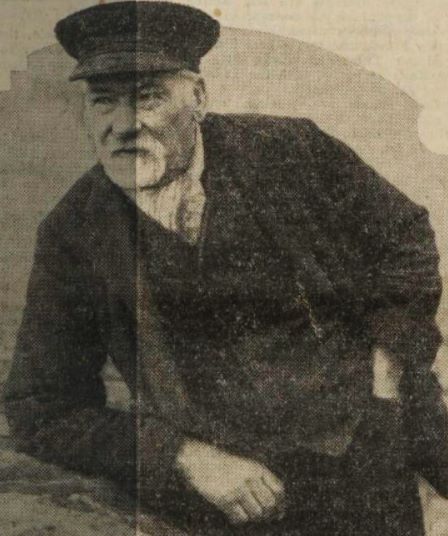
The East Neuk’s Grand Old Man of the Sea By MRS A. R. ROWLANDS

When ye see the May Licht a abune the tap o’ the highest wave ye’re safe to mak’ Anster harbour”  was the storm-lore imparted by an old-time mariner to his son now a well-known Cellardyke skipper.

Nowhere on the coast of the Fifeshire peninsula is there such a dangerous rock bound shore as that washed by the Forth, and lying between Fifeness and Kincraig Point, Elie.

 Hence the reason for one of earliest lifeboats relegated to “The Kingdom” being stationed at Anstruther.

It has fallen to Mr John Jack, James Street, Cellardyke, to have this unique experience of spending eighty three years of life in connection with the district lifeboat ,he has he proudly asserts served on three such boats,  and it is now his sole ambition to assist at the launching of the fourth, the new motor lifeboat which is shortly to supersede the present sailing-vessel.

In 1880 Mr Jack “signed on” as one of the crew of the Admiral Fitzroy. This vessel was succeeded by the Royal Stuart which in turn gave place to the present vessel the James and Mary Walker.

The Launch of the last-named boat was unparalleled in the annals of lifeboat history, for she slipped from her cradle with sails unfurled and billowing in the breeze. Contrary to the expectations and outspoken criticism of the spectators, she took to the water as gracefully as one of our “sea maws.”

Anster’s Four Coxswains

Anstruther’s lifeboats, from their earliest have proudly vaunted their four coxswains who hold simultaneous office. These four concurrent appointments were made so that, though the others might be absent at the various “fishings, one man at least, should be at home to “carry the boat.”

During the winter herring season only were the four coxswains together available for duty. To prevent friction arising during this period, a superintendent coxswain was appointed to take full control of the boat.

A rock-bound coast and lee-shore upon which the south-east wind vents its full and direct fury renders the waygoing of the lifeboat a peculiarly difficult and dangerous venture. Before reaching the open sea, she must accomplish the well-nigh impossible task of crossing the harbour bar, and rounding the point of a pier hidden by clouds of spray.

She must then tack round and approach the distressed vessel from the weather-side, that is with the wind in her favour.

A lifeboat is destined for the preservation, not for the casting away of lives; it is the prerogative therefore of the coxswain to determine whether or not he shall risk the safety of his boat and crew in going to the rescue of a doomed vessel. Should the crew volunteer along with him, then he puts out to sea, and it stands to the honour and credit of the lifeboat crews that no man ever withdraws. It is indeed only after repeated attempts at rescue that any of our lifeboats have ever failed in their objective.

Beating Berwick to it

An example of coxswain and crew’s persistence and daring was given many years ago when a local vessel, the Providence, while making for the home harbour, was caught in a sudden stupendous gale. Disabled by a broken mast, and with her anchor caught on the Isle of May cable, she was cast on the rocks of the Billow Ness, where, buffeted by the breakers, she was in imminent danger of being dashed to pieces.

At half-past one in the morning the James and Mary Walker responded to the warning gun; but so high were the Cellardyke mountainous seas that the harbour bar became an insurmountable barrier. Thrice the lifeboat essayed to reach the open Firth, and her third attempt was almost disastrous, for she was caught the grip of the waves and dashed to the back of the pier.

The report hereafter arose that the North Berwick lifeboat, launched from a weather shore and having in consequence a following wind, was proceeding to the scene.

“Gin the Berwick lifeboat taks aff thae men, it’ll be slur on Cellardyke fishermen a’ their days,” commented a bystander on the pier.

“Wha’ll volunteer along wi’ me, an’ I’ll gang fourth time!” bawled the coxswain above the storm.

In response the crew once more manned the lifeboat. This time she succeeded reaching the stranded vessel; “standing by in case assistance was needed.

The gale, however, somewhat abated its force, and the Providence having rigged a jurv-mast, and having also fortunately cleared her anchor, made Anstruther harbour in safety.

Her encounter with the back o’ the pier cost the James and Mary Walker four holes her hull

“ . . . an’ a Newfun’lan’ Dug “

“It’s gey queer,” commented the old fisherman, “that when the gun roars out its warning call to the lifeboatmen, it’s either the mirkest oor o’ the nicht. or else the tide’s at its lowest ebb.”

It was in the ” wee sma’ oors ” of the morning that the summons came to rescue a steamer cast ashore on the rocks below St Monans’ Kirk. In extreme haste the boat was launched, and sore was her strain against the storm before she drew alongside the trapped vessel.

It was with much gusto that Mr Jack related how, during her hurried launch, the boat caught the side of her carriage and almost ripped off her rudder, ” but,” he finished with evident pride, “they took aff eighteen men an’ a Newfun’lan’ dug. We jaloosed, ye ken, that there wis something wrang wi’ the boat, but we jist keepit her gaun; when we got hame we had look at her, an’— her rudder wis nearly a’ torn awa’.”

Mountainous seas driven by furious gales against a lee-shore; piers and seadykes hidden by the spume and spray of the breakers; handful of weatherbeaten fishermen, and a gallant boat turning a determined bow to the elements, setting out to quest her way amid the tumultuous billows—these are the scenes recalled by an old man’s tales.

Eyes dimmed by eighty-three years’ vigil sparkle once more, and the voice resumes its old-time timbre as the veteran relives past days.

Always Second Cox.

Many speeches of congratulation have been made, and many messages sent to our Grand Old Man of the Sea but none has given him more pleasure than the letter sent by our member for East Fife, Mr J. Henderson Stewart.

“An’ it’s in his ain haund o’ write,” said the recipient as he fondled the cherished missive before handing it over again to the safe keeping of “the wife.”

“But I never was coxswain,” was the conclusion of Mr Jack’s narrative.

“Ay,” he added slyly, nodding at his beaming consort on the opposite side of the hearth, ” I wis aye on the lifeboat, jist the same as I am at hame, second cox.” JOHN JACK

1934

CELLARDYKE FISHERMAN’S DEATH INQUIRY.

A formal verdict was returned at Cupar yesterday in an inquiry into the death of Thomas Anderson, fisherman, 7 Dove Street, Cellardvke, who on 7th February fell overboard from the fishing boat Just Reward in the Firth of Forth, about a mile north of May Island.

It was stated that after Anderson had fallen overboard he was seen in the water 25 yards away, but he disappeared, and, despite the fact that the searchlight was put and a life-belt thrown, there was no trace of the deceased. The vessel searched for about an hour.

DUNDEE OFFICERS HONOURED RESCUES FROM BURNING LINER

Awards from French Government

Awards for gallantry to Dundee, Monifieth, and Cellardyke ship’s officers are announced.

At Liverpool Town Hall this week the Lord Mayor presented diplomas and medals behalf of the French Government to Captains Kershaw and Owens of the Liverpool steamers Mahsud and Contractor, and to officers and members of the crews.

The awards are in recognition of their gallantry in rescuing over 260 persons from the new French liner Georges Phillipar when she was destroyed by fire on 16th May 1932.

Among recipients of the awards are:— Third Officer J. S. Richardson, of the Mahsud, who resides Penninah, Monifieth (diploma and silver medal first class); Mr T. M. Gardner, of 18 Fowler Street,. Cellardyke (diploma and silver medal of” second class);………………….

The Cellardyke Echo – 18/3/2021 – Issue -278

1860

ESTIMATES WANTED, FOR ERECTING a CHAPEL and VESTRY at East Green, according to Plans and Specifications which will be shewn James Fowler, Cellardyke ; by whom Offers will be received to the 20th inst. Information will also be furnished by Mr J. Hall, Architect, St Andrews. Anstruther.

The next article appeared in Local Papers, The Scotsman and this version was extracted from “The Star of Gwent” Cellardyke hits the news in Wales.

Some excitement is at present occasioned in the small town of Cellardyke, in the East Neuk of Fife, by the breaking out of the revival movement. Meetings are held every night, which are protracted to late hours, and at which all the signs of the revival movement are exhibited. At these meetings there have been various instances of prostration, and wailings and moanings are heard proceeding from the audiences, who assemble in small groups in the various corners of the room, each group engaging separately in devotional exercises, which are in instances conducted by mere boys and girls who have been suddenly “converted.” One or two of the clergymen in Anstruther, the adjoining town, are encouraging the movement; but others are trying to put down all exciting meetings. While an improvement is admitted to have taken place in the habits of a portion of the population by the movement, it has been apparently attended by the same painful effects as have been observed in other quarters. One girl is said to be permanently affected in her mind, and scenes have occurred on the streets which are by no of a creditable character, such as small groups of girls going about the street telling those persons they met that they had “found peace noo,” and ethers singing with great vehemence matches of hymns

A few days later

The Revival Movement. – The religious awakening in this place, which we noticed last week, still continues, though in a somewhat subdued degree. Meetings still continue to be held every night in every available place, and during the day clergy and some others go through the different houses to impart religious knowledge. The evening meetings are all presided over by some of the ministers, and the greatest caution has been taken to keep down all undue excitement, though we question the policy of the plan adopted at some of the meetings of allowing some of the “new converts,” as they are called, to address the audience and relate their religious experiences. The readiness and zeal with which these individuals step forward to address their fellow sinners is somewhat remarkable, as also the prayers they will offer up in the presence of some hundreds. New-born zeal is always impetuous, however, and we only sincerely hope that the light they confess has been imparted to them will be of abiding nature, and bring forth fruit. It cannot be denied that much good has been done, and there is a great apparent reformation in the lives and conduct of some who formerly held quite different character. Since the movement began, there has been marked increase in the attendance at all the churches, and apparent attention to the teachings of the ministers. Another pleasing feature in it is its catholicity, for in the same meeting were to be found Established. Free, U.P., Baptist, and E.U. ministers and elders, all labouring for the same end, and each in turn taking part in the proceedings. We are sorry to learn, however, that a schism, or rather inclination to inculcate sectarian views and doctrines, has arisen among the clergy themselves, to the grief of those who looked upon the movement favourably. It is a pity that such should be the case, when so much apparent good was beginning to appear. During the first of this week, a great number of strangers have paid the place a visit, to witness for themselves the working of a religious revival; and some of the fishermen themselves have gone as deputations to other towns, far and near, with a view of exciting them to a similar demonstration. One practical proof of the good that has been done, we cannot help relating. A certain man, now in business on his own account, has, since the revival-commenced, paid the employer with whom he learned his trade a visit, and refunded the sum of 30s which he said, he had appropriated in small sums to his own use while an apprentice, and the reason given for this “confession of the conscience” was, that could not now remain a Christian until he had it off his conscience.

1861

The Herring Fishery.— The following letter has been addressed by Mr Methuen to the Secretary of the Board of Fisheries: Leith, 13th March, 1861. Sir, —The illegal destruction of herring fry is as great this morning at Newhaven as usual, since illegal nets have been permitted by the Hon. Board of Fisheries Regulation of 3d Jan., 1861, whereby millions of young herring fry have been, and are being, destroyed. I find it is of no use requesting the members of the hon. Board to go to Newhaven any morning to see the destruction of young herring fry and herrings of all sizes in myriads, this illegal destruction still continues under the cognisance of yourself, the hon. Secretary of the Board, and of your two commanders and forty armed men. With twenty-six officers of the Fishery at your beck, and with all this force, which you keep lying snugly in Granton Harbour, or cruising without orders, instead of enforcing the Acts of Parliament, our valuable fisheries are being destroyed. If you, the appointed secretary and protector of the herring spawn and fry, and seizer of all illegal nets, give liberty to fish contrary to the Acts of Parliament, I ask you and the hon. Board how the fisheries can be expected to produce full-grown herrings to Crown brand at 4d per barrel, to pay your expenditure of about £14,000 per annum? And, the branding system is expected to be self-supporting, by 4d per barrel charged on full-grown herrings, I ask it can be expected to do so when you make regulations to destroy the young herrings (and by this you scatter and disperse all other fish) ? This morning, I am told, an Edinburgh fishmonger has bought all the cod brought into Newhaven at 5s to each. I recollect, when no garvie herring fry fishing was allowed, I cured thousands of cod at 3d and 4d each, caught between Burntisland and Kincardine, on which ground not a cod is now to be got; and at the great cod emporium of Cellardyke, the cod fishing, instead of three score for a boat’s fishing, has dwindled down to about half a dozen cod; and as to haddocks, your permissive destruction has driven the haddocks from their usual haunts —insomuch that the patience of the fishermen from Berwick-on-Tweed to Caithness put to the severest test by poverty and want that ever existed (exclusive of the towns in the Forth, who are benefited by illegal fishing, and the large herrings also having been driven from their usual haunts.) I do not wonder at your being still to learn, as it appears— by your going in the cutter trawling for herring spawn, instead of seizing Illegal nets, by which myriads of young herrings have been daily destroyed under your very eyes—you have forgot the lesson you ought to have learned years ago, by trawling spawn off Ballantrae ; so that you seem never to have got practical knowledge of our fisheries. We have the highest authority for stating that any house thus divided against itself cannot stand, I am, &c., James Methuen. Hon. B. F. Primrose, Secretary, Board of Fisheries, Edinburgh,

1862

On the evening of Saturday last a concert of vocal and instrumental music, under the patronage of the officers of the Third Fifeshire Volunteers, was given in the Infant Schoolroom, Cellardyke, by the brass band of that corps and other local amateurs. Shortly before the proceedings commenced the band promenaded the town, playing a number of lively airs, which excited quite a sensation, and added in no small measure to the interest of the occasion. The programme consisted of a judicious selection of humorous and sentimental songs and popular tunes of the day; and its several pieces were given with much taste and spirit, and appeared to be very gratifying to the very numerous auditory, which, of course, was mostly composed of the seafaring portion of the community. It were invidious to particularise where all were entitled to the warmest commendation, both on account of the disinterestedness of the performers and the excellence of their performance. We may mention, however, that the duet of ” Row well, my boatie,” by the Messrs Williamson, was received with marked favour, and encored. Several songs Messrs Hay, Thomson, and Bertie, were also greeted with hearty approbation.

1863

On Friday last week, Cellardyke boat landed here a shark, which they had caught on their great line. It measured nine and a-half feet in length, and was nearly five feet in girth. It was purchased by Mr Todd, fishcurer, for 10s—being only valuable for its liver. On the previous day, another Cellardyke boat captured one much larger. It also had become entangled in the lines, and was brought to the surface of the water and secured with considerable difficulty. The crew, however, were unable to take it on board of their boat; and after extracting two basketfuls of the liver, the carcase was abandoned. They were both of the blue species, rarely found in the Firth; but which, at the distant fishing ground now resorted to by our boats are not unfrequently met with.

1864

As one of the Cellardyke boats, of which Mr George Barclay is skipper, was prosecuting the great line fishing last week, large shark of the blue species was captured on the hooks. With some difficulty the “scourge of the seas” was taken on board the boat and landed our harbour on Saturday last, when it excited very general curiosity. It measured 9 feet inches in extreme length, and weighed 5 ½  cwts. The fishermen received 15s for it from Thomas Cormack, fish-curer, Cellardyke, who purchased it for the liver, which yields oil of considerable value.

1865

James Christie, carter, from Cellardyke, was charged with having, on the 10th February, assaulted Andrew Anderson, flesher, near Anstruther Easter, with a walking stick, to the effusion of his blood, and serious injury his person. The accused pled not guilty, but after proof had been led he was found guilty, and sentenced to pay a fine of 30s, or prison for twenty days.

Cheap Loaves.—An extraordinary spirit of competition present exists amongst the bakers here and Cellardyke, in consequence of which the fine 4lb. loaf was reduced Wednesday week from 5d to 4½d, and the following day from the latter rate to 4d. We understand the object of the party who was the first to move in the matter, is to suppress the retail trade, and bring the baker into direct connection with the consumer of his bread. With the lowest quotations of flour at 31s 6d per sack, it is not, however, to be presumed that the public will long enjoy the benefit with which they are in the meantime being privileged.

The Anstruther Harbour Commissioners Clerk reported that Lieutenant Bainbridge, of the Coastguard, had had an interview with the Cellardyke fishermen in reference to procuring a life-preserving or Manby’s Apparatus at this harbour, but that the Board of Trade, in answer to their application, had intimated that, these apparatuses being supplied at Elie, Fifeness, and St Andrews, they deemed the supply sufficient for the coast. The Lieutenant advised the fishermen keep on board their boats a sufficient number of life buoys and cork jackets, as being most serviceable in cases of danger, and being more use them than Manby’s rockets, which, in the case of fishing boats, might turn out lather disadvantageous than otherwise to them. The fishermen appeared concur the recommendations made them.

1866

FIFE. IN CONSEQUENCE of the Short Hour Movement, and the rise in Journeymen’s Wages, the Master Tailors of Elie, Monance, Pittenweem, Anstruther, and Cellardyke, have agreed to Raise and Equalise the Price of Garments they make up from ten to twelve per cent., on and after the First Day of March, 1866.

WANTED, a few JOURNEYMEN SHOEMAKERS to Rivet and do Pegged Work Apply to John Gilchrist Cellardyke, Fife.

TO WOODCUTTERS. WANTED, ESTIMATES for Cutting Down and Dressing a few Acres of Wood at Lochty in the Parish of Carnbee. Fifeshire. The Wood may be seen on Monday, April 2nd, on application to Mr David Gibb, Farmer, Over- Carnbee; and Offers must be sent in not later than Friday, April 6th, to Thomas Cormack, Anstruther. Cellardyke Saw Mills,

1867

At Burgh Criminal Court held here on Monday—Provost Todd and Bailie Brown on the bench -James Gardiner, boat skipper, Cellardyke, was charged with having caused, along with Michael Trainer, an Irish labourer, and James Dick, fisherman, Cellardyke, disturbance in Mrs Forrester’s inn on the evening of Saturday. the 23d ult. The panel pleaded not guilty. When evidence was called for the prosecution, Mrs Forrester, the keeper of the inn, deponed that at the time and place in question, James Gardiner entered her house and caused a disturbance with Trainer, who had been previously sitting perfectly quiet. William Pattie, carter, and John Driver, mason, gave evidence that a brawl had taken place between Trainer and Dick, the former saying that all the Cellardyke fishermen were “rogues;”’ but that Jas. Gardiner no way conducted himself in improper manner. Other two witnesses were called, but they failed to make an appearance. The bench, therefore, held that the indictment was not proved, and the panel was accordingly dismissed from the bar. The result of the trial appeared to give great satisfaction the large audience, as it called forth a general burst of applause, which, of course, was immediately suppressed.

The Late French Fishing Exhibition.—ln compliance with the general invitation which was issued to the fishing interests in this country by the promoters the International Fishery Exhibition Boulogne-sur-Mer in 1866, for specimens of British cured fish, fishing implements, gear, 4c., Messrs .Sharp & Murray, general merchants and manufacturers, Cellardyke, sent thither samples their fishing lines and cotton nets. In the course of the last few days this enterprising local firm have had the satisfaction of receiving an official communication from M. Paillard, the president of the commission, announcing that articles transmitted them to the Exhibition had obtained honourable mention, and at the same time paying handsome compliment to the superior quality and make up both the lines and netting. This flattering recognition and acknowledgment of the excellence of the Cellardyke specimens is the more gratifying from the fact that those specimens were not, as is usually the case, specially made for the Exhibition, but were simply fair average sample of the fishing gear commonly supplied Messrs Sharp & Murray, and which is so deservedly in the highest requisition the leading stations on the east coast.

Daring Cases of Burglary.—On Tuesday morning two places of business in Cellardyke—the one the shop of Mr John Gilchrist, shoemaker, the other being the extensive mercantile premises of Messrs , Sharp & Murray—were discovered have been broken into during the night some party or parties in most daring and deliberate manner. In both cases a similar method was adopted to obtain entrance, from which, with other circumstances, it would appear that the same individuals, or it might be the same gang, had been the perpetrators. Mr Gilchrist’s shop, which contained a large and miscellaneous stock of groceries well as of boots and shoes, is on the middle flat of the building, but is level with the street in front. The burglars, however, had without much difficulty climbed up the windows of an apartment communicating with the shop, when they had obtained an entrance by lifting the under sash, the bolt or fastening of which they had removed by smashing in pane of glass. Once inside the thieves appeared to have made a deliberate survey of the premises, of course, with the view of obtaining money, but fortunately, with the exception of three or four shillings worth of coppers, in the till all the money had been removed when the shop was closed on Monday evening. The burglars, however, were resolved not go away empty handed, for besides emptying the till they also carried of about six pounds of tobacco and three pairs of women’s boots, least so far as Mr Gilchrist or his employees are aware. In breaking the pane of glass one of the thieves would appear to have cut his hand severely, as marks of bloody hand were left on various parts of the shop-fittings and floor. The fact that the shop had been broken into was first discovered about six o’clock in the morning by Peter Campbell, the foreman of Mr Gilchrist’s shoemaking establishment, who gave the earliest notice of the occurrence, for although Mr Gilchrist resides above the shop, on either side of which there are also dwelling houses, nothing whatever was seen or heard of the thieves. One thing however is certain, and that is they must have been familiar with the locale of the premises, for their first attempt to enter the shop was made forcing open the insecure door of a cellar, which communicates with the flat above by trap door, but which they found impossible to open from some casks being piled upon it.

In the case of Messrs Sharp and Murray’s premises the thieves obtained entrance, as we have said, in a precisely similar manner. They likewise showed here familiar knowledge with the neighbourhood, by selecting part the building where they were least likely to be detected. Their point of ingress was one of the west windows of the large southern wing, which runs parallel with the west pier of the harbour, and which they found easy ascent from the roof of adjoining outhouse. To still a greater extent than in the former case the thieves were disappointed in carrying off money booty, for as the door leading to the front shop was firmly fastened up, they were unable to find their way beyond the store. Their attention appears to have been drawn to some bottles of vinegar, which they had no doubt eagerly seized at first, in the belief that they were brandy, but in finding out their true contents they left them behind. Three or more large cheese, however, proved more tempting, and these, with a tin of marmalade, were carried off. The cheese would seem to have been sufficient burthen for the thieves, for after consuming about two pounds of the jelly, they cast the tin away about two hundred yards from Messrs Sharp and Murray’s door. The police constable was communicated with as soon possible both cases, but notwithstanding the most careful inquiries no clue can found as to who are the guilty parties. Indeed, beyond the marks the blood in Mr Gilchrist’s shop, and tracks of heavy boot, with hob nails in the sole, in the neighbouring ground, no other trace would seem to exist of the burglars, except the loss they have occasioned.

1868

Industrial Exhibition – Wick

Fisheries …. Mr Charles Bruce showsthe only samples of oil clothing manufactured in Wick. Messrs J. Ireland & Son, Buekhaven, Fife have forwarded some of their nets for exhibition, and Mr John Martin, Cellardyke, shows a large number of lines, twines and samples of oil clothing

The Board of Trade Barometer.—We understand that an official notification has been received, to the effect that the barometer which was supplied to this place some years ago by the Board of Trade through the Board of Fishery, will be removed soon as the barometer which has been presented to the Cellardyke fishermen by the lady donor of the lifeboat is erected in the gable of the lifeboat-house. The intimation giving the notice of the removal of the barometer states that these instruments are simply given “loans.” and not as gifts, by the Government, and that they fall to be removed as soon any locality in possession of them comes to have another by private donation or otherwise, the object of the authorities in removing the barometer in such case being that it may be fitted in a locality not as yet provided with them, in order that meteorological observations may be as extensive and complete over the coast possible. As this barometer is acknowledged to be one of the best of its class, it is much to be regretted that the locality should lose the benefit of it, and this is more especially the case when it is considered that if a site had been selected for the new barometer accordance with the wishes of its benevolent donor and the feelings of the Cellardyke fishermen, to whom the gift was made, no such unfortunate issue would have taken place. It only remains to be hoped that effort will yet be made by our fishermen to have the barometer placed, in Cellardyke, and so retain the present one in Anstruther.

1869

Registering of Fishing Boats. – During the week the fishermen of Cellardyke have made considerable progress in registering and numbering their fishing boats, as required by the recent order of the Board of Trade. In this novel and therefore embarrassing duty, the fishermen have found a valuable friend in William Gillis, Esq., fishery officer, who has most kindly given his experience and help in filling up the forms required by law. The changes caused by the new system are somewhat curious, as instead of beginning at Buckhaven, as was the case before, the first numbers have been issued for Cellardyke boats, when K.Y. No. 1 is to appear on the boat of Skipper John Gardiner, and where advanced number like 651 is to be replaced by a primary 5. About 100 Cellardyke boats have been already numbered, and we trust that no time will be lost by the fishermen in complying with the order, as no boats in the case of neglect will be allowed to sea after April.

The Cellardyke Echo – 11/03/2021 – Issue 277

1896

CELLARDYKE. ROYAL NAVAL RESERVE.- During the past few months a new arrangement has been made with reference to the enrolment of fishermen and sailors in the Royal Naval Reserve. Before that time, men applying for enrolment were sent by the Registrar of Naval Reserve at Methil to the drill ship, H.M.S. “Durham,” at Leith, but owing to the bad train service ???? was caused and much loss of time entailed on the candidates. Candidates for the Reserve are now sent by the Registrar to the chief officer of H.M. Coastguard at Dysart and the naval agent at that station. There are several vacancies for firemen and 2nd class Reserve men in the Methil district register, and some dozen men have been enrolled from the district within the last three months. Three years’ service at the fishing is required before a fisherman can be enrolled as a 2nd class man. The candidate must be 19 years of age. After two years’ service in the 2nd class a reserve man can get promotion, if sufficiently qualified, to the 1st class. 1st class men get pensions of £12 a year after 15 or 20 years’ service. A fireman must have two years’ service as fireman. He has the same retainer and pension as a 1st class man. The new candidates came from Buckhaven, Anstruther, Elie, Dysart, and Methil. Each year a reserve man has to put in one month’s drill, for which he is well paid. The annual retainer for 1st class men is £6; 2nd class, £3 5s ; fireman, £6. The Methil Reserve District extends from Fife Ness to Buckhaven.

During the height of the carting traffic to the Western Station, the trench for the new drainage system at West Anstruther was the scene of strange accident. A horse belonging Mr A. Blyth, Cellardyke, was being driven past the Port, when it reared and shied, the swerve causing it to fall into the cutting, when it was once strangled, life being extinct before it could be extricated.

Anstruther harbour Commission.

A letter was read from David Doig, Ellice Street, Cellardyke, stating that as a few old men had commenced the line fishing in a yawl fully 30 feet in length, they hoped that the Commissioners would see their way to reduce the dues to 6d. They were paying is the same as the boats. They hoped that something might be done for them in their present circumstances. The Chairman said this yawl might be an exception, but there might be other boats two feet above the 30 and the owners may come and ask for a reduction as well. Mr Cunningham said it was all very well to hold to the letter the law, but it was never the spirit of the law to charge these yawls, for they were yawls the same as a big fishing boat. It was decided to charge this and the Zulu yawl, the Silver Cup, at the rate of 6d, from now until the 1st of October, but that they were not to form a precedent.

St Monance – Launch of Fishing Boat.- On Monday night a first-class fishing boat, built to the order William Stewart & Sons, Cellardyke, was launched from the building yard of James Miller. As the craft left the ways she was named the Unity by a daughter of one of the owners. She is 62 feet long, a splendid model, and is to be fitted up on the newest principle, with steam engine for hauling nets, and will be available for all the branches of the fishing.

1897

To Let- That Shop 60 James Street lately occupied by A Gardyne, rent £5, or said shop with back room upstairs at £7. Entry Whitsunday Apply H.B Mackintosh Solicitors, Anstruther

SCOTTISH DIVORCE CASES. THE CARTER AND THE WIDOW. Lord Kyllachy, the Court of Session to-day, heard evidence in an action for divorce by Margaret Keith or Brown, 3 West Forth Street, Cellardyke, Anstruther, against her husband, Peter Brown, 9 Earl Street, Peterhead. Pursuer (34) reply to Mr A. M. Anderson, said she was married to the defender in 1880. The defender was a carter. Three children had been born. Two years of the married life were passed happily enough, but the defender’s drinking habits got worse and worse. Sometimes he was from home for months. In May, 1884, he went away without saying where he was going, and she had not seen him since. She discovered his address and wrote him, but he never replied. She knew that he was now living with a widow Peterhead as husband and wife. Further evidence having been led, Lord Kyllachy granted of divorce. Custody of the youngest child was given to the pursuer.

1898

On Wednesday last week, Mr Donaldson, baker, Cellardyke, was under the necessity of having his leg amputated above the knee. Dr Black of Anster was the operator, who applied chloroform in the usual way, and the patient was unconscious of pain during the operation.

K. Y. BOOT FACTORY EMPLOYEES SOCIAL AND DANCE. —The second annual social meeting and dance in connection with the above was held on Friday evening, and proved a grand success. Mr Leslie, chairman of the Directors, presided, and was accompanied on the platform by Provost Porter, West Anstruther; Bailie Williamson and Councillors Clark, Cellardyke, and Messrs Smith and Mackintosh. After an excellent tea, purveyed by Mr G. M. Birrell, in splendid style, the chairman, in a short address welcomed to their social, and in the course of his remarks said he believed that the K. Y. Boot Factory had come to stay among them. Provost Porter during the evening also contributed a humorous speech, remarking that the only thing that could beat Cellardyke leather was Cellardyke women. A capital programme was submitted and creditably performed, consisting of songs, dances, part songs, etc., by the following ladies and gentlemen :—Misses Wood, M. Keay, Bella Jack, Hepburn, and Campbell; and Messrs Williamson, Wood, and Watson. Mr Mudie gave an exhibition of Indian Clubs which was highly appreciated. Bailie Williamson and Mrs Williamson kindly favoured the company with songs which were also highly appreciated. The Bailie also made a few remarks. The concert all through was a decided success, and reflected great credit on the management of Mr Mudie and his committee. After the concert a dance was engaged in, Mr Higgins contributing the music, while the duties of M.C. were satisfactorily discharged by Mr Mudie.

ln the Town Hall, Cellardyke, Saturday night Rev. Mr Turnbull, St Monans, deliveied a lecture, illustrated with limelight views, on the fishing ports of Yarmouth and Lowestoft, to which the fishermen go every year. The attendance was good and the lecture heartily appreciated.

CORNER SHOP, 34 James Street, Cellardyke to Let, suitable for any business, with counter and fittings. Apply Alex Keay.

1897

SCOTTISH GIRLS FRIENDLY SOCIETY. LECTURE BY DR WILSON, ANSTRUTHER. On Monday evening, Dr Wilson, Anstruther, delivered a lecture on ” the care of the body,” to the girls, associates, and friends of the Anstruther and Cellardyke branch of the above Society in Cellardyke Forth Street Hall. There was a large audience. Among those present were Mrs Wilson, Elm Lodge, Misses McLaren of Innergellie, Mrs Tosh, St Ayles, Misses Cook, Spence, Finlayson, Rennie, &c. Mrs McVean, the President, presided, and in introducing Dr Wilson, said that she was sure they would all heartily agree with her that it was extremely kind of Dr Wilson to give so much time to them that evening, ant more especially, after a busy day’s work. The best way they could show their appreciation of the Doctor’s lecture was by giving him an attentive and interested hearing. Dr Wilson, who was heartily received, intimated the subject of his lecture, and said there was great need, of women especially, learning a few facts in regard to the principles and theories of the supplying of good clothes, good food, fresh air, and sunshine. Speaking of the latter, he said the benefits of fresh air and sunshine, why these things were essential to life and vitality, were what lie wished to impress on them. He briefly described the lungs. ……………………………. To live we must have fresh air, and in house and closed spaces the air must be periodically renewed, that is to say we must have VENTILATION.

He did not wish to go into figures, but what was aimed at was to give each person in a room 3000 cubic feet per hour. The ventilation of rooms takes place naturally by the chimney, doom and windows. There is a natural draught up every chimney, especially when a tire is on, and the fresh air passes in beneath the door, and in at the chinks of the windows. Although natural ventilation was of use to a certain extent, still they require to open windows to purify the room properly, and as all the bad air rose to the ceiling at first all windows should open at the top. It was a great mistake to shut dampers or close up chimneys in houses even if no fires were used. He feared the majority did not appreciate the advantages of fresh air. In many houses the gas was kept burning all night, and by this means oxygen was used up, and carbonic acid was given off, so that the air was contaminated, and with two, three, or even more people sleeping in the room, and the door never open for perhaps 8 hours, the bad air accumulated and acted as a poison on those asleep. The effects of that bad air were often felt in the morning by a feeling of general debility, furred tongue, nasty taste in the mouth, and headache, and often lead to bloodlessness in girls. In going about his work he often thought what a great improvement it would be if box beds and curtains were done away with. In box beds, especially, if the curtains are drawn ever so little, the unfortunate prisoner was breathing and re-breathing the same air over and over again, and poisoning the system. Another point in regard to box beds was, that when illness overtook one, it was a most difficult matter getting the patient moved about in bed, or the clothes on the bed changed. If only some of the young people would start with good iron beds in their own houses, it would be a vast improvement. In. addition to fresh air, every house should have plenty of which was one of the most necessary things they required. Without it, what would the world be like? Take a flower and hide it away from the sunshine, and it very quickly became white and poor in health. The same thing happened to human beings if deprived of sunshine.

The benefits of sunshine were now so much recognised that patients were ordered sun-baths. They sit out all daylong in the sunshine, and the effects was most wonderful, it caused the white colour to disappear, and the blood to increase in quantity and quality. The sunshine also acted as a destroyer of micro-organisms or germs. The organism of consumption and the tubercle bacillus were destroyed and killed by sunshine. That was why in the cure for consumption they got their patients out into the fresh air, to make them breathe as much pure, fresh sir as they could, and be exposed to sunshine as long as possible. Again when the situation for a house was being chosen the side of the street which obtained most sunshine should be adopted. Do not be afraid to have their blinds up, even though it caused their carpets and curtains to fade. Rather lose the colour of the carpets than the colour of their cheeks- When it could be managed try to have their window open by day as well as by night. A chink from the top did no harm to any one, and it ensured that fresh air was always entering the house. ……………

Proceeding to speak of THE SKIN

He referred to the different glands, and said if they wished to avoid cold, they should keep their skins as dry as possible. If any one went out into the fresh air when they were perspiring freely, say after any exertion, such as washing over a tub with hot water in it, where, in addition to the exertion, there was also a moist atmosphere of steam, the result was that the cold air both made the blood vessels in the skin contract and also caused evaporation to take place, and the temperature of the skin was reduce. The blood from the skin was driven inwards, and if the cold was excessive congestion of internal organs was produced which might pass off, and be only temporary. If the cold was still more excessive, however, the effect was that the blood vessels were unable to contract, and there was a very great loss of heat from the skin, and the heat regulating centre might not be able to keep up a sufficient supply of heat, and the individual consequently took a chill, resulting in bronchitis, inflammation, &c. Then if the head was produced too late they got a condition of feverishness, and they might have to bring on perspiration to reduce the fever.

How could they BEST AVOID AND PREVENT COLDS ? First, by training the skin to withstand cold, and this could be done by being in the open air as much as possible. Secondly by wearing substances next the skin which would both keep in the heat of the body and keep the cold out. Thirdly by wearing substances which would keep the body as dry as possible. The substances which kept them warmest were those which prevented the heat of the body from passing out, that was, they conducted the heat of the body badly. They were in order hare-skin, down, beaver skin, new silk, taffeta, sheep’s wool, cotton wool, and flax from which linen was made. The first one which they could get in abundance was wool, which was made up of a large number of fine fibres of animal material, and between the separate fibres of wool they had a great quantity of air, which being a bad conductor of heat, served to keep the heat in. He was speaking of the body heat. As soon as they put on any flannel material they felt warm almost at once. Why? Because the layer of wool next their skin was rapidly warmed, and the heat of the body was very slowly taken away. Wool differed from linen and cotton in this respect, that these two latter, although they got heated fast enough, carried the heat more rapidly away from the skin, and so the skin remained cold for a much longer time, the linen taking longer to warm. Again, woollen garments had this second advantage over linen and cotton, in that the wool had large numbers of air spaces which absorbed water from the body, if it did not get wet with perspiration, and also if the clothes got wet from the outside the water took longer to penetrate. The same weight of wool absorbed twice the quantity of water the same weight of linen did. What he would impress on all was, that everyone, male or female, young or old, should wear flannel or some woollen material next the skin. Why was it that those who lived in Cellardyke always clothed their men in woollen underclothes? Simply because they knew by experience that they were kept warmest by them. They should take just as good care of themselves. He was afraid a great many of the gentler sex did not wear flannel next their skin. Was it because it might make the figure a little less neat? He was only asking for information, Perhaps the second reason they would give was that of expense. If they carefully watched they would find that flannel would last far longer time than either cotton of linen, particularly than that fraudulent stuff called flanellette. He called it a fraud because the name was meant to deceive as there was not a trace of wool in it. Some people complained that flannel made them uncomfortable, but he thought if only they would persevere the discomfort would soon wear off.

One point more in REGARD TO CLOTHING he should like to refer to. Dark material absorbed more of the sun’s rays than light material. Hence they generally wore dark clothes in winter and light ones in summer- He had said enough on this matter, and be would only ask them who did not wear wool next the skin to seriously consider the matter, as by so doing they might save themselves a great deal of ill health, and save a lot of sorrow to their friends. Mothers should see that their children were all clad with flannel next the skin, as they were far more susceptible to colds than adults. In conclusion, he would say that although all these matters he had spoken of seem very small, still life in the majority of instances was made up of small items, and it was only by attending to these little affairs that they could keep themselves healthy and prolong life.

The Doctor was frequently applauded, and the lecture was illustrated by diagrams and views thrown on a screen by a lantern manipulated by Mr James Leslie. At the close, the President proposed a hearty vote of thanks to Dr Wilson for his most interesting and instructive lecture. She hoped they would carry home the many lessons and facts they had heard, and carry them into practice in their lives. (Applause.)

Dr Wilson acknowledged the compliment, and said he ought rather to thank them for allowing him the pleasure of addressing them, for in so doing he had rubbed up old subjects, and no doubt gained fresh information. (Applause.)

A vote of thanks was passed to Mr Leslie for manipulating the lantern and exhibiting the views. It was announced that there had been a local home baking competition of oat cakes and scones, preparatory to a similar competition for the Perthshire division, of which Anstruther forms a part.

The Cellardyke Echo – 4/3/2021 – Issue 276

1890

Forthcoming entertainments – Rev Mr Mursell delivers his lecture in the Town hall, Anstruther, tonight, the proceeds of which are to be devoted to the funds of the soup kitchens in Anstruther and Cellardyke. Mr Mursell has a long experience as a lecturer, and is one of the most eloquent platform speakers at present before the public. His lecture should be highly attended. The hall is to be heated up for the occasion.

CELLARDYKE FISHERMAN DROWNED. The worst fears as to the gale were borne out by the telegram at 5 p.m. last night to the effect that the young Cellardyke fisherman, Andrew Keay, had been washed overboard from his uncle’s boat, the Eclipse, of Cellardyke, which then tacked into Arbroath. He was the second son of Mr Andrew Keay residing in John Street. He was about six-and-twenty. The Barbara Wood, of Monance, was towed by the Maggie Scott, of Cellardyke, in the course of the evening tide into Anstruther. The close reefed sail was torn into ribbons, so that she was drifting like a log at the mercy of the gale when Skipper Gardiner bore up to the rescue. Boat after boat arrived with the tackle, if at all, like tangled threads, so that the loss of gear is unparalleled the Forth.

A second report with additional detail

LOSS OF A FISHERMAN AT SEA The Kirkcaldy fishing boat No. 2072 John Boyter skipper, took shelter in Arbroath harbour yesterday afternoon, and reported that at three o’clock on the morning, when near the North Carr Lightship, the boat was struck by a heavy sea, and, Andrew Keay one of the crew, was washed overboard. An oar was thrown to him, but he failed to catch it and was drowned. He was twenty-seven years of age, unmarried, and resided in Cellardyke with his parents.

LAUNCH – St Andrews – A new fishing boat was launched from the building yard of Mr Miller at the East Bents on Saturday afternoon, and the event was witnessed by large crowd of fishermen and others. The boat is 60 feet in keel, and has many improvements in construction. The boat belongs to a fisherman at Cellardyke. (Andrew Miller was a brother to Miller’s of St Monans, and ran a yard in St Andrews for a number of years. he later retired to Elie and became Provost)

1891

PROPERTIES IN CELLARDYKE FOR SALE. To be SOLD by Public Roup, within the Tows Hall of Cellardyke, on SATURDAY, the 2sth day of March 1891, at 12 o’clock Noon, in virtue of the powers of Sale contained in Bands and Dispositions in Security THE DWELLING-HOUSE and, SHOPS, and others, Nos. 1,3, and 5 John Street, and DWELLING HOUSES, SHOP, BAKEHOUSE, STABLES, STORAGE, and others on East end of Tolbooth Wynd, and below John Street, Cellardyke, belonging or which belonged to John Gilchrist, Shoe Merchant. Apply to DAVID COOK, Solicitor, Anstruther.

MISSING SHIP – ROMAN EMPIRE.- It is now believed that this ship which left Liverpool on the 29th July last year, his foundered with the loss of all her crew of 32 hands. Among those on board were John Parker, sailmaker, belonging to Cellardyke, whose wife resides there, and William Hutton, sailmaker and B.A., belonging to Crail. Much sympathy is being expressed for their relatives. The ship belonged to Messrs George Duncan & Co., of London.

1892

John o Groats Journal – The Cellardyke fishermen have agreed that close time for summer herring on the East Coast should from 1st May till 1st July, both inclusive.

THE LATE BAILIE SHARP, Cellardyke – Another prominent and well known citizen of the East of Fife district has this week been taken away in the person of Bailie Sharp, Cellardyke. His death occurred with startling suddenness at half past ten o’clock on Tuesday night at his residence, Viewforth House, in West Forth Street. For more than a year he had been troubled with a cancerous growth in his throat. Eminent physicians in Edinburgh were consulted, but they could do little or nothing to stop the deadly canker. Since that time, he has suffered more or less, but it was evident to all his friends for some weeks back that the disease was gaining a firmer hold.

On Tuesday, however, he attended to business as usual, and both in the forenoon and afternoon was down the pier at the sales of fish. In the evening at the hour above mentioned he was suddenly seized by a spasm, and died within a few minutes. His death when it became known on Wednesday morning created a painful impression in the community, and the expressions of regret were general at the loss sustained by the widow and large family, and by the district.

 A native of Cellardyke, Mr Sharp was in the 62nd year of his age. When quite a youth he served an apprenticeship in the Commercial Bank, Anstruther, after which he acted, with much acceptance, as accountant for some years. In the year 1859, Messrs James Fowler & Son, merchants, Cellardyke, retired from business, and in December of that year, Mr Sharp, with his partner, Mr David Murray, St Ayles Crescent, Anstruther, opened the establishment. Under the new firm the business soon increased to such an extent that they were led to engage in fishcuring, and in 1862 to build and open a very considerable net and oilcloth manufactory. Every description of fishing gear was made, and the firm attained one of the foremost places in the seafaring enterprise of the coast. They opened branches to different places in Scotland and in England as the necessities arose, in Aberdeen, Balta, and Yarmouth. Further development was made in opening a branch in Australia, to which they have continued ever since to send consignments of their curing establishments. Mr Sharp’s business capacity was soon recognised, and not long after he started business he was induced to take an interest in the affairs of his native town. The burgh was then disfranchised, and had been in that position since the 20’s. It was managed by managers, and Mr Sharp for some years faithfully discharged the duties of the Treasurer. The burgh restored to its full municipal status in 1868, when the Municipal Burghs Act was passed. At the first election for the Town Council in that year, 19 candidates went to the poll, and showing the respect in which Mr Sharp was held, and the gratitude felt for his past services, he was returned at the top of the poll with 149 votes. When the offices came to be filled, he was pressed to become Provost, but he declined to accede to the wish of his colleagues, and chose rather the post of first Bailie. He has continued in that position ever since, a period of upwards of 23 years. During that time he was frequently asked to fill the civic chair, but be always refused. In the business of the Council he took a prominent part, his shrewd common sense combined with his business tact, and his intimate acquaintance with the town, enabling him to discharge the duties in an efficient manner At addition to his work the Council, he was elected a member of the first School Board in 1872 on the passing of the Education Act. He has remained on the Board ever since, and for the period of three years he acted as the Chairman. Two years ago be was elected the representative of the Board to the Waid Governors, but his illness prevented him from attending the meetings as often he desired. Shortly after the passing of the Anstruther Union Harbour Act in 1860, Ballie Sharp was elected as one of representatives of Kilrenny to the Harbour Commission. He took a keen interest in all questions relating to the fishing industry, and he very frequently brought up matters to improve the harbour, and afford better accommodation to the fishermen. He has continued a member of the Commission until now, he was also the representative of Kilrenny to Fife County Council. In these and in many other ways, the Bailie did his best to serve the community. He invariably found time to attend the meetings of the different bodies with which he was connected notwithstanding the heavy claims of his large business. His example in this respect should be a good incentive to others to show their interest in the public work of the localities in which they reside.

In politics, Mr Sharp was a lifelong Liberal. He was a strong supporter of the late Mr Ellice, during his long connection with the burghs, and he motioned to give the some strenuous assistance to Mr Williamson, when he was elected in 1880. In religion, Mr Sharp wen a dissenter, sad regularly attended the Baptist Church. Throughout the whole district, Mr Sharp was a general favourite, and had a frank and genial disposition which made him very popular with all classes.

The funeral is to be on Saturday to Kilrenny Churchyard, when doubtless very many will turn out to pay the last tribute of respect to one who was so deservedly respected in the East of Fife.

Boys Brigade – On Sunday afternoon the Cellardyke Boys’ Brigade, to this number upwards of 100, met at their Drill Hall and marched to Cellardyke Church. The Rev. Mr Roy officiated, and preached an appropriate discourse the boys. Large crowds of people witnessed the march to and from the church. The officers present were Captain G Black, Lieutenant J. Watson, Thomson, and A. Black, Piper Jamieson, and Drill-Instructor Trainer,

Saturday night Disturbance.- At Cellardyke Burgh Court on Monday three fishermen and two bakers from Colinsburgh were charged with creating a disturbance in Tollbooth Wynd on Saturday night. The two bakers pled guilty, and said they were walking along the street when the three fishermen attacked them without any provocation. The fishermen ware convicted on the evidence, and were fined 10s each, or seven days, and the bakers 7s 6d each.

1893

 The crew of the Anster Fair have received £5 from the Boat Insurance Company for towing the Cellardyke boat Gratitude into the harbour a fortnight ago during the heavy gale.

Banffshire advertiser – THE fishermen of Cellardyke, Fifeshire, have resolved, by a large majority, that the close time for the summer herring fishing on the east coast should last from the 1st of June to the 10th of July, the close time to include not only the binding but the curing of herring.

1894

A GOLDEN WEDDING.—The Golden Wedding of Mr and Mrs Wm. Watson (Rodger), 22 George Street, was celebrated on Friday last, when they were presented with tokens of friendship sent by friends at home and at it distance. The family includes-1 son, 3 daughters, 13 grandchildren, and 2 great grandchildren.

St Andrews – The Storm – A strong gale rose early on Thursday morning from the south by south west, and in consequence the herring fishing fleet from Cellardyke were obliged to make for the harbour for shelter. After repeated tacking,” they were unable to weather Fife Ness, but ultimately arrived safely here. There were about thirty boats altogether. A considerable number of the crews having shot their nets, they continued riding there in spite of the storm. The cold on Thursday was intense.

Cellardyke School – The number on roll was 230, and the averages wore 203, 203, and 204. At the Infant, 250 were on the roll, with the average 187, 160, and 171.

Two applications were received for the female assistantship in Cellardyke School, and it was resolved to appoint Miss McGillivray, Arbroath, and to telegraph asking when she could enter on her duties, It mentioned that many of the slates on the roof of Cellardyke School had been blown off, and it was agreed to ask a practical man to examine and report. Complaint was made of the boys playing football in the playground, and the clerk was instructed to issue handbills warning parties that they would be prosecuted if they persisted in the future.

The Cellardyke Echo – 25/2/2021 – Issue 275

1866

Early Saturday morning, one of the boats belonging Cellardyke was returning from the fishing, through some strange mischance she went ashore among the rocks between Anstruther and Cellardyke, and in a few hours became a total wreck. The statements of the circumstances connected with the case seem to be of a somewhat conflicting character; but the one which receives most credence is that between one and two o’clock in the morning question, whilst the crew were asleep, the man at the helm had occasion to enter the sleeping berth, and being benumbed and stupefied by the cold, he fell asleep by the fire. The boat held her course until the crew were only awakened by the dashing of the boat among the rocks, and the rushing in of the water through a hole which was quickly driven in her bottom. Seeing that to save the boat would be impossible, the men used their best endeavours to save their lives, which happily they were successful.

Another report of the same incident

About midnight on Friday the inhabitants in the neighbourhood of Urquhart Wynd, Cellardyke, were alarmed loud cries from the shore, as if some sailors or fishermen were in urgent distress. This was soon ascertained to be the case, for the night being clear and starry, large fishing boat was observed tossing amongst the rugged rocks about a hundred yards from the land. A crowd speedily assembled, but these were principally women—the fishermen not having yet arrived home—no assistance could be rendered by the helpless and agitated spectators, who could only look on in inexpressible suspense on the jeopardy of the wrecked crew. The anxiety of the people on shore, however, was at length relieved by seeing the men, six in number, suspend a mast between the boat and a high rock, to which by this means they with some difficulty clambered in safety. In the meantime a boat had been launched from Cellardyke harbour and endeavoured to reach the rock, but failed to do so from the heavy surf which was breaking on the strand- A large boat, however, manned by Sir William Muir and his crew, arrived from Anstruther, and undeterred by the peril of the attempt, gallantly succeeded in taking the men off the ledge, from which they must soon have been swept the fast rising tide. The unfortunate boat proved to be the Helen of Cellardyke, owned by the skipper, Thomas Ritchie. The circumstances under which the accident occurred are of somewhat singular nature, and may be briefly stated as follows: The boat had returned from the fishing ground before Anstruther harbour could be entered from the low state of the tide, and until this could be done she was hove to in the offing of the Billowness. The night being fine and no danger anticipated, the crew retired to the cabin, where, weary and cold from the labour and exposure of the night, they all fell asleep. A terrible waking, however, was soon before them. The wind, which had been blowing from the northeast, veered suddenly round to the westward, and this influence with the action of the current, had the effect of driving the unheeded boat upon the shore at the time in the place we have just narrated. The crash of the timbers and the rush of water into their boat were the first signals the sleeping crew received of their danger. Their preservation was due to a higher agency than that of man, for had the mishap occurred on shelving rock few yards the westward their escape could barely have been possible. Soon after being abandoned, the boat went to pieces; but the greater part of the tackling and fishing gear, including the nets, were recovered, although a very damaged state. The boat, which was only about three years old, was in excellent condition, and their loss cannot be estimated at much less than one hundred pounds. ( In May of 1865 a boat also called the Helen, Skipper Henry Bett was lost with all hands)

1867

Witty and Cutting

The other night two young men belonging Pittenweem, who would appear, as the phrenologists say, to have an undue development of number ten or self-esteem, visited Cellardyke, where they attempted to- make bit of a sensation by imitating, like monkeys, the practices and pranks of our neighbours on the south side of the Tweed. Each of them was provided with a huge false beard and whiskers, and under the cover of this disguise they “bounced and flourished” most amazingly, or rather most amusingly, for the good folks of Cellardyke were not long in taking the true measure of the vapouring fools, who thus were the cause of many laugh by their strutting and nonsense. In the course of their walk through the streets they passed a doorway in which several young women were standing; obviously to attract their notice, the fops redoubled their antics, when one the girls called to a friend on the other side the way “Ay, Jean, they’re worth looking at; it’s no often that the sheep’s heids an goat chins are to be seen on the same body. The remark which was made very audibly, had all the effect of a cold bath on the feverish self-conceit of the party, who forthwith bolted out of sight to avoid the merry peals laughter which followed the racy hit the sharp witted Dyker damsel.

Desirable opening – HOUSE, SHOP, GARDEN, AND OILING PREMISES TO BE LET. The heirs of the late Mr John Nicol spirit Denier, and OIL-Cloth Manufacturer. Cellardyke, by Anstruther, being desirous of retiring from the business in that district, in that offer to Let for a period of years as may be agreed on, the House, Shop and Fittings, Oiling Premises, Garden, with the goodwill of business, occupied them. The Business has been carried on successfully for upwards of Twenty Years. Entry immediately offers to lodged with Mrs Nicol, Cellardyke on or before 8th March ensuing.

1868

We also hear of several new dwelling houses that will probably be in progress in the locality—particularly a fine villa residence which will be erected the west end of Cellardyke by George Sharp, Esq. In Cellardyke, we may here notice range four commodious self-contained houses, suitable for fishermen, have been added the new street now almost completed between the Bog Causeway road and the female school.

ANNUAL CLEARING SALE OF DRAPERY GOODS.

Peter Thomson, GENERAL DRAPER. CELLARDYKE, BEGS announce that his ANNUAL SALE Commenced Wednesday 29th January, and will  be

CONTINUED FOR THREE WEEKS,

When, in addition to the present large and well-selected STOCK, which will be submitted at GREATLY REDUCED PRICES. he would call particular attention to the following Special Lots of Goods which, owing to the great depression of trade in the manufacturing districts, has been bought at prices greatly below the original cost:—

Lot First-WINCEYS.

Plain WINCEYS, variety of Shades, 7d per Yard, worth 10d.

ABERDEEN WINCEYS, in variety of shades, 9 ½ d and 11d, worth 1s 4d and 1s 6d.

Lot Second -FRENCH MERINOS.

FRENCH MERINOS, in all Shades, 1s 4d, 1s 6d, 1s 10d, and 2s 2d, worth 1s 7d, 2s, 2s 6d 3s.

Lot Third.- BLUE PILOTS.

Best INDIGO (Twilled) PILOTS, 10s, and 11s 6d, worth 12s 6d and 14s.

Lot Fourth.- SHEETINGS.

LINEN SHEETINGS, 7s and 9s 6d, worth 9s and 12s. Home Made.

COTTON SHEETINGS, 2s 11d per Pair, worth 4s.

Lot Fifth. – FLANNELS.

400 Yards of 4-4 WHITE WELSH FLANNEL, ls 6d and 1s 8d, worth 1s 9 ½  d and 2s.

Lot Sixth.—MUFFLERS.

A great variety of MEN’S MUFFLERS, 1s 4d, worth 2s

P. THOMSON would also call attention to his superior Stock of SCOTCH BLANKETS, now reduced to 9s formerly  11s 6d ; 13s, formerly 16s 6d ; 16s, formerly 18s 6d

 AN EARLY CALL RESPECTULLY INVITED- Cellardyke, February, 1868.

SHARP & MURRAY, general merchants, Cellardyke, WILL CONTINUE THE CHEAP sale OF THEIR GENERAL stock of drapery goods, FOR ANOTHER WEEK greatly reduced prices,  Cellardyke, February, 1868

1869

Sloop Ashore. – About ten o’clock on Thursday morning considerable excitement was caused here by a small sloop, which was afterwards ascertained to be the Maggie Lauder, of Kirkcaldy, having been seen in dangerous proximity to the Billowness rocks. As it was less than two hours’ flood, and consequently a very insufficient depth of water in the harbour, and the strong wind also at the time blowing little short of a gale from the south-west, great anxiety was felt for the safety of the vessel, and this feeling at once prompted the launching of the lifeboat, which was soon manned and in readiness for the humane service, skipper Thomas Birrell, of Cellardyke, being the coxswain on the occasion. In the meantime the vessel had grounded in the fairway about hundred yards from the pier head, and the steamer’s skiff with two men on board had gone to her assistance shortly before the lifeboat came alongside, which, with the skiff, did good service in running out ropes, in order to prevent the stranded vessel from drifting to leeward of the harbour. As the tide made she was gradually drawn into the harbour, apparently but little the worse of her mishap, although being an old vessel she must have been considerably strained while beating on the strand. The Maggie Lauder was bound to Anstruther with causeway stones for the new pier from Carlins Nose, and had sprung a leak, which had induced the master, with the knowledge that there was little water at the time, to run for the harbour.

On Friday afternoon, while the fleet was leaving for the fishing. ground, and as sail was being hoisted the Cellardyke boat owned by skipper Leslie Brown, which had little more than cleared the harbour, she was run into by the steam-lighter Hemaja, employed at the new harbour works. The sharp iron prow of the steamer cut through the gunwale and several planks of the boat, which compelled the crew put back to the harbour, and so lose their fishing for the night. That the vessel was in the fault may be inferred from the fact that the carpenters employed at the new harbour were set to work next day to repair the damage sustained by the boat, but we hear that the claim for compensation for the loss of the night’s fishing, to which the crew consider they have right, is not yet arranged.

The Cellardyke Echo – 18/2/2021 – Issue 274

1861

ANSTRUTHER. HARBOUR. The unhappy difference between the Harbour Commissioners and the Cellardyke fishermen, instead of being smoothed down by time and experience, seems to be assuming a more decided attitude with every new phase into which the question enters. For the purpose (as alleged) of presenting as good a revenue as possible, in the prospect of applying for money to proceed with the works, the commissioners have exacted the highest rate of anchorage from fishing-boats, while (with doubtful consistency) they have reduced the rate on all other vessels; and thus, in effect, changing the proportion between boats and other vessels which the Legislature fixed. The fishermen cannot escape from the exaction; and, therefore, it has been paid, with one or two exceptions. But the dues of one penny per barrel on fish unshipped cannot be so easily brought home to them, with apparently the best intentions to do so. They refuse liability on the ground that the fish belong to the purchaser when landed; and. having reported who the purchaser is, they hold themselves free. The fishcurers, who are generally the purchasers before being unshipped, seem equally desirous to evade the impost, and between the two the enforcers of the law are not a little tantalised as to how and where to obtain their dues. A case was brought before the Sheriff last week, which it was hoped would decide the point between these two parties. The pursuers were furnished with ample evidence against the fishermen, but had concluded evidence unnecessary against the curer -(himself a Commissioner too!) — when the case was heard. The curer very adroitly admitted nothing, and the case fell to the ground for want of evidence.

Pittenweem –

The high rates at Anstruther are acting beneficially toward this place, there being a greater number than ordinary of stranger fishermen frequenting the harbour. Among the rest, we observe Cellardyke has furnished its quota. The moderate scale of rates chargeable here, has acted so powerfully upon the Cellardyke fishermen that, we understand, they have been making enquiry after lodgings, for the Lammas drave. If our present harbour is thus drawing fishermen from Cellardyke, we may expect, when the proposed harbour improvement is completed, that they will give the pauper harbour a wide berth, when they can get ample accommodation, combined with moderate rates, in the ‘ good old burgh of Pittenweem.’

Leslie Brown Wilson and Thomas Cormack, fishcurer, Cellardyke, were placed the bar charged by. Mackintosh with contravening said Acts of Parliament so far as the boat “Sivan” having entered Anstruther Union Harbour on the morning of 19th January last, there were, on that same day, and between the hours of seven A.M. and two P.M., unshipped from the said boat, within the limits of the said harbour one cran and one halfcran, or thereby, of fresh herrings, less or more, being the cargo or part of the cargo of said boat, and which cran and one half-cran of herring were delivered then and there to the said Thomas Cormack, who took delivery thereof, and removed them from the premises of the Commissioners of the said harbour, ………….  Wilson nor the said Thomas Cormack did make payment of the rates payable the Commissioners of the said harbour in respect of the said herrings, and both of the said Leslie Brown Wilson and Thomas Cormack had since refused to pay the said rates, which rates amounted to one penny and one half-penny, less or more, and thereby they, one or other of them did evade the payment of the said rates,

1862

Alexander Wood, a fisherman, residing in Cellardyke, was charged with having, on the 11th instant, been guilty of a breach of the peace and assault. The panel pled guilty to breach of the peace only, which plea having been accepted by the Procurators, Wood was sentenced to pay a fine of 255, with the alternative of twenty days’ imprisonment.

1864

Narrow Escape of a fishing boat and crew

On Saturday afternoon during the height of the sever gale from WSW which then prevailed, a large fishing boat which belongs to St Monance of which Mr James Innes is skipper and owner, in attempting to enter this harbour for shelter, struck amongst the rocks a little to the westward of the Fairway – there being at the time only about two hours of flood tide. Fortunately, the movements of the boat had been previously watched with great interest by many of the fishermen, and no sooner did she come contact with the shore than, with characteristic activity, they hastened to her assistance. Two yawls were quickly launched and manned with gallant fellows, by whose efficient help the imperilled crew lightened their boat, by throwing overboard the ballast; after which, by means of strong new ropes (which were kindly furnished by Messrs Sharp & Murray) and hundreds of willing hands, she was soon drawn beyond the threatening waves, and placed in safety upon the beach above high water mark. The boat, which is nearly new, has been very much damaged, and it is estimated that over £20 will be required to complete the necessary repairs. For their prompt and active conduct on this occasion, the Cellardyke fishermen deserve the warmest praise—and to this also the women are well entitled; as, instead of remaining idle spectators, or yielding themselves up to fear and excitement, they seemed eager to do what they could, and. pulling on the ropes, materially helped the efforts of the men.

The fishermen of St Monance have, on many former occasions, been indebted to their neighbours in Cellardyke for kind assistance and hospitality in similar circumstances. We are happy to find that what has thus often been so finely given has not been ungratefully received, and that a friendly spirit and intercourse obtain between the two communities, confirmed by the experience of much mutual kindness, and cemented by frequent intermarriages.  

A Cellardyke crew picked up. about two miles to the eastward of the Isle of May. a life-buoy, painted white, with the name ” Meltia” of Glasgow marked on black letters.

1865

NARROW ESCAPE PROM DROWNING. —On Wednesday forenoon, while a young boy of about seven years of age, son of Mr David Boyter, fisherman, was amusing himself among the rocks ‘ nearly opposite the Town Hall, he fell into the deep water beyond his depth, and was carried and tossed greatly about by the action of the water for about twenty minutes. His perilous condition was fortunately noticed by some neighbours, who immediately got a small yawl manned, and, alter some difficulty, they got him landed in an apparently lifeless state. Dr MacArthur, who fortunately happened to be in the neighbourhood, went immediately to the sufferer’s assistance, along with Dr Jamieson, who used every means in their power to restore animation, and we are glad to say that, after some time had elapsed their efforts were crowned with success. The ‘boy is now fast recovering.

Meeting of Fishermen.-  On Friday evening last, a meeting of the fishermen of Cellardyke was convened by the town crier, and held in the Female School there. Nearly all the fishermen attended, and Mr Alexander Tarvit was elected to the chair, on taking which he stated that the meeting had been called to consider the advisability of having a suitable boat or coble stationed at Anstruther harbour to be ready for use in the event of any emergency. All present appeared to concur in the desirableness of the project, and it was all but unanimously agreed that the sum of 2s should be weekly contributed by each boat now prosecuting the herring fishing, the sum being continued for three weeks, when a total sum of about £18 would be collected — the estimate expense of the boat. A committee was appointed to meet with the Commissioners of the Union Harbour as to the obtaining of a proper place to deposit the boat when not required, and also to solicit them to use their best exertions to have a Manby Apparatus Station at Anstruther —a suggestion which, by the way, we earnestly urged a few weeks ago. In the course of the proceedings, the present by no means unreasonable dissatisfaction of the fishermen, was manifested at the ruinous state of the Anstruther Harbour works. The business then terminated with a vote of thanks to the Chairman. We cannot conclude this notice without expressing our sincere admiration of the praiseworthy spirit of self- help which on this, as indeed on all other occasions, so eminently distinguishes our fishermen; and ‘we earnestly hope that their exemplary conduct will be appreciated as it ought to be by the Union and Harbour Commissioners, and that every encouragement and support will be afforded for the successful carrying out of these most desirable schemes.

The Harbour Commissioners Clerk stated that he had been waited upon by a deputation from the Cellardyke fishermen regarding a site for a wooden house for a coble 29 feet long and 9 feet broad, to be used in eases of emergency; and also that the Commission should use their influence to have a rocket apparatus stationed at Anstruther. The Board unanimously agreed to grant a site at the road leading from the Forth, and contiguous to the back of the East Pier; and the Clerk was instructed to communicate with Lieutenant Bainbridge, R. N., Elie, in order that an application might be lodged in due form with the Board of Trade.

The Cellardyke Echo – 11/2/2021 – Issue 273

1925

OILSKIN FACTORY IN CELLARDYKE – FOR SALE. There will be re-exposed for sale by Public roup. within the Town Hall , Cellardyke , on Wednesday , 11th  February , at 2 pm ., those Extensive PREMISES in JAMES STREET , CELLARDYKE long occupied by Alex . Black & Co. as a NET AND OILSKIN FACTORY , including Drying Floors, Store Rooms, Sewing and Cutting Rooms, Sale Shop, Office, Bootmaker ‘ s Shop, Boiler , Engine. Sewing Machines, &c. Immediate Occupation. REDUCED UPSET PRICE £350. Feu-duty nominal. For further particulars, apply to GUTHRIE & MAXWELL. Solicitors. Anstruther.

John Clark, motor engineer, Cellardyke, admitted having no lights on his motor car, and Mr Ian W. Mclnnes, W.S., Cupar, on his behalf, said he had gone with some people to a dance at Pittenweem. His accumulators were running low, and he switched off the lights when he turned the car into a side street. The police informed him that, the parking place was at the next street, he was fined 10s.

1926

BLAZE IN KILRENNY SHOP.

Tenants Burning Injuries. –

Fire broke out in the premises of Mr William Crease, confectioner, Kilrenny, last night.

The outbreak is supposed to have been caused by an explosion of the carbide plant which Mr Crease installed to supply light to his shop and house.

The village was agog with excitement when the alarm was given, and numerous helpers with pails of water succeeded in quelling the conflagration, the services of the joint fire brigade of Anstruther and Cellardyke being unnecessary.

Mr Crease, who belongs to Crail, was badly injured and was brought to Anstruther suffering from a burnt wrist and a badly scorched face. He was attended to by Dr Wilson. Anstruther, and was later able to proceed home. The stock the front shop is ruined. It was only two years ago that the same building was practically gutted by fire.

DANCE MERRIMENT AT CELLARDYKE.

Badminton Club’s Jovial Gathering.

Over 50 couples accepted the invitation to Cellardyke Badminton Club dance, which was held in the Town Hall, Cellardyke, last night.

With pretty decorations enhanced by electric bulbs a fine effect was obtained. Music was provided by the Olympia Palais de Danse Band, Kirkcaldy, and members of the committee acted as M.C.s.

1927

 Dysart Town Council

WATERPROOFS FOR TOWN EMPLOYEES.

The Council approved minute of the Streets Committee authorising the Burgh Surveyor accept the offer of Martin, Cellardyke, to supply the town employees with six oilproof suits, and one oilproof jacket, at the price of 17s 7d per suit.

Cupar Sheriff  Court

For having carried eleven passengers in excess of the number which his vehicle was constructed to carry, James Stevenson, bus driver, 25 James Street, Cellardyke, was fined £1.

1928

The silver cross of the Imperial Scout Headquarters was presented to Scout Philip Anderson, 56 John Street, Cellardyke, in the Drill Hal. The entire troop of the 1st Anstruther Scouts was on parade, and Bailie W. M. Carstairs presided, and Major Lumsden Tarvit made the presentation. Scout Anderson last summer at the Craigs at Cellardyke rescued a small boy from drowning.

CROWN SALMON FISHINGS-TO LET

THE COMMISSIONERS OF CROWN LANDS are prepared to receive TENDERS for a LEASE of the SALMON FISHINGS in the Sea extending, from the Pier at the southern end of Cellardyke Harbour in the Parish of Kilrenny to Fifeness in the Parish of Crail in the Firth of Forth in the County of Fife , Particulars and Forms of Tender may be obtained on application to the SECRETARY, OFFICE OF COMMISSIONERS OF CROWN LANDS. 1 WHITEHALL, LONDON SW1, tenders to be received no later than 15th March 1928

1929

Property for Salle. FIFESHIRE. ANSTRUTHER.— For Sale, by Private Bargain, that Highly Desirable DWELLING HOUSE known “BRACKNESS,” Lady Walk, Anstruther, belonging to Mr Robert Watson, Manufacturer, Cellardyke, consisting Two Public Rooms, Four Bedrooms, Maid’s Room, Bathroom (H. and C.), and all Modern Conveniences- Garden back and front, also Garage. Annual Value. £33. Feu-Duty, £3. Casualties Redeemed. Early Entry.

For further particulars and Cards to View apply to the Subscribers, with whom Offers may be lodged or before 20th February. MACKINTOSH & WATSON, Solicitors. National Bank Buildings. Anstruther, 5th February, 1929

OFFICIAL NOTICE. PROPOSAL TO CHANGE A SHIP’S NAME. , We – JOHN MUIR Cellardyke and WILLIAM CUMMINGS WILSON Whitley Bay-HEREBY GIVE NOTICE. That in consequence unsuitability have applied to the Board Trade, under Section the Merchant Shipping Act, 1894. In respect of our ship CRAIGHALL. of Kirkcaldy, Official Number 145547, Gross Tonnage 95.4, Register Tonnage 39.44, heretofore owned by Samuel Chapman, Senior; Samuel Chapman, Junior; Frederick Chapman, and Benjamin Chapman. Fish Docks. Grimsby, for permission to change her name to “SPES AUREA,” to be registered in the said new name at the Port Kirkcaldy as owned by John Muir and William Wilson. Any objections to the proposed change sent to the REGISTRAR-GENERAL OF SHIPPING AND SEAMEN, Tower Hill, E.1, within Seven Days from the appearance this advertisement. Dated at Anstruther this Fourteenth Day February, 1929. JOHN MUIR. WILLIAM CUMMINGS WILSON. – the boat was registered KY45

The Cellardyke Echo – 4/2/2021 – Issue 272

1920

In connection with the proposed war memorial for the parish of Kilrenny it desired to have a complete list of those connected with the parish who fell in the war. Particulars from relatives are being received by Mr William W. Carstairs, Cellardyke, on behalf of the committee.

1921

HERRING FISHING. ANSTRUTHER. Wednesday.-About forty boats averaged 15 crans. Highest shots:- White Heather (Cellardyke), 50 crans: Ebenezer (A.H.), 40 crans; and number with 30 each Price fell to-day, the cran selling at 35s.  (only two days before a Cellardyke boat the Cellardyke boat got 90s per cran, but a crisis in the herring industry had been building since they lost the german and Russian markets after the war, nationally catching capacity was estimated to be so high that some in the industry were suggesting halfing the fleet.)

1923

 The annual collection taken in Cellardyke and Kilrenny on behalf of the Sick Children’s Hospital, Edinburgh, amounted to £25 6s 6d a decrease compared to last year of 10s 6d. The collectors were Misses M Carstairs, L Bett, C Smith and E Gardner.

SONG AND STORY AT KINGSBARNS W.R.I. A lecture on Burns was given Mr Frazer, St Andrews, to Kingsbarns W.R.I. Recitations and songs were contributed by Mr Evans Johnstone, Mr T. Reid, and Miss Bett, Cellardyke. Mrs Laurence was accompanist.

CRAIL CONGREGATION ENTERTAINED. SPLENDIDLY VARIED PROGRAMME. A social meeting in connection with Crail United Free Church was held in the Church Hall last night, when a large company was present. ………….Readings were given by Miss Rita Duncan and Mr M. Ireland, and Mr William Watson, Cellardyke, rendered selections on the violin.

FIFE BOAT ABLAZE IN HARBOUR. Cellardyke Vessel Destroyed. Fire broke out in the early hours of yesterday morning on the motor fishing bauldie, Faithful 11 ( mistaken reporting of the name this was the Fruitful 11, KY 57) ., lying at Anstruther, resulting in the destruction of the vessel. The bauldie, which was moored at the entrance of the harbour near the East Pier, was being made ready for being brought into the inner harbour when the outbreak occurred. The rocking of the boat, after the motor was started overturned acetylene lamp, with the result that the lid was knocked off and the oil caught fire. An Anstruther coastguard watchman on duty observed the occurrence, and once raised the alarm. He communicated with Mr H. Watson, hon. secretarv of the local lifeboat, and also with the local fire brigade, which at once proceeded to the scene. Efforts to subdue the flames were, however, unavailing, and the bauldie was gutted very short time. The bauldie belonged to Mr John Deas, Cellardyke, and is understood to be insured.

1924

INDIGNANT FIFE FISHERMEN LANDING OF IMMATURE HERRING

“Ring Net Catches in Forth and Tay Should be Prohibited”

Those connected with the fishing industry in East Fife are severely criticising the landing of immature herring in that area, These herring, which are very small, are got by the “ring” net method. In the upper reaches of the Firths of Forth and Tay and since the season opened many crans have been landed the various ports. Fishermen at Cellardyke and Anstruther are most indignant about the matter, which they maintain is the cause of the continued failure of the winter herring fishing. That all kinds of bag net fishing ought to be prohibited is the general opinion.

Anstruther Threat.

So seriously do they view the present state of affairs that they have decided not to allow any more of the “ringed” herrings to be landed at Anstruther Harbour, and the fish buyers at a meeting held there last week agreed to support the fishermen by refusing to purchase the catches landed. As far as is known, however, buyers at other ports continue to buy the herring, but efforts are being made induce them to fall in with the fish buyers at Anstruther. A deputation consisting of Skippers Henry Bett and Martin Gardner, Cellardyke; Mr Jack T. Graham, fish salesman; Mr Forbes, secretary, Anstruther; and Skipper James Wood (Allan), St Monans, visited Edinburgh on Saturday, when they interviewed Mr Jones, chairman of the Fishery Board. The deputation was introduced by Mr J. Duncan Millar, M.P. for East Fife.

Two St Monans motor bauldies, the Viligant and the Children’s Friend, arrived at Anstruther on Saturday forenoon, both having several crans of “ringed” herrings. A long and at times somewhat heated argument took place at the sale ring after the skippers and crews were told of the buyers’ decision that they were not to bid.

Skipper T. Adam, of the Vigilant, pleaded that they were not aware of the rule that had been made. During the general discussion it was emphasised that the upper reaches of the Firths, and especially the Firth of Forth, were the best spawning beds for all kinds of fish.

A member of one of the crews was not sure that that was the case. “I like the Irishman who remarked that no one can fathom the brain of a herring,” he replied.

Eventually the herring were disposed of privately. With the same tide a few yawls landed small shots of drift net herring, which realised to £2 10s per cran.

FIFE FISHERMEN’S CRUSADE. AGAINST KILLING OF IMMATURE HERRINGS.

MEMORANDUM FISHERY BOARD.

Cellardyke fishermen and those connected with the fishing industry in the East Fife are determined to leave no stone unturned to enlist sympathy in their efforts lb prohibit the catching of immature fish.

A mass meeting of fishermen was held in Cellardyke Town Hall, and was largely attended. Bailie Carstairs. Cellardyke, presided, and explained that the object of the meeting was for the purpose of forming an Association. He called upon Mr A. G. Forbes, agent. North of Scotland Bank, Anstruther, secretary and treasurer of the Fishermen’s Committee, to make a report.

Mr Forbes said that the Fishermen’s Committee, which had been appointed at a recent meeting, felt that, as they had only been appointed in consultative capacity, questions were now arising which they thought they had not the power to deal with, and on their recommendation the meeting was called so that an Association might rightly formed and an Executive Committee appointed to deal with the larger questions.

Skipper Sutherland moved and Skipper W. Watson seconded that an Association be formed to represent the fishing industry in Cellardyke, and the motion was unanimously carried.

The following were appointed to the Executive Committee: —Chairman, Bailie Carstairs, Cellardyke; vice-chairman, Jack T. Graham. Anstruther; secretary and treasurer. Mr A. G. Forbes. Anstruther; committee Skippers Sutherland. Henry Bett. A. Wood. Martin. Gardiner, Lock. Horsburgh, W. Wood, and Mr John Sheriff.

SHORTAGE OF HERRING.

Called upon by the chairman to give the position as regards the present controversy relating to the destruction of immature fish, Jack T Graham explained that five of the deputation of which he was member had been to the Fishery Board, the chairman of which had previously granted them an interview. He submitted a memorandum which, if approved by the Executive Committee, would be forwarded to the Fishery Board as from the Association.

The memorandum, which is a lengthy document, stated there was no doubt, as official statistics proved, there was a tremendous shortage of herring the Firth of Forth grounds, where, during the pre-war years in the months of January, February, and March many vessels were catching this class of fish.

The East of Fife fishermen asserted and believed that the scientist would agree that the Firth of Forth was a nursery for the young herring. Owing to the failure of the fishing off Anstruther and St Monans, following it did the very lean times during the past two years In particular, many of the fishermen were now taking part in the seine net fishing for herring in the upper reaches of the Firth. These men state, as conservative estimate, that of the fish which taken in the net fifty per cent is returned to the sea killed, they were so small that they were of no use for human consumption. The fish were killed before they were taken aboard.

USELESS FOR FOOD MARKETS.

The fish which is landed is of such a mixed variety and contained such a large percentage of small stuff that the catches were practically useless for the food Markets.

Anstruther the salesmen, curers, and fishers had agreed that no more herrings caught by the same means as were the herrings present in the upper reaches would be exposed for sale or purchased at that port. The men referred to realised that the wholesale slaughter of young immature and unmarketable fish, occasioned that method of fishing in a nursery such as the Firth of Forth was acknowledged to be, should not encouraged, but rather strong steps should be taken to have it made illegal.

The destruction of immature fish was an evil of long standing, and the waste of fish involved thereby was vital importance to the future of the country’s food supplies and her exports of cured herrings to Continental and other countries.

As an alternative method to the bag, boom, and ring net, a practical fisherman of the East of Fife suggested the anchor or drift net of a mesh to be decided by the Fishery Board for Scotland, which would allow, having no hag, way of escape for the young fish. It was agreed to forward the memorandum to the Fishery Board.

The Cellardyke Echo – 28/1/2021 – Issue 271

1915

FATAL ACCIDENT AT ROSYTH NAVAL BASE. A fatal accident occurred Rosyth Naval Base yesterday afternoon, the victim being Alexander Pratt (45), labourer, residing in Village. Pratt was engaged erecting a bucket-conveyer machine at the electric generating power station. He was standing at the time on a gangway over 30 feet high, when a plank slipped and he was precipitated on to  the concrete floor beneath. He died while being conveyed to the Dunfermline and West Fife Hospital. Prior to coming to Rosyth Pratt was engaged as a fisherman at Cellardyke.

1916

CELLARDYKE WOMAN GETS ALIMENT. Andrewina Watson or Gow, who sued her husband. John Gow, blacksmith, 24 West Forth Street, Cellardyke, for 30s weekly for aliment for herself and child in Cupar Sheriff Court yesterday, after proof had been partly led, got an award of 18s per week, with 31s 6d of expenses. Mrs Gow complained that her husband, who was now working on munitions Glasgow, had used violence to her. The Sheriff said that Gow seemed to have a bad temper and the pursuer a sharp tongue.

1917

DIED OF WOUNDS Royal Scots. –  Smith, 27915 J., Cellardyke.

The importance attached to being a good swimmer was well evidenced in the Firth of Forth off Anstruther last Thursday morning. It seems that about eight o’clock the crew of the fishing boat Water Lily (Skipper Alex- Reid) were on their way to haul their nets, when one of them (Alex. Thomson, Burnside Terrace, Cellardyke) was accidentally knocked overboard by the sail into the water. At this time the boat was about half a mile out, and it was immediately swung round and a rope thrown to Thomson. It, however, took him some time to reach it, having on his oilskin coat and heavy boots; and but for the fact that he was a good swimmer, and was able to keep himself afloat until he got hold of the rope, the probabilities are that he would have been drowned. Having been ultimately safely got on board, he was soon brought home, but it has taken him some time to recover the exertions he made.

Sudden Death of Mr A. Gardner. A very painful case of sudden death of a well-known Anstruther man occurred in Cellardyke 4.0 Tuesday morning. It seems that Mr Alex. Gardner, who has long been the driver of the railway goods lorry, was apparently in good health, and was driving the lorry along James Street, Cellardyke, when he was observed to collapse and fall backward. Assistance was quickly rendered, and he was carried into an adjoining house, when it was found that death had supervened. Dr Wilson was sent for, and on arriving found that the cause of death was heart failure. Mr Gardner, who was 65 years of age, was a native of Anstruther, in which his whole life had been spent. He was originally a wood carter, but for the last 30 years he had been in railway service. He was well known and highly respected for his quiet and unassuming disposition. He leaves a widow and grown-up family to mourn his loss, and they have the sympathy of the community in their sudden bereavement.

Volunteer Smoking Concert and Presentation.

A well-attended social and smoking concert of the Anstruther and Cellardyke platoons of the Fifeshire Volunteer Regiment was held in the drill Hall, on Friday evening, and occasion was taken to present Sergt. John Laing with a handsome gold watch and chain in recognition of the services he has rendered as drill instructor. Provost Black made the presentation in a racy and felicitous speech, in the course of which be stated that the Sergeant was admirably fitted for such a position, he having by his exertions brought the Corps up to its present high state of efficiency. Sergt. Laing, in a few well-chosen remarks, suitably acknowledged the gift, stating that the work had given him great pleasure, the enthusiasm of the men, having greatly helped him in his duties as instructor, and that the local platoons were second to none in the regiment in point of strength and efficiency. The watch, which was selected from the stock of Second-Lieut. Bailie A. Burd. watchmaker, Rodger Street, bears the following inscription :—”Presented to Sergt. John Laing by Anstruther and Cellardyke Volunteers. January 19, 1917.” The company thereafter stood to attention and sang the National Anthem. After refreshments had been served, a most enjoyable social evening was spent in sentiment and song. The vocalists were—Lieut. W; S. Bonthron, Second Lieut. Bailie Burd, Lance-Corpl. W. Carstairs, Privates J. Bonthron, T. S. Laverock, W. White, D. Coleman, and G. Melville, while recitations were also given by Lance-Corporal J. Paterson, and Private Tait. Special allow mention should he made our local poet, Private P Smith, who delighted his hearers with two capital recitations, one of. which was his own compositions. Gramophone selections were also given by Corporal J S Gray, while the pianoforte accompaniments were tastefully played by Private W Alexander, The Concert broke up about 11 o’clock, everyone being highly delighted with the evening’s entertainment.

The new oilskin factory at Leven, belonging to Messrs John Martin & Company, Cellardyke, is expected to be completed within a, few weeks. The works will be capable considerable expansion, and will furnish another useful avenue of employment the town and district.

1918

Private Adam Brown. Cellardyke, Machine Gun Section, has been awarded the Military Medal for distinguished service during the fighting in November.

1919

DICK.—Pte. Andrew H. Dick, No. 250347, Company, 6th Black Watch, reported missing since 9th April 1918. Parents inquire—Mr and Mrs Dick, East Forth St.; Cellardyke.

CELLARDYKE MAN AWARDED D.S.M. Intimation has been received in Cellardyke that Adam Reid (Birrell), 25 Shore Street, has been awarded the D.S.M. for a gallant action performed while engaged in minesweeping. The crew of a fishing boat were observed in difficulties, and on coming up to them the minesweeper’s crew found that their gear had got fouled in a minefield- The commander asked for volunteers to endeavour to rescue the gear, and Reid and another young man agreed to attempt the hazardous work, and after some time they were successful.

Released Prisoners of war, arrived in England from Germany

BLACK WATCH………. Doig 291520 R. B. (Cellardyke);

The Cellardyke Echo – 21/Jan/2021 – Issue 270

1910

CELLARDYKE FISHERS HOOT AND SNOWBALL ST ANDREWS M.P.

Duncan Millar, M.P., visited his constituents in the coast burghs yesterday. Crail, Anstruther, and Pittenweem he was well received, but at Cellardyke was given a hostile reception. A number of young fishermen snowballed the member and his wife, who were struck more than once. The cushions and rugs of their motor car were littered with snow, and the crowd hooted lustily.

In connection with the damage done to property in Anstruther and Cellardyke on the night of the election, claims have been lodged with the Anstruther and Cellardyke Town Councils to repair the damage done at the expense of the towns.

Complaints having been made to the Police authorities of the county as to the attack made on Mr and Mrs Duncan Millar at Cellardyke on Tuesday, an investigation is likely to be made by the police, and criminal action taken against the ringleaders whose names and addresses are well known.

1911

GREAT LOSS OF GEAR.

A fleet about 50 boats left Anstruther onTuesday in mild weather. The nets were shot mostly along the land, on the south side of the Firth Forth. Shortly after darkening a strong north-easterly gale sprung up, with the remit that number of crews had to cast their nets adrift, to save the boats going on the shore. One boat arrived home about ten o’clock Wednesday night, having lost 25 nets.

But it was only the arrival of the boats yesterday morning that the disastrous effects of the storm were realised. About one-third of the boats that had reached the harbour up to noon yesterday had lost, their entire drift, of nets and ropes, and a portion the fleet had to arrive.

The loss the Cellardyke fishermen alone is moderately estimated at over £2000, and that sum may greatly exceeded when all boats have been accounted for.

The loss is the most serious experienced by the local fishermen for a number of years, and coming as it does at the opening the season, and when the fishing prospects were brighter than for a few years, it will seriously handicap a number of them. The Pittenweem and St Monans fishermen fished farther up the Firth Forth, and more sheltered waters, and their loss is not so heavy.

Two local steam drifters, with a large number fishermen on board, left yesterday make for the missing nets, but as there is still a heavy gale and a heavy sea running the coast, it not considered likely that much the gear will be picked tip. The Fishery Board cruisers are also to assist the fishermen to recover the lost gear.

Breach of the Peace.—At Burgh Police Court held West Anstruther an Friday—Provost Porter and Bailie Menzies presiding—John MacRuvie, fisherman, Cellardyke, pleaded guilty to a charge of breach of the peace in the High Street on New Year’s morning. He admitted several previous convictions, and was fined 25s.

DANCING. GRAHAME MACNEILAGE begins a DANCING SCHOOL in CELLARDYKE TOWN HALL, on MONDAY, January 23rd. Juveniles, 6 p.m. Adults, 8 p.m. Pupils enrolled at Hall.

BOAT-BUILDING TRADE.—For some time back, the boat building trade has been in a very stagnant condition, and so far there is not any demand for drifters and large boats. Mr Miller’s workmen have been engaged recently in building yawls and bauldies for the inshore fishings, and on Wednesday a bauldie was launched by Mr Miller for a Pittenweem fisherman.

Mr Alexander Thomson has also got an order for a bauldie, 25 feet in length, for one of the local fishermen, and has secured the contract for considerable alterations and repairs in the steam drifter Rothesay Bay, recently purchased by several Cellardyke fishermen from Aberdeen owners.

CELLARDYKE – THEFT BY TRAMP.—Before Provost Black and Bailie Butters, on Tuesday, Peter Lynch, a man between 30 and 40 years of age, of no fixed residence, was charged with having, on Monday, 16th January, at a shop occupied by Mrs Charlotte Davidson or Bett, stolen four penknives, with mother-of-pearl handles, valued at 1s each. Accused pleaded guilty. The Fiscal stated that when accused entered the shop, Mrs Bett was upstairs in her house. On coming down to the shop, accused asked her to give him money. She refused, and accused left the shop. Shortly afterwards, Mrs Bett noticed that four penknives had been removed from a pasteboard sheet which was lying on the counter. She immediately notified the police, who, from the description furnished by Mrs Bett, arrested the accused in James Street. The accused had given the knives to four young lads at the foot of the Loan. He got nothing for them. The object of the theft was not apparent. The Fiscal said that there were several characters such as accused wandering about the district, and it should be made known that such conduct would not be tolerated. The accused stated that he was the worse of drink, or he would never have committed the theft. Provost Black – That is no excuse whatever. You should let drink alone. Sergeant Graham He was not so far gone in drink but to know perfectly well what he was doing. Sentence of 10s or 10 days was passed, and Lynch left for Dundee.

Alleged Case of Trawling. —On Saturday while the S.S. Eva with a large crew of fishermen, who were out in search of fishing gear, were returning, they observed the crew of a trawler engaged trawling, apparently, within the three mile limit. On their return the harbour they reported the matter.

Recovery of Fishing Gear.

As reported in last week’s issue, the fishermen of the Fife coast, particularly in Cellardyke, lost large quantity of nets through the storm of Wednesday night and Thursday morning. Since that time, active and continuous search has been made; sail craft and steam being engaged. Their efforts have been, so far, successful in that all the ropes have been found, and large quantity of nets, although the latter have been so much injured that it will take hundreds of pounds to cover the damage.

1912

OBJECTIONS TO MEDICAL EXAMINATIONS

A memorandum by Dr Currie dealt with the advisability of forming Care Committees under each School Board. The memorandum stated that medical officers and school nurses with wide areas under their charge and district nurses with urgent duties to perform apart from medical inspection, might often be prevented from devoting to particular cases the time and attention which alone could ensure success, or might unable, from Want local knowledge or acquaintance with the circumstances of parents, to bring their influence bear its most convincing form. They might even be viewed with misgiving by some the heralds of proceedings under statute. There was thus gap in the line this point. It could made good with the aid of voluntary workers, whose office it would to supplement and reinforce the efforts of school nurses and medical inspectors. Voluntary helpers associated for this purpose were children’s Care Committees. The Secretary said they had had difficulty in carrying out the schemes of medical inspection all along, obstacles having been placed in the way by the Boards themselves and by parents the very children they ought to get at. Those parents either kept their children from school on too day of medical inspection or sent notice to the teacher that their children were not “medically examined. In that case nothing could be done with the children. The worst places for this were the fishing burghs—the Anstruthers, Cellardyke, St Monans, and, in lesser degree, Pittenweem. Dr Currie said up to the present point everything they were doing was to too effect of impressing upon parents the necessity of observing their duty to their children. He was sorry Sir Ralph Anstruther did not seem to agree with him that point. It was when they went further and established school clinics that they took over the care the children from the parents. He did not recommend that, because the time for that had not yet come.

1913

DAMAGE TO TRAWLERS’ NETS. To-morrow Major will ask the First Lord of the Admiralty whether claims have been received from George Keay and crew, of Cellardyke, of the steam drifter S.N. 297 Redvers Buller. North Shields, for £4. and from James Muir and crew, of Cellardyke, of the steam drifter S.N. 268 Baden Powell, North Shields, for £5 10s, for nets or gear destroyed on Thursday, July 18. by His Majesty’s gunboats, about 40 miles east by south of the Tyne, and, if so, whether he can expedite the settlement of these claims, which have been pending for six months.

Redvers Buller SN 297 Built by Millers of Anstruther for North Shields in 1901 but hired by Cellardyke Crew

1914

CELLARDYKE. Fire in Public School.

Shortly after noon on Friday the pupils and teacher of one of the classrooms were startled by a boy bursting into the room and yelling “The school’s ahaud.” Immediately the whole class jumped to their feet, but with commendable presence of mind the teacher quelled the excited children, and in good order first the girls and then the boys; were marched downstairs and out of the building. The other classes were also divulged in an orderly manner, and at the same time buckets of water were requisitioned and a beginning made to overcome the outbreak. Warning was also seat to Provost Black, the Chairman of the Board, and to Mr Barbour, who at the time, was engaged at the Technical School in Lady Walk. The Provost arrived in a few minutes bringing with him several ‘Minimax’ fire extinguishers. Fortunately these were not required as the outbreak was being stamped out by buckets of water. In a short time the fire was extinguished. The outbreak was caused by the overheating of a flue from the furnace, and had it occurred in the dinner interval, doubtless the damage would have been considerable. The loss, of course, is covered by insurance.