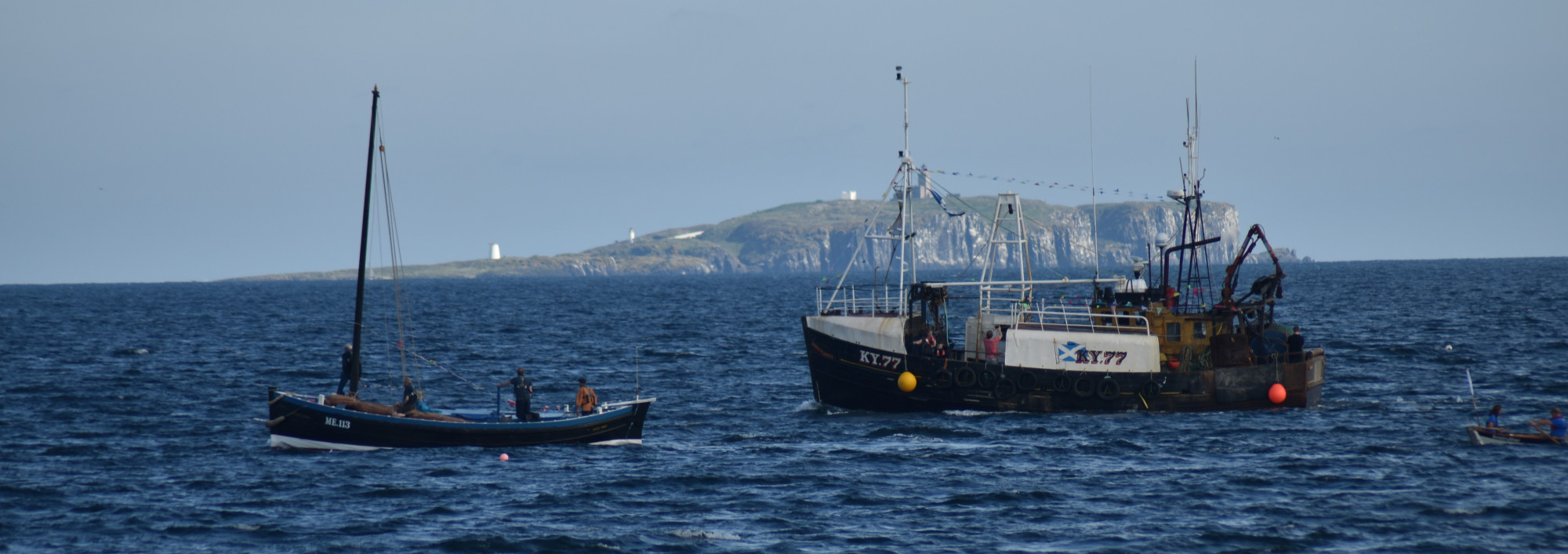

The Cellardyke Echo 22/7/2020

A few tragedies this week and a hen who could not have been very comfortable!

1885

Sad Occurrence on the Coast.—The old Cellardyke boat, ” Otway,” utilised, like several others, some time ago into a kind of keel, ran into Pittenweem on Friday morning, when the skipper, Robert Campbell, reported that he had lost his mate, Wm. Muir, about the turn of the night in the offing of Elie Ness. The little craft was on her way from Leith to Anstruther to re-ship cement for the Isle of May. All had gone well till, the skipper was trimming the foresheet, the unfortunate man was knocked over by the jibing of the mainsail. To throw oar and launch the dingy was only the work of a few minutes, but the generous endeavour was all unavailing, and he sank into a watery grave. Meanwhile the vessel was dragging before the wind, so that it was with no little exertion that the skipper himself regained the deck. By those who knew him, Wm. Muir is lamented as a quiet and useful man. He was over forty years of age— native of Orkney, but settled for some time in Leith, where he leaves a widow and five children to bewail his loss.

Among those present at the Lord Mayor of London’s banquet to the Lord Mayors and Provosts of the United Kingdom at the Mansion House, London, on Friday evening last week, was Provost Skinner, Cellardyke, who was officially styled “His Worshipful the Provost of Kilrenny.”

COLLISION IN ABERDEEN BAY—CELLARDYKE FISHING BOAT SUNK.—

At early hour this morning—between one and two o’clock—a collision of an alarming nature occurred in Aberdeen Bay between the steamer St Ronald, of this port, and the fishing boat Mizpah, KY, 2023, belonging to Cellardyke, of which James Cunningham is master. The boat, it appears, had been engaged in the prosecution of the herring fishing, and at the time of the occurrence had been returning from the fishing ground. The night was dark and a very a thick fog prevailed, so that navigation had to be managed very cautiously. The boat had succeeded in passing within the South Breakwater in safety, preparatory to taking the navigation channel, when several of the fishermen thought they descried a light bearing down their direction. Conjecturing that the belonged to a craft evidently making for the south they steered their boat well to the north of the channel, for the purpose of giving the stranger clear way. The bow of the steamer was shortly thereafter seen. As it appeared the fishermen at the time the steamer suddenly changed her course, this point it is rather difficult to say much with anything like certainty. However, this alleged change of course put the steamer directly in line with the fishing boat, with the result that before the fishermen had time to take their boat out the way the steamer was upon them. Immediately before striking the boat, the engines of the Ronald were reversed, so that, to a certain extent, the force of the blow inflicted upon the tiny craft was somewhat retarded. It was sufficient, however, to cut her to the water’s edge, and make the boat sink almost immediately. The crew had a narrow escape from drowning, and their safety was entirely due to the prompt measures taken by those board the steamer. Ropes were thrown to the fishermen, and after some time, they were all landed on board the St Ronald from where they were shortly afterwards transferred to the tug Bon-Accord and brought to port. The excitement on board the steamer was naturally very great among the passengers, in the darkness nothing like an accurate idea of the extent of the casualty could be gained. The exact point where the occurrence took place is about five hundred yards outside the North Breakwater. The following are the names the crew the fishing boat Cunningham (61), Cellardyke : Alexander Cunningham, Cellardyke; Alexander Gardiner, John Street, Cellardyke ; George Oliphant, Cupar-Fife ; James Main, Green, Anstruther ; Andrew Meldrum, Crail ; William Neil, Shore Street, Crail.

Divers were engaged in the morning trying to raise the sunken boat, but their efforts up the present time have proved futile.

It is asserted that at the time of the collision no lights were displayed the Mizaph.

1886

The Cellardyke herring boat, Alaska, numbered Kirkcaldy 332 arrived at Arbroath on Tuesday Morning. The Skipper David Davidson reported that at half past one o’clock on Tuesday Morning, when the boat was between the May Island and Bell Rock, Robert Watson, one of the crew, was caught by the weather rope, dragged overboard and drowned. Watson was about thirty years of age, unmarried and resided in Crail. (other reports say he was 20 years old)

One week later

CELLARDYKE FISHERMAN DROWNED OFF ABERDEEN.- While the fishing boat Pioneer, No. 1051, was making for Aberdeen Harbour Saturday morning George Henderson, 32 years of age, one of the hired men, who resided at Tolbooth Wynd, was knocked overboard by the lurching the boat. He floated on his back for a few minutes, and was rescued by the crew of an Inverness boat. Everything was done to restore animation, but without avail, Henderson expiring shortly after being taken out the water. He was married, and leaves a widow and one child.

1887

The annual holidays in Anstruther and Cellardyke are to be observed on Wednesday and Thursday next week. In the absence of the boats, business is extremely dull at present, in both towns. So much is this the case in Cellardyke that the merchants there, as in former years, have begun to close at six o’clock in the evening, and to observe each Wednesday as a whole holiday.

On Saturday an accident occurred at the harbour by which a boy named Stewart, about nine years of age, got one of his legs severely crushed. He was sitting on the pier with his legs dangling over the edge, when a boat, with the motion of the tide, jammed one of them between its gunwale and the pier. He was immediately taken to Dr McCallum’s where the bruised limb was stitched, then home to his father’s, James Stewart, Rodger St., Cellardyke.

Large Eggs

We have had handed to us for inspection two eggs, dropped by a hen belonging to ex-Bailie Brown, Cellardyke, which, on account of their size, demand a passing notice. One measures 6 ¼ inches in circumference, 4 inches in diameter, and weighs within a fraction of ¼ of a lb. The other is 6 inches in circumference, 4 inches in diameter, and weighs 3 ½ oz. The hen which acknowledges these eggs doesn’t lay often, but when she does lay she seems determined to make a good job of it.

On Monday the contractor made a beginning in laying the water pipes through the streets of Cellardyke. The commencement was made at the head of Tolbooth Road. So far the progress has been easy; but as advance is made along John Street and George Street it is anticipated that rock will be largely met with. As traffic just now is at a minimum, interruption won’t be so great it would have been any other season of the year.

1889

The row of old houses with the spacious new factory built a few years ago for Messrs Duncan & Black, net spinners, in the west end of Cellardyke, was exposed in one lot by the Commercial Bank, in virtue of a bond for £900, in the Town Hall on Monday. It was put up at the reduced upset price of £740, at which it was secured by Mr David Black, baker. The factory, it is said, coat £500, so that in view of the accessories this is a telling instance of the depreciation of property of late in the East of Fife.


The Cellardyke Echo 15/7/2020

1880

Water Supply. -The Police Commissioners Cellardyke having come to a resolution to improve the water supply, recourse has been had to boring, which is now being carried out on an extensive scale about 200 yards to the north of the new Mission Church. At depth of little more than 100 feet, and an outlay of scarcely £20, a spring has been struck which yields with little, if any, diminution, some 300 gallons hour; but it has been resolved to prosecute the work for another 50 feet, in the hope of reaching such a supply as would alleviate all possible fear with regard to this prime element of health and comfort for many years to come.

1881

Horse Killed at Cellardyke.—On Monday morning a horse yoked into a cart, and belonging to Mr Morris, Crail, backed right over the west pier on to the rocks below, and sustained such serious injuries that it had shortly afterwards to be killed.


Theft From a boat

On Wednesday afternoon, William Spice, 24 years of age, a native of Sittingbourne, England, was committed to prison at Falkirk, for late the previous night broken into the trunk of Skipper John Watson, the owner of the fishing boat “Prime,” of Cellardyke, and with having stolen therefrom about £18 in gold and silver, with which he absconded. The boat was homeward bound from the Irish herring fishing, and on Tuesday night put up at Grangemouth, where the theft was committed. Information having been lodged with the police, the thief was traced to Bo’ness, where he was arrested in a lodging-house, four hours after the theft, with the stolen money in his possession.


The employees of Messrs Robert Watson & Co., merchants and manufacturers, were on Wednesday kindly treated to an excursion by their employers. The company accommodated in four waggonettes were conveyed to Ceres, and afterwards walked to Craigha’ Den. The weather being favourable, the whole of those present spent a most enjoyable day, and returned in the evening highly delighted with their outing.


Self-Reliance. — A fine example of the old proverb, “Where there’s a will there’s a way,” has just been exhibited at Anstruther pier. A Cellardyke skipper, Mr David McKenzie, being satisfied of the superiority of the cutter to the yawl rig for his boat, set to work, and with his own hands effected the necessary transformation, first on the boat and then on the sails, wielding both hatchet and needle in a way that would have been no discredit to the respective trades. The old Union, as a trim little smack, has now sailed to Sandhaven for the season, where the saving of time and trouble, not to refer to the unspeakable gain in the way of safety, will at last, it is hoped; induce others to “go and do like- wise.”


1882

The fleet this season includes the finest and largest busts ever fitted out from the East of Fife. Amongst these being notably the dashing clipper Ruby, which was launched the other day Councillor Jarvis to the crier of the old Cellardyke skipper, Mr David Wilson. For the last thirty years boat-building has been carried on with on greater enterprise on the East coast than at the Brae of Anstruther; but the Ruby is beyond question the queen of the fleet. She is longer by a foot than any other built here, her dimensions being —length, 55; beam, 18; and depth of hold, 7 ½ feet; but, in addition to this, she also challenges attention by the fineness and symmetry of her mould. Councillor Jarvis has also contracted, not for a boat, but a regular deep-sea going smack to the order of another Cellardyke skipper, Mr Robert Cunningham.


Anstruther HarbourA letter, dated from Aberdeen, was laid on the table from a well-known skipper of Cellardyke, Mr Thomas Birrell, asking to be recouped for outlay of 27s; also, for detention and trouble by his boat, the “Four Brothers,” being bilged at her moorings on Sabbath week. Mr Birrell did not, or could not, specify the cause of the accident, and in view of this the Board agreed to hold over the letter for further consideration.


1883

SANGER & SON’S GRAND CIRCUS. —This circus, said to be the largest in the world, and certainly the most extensive ever seen in the locality, paid a visit to Anstruther on Wednesday. The number of horses, nearly all white or piebald, and in fine condition, is no less than 156, while in addition there are ten elephants and four dromedaries and camels, the employees connected with the establishment numbering 86. At mid-day a grand procession, headed by the splendid brass band, which plays exclusively on instruments manufactured by Messrs F. Beason & Co., 198 Easton Road, London, started from the Crail Road, and marched through Rodger Street, Shore Street, East Green, and a portion of Cellardyke. It was witnessed by large crowds of people, who were loud in their praises, the feat of driving forty horses four abreast being specially admired. At both performances there was a large attendance, many owning from a distance, and every one appeared to be highly satisfied with the entertainment provided for them. The equestrian feats of Miss Lavinia Sanger, Miss Lucia Carr, Mdle. Lillie Hartley, and Miss L Talliott, as well as the daring performances of Mr Claude Randall, were greatly applauded, while the performing horses introduced by Herr Hoffman were the objects of much admiration. Two novel features in the entertainment were the performing elephants and the snake charming of Mdle. Demajuta.


1884

Body Found- Extraordinary IncidentAs the flood tide was setting on the shore on Tuesday morning (the water meanwhile being as clear as crystal) some fisher lads standing on the east breakwater observed the body of a man floating, like a mass of seaweed, towards the harbour. It was a ghastly sight. Scalp and face, as well as the skin of the hands, had disappeared. The alarm having been given, a boat went out and landed the mournful relic. It was conveyed to the old packet office, where it lay under lock and key for investigation. That was scarcely begun under the eye of P. C. Martin when the body was identified as that of Peter Masterton, at one time a waiter in Dundee, who at Whitsunday opened a small confection shop in the old house so long the residence of Bailie Peacock a little to the west of Cellardyke Town Hall. There he resided with his wife and only child; but, as so often happens, the little shift does not seem to have realised his expectations. He is said to have become the victim of low spirits, though not so much so as to excite the alarm or misgivings of his family, whom he left three weeks ago. The rest is only conjecture. It is not known whether an unwary step or some fatal resolution hurried him to his fate. Under the impression that he had returned to Dundee, his family – comparatively strangers, as they are – made few, if any, inquiries concerning him; and thus the terrible discovery of Tuesday was the first intimation of the melancholy secret. He was about thirty years of age; spare, but well knit; and so pleasant and cheerful in his manners when in health as to make a very favourable impression on those who met him in his brief sojourn in the east of Fifeshire.


Anstruther – On the forenoon of Saturday last, a fine carvel-built fishing boat was launched from Councillor Jarvis’s building yard here. Her length was 51 ½ feet, and breadth 18 feet. The owner is Skipper David Corstorphine, Cellardyke, whose boat, it will be remembered, came into collision near the Bell Rock with another boat, belonging to Arbroath, on the 26th of March last. The boat which was launched on Saturday has been named “The Betsy.”

The Cellardyke Echo 10/7/2020

1875

RETURN OF FISHING BOATS FROM HOWTH. —The four Cellardyke fishing boats which were engaged at the herring fishing on the Irish coast have now returned. All the crews have fished well, that of Skipper Thomas Watson being highest with a sum of £160, the second bringing only £5 less. The success which has attended this trial is almost certain to induce a large number of the Cellardyke fishermen to proceed to Howth next year.

A large number of the fishing boats left for the north on Tuesday, and there was considerable stir about the harbour consequent on the assembling of a large number of people to witness their departure. The remainder of the crews, with one or two exceptions, left on Wednesday and yesterday. The number of Cellardyke boats to be engaged in the fishing this year is 155, but others have hired boats are wholly manned by Cellardyke fishermen, making the total 162, or slightly above last year. A very favourable commencement has already been made to the fishing in the north, and the local crews will doubtless as on former occasions participate in any success which may attend the principal fishing of the year.

1876

Alexander Mackay, a native of Sutherland but for some time employed in the fishing at Cellardyke, was charged before Kilrenny Magistrates on Friday with assaulting Mrs James Watson in her public house near the Tolbooth, and also with a breach of the peace at the same time and place, Sandy repelled the charge of assault, when evidence was led, in the course of which Mrs Watson, Mrs Murray, and Margaret Fowler detailed the circumstances of the case. From three statements it appeared that Mackay had refused leave the house, when Mrs Watson threatened to expel him with the poker, of which, however, she had been summarily disarmed by the brawny clansman After hearing parties the Magistrates found the charge not proved, but sustained that of breach the peace, and sentenced the panel to a fine of 10s 6d.

A boy named Muir, ten years of age, son of Jas. Muir, fisherman, was drowned at Cellardyke on Friday. He was engaged, along with a companion, in fishing from a large rock near the harbour, and while throwing out his hoe overbalanced himself, and was drowned before assistance could be procured. The body was recovered about an hour afterwards.

CELLARDYKE DEATH OF A WELL-KNOWN FISHERMAN.-Our fishing community has lost one of its most enterprising and successful members by the death of Skipper Andrew Henderson, which event took place last Saturday morning. The deceased was taken ill at Howth, where he was engaged at the herring fishing, and was obliged to leave his boat and come home, where, after suffering severely for several weeks, he succumbed to the painful disease with which he was seized. For a number of years past he was known as The King of the fishers’ in consequence of his crew being almost invariably the best fished in Cellardyke, and being a man of frank disposition, and of steady and of industrious habits, was well known and respected by all with whom he came in contact both here and at other fishing stations. He was only 46 years of age. Although the whole of the fishermen are at present in the north, his funeral was largely attended on Monday.

1877

Burgh Police Court. —At a Burgh Court held on Friday last, Andrew Smith carter, Cellardyke, was convicted of driving at a furious rate on the 16th June, and was fined 10s 6d. Alex. Wood, cabinetmaker, Cellardyke, and Robert Bell and John Cumming, ploughmen, Airdrie, pleaded guilty to committing a breach of the peace opposite the Royal Hotel, on the 23rd  June, and were sentenced to a fine of 10s 6d, and the others to 7s 6d . At a Court held at Cellardyke the same day, a woman named Elizabeth Watson was fined 5s for a breach of the peace in the village of Kilrenny.

The Kilrenny School Board have accepted contracts, amounting in all to about £1950, for the erection of a new school and teacher’s house at Cellardyke.

1878

Fifeshire Fisherman Drowned off Stonehaven —On Wednesday afternoon about 4 o’clock John Montadore, owner and skipper of the boat Jacobines, number 1378, from Cellardyke, while assisting to set the jib sail, tripped his foot, fell backwards over the gunwale into the sea, and although the crew did everything to assist him he sank and was drowned. The crew remained some time about the place, and then returned to the harbour. The authorities are investigating the case.

The New Mission Church Cellardyke— Description of the Plan, &c

The designs for this interesting new place of worship have just been submitted to the friends of the movement in the locality. The church, which we may remind our readers, to be erected on a sunny site on the Powcauseway Road, immediately opposite the new Public School, is in the form of cross, and in the pointed style of architecture. The front or west elevation exhibits a massive circle, some thirty-eight feet breadth and rather more in height, pierced a handsome three light window, and surmounted by the sacred emblem of our blessed faith. The gable is flanked on the north by well-defined porch, and on the south by a lofty tower, showing clock face on its three open sides, and with spire and weather vane springing from the embattled parapet, forty-five feet from the ground, the whole elevation being over sixty feet. The tower is also utilised as an entrance door and as stair to the gallery. The south wall, which is to be skirted by a new roadway, is relieved by the gable of the transept, pierced like the wall with pointed windows. The vestry is in the rear of the church, where there is also provision for a large hall or class-room for congregational work. Coming now to the interior, we find the pulpit on the east gable with the transepts —measuring between seventy and eighty feet from north to south – on either side, and having the spacious nave and gallery in front. From this point the fabric will have a decidedly imposing appearance, enhanced by the open timber roof, which like the more salient carpenter work has been treated with subdued but masterly taste. There are sittings for 800—650 on the floor, and 150 in the gallery. The architect is Mr Johnstone, of Dundee, and altogether the design seems admirably suited to the end view, namely to accommodate a large congregation so to participate with comfort and satisfaction in the services of the sanctuary. In all this Mr Johnstone had to regulate his pencil to a given outlay, but however fettered in respect of decoration, he has evinced a thorough appreciation of the resources of his noble art, not only in the treatment of details, but in the general outline, which is pleasing and even picturesque, though we trust, in justice to the design, that provision will be made in the contracts for a higher elevation, if not to the gable, at least ” to the heavenward pointing spire,” so as to save such after regret as that in the case of the Memorial Church St Monance, in which an otherwise happy imitation of brave old St Mary’s, of Northampton, has been so sadly ruined. As will have been seen from our advertising columns, another bazaar is to be held in Elie in aid of the building fund of the Cellardyke church, which will be in progress as soon as the preliminary arrangements can be concluded. The estimated expense, we may state, is about £2600. The Rev. Christie, Professor of Church History, has now removed to Aberdeen, but he and his amiable partner continue to take the same deep and unwearied interest in the scheme, which has been hitherto fraught with such signal encouragement and success.

The Cellardyke Echo – 2/7/2020

Cellardyke Echo this week,, Sam Bough’s visit produced a couple of paintings of Cellardyke which i’d love to see, one of these paintings was turned into the well known etching above ( sometimes the etching image is attributed to Sam Bough, but the way these things worked was that the skilled etchers would copy the paintings and then sell the etchings and therefore the correct attribituon is as below)

Cellardyke Harbour by Theophile Narcisse Chauvel after Sam Bough

1870

OPENING OF THE NEW HALL, CELLARDYKE.THE NEW FREE CHURCH HALL, CELLARDYKE, will be OPENED (D.V.) the Evening of SABBATH, the 17th inst., when the Rev. D. M’COLL, of the Bridgegate Church, Glasgow, will conduct the Services. Public worship will commence at a Quarter past Six o’clock.A Collection in aid of the Building Fund will be made at the Door, which it is hoped will be liberal.

1871

FISHING BOAT AND MATERIAL FOR SALE. To be Sold by Public Roup, at the House of JAMES GARDNER, Cellardyke, on SATURDAY the 15th July, at two o’clock p.m.,THE Decked BOAT “CHARM,” K.Y. 151, 44 feet long, 6 years old, with 2 Fore- Sails, 2 Fore-Masts, Jib, 2 mizzen-Sails, 1 Mizzen-Mast, 2 Booms, Spanker, 3 Chains, 3 Anchors, Riding Ropes, 8 Oars, 3 Boat Hooks, &c .Also, Upward 30 Barked nets, 4 or 5 White Do. with Pallets, Bladders, Corks, &c.Also, a quantity of corks, suitable for Yarmouth Fishing.NOTE. – The above Nets are all mended and barked, and ready for use.The Sale will commence with the Boat at Anstruther Harbour. Mr BONTHRON. Auctioneer.

1872

Cellardyke.Good Templar Festivities. – Last week was a blythesome and memorable one with the hardy fishers of the East Neuk in connection with this remarkable movement, which the meantime is drawing all hands and hearts to the temperance flag. On Friday last the ”Lifeboat” Lodge of St Monance, with a gallant crew of over 400-young and old-had a grand festive trip to “Keil’s Den” They took the rail so far as Largo, and it was an interesting sight to see so many stalwart sons of Neptune, with the buxom sisters of the brave old fisher town, strolling or sitting amongst the fragrant trees and flowers, and otherwise enjoying themselves amongst the sweet sylvan shades of this favourite retreat; and, altogether, the pleasures of the day seemed quite in harmony with the fanciful remark of the sentimental old tailor, who, when accosted by a neighbour, “Weel, Robert, hoo hae ye gotten on the day?, and .” enthusiastically replied, “Oh grand man – jist anither picture to hang up an’ mak’ the chamber wall o memory bricht forever”On the evening the “Guiding Star” lodge of this place celebrated its first anniversary by a fine procession of flags and music through the streets of Cellardyke and Anstruther, and thereafter by a festive meeting in the Free Church hall, which in both cases came in with overflowing success. The meeting was presided over by Brother Brown, W.C., who spoke in his usual earnestness and point; and the Rev Mr Grant of the Baptist Church; and Mr Patterson, the elect pastor of the E.U. Church, also occupied the platform great acceptance – the address of the latter being an ably-sustained allegory, after the manner of Bunyan’s Holy War, on the influence of drink as an enemy of the temporal and spiritual welfare of man. But “the speech of the evening” to use a familiar phrase, and in saying so we know we will be excused for any seeming invidiousness, was by one of our fishermen, Brother William Stewart who gave some revelations of his former career, in which he, as it were, lifted the curtain from that saddest type of wreck and misery, a drunkards home, and contrasted it with the ringing songs and mirth of the dram-shop, where, as one in the delirium of madness, the poor abandoned drunkard was ready to sacrifice day and night, all that was sweet and beautiful in life – heeding as little as the voice of the wind the sob of a broken hearted wife, or the cry for bread and mercy of famishing children – which he described with a graphic force and pathos that melted every heart. We would gladly have given a fuller report; but this, as in all kindred appeals, the words, however strong and touching were less eloquent than the emotion of the speaker, who closed his address amidst a deafening round of applause. The excellent young secretary, Mr Alex. Black, submitted some interesting statistics, from which it appeared there were at present 240 members of the lodge but the initiations had amounted to 290. The difference in these numbers was traced to a few defections from the cause, but mainly to the admission of fishermen from the north country, who, though they had left their “mother lodge” had on their return home, it had been gratifying to know, been pioneers of temperance; and in this way Cellardyke had been the parent of a strong promising lodge in a far distant part of the Sottish coast. The meeting was largely attended and the Proceedings were appreciated by all present.

1873

The Herring Fleet of 1873. —According to the preparations now so actively begun, the present season will see the largest herring, fleet ever sent afloat from the East of Fife. Cellardyke promises to contribute about 175 of the finest and largest boats to the Scottish herring squadron, and Pittenweem can muster over 50, while St Monance, that true spirit of progress which distinguishes her, soon will be able, if required, to send 105—making a total for the three stations of 335 first-class boats.

Artists in the East of Fife.—There are present many as five artists —including the distinguished landscape painter, Mr Samuel Bough, of Edinburgh—sketching various points of interest in the East of Fife. The favourite subject with all seems to be the romantic sea shore, where the busy fisher craft may be everywhere seen speeding along with dark, brown wings ; but the memorable and picturesque, wherever it may exist in the neighbourhood, is likely to have more or less of the attention of these interesting visitors.T

he Cost of a Boat Stance.–The old shipbuilding ground the beach Anstruther harbour was let by public auction, for wintering boats, on Saturday evening, when the six stances realised £3 each. This may appear a high price to give for the small area required to lay down a boat, especially when the boat stances at Cellardyke Green are to be had for some six or seven shillings but even rent of 60s the Anstruther stances are preferred, as, besides other advantages, the fishermen there save the cost of shifting with the engines, for which over a pound now charged, and another when the boat is beached or launched.

1874

ArbroathThere were launched yesterday from the boatbuilding yard of George Leslie, Old Shorehead, two fine, large carvel-built fishing boats, each 45 feet long, 16 feet broad, and about 7 feet deep. They are the first built here by Mr Leslie, though some of similar style have been built the late Shipbuilding Company. They are both sold, one to Mr John Doig, Cellardyke, and the other to Mr Thomas Webster, Broughty Ferry. The launching was effected by means of the steam-tug drawing them over the quay, there being yet no slip for the purpose. The whole was accomplished in safety.

The Cellardyke Echo 26/6/2020

1926

BUS COMPLAINTS IN CUPAR COURT. For allowing a ‘bus to overcrowded, Alexander ‘Cuthbert, motor driver, 22 Shore Street. Anstruther, was fined Cupar Sheriff Court yesterday. Thomas Gardner, Harbour Head Garage, Anstruther, was charged with having left the stance at St Andrews with a motor ‘bus at 4.18 p.m. instead of 3.30 p.m. or 5 p.m., contrary to the Omnibus Byelaws for the county.  He was also charged with having failed to have the number of the ‘bus and the name of the licensing authority painted in conspicuous position on the ‘bus. His plea of not guilty was tendered on the first charge and of guilty on the second. Both charges will be dealt with on June. Alex. Hodge, Shore Terrace, Cellardyke, was fined 10s for acting as conductor of a ‘bus without being licensed for the purpose.

1927

In Cupar Sheriff Court Tuesday, before Sheriff Dudley Stuart, Charles Graham Smith, farm manager. Cuplahills, Balmullo, admitted a charge of having, on the St Andrews – Anstruther public highway, driven a motor car in a reckless manner, and collided with a motor cycle driven by Duncan McIntyre, shop manager, 13 George Street. Cellardyke. R. N, Robertson, solicitor, Cupar, said the windscreen accused car was obscured, and when was going slowly round a bend, came upon some ducks crossing the road. As the ducks were slow, he swerved over to pass behind them, and a motor cyclist came round the bend, and went over to the other side to avoid him. Accused also swerved, and the two collided. The Sheriff, imposing fine of £2, said it all went to show that a motorist should never to his wrong side, even to avoid ducks. (Laughter.)

1928

New Company

Robert Watson & Co Ltd – 11 George Street Cellardyke. Capital £15 000, in 10 000 preference and 5000 ordinary shares of £1 each. Private Co to acquire the business of waterproof manufacturers carried on by Robert Watson & co at Cellardyke, and Newburgh, Fife. Subscribers. David Mitchell waterproof manufacturer, Glendower Anstruther and R Watson waterproof manufacturer Brackness Anstruther.

1931

Making Our Fishermen’s Gear

THE MODERN WAY OF HOW FIFE LASSIES OBTAIN THEIR GRACE :

THE WONDERS OF “CARSTAIRSES’ FACTORY.” By Mrs A. R. Rowlands, Cellardyke.

” What big balloons, mummy !” shrieks the city child as he points an excited finger at the huge globes crowning a lorry load of fishing gear which was being driven down to the boats in preparation for the drave,” or summer herring fishing. Those gaily painted spheres which often cause much speculation among towns folk paying their first visit to a fishing port, are the “pallets” floats, buoys, or “cows,” as they are called in some districts, used for supporting the drift nets, and also for indicating the location of the nets in the water. To our grandfathers, those well finished, easily handled, and indispensable items of a fisherman’s equipment were unknown. The pallets of a past generation were made not of foiled canvas, like those of to-day, but of sheepskins. The wool having been first removed, the pelts were soaked in lime water for period of fourteen days, being thus thoroughly cleansed. The hides were then dried the sun before subjection to a further few days’ “steeping” in strong solution of salt and water. After a second drying in the sun, the skins were cut in circular shape in readiness to receive a good coating of tar on both outer and inner surfaces. This operation rendered them strictly water and air tight.

The Old Way

After a visit to one of the best equipped and most modern of our pallet making factories, I not unnaturally inquired from an experienced old fisherman, “How did you fill the ‘ bows ‘ before the invention of compressed air machines?”

“Blew them up wi’ oor breath,” was the laconic rejoinder.

“You would need- good pair of lungs,” I retorted, sensing fun at my expense.

“Weel, ye see !” continued the pawky old salt, tilting his cap, while he scratched his ” pow ” reflectively. “If ye didna hae enough wind, ye taen the bellowses.”

The pioneer of the canvas pallet was the late Provost Black, Cellardyke, whose factory “wast the toon ” has, within recent years, been acquired by Messrs A. & W. Myles. The large modern erection of John Martin & Co., Ltd., in Cellardyke is known throughout the East Neuk o” Fife as “Carstairses’ Factory.”

The large and extensive premises erected within recent years at the top of the Urquhart Wynd are devoted not only to the manufacture of fishing gear, such as pallets, but also to the making of fishermen’s oilskins; that is, their heavy coats, “sou-westers,” and frocks.” The last-mentioned are these chemise-shaped garments which cover their wearers from the neck to well below the knee.

 Let it not be supposed that only useful, unromantic “oilskins” are made in this factory. In the warehouses and showrooms hang hundreds of the daintiest and most delicately coloured silk oilskin coats, fit wear for the fairest ladies in the land.

When Tar Was Scarce

Near the huge- entrance gates the hum and babble of many girlish voices greet us. Entering the large yard, we pass wide open doors through which the summer air enters.

On our way we catch glimpse of youthful forms swaying, and busy arms moving to and fro as their owners tend to their machines. There is no need to wonder whence Anstruther lassies obtain their graceful figures and erect carriage. Our observation tells us that their day’s work provides all the necessary figure forming and “slimming exercises.

Two or three pairs of bright eyes smile at us, and several rows of white teeth flash a greeting as their possessors revert once more to their tasks. The modern pallets have been for many years made of oiled canvas. The divisions, shaped like a quarter of an orange, are firmly sewn together with strong thread before the article is handed over to the oilers.

Before the war, oiling of “pallets” was unknown, tarring being the uniform process During the war-time, owing to the scarcity of tar, oiling was adopted, and this method having proved more satisfactory has been retained.

The pallets are first turned wrong side out and completely and carefully oiled inside, after which they are hung in the drying shed to dry. After a further coating of oil and a second drying thev are turned to their right side ready for the broding machine.

Coloured Buoys

The ” brod or board is that circular piece of wood which fits like a lid exactly into the opening of the pallet. The rim of the ” brod is firmly lashed to the pallet with strong twine by the broding machine.

On the ” brod ” is a strong handle through which passes the hole for the rope which binds the float of the net and bored through the ” brod ” is also a small round aperture for the insertion of the air-plug.

The finished or ” broded ” pallet, having now been removed from the broding machine, a coating of oil is given to the outer surface. A further time is spent the drying-room before final coat is bestowed. T

he pallet is now ready to receive its ” top-dressing ” of paint; a special group of girls being detailed off for this branch of the work.

Many years ago Scottish fishermen preferred an all-black buoy; English buyers were the first to use the pure white pallet, which, since its introduction, has become first favourite in the fishing world. Preference for the white buoy is due to its visibility in the pitch blackness of a starless night.

It is quite common, however, to see gaily painted pallets—red, blue, and even green—clustered like huge balloons beside fishermen’s gear. Buoys in olden times were uniformly round in shape. With the development of the canvas float, they became orange shaped.

Recently, however, the pear-shaped pallet has been copied from those used by Dutch and German fishermen.

The Air Plugs

The buoys, all painted and ready for sale pendant in a very flabby condition in the factory stock room, present quite different appearance from those inflated globes which will in due time float the nets.

We have’ already noticed in the “brod” or lid that tiny round hole for the reception of the air plug, which forms a small but indispensable part of the pallet.

A tiny cone-shaped article is this plug, made of stout white cord wrapped with tow. While examining the neat little accessory, our attention is drawn to the machine used in its manufacture.

We are shown a cord drawn taut between two clamps of a machine beside which is a bundle of tow and a jar of tar. The girl in charge seats herself and sets the machine in motion; taking a few strands of the tow, she weaves them deftly at the right hand end of the cord, which is now revolving rapidly, at the same time coating them liberally with the tar, which is used not only to bind the strands together, but also render the plugs strictly waterproof.

By means of a few strokes of a peculiarly shaped knife, the machinist forms the plug, drawing the thickness from right to left, thus obtaining the cone shape.

When the exact shape and size is obtained, the worker immediately adds further strands of tow for the formation of another plug, and so on until the complete length of cord has been used. The line of plugs is then detached from the machine and is neatly clipped asunder into its several sections ready for use.

The Hot Plate

We now turn aside to where at long tables, and with hard brushes, girls are oiling pieces of canvas which, by their shape, we know to be fisher men’s overalls.

Later we notice the finished garments hanging in the store room; we have seen others like them covered with herring scales, enveloping their owners as they trudged up the pier on a cold morning during the “winter herring.”

In another department, a long steel topped table arrests our attention; we touch it gingerly amid amused smiles from the onlookers; it is hot, in fact, too hot for our comfort.

This, we are informed, is the hot plate; its use is presently explained to us.

A web of crimson-hued oiled silk is lying near, and close at hand are buckets containing a mixture; we are told that a coating of this liquid is first applied to the oiled silk before the latter is rolled over the hot plate. In this way all stickiness is removed from the oilskin used in coat making.

Having passed through ” kilns ” or drying rooms, and visited stock rooms, wherein hang rows upon rows of pallets, fishermen’s oilskin frocks, coats, and ” sou-westers,” we come to a little room in which is a line of porcelain basins with bright nickel taps, each bearing the well-known letters ” H ” and ” C.”

Opposite the basins is row of presses or wardrobes, where the girls hang their outdoor garments. We have seen these girls at work, wearing heavy oilskin, aprons, their fingers coated and sticky with tar. We notice them later going to meals with all traces of toil removed. Here, the workers have both the means and the opportunity of making themselves clean and smart before appearing in public.

D’ye Want a Dook?

Within the nearest shed a large tank of paraffin is making its presence felt; its purpose is doubtless to remove all superfluous tar from the plugs before they are fitted into the pallet brods.

“D’ye want a dook?” queried the damsel in charge, waving her hand suggestively towards the tank and its oily and uninviting contents. There is another, and as yet unexplored territory, where woollies of every shade, size, and design are made. Many golfer on our classic Scottish links wears a pullover of intricate pattern knitted by Cellardyke lassies in “Carstairses’ Factory.”

The Cellardyke Echo 17/06/2020

1920

CELLARDYKE WAR MEMORIAL. At a public meeting the inhabitants of Cellardyke held on Saturday evening it was unanimously resolved to adopt the recommendation of the Memorial Committee that a monument be erected on Kilrenny Common to the fallen belonging to the parish.

The monument is to stand 23 feet high and has been designed Mr Murdoch! Kirkcaldy. Sufficient funds are in hand to erect the suggested memorial.

1921

Summer Quarters to Let

1 room, 2 beds, own key, August, G. Elder. 17 Dove Street, Cellardyke.

1922

St Andrews

MOTOR LAUNCH TRIPS. Mr Muir, Cellardyke, asked for permission to make motor launch trips and to hire from 5 to 7 rowing boats on the beach. After consideration the Town Council in Committee recommended that the necessary permission should be granted Mr Muir on payment of a sum of for the season; that the boats should be inspected by Councillor Wilson, and that Mr Muir should be allowed to put shed to hold the boats, lines, etc., at position to be approved by the Burgh Surveyor, The Council approved of the recommendations.

1923

Up-to-date Civic Enterprise – Cellardyke is becoming more popular as a health resort, and in order to make the district attractive as possible to ‘visitors the Town Council have formed themselves into a Town Improvements Committee. Incidentally the Council also have in view the reduction of the rates from the profits of their ventures.

A Badminton club formed during the winter months, proved very successful, and is “still going strong,” and the latest project is the construction of a putting green, which was formally declared open for play by Provost Mitchell. The putting green one of the largest to laid out in the district, being 18 holes in extent. Situated to the east of the “town’s green” it lies close to the edge of the beach. An exceptionally large crowd was present when Provost Mitchell, declaring the green open, said the object the Town Council had in view was one which, he thought, would appeal to all the ratepayer of the town, vis., the raising of funds for the benefit of the old burgh. (Applauses) Mrs Mitchell, wife of the Provost, played the first ball, and long line of patrons formed up for game. Two pripes—the gift of Provost Mitchell were competed for, and the green was very busy up to late hour.

1924

LOSS TO EAST NEUK COMMUNITIES. Provost Cunningham’s Public Services.

The East of Fife is poorer by the death Mr Thomas Cunningham, Provost of Anstruther Easter, which has taken place at his residence, Glenogle, suddenly. Mr Cunningham had recently recovered from a severe attack of influenza, and had resumed his daily duties. Saturday he was going about as usual, and appeared to be in good health. While dressing for church on Sunday forenoon, however, he had a sudden attack of faintness, and took to bed. Medical aid was summoned, and it was considered that the attack would pass, but about midnight he collapsed, death being due to heart failure.

Mr Cunningham will be much missed in the district, especially by his many fisherman friends. A native of Cellardyke, he was brought up in the fishing community, and he had a wide knowledge and experience of what was beneficial to the men of the sea. This knowledge was always available to all who desired it. In business Mr Cunningham had many interests. He was founder and senior partner of the firm of T. Cunningham & Sons, ship chandlers, Anstruther, and also was connected with the firm of Cunningham & Davidson, -fish salesmen, Aberdeen and Anstruther. In addition his firm did an extensive coal trade with the local steam drifters, for many of which they were managers.

Public Work.

While he was an exceptionally busy man, Mr Cunningham devoted a good lot of his time to public work. For 26 years he was a member of Anstruther Union Harbour Commissioners, and along with the Provosts of Anstruther Wester and Kilrenny was chairman ex officio. Mr Cunningham was elected a member of Anstruther Easter Town Council in May, 1915, and in December, three years later, was appointed Provost, and after the last election was unanimously re-elected to that post.

Kind-hearted and leal, many of the poorer people of the burghs will mourn his loss as a benefactor, as Mr Cunningham was always to the forefront when a helping hand was needed.

He was a Freemason, being member of Lodge Ayle (No. 95), Anstruther, but in recent years he did not take any active part in the work of the Lodge. Provost Cunningham’s chief recreations were cycling and angling. Only about a week ago he was enjoying his favourite sport at Balmonth Water Works.

Provost Cunningham was a prominent member of Chalmers Memorial Church, and was ordained an elder several years ago. Deceased, who was 64 years of age, is survived by his widow, two daughters, and one son. Another son. George, paid the supreme sacrifice while serving with the 7th Black Watch in France.

1925

Fife Workers and Employers. When we hear so much of capital versus labour it is a pleasure to put on record that there are firms in existence who have the interest of their workers at heart. It is an equal pleasure to know that there are workers who appreciate such interest, and show it in practical form.

The employees of an oilskin factory Cellardyke had their annual outing the, other day to Blairgowrie. Being desirous of advertising the firm’s production, each worker made an oilskin hat for her chum. Most were gaily coloured, and the makers allowed their fancy to rove in design. There were big hats and little hats, hats plain and hats pretty, hats novel and hats grotesque. But this was not enough to attract attention, the girls constructed umbrellas, and printed on them ” Buy your oilskins at ……………….& Co’s.” The morning was appropriate for oilskins, but the day brightened up, and the energetic lassies returned full of happy memories of a pleasant outing, and satisfied they had done their bit to bring work to their employers and themselves.

The Cellardyke Echo 10/6/2020

1885

Aberdeen—Accident to Two Fishermen. —Yesterday afternoon the fishing boat KY 1593 (Brunton, master) was towed into Aberdeen the Granite City tug. The boat, which had been struck a squall some distance off the land, had her foremast broken, so that she was practically disabled. By the falling of the foremast two of the crew were badly hurt, one having his arm broken, while the other had one of his legs seriously injured. The boat, which belongs to Cellardyke, was her way from that port Shetland for the prosecution the herring fishing.

This boat is Jimmy Brunton’s Jessie KY1593

For Sale, Boat “Catherine Fowler” of Cellardyke, 42 feet long, with two Foresails, and otherwise found for sea ; also quantity of superior Nets. Apply Bailie Smith, Cellardyke.

Andrew Robertson, young Cellardyke sailmaker, about nineteen years of age, pleaded guilty to street bawling in drink near Mr Morton’s bakery the other night. After a pointed warning by Bailie Darsie, he was also fined in 7s 6d.

IMPORTANT TO FISHERMEN. FOWLER’S “ANTI-FOULING PAINTS’. ‘THESE Class of PAINTS are invariably used for Ships, and Fishermen will find it to their advantage to use them, as they will prevent Destruction to the Boats’ Bottoms by Fouling. They have also the advantage of adhering to and even drying immediately on a damp surface. To be had in all colours, price 5 ½ d per lb. BLACK VARNISH, also for Boat Painting, One Shilling per gallon. ALEX, MARR’S, Grocer, Cellardyke.

SOUTERS PATENT NET HAULER, ” KING FISHER,” Is the most Powerful and complete Net handling Machine yet invented. Price, with Wheel, Guard, &c., £7 10s. Sole Agent for Fife ALEX, MARR, Cellardyke.

1886

An Aberdeen curer has engaged almost a dozen Cellardyke boats to fish at Unst, Shetland, at 12s per cran for 100 crans in June, and 16s per cran for 250 crans up to the middle of July.

Capture of a Shark. —On Saturday the Cellardyke boat James Ritchie Welch took into Anstruther a large shark, which had been caught by the great lines the deep sea. The shark measured 11ft. 6in in length, and was visited by large numbers of people. It was sold for 7s 6d to Mr Cormack, fish curer.

1887

Al the Burgh Court of East Anstruther on Saturday, all the Magistrates on the bench, the young Cellardyke fisher, Alexander Watson, was charged with a breach of the peace by using bad and insulting language, specially towards Police Constable Martin and White, while under the influence of drink on the midnight of Saturday the 14th May. He pled guilty, and was fined 7s 6d.

BOATS for SALE, 12 feet long, suitable for SHETLAND, or other purposes. Cheap. J. MILLAR, West Anstruther.

BREAD! BREAD! BREAD:

PATENT GRANULATED WHITE MEAL BREAD, made from Squire’s Patent Yeast, extracted from Malt.

We are not to present any of this bread to Doctors to assist us in getting up Testimonials, as it speaks volumes for itself. No household should be without it. Half Loaf, 2 1/2d each. To be had of JOHN MORRIS, Baker. 1 Shore Street. Cellardyke, And DAVID GUILLAN, Baker, 66 James Street, Cellardyke. Orders punctually attended to.

New Lifeboat for Anstruther. – A meeting of the Lifeboat Committee for Anstruther and Cellardyke was held on Saturday to consider an offer made by the parent institution to provide a new and more modern lifeboat for Anstruther, instead of the present Admiral Fitzroy. It was unanimously agreed to accept of the offer, and to increase the size of the shed for laying up the boat when not required. Lieutenant Beddowes made his annual inspection of the station, and with a number of fishermen exercised the boat in the Forth.

1888

The death is announced as having taken place at Langside, Glasgow, of Captain James Rodger, a native of Cellardyke, and last surviving son of the late Captain David Rodger. Like his four brothers, Captain James began life in a fishing boat, and like them also took to the ocean trade. He was long and well known as a successful captain in the American and Pacific trade. His brothers were Captain Alexander, who developed the China tea trade, Captains Thomas and Robert, who were well known and highly respected in shipping circles. After retiring from the sea, Captain James Rodger was employed for many years as ships’ husband to the famous Liverpool firm of Williamson, Milligan, & Co. A few years ago he retired to live in Glasgow, and has just passed away at the age of 84. He is survived by three daughters. The Captain took a keen interest in the affairs of the district, and was always glad to learn of the prosperity of the natives of the East of Fife.

1889

THE SAILING OF THE FIFE FLEET TO SHETLAND. This has been an eventful week in the fisher homes of Fife refitting boat and tackle for the Shetland seas. It has been especially so in Cellardyke, which is to send a hundred sail—just one-half of the herring fleet, but Pittenweem shore telling the same tale with twenty boats, and you so far get the echo at least in the five or six at St Monans’. The principle is the same in the Scottish seas— that is, the skipper with his mate, and, perhaps, another, provided with fifty to sixty nets, worked with the help say of three sturdy sons of the heather known in this way as half-dealsmen. As a rule the crews will live like “Jack Afloat ” —that is, on board the boat fitted to-day with every comfort in the way of beds, cooking, stoves, &c., and then, if it is ever to be summer at the Isles, it is when, we heard one veteran tell, ” I could see to read my big printed Testament on the deck at the turn o the nicht.” There will be two or three Fife boats all the leading points in the hundred isles, but the principal rendezvous will be the fiord like Sound of Balta, so contiguous to the herring sea, on which some crews, we observe, will drift as in the English coast—-that is, with the top of the net kept like wall with its beading of cork, while others seek the same end by stones along the foot of the lint, though in either case the nets will float within fathom or two of the surface, seeing there little fear of any collision with ships in these lonely seas. “I was sae gled tae get yer letter,” we heard a half-dealsman, springing you may have seen a St Bernard to his master, as to sail Monday, though others have yet much to do at the triangles with the tar brush that they will not be able to cross the bar the outward tack till another week. “I hope,” writes one from Mid Yell, that you will be with us as soon you can.” Bait was fished with much success at the Haaf that a big shoal is evidently not far at sea. The quality is also very fine, and, according to latest news from the Lewis few early cargoes would well the German market.

John Keith, a fish-cadger from Cellardyke, was charged with a contravention of the Police Act, having foolishly left his horse and cart in Abbey Street, while he himself went home to Cellardyke in the train. For this extraordinary conduct, John had to table five shillings, or suffer three days’ imprisonment.

The Cellardyke Echo 4/6/2020

1880

FOR SALE, DORKINGS— Dark and Silver Cocks and Hens, and Dark Brahmas—all of them Prize Winners; cheap. T. Thomson, CELLARDYKE.

FISH TEINDS ANSTRUTHER HARBOUR.

Nothing has been done to carry out the proposal to buy up the fish teinds, for which the Cellardyke fishermen are held to liable to Admiral Bethune as superior of Kilrenny. The price as fixed upon was £1500, but the old arrangement of holding the teinds tack from year to year is likely in present circumstances to be adhered to. No fish are landed in Cellardyke, but in virtue of an old covenant in the days of Cardinal Beaton, the obligation pay the teind follows the fishermen to Anstruther, where with this extraordinary exception it has long been a dead letter —that is, it is never asked from or paid by any other, whether neighbours or strangers.’ Anstruther boats being thus not liable, it is not unlikely but that the question at no distant day will come up for decision, as to how far Cellardyke fishermen if on board of these are liable to their laird for this old world burthen.

The Coming Herring Fishing at ANSTRUTHER. —Great hopes are already being entertained on the coast with regard to the chances of the coming drave in the Forth. In Pittenweem and Cellardyke many of the crews are so engaged as to be at liberty to choose between Aberdeen or Stonehaven or their own homes; but at St Monance some twenty thirty crews are content to rest their fortunes with their native sea. Some of these boats are accepting local engagements at such rates 20s a cran and bounty for the usual complement of 200 crans ; but, as a rule, the crews would seem to prefer the market of the day—that is, to be free to choose their own port and merchant as circumstances may decide. Several stranger crews are also to have branch stations one or other of the harbours of the districts, and if we believe the old salts wise in such matters, the appearances are such as amply to justify the active preparations which are going on by sea and shore.

The Cellardyke boats have safely returned this week from Shetland, where they are understood to have made a remunerative season, though their gross earnings have been equalled, if not more than equalled by others on the coast.

1881

Pittenweem Boat Amissing. The shore of Pittenweem is the scene of no little agitation and alarm over the unaccountable absence of one of the deep sea going boats, to wit, the Isabella and Jane, Robert Peebles master. She sailed for the fishing ground three weeks ago, but instead of returning the Forth she and the Cyprus Cellardyke found a market at Aberdeen. Both boats sailed from the Dee on Monday fortnight to resume the errand of the sea, but the violent gale which sent back the Fife boats to the Firth broke upon them. Sea and wind rose in the wild conflict, and all was hid in the darkness of the storm, but the Cyprus returned to the shore, although her crew were unable to see or hear aught of the other boat. The sequel is all doubt and mystery. Every possible inquiry has been made, but the answer has been ever the same weary and disappointing one, and hence the wild fear and misgivings which we grieve to say has settled on every heart. The boat was one of the finest of her class, but the seventh hand was not on board, being one of the two sons of the skipper, and was, it is said, detained on shore through illness.

Large Delivery of Herrings. — Yesterday morning several of the Cellardyke boats fishing for herring bait in the North Sea, were so successful that they ran to the Forth with their takes.

Perhaps also they were decided in this course by the shift of wind to the north-east, but be that as it may not a few had from five to ten crans and upwards. The best fished bore away for Newhaven and elsewhere, but others arrived at Anstruther pier. The herrings were small, about 300 in a basket, but they were in fine condition, though they only realised the nominal price of 1s per 100.

Cheap Fish Dinners.- ln the end of last week the fish supplies at Anstruther exceeded the demand for the first time this season, we had almost said the possibility of consuming them, as halibut, which the other day were esteemed a bargain at three or four shillings a stone, were now of less value than an ordinary ling or cod. They were retailed at the Cross at a penny or three halfpence a pound, but these prime dainties – as heavy as a man could conveniently carry – were bought or sold at the pier at from ninepence to one shilling or less. The consequence was that the poorest families on the coast enjoyed all the luxury of a lord in a halibut dinner on Sunday, and that to an extent, we learn, altogether unapproached in the annals of the shore.

ROUP OF CELLARDYKE BOAT STANCES. THESE BOAT STANCES will be Exposed, to LET, by Public Roup, SATURDAY, 25th June 1881.

Roup to commence at Harbour Beach at 7 0 clock Evening. Mr BONTHRON, Auctioneer

Wanted offers to haul down those boats lying on Cellardyke towns braes. Offers to be lodged with Provost Watson on or before the 16th instant.

1882

Two urchins, in their “teens,” to wit, James Cuthbert. West Anstruther, and Mitchell Doig, Cellardyke, were charged with quarrelling and fighting, and being convicted were sentenced to a fine of 10s, or ten days in jail.

Same story “Urchins and teens” or “fisherman and fireman”

At a Burgh Court held on Saturday, Mitchell Doig, fisherman, Cellardyke, and James Cuthbert, fireman, West Anstruther, were charged with committing a breach of the peace in Rodger Street between nine and eleven o’clock on the evening of Saturday, the 20th May, by conducting themselves in a riotous and disorderly manner and fighting with each other. Doig pleaded guilty, but Cuthbert denied the charge. After hearing the evidence, the Magistrates found the charge proven, and fined the panels 103 each, with the alternative of ten days imprisonment.

Andrew Scott, carter, Cellardyke, was found guilty of contravening the Turnpike Act, and was fined 1s, with 7s 6d expenses.

The six Cellardyke boats are now expected every day from Shetland. Like the rest of the fleet they have had indifferent success, but the local boat at the Kinsale herring fishing is understood have had a full share in prosperity.

The other evening as a young lad, named John Mitchell, was in the act of minding a cart belonging to Mr Henderson. flesher, Cellardyke, his foot slipped. Seemingly nothing could have been more casual; but it was seen that he had broken his leg, by which, apart from the suffering, he will be disabled so long from work.

Our townsman, Councillor Jarvis, has just completed two handsome fishing boats, numbers 122 and 123 respectively, in the building yard. Their tonnage and size is exactly that of old creers, in which the Men of Fife used to fish at Lerwick and Stornoway just three hundred years ago.; but, of course, their smart clipper-build forms a curious contrast to the unshapely, if well fastened, arks of the ancient fathers. Councillor Jarvis has also on hand one of the largest fishing craft ever constructed on the coast. She is about five and fifty feet long, and is at least forty tons by shipwright measurement. Her maiden cruise will be to the herring drave, but she is fitted so as to fish in all waters, where, from her beautiful lines and powerful build, we are sure she will be no laggard when the waves are dancing to the whistling breeze. She is to the order of the veteran Cellardyke skipper, Mr David Wilson, but the family, we believe, likewise share in the gallant venture. The two others are also for Cellardyke owners.

(One was for Skipper John Stewart (Stevenson). is 46 feet in length, and was named “Benevolent.’ The other was for Skipper George Moncrieff (Watson), is 47 feet in length, and was named “Endeavour.” Benevolent KY 2044, Endeavour KY2052 were launched on the 23rd June)

1883

Shetland Times – Advert

INTERNATIONAL FISHERIES EXHIBITION, EDINBURGH. 1882, Cold Medal for Deep-Sea Nets. Silver Medal and Money Prize for Deep-Sea Fishing Lines. Diploma for Excellence of Fishermen’s Suits Oilskins. The above having been awarded to SHARP & MURRAY, CELLARDYKE, they are now making Stock to suit the Trade, with the very best material.

Nets for the Shetland Isles, mounted, barked, and ready for sea; as well Great Lines, mounted and barked in Cane Sculls or Maunds, ready to bait. Barked Cotton in skeins for mending, in all the sizes: in fact, every requisite required for the Industry, supplied at lowest possible prices.

1884

CELLARDYKE. WINDING up of the relief fund,  A special meeting of the trustees of that fund, which originated with the memorable disasters to the North Sea fleet in the spring of 1880, was held on Saturday. The sitting included the Rev. G. S. Anderson (Chairman), Treasurer Thomson, ex-Provost Watson, Mr Sharp, and Mr Brown. According to the treasurer’s report, the sum of £34 9s had been expended in the relief of the widows and orphans in the course of the year, leaving a balance on hand of £6 1s 6d, which it was agreed to allocate as follows:—Widow Andrew Muir, £3 5s.; widow Andrew Brown, £l8; the children of Andrew Fleming, 19s ; and widow Gardiner, 9s 6d. The mission of the Committee having been thus fulfilled, it was agreed to dissolve. A cordial vote of thanks was passed to the Chairman and to Treasurer Thomson for their ungrudging services in a truly labour of love. It deserves notice that previous to the report no less a sum than £190 10s 6d had been expended among the six widows and fifteen children who have been the weekly recipients of the fund from first to last.

The Cellardyke Echo 27/5/2020

1875

APPRENTICE WANTED to the DRAPERY it BUSINESS: Apply to PETER THOMSON, Cellardyke.

GEORGE MACKAY, CORK MANUFACTURER, beg to intimate that he has REMOVED from John Street, Cellardyke, to more Central Premises in Shore Street, Anstruther, and in thanking his numerous Customers for the support he has received. He assures them of his intention to continue sending out first-class Articles. CORK SHAVINGS for Lighting Fires, 6d par Bag.

This week, four Cellardyke boats left for the Irish coast to be engaged at the herring fishing at Howth. None of the Cellardyke fishermen have hitherto engaged in this fishing, but should these pioneers be successful, it is probable that a considerable number will make a trial on that coast next year.

CELLARDYKE. Police Commission.—At a meeting of this Board held on Monday, Donald Ross, labourer, was appointed scavenger and lamp-lighter, his wages being filed at 20s per week.

THE KILRENNY HEARSE SOCIETY.— meeting of this Society was held in the Town Hall  of Cellardyke on Friday evening to consider a remit from the committee with regard to the proposal for new hearse. George Watson, inspector, was called to the chair, and with characteristic point and expression explained the circumstances of the meeting. The recommendation of the committee that a new and serviceable hearse ought substituted for the mean and dilapidated vehicle now in use, was then submitted. Mr Skinner, merchant, Skipper Thomas Birrell, and others supported the proposal, as being one urgently called for, not only as necessary improvement but also to relieve the community from the reproach of the remains of those they loved and mourned borne to their last resting place by a rusty and tawdry carriage, like the old hearse, which was simply a scandal to the country side, and far inferior in appearance to the parish hearse of the humblest rural district. Skipper Robert Murray objected to the proposal, and emphatically hinted that the new hearse was wanted, not for the honest fisher folk of Cellardyke, but to meet the wishes of certain “Athenians,” or lovers of change, for its own sake, in and outside the parish. The feeling of the meeting, however, was with the suggestions of the committee, which were consequently approved of, and instructions given to consult with one or more carriage builders in order to ascertain the cost of a new hearse. The Kilrenny Society had its origin the exciting days of the ” resurrection men,” when its leading object was secure the grave against robbery by means of the well-known “mortsafes” strong iron cages locked to sleepers which embraced the coffin ; but after this laborious contrivance with the sister societies in almost every parish, have become only memories of the bygone times. The Association here referred to is carefully cherished for the sake of the carriage so often in use bear the dead from the populous sea town of Cellardyke the ancient “God’s acre” of Kilrenny. The hearse is indeed an antiquarian relict, and is more than’an nucleus of the old family carriage of Methven, Earl of Kellie, who gave it as a gift to the parish during the ministry of the Rev. James Brown. The sable sides were made terrible with skulls and crossbones by the grim humourist, Painter Bain ; but however interesting the reminiscences, few, dare say, will regret the resolution which has discarded the unshapely and worn-out old vehicle, which a society like that of Kilrenny, with membership of some four hundred, can with little sacrifice adequately replace in accordance with the tastes of the times.

At a Justice of Peace Court held on Tuesday—James Bell, grocer, West Anstruther, pled guilty to having had a number of light weights in his possession, and was fined £2 ; and William Black Waterston, baker and confectioner, Cellardyke, was fined in a like sum for a similar offence.

1876

SHIPWRECKED FISHERMEN AND MARINERS’ ROYAL BENEVOLENT SOCIETY. The committee having heard through their honorary agents that the towns of Cellardyke and Str. Monance, in Fifeshire, had lost in one blow 37 of the flower of their sea-going men, leaving 19 women widows and 72 children orphan*, and that a local fund was being raised to help these destitute ones, resolved to head the list of contributions with £150.

Fifteen Cellardyke boats left this week for Howth to be engaged in the herring fishing there. From Pittenweem the number is 20, and from St Monance 7. Altogether between 60 and 80 crews from the Anstruther district, which includes the stations from St Andrews to Buckhaven inclusive, will prosecute the fishing on the Irish coast.

EAST OF FIFE MUTUAL INSURANCE BOAT CLUB. THE Directors are now prepared to receive PROPOSALS for Policies. Applications to be made to Mr George Sharp, merchant, Cellardyke, Secretary and Treasurer. Cellardyke, 28th April 1876.

1877

DERELICT TOWED INTO HARBOUR.

The abandoned galliot, which been so frequently reported of late in the North Sea, was fallen in with some six leagues the offing of St Abb’s, about noon Thursday, and towed into Anster harbour by the two Cellardyke boats, the North Star, Skipper John Gardiner, and the Economy, Skipper John Watson. The voyage was critical one, the wreck, though timber laden, was waterlogged that her decks were washed every wave. Her main mast was cut away to a stump, and her foremast, though still erect, was naked as a finger post; but the wind being fair, she was safely berthed within the piers about ten o’clock Friday morning, some twenty-one hours after being taken into tow. When first seen by the Fife boats, in the fishing trip of the previous week, she was about ninety miles to the seaward of the May, where she appears to have been thoroughly stripped of her gear and stores by the French luggers. So complete had been the plunder, or the ravage of the waves, that name board and everything had disappeared that could tell the port or designation of the vessel. The fate of her crew is no less a mystery, but she has been evidently weeks adrift in the course of Baltic traders and fishing craft, so that the poor mariners were in all probability saved from the wreck if, indeed, the disaster was not the consequence of collision with another ship, her broken stern has led some to believe. The hulk, however, is that of a galliot of about hundred plus tons burthen, packed like egg from stem to stern with Norwegian pine wood in staves for dry ware casks and barrels, which are being unloaded by the salvers in good condition, though the battered wreck is only much firewood. The salvage will little more than recompense the two crews for their exertions and sacrifice of time ; but apart from all questions of prize money, they have, it will be allowed on the coast, done good service in removing obstruction so fraught with danger and disaster, especially after nightfall, to those sailing the North Sea. The hull and cargo, of course, are in charge of  the Deputy Receiver Wrecks, Anstruther.

At Cellardyke, Mr Brown is making good progress in the formation of Rodger Street. Shortly after Admiral Bethune agreed to feu the ground, two of the sites were taken up, and the buildings, which consist of a single and a double house of two storeys each, are now well advanced, and when completed will give accommodation for 12 families. Mr Thomas Fowler, merchant, is to be the proprietor of the single house, and the other is being built for Messrs Robert and George Ritchie. Messrs Mitchell Doeg (Pratt) and John Doeg (Smith) have also secured sites, and Mr Brown is to build thereon another double house. More of the feus will, it is expected, shortly be taken up. In George Street, Mr Wallace, builder, Anstruther, has erected a new house of two storeys and attics for Mr James Brunton. The masonry is completed, and the joiner work, which is being executed by Mr John Jameson, Pittenweem is well advanced. In George Street, the old tenement formerly belonging to Mr Peter Murray, Williamstown, and which was purchased by Mr Henry Stevenson, is to be taken down, and a new and commodious house of two storeys and sunk cellars built by Mr Brown. In connection with these operations, we hear that Mr Brown has obtained a lease of the old quarry below Kilrenny Manse, and from which the stones used in building the manse and Kilrenny Church were obtained. It has not been in operation for nearly 60 years, but as the depth is about 40 feet an almost unlimited supply can be obtained at comparatively small expense.

1878

The steam fishing boat Onward also arrived on Wednesday afternoon, and landed a fair cargo, the sum realised being close on £21. The crews of these report the weather at sea as having been stormy, and it is considered probable that many of those at sea would not have cast their nets on Tuesday night, which would account for their non-arrival. So far as we have heard, the number of Cellardyke boats to be engaged in the herring fishing at Howth this year is only three, two of which left last night

1879

It is pleasing to observe that a marked improvement has taken piece in the health of the Coast. Scarlatina and other epidemics scarce linger on the threshold, but a fatal case of a sebrile nature occurred in Cellardyke on the Sabbath, in the death of a child of seven years, the daughter of Mr David Boyter.

Shetland, Fishing. —All the south country boats have now left here except the two hailing from Cellardyke, which have been remarkably fortunate all through the season.

The Cellardyke Echo 21/5/2020

1870

NATIVES of Anstruther in Australia

 David Murray, son of William Murray, of Adelaide Lodge here, has we learn from Australian Papers been elected a member of the legislature of South Australia. There were four candidates, and one of Mr Murray’s opponents was Mr D Fowler, son of James Fowler, Esq, Cellardyke, who was next to him in the number of votes polled.

On Monday last, a sheriff officer arrived here from Cupar for the purpose of executing a warrant, at the instance of his creditors, for the apprehension of Thomas Paterson, a confectioner who lately commenced business in Cellardyke. Paterson appears to have got an inkling of the Cupar functionary’s intended mission to the east coast, and resolved, in order to avoid all disagreeable intimacy with him, to take a day at the yawl fishing. He accordingly went out in a boat in the forenoon to enjoy the sweets of the ocean breeze. The beagle, along with an assistant, called repeatedly at the house and shop of the truant, but could never see or get any satisfactory knowledge of his whereabouts, until six o’clock in the evening. He was then about to start homewards without any prospect of being able to accomplish his mission, when, in taking a look at the new harbour, he overheard some persons conversing about the Cellardyke confectioner having gone out to fish in a small boat along with a certain other party. At this he no doubt pricked his ears, and resolved to await the boat’s return, which it did about nine o’clock in the evening, landing at West Anstruther pier. The officer, of course, and a considerable crowd of persons, made it a point to be present to welcome him on his return front the sea voyage, and the boat had no sooner touched the pier than he swung himself aboard and at once captured the runaway. He was conveyed at once to St Andrews, en route to Cupar.

A boat’s crew, belonging to Cellardyke,  a few days ago fell in with a number of deed sheep floating out at sea east of the of May. The carcases were brought onshore and proved to be wholesome food. They had been washed overboard from the Leith end Baltic steam traders, the Dresden and Vistula, which during the late gale lost about 900 sheep and cattle. A life buoy, narked “Gibraltar” was also picked up, and is supposed to have belonged to the steam tug of that name, ran into and sunk near Dunbar.

1871

Property in Cellardyke for sale to be by private bargain, that commodious front dwelling house in East Forth street, and the flesher’s shop adjoining, with cellar and garden ground, belonging to Mr George Henderson, flesher, Cellardyke. offers to be lodged with Messrs Smith & Cook.

HOLIDAY. The annual Queen’s birthday holiday was observed in Anstruther, Cellardyke, and Pittenweem yesterday, when business was generally suspended. The weather was very unfavourable, rain falling very heavily up till nearly four clock in the afternoon, and the number of persons who left the town to visit other places was far less than in former years

1872

WRECK- The wreck of the schooner Maori,’ of Montrose, which sunk some time ago between Fifeness and Crail, was exposed for sale in the Golf Inn here on Wednesday. There was only one bid for the wreck, and it was knocked down to Mr Alex. Cunningham, Cellardyke, for £5. The long-boat belonging to the vessel was also sold, the purchaser being ex-Bailie Gay, at the low sum of 32s 6d. Bailie Bonthron, Anstruther, officiated as auctioneer.

WANTED, a Stout LAD, as an Apprentice to the Boatbuilding Trade. Apply to J. A. MILLAR, Cellardyke.

IMPROVEMENTS IN CELLARDYKE. During the last twenty or thirty years, reforms and improvements- social, political, and scientific – have been the order of the day. The East of Fife burghs have been no exception to this general movement, and we have on various occasions noticed improvements as they have been effected in the district; but it may perhaps not be uninteresting in these dull times to refer more particularly to those which have taken place in the prosperous and important fishing place of Cellardyke. Before these improvements were projected, the state of the town was far from being creditable to the inhabitants, although it was perhaps not worse than some of the other fishing towns along the coast. Part of the Lower Street was at that time laid with round bullets, and at many places it was almost impassable for carts. The first improvement was the lifting up of these bullets and the substitution of a macadamised road. A few years ago part of the east end of the town was paved with Carlingnose stones, and at present a considerable portion of the street to the west of the town hull is being laid in the same way, and when this is finished, the only parts remaining unpaved of the principal street will be small portions between the town hall and the Urquhart Wynd and at the west entrance to the town, which it is expected will also be done as soon as the state of the funds at the disposal of the Police Commissioners will permit. The old system of having outside projecting stairs to houses prevailed to a considerable extent in the burgh, but these have been nearly all removed, as well as many obstructions end buildings jutting out upon the pavement. This has more especially been the case since the passing of the Act which put the management of the affairs of the burgh again into the hands of the ratepayers, whose selection of representatives has done them great credit. For the improvements which we have briefly alluded to, the community is undoubtedly mainly indebted to Provost Martin, and his colleagues in the Magistracy, Bailies Sharp and Watson, who have taken advantage of every opportunity not only to improve the condition of the burgh, but also to forward the interests of the inhabitants in every way. As instances, we need only point out the raising of the Post Office to a money order office in 1889 and to a telegraph office last year, and also to the appointment of a new letter-carrier—all matters of importance to the community, and the concession of which were entirely due to the praiseworthy exertions of the Provost and his colleagues. The great increase in the population has also led to the erection of a large number of new houses and the enlargement of others. In 1763, the population. of the parish was 1348 ; but in 1790, when a census was taken at the instance of Sir John Sinclair, who got it done by the ministers of the various Scottish parishes, in order to tarnish materials for the Statistical Account of Scotland, it had decreased to 1080 ; and in 1801, when the first official census was taken, to 1042. Since the beginning of the present century, however, it has steadily increased until last year, when the population, including that portion of the parish situated within the parliamentary burgh of Anstruther- Easter, was 3050, being an increase of nearly one third during the 70 years. The number of houses has also increased from 205 in 1801 to 310 in 1871, and at the latter date on an average each house was occupied by two families, or nine individuals. The population of the burgh is about 2500, of which 426, or about one sixth, are fishermen. Among the new houses which have been erected during the last twenty years are the large tenements in Dove Street, in the neighbourhood of the harbour, the fine block of houses known as East Forth Street, extending from Mr George Henderson’s to the New Free Church Hall, Ellice Street, and West Forth Street. In the last mentioned, Mr Wallace, builder, Anstruther, is at present finishing four new houses, while a little further west Mr Guthrie, Crail, is engaged in putting up three more for Mr Ritchie, fishcurer. The site to the west of Mr Ritchie’s houses is also to be built upon immediately, so that there will be additional accommodation in a short time for sixteen families. Many other minor improvements have also taken place in the taking down of old houses and rebuilding of new ones, which have all tended to improve the appearance of the burgh. In regard to sanitary matters, the Local Authority, have been active in their endeavours to remove all nuisances, and lately the Police Commissioners adopted several clauses of the Lindsay Act, which will extend their powers in this respect.

1873

Dispute about Public Property. A curious misunderstanding has just come to issue between the Town Council and the fishermen respecting the foreshore at the harbour, which has been an everyday topic of lively and anxious debate for some time past. As the point, however, is beset with some local peculiarities, few prefatory remarks may not unwelcome to our readers. Both a burgh of Regality under its early superiors, the Archbishops of St Andrews, from Patrick Graham to John Hamilton, and a Royal Burgh ever since the youthful days of King James, the town of Kilrenny or Cellardyke has, like other Scottish burghs, had an undoubted right to “all vacant ground,” including the foreshore, which with the harbour was formally ceded by charter to the inhabitants by its first lay master, John Bethune, nearly 300 years ago. From time immemorial, however, the fishermen had been in the habit—which was any winter night in the days of the old storm-swept harbour—of hauling their boats upon the beach without leave being asked or granted, and so matters remained till at a comparatively recent period, when it was resolved by the Burgh Managers with the consent of the fishermen to let the foreshore for yearly payment as wintering place for boats. Subsequently, however, the Managers gave the charge of the foreshore to the fishermen who were and are represented, we may say, by what is called the “Teind Committee,” that is, four of their number who lease the tithes of Kilrenny from Admiral Bethune, and for which £50 has been for some time annually paid. The Teind Committee, from some curious mistake, had thought they were bound to keep up the harbour, and it was avowedly with the view that a fund might be set aside for this purpose that the foreshore was surrendered by the Burgh authorities, who, however,  have always let the ground without question as fishcuring stations. In this position the case remained till at meeting in June last when the Council resolved, on the motion of Provost Martin, to resume possession of the foreshore. The authorities were induced to take this step from a strong sense of public duty, the language on the occasion being that “the Town Council were the trustees of the community, and such could not and ought not as faithful guardians give up any part of the town’s property.” It was specially resolved, however, that the rent raised from the foreshore should be exclusively devoted to uphold the harbour and its approaches; but as the old saying has it, ” There are always two at a bargain making,” and on their part the Teind Committee seem to have taken offence that the constituents, the fishermen, had neither been consulted nor recognised in the arrangement. ” We, and our fathers before us,” said they, have had a free right to the beach ; and though we may agree to pay for it amongst ourselves, yet it is so far like a bargain in a family, which other party has a right interfere with or disturb.” Accordingly the Committee, as usual, gave notice that the foreshore would be publicly offered for set on the last Saturday of May; but the Council at once accepted the advertisement as a declaration of war, and that spirit, we may say, prepared to vindicate the burgh rights. At least so we may infer, as at the meeting on Saturday the Council resolved, unless the Teind Committee resiled from the intended proceedings to apply for interdict from the Sheriff, and bring the case to a legal issue. But fortunately for the interests peace, this extreme course was avoided by a suggestion from Bailie Watson, who is also the secretary of the Committee, to adjourn the meeting till the evening, in order to allow time for an amicable understanding being come to. The Committee, which consists of Skippers Robt. Brown, Jas. Cunningham, Alexander Watson, and George Moncrieff, with their worthy secretary, were fully persuaded of the justice of the claim made on behalf of the fishermen, but out of enlightened regard for unity and peace, they resolved to withdraw the advertisement and stop the intended auction rather than allow the town to be divided by any profitless and unseemly strife. At the adjourned meeting held the same evening, the Town Council frankly accepted the concession by the tacksmen, and agreed to take no” further action in the meantime. The money, however, realised by the auction of the foreshore last summer still lies unappropriated in the bank, and as the question may be said to be merely postponed rather than decided it presently stands, itis earnestly to be hoped that some fair and permanent arrangement will be speedily come to. It is obvious that Provost Martin and his colleagues are in this matter acting from a high sense of public duty, and that the difference, or rather misunderstanding, with the fishermen must be to them a source very much pain and regret; while, on the other hand, the hardy mariners, who all but represent the community, have an undoubted ” use and wont” right to vindicate and defend; but still, in those privileged times, when the fishermen may be said “to have the haft and blade in their own hand” in the election of the burgh rulers, think that the spirit of prudence and moderation will gradually bring about the proper solution of the question without the costly and vexatious agency of the law.