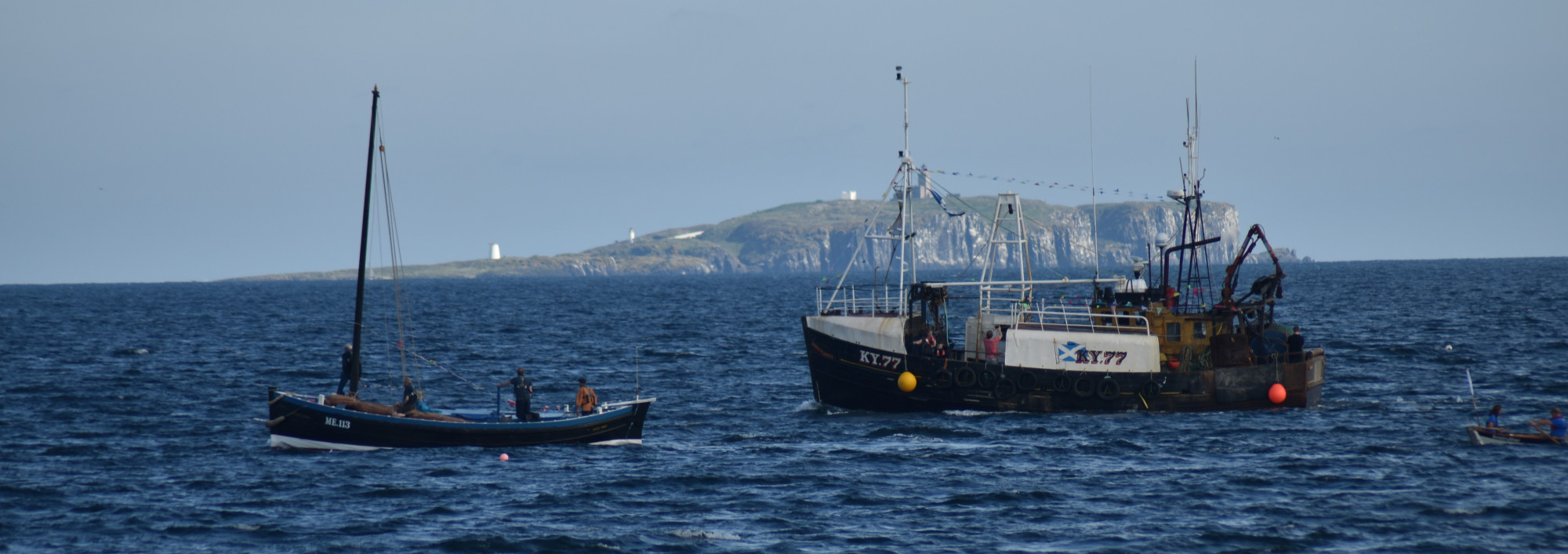

The Cellardyke Echo – 18/1/2017

1815

Last week a boat belonging to Cellardyke while out in the Firth fishing for herrings, was upset, and the crew (a father and son, and another person) unhappily perished. By this melancholy accident, we are sorry to learn, 10 children have been made fatherless.

1826

Fishing Company (Edinburgh)

The Company do not intend, at least in the first instance, to equip fishing boats of their own and hire fishermen, or to teach new and improved methods of fishing. They merely propose to buy the fish from real fishers at Cellardyke, Cockenzie and Eyemouth from whom the Newhaven and Fisherrow boatmen buy them at present. – to prepare smacks for receiving and boxes for packing them – and to make the most effectual means for insuring a regular and early supply for the Edinburgh Market. The mode recommended at first, as most safe and economical, is to contract with a certain number of boat’s crews, on some particular station, for all the fish of good quality they catch. These would be delivered to the company’s agent, packed and dispatched to Edinburgh by a steam vessel, the greater the expedition and certainty in this species of navigation compensating for the additional expense, Captain Carnegie has ascertained from an experienced fisher at Cellardyke (Mr Connolly), that the fishermen there would be quite willing to contract with the company, and that a steady supply could be depended on. The prices as stated by Mr Connolly at this station will surprise the consumers of the same fish in this town. The price for haddocks at Cellardyke has been for years only from sixpence to one shilling per score in the summer, when we have none in pour markets and from eight to eighteen pence in the winter when the fish are in perfection. Last November it was from eighteen pence to two shillings, Cod has been sold there for years at ten shillings per score in summer and eleven shillings and eight pence in winter. Most of the cod that comes to our market can be bought there for nine pence for three fish…. The Cellardyke seamen are very adventurous. In winter they never go less than 8 or 10 miles beyond the mouth of the Firth to the deep sea fishing, and in summer they often go 30 or forty miles to the eastward of the Isle of May and occupy the same ground as the Dutchmen, whose vessels they often board. There are thirty boats in all at Cellardyke, and ten of these Mr Connolly thinks would supply the Edinburgh Market.

1838

New Year’s gift – On Sabbath week, at the close of the exercises of the Sabbath School of Cellardyke, the Scholars presented their esteemed teacher, Mr Thomas Brown, with a handsome copy of Scott’s Commentary, in six volumes, together with a beautifully bound pocket bible, as a testimony of gratitude for his unwearied labours in promoting their spiritual welfare.

1841

The Anstruther and Cellardyke Total Abstinence Society held its third soiree in the independent Chapel here on the evening of Tuesday last, when there was a very numerous and respectable attendance. The president of the society, Mr Fowler, merchant Cellardyke presided. Amongst the speakers was the Rev, Mr Scott of Leslie, who powerfully advocated the cause of total abstinence, and made strong appeals to the consciences of non-total-abstainers, relating a number of suitable and humorous anecdotes that had come into his own observation. The Rev Messrs Thom and Murdoch also delivered excellent addresses, and the Rev Mr Kinninmont read an interesting essay on the ‘diffusion of knowledge’  last though not least a choir of vocal music, led by Mr Dick shoemaker, made up the intervals. Altogether were were highly gratified, and we may congratulate the society on the countenance and support it receives.

1843

Outrageous incident –

On the night of Wednesday the 11th ins, between the hours of eleven and twelve, the house of James Wilson, Vintner, was forcibly broken into by four young men belonging this place and Cellardyke. It appears they were tipsy, and had knocked at the door for admission, which was very properly refused them, on account of the lateness of the hour. They were determined, however, to make way for themselves, and, taking up a log of wood which was lying near, they commenced an attack on the house door, and in a short time smashed it to pieces. They also broke six or eight panes of glass; and, after having forced an entrance assaulted the inmates of the house, some of whom were rather severely hurt. Consequences much more serious might have occurred had it not been for the assistance of some neighbours.

Accident – on the morning of Tuesday the 10th – a man, named James Imrie fell from the top of a granary stair in Cellardyke. in drawing to the door after him, a ring which was affixed to it for that purpose came out, and he was in consequence precipitated to the road below, a height of some 15 or 20 feet. When taken up he was quite insensible, but is now slowly recovering. His leg is said to be broken above the knee.

1846

The great superiority of Elie harbour over all others o the East Coast of Fife, in easterly storms was fully verified yesterday, during the severe storm which raged from that quarter; for before dark about forty fishing boats, belonging to St Monans and Cellardyke, (the greater number, containing eight hands each, amounting in all upwards of two hundred men) took shelter in our safe, but long neglected harbour…

The Cellardyke Echo – 11/1/2017

Just a single long article this week, I’m sure folk will enjoy this.

Published by a regular Cellardyke Correspondent Mrs Rowland

5th January 1931 Dundee Evening Telegraph

Etiquette that is strictly observed by the ‘Children of the Sea’

Cellardyke, that picturesque, Dutch looking fishing town, with its red roofs and quaint name, forms part of the Burgh of Kilrenny, the most easterly of those triple Royal Burghs, known since their amalgamation by the official title of Anstruther.

Anstruther Easter, Commonly called in the East Neuk of Fife ‘Anster’ has been for many years recognised as the business centre of the three towns.

The Ancient Burgh of West Anstruther is now a fashionable summer resort, while the populous and prosperous Cellardyke is the home of the skippers and crews of the Steam drifters now berthed in the Union Harbour of ‘Anster’.

The fisherman’s financial year closes after the return of the boats from the ‘sooth fishin’; the first week of December sees the drifters safe in their home harbours.

 Before the of the month comes the reckoning up of profits and losses, and the ‘pairtin oot’ or apportioning to each crew member of the boats crew his share of the balance left after all expenses are paid.

A successful Yarmouth fishing means a busy wedding season in the fishing towns, the new year being the recognised time for setting sail on ‘ the sea of matrimony’

In the short period preceding Hogmanay, the prospective bride and groom will be busily engaged in getting their future home into ‘ship shape’ order. The forth coming ‘launch’ will be the subject of many comments and much criticism, but none can truthfully predict which of the bridal pair will eventually become ’skipper’

The Dyker Lass is but a bairn in cradle when the first of her ‘providin’ is laid in her kist by her shrewd and thrifty mother. ‘She’ll hae a hoose o’ her ain someday, even though she disna get a man,’ is the explanation given for this early buying of the trousseau.

Thus it happens that our fisher lassies are amply provided with all the household necessities in the shape of sheets, table cloths and towels. They are all possessed of a miscellaneous collection of useful articles presented by friends or gathered themselves during girlhood’s years.

‘The hoose is taen’ shortly before the close of the Yarmouth fishing, and just after her groom’s return, the bride ‘gies up her job’ at the oilskin factory in which she is engaged.

Although she always attempts to slip away quietly and unnoticed by her workmates, all her attempts are usually frustrated. Several pairs of keen eyes are on the watch, and willing hands are ready to pounce upon the escaping bride.

However unwilling the ’victim’ may be, she gives in with the best grace possible, and submits to the ordeal of being ‘ hurled hame’ knowing that the less fuss she makes the more easily she will, be let off.

The substantial works ‘barry’ or hand cart is ready at the ‘big gate’ and the bride, draped in a white lace window curtain, ‘loaned for the occasion,’ in lieu of a bridal veil, is led forth by her attendants, her assembled chums meanwhile showering her with confetti.

The bride assisted to her ‘chariot’ and tied down, while hefty lases apply themselves to the shafts; others harness themselves with ropes to the ‘turn oot’.

A procession is formed, the leader bearing a placard proclaiming ‘Here comes the Bride’ .

With cheers and merry laughter, the happy crowd proceed through the streets to the bride’s home. Nor does distance daunt, for they have been known to ‘hurl a bride hame’ to Pittenweem a distance of fully two miles from Cellardyke.

A delicate situation

In Cellardyke we have our own special and rigidly observed forms of wedding etiquette. With us, the bridegroom’s mother bears all the responsibility of furnishing and setting in order the house for the reception of the youthful pair.

The situation is oft times delicate and even critical, and requires both tact and forbearance on the part of the mother in law and bride to be, in order to steer the bridal barque past the treacherous rocks of discord into the peaceful haven of harmony.

The future home must first of all be freshly papered and painted in readiness for its furniture. The mother in law may invite the bride to be to ‘pick her paper’, that is choose her wallpaper, or she may not.

The prospective wife may also be allowed ‘some say’ in the selection of the furniture. In most cases she is permitted to make her own choice, but only by courtesy of ‘the man’s mither’

The only article of furniture which the happy pair usually purchase together is the ‘nock’ or large wall clock, without which the furnishing of a fisherman’s home is not complete.

The bride’s contributions towards her future abode are the contents of a large and well filled kist, and, of course, her own marriage presents, one of which may consist of a set of ‘cheeny’ from the best maid.

She also ‘fills the bed’ that is, provides blankets, sheets and all necessary bedding.

About a week beiore the wedding, a visit is paid to the fashionable shops of one of our large cities, in order to purchase the bridal array.

The bride, who is accompanied by the bridegroom’s mother, is here allowed to exercise her own taste. But her expenditure is limited by the length of the bridegroom’s purse, for he, through the medium of his mother, pays all expenses connected with the house furnishing, as well as with his bride’s outer adornment for that ‘day of days’.

The bridal outfit usually consists of a dress, coat, hat, gloves, stockings and shoes. In these modern times, however, our bonny brides may prefer a conventional wedding gown and veil, and her wishes are strictly carried out, for ‘braw waddins’ are the rule, not the exception in Cellardyke.

Friday evening is invariably wedding night in ‘oor toon’ and on the previous Sunday the banns are proclaimed in the Parish Church of Kilrenny.

On the Friday evening, just after the engaged couple have left the bride’s house in order to ‘pit in the cries’ the youngest member of the crew of the bridegroom’s boat arrives at the home of the bride’s parents.

The visitor is given ‘the bride’s piece’ and a dram, twelve shillings and sixpence to buy and bottle of ‘whusky’ and the specially prepared ‘marriage flag’ consisting of vertical stripes of red, white and blue cloth.

Down to the boat goes the youth, and in the darkness of the evening, hoists the marriage flag – red stripe next the pole – to the top of the mizzen mast.

There it flies and the ‘youngest o’ the crew’ must see that it is kept flying until after the marriage ceremony, when it is quietly hauled down and later presented as a keepsake to the newly wedded wife.

Lucky the wedded couple whose marriage flag ‘blaws in a breeze o’ wind’ the more boisterous the breeze, the stronger the luck. Happy the bride, the blue of whose flag is ‘blown awa’ but happiest of all the married pair whose wedding flag ‘blaws clean awa a’ th’gither’.

The hoose fillin

The ‘hoose fillin’ takes place on the night before that appointed for the ceremony. The furniture which has arrived sometime during the week is now arranged by friends of the bride and bridegroom. Curtains are put up, pictures hung, and everything set in readiness for the homecoming of the newly wedded paitr.

At this function the bridegroom’s mother, as usual, is mistress of ceremonies, and all arranging is done under her superintendence. It is she ‘who makes the beds’ while the ‘best maid’ arranges the bride’s china in the cupboards.

It is not etiquette for the bride to be present at ‘her ain hoose fillin’.  The bridegroom may look in for a little while to express his opinions regarding placing of various articles or to ‘gie a haund wi’ the furniture, but on the first sign of ‘bed makin’ he retires, otherwise he might be caught and tossed in the blankets by his mischief loving chums.

With jokes and laughter the hoose fillin proceeds merry apace. Light refreshments are served and songs are sung. The fun being kept up until the early hours of the morning.

The marriage ceremony may be performed at the manse or in the town hall. Seldom are church weddings held in Cellardyke.

Before leaving her parent’s home, the bride stands in state for a while friends and neighbours flock in to ‘see her dressed’ in her bridal array, to express her admiration and to give final congratulations and words of cheer.

The coming of the bride’s car is the signal for the bairns to gather round in anxious anticipation of the shower of ‘bawbees’ which is invariably rained on them.

After the marriage ceremony, the bride and bridegroom proceed at once to their own house.

There the bridegroom’s mother is in readiness with a huge cake of shortbread, which is broken by her over the head of the newly wedded wife as she crosses the threshold of her own home. The falling fragments of cake are immediately pounced upon by

 The waiting crowd of bystanders, and are supposed to bring plenteous good luck to the recipients.

A poker is afterwards presented to the young wife with the injunction to ‘redd her ribs’ that is clear away the ashes from the bars of the grate.

After a brief interval in their own home, the young couple proceed to the hall to ‘cut the cake’ and receive the congratulation s of their friends. The handsome wedding cake is provided by the parents of the bride, but the marriage supper is supplied by the bridegroom.

The supper table, which is spread with a variety of substantial viands, is now surrounded by a jolly crowd, who have evidently not forgotten their appetites, but show hearty appreciation of the feast.

Nor are those friends who are unable to be present forgotten. ‘Suppers’ consisting of heaped up plates of beef steak pie and other dainties, are carried to absent ones by willing helpers. Many a lonely old body in Cellardyke has been cheered by a share of wedding supper.

A dance follows the supper, the festivities being carried on until ‘the sma ‘oors o the mornin’ Long before the merriment is over the happy pair for whom there is no honeymoon have  ‘slippit cannily awa’ hame’

Sunday sees the ‘kirkin o the bride’. Bride and bride groom, best man and best maid, together attend public worship in time honoured fashion of their ancestors.

In the quaint old town of Cellardyke the fisher las weds a fisher lass; who but she can mend the nets and tend the gear.

Our lads in the fishing seasons visit many towns and districts far from the shores of the Forth; thus we have bonny lasses from Lerwick and Lossie, and fair maids from ‘Heymouth’ (Eyemouth) happily wed in Cellardyke.

We are a friendly, sociable folk, we fishers o’ the East Neuk o’ Fife, so whether the brides are ‘Norlanders’ or ‘frae the sooth countree’ we give them all a hearty welcome, for are they not, as we are ‘Children of the sea’?

The Cellardyke Echo – 4/1/2017

1917

One of the oldest and best known fishermen on the East Coast was Mr Martin Gardner, Cellardyke, who has just died at the age of 82, throughout his life he had been closely associated with the fishing industry. He manifested a keen interest in the public affairs, being some time a member of the Kilrenny town council, and until quite recently also a member of the Parish council. He was also for a time Harbourmaster at Anstruther. He was the oldest elder in Cellardyke Parish church, and was one of the oldest members of the St Ayle Lodge (No95) of Freemasons.

1923

Over 100 poor and aged of Cellardyke each received half a ton of coal from Mr George Fowler, Binghampton USA, a native of the town.

1925

It was purely due to ignorance, said Mr Ian W MacInnes, Cupar, who tendered a pleas of guilty at Cupar Sherriff Court yesterday on behalf of Margaret Boyter, grocer, 69 George Street, Cellardyke who was charged with failing to exhibit a label on some margarine exposed for sale.

Mr MacInnes said the accused opened a little shop in June in order to provide some form of livelihood for her father, who was a fisherman and unable to work. The rental of the shop was only £6 10s. She had no business experience, and she was greatly surprised when the inspector came in and pointed out that there ought to have been a label on the margarine.

The fiscal said he was satisfied with the explanation.

The Hon Sheriff Osborne said he would not inflict a penalty beyond the expenses 10s.

For a similar offence committed at their premises at Crail, William Fisher and David Donaldson, partners of the firm of Fisher and Donaldson, bakers and confectioners were also mulcted in 10s.

1928

The theft of a Tam o Shanter from Kingsbarns public hall was admitted by James Bett, 36 West Forth Street, Cellardyke, at Cupar Sheriff Court yesterday.

Appearing on behalf of the accused, Mr Ian McInnes, W.S. Cupar stated that on Christmas Eve, Bett attended a dance at Kingsbarns. He was one of the last to leave the hall and when he entered the cloakroom he found that his cap, a new one had gone. It was snowing heavily, and as he had about eight miles to walk home, he donned a disreputable looking Tam o Shanter, which he saw hanging up. It was his intention to return the Tam o Shanter to the hall as soon as he possibly could. When he was on his way home he was stopped near Crail by the Police and asked to hand over the Tam o Shanter.

 Sheriff Dudley Stuart imposed a penalty of 5s.

The entries for the annual show of Anstruther and District Cage bird Society exceeded last year’s total. The BFCC medal for the best bird in show was awarded to Mr W Dowie, Methil, the runner up being Mr Duncan Pittenweem who also secured a special award. The honour for the best hen in the show went to W Motion, Cellardyke..

1930

Subjects at 6 Dove Street Cellardyke for sale.

For sale by public roup, by warrant of the Sheriff, in an application for division and sale, Within the Council Chamber, Anstruther Easter, on Wednesday 29th Day January 1930, at 2 o Clock Afternoon.

That tenement of dwelling houses, with pertinents, situated at No 6 Dove Street, Cellardyke, and occupied by Mary Gourlay, Alexander McRuvie and George Gardner.

Rental £16 15s feu Duty nominal

Reduced upset price £125

Further Particulars from D and A Cook, Solicitors, who hold the Title deeds and articles of roup.

Advert placed by W s Bonthron Anstruther 9th Jan 1930

The Cellardyke Echo – 29/12/2016

1905

At Pittenweem Burgh Court yesterday, before a full bench of magistrates, Walter Myles, confectioner Cellardyke, pleaded guilty to having on Sunday, the 17th inst., at the Commercial Hotel, James Street, falsely represented that he had come from Colinsburgh, by which he obtained a glass of whisky and a glass of beer. Provost Christie passed sentence of a fine of 15s or ten days imprisonment.

1908

An interesting function was held in Cellardyke town hall, when County Committee certificates for navigation were presented to those fishermen who attended the navigation class.

The certificates were presented by Major Anstruther Gray MP who remarked that it was a source of great gratification to know that of a total class of fifty six, forty one men had been successful in taking certificates……

1909

Miss MacMillan, M A Edinburgh of Edinburgh’s National Women’s Suffrage Society, which is affiliated to the WSPU., addressed a largely attended public meeting in Cellardyke town hall on Tuesday evening. She said that at a meeting of her society recently it was decided to support any candidate, of whatever political opinions who pledged himself to vote for a Bill in Parliament enfranchising women.

A crowded meeting was addressed by Major Anstruther Gray, M.P for St Andrews Burghs, in Cellardyke Town hall. He first dealt with fishery questions, and said that when the unionist Government was in power the radicals were constantly condemning that Government for allowing trawling in the Moray Firth. Action was taken by the late Lord Linlithgow, and a master of a foreign trawler was convicted and imprisoned. When the present Government came in, instead of backing the Scottish Fishery board and the law of Scotland, the Scottish office was ordered by the Foreign Office to have the conviction quashed, with the result the Moray Firth was again open to foreigners, but still remained closed to British trawlers…. It was time the Government passed a law prohibiting fish caught by foreign trawlers being landed in English ports. That was all very well but he was strongly in favour of either opening the Moray Firth to everybody or closing it to everyone (Cheers)  He thought the three mile limit should be enforced right round our Islands….. there was no heckling and votes of thanks were passed..

1910

A distressing case of suicide was brought to light on Tuesday morning at West Forth Street, Cellardyke, when James Watson (51), was found dead in a loft or garret, hanging from one of the rafters. It seems that Watson’s non-appearance at breakfast roused alarm in his household, and a search was made for him. It was noticed that the key for the loft was missing, and his son-in law on entering found the unfortunate man’s body suspended from the rafters. Medical aid was called, but life had been extinct for several hours.

1911

The Rev Robert Gardner MA, Cellardyke has been appointed assistant in the Parish of Church, Peebles, and will commence his duties on the first Sunday in the year. He starts his career with the best wishes of a large number of friends in the district.

As usual the old folks attending Cellardyke Parish Church received their annual treat from Mrs Oliphant, Mayview.

1912

The fishermen of Cellardyke met in the town hall, when Mr Bertram Dunbar, Secretary of the East Coast Fisheries Association, delivered an address on Trawling for Herrings and Gun firing in the Forth. Mr T S Laverock president of the local branch presided. Mr Bertram said that during the last few months the burning question in fishing circles had been the barbarous for of fishing known as trawling for herrings. The murderous nets of the steam trawlers swept along gathering in all sorts and conditions of fish, vast numbers which are immature. As every fisherman knows the herring was a very delicate fish, and once enclosed in that submarine trap its career was ended…… Another grievance was gun firing in the Forth . The speaker said he had considerable correspondence with the Admiralty on the subject. In their last letter the Admiralty stated that gun firing would be confined to the mouth or outwith the Forth as far as possible, but that as Rosyth was an important Naval Base, it could not be expected that the Forth would be free from gun firing…. On the motion of Skipper Martin Gardner, it was agreed to meet the Skippers and ask them to get their crews to pay 7s per crew out of expenses, thus trying to get every fisherman to become a member of the Society….

This next report was briefly mentioned at this time last year.

1915

While many heroic and glorious deeds on land and sea are being recorded at the present time, none could possibly excel the daring, undaunted courage and cool resource of captain Michael Doig of the Aberdeen trawler Monarch, and his brave men in rescuing the crew – six in number – of the drifter Success, which was wrecked off Donmouth while on a voyage from Berwick to Peterhead. The clever handling of the Monarch in the tempestuous sea which raged along the Aberdeenshire coast was unquestionably the means of saving six men from a watery grave, and the remarkable coolness and gallantry displayed in the face of certain destruction, if anything miscarried in the navigation, calculations, affords another striking example of men willing to lay down their lives for their fellows. When such noble acts are recognised on land, it is hoped that the men of the Monarch will not go unrewarded at the proper quarter.

Captain Doig, a well-built cautious and fearless looking type of the hardy Scottish Fisherman – he is a native of Cellardyke and 43 years of age – gave an account of the rescue to an Express reporter with the modesty characteristic of the man. They had been fishing at the grounds off Peterhead, and during the night it came on to blow very heavily, and as they made their way up for Aberdeen harbour an angry sea was raging, betokening more dirty weather to follow. They came dodging up easy ahead, waiting to see if there was any chance of running the bar, but it was out of the question on account of the wild waves that were lashed into a fury at the harbour mouth. About a mile and a half off Donmouth the Skipper had his attention had his attention directed to the ill-fated Empress, which was making for the harbour, and he remarked to the second fisherman that they would watch how she got in. Just then they saw the Success, and heard her signals of distress; the whistle was blowing and the crew were waving a flag. They were trying to get off shore but they could not manage it. No headway could be made, and so violent was the storm that although full steam was up the vessel was going astern.

Wild billows raced across the bay, and the Monarch was swept from stem to stern, huge lumps of water dashing on board the craft, and every minute imperilling the lives of the fishermen. It was a spectacle that would have daunted most men, but Skipper Doig kept up a stout heart, and, having once made up his mind, determined to go to the assistance of his distressed comrades. It was a tremendous gale and getting worse all the time, the huge seas were about swamping both vessels, and the Success being a lighter craft, was tumbling about like a cockle shell. She was right on the leas shore, and, to make matters worse, was unmanageable. The Monarch had to turn right round about to get up the weather side of the Success and ascertain what was the matter with the boat, which was rolling about in all directions, sometimes alongside and the next time nearly half a mile apart. They could not get spoken to the distressed vessel on account of the heavy sea and the wind, but after some manoeuvring the Monarch dropped a buoy overboard with a line attached to drift down to the success for the purpose of towing her out to seas. Connection between the two vessels was successfully established, but the tow rope had not been aboard the Monarch five minutes when it snapped..

The skipper of the unfortunate craft then declared he could not steam to sea and wanted out of the boat all together. Then captain Doig skilfully manoeuvred his vessel into position again, and at the end of eighty fathoms of line tied a buoy and half a dozen lifebelts, one for each of the crew of the Success. These he dropped overboard and they drifted towards the success and were hauled on board. Captain Doing made signs to the crew to make themselves fast with the lifebelts and they would be dragged through the water to the deck of the Monarch. When the first one plunged into the wild breakers and was safely got on board, the rest quickly followed, and were all safely landed in half an hour in getting alongside the Success. James Reid the Skipper’s son saved the situation on the doomed craft. He made everyone fast, and stuck to the last himself. He was a very plucky chap, was the comment of Skipper Doig.

 Some of the men were very exhausted, and the skipper had a narrow escape from being jammed between the two vessels, but Captain Doig seized him by the shoulder and got him on board. The crew had a marvellous escape and but for the skilful seamanship of the rescuers would all in probability have perished. Captain Doig was in the Wheelhouse with George Fowler the mate. Four of the windows were smashed, and the wheelhouse was half full of water, but fortunately no one was injured.

The Monarch after the rescue steamed towards Gridleness, but the sea was too heavy to risk entrance to the harbour, and the boat put out to the bay all night, returning the next day. By that time there was only one loaf among fourteen, and very little water. They could not stay out longer, and ran the bar in the face of a terrible sea, and it was a big risk even at that time.

 The crew of the rescuing vessel were

Captain Michael Doig

George Fowler, mate

William Beveridge, second fisherman,

John Duncan, deckhand

John Duncan , deckhand,

Alexander Robb, Chief engineer

William Leiper, second Engineer

Robert Bowe, Cook.

Captain Doig has been a fisherman all his life, on sailboats, drifters and steam trawlers, and has been seventeen years on board the Monarch which belongs to his father, himself, and Mr Davidson Fish salesman.

The Cellardyke Echo – 21/12/2016

1894

Last night the Gladstonian Candidate for the St Andrews Burghs, addressed a meeting of Cellardyke Fisherman and others in the Town hall.

Provost Martin presided. Mr Paton held that the fishermen should be represented on the Fishery Board; no trawler should be allowed to come within 10 or 12 miles off shore; every trawler should have a certified Captain, and if convicted of breach of the By-laws within enclosed waters, his certificate should be forfeited. The Government should give generous grants of money for the improvement of Anstruther and other harbours in Scotland. After several questions had been answered, a vote declaring Mr Paton a fit proper candidate was unanimously carried.

Leith      –              Yesterday over a dozen Fife Fishing boats from Cellardyke and St Monans put into Leith for Shelter. The boats were all herring fishing outside the May Island and at 11 o clock on Monday night a terrific SE gale came on. Several of them lost their nets. Some of the boats were clean and others did not catch more than two boxes of herring.

A number of buoys and fragments of nets were washed ashore at the west end of St Monans. By the initials on the buoys they were supposed to belong to Cellardyke fishermen, who have probably either broken or cut them adrift during Tuesday’s gale.

1896

Sudden death – On Monday Morning, James Christie, Carter, Shore Street Cellardyke was found dead in bed. He had been in his usual health the previous day and retired to rest at the usual time. Heart disease was the cause of death. Christie was 59 years of age.

1899

Evening classes – Cookery and laundry classes were opened at Strathmiglo and Cellardyke with a satisfactory attendance.

At a public meeting of Cellardyke fishermen, it was unanimously decided that on the approaching herring fishing at Anstruther no herring or other fish shall be sold or discharged before 7.30 o clock each morning so as to give a fair field and no favour to all the fish buyers and merchants, and to allow of telegrams to be received from other centres before the fish are sold. It is understood that the merchants and curers have acquiesced in this decision, and that stranger fishermen who come to prosecute the fishing will also loyally abide by it.

The winter herring yielded 15, 775 crans and increase of 10 562 over 1898, it was the best season since 1892. The spring deep sea fishing was prosecuted with a fair measure of success by the fishermen, while the Drave at the north ports was peculiar in the respect that exceptionally high prices were realised. Some of the Cellardyke boats were very successful having upwards of £600; while none of the fleet were below £100, the average earnings was close on £200. The boats returned from the Scarborough and Lowestoft and Yarmouth fishings on the last week of November, the season having proved to them to be the best on record so far as the money earned was concerned. The average of the 25 crews engaged was fully £500 and this works out a gross total of £12000. Assuming that the salesman commission and expenses were £2000 this leaves a large sum of £10 000 as having been brought from the south by these crews, some of the members of which have received fully £100 per man as their share. Never before has such a lot of money been brought back, and the result of it is already seen in the orders that are being given for new boats of about 70ft in length..

1900

Mr Fulton (Pittenweem) has just taken an order to build a large sailing liner for Mr William Brown, Cellardyke. Having a good working staff at present, he anticipates having all the orders on hand executed by the first of next Lammas fishing.

1901

The Steam Trawler Lochnagar, belonging to the Loch Line Steam Trawling Company, which left Aberdeen for the fishing grounds on Thursday, returned to the Albert Basin on Friday, and the captain George Gimmer reported having lost overboard on of his deck hands, Robert Dickson, residing at 70 Wales Street. It appears that while the Lochnagar was about 100 miles off Aberdeen, Dickson was struck by the boom of the after mizzen and knocked overboard. The alarm was at once raised, and a search made for the missing deck hand, but in vain. Deceased was a native of Cellardyke, was married and leaves a widow and five children to mourn his loss.

1902

Dundee trawler fatality.

To Anstruther and Cellardyke people the fatal accident on board the trawler Stork appealed very forcibly. Thomas Ritchie was a native of Cellardyke and his early years at sea were on local boats but his skill and intelligence had won for him a place as master. The Stork did well under his command, and only a month ago he was revisiting old scenes and too away a bride from Anstruther. Great sympathy is felt for the widow at such a trying moment.

1904

Fatal accident enquiry……. The last had reference to the death by drowning of John Deas Fisherman and Alexander Gilmour Deas, assistant fisherman, 25 Rodger Street Cellardyke, on Monday 25th July. The evidence showed that the deceased were in the service of their father James Deas, on board the Fishing Boat Thistle KY 372, and on the morning in question were engaged on the Thistle while it was leaving Anstruther harbour for the North herring fishing, and when the boat was fifty yards from the pier. Alexander was accidentally struck by the mainsail, and knocked into the water. John leaped into the water to go to his assistance, and they were both drowned.

The Cellardyke Echo – 14/12/2016

1880

Two Cellardyke boats, The Margarets, David Davidson, master, and the Flower of the Forest, John Stewart, master, were caught in what seemed to be the vortex of the storm in the offing off Burnmouth on Friday afternoon, these boats had escaped into Holy island from the storm of the previous night, but a new and worse peril now assailed them, as the last sail had scarcely been taken in when the squall was upon them like the sweep of a hurricane. One hope was left, the anchor might hold, and this was being done as men work on the verge of despair, when the fishermen of Eyemouth, in the true spirit of the sea, launched one of their big boats in order to help the struggling crews. It was a critical moment, but, with four of the rescue party in each of the boats, sail was once more made for the harbour. The old port and the cliffs were crowded with spectators as the little craft came driving through scud and foam – now on the port, now on the starboard tack, and all but overborne in the wrestle with the gale. Once, indeed, the struggle had all but ended. The Margarets was shooting past with the grim hurkers white with foam on the lee, when the sheet parted, and with it seemingly the last chance for one and all. More than one brave man turned to take a farewell look at sea and sky, but thanks to the Providence which had lead the Eyemouth men to the rescue, for now, with a pilot at the helm, the boat was threaded, as through the eye of a needle, to a safe offing, and eventually into the harbour, where her consort had also in the meantime, made a good landing. Nor did the kindness of the people of Eyemouth end till every comfort had been provided for our wet and weary crews.

A petition was submitted to Anstruther Harbour board by 56 Cellardyke skippers, asking to replace the leading lights, as being absolutely necessary for the safe navigation of the harbour…. The committee was instructed to meet with a deputation of the fishermen to fix their precise situation and bearing

1881

Thursday was observed as the fast day in the Parishes of East Anstruther and Kilrenny. There was also a service in the Free and Mission services. As a rule, there was a Sabbath like air about the coast; indeed the only work actively engaged in was the demolition of the old Town House in Cellardyke.

1882

A meeting of the master bakers of the East of Fife was held in the Royal Hotel, Anstruther on Saturday evening. The trade was well represented – Mr Morris, ex provost of Earlsferry being in the Chair. The question of the night was the misunderstanding which led the other week to a reduction of the 4lb loaf to sixpence in Anstruther and Cellardyke, while elsewhere it was and still is being retailed at 6 1/2d, the initiative it appears to have been taken by one of our local bakers, who justifies the step by the allegation that certain of his brethren had in breach of faith given a present in the way of cakes to their customers. The point was keenly, we may almost say hotly discussed at the meeting, but we understand no compromise or arrangement could be come to, so that the anomaly as regards the price of the ‘Staff of Life’ continues with us as before.

1883

Mr Williamson, MP speaking on Saturday evening at Cellardyke mentioned that he had done all he could to have a light for the Carr rocks. He had been told that there would be a lighthouse on the land provided with apparatus for signalling during fog.

This was part of a greater meeting

Mr Williamson concluded by quoting statistics relative to crime and liquor licences in Fife (excluding Kirkcaldy which had a separate jurisdiction)  there were 1032 crimes committed in the county the previous year, or one for every 138 inhabitants..  In thirteen of the parishes there were 250 licences or one for every 168 inhabitants and the convictions were 578 or one for every 73 inhabitants.,,,in six parishes there were no licences and only two convictions, or one for every 1600 of the population.

1884

Great sensation has been caused in the fishing town of Cellardyke by the Elopement of a married fisherman named Robert Cunningham (Wood) belonging to Cellardyke with a married woman. It appears that Cunningham while at the Shetland fishing in Baltasound in June got very intimately acquainted with a woman who was working at a curing station. At the end of that time the boat in which he was engaged left for Anstruther, and after a short interval proceeded to the fishing in Aberdeen. Near the end of September the crew went to Lowestoft for the herring fishing, where it seems, that Cunningham was joined by the woman, who, it is alleged, had been refused admittance into her husband’s house after he had made inquiries as to her conduct at Balta Sound. At Lowestoft the two cohabited and at the close of the fishing, Cunningham refused to go home in the boat with the rest of the crew. However, they went off without him, and nothing more was heard of him until yesterday, when a telegram was received by his wife stating that Cunningham accompanied by the woman in question had left the country, but giving no information as to their destination. On inquiries being made by Mrs Cunningham the whole story came out, and yesterday two fishermen left Anstruther for Lowestoft to make an endeavour to find Cunningham. Besides his wife, the runaway left four children.

1885

16th Dec the Robinson Crusoe Statue was unveiled, made by Mr T Stuart Burnett.. a procession consisting of two men on horseback representing Crusoe and Man Friday was followed by Largo Brass band and then the guests, and a further procession of bobbin winders, guarders , other net workers from the Cardy works, the fishermen and fisher lasses of Largo accompanying the fishing boat ‘ Robinson Crusoe’ mounted on a cart, fish cadgers, boat builders and finally the cork cutters —- representing Cellardyke amongst the guests was Bailie Martin

Arbroath – A very large boat the Hawarden Castle, of Cellardyke came in windbound. She is the largest boat ever seen in our harbour… possibly KY 346 and only 56ft of keel..

The Cellardyke Echo – 7/12/2016

1870

Much interest was felt in some circles here by the visit, a few days ago, of Captain Peter Hart, the master of a Dutch Schooner, who is well known in many of the East Coast ports for his gifts and piety..It appears while on a homeward journey his vessel was damaged and put in for repairs, giving the good skipper an opportunity of being in Cellardyke. There is enough of interest about a preacher being a sea faring man and a foreigner to secure general attention, but in any position or under any circumstances Peter Hart will be found no common man. He is a burly dark complexioned individual, with a broad Dutch face, which lights up with a singular earnest and benignant expression when he speaks of his favourite theme of religion. He has a good command of English, acquired in the course of his voyages, but this is never so apparent as when he quotes our version of the scriptures, which he does with remarkable ease and appropriateness.  His massive well defined forehead wold give a phrenologist a high opinion of his capacity; and no one can listen to his discoursing, so rich with graphic illustration, and piquant with quaint sayings, without being struck with his intellectual strength and fruitfulness, and however rude that discoursing may at times sound to ‘ears polite’ there will be few sleepers when the Dutchman addresses the congregation. ‘Oh friends let me warn you all, de debil don’t go clattering about with clogs, him slip on stocking soles, not like him ugly black self, but with a bible in him’s oxter’   Captain hart seems to have formed some cherished friendships in Cellardyke, where he has always a cordial welcome, and readily secures a numerous hearing on the occasion of a meeting. We are told that on ship board he is always ready to engage in devotional exercises with those around him, and that meetings are often largely attended both by British and foreign sailors, many of whom gratefully acknowledge the good and salutary influence of the pious Dutchman.

At a meeting of the Parochial board of Kilrenny on Wednesday last, it was agreed to distribute half a ton of coals to each of the registered poor of the Parish, about the end of the year.

The Fishing our boats all except four have returned from the Yarmouth Fishing, twenty five in number, and although the successes on the whole have been varied, our fishermen have made a very good thing of it. A good many have grossed £350 or upwards, and perhaps £250 may be taken as an average. It is likely that the result will induce a good many to try their luck in that quarter next season.

Death of Captain David Watson in Australia – Intelligence was received last week of the death under peculiar circumstances of Captain Watson, a native of Cellardyke. From the particulars it appears that Captain Watson had bought a ship and taken it out to Freemantle or Perth Australia, where he sold the vessel. He intended to return home by the regular mail steamer, but before reaching the port of departure it was necessary to cross a tract of unpopulated land about 250 miles in extent. Previous to starting on the journey, Captain Watson remitted the money received for his ship to his friends in London, keeping about £100 for his expenses returning home. The only means of conveyance across the tract of land above referred to was a small mail gig. In which, along with two other persons the Captain took his place. When they had gone about 70 miles on their journey the gig broke down in a bog or swamp, and while his companions were getting the vehicle repaired Captain Watson said he would walk on, and they could overtake him. On again resuming their way they could not discover their fellow passenger, but as police stations are situated every ten miles or so along the road, it was thought that he had succeeded in reaching the next one. This was found, however to be erroneous, as on their arrival at the station nothing had been seen of him. The mail gig having to continue the journey in order to catch the steamer, the alarm was given to search the road in the hope that the missing gentleman had wandered from the track and lost his way. This was done but it was 14 days afterwards before the body of Captain Watson was found lying not far from where th gig had broken down. When th last intelligence left Australia, the investigation into the circumstances of the case was still going on. Another Correspondent writes :-  Captain Watson was over 50 years of age. He was one of those energetic self reliant spirits from this place, who from the humble vocation of the fisherman have acquired position and fortune by their own good conduct and force of character. He was for many years one of the best known Captains in the East India and China Trade. The unfortunate gentleman, who was twice married, leaves a widow and daughter to mourn his untimely fate – their affliction being all the more that his homecoming was daily expected.

1872

On Wednesday the largest take of Haddocks landed by any of our Cellardyke boats this season was brought by Skipper Charles Carstairs. It amounted to over 31 hundred weight. But this may be said to have been the one prize of the lottery, as the success of the other hardy crews who buffeted the billow and breeze only ranged from 2 ½ – 11 ½ cwt. Singular, however as Skipper Carstairs fortune was, it was exceeded by Skipper Archibald Peebles of pittenweem, who landed 34cwt at Anstruther on Saturday. Haddocks have been selling very cheap on the Fife Coast this week, considering how the late storms must have affected the fish supplies of the large cities, as they only realised from 10s to 10s 6d on Tuesday ; but the fine take the next day brought 13s 6d per cwt. The fleet of boats fishing haddocks belonging to Cellardyke are at present 40.

1873

Yesterday while the crew of a Cellardyke fishing boat were preparing to cast their nets about 30 miles from land, one of them, named John Wood, was engaged in passing the end of the sail with a hook, when the boat gave a lurch and he was precipitated into the sea. Every exertion was made to save him, but, being unable to swim, Wood Sank in minutes. Wood was married only a fortnight ago.  (The Boat was his Father’s the Anne of Cellardyke)

1874

Three fatal cases of Scarlatina have been reported in Cellardyke during the last nine days. One of these was a fine girl of three summers, the child of Mr James Dick, fisherman, Cellardyke, who died on Friday; another was a son of Robert Thomson’s, whose sufferings closed on the following day in his sixth year; and the third victim was a promising boy about thirteen years of age, who was reft from the household of Mr John Dickson.

On Thursday Morning Mr Robert Cunningham, the oldest fisherman in Cellardyke, breathed his last at the ripe old age of eighty nine.

1875 – The start of December the papers were full of the disaster which struck the East Neuk Fleet heading home from Yarmouth and Lowestoft. The three St Monans boats lost, Beautiful Star, Thane and Quest are still remembered in a memorial stone carved like a Fifie in Kings Lynn Cemetery.. But also lost were two Cellardyke boats.

‘Janet Anderson’ KY 1176, and ‘Vigilant’ KY 1214 (which had only been launched that summer)

Crew of the Janet Anderson

James Murray, Skipper aged 26 who was to have been married on his return home,

Andrew Stewart 34, 4 children one being born a week before the disaster.

William Bridges,  22 married 1 child

James Walker of Kingsbarns married 4 children

Alex Lothian 54, Married 4 children

And two unmarried cousins from Portaskerrie in the North of Scotland

Crew of the Vigilant

Robert Stewart Skipper, 42, 4 children

William Stewart, 45,  1 child and pregnant wife

James McRuvie 45 4 children including his son James aged 16 who was also lost with this boat

Alex Doig, 32, 6 children

Leslie Brown 19 un married

Also lost in the storm

Alexander McRuvie, 17, Lost over board from the Excelsior

Also John Watson was washed overboard

And others hrt badly ion other boats.

Cellardyke lost 15 men, St Monans lost 21 and 71 children in the two towns made fatherless

The Cellardyke Echo – 30/11/2016

1825

The sloop Industrious Mary, which lately struck the Carr Rock, and went to the bottom, has, by great exertions, been weighed by a few boats belonging to Cellardyke, and taken to Crail harbour, where she now lies to be repaired. The cargo was all lost. A subscription has begun on behoof of the owner.

1844

This winter throughout has been very unprofitable to the industrious fishermen of the east of Fife, there being no fish inside the island of May. In former years a fair livelihood could be made there being cod, haddock throughout the whole of the Firth of Forth. At present the boats must be 12 or 15 miles east of the May Island, in the German Ocean, before fishermen can get anything like a fair remuneration for their labour. The boats of St Monance are of a smaller size than either the Cellardyke or Pittenweem ones, making the sailing dangerous in these strong westerly gales so prevalent at this season of the year. On Thursday week, the boats got to a place where the finny tribe resort and had a fair take.

1860

George Watson, carter of Cellardyke pleaded guilty to a charge of stealing some sacks from a farm in the neighbourhood of Crail and was sentenced to be imprisoned for 20 days.

1861

One of the Cellardyke fishing boats which put into St Andrews harbour on Thursday evening on account of a strong gale from the South, having been moored alongside a schooner which was lying in the harbour, and the fishermen had the occasion to board the Schooner in order to reach the shore, one of them in the act of crossing in the dark, the hatchway not being covered, fell through its hold and dislocated one of his thigh joints. Immediate assistance was rendered to the poor sufferer, and medical aid was procured with the least possible delay, and we understand he is progressing favourably.

1862

One of the large Cellardyke boats was this week purchased and dispatched for England, for the purpose of being used as a model for others which are to be constructed of iron for the fishermen of that coast.

On Saturday, an accident of a very serious nature occurred at Mr T Cormack’s saw mills Cellardyke, to one of the sawyers named David Wallace. It seems that while feeding one of the large circular saws, it struck on a knot in the wood and instantly threw the log over and squeezed Wallace’s left hand upon the face of the saw, which in a moment cut off the thumb and forefinger, and otherwise tore the hand. The poor fellow was immediately conveyed to Drs Black and McArthur, who required to make some operation before dressing it.

In another paper on the front page adverts……

Wanted immediately, a steady, trusty and experienced man for a saw mill, Apply to T Cormack, Cellardyke.

1863

Concert – On Saturday evening last week a concert of vocal and instrumental music was given in the infant schoolroom here, by and for behoof of, the brass band of Anstruther Rifle Corps……. The schoolroom being so crowded that many failed to obtain admission. In addition to several members of the band – which performed in the course of the evening a number of popular tunes in excellent style – Messrs T McGrael, Dundee, J Duff Cellardyke and Mr W Brown , Pittenweem, also appeared as vocalists, and the very demonstrative applause and frequent encores they received, testified how much their talents were appreciated by the audience. Not the least attractive feature of the entertainment was a ventriloquial colloquy given by Mr Thomson, with that spirit and humour which has rendered his name famous over the county. We understand that nearly £6 was realised on the occasion.

The reckless manner in which several parties, having charge of carts, are in the habit of driving through the streets of this place has become a subject of general complaint, from the danger to which the inhabitants are inconsequence exposed. As the practice is most frequently indulged in on the return of the boats from the sea, when the streets are thronged by the bustle and excitement characteristic of such occasions, the danger to lives and limbs of the lieges – especially children and aged persons – is of a most imminent nature. This will generally be understood when it is stated that the main street is so narrow as to scarcely admit in some places of two carts passing each other, without encroaching on the footpaths, which by the way, are rendered, at these times altogether unavailable for passage, as, in addition to the ordinary obstructions of raised sunk doorsteps, they are covered, nearly from one end of the town to the other with sculls and fishing gear. The frequency with which accidents have happened is a proof how urgently the matter demands the attention of the authorities, who, it is to be hoped, will ere long adopt such stringent measures as will effectually prevent its occurrence in future.

1864

A meeting of the Cellardyke fishermen was held on Tuesday evening for the purpose of considering the necessity of having a storm signal erected on the shore for the use of fishermen and others… after considering the matter, it was agreed to memorialise the Lords of the Admiralty to sanction its erection, and to forward for its use at this port the official telegrams forecasting the weather. The proposal was regarded by some present as a sort of innovation on their old and somewhat stale method of reading weather prognostications, but there can be no doubt that a storm signal in operation here would sometimes prove immense advantage to the fishermen. The proposed site for its erection was on the end of East Anstruther East pier.

Wanted. Two or three good workers on net machines, apply to Sharp and Murray, Cellardyke

1865, one year on

Sharp and Murray are advertising again for 2 good net workers

The Cellardyke Echo – 23/11/2016

1930

There has been no poll in the Anstruther Harbour Commission election, there being three candidates for three vacancies, and Mr CS Ingram and Mr Di Mitchell have been reappointed. The New member is Mr Martin Gardner who takes the place of the late Philip Gardner, Cellardyke.

1934

A concert under the auspices of Cupar Holiday Development Association was held last night in the Duncan Institute, Cupar, when Provost Struth presided.

 Solos were rendered by Mrs Hosie, Cellardyke, Mr Fred J Rogers, Cupar and Mr James Macleod, Cellardyke.

Mrs Hosie and Mr Macleod gave duets, while Misses Evelyn and Elma and Mr David McArthur, Kirkcaldy contributed dances. While conjuring tricks by Mr G B Bryce, Cupar, mystified the audience.

1935

Anstruther bankers held their annual dance at the town hall last night.

About 90 couples took the floor to music by Jack Campbell’s band , Kirkcaldy

The hall was beautifully decorated…….

Following were the Cellardyke acceptances……. Mr Band, , Miss Brown, Miss Brunton ,,, Misses Carstairs,  Mr Comb. ,,  Miss Gardner, Mr Henderson, Mr, Mrs and Miss Hodge, Miss Murray, Miss Muir, Misses Scott,  Miss B Smith, Mr Spence and party, Miss Stevenson, Miss Tawse and  Miss Black, Kilrenny,

The ill-fated St Monance motor fishing boat Sunshine, which lost two of her crew off the English Coast on Thursday arrived home last night,

Following the tragedy, which involved the loss of William Inness and James Tarvet, the Sunshine harboured at Hartlepool after encountering a storm.

Calm weather at the weekend enabled the vessel to finish her voyage with five of a crew, Skipper James Innes having returned home by train. The crew were Robert Allan, Robert Horsburgh (Cellardyke) Alex Bowman, (Pittenweem) Tom Summers and George Ritchie (Cellardyke).

 The vessel on its arrival at St Monance bore evidence of its encounter with the storm.

During the weekend a number of other boats returned from Yarmouth and Lowestoft.

1936

Cellardyke Church Choir held a variety entertainment in Cellardyke Town hall last night.

Items rendered by the choir included ‘Laughing Chorus’ and ‘Fantasia on songs of Burns’

Solos were given by Mr Frederick Chivers, while violin solos were played by Mr Walter Reekie Jnr. Mr J McLeod and Mrs Hosie, Miss J Doig and Miss M Murray also contributed to the programme.

A dancing display was given by Miss Georgie Telfer, Pittenweem.

The accompanist was Mr Blair.

Two sketches were performed by the following ‘Honest Folk’ Misses Maggie Hodge, Kathleen Scott, Dora Murray, Martha Boyter and Mr Melville Hodge. ‘Easy-osey’ Mr D jack, Mrs Hosie, Mr W Riddell, Misses Margaret Murray, Agnes Carstairs and Chrissie Anderson.

1938

Mr and Mrs R Wilson, who have been Licensees of the ‘Auld Hoose’ Windygates for the past 15 years, are leaving to take over the Boat Tavern, Cellardyke, were the guests of honour at a smoker, over which Mr T Shields presided. After an address by Mr Shields, Mr Ben Holmes handed over a dining room clock to Mr and Mrs R Wilson.

For sale with immediate occupation. Licensed Grocers Business at 23 George Street, Cellardyke, carried on for many years by James Bett, the stock is fresh and can be acquired at valuation, ingoing capital required, approximately £300. Apply to Maxwell and Dow Solicitors Anstruther.

Pittenweem Baptist Church gospel meeting was presided over by Mr John Bruce, Cellardyke, Representatives from Anstruther Baptist Church CE gave addresses, and soloists were Miss D Mathers and Miss J Doig, Cellardyke, with Miss Ina May Hughes accompanist.

Dundee Evening Telegraph Children’s Corner

The following lucky girls and boys in my Jumbled words Competition………… Snow White zip Purse, Agnes Anderson, 14 Shore Street Cellardyke.

The Cellardyke Echo – 16/11/2016

1900

A letter from Mr Anstruther MP was read yesterday at Kilrenny Town Council congratulating them on the success of their appeal to the Fishery Board for a grant of £1000 for the repair of Cellardyke Harbour.

Pittenweem –  On Friday evening the whole of the workmen in the employment of Mr John Clark, builder, Cellardyke, the contractor for the building of the new villa at the west end of the burgh, were , on her invitation, entertained within  the town hall to an excellent supper purveyed by Mr Kember, Commercial Hotel. The company which was numbered 35, was presided by Mr Clark, who after the supper proposed the health of Mrs Bowman and also of the Misses Bowman, and wished them health and enjoyment of the new villa when completed. The toast was responded to with great heartiness, and a pleasant evening was spent.

An attempt on the initiative of the Rev Mr Ray, has been made to resuscitate the Boys Brigade in Cellardyke, and the encouragement has been such as to encourage the movement. On Tuesday about 110 were enrolled. The office bearer are as follows :- Hon captain and Chaplain – Rev Mr Ray, Capt – George Black, Lieutenants – Messrs Brown, Chalmers, Rosie and Watson. A bible class in connection with the above has been started on Sunday mornings with an attendance of 80. The meetings are held weekly in Cellardyke town hall.

1902

 The large and commodious oilskin premises of Messrs Martin & Co, Cellardyke were discovered to be on fire this morning shortly after ten o clock. On the alarm being given the local fire brigade were quickly on the spot, but by this time the fire had secured a firm hold on the buildings.

The fire being fanned by a high east wind, the inside furnishings being composed of varnished wood added to the fierceness of the flames. The greatest excitement prevailed amongst the tenants of the adjoining houses, who were asked to vacate their dwellings when it was seen the flames had ignited the frameworks of the windows overlooking the factory.

It is surmised that the fire originated by the boiling over of the linseed oil boilers. The damage is roughly estimated at from £8000 to £10000, we understand which is partially covered by insurance. The premises have only been occupied a few months, and the conflagration will throw a large number of employees out of work.

(another report)

The oilskin factory belonging to Messrs John Martin was burned to the ground…. At one time it was feared the Free Church hall and adjoining properties would also be burned……. The St Andrews Fire Brigade was wired for but fortunately there services were not required!..

(Yet another report)

The factory and large stock were completely destroyed, the office front shop and engine room were however saved…… the building (a wood one with a slate roof)  was a new one and had only been occupied about 6 months.

1906

Buckhaven – Bailie Kinnear retires –  a round robin signed by all the fishcurers in St Monans ,Pittenweem, Anstruther and Cellardyke was presented as a token of regard in which he was held by those engaged in the fishing industry in these communities.

1909

Children’s Court at Cupar.

James Tarvit, son of Thomas Tarvit fisherman 19 Forth Street, Cellardyke admitted, on 30th Oct, on board the fishing boat, Elizabeth Keays, then lying in Anstruther Union harbour, stolen six fathoms of manila rope and 16ft of small sheet rope.

The fiscal said the value of the rope stolen was 12s 6d, and the accused had sold it for sixpence. The Burgh Prosecutor considered there was something wrong in the facility with which the boy was able to sell the rope, and the matter was being investigated with a view to seeing whether a charge of reset could not be brought against the purchaser.

The mother of the accused said he was a very obedient boy, and she was astonished when she heard of the charge. The boys were accustomed to gather old ropes in the mud, and it appeared that they had boarded that boat, cut the rope and sold it to the ‘pig man’. His lordship dismissed the boy with an admonition.

1911

Guardbridge – Mrs Stewart (wife of the retiring Chirnside Paper mills manager) was presented at a meeting of the UF church Work Party with a very handsome drawing room cake stand as a token of their appreciation of her valuable services there. Mrs Stewart is very well connected, being a sister of the highly esteemed Provost Black, Cellardyke.

1912

Although an inquest was held at the Mariner’s refuge, Gorleston upon the body of John Watson, aged 27, fireman of the Kirkcaldy steam drifter Guerdon, which was recovered from Yarmouth harbour after he had been missing for three weeks, no real light had been shed upon his fate.

He had lived with his mother, a widow, at Cellardyke, and according to the skipper of the Guerdon, Adam Reid, he left the vessel on the night of October 18th to go on shore and never returned to her.

Adam Reid, son of the skipper, said he met deceased in King Street Yarmouth at 10.10 pm more than an hour after he had left the Guerdon, and he was not the worse for drink, but the night was dark and thick with rain, and as the Guerdon was the fourth boat off the quay, Watson might make a slip in getting on board. No cry was heard during the night, and deceased never came on board again. On his body being searched by a policeman, he stated he found nothing in his pockets.

The coroner said there was no evidence to show how or where deceased got into the river, but it was probable he stumbled and fell when getting to his boat from the quay. An open verdict of ‘found drowned’ was recorded.

1913

Deaths

At 2 Carmelite street , Aberdeen on 16th Nov,  James Sutherland, trawl fisherman late of Cellardyke, aged 43 years, deeply regretted, funeral on Wednesday 19th at 2.30 pm to St Peter’s cemetery, All friends please accept this (the only) intimation and invitation

1916

After several unsuccessful attempts the Steamer Streatham of London, which was driven ashore opposite Kilrenny Mill, near Cellardyke during a severe gale six weeks ago has successfully been refloated. Part of the cargo had been removed, and advantage was taken of a high tide to tow the steamer into the East harbour, Anstruther. This was successfully accomplished by the tugs Empress of India and Flying Bat, leith.

Considerable damage has been done to the iron plates below the sea mark, and it is expected the vessel will be taken to Leith or Dublin for repairs. The Streatham was built only two years ago and has a gross tonnage of about 1700 tons.

1917 War office contracts – clothing, Oilskin &c – J Martin and Co, Cellardyke.

1918

The girl oilskin workers in Cellardyke have been having a series of meetings in connection with Union federation, as a result of this those of them in the employment of Messrs R Watson & Co have come out on strike.

Private James Woodward, son of Mr and Mrs Woodward, James Street Cellardyke has been awarded the Military medal for gallantry on the field on 24th July last. He has been twice wounded.