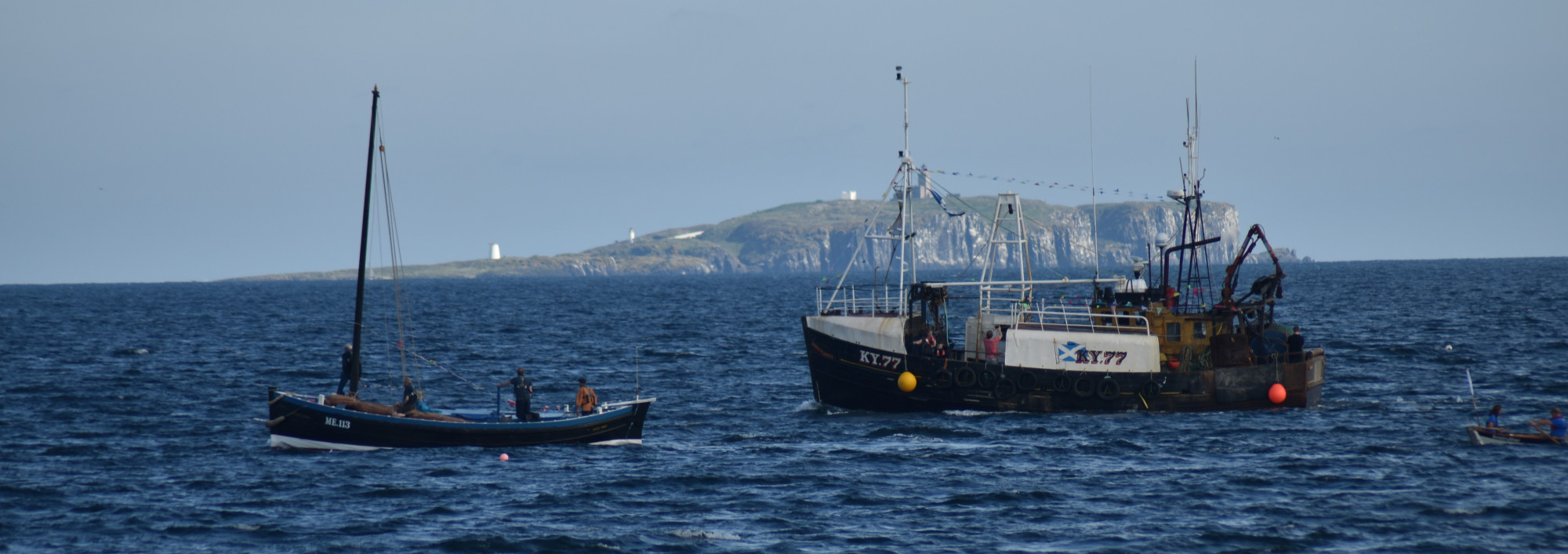

The Cellardyke Echo – 13/6/2018

1876

The School Board of Kilrenny have resolved to build a new school in Cellardyke to accommodate 225 children , and to discontinue the grant of £10 hitherto paid annually towards the expense of maintaining the school at Benerbo. The sum required to be raised by assessment was fixed at £260, or the same as last year .

Estimates in Cellardyke – The erection at once to be proceeded with a handsome range of business premises for Marr, general merchant. The designs were prepared our local architect, Thomas Brown, who is also the contractor for the mason work £398, the joiner’s estimate being in the hands Bailie John Lumsden, total cost being about £800. Mr Brown has also prepared a working plan to cost £100 of a slip at Cellardyke harbour, to facilitate the beaching the large boats. At present this is a most laborious operation, owing to the steepness of the incline, in which also the carriage wheels under the load the big boats sink every turn of the axles. The undertaking has been resolved upon by the Town Council, and the expense will met by the rents paid as boat stances on the beach, which like other vacant ground in the burgh, is in virtue of the charter granted of old by the lairds of Kilrenny—the unquestionable property of the inhabitants as part of the common good of the town.

1877

DEATH A DISTINGUISHED NATIVE Many in Fifeshire will learn with deep emotion of the death of that distinguished and native Cellardyke, Captain Alexander Rodger, the melancholy event having taken place Glasgow on Wednesday afternoon, the 6th inst. Captain Rodger had been for some time yielding to the infirmities age and to the fatigues of a busy life passed in all quarters of the globe, and it might be to the yet greater trials of household sorrow and bereavement; but about a fortnight ago he was seized with an alarming malady which from the first-aroused those fears which the sad event has only too well verified.

Let us sketch the romantic life story which has now closed in honour and respect of all. Alexander Rodger was born in old Cellardyke in 1804. He is thus about seventy-three years age, but was only ten when he was left an orphan by the loss of his father, who perished with the oldest of the household by the capsizing of his boat while at the Burntisland herring fishery on the last day the year 1814. The stricken fold, however, was not left unprotected. Heaven was near in that holiest angel of earth, a faithful and devoted mother; and great as it was, her charge was so blessed that four of her sons rose to the highest honours in their profession as master mariners in as fine ships as sailed the seas. Alexander Rodger owed little to his early opportunities.  He was one of the little crowd at the Parish School, in those days when was only the grim “ben end” of Dominie Orphit’s dwelling-house, and a few years later he was one of the crew in his brother David’s fishing boat, but like a young bird he was fretting all the time for a nobler flight, conscious of that which was in him, and longing for the wrestle and the race. For the sake of the future he at eighteen began life as a sailor on the little Dundee brig the “Ocean,” and the cramped forecastle of the Baltic-man he exchanged for the rougher service of a collier; but steel that was in him so clave through all obstacles, that when little more than twenty two he was sailing master of a square rigged ship trading to the Mediterranean. Here we must introduce an anecdote characteristic the man. The Archipelago was at this time infested with pirates and one day the brig “Hind “ was in the offing the wind fell, and she lay at the mercy of the sea wolves. Nor had the crew long to wait before the brig was in the hands of the pirates. No resistance was or could be offered, and aware this the ruffians were coolly ransacking the ship when the eye of the leader fell on Alexander Rodger’s flute as it lay in the binnacle. He made a gesture to play. It was a command not to be refused, and there and then the young Cellardyke sailor engaged the old Scottish melodies. “I believed it t was last time I would ever so, and played accordingly,” said the gallant narrator. But such was the influence the music on the desperadoes that after caressing the minstrel they quitted the ship without any molestation to crew or cargo. Subsequently Captain Rodger was in command on voyages to all parts the world, in the course of which his ship was the first to sail from Glasgow to Australia—an incident the time attracted much attention as an extraordinary era in the navigation of the Clyde. About this period also his name was honourably associated with an important discovery which made in the Indian seas. He was homeward bound on his own ship the “Helen,” when one evening the topsails flapped the fitful breeze, though the vessel rolled like a drunken man in the swell of the recent storm – consternation fell on all on board as the cry rose “the ship is on the reef.” The charts showed a clear and open sea, but the masts quivered with the crash, and the false keel was floating alongside, when the vessel providentially swung from the rock, which, like a true sailor, her captain accurately surveyed, and “Rodger’s Rock.” it is called, is now shorn of its terrors in every chart the Indian seas.

About seven and twenty years ago the state his health induced him quit the sea, but his energy was not to be tamed or subdued. The country was ringing with the gold fields Australia, and Captain Rodger was first perhaps to organise an association from Britain to open the treasures of the colony.  It was composed of the flower of Cellardyke who went out on Captain Rodger’s charge, and that eventful summer day will not soon be forgotten when, with mothers and sweethearts weeping on the oil pier, but with the Xantbo’s” colours fluttering proudly and the cheer of the brave young hearts rising high and long In the sunny air, the gallant adventurers sailed from Anstruther harbour to enter on the distant expedition which did great honour to the Captain’s head and heart. He returned, however, so far disappointed;  it was seen that the harvest had been exaggerated, but almost on stepping ashore the old country he became the pioneer one the most magnificent enterprises of the times. This was the establishment of what were called the China tea clippers, these noble ocean racers which made the British flag peerless all waters. His own ships were like household words either side the Atlantic; need we mention such favourites as the Kate Kierny, the Taeping, the Lahloo.

But, however surrounded success as merchant and ship-owner, Captain Rodger never forgot the home and friends of his youth.  On the Contrary, in his unwearied efforts to promote the well-being of the inhabitants- the public bleaching green, the new wintering berths for the boats, the improved harbour and fairway, are understood to have cost over a thousand pounds, which he raised with no other object than to do good to his native community- Year after year his generous hand gladdened the hearts of the old and unfortunate by his Christmas dinners; but in a thousand ways besides he fulfilled the holy maxim of not allowing the sun to shine upon his charity.

Captain Rodger has stood by the open grave of his venerable partner, and all his promising sons have one after another gone before him to ‘the narrow house’ but he is survived by three married and one unmarried  daughter, whose sorrow is to-day largely and sincerely shared by very many hearts on the shores of the Forth.

1878

Sale of Fish curing Premises.—We understand that the well-known fish curing premises in Cellardyke erected by the late Bailie Crawford, and presently occupied by “the father of the trade” Mr James Watson, have just been purchased by private bargain by Mr Robert Melville, whose premises, as our readers may remember, was bought some time ago in a similar way by Mr Andrew Mitchell, draper. The property opens from the street, and extends to the remarkable creek of Craignoon, which at a trifling outlay could be made perhaps the most accessible landing-place in all states of the tide on the coast, so that in leading feature the premises offer unequalled facilities for the interesting and varied speculations in the season of net and line and creel, which mark the fish curing enterprise of to-day. If rumour to be believed, the property, with the two front houses, have changed hands at the price of £800.

1879

Shetland – All the south country boats have now left, the two Cellardyke boats being the last and leaving this week. They have been very successful, we understand, having caught between eight and nine hundred cwt. of market fish each, besides halibut, skate, roes, livers, &c., and their earnings will amount to over £300 per boat, for nine week’s fishing.

The Cellardyke fishing craft, the “Refuge,” was running before the breeze, when one the crew, Mr Alex. Rodger, son-in-law of Provost Watson, while duty at the tack, was thrown overboard by the jibbing of the sail. Providentially, Mr Rodger retained his presence of mind, and at once struck out for a piece of lumber wood which one of his boat mates threw as the lively craft darted on her course. It was a painful and exciting interval, as the boat had to be worked to windward, the poor mariner all the while clutching for life to the piece of driftwood; but eventually, though not till the lapse of about thirty minutes, the “Refuge,” as she indeed proved, ranged alongside, when he was caught and saved by a friendly hand. Notwithstanding his long immersion, a little rest – thanks the comfort and convenience of the cabin with which the deep-sea boats are now provided—he was soon restored to the active duties of the fishing cruise.

The Cellardyke Echo – 5/6/2018

1869

A Justice of Peace Small Debt Court was held here on Wednesday—Provost Todd and William Murray, Esq., on the bench ; John Smith, Esq., being assessor. ……… the Court was principally taken by the objections urged in two of the five cases the instance of David Walls, merchant, Anstruther. In one of these the pursuer sued John Montedore, fisherman, Cellardyke, for the sum of 17s 4d, being account for alum, furnace fittings, &e., supplied in 1867. Mrs Montedore appeared and objected the account on the ground that she had paid several of the articles, as in the case of the alum. She admitted she had no receipt, but there were certain anomalies on the face of the account which she held prove the payment. The price of alum she said in 1867 was 1 ½d  per lb., and not 1d, as charged by Mr Walls, who was thus giving her a benefit she could not understand, and besides this evident mistake the pursuer had rendered her accounts subsequently, without, however, these disputed articles being included. She produced receipts for these accounts, which had reference to transactions in I868. The defender himself also appeared in Court, and denied having receipted other items marked in the account. Mr Murray asked the pursuer to explain the irregularity in not including the articles now disputed in subsequent accounts, when Mr Walls stated in reply that he had reminded Mrs Montedore of them shortly after they had been got when she came to settle her account, but that she had then disputed having got them. He had then told her to investigate the matter, and had done the same himself, when he found that he was quite right. Mr Murray said that in the absence of any receipt the Court had no other course open than to leave the account to the oath of the pursuer. At the request of the defender Mr Walls was then sworn, and having deponed to the correctness of the various items, the account was allowed in foil, with expenses. On the decision being given against him, the defender at once paid the account in Court.

An important improvement is about to be made on Cellardyke harbour by the removal of some dangerous sunk rocks from the Fairway, at the instance of Captain Alexander Rodger of Glasgow, who on so many former occasions  exerted himself for the good of his native town. Last year, through the same kindly interest, Mr Pottinger, boatbuilder, was employed, and not without success, in removing some formidable obstructions, but other rocks, familiarly known as the “inner and outer buss,” being all but submerged low water of spring tides, it was found impossible to reach them effectually without the aid of the diving apparatus. With this view Mr David Murray, the well-known merchant, communicated with an experienced diver in Greenock, who came through to Cellardyke about the beginning of the year, and personally examined the rocks, and their removal being found practicable. Captain Rodger made arrangements for this being done in June, and accordingly the diver with his assistant, arrived here on Thursday night to begin the work. The result of these operations will not fail to confer incalculable benefit on the fishermen of Cellardyke, as it will give free and safe access to their harbour, which is likely to be more than ever resorted to. is seldom that we find so much practical benevolence and public spirit exhibited as in the case of Captain Rodger.

1870

Alleged Theft of Timber – Last Friday, before Sheriff Bell, Joseph Walker and James Walker, fishermen, Cellardyke, were charged with stealing larch fir, measuring forty feet in length, from a plantation in the parish of Kingsbarns. From an explanation made by Mr Davidson, it appeared that they had been in the habit of using the wood in the plantation for great number of years back, and had never been interfered with. They were dismissed

New Free Church.- The handsome new hall or church in connection with the Free Church Mission in Cellardyke is now so well advanced in the joiner and plaster work that it is expected to be opened the 17th of next month or previous to the fishermen sailing for the herring fishing in the north. The south gable or street elevation of the new edifice is a fine specimen of early English architecture, and in its elevated and conspicuous situation it has the merit of being a great ornament to the town well as of supplying long felt want for the moral and religious instruction of the community. We understand that the subscriptions now amount to £213, which, with the £200, the purchase price by Messrs Sharp & Murray for the old hall, will raise the fund to within about of the cost of the new building, but it is hoped that local benevolence and the liberality of Christian friends will ere long remove all encumbrance.

1872

Boatbuilding.- lt is cheering to observe in the prevailing dullness of local trade, the activity of the boatbuilders, who, like the coopers, are straining every nerve anticipate the fast approaching “herring harvest” of Lammas. From Cellardyke to St Monance the carpenter’s hammer is ringing as merrily we have heard it for many long years, and in some cases, like their neighbours, ” the barrel weavers,” the men are working extra hours in order that the new boats contracted for may be launched by the given time. Mr William Jarvis of Anstruther, has already taken rank as one of the most successful boatbuilders on the coast of Scotland, but in his yard, in the others, the boats turned out this season, are all very much after the same type and size. The carvel boat, so popular in Buckhaven, is still a stranger in the East of Fife, but many skippers talk very favourably of this description of build, which only require a beginning some say to find general favour. It is curious, we may here remark, to observe the ever recurring changes which take place in the systems of fishing. About ten years ago our fisherman vied with each other in the size of their boats, and at one time it seemed as if the era of fishing smacks and luggers was actually at the door ; and some people, indeed, wiser than the rest of the world, went so far as to build a model craft—the princess of the fleet be—but of late years the big boats have gone out of repute, for the best of all reasons that they “would not pay,” and now-a-days the favourite boat is one that can be employed both for inshore and outshore fishing. We cannot better illustrate the particular class of boat best adapted to the opinions or tastes of our East of Fife fishermen than by giving the measurements of a very fine specimen now being built by Mr Alexander Cunningham of Cellardyke, whose ingenuity has done so to perfect our deep sea going boats. The new boat is 44 feet in length and 16 in breadth, and over 7 in depth, and will cost somewhere about £2 10s a foot. This boat is in all respects fair representative of her class, as she is being built for an enterprising young fisherman with a view to prosecute the herring fishing the coast f Suffolk, and in all probability will remain afloat all the year through, wherein, in fact, is the chief secret of profit-yielding fishing boat of the present day.

1873

CELLARDYKE. Numbering the Houses.—The Police Commissioners are about to take steps to have the houses numbered, so that every residence may be readily traced out and recognised in whatever part of our long and somewhat intricate streets it may situated. Dr Robert Chambers, in his interesting account of Buckhaven saw it in 1833, tells us that there were then 160 families in the village, but with only about a dozen surnames. ……… In Cellardyke, there is also curious singularity names. For instances, in the list of voters for last year there were seven James Watsons, six William and five David Watsons, and five James Smiths; but here the custom of the place is more kindly than the method referred to by Dr Chambers, as it is usual to add the wives’ name by way of distinction, though no little trouble, inconvenience, and, we may add, vexation, will be saved by the houses being numbered, as agreed to by the Police Commissioners.

1875

William Pattie, carter, Cellardyke, appeared the bar of the Burgh Court on Monday – all the Magistrates being on the bench – charged with the contravention of the sweeping 251st clause of the Lindsay Act, In so far that he had kept two or more pigs and a quantity of dung in the rear of his house in John Street after being warned, on the 17th ultimo, to remove the nuisance. The panel pleaded guilty to having the pigs in his back yard, bat denied the charge with regard to the dung, and also complained in strong terms of having been “singled out amongst many offenders for prosecution” The Magistrates sentenced him to the mitigated penalty 15s, or 15 days’ imprisonment and ordered him at the same time have the pigs removed by Saturday.

The Cellardyke Echo – 29/5/2018

1862

GOURDON.—Some idea may be formed of the profitableness of the deep sea fishing when we state that about £200 was, last week, paid to the crews of ten Cellardyke and Gourdon boats for their takes.

1863

James Skinner, grocer, Cellardyke, was fined £.2. 5s, and 15s of expenses, for having deficient weights in his possession, on the 13th May last.

1864

CELLARDYKE. Harbour Improvements.  – The increase in the fishing trade here within the last few years has made the provision of adequate shelter and accommodation for the boats a question of deep importance. But lately the fishing fleet amounted to only ten twenty five feet yawls, now there are forty of the finest boats on the East Coast of Scotland. About 33 years ago, ”Skinfasthaven” as it was then called, was enlarged and improved, but the harbour is still unsafe from storms and too limited in extent. In order to remedy this, a dangerous ledge of rock, known as the “Buss” is immediately to be excavated from the fairway, and the stones applied to making slip on the beach, for landing and drawing up the boats. For these improvements our fishermen are much indebted to the kindness Alex. Rodger, Esq. of Glasgow, who takes great interest in the welfare of his native town. The proposed Union Harbour will not, we expect, be commenced before next year, a delay owing to a cry for an extension of Anstruther Harbour. It must be remembered, however, that if the boats increase in number as they have done of late, another enlargement would soon be necessary, and besides, is possible that a class of vessels like the Alexandra may ere long be stationed here. Under these circumstances our fishermen prefer to wait, meanwhile doing what they can for the success of an undertaking which will benefit succeeding generations.

1865

There no doubt that the large fishing boat, Helen, of Cellardyke, which was owned by the skipper, Mr Henry Bett, and which sailed with the rest of the fleet from Anstruther harbour about two o’clock on Monday morning week for the fishing ground, has been lost, along with her crew, eight in number. The Arbroath correspondent of the Scotsman says: The schooner Charm, of Arbroath, J. Bremner, master, while on her passage from London to Arbroath, and when about fifteen miles from Tynemouth Castle, bearing about west by south, came last Sunday morning upon a fishing-line end, to which were attached five bladders, one of them being marked “T. Brown, R.” – the name of one of the crew of the Helen. It was picked up and has since been identified by the brothers of the skipper of the missing boat.”

The names of the unfortunate crew, with the number of their families, are as follows: – Henry Bett, leaves a widow and four children; Thomas Brown, leaves a widow and two children; Andrew Robertson, leaves a widow and six children; Thomas Wood, leaves a widow and three children; Daniel Fleming, leaves widow and two children; Francis Montidore, unmarried; Thomas Muir, do., Thomas Reid, do.

Much sympathy is especially expressed for the mother of the latter, as her trials have been remarkably severe. She been twice married, and both of her husbands have been drowned, as likewise a son by the first marriage ; and by the disaster which we have just related, in addition to her son, she has lost two sons-in-law.

In the beginning of the week Messrs Sharp and Murray, the well-known general merchants, convened a number of the fishermen to consider what was most advisable to be done for the relief of the sufferers, when it was agreed to have subscription lists printed and circulated for that purpose. This has accordingly been done, and we understand that the appeal is likely meet with a universal response. By the calamity five wives and eighteen children have been deprived of husbands and fathers, and all of the latter, save the case of Andrew Robertson’s family, three or four of whom are able to provide for themselves, one daughter being married, are so young as to be entirely helpless. In the end of the last week Mr Thomas Bett, brother of the skipper of the missing boat, sailed into Arbroath with his boat for the purpose instituting inquiries relative to the fate the crew, Mr Bett identified the articles which the crew of the schooner reported they had found floating about fifteen miles in the offing of Tynemouth. Mr Bett was likewise informed that the crew of a Copenhagen smack had broken two grappling irons on Friday the 12th inst., in the unsuccessful endeavour to recover large fishing boat which was filled with water, and that state they found floating about a hundred miles to the eastward of the Isle of May. Front he description the foreigners gave of the boat, it is reasonably concluded she was the unfortunate Helen.

1867

Margaret Stewart, daughter of, and residing with, Ann Smith or Stewart, Cellardyke, was charged with having, on the 3rd of May, and within the house in Cellardyke occupied by Ann Smith or Stewart, committed a breach of the peace, and also with having used threatening language towards two Sheriff-officers while the discharge of their duty within said house. She pleaded guilty to the charge of breach of the peace, and was sentenced to pay a fine of 15s, or to suffer fourteen days’ imprisonment.

1868

The Harbour Barometer.—We understand that the Board Trade, in compliance with the application of John Martin, Esq, Chief Manager of the burgh of Kilrenny, to that effect, has issued instructions to remove the barometer which was supplied by the Board of Fishery from its present site near Anstruther harbour to Cellardyke, where it is to be erected on the east wall of Messrs Sharp & Murray’s premises adjoining the west pier. Since being gifted to the locality, now several years ago, this barometer has been much and deservedly appreciated by the fishermen and others.

The Cellardyke Echo – 23/5/2018

1845

The sloop Trio, Anderson, of Arbroath, left Montrose on Saturday week, with a cargo of wood for the Firth of Forth, which she had gained on the following evening and, whether in consequence of bad lookout or not, she was the same night struck by the Eclipse, of Dundee, heavily laden, for Montreal. Her starboard-side was consequence stove and the crew, thinking her sinking state, went on board the brig, and were landed at Cellardyke. The Trio was discovered on Monday morning, and taken possession of by a Newhaven boat’s crew, a little to the south-east of the Isle of May. She was brought safely into Leith, very little worse.

1847

Miraculous Preservation. —About five o’clock on the morning of Thursday week, while a boat belonging to Broughty Ferry, and another belonging to Cellardyke, were passing No. 5 Buoy in the river Tay, they observed the topmast of a vessel; and, on their nearing, they, to their astonishment, found the body of a man made fast to the rigging. They immediately proceeded to take the body out, and brought it to Dundee, when it was recognised to be that of James Jack, master and owner of the sloop Altnaskiach of Pittenweem, which had struck upon the Elbow End, and drifted up and sunk. In the course of the day, while all were of one opinion in regard to the fate of the crew (five in number), word arrived in town that the boy, James Jack, nephew of the captain, had been saved, and had arrived at Pittenweem. From him, it was ascertained that, about half-past ten clock on Wednesday night, when taking the river, they lost the lights, and the vessel struck; that the sea breaking over her; and, while they were in the act of loosing the boat from off the deck, a sea struck her, and he and all the rest of the crew, as supposed, were washed overboard. Fortunately, he got hold of the ladder, which was swept off at the same time; and, getting his legs inside of the steps, he was buffeted about upon this frail support for five hours, until, about half-past three o’clock in the morning he descried a boat, and got them to notice him; when he was relieved from his most dreadful position, quite unconscious of the fate of his uncle, and the others on board.

In the meantime, Captain Davidson of the brig Jessie, who was very’ intimate with Captain Jack, took charge of the corpse; and the young man was so far recovered as to be able to come over to Dundee next day—when a coffin having been made, and all things arranged, the body was conveyed home to Pittenweem. We have not heard yet if any of the crew have been found. We may mention that, when the body of Captain Jack was found, he had his watch and upwards of £4 on his person; and the watch was stopped twenty minutes past twelve o’clock—being nearly two hours after the young man was swept off the deck: so we suppose the captain had taken to the rigging at that time, namely, half-past ten, and had remained there until the vessel sunk, at the time indicated by the watch. Warder.

1848

Mr. Sharp, farmer, Newton, of Kiltrean, has in his possession small Highland pony, whose history is certainly somewhat extraordinary. This beautiful little animal was first brought from Orkney to Cellardyke, in Fifeshire, a fishing boat. He was purchased by Mr. Sharp’s late father, by whom he was much used as riding pony for many years ; next by his son who is 45 years younger ; afterwards his grandchildren, the youngest of whom is 85 years younger ; and lastly by his great-grand-daughter, who is 107 years younger. The most remarkable circumstance connected with this pony is, that notwithstanding his extreme age, he still lively and vigorous, and could trot at the rate of ten miles hour, on good road, with ease. The late Lord President Hope, in 1822, informed friend of mine that he had then a horse forty-six years old ; still, I question if this famous charger ever attained the age of little Donald, or performed the same service four generations.—

1849

The Attempt to teach the Highlanders to Fish. — The boats which were sent from Cellardyke by the Highland Destitution Board to fish at the West Highlands have not been as yet very successful: indeed, they have been but seldom at sea, owing to the fierce and stormy state of the weather, and those few attempts have been made principally for the purpose of exploring the fishing grounds, a circumstance absolutely necessary for the prosecution of the fishing. The express object of this mission, as everyone knows, was to teach the inhabitants, men and women, the art of fishing successfully, so that they may not become a burden to the country, if such dire times should again visit our land as but very recently befell it. But, with shame to the West Highlanders be it told — all the attempts of the board to make them industrious and efficient members of society are rendered utterly futile from their obstinate refusal to become instructed in the art. They have been offered 10s. per week, and a part of the proceeds of the fishing, but even this tempting offer has been rejected with scorn.

Extraordinary Birth.—On Wednesday week, Mrs Robertson, wife of James Robertson, m-n, Cellardyke, gave birth three children, females. The children are all alive and in a healthy state. Cellardyke has been long famed for its possessing a preponderance of males over females; but nature appears now to be beginning to make reparation for its former delinquencies, by throwing the balance in the opposite scale, which is the best.

1850

Betty Nicol, the Benevolent Cellardyke Witch—One of the principal achievements of Betty, which gained for her the character of being in league with the Evil One runs this: During a Lammas Drave, about thirty years ago, the boats returned day after day, without catching anything ; the spirits the men were sinking, and gloomy forebodings were rife among the fishermen of the Dyke. Betty heard what was going on, and went to the wife of a fisherman to advise her about the impending calamity. I will tell you what to do,” said Betty, “just follow my advice, and yell get plenty o’ fish.” Betty took a halfpenny from her pocket, and spat the one side and then on the other, with becoming gravity. “Now,” said Betty. “Put that bawbee into your man’s right boot afore he gang out to the fishing, and my name’s no Betty Nicol if come toom handed.” The woman followed Betty’s directions, and it turned out she predicted, the boat came home laden with fish, —each man had L.7 for that nights deal, and no other boat caught single herring. The fisher who relates this story, and into whose hoot the halfpenny was put, is living at Cellardyke at this day.

1852

Emigration from Cellardyke.—In addition to the number of emigrants mentioned in our last (says the Pittenweem News Letter), we understand there are no less than sixteen fishermen preparing to leave this town for Australia. Whether they intend to follow the occupation they have been accustomed to, on landing in that country, or apply themselves to the “diggins,” we have not learned, but it is certainly an uncommon thing for fishermen to emigrate, especially in such numbers.

1857

The equanimity of our ”oldest inhabitant” was last week agreeably disturbed the unusual success of our boats. On Friday there were about thirty boats at sea, and of those that returned that evening the take of fish (white) varied from 4000 to 6000 –  one boat landed fully the latter number —but the average would be about 5000, and chiefly of a large size. This immense capture of large fish, chiefly haddocks, may appear incredible to our inland friends, but the statement of a few facts, not very generally known, may tend to dissipate their incredulity. In each boat there are eight men. Each man has his line consisting of fifteen “(taes) or (ties?), each “tae” sixty fathoms long, and has attached it 120 hooks. Each man the fleet thus fishes with a line of 900 fathoms, or rather more than a mile in length, having upon it 1800 well baited hooks. Each boat’s crew join their lines together, and when they are shot lines of each boat extend over a space of sea upwards of eight miles with 1800 hooks at less than a fathom apart. The whole fleet of thirty boats, containing 240 men, thus fish with a line having attached to 54,000 hooks, and covering a space of sea extending upwards of 240 miles. The “deep sea fishing” at this season is prosecuted at a great distance from land. On Friday last the fish were taken at 70 miles distance, and in 45 fathom’s depth of water. The partially decked boats lately introduced are found very conducive to the comfort of our hardy and enterprising fishermen.

1858

The fame the herring fishing boats of Wick build has of late years been so extending that a considerable number have been built for distant stations. Within the last few days, four magnificent boats have been launched and despatched to such distant destinations—two to the neighbourhood of Fraserburgh, one to near Montrose, and the other to Cellardyke. It is believed that should the fishing turn out well, the character of these boats will ensure a spirited winter of it at Wick in building new boats for the opposite coast.

The Cellardyke Echo – 16/5/2018

1824

HERITABLE PROPERTY SITUATED WITHIN, ANDBELONGING TO, THE BURGH OF KILRENNY, FOR SALE.

To Sold by public roup, within the Town-house of Kilrenny, on Monday the 7th day of June next, between the hours of noon and afternoon,

ALL and WHOLE that PIECE of Vacant GRO RIND, lying near the Harbour of CELLARDYKE, on the South side of the street, extending to thirty two feet or thereby, immediately to the eastward of David Morris’ house. This piece of ground is well adapted for the stance a dwelling house, and from being close to the harbour, its situation is for suitable for carrying on business.

For further particulars application may be made to any of the Magistrates of Kilrenny, or to M. F. Conollv, Town Clerk, any time betwixt and the day sale.

1825

PROPERTY AT CELLARDYKE, FOR SALE.

To be Sold by public roup, within the Town-house of Kilrenny, on Friday the 3d day of June next, at one o’clock afternoon

ALL and WHOLE the SUBJECTS at the SHORE of CELLARDYKE, formerly occupied by Messrs James and Peter Davidson, fish-curers, Dundee, consisting of a large fish house, yard, and smoking house, with sundry conveniences.

From the advantageous situation of the premises, being close to the harbour, and from Cellardyke being now one of the first fishing stations in Scotland, this property is well adapted for carrying on the fish curing business, and well worth the attention of such as are concerned In that line. For further particulars application may be made to Mr Miln, Union Bank, Dundee, or to M. F. Conolly, writer in Anstruther. 16th May, 1825.

One week later

NOTICE. THE PROPERTY at CELLARDYKE, formerly occupied by Messrs James and Peter Davidson, fish-curers in Dundee, which was advertised for public sale in last week’s Herald, has been Sold by private bargain.

1829

CONTRACTORS. THE Commissioners for the Herring Fishery have it in view to ENLARGE arid EXTEND the BOAT HABBOUR at CELLARDYKE, in the county Fife, and also to ERECT A BOAT HARBOUR at the COVE DUNGLASS, in thee county of Haddington. Estimates are therefore wanted for executing the said works, the plans and specifications of which may he seen applying to Mr Dunsmure, Secretary to the Commissioners, at the Fishery Office, Edinburgh.

Intending Contractors are requested to understand that ample security for performing the works within the prescribed time will be required, and that the Commissioners do not hold themselves bound to accept the lowest estimate, unless otherwise  eligible.

Sealed offers, to be lodged with the Secretary, on or before the 20th day of June next. Office for the Herring Fishery, Edinburgh, May 20, 1829.

1832

SPECIFICATION OF THE BOUNDARIES OF BURGHS, &c., … The Bill to settle these boundaries has accordingly been printed, and we present our readers with such parts of it refer to this county, DISTRICTS TO RETURN ONE MEMBER EACH.

Easter Anstruther —From the point at which the Dreel Bum joins the Firth of Forth, up the Dreel burn to the point at which the mill-dam of the mill of Anstruther branches off; thence in a straight line in the direction of the spire of Kilrenny church to the point at which such straight line cuts the Cunzie burn; thence in a straight line to the point at which the Cellardyke’s burn crosses the road to Upper Kilrenny ; thence down the Cellardyke’s burn to the point at which the same joins the Firth of Forth; thence along the shore of the Firth of Forth to the point first described.

Kilrenny

From the point at which the Cellardyke’s bum joins the Firth of Forth, up the Cellardyke’s burn to the point at which the same crosses the road from Anstruther to Upper Kilrenny ; thence in a straight line to the Skeigh stone; thence in a straight line to the point at which the Gelly burn meets the Well of Spa burn; thence in a straight line to a point on the Crail road, which is distant 400 yards, (measured along the Crail road,) to the north-east of the bridge on the same over the Gelly burn ; thence in straight line to a point on the Gelly burn, which is distant 300 yards (measured along the Gelly bum) below the said bridge on the Crail road ; thence down the Gelly burn the point at which the same joins the Firth of Forth; thence along the shore of the Firth of Forth to the point first described.

1839

NOTES AT THE PERTH CIRCUIT. April 1839. ………

 Archibald Williamson, shipmaster, Cellardyke, claimed to be exempted from serving, on the ground of his being manager for the burgh of Kilrenny, in Fife, discharging all the duties, except judicial functions, which a magistrate can exercise.

The Advocate-Depute (Innes) answered—That Mr Williamson was not entitled exempted from serving as a juror. The Burgh of Kilrenny bad been disfranchised: Williamson is only manager of its funds, deriving his appointment from the Court of Session. He is not a magistrate of a royal burgh elected by the Burgesses of Council, and is bound to serve.

Lord Moncreiff was of opinion that Mr Williamson, being only a manager, whose duty it was to look after the funds and affairs the burgh, and not being a magistrate, and, as admitted by himself, neither taking oaths nor declarations, nor judging in causes, objection could be granted. Objection repelled.

1842

The herring Trade from the John O Groats Journal

The English markets are completely shut. A friend from Liverpool informs me, that he has on hand 400 barrels of red herrings, and cannot get a barrel off at any price, and adds, “What may be done next season remains to be proved, but fear it will be very bad here and elsewhere for the curer.”—The Glasgow and Greenock markets are even worse than Leith. Gutted herrings there are not worth more than 12s. to 14s., the greater part of which cost per 20s per cran in the Highlands.—The boats that are engaged this season are fortunate in having done so before the budget was revealed. Those that are yet to engage, will not get within 2s per cran of the former. One of our principal curers, while in Cellardyke last week, was hunted through the streets by several crews of fishermen, praying to be engaged to fish the North at any money.

They are panic-struck at the prospect this season in the Frith of Forth, and not without cause, if all was known. They have suffered by staying at home the two past years, having made barely a living of it, and even that was obtained from the French -boats buying the few herrings which they caught at a high price, disregarding si2e or quality. That market for them is at an end. The French boats are no longer allowed to come here; and the native crews, with few exceptions, are not inclined to embark the Forth fishing this season, unless at a low price, say 7s to 8s per cran. They paid dear for their whistle last summer. It expected that about double the number Frith beats will be at Wick this season to what was the last, principally from Cellardyke; they are agreed with at 10s. 6d. per cran, and perquisites.

Licensing courts

Jane Boyter, Cellardyke – Had been refused because the justices had been under a misapprehension that the license was asked for a new house, whereas appellant only wished to come in room of her husband, dead a few months ago -Granted.

  1. James Brown, Cellardyke – Had been refused because a new house. Appellant had formerly had a license, but had voluntarily given it up, finding his employment as a fisherman sufficient to support him. Owing to having been afflicted with disease, he was now unable to labour as a fisherman—and on that consideration he hoped the court would restore his license. – Refused.

1844

Approx. 23rd May The Boat was called  the ‘William’

CELLARDYKE. Eight Lives Lost—On the afternoon Thursday last our fishermen put out to sea in gay spirits —the weather being fine, and the prospect beautiful sea and land. About eleven o’clock p.m., however, while still on their way to the deep-sea-fishing, the wind, which had hitherto been gentle, rose furiously, and, descending from the north like the rushing of a mighty torrent, caught a number of the crews by surprise, and, striking their sails aback, placed them in the greatest jeopardy. On this occasion, are sorry to say, one of the crews, with their sails all set were quite unprepared for the trying emergency, being, with the exception of young man at the helm, all fast asleep at the bottom of the boat, little dreaming they were soon to sleep ” the sleep which knows no waking.’ A neighbour boat, in passing, called out to them to strike their sails, but no sign was returned of their being sensible of the approaching danger. The consequence has been that they have not been heard of since; and there is no doubt the boat was immediately upset and swept out to sea, and that all hands perished. Six of the men were married, and have left wives and families in helpless circumstances. Their names were—George Smith, jun., boat skipper; James Smith, his brother George Smith, son of James; James Watson ; James Salter; Robert Mackay; John Sutherland, jun. ; Wilson Brunton.—Fifeshire Journal.

The Sentinel states—” It has often surprised us that our adventurous fishermen have not availed themselves of the means which modern science and ingenuity have placed within their reach, at the cost of a few shillings, of floating the person in the water for an indefinite length of time. Mr Carte’s invention, composed of cork, and not exceeding a small dressing-case in its whole bulk, costs twelve shillings. Belts of inflatable Macintosh, equally efficient for floating but less certain to resist damage, can be had at about the same expense. Then there Mr Carte’s admirable life buoy, which on an emergency could support four persons in water, besides other ingenious appliances for the same purpose. Considering their proved efficiency, their convenience, and cheapness, it seems little less than mindless folly for men accustomed to be at sea to want them—a folly as great it would be to despise having linch-pins in a carriage, or a hearth-stone and fender save a house from taking fire.”

The Cellardyke Echo – 9/5/2018

1921

IMPORTANT ROUP HOUSEHOLD FURNITURE, BUTCHER’S SHOP FITTINGS, HORSE. HARNESS. CARTS. SOWS, PIGS, &c, on WEDNESDAY, 11th May, 1921, Eleven  o’clock Forenoon, belonging to Mr GEORGE H. KIRKALDY, at TOLLBOOTH ROAD, Cellardyke. W. S. BONTHRON, Auctioneer. National Bank Buildings, Anstruther. April. 1921.

1922

BIG BLAZE IN FIFE CELLARDYKE WORKS GUTTED Heavy Damage One of the most disastrous fires that has occurred in the East of Fife for many years broke out last night in the oilskin works of Messrs Martin & Co., Cellardyke. Fed on the highly inflammable contents of the factory, the flames spread with amazing rapidity, and although St Andrews Fire Brigade was early on the scene, so fierce already was the blaze that for a time they could do little to check its progress. The fire originated in the new wing of the factory which was erected during the war, but soon the greater part of the works was involved. The blaze lit up the sky with a ruddy glow that was seen for many miles around, and the scene of the fire a great crowd collected, watching with awe the progress 61 the flames. About midnight the Buckhaven Fire Brigade arrived and added their efforts to those of the St Andrews brigade. The fire fighters worked with feverish zeal, but for long time little progress could be made against the roaring flames. Householders in the vicinity of the blaze worked with frantic energy to remove their belongings to places of safety, and in this they were aided by many willing hands. An old church standing next to the factory, which was used as a store, was cleared of its contents. Strenuous efforts were made to remove as great quantity of the oilskins and pallets from the stores as possible, and lorries were requisitioned to carry the salvaged goods to safety. The machine-room and the store to the east of the factory have been saved, but the rest of the factory has been practically gutted. The fire was still raging in the early hours of this morning, and the damage will amount to several thousands of pounds.

OVER £10,000 DAMAGE BIG FIRE AT CELLARDYKE WORKS. The big blaze which raged at the oilskin works of Martin & Co., Cellardyke, on Tuesday night and yesterday morning was successfully overcome about five o’clock. Throughout yesterday the workers (over one hundred) were engaged returning the large stocks of oilskins, pallets, silk, cloth, &c-., to the stores which were preserved from the flames. The damage is considerable and cannot yet be estimated. A rough calculation places it between £10,000 and £15, 000

Only two stores, the offices, the stitching machine room, and the cutting-room were saved. The factory proper completely gutted, involving the loss of valuable machinery.

The cause of the outbreak is unknown. A similar fire occurred at the factory twenty years ago, but during the intervening years the firm had made extensive additions.

St Andrews Fire Brigade turned out very smartly on Wednesday night when they were called to the big fire at Cellardyke. The message summoning the brigade was received 9.45, and they were on the scene of the fire in twenty-five minutes after the call. The motor engine pumped water from Cellardyke harbour half-a-mile away, and when two strong jets were turned on the flames the fire was quickly got under.

1924

CELLARDYKE BOOT SHOP IN FLAMES. DAMAGE ESTIMATED AT ABOUT £200. Cellardyke Fire Brigade was called out last night to an outbreak of fire which occurred in the premises tenanted by Mr A Gourlay, bootmaker, James Street. The boot shop was burnt considerably, and all the stock of boots and shoes practically destroyed. The stock understood to be covered by insurance, and the estimated damage is £200.

1928

DEATH OF CELLARDYKE NATIVE. The death of Mr George Hodge, Cellardyke, has removed from the community one who was very well known and extremely popular. A native of Cellardyke, Mr Hodge was by trade a cooper and for 21 years saw service in the Royal Navy. Coming ashore, he entered the employment of John Martin & Company, oilskin manufacturers, and served that firm for time. Just about a year ago he was taken ill, but was for while still able to be out of doors.

He was of a quiet disposition, which endeared him to many, and leaves a wide circle of friends and acquaintances to mourn his loss.

New Companies registered in Scotland this week

Gray & Pringle, Ltd,, High Street Anstruther. Capital, £8000, £1 shares. Private company to acquire the business of ironmongers and cabinetmakers presently carried on by Gray & Pringle, Anstruther. Subscribers—William Watson Carstairs, oilskin manufacturer, East Forth St., Cellardyke; John Cornfoot, cabinetmaker, Cunzie Street, Anstruther.

1929

LIBERAL SOCIALS AT CELLARDYKE AND DUNSHELT. Under the auspices of Anstruther and Cellardyke Liberal Association a social meeting for women was held in the Town Hall, Cellardyke. Mrs Russell presided, and addresses were delivered by Mrs Barton, Prestwick, and Ex-Bailie Lawrie, Liberal organiser, Leven. Songs and recitations were given Miss Kinnear and Miss Kilgour, Leven. Miss Kemlaw was pianist, and Mrs Alex. Myles, along with number of ladies, served tea.

1930

CELLAKDYKE MAN’S DEATH SONS’ DASH HOME IN RESPONSE TO S.O.S. A Cellardyke man, Mr James Muir, 12 Fowler Street, has died his 78th year, and on account of the seriousness of his illness a broadcast appeal was sent out on Monday night. . One son, Mr Alexander Muir, was on the fishing boat Refloresco, and another. John Muir, on the Specsaurrer, both of which were at the fishing grounds. The wireless S.O.S. failed reach either man. It was only when the Specsaurrer put into South Shields to sell the fish that Mr Alex Muir was informed of his father’s illness.  He immediately entrained for home, reaching the East Neuk on Wednesday. His brother, Mr John Muir, was informed of his father’s illness when his ship put into South Shields for repairs. He returned home immediately, but was too late to see his father alive.

NEW TROPHY FOR EAST FIFER AMATEURS. At a meeting of the East Fife Amateur Football Association in Andrews, the committee accepted the custody of a handsome shield gifted by Bailie Carstairs, Cellardyke, and this trophy will be competed for annually.

ANSTRUTHER COAT OF ARMS MOTTOES FOR UNITED BURGH Provost Readdie presided the monthly meeting of the Town Council of the amalgamated burgh of Anstruther Easter, Anstruther Wester, and Kilrenny. Bailie Carstairs, reporting on meeting of the Coat of Arms Committee, stated that they recommended the adoption of the shield in tierce bearing the three coats of arms of the individual burghs as drawn by the Lord Lyon King of Arms. Regarding the question a motto, the Lord Lyon had suggested that the two ancient mottoes of Anstruther Easter and Kilrenny should be continued. The Council agreed, and resolved to pay the necessary £20 for permanent registration

The Cellardyke Echo – 1/5/2018

1911

LAUNCHES AT ABERDEEN. DRIFTER FOR CELLARDYKE. Messrs Alexander Hall and Company launched a steam drifter, built to the order of Mr Philip Gardner, from their yard on Saturday afternoon. As the vessel left the ways, she was named Coreopsis by Mrs A. Reid, daughter of the owner. The dimensions of the vessel are Length between perpendiculars, 86 feet; breadth, 18 feet 6 inches; depth (moulded), 9 feet 9 inches. She is to be fitted with triple expansion engines, and a boiler working at a pressure 180 pounds to the square inch, and with all the latest appliances. There was a large attendance the launching. Those present included Mr Philip Gardner, the owner; Mrs Gardner. Mrs Reid, Mr A Farquhar. and A. Gray, A. Hall and Company ; Miss Farquhar, Miss Walker, Councillor Newton, W. M. Brechin, Mr J. Bonthron. Anstruther; Mr A. Coutts, Mr A. G Emslie, Captain Walker, Mr A. S. Captain Buthlay, John Main, Mr Lock, United Kingdom Insurance Company; Mr William Webster, Mr A. Cunningham, John Rust, and Mr William Walker.

After the launching ceremony, “the company were entertained at a cake and wine banquet. Mr Farquhar presided and submitted the loyal and patriotic toasts.

Mr Farquhar in giving “The Coreopsis and her Owner.” said that he hoped that when Mr Gardner got the vessel she would give him every satisfaction and be a credit to the builders. (Applause.) Mr Gardner, in replying, hoped the vessel would be a great success. He would do all he could himself to give the vessel a good name, but he thought she had that already. (Applause.)

Mr Bonthron gave “continued prosperity of the builders. Their boats had given every satisfaction, and he was quite sure the Coreopsis would prove a good boat, and be as good as the last one they had from Messrs A. Hall and Company (Applause.)

Mr Farquhar replied. They always endeavoured to please their customers, and the motto of the firm was to give their customers the best possible vessels. (Applause.)

Mr Farquhar submitted the health of Mrs Reid who had so gracefully named the vessel, he presented her with a gold bangle in commemoration of the occasion.

Mr Webster replied on behalf of Miss Reid

 Councillor Newton gave ” The Fishing Industry.” and referred to the rapid strides the industry had made in Aberdeen.

MR James S. Melville, trawl owner, replied.

Mr Farquhar submitted “The health the ladies” and Mr W. M. Brechin replied on their behalf.

Mr Farquhar also gave ” Bona-Accord, and this conducted the proceedings.

CELLARDYKE. Parish Council.—This body met on Friday evening—the Rev. Mr Ray, chairman, presiding. The ’Clerk intimated a claim from Edinburgh in the case of girl 8 years of age found dead. The Clerk had denied liability, and advised Edinburgh to claim elsewhere on the ground of a residential settlement. As he had heard no further word, he thought Edinburgh had apparently taken his advice. The Council approved of the Clerk’s action.

1913

FUNERAL OF DROWNED CELLARDYKE SKIPPER. The remains of Skipper John Sutherland, of the Cellardyke steam drifter Dreel Castle, who was found drowned at Hartlepool on Sunday, were interred in Kilrenny Churchyard yesterday afternoon, a Masonic funeral being accorded to deceased, who had lately joined the craft.

There was a large attendance of brethren of Lodge St Ayle, while there was also a big gathering of townspeople. The service at the house was conducted by the Rev. G. S. Anderson, Kilrenny, while at the graveside R.W.M. T. D. Murray read a passage of Scripture, and Chaplain the Rev. J. A. Paterson, West Anstruther, offered a prayer.

Admiralty Compensates Fife Fishing-Boat Owners.-During the course of the winter herring fishing in the Firth of Forth numerous complaints of damage to the nets of Fife fishing boats by His Majesty’s war vessels were received by the Fishery Board for Scotland. The complaints having been investigated by the Board’s local officer, in conjunction with the Coastguard and the amount of damage assessed by them, claims for compensation were forwarded by the Board to the Admiralty, and the Board have now been officially informed that 30 claims by Cellardyke, Pittenweem, and St Monans fishermen, ranging from £1 10s to £11 11s 6d each, and amounting in all to £142 19s 6d, have been admitted by the Admiralty, and will shortly be paid. Other claims are still under consideration by the Admiralty.

1915

Information was received on Wednesday by the parents of Lance-Corporal Murray. Rodger Street, Cellardyke, that their son, who is a member of the Canadian Contingent, has been wounded in the recent engagement in which the Canadians took part.

(This article was slightly outside my 7 days either side of the posting date 10th May)

RECRUITING EFFORT AT ANSTRUTHER. The pipe band of the Black Watch, composed of men who were recently sent home from the front wounded, visited Anstruther on a recruiting expedition. Marching through Anstruther and Cellardyke they attracted much attention. Fifteen young men offered their services to their country. Major Selbie, Kirkcaldy, recruiting officer for Fife, accompanied the band.

1916 death notice

CELLARDYKE CANADIAN KILLED IN ACTION. Mrs John Wilson, Shore Street, Cellardyke, has had letter to her son, Sergeant George Wilson, of the Canadian contingent, returned with the announcement, ” Killed in action.” Sergeant Wilson, who was 27 years of age, and unmarried, served his apprenticeship as plumber and tinsmith with Messrs Gray & Pringle, Anstruther, and went to Canada three years since. He was among the first enlist after the outbreak of war. Two brothers of deceased are serving with the ‘colours.

WATSON.—At 21 Glenbervie Road, (the her son, John Watson), on the 30th April, Mary Muir, widow David Watson, fisherman, late of Cellardyke, aged years. Funeral Tuesday, 2nd May, 3 p.m., to Churchyard. Friends please accept this (the only) intimation and invitation.

1919

SELLING NEW BREAD. Cellardyke Baker Fined £7.

A plea of guilty was tendered in Cupar 1 sheriff Court this afternoon on behalf of Alexander Neilson, master baker, Cellardyke, who was charged with having sold a 2-lb. loaf that had not been baked 12 hours previously.

 J. K. Tasker, his agent, said Mr Neilson was doing just as everybody else was doing selling new bread. He believed in Dundee and elsewhere it was the common practice to sell new bread.

Hon. Sheriff Osborne said the regulations were still in force, and heavy fines had been inflicted quite recently. He could not accept a plea of ignorance. The sentence would be a fine of £7, or thirty days’ imprisonment.

(During the First World War, British food supplies were affected by poor harvests at home and abroad; reduced food imports as a result of enemy action; In May 1917, the Minister for Food warned the Cabinet that feeding the country after September would be ‘a difficult problem’. The Ministry of Food and wider government made attempts to influence consumption, as well as production, by introducing the Bread Order in 1917. This regulation made it illegal to sell bread until 12 hours after it had been baked. According to The Times, the government realised that stale bread was ‘more nutritious’ and would be consumed 5% less than fresh bread)

The Cellardyke Echo – 24/4/2018

1902

A highly successful dance under the auspices the recently formed Anstruther Hockey Club was held in the Cellardyke Town Hall on Friday evening. The arrangements, which were under committee of ladies, were every way complete

On Thursday, last week, Mr Millar, boatbuilder, Anstruther, launched from his boatbuilding yard a first class Fishing boat built to the order of a Shetland Fisherman. As she left the weighs, she was named “The Mizpah.” She is some feet shorter than those recently built for local owners. Mr Millar is about lay on a keel for another craft the order rears A. & J. Watson, Cellardyke.

( Millers of St Monans, owned the yard next to Anstruther lifeboat Shed from 1899 until about 1913)

1903

Besides at present preparing two fishing boats for the Shetland coast, Mr Millar, boatbuilder is busy making a patent slip for the same district. The slip is of similar dimensions to the one now in use.

On Tuesday afternoon, while Alexander Stobie, cattleman, Rennyhill, was returning from the station, and when in Cellardyke, he accidently slipped, and falling heavily the ground, broke his leg. He was immediately taken home, and medical aid summoned.

Sale of Work. A Sale of work in connection with Cellardyke Y.M.C.A. was held in Cellardyke Town Hall on Saturday afternoon, the proceeds to be devoted to the purchase of an organ for use at the Sunday morning and other services. The sum drawn amounted to £22.

1904

A complaint was together submitted from Mr Oliphant, Anstruther, as to a nuisance in front his property in John Street Cellardyke. The Sanitary Inspector was instructed to rectify the same, and to require those proprietors who had failed to connect their outlets with the street sewer to do so.

1907

ST MONANS. Launch –  On Saturday there was launched a steam drifter, built to the order of Mr David Corstorphine and others. As the craft left the ways she was named the Unity by Miss Lizzie Strachan, Cellardyke. The Unity is a splendid model, and her graceful lines were greatly admired. She is 92 feet extreme length; length of keel, 85 feet; depth of hold, 9 feet. She is to be fitted up with compound engines, and, like others of the same class, will be available for the prosecution of the herring and cod fishing. Her first trip will the cod fishing in the North Sea.

1909

TRAWLER RUNS ASHORE NEAR MONTROSE, AND CREW ARE RESCUED BY JOHNSHAVEN LIFEBOAT.

The Granton trawler Kirton, owned Messrs T. Devlin & Sons, ran ashore at St Cyrus, near Montrose, early yesterday morning, and the crew of nine were rescued by the Johnshaven lifeboat. The Kirton left Granton on Monday, and had been prosecuting the fishing till Thursday, when she commenced to steam for home. With the coming of darkness on Thursday night a heavy sea arose, and a strong wind approaching almost a gale sprang up. The elements were at their worst when a torrential rain commenced to fall. Cautiously the Kirton steamed ahead on what her skipper thought was her homeward course. But there was a dull thud, twice repeated, and the trawler stuck fast.

SET FIRE TO BEDDING.

Not knowing exactly where they were, the crew set fire to the bedding, and by this means gave the distress signal. This was observed by the coastguard at Johnshaven, and on his summons the lifeboat quickly put to sea. The Montrose lifeboat also took the water, but after a stiff flight with the surging billows the Johnshaven crew, under the command of Chief Coxswain McBay, reached the distressed vessel first. It was no easy task getting the men off the grounded trawler, which threatened every moment to glide from her bed of sand and capsize, and on two different occasions the lifeboat was tossed over the salmon fishing stake-net. Ultimately Captain Deas, who belongs to Cellardyke, and his eight men were got into the lifeboat and landed safety at Johnshaven. When the tide receded the vessel was left high and dry on the sand. She is deeply embedded and it is thought it will impossible to float her for about fortnight, owing the low tides at present. Captain Deas stated to our Montrose representative yesterday that he closely followed the compass, which had apparently gone wrong. The darkness and the thick rain prevented him seeing where he was.

The Cellardyke Echo – 18/4/2018

1901

Football

Anstruther refused to be damped by mere rain on Saturday in presence the match Crail Union v. Cellardyke Bluejackets, in the semi-final the Burgh Cup. It revived the rivalry of fifteen years ago, but of course it was in name only, none of the players ever met before. A stubborn fight was waged, and right up to the finish was the issue open.  Only a little more skill goal, and Cellardyke would have done the ‘trick’. It was there the Union youths beat them.

Census returns

Anstruther-Wester.—The returns show the population to be 558, against 593 in 1891, decrease of 35. In the burgh the figures are 476, and in the landward part 82. The males have decreased 25, and the females by 10.

Pittenweem.—The population is now 1907, against 1991, a decrease of 84. the burgh the population is 1859, and in the landward part 48.

Crail.—The total population is 1531, made of 1087 in the town, 428 in the landward part, and 16 on the island of May. Compared with 1891, there is a decrease of 82. the figures then being 1613.

Kilrenny.—ln Cellardyke the population is 2353, against 2429—decrease of 76; in village of Kilrenny, 189, against 181—increase 8; in landward portion, 242. against 279—decrease of 37; and in Anstruther, easter portion of parish, 150. against 109—increase of 41. The net decrease is 64.

On Sunday morning, the steam liner, Anster Fair, caught fire in the coal bunker. Fortunately the smoke issuing was noticed in time, and the fire extinguished before damage to any extent was done.

The only craft engaged at the harbour meantime are the steam liners, whose shots last week ranged from £30 to £66. The value of fish landed at Anstruther for the last month £5473, showing decrease of £5381. For the quarter, the total was £33,051, decrease, £3284.

Boys’ Brigade Church Parade. The recently-formed Boys’ Brigade paraded at Cellardyke Church on Sunday forenoon, when an excellent sermon was delivered to them by the Rev. Mr Ray, chaplain, on ‘the necessary qualifications of a soldier’. The day, unfortunately, was very wet but, notwithstanding, there was a fair muster of the lads. The officers in command were—Captain Black and Lieuts. Rorie and Watson. On retiring, collection was made in aid of the funds of the Brigade.

Last night. Private Mair, 1st Gordon Highlanders, was the recipient-of a watch, chain, and purse sovereigns from his fellow townsmen and friends in the surrounding district Cellardyke Town Hall Councillor Black presided.  Provost Thomson made the presentation. Private Mair said the hardest work was when fighting continuously for twenty-one days.

Honouring a South African Hero. —The Town Hall, Cellardyke, was on Saturday evening the scene of one of the most hearty and enthusiastic meetings held in the district for some time. The occasion was a desire the part of his many friends to pay honour to a returned soldier, and express gratitude that, notwithstanding numerous engagements, he had escaped without scratch. Private Moir, who served in the Chitral campaign and received the medal, re-joined the famous Gordons in 1898, and in November 1899 left with the 1st Battalion for South Africa. The meeting, which was a crowded one, was attended by both sexes, and was presided over by Provost Thomson, who was accompanied on the platform most of the members of the Council and the presentation committee. A letter of apology from the Rev. Mr Ray, who has taken an active interest in the presentation, read as follows

Dear Provost,—l regret exceedingly it will be impossible for me to be present this evening in the Town Hall to rejoice with my parishioners over the return from the field war of Private Moir. One of our and world-famed Gordons. Everywhere the officers who have come home have been received with enthusiasm and honour, and if the officers, why not the rank and file? Why not the common soldiers. Have not their bravery and endurance fighting qualities been the admiration of the world, and has not their conduct compelled even those who hate us to sing their praises? It is true that in certain quarters attempts have been made blacken their character, but in every instance those attempts have failed and covered with disgrace, not our soldiers, but the men who ventured make them. I hope Private Moir will tell his fellow-townsmen the story of his experiences in South Africa with the same fullness he related it to me a few days ago at the manse, and that he will not forget to say in public what be said to about the moral behaviour of his fellow soldiers. With best wishes for a pleasant and enthusiastic meeting,—Believe me, yours faithfully, James Ray.

The Chairman said they all regretted the absence of Rev. Mr Ray from the meeting. At the same time they were very thankful to him for the letter. He (the Chairman) expressed his gratitude that they had turned out in such large numbers to show their respect for their follow-townsman. He called upon Councillor Black to make the presentation. Mr Black, in an interesting speech, said had great pleasure in asking Private Moir to accept this handsome silver lever with gold chain and appendant, along with a purse of sovereigns. The amount collected altogether was £23 ls 8d. (Cheers.) The sums ranged from 3d to 10s. He asked Private Moir to accept the gifts as a token of the respect and esteem in which he was held by his fellow townsmen. (Cheers.) Private Moir, on rising to reply, was met with perfect storm of cheering, the audience striking up “For he’s jolly good fellow.” He had, said, been in many a tight battle, and was proud to hear they had taken such interest in him He thanked them sincerely for their magnificent presents. He would always remember their kindnesses and their gifts, but he valued them more when thought how proud his old mother would be when she knew. (Cheers.) With regard the war, they had come through a great many hardships; but he was always ready to go back again and do his duty, as every good soldier ought to. (Cheers.) Messrs Rosie and Moncrieff, with the pipes, and Miss Melville, piano, gave several selections, after which the Chairman said the music of the pipes had inspired their guest with more of the famous Gordon courage, and was now prepared to give them some reminiscences of the campaign. (Cheers.) In the course of an interesting speech Private Moir said they landed in South Africa in November. They were taken right up country, being entrained three days and three nights. On Monday, 10th December, they reached Magersfontein, and at three o’clock went out with the naval guns to commence the battle. He proceeded to give an account of their march to Pretoria, including the Cronje. The speech,. Private Moir’s first attempt at public sneaking, was interspersed with anecdote, and was highly appreciated. While refraining from anything like a criticism of the officers, he could not help paying a high compliment to Lord Roberts, who was worshipped by his men. Something of the hardships endured by Private Moir and his companions maybe imagined when it is stated that for four months he wore the same shirt; and when he reached Pretoria he had half a shirt, part of a tunic, and a pair of boots. The usual fare was biscuit or two biscuits a day. After Mr James Wood hail sung “The old soldier,” Mr Watson, solicitor, jocularly advised Private Moir to go round the district and give some of his experiences, taking collections for the War Fund. (Applause.) After the usual vote of thanks, an enthusiastic meeting brought to clone with the singing of the National Anthem. The watch was supplied by Andrew Donaldson, Anstruther, and bore the following inscription ; Presented, with a purse  of sovereigns, to Private James Moir, of the 1st Battalion Gordon Highlanders, by the inhabitants his native town in token their respect for him as man and a soldier, as well as their joy at his safe return from South Africa. Cellardyke, 20th April 1901.”

Hockey Dance.—A highly successful dance under the auspices the recently formed Anstruther Hockey Club was held in the Cellardyke Town Hall on Friday evening. The arrangements, which were under committee of ladies, were every way complete

Mr Jordan, the world’s champion draughts player, paid a return visit to Anstruther last week, when notwithstanding the fine weather and numerous outdoor attractions, he was met by a fair number of local exponents of the “silent game.’’ During the evening, Jordan played about 90 games, winch he won, the other 10 being drawn.’ The successful players who managed to draw were— – Constable Wilson. Anstruther, 2; David Wilson, Cellardyke, 2; William Mathers, James Ferguson, and D. Gravity, St Monans, 2 each. At the close, Mr Jordan was heartily thanked fur his exhibition.

The Cellardyke Echo – 10/4/2018

1891

At  a Burgh Court in Anstruther yesterday two young lads from Cellardyke, named Thomas Corstorphine and Peter Murray, were charged with stealing 2s 6d from the till of the shoe shop Shorn Street occupied by Messrs Kerr on the 4th inst. Corstorphine pled guilty, but Murray denied the charge. From the evidence it appeared that Corstorphine went into the shop, and before the assistant had time name he had reached over his hand and lifted the 2s 6d. On the assistant making his appearance he coolly asked change for the 2s 6d which was refused. Missing 2s 6d from the till, the assistant watched the movements of Corstorphine, who was joined by Murray, and after they had gone into several other shops he got them persuaded come in. He sent for the Police and Corstorphine confessed that he had stolen the money, and Murray that had changed it in a grocer’s shop. One them had ls 6d and the other ls. Murray was found not guilty and Corstorphine was fined 5s or 5days in jail.

The Fishing Industry Anstruther and Cellardyke.—An attempt has been made in Anstruther and Cellardyke to revive the fishing, which for the past three or four years, has been in state of severe depression. In Cellardyke so serious has been the loss that many of the fishermen have left the district and sought employment in other occupations elsewhere. It is computed that in Cellardyke alone there are 60 empty houses, where five years ago one was not to be had for love or money. The particular method adopted for the revival of this industry is the formation limited liability company to purchase steam liners to fish principally at Anstruther. Every encouragement has been given to the project, and already representative committee has been appointed to ascertain the working expenses and cost of the liners, and the amount of capital which can raised in the district. It is considered that steamers of about 80 feet in length, and drawing from 8 to 9 feet of water, could be accommodated in Anstruther harbour, and it is likely that one or two of these dimensions will purchased.

1892

SHARP & MURRAY , Merchants and Fishcurers , Cellardyke , having executed a TRUST DEED for behoof of their CREDITORS In favour of the subscribers ALL PARTIES having against the said Firm and the Individual partners thereof are requested to lodge the Same , duly verified , with him, on or before 14th April 1892 ;  and ALL PARTIES INDEBTED to the said Firm of the Partners thereof, are requested to make payment to him within the like period . _________ JOHN GUTHRIE , Solicitor , Anstruther .

A meeting of fishermen and others interested in the formation of a second limited Steam Line Fishing Company for the East of Fife was held on Saturday night—Mr James Leslie presiding. It was reported that the idea of forming the Company had started among the fishermen, who recognised the necessity there was of getting steam- boats. Their proposal was to raise sufficient money to build two vessels at a cost of fully £4000, and that of the crew of each boat three in each should subscribe five or more shares of £10 each share in order to give them a personal interest in the venture. Already six Cellardyke fishermen had come forward and subscribed five shares each. After discussion all present were formed into a Committee to try and float the Company, and Messrs W. Bonthron, A. Black, Thomas Cunningham, John Porter, and James Leslie were appointed a Sub-Committee to canvass the district, and outside of it well, for subscriptions, the result to be reported to another meeting to be held in fortnight.

At Cupar, on Thursday – before Sheriff Spiers – Mr Henry Butters, draper St Andrews appeared for public examination in his bankruptcy.

Bankrupt deponed – I commenced business in St Andrews in May 1890. For 20 years previously I was employed in the shiop now occupied by Provost Ramsay, Cupar. In May 1890 I purchased a drapery business in Market Street, St Andrews from Mr E Turner for £1375. I had at that time £100 of my won. I did not pay the stock in cash, but by bills, which were renewed from time to time……… I have lost about £700 in two years….. I account for this loss by the fact that the stock was over valued by £300 or £400….. My brother, John Butters, merchant, Cellardyke is a creditor. I got fishing gear from him, he sent me regular invoices and he got goods from me. I am due him £44 16s 6d. He got a carpet and a rug from me on Monday 29th February, and he took it away with him to save carriage. The carpet is marked down to him in my books………

Liabilities £2147 3s 6d, assets £1566 14s 5 ½ d deficiency £580 8s 10d..

Fire in A Shop- Shortly before ten o’clock on Tuesday night fire was discovered to have broken out in the grocer’s shop in George Street, Cellardyke, belonging to W. Sutherland. The fire got good hold of the counter, but by the aid of buckets water it was extinguished before a great deal of damage was done.

1893

FISHING BOAT ASHORE NEAR BAMBUBGH. During the dense fog which prevailed Thursday morning, a Scotch Fishing boat, the Glengarry. K.Y.95, Davidson (skipper), hailing from Cellardyke, ran ashore near Monk’s House on the coast between North Sunderland and Bamburgh. The boat had about 30 score of big fish, which were sold by Mr J Ross auctioneer, for £12 2s 6d. The fish and gear were landed at North Sunderland by cobles. It is not expected the boat will have sustained much damage, as she lies on a sandy bottom.

1894

For some time past great difficulty has been experienced in the procuring of bait both for the small line and great line boats belonging to Aberdeen. On many occasions during the last two months several of the steam-liners were on this account unable to proceed to sea for days, and even weeks, and the loss resulting from this is considerable. Most of the herring used by the steam-liners comes from Cellardyke and Peterhead, and the herring is mostly caught by small boats which in any stress of weather cannot proceed to the fishing grounds, the consequence is that when easterly winds raises the sea neither the Peterhead nor the Cellardyke boats venture out, thereby throwing the steam-liners out of employment. In the hope of remedying this state of matters, several kinds of bait, including liver and crimps, were tried, but all proved defective, and the only alternative remaining was to pay enormous prices for mussel bait coming from the north coast of Ireland, Port Glasgow, and Holland. For the last few months an innovation has been made by using the sea-worm or “lug,” which are taken from the shores of the Beauly and Cromarty Firths; and for the purposes of matching haddocks and codling, this bait has proved very successful. Both among the Footdee and Torry fishermen, a strong opinion is held that something must be done in the near future to remedy the existing difficulties in the procuring of bait.

DUNDEE STEAMER ASHORE ON THE MAY. During the dense fog which hung over the firth all night the Jasper, 1800 tons burden (Captain Douglas), belonging to the Gem Line, Dundee, ran ashore on the South Ness of the May early yesterday morning. She was steaming from Dundee to Burntisland in ballast, when, to the surprise of all, she struck between two and three o’clock. A breeze from the north-east prevailed at the time, but it failed to lift the fog, through which the crew declared even the powerful electric light of the May did not penetrate.

A number barges are presently landing the usual supply of coal, and lookout stationed on one of these vessels corroborates the report that it was impossible to see anything, the first notice he received of the vicinity of the steamer being when she fired a rocket. He immediately aroused his companions, and they proceeded in the direction of the signal, when they discovered the crew of the Jasper scrambling ashore over the rocks. Jill the crew reached land without mishap. When daylight broke they returned the steamer for their effects. The Jasper had been making water, and as the result of rapid survey they found she was already considerably damaged. A heavy swell roiling from the sea had shaken her severely. The Cellardyke pilot landed the mate at Anstruther in the forenoon, when the accident was telegraphed to Dundee. The Jasper is fully insured.

1895

At present this week bids fair to be worse than the previous, when out of forty boats a dozen had from £2 to £14, while the section which proceeded to Shields for the season had also few pounds amongst them. But, if the boats so failed in the errand, the steamers were as signally successful. The coast was soon acquainted with the Glenogil’s  £131 shot, and on Friday again an interested crowd gathered to watch, as score after score of ling was laid on the pier from the Anster Fair. Soon the quay was gleaming with apparently unlimited supply of ling, the shot being composed, with the exception of a few turbot, of these fish. They realised about £90, but it is undoubted that had they been landed 0n the preceding day, magnificent was Skipper Birrell’s total, it would have been eclipsed. The gross reached £99 The Maggie came up with the same tide, and had £66, while the Rob, which steamed past as the other shots were selling, had £35 at Newhaven. A telegram from Skipper Parker announced that the Bernicia had earned some £73. So keen were some of the steamer men to catch Lent that on Friday two liners left to obtain supply of bait in Aberdeen, and be ready to start for the Pentland Firth on Monday. The others left just after midnight, and by daybreak on Monday would be half-way to the distant banks. The gale upset all calculations, and in place of Anstruther being alive with boats and steamers, the harbour is almost deserted. One pleasing item to hand a telegram from Shields intimating that the Bernicia had above £70 to reward a fortunate trip. No word is to hand of any of the Anstruther liners except the Glenogil, which ran in on the turn of the tide. She was seen to be well fished, and the skipper’s calculation that fully seventy score was board wrought a transformation. The long quay became crowded with men and carts, and as fast the fish were put out they were rouped and posted to the station. Cod began at £2, but 30s was the general price. There is the prospect of the stuff despatched on Thursday night getting into the markets with Good Friday, and consequently of their being moderate competition for each lot. Fully £100 had been realised, and some ten score of fish are yet to come out, so that the gross total will run to about £120. The yawl crews had some rare chances this week. In spite of the gale on Tuesday nothing would deter the sea dogs from venturing, and with 18s waiting them for each box of prime haddocks, and 10s for small, they considered they were fairly rewarded. At Pittenweem on the following afternoon the price was 9a to 12s. On Thursday afternoon the last built of the Anstruther liners, the Copley, returned from Leith, her engines, &c., having been put on board. She will commence work in few days, Skipper D. Wood being her captain.

1896

Lent week was a blank so far as the Cellardyke sailing boats were concerned, only one crew (Skipper .lames Moncrieff) being at sea by Monday, and getting the market, when £43 was grossed. The rest of the crews had dropped the nets, and were fitting out for the great-lines in earnest, their programme including the necessary outfit to tide over a spell at Scarborough or other English ports. 37 boats left with this intention on Monday, and as up the present none have returned it is evident the skippers have not seen reason to alter their course. The fleet will distributed between Scarborough, Shields, Hartlepool, and Aberdeen. The liners had also bigger markets than Anstruther in view, at least those of them which were able to get back before the all-important festival. The lucky crafts were the Hibernia, £134; the Pioneer, £129; Copley, £75; Edith, £44; East Neuk, £31; and Rob, £60, selling at Anstruther; the Maggie, £45, and Glenogil. £65, going into other marts. Prices early in the week were 80s and so on per score, but after the rush was past they rapidly declined. The Anster Fair, while working near the Orkneys, had the misfortune to lose all her gear, and came home clean. All the boats are at sea. The St Monance men were busy running up the firth, with takes of £12 to £18. At Largo couple of big boats are plying the haddock lines, 18 22 boxes being their reward on the inner grounds last week.

March. 1896.                     March, 1895.

 Anstruther District,        £5902                                  £3473

Anstruther                         £3283                                  £1094

Pittenweem,                     £481                                     £658

St Monance,                     £602                                    £411

Crail and Kingsbarns,     £43                                      £2

Value for District, March,             1894      £4001

1893      £9084

1892       £5501

1891       £3828

A number of Cellardyke boats are being prepared for the early fishing Scrabster, the crews counting upon leaving for the North in the opening week of May. Two Buckhaven crafts are destined for Kinsale. All haste is being shown in getting the outfit complete for a start within the next few days.

1897

Annexed is sketch of the Public School of Cellardyke. The school formerly consisted of one storey, but second storey has been added.

CELLARDYKE PUBLIC SCHOOL. The reopening of this building is to be an event of some importance in the community, and the Board is endeavouring to carry out the opening with fitting ceremony. Dr Dunn, Her Majesty’s School Inspector, is to declare the school open to-morrow. It was on his recommendation that the extension was begun, and this has been done according plans by Messrs A. & A. C. Dewar, architects, Leven, who are to be complimented on the splendid work they have done. The entire school has been remodelled and the accommodation doubled. The roof, which was formerly array of pinnacles, has been taken off and more substantial air imparted the erection by the addition of another storey, and a wing in the west gable, the roof being surmounted with five exhaust ventilators, while three gables form the main feature. The difference in colour between the old and new stonework has been met the redressing of the former. Several other difficulties were got over in the same practical way, and the school is now second to none in the Kingdom in appearance. The interior is splendidly finished. The accommodation on the ground floor is one large classroom, 39 feet by 33 feet, for infants, holding 160 pupils ; another 33 feet 20 feet, holding 66 ; and other two 26 feet by 21 feet, for infants, holding 60 each. At the back will two large cloakrooms, 17 feet by 16 feet, and the entrance to the staircase to the upper floor. On the first floor there will be five large rooms for an average of 60 pupils. It also contains two large cloakrooms and a staircase at the back. The contractors are—Messrs J. & D. Lawrie, mason; John Forrester, joiner; T. A. Dalzell, plumber; R. Williamson, plasterer; R. Arthur, Dundee, slater: J. Rodger, Colinsburgh, painter; and Messrs Mackenzie & Moncur, heating apparatus. Mr J. Adamson. Pittenweem, made an efficient clerk of works. Thanks to the excellent manner in which the building has been planned, the working the school will be easily accomplished. The playground has been enclosed with a wall and railing.

1898

On Friday evening a grand concert was held in Cellardyke Town Hall in aid of the cleaning fund of the hall. Provost Thomson presided over a large audience.A long programme was sustained Misses Borthwick, Edinburgh, and Duncan. St Monance ; Messrs Linskill, St Andrews ; J. and A. Hanning, Edinburgh ; Black, Thomson, and the orchestra the East Fife Musical Association.

1899

In the East of Fife the winter herring fishing has been prosecuted with great success so far as the quantity landed is concerned. The total catch has been close 15,000 crans, the highest since 1893. A new feature in the fishing has been the curing the herrings, the first time this has been done, and the curers received remunerative prices from the Stettin markets. The prices have ranged from 4s to 30s per cran, the latter sum being given for baiting purposes. The steam liners and trawlers have done extremely well, and one liner is credited with having an average of £100 per week since the New Year. Two the fleet of liners have been sold, one to a Shields firm and the other to a Dundee firm, but the latter is still manned by a crew of Cellardyke fishermen.