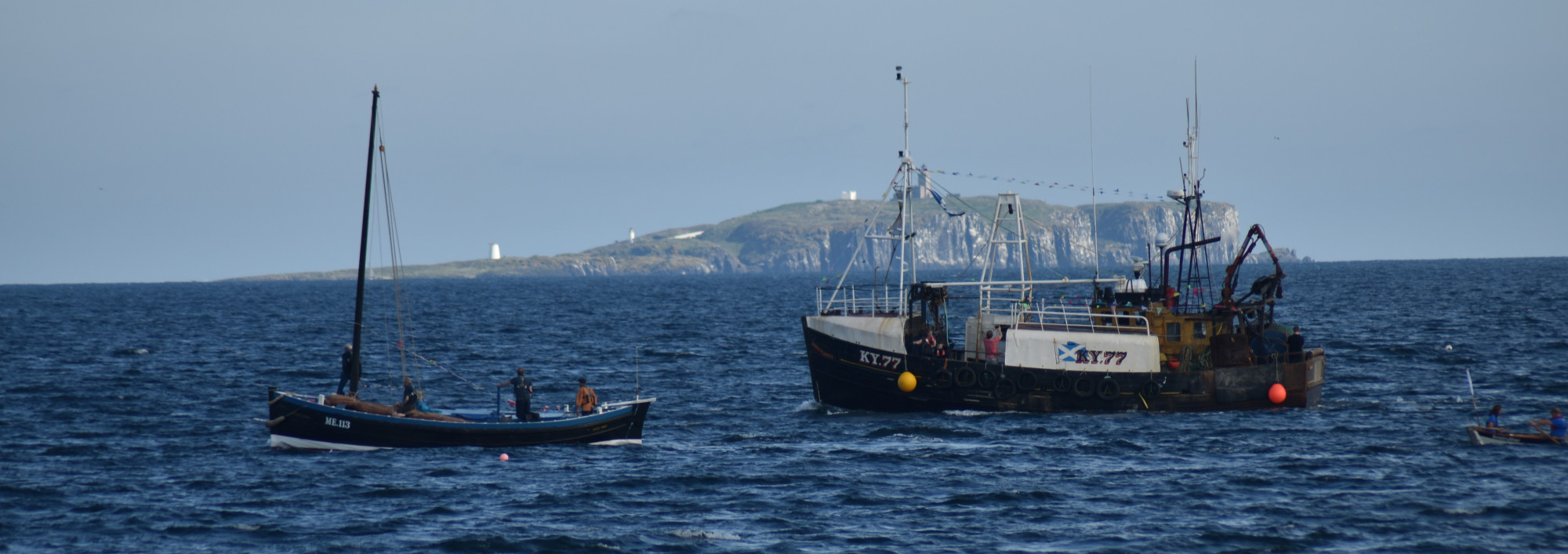

The Cellardyke Echo – 14/3/2018

1872

Burgh Court

Two cases were before Provost Todd and Bailie White on Thursday, namely, Alex. Trail, carter, Cellardyke, who was charged with an assault upon Alex. Smith, better known as “Sandy Ba ‘” in the Mason’s Tavern on the evening of Saturday, the 17th inst. He pleaded not guilty, but proof having been adduced the charge was found fully proved, and be was sentenced to a fine of 10s, or ten days’ imprisonment. In passing the sentence the Provost characterised the case as a “drunken row which all the parties would be to blame”. The next case was that of Alex. Pottie, also Cellardyke carter, who was charged with furious driving along the Shore, and which he pleaded guilty and was sentenced to fine of 7s 6d, or eight days imprisonment—the Provost at the same time administering a sharp reprimand on the dangerous practice furious driving, especially when, as he said, there was no occasion to do so.

1873

Novel Housebuilding. Mr John Gilchrist, of the Cellardyke Steam Boot and Shoe Works, is at present erecting handsome edifice on the celebrated concrete principle on the fine corner opposite the Tolbooth of our thriving sister burgh. The novel erection is 33 feet long, 21 wide, and 22 high in the front wall, and is to embrace an elegant and commodious shop on the ground floor, with neat family apartments above; and as it has swept away the mean and incongruous subjects which so long disfigured the locality, Mr Gilchrist’s enterprise has effected one of the most decided improvements ever carried out in Cellardyke.

1874

A singularly touching instance of family affliction has just occurred in the death of Miss Grace Watson daughter bailie Robert Watson, merchant, who succumbed to a subtle and malignant disease after a  very few days illness, on Friday last. Miss Watson has been verily cut down like the of early summer-being only in her twentieth year and it gives a deeper touch of pathos to her affecting story that she was within a few weeks of becoming the bride of an amiable young man, who was recently associated, as a partner business with her respected father. This lamented young woman belongs to one of the oldest and most esteemed families in Cellardyke, many of whose members have been remarkable in no ordinary degree for their exalted qualities of head and heart ……

1877

The other day, the Cellardyke deep sea going boat “Southern Cross,” Skipper Alexander Fowler, was at the cod fishery some leagues seaward of the May, a strange boat was espied running the same track, and her nefarious errand was only made too intelligible by the irritating discovery that the fishing gear had apparently been raised to the surface means of small grappling irons, and then deliberately stripped hook by hook, the piracy being ended taking away about two thousand yards of the gear, which was likewise cast adrift to the mercy of the storm. The matter is at under investigation by Gillis, of the Fishery Board.

Early on Wednesday morning one of the Cellardyke fishing boats was overtaken by the storm while at sea, and during a heavy squall three of the crew were washed overboard. The skipper and another man were with much difficulty rescued by the remainder of the crew, but a lad named Robert Doig, aged about 18 years was drowned.

1878

Disaster to Fishing Boat.-Early on Friday morning, as the Cellardyke boat “Six Brothers,” Skipper John Dickson, was entering the harbour, she was struck with the squall, which threw her so far to the leaward at the very instant of weathering the fairway that she came into violent collision with the eastern breakwater. It was a critical moment for the boat and crew, but fortunately the harbour was gained, though not without considerable damage to the former, which in particular, had five or six of her bow planks crushed in by the collision.

1879

New Fishing Craft.— It speaks well for the enterprise of the fishers of Fife that, notwithstanding an occasional ebb in the fortunes of the sea, the orders for new and improved fishing craft were never so spirited as they are to-day. Our district building-yards are ringing merrily with a new squadron for the coming Drave, and we farther learn that two of our Cellardyke skippers, Messrs George Barclay and Adam Watson, have entrusted their commissions to Mr Whitehead, of Fraserburgh, who is so successfully developing in the north the fine sea lines, for which the Eyemouth fleet are so justly renowned. All this activity is the natural and spontaneous result of the seaward chase, which is now firing the Scottish coast, and which but yesterday, as it were, has opened up new and boundless resources wealth and prosperity, whether with regard to the white or herring fisheries. Thus the favourite boats few yean ago are being sold at whatever sacrifice for the sake of others more suited to the times. We even hear of staunch drave boats, like the “Watsons,” of Cellardyke, being sold, tackle and all, for the nominal price of twenty-five pounds or so, and the crack clippers at the last cruize are being laid aside for no other reason than that they are unequal in respect of size for the burthen and the race. As yet the movement has only to do with the dimensions of the boat; but we hear interesting experiment at the instance of Skipper Robert Montidore, who is to rig out his new boat on the principle of the Penzance luggers, the value of which can be realised by seafaring readers when we say that it is expected to reduce the big mast, say from fifty-three to forty three feet in length, which will lessen, if it does not altogether remove, one of the most constant perils of our Scottish fishermen. We also observe a new expedient in the way of ballast, for which, amongst its hundred purposes, concrete is being used by Skipper Key in the outfit of the “Comfort,” launched the other day at Pittenweem. The concrete is being filled in as kind of packing between the timbers, and will, least, leave more berthage for gear and cargo. In reference to the grand question of steam fishing, its Introduction appears to be as distant ever in the East of Fife. The experiment of the Leith sisters the “ Onward ” and “Advance,” have by no means favoured the principle; but we may State here that our townsman, Mr John Millar, boatbuilder, has of late given the subject much consideration, and so far the result may be fairly accepted the best solution of the difficult problem. Mr Millar, it may be explained, contemplates the application of the screw to a smart North Sea racer, say of fifty feet or upwards, in which the machinery, being placed amidships would serve as ballast, and render the craft as lively as a duck in any weather. The grand obstacle however is the expense. This indeed is limited to £600, or scarcely more than the half of the steam fishers of Leith; but as fishing associations are not in repute in the sea homes of Fife, and as none of our Skippers are likely to take so large a hazard in the meantime at least on their own shoulders, the enterprise, as we have said, is still a shadow of the future, though it is understood that if any fisherman of recognised experience would engage a superintendent the requisite capital could be once subscribed by those otherwise persuaded of a harvest success..

The Cellardyke Echo – 6/3/2018

1856

Craignoon Habbour.—Mr Stephenson, engineer, who arrived here has commenced to make a survey of the site, and draw a plan the proposed harbour at Craignoon.

1858 two reports of the same storm… the second I have just selected the Cellardyke part but the full report was over a 100 words long

The winter herring-fishing partially revived since the late stormy weather, there being pretty good takes on Friday and Saturday last. The price per cran is still high; and it is much to be regretted that the weather has so much interfered with the pursuits of the fishermen. Accident.—We understand that on Saturday morning last, a boat returning from the fishing, and said to be manned by the folks of the “Lang Town,” was accidentally run down by another boat. We are glad to say that no loss of life occurred, one man only having his leg severely hurt. The boat, with all its apurtenances, is lost; and such a loss is great, considering the time, labour, and the expense attendant on the fitting out of even a fishing boat. We learn that the injured man is slowly recovering.

COAST OF FIFE.—Elemental Commotion …………… The fishermen resumed their precarious enterprise with considerable success, having secured draughts various magnitude, which realised excellent prices. But on Friday night the atmosphere resumed its impassioned fury, threatening destruction to all exposed to its impetuous current. One boat came in violent collision with another, and sent her slap-dash to Davie Jones’ locker. But with praiseworthy activity, the imperilled crew were rescued from a premature grave in the caverns of the deep. In consequence of the accident, however, a man belonging to Cellardyke is reported to have sustained severe fracture of one of his legs; and it seems truly miraculous that a much greater amount of mischief has not been the result of such sudden and frightful tornado, which continued shifting from one point of the compass to another. The wind continued to blow with increasing violence during the whole of Saturday, imparting a wonderful change of appearance to many objects in the visible creation, whether animate or inanimate. Even brace of accomplished ladies (the daughters of Lord), were observed exerting all the agility of their limbs in pursuit of their exquisite bonnets, which had leaped from their heads, and wore flying before them like Gilpin’s hat and wig, and making much more progress than their denuded pursuers, until intercepted by some convenient obstruction. It was verily killing sight to behold the lovely, the well-cultivated tresses wildly streaming in the wind. ………….

1860 – on the week after the Baptist church is getting stripped out

ESTIMATES WANTED, FOR ERECTING a CHAPEL and VESTRY at East Green, according to Plans and Specifications which will be shewn James Fowler, Cellardyke ; by whom Offers will be received to the 20th inst. Information will also be furnished by Mr J. Hall, Architect, St Andrews. Anstruther, March 7, 1860.

1862

On the forenoon of Friday last, as an aged fisherman, named Doig, belonging to Cellardyke, was proceeding homeward, he was overtaken two spring-carts following close on each other. The first, jostling against him, threw the unfortunate man to the ground, when the other, which was heavily loaded, almost instantly passed over his body, crushing him severely. Surgical assistance was promptly in attendance, and hopes are entertained of his recovery. The case is being, investigated into the authorities.

Snow-Storm. —On Sunday afternoon the wind, which on the former part of the day had been from the westward, accompanied with occasional slight showers of rain, suddenly veered round to the northeast, and shortly after snow began to fall, and in a few hours the ground was covered to the depth of five or six inches. Such an unexpected change of weather subjected our fishermen to a very great amount of trouble and inconvenience, as their nets usually lie on the fields from Saturday to Monday, order if possible that they may be thoroughly dried. Many of them, therefore, on returning from church, wore under the necessity of having to proceed to the removal of the exposed netting—an operation which, from their being so deeply imbedded in the snow, and in the very disagreeable state of the weather, was only accomplished after much difficulty and exertion.

1865

James Christie, carter, from Cellardyke, was charged with having, on the 10th February, assaulted Andrew Anderson, flesher, near Anstruther Easter, with a walking stick, to the effusion of his blood, and serious injury his person. The accused pled not guilty, bat after proof had been led he was found guilty, and sentenced to pay a fine of 30s, or prison for twenty days.

1866

It has often of late been our pleasing duty to notice the splendid donations of Walter Hughes, Esq., to local institutions and charities. This week, however, so far at least as the public have had an opportunity of knowing, this noble minded gentleman has exceeded all his former benefactions. The recent boat disaster at Cellardyke having been brought under Mr Hughes’ notice, lie visited that town the other day, with the special object, it is said, of making himself acquainted with all the circumstances of the case. Having satisfied himself that the owner of the wrecked boat was worthy of his kindness, he, with a generosity which must challenge the admiration of all, agreed to present, at his own coat, the poor fisherman with new boat of the largest size, and be constructed of the best materials. Mr Hughes also presented number of poor persons in Cellardyke with handsome gratuities. Than this estimable gentleman, few have given with so liberal a hand to the relief of the poor and unfortunate, and many, we feel assured, are the blessings which grateful hearts here shower upon him for his innumerable bounties.

(This boat was to be the experimental Pioneer built at Pottinger’s yard in Anstruther)

1867

Alleged death from an overdose of Chlorodyne- On Wednesday considerable excitement was caused in the west end of Cellardyke by a report that an old woman of the name of May Davidson, the widow of the late James Pringle, labourer, had died from an overdose of Chlorodyne. On enquiry, however, it appears that this rumour is without foundation and that the deceased, who is about 85 years of age succumbed to a fit of palsy.

1868

We understand that an amicable arrangement has been come to with respect to the loss of the Cellardyke boat, (Marimne KY 433), by the owner of the barque Danubio (which ran the boat down), consenting to pay the claim of £160, compensation for the loss sustained by her owner, Mr John Watson, Cellardyke, with further sum, said to be £12, to the crew, to make for the loss of clothing and other effects belonging to them, and which were not saved.

A Disorderly Patlander.— Before the Summary Criminal Court of Cupar on Wednesday— Substitute Taylor on the bench— Martin Brogav an Irish labourer, was charged with having committed a breach of the peace in the house of Christina Lillie or Salter, Cellardyke, and also with having broken several panes of glass in the said house on the previous evening. Brogan pleaded guilty, and was sentenced to pay a fine of 20s or fourteen days’ imprisonment. The fine not being forthcoming he was removed to jail

1869

During the week the fishermen of Cellardyke have made considerable progress in registering and numbering their fishing boats, as required by the recent order of the Board of Trade. In this novel and therefore embarrassing duty, the fishermen have found a valuable friend in William Gillis, Esq., fishery officer, who has most kindly given his experience and help in filling up the forms required by law. The changes caused by the new system are somewhat curious, as instead of beginning at Buckhaven, as was the case before, the first numbers have been issued for Cellardyke boats, when K.Y. No. 1 is to appear on the boat of Skipper John Gardiner, and where an advanced number like 651 is to be replaced by a primary 5. About 100 Cellardyke boats have been already numbered, and we trust that no time will be lost by the fishermen in complying with the order, as no boats in the case of neglect will be allowed to sea after April.

The Cellardyke Echo – 28/2/2018

1827

Five boats, belonging Crail, Cellardyke, and St. Monance, near this place, fishing on Saturday, were overtaken with the storm, and none of them have reached home. The crews may amount to from 20 to 30 men.

1838

On the night of Saturday last, we were visited with a very severe gale of wind from the eastward, and the damage done upon the Coast has been very great. The wind was accompanied a heavy fall of snow, and the roads were for a second time this season blocked up. On Sunday the storm raged with equal violence, and there being a stream-tide the sea broke upon the shore with great force. The new building on the south pier at Cellardyke harbour is almost totally destroyed, and several hundred cart-loads of stones, which composed the centre part of the pier, are now lying in the middle of the harbour, which is of course useless. A few years ago about £1700 were expended in improving the accommodation for the boats of this thriving fishing station, but we are sorry to say to little purpose, the basin never having been a safe shelter from the sea any wind, although in good weather the boats were generally moored in it.

1844

Herring Fishery.— During last week this branch our fisheries was prosecuted with success unexampled for a number of years. ……….On 15th 100 boats out; average take nine crans—price 10s. 6d. On the 16th the average was eleven crans a boat—price The quantity landed this day exceeded 1,000 crans. On the 17th the boats returned well fished. The weather has been favourable, and the fish of good quality. They are caught about a mile from Cellardyke shore.

(For those of you who do not know a Cran is about 1000 herring, just over 37 imperial gallons or a cured barrel of fish. So on the 16th Feb 1844 over 1 million fish were landed, caught within a mile of Cellardyke)

1845

INTIMATION IS HIEREBY GIVEN, in terms of Act of Parliament, 1st George, IV., cap. 37, by the CORPORATION of the MASTER and ASSISTANTS of the TRINITY HOUSE of LEITH, of ReCALL of the LICENSES of the following persons who were Licensed by the said Corporation to act as SEA PILOTS, viz.,-

LEITH. …………. KIRIKALDY. Robert Moys. SAINT ANDREW’S. George Wallace (dead, supposed about 1841.) EYEMIOUTM. George Willis, James Dougall. BURNMOUTH. Alexander Martin, Robert Johnston. CELLARDYKE. Alexander Cunningham, James Murray…………..

1848

CELLARDYKE. A public meeting of the fishermen was held in the Town Hall, here, Tuesday week, to consider memorial containing objections to the Dunbar Harbour Dues Assessment Bill, now pending the House of Commons, various clauses of which are very unjust and oppressive to the whole of the fishing population on the Frith of Forth…..

1850

Petitions to Parliament from the Magistrates and Council of the burgh, and from the Sabbath School teachers in Anstruther and Cellardyke, in favour the total cessation of business throughout the entire- post-office department on the Lord’s-Day, have been forwarded to Mr Ellice, MP, for presentation. Thirty-five names were adhibited the teachers’ petition.

1853

The following persons were tried before Mr Sheriff Grant during the “past week:—William Watson (Sime) and John Watson (Sime), fishermen, residing in Cellardyke, were both charged with assault to the effusion of blood. They pleaded guilty, and were sentenced to pay a fine of 15s, or suffer 15 days’ imprisonment. Fine paid.

1854

Australia.-William and Philip Black in company with three Cellardyke men, named Boyter, Henderson, and another whose name did not hear, had tried the fishing in Geelong Bay, and were earning from L.3 to L.6 per day which leaves the diggings in the shade. The fish caught are represented to be thick and short, about the size of half-cod. The fishermen there had kept their trade as much secret as possible but now, that the East of Fife men have got hold of it, the trade will soon be opened, and this occupation will be more congenial to them than the diggings.— Pittenweem Register.

1855

DISASTERS ANSTRUTHER HARBOUR. We are sorry learn that the storm which raged with much violence, and widely, last week, hat inflicted great damage on the fishing-boats in Anstruther harbour. In addition to the Cellardyke boats, there were many stranger boats in the harbour attracted the herring-fishing, now being prosecuted along the coast. The fishermen disliked the appearance of the weather on Wednesday evening, and only a few boats went to sea—the rest, numbering somewhere about 140, having on board their nets and other fishing-gear, remained at anchor the harbour. About nine o’ clock the wind rose, and about twelve o’clock,  it blew a gale, which, from one to three o’clock, increased till it blew a hurricane. When the storm was at its worst, it was high water, and the wind, being from the south west, blew directly into the mouth the harbour. The boats soon began to drag their anchors, and, drifting against each other, were in a body dashed against the quay of Shore Street.  Many of the fishermen were present, and soon all of them, aroused from their beds, by the drummer announcing that their boats were adrift, crowded the quays; but the great seas rolling into the harbour, the blinding spray, and the howling wind, paralysed all their efforts, and left them only to look helplessly 0n, as their boats, grinding against each other, and hurled against the quay, were stoved in, or went to pieces before their eyes. There were indeed a few cases bold successful daring, where the parties, flinging themselves into their boats, skilfully steered them from the crash. There also were cases of hairbreadth escapes. One man was washed off the east quay, but was fortunately got hold of; another would have been crushed between his boat and the quay help had not been at hand. When day dawned the harbour presented a scene of such wreck and disaster as the oldest inhabitant had neither seen nor heard of. Crushed against or upon each other, and jammed against the quay, like a scared flock of sheep on a steamer’s deck, lay almost all those boats that rode so freely at sunset. It was found that while few escaped quite unscathed, there were forty-two boats so damaged that would cost from £8 to £40 each to repair them, and that, too, exclusive of the loss by nets torn and damaged. One boat was literally smashed, and had to be lifted over the wall in fragments. It is calculated that many hundreds of pounds must expended before all those damaged boats can proceed to sea. But that even is not the extent of the loss. The winter herring fishing now at in its commencement—it lasts but a week or two—and this disaster has spread a gloom over our fishermen generally, as well as crippled, quite disabled, many of them for this season’s fishing. We learn that nothing is now spoken but Craignoon Harbour; and the idea of a  low water harbour (here with a safety-basin was ardently desired before, that wish has, by this disaster, been now fanned into an enthusiastic determination to have It accomplished.  Its necessity seems to equally felt by fishermen from Newhaven, Buckhaven, and all along the coast, they express their readiness give pecuniary assistance.

Additional one for entertainment 02/03/2018

24th Feb 1887

FISHERMEN IN BAD COMPANY.— Arbroath – At the Police Court this morning, William Donald, hairdresser or flaxdresser; Mary Ann Murray Winton or Donald, his wife; and a young woman named Mary Bates or Thoms were charged with keeping disorderly house at No. 11 Lordburn yesterday afternoon. They pleaded not guilty-. John Morris, fisherman, belonging to the Vesta, of Cellardyke, said was in the house kept by the accused yesterday afternoon. He was taken to the house by the two women. While there some drink was consumed, and he had been robbed of £3 in notes and some silver money. Robert Mair, another fisherman belonging to the Vesta, said he was also in the house. He could not say how he got there, he having been the worse of drink at the time. Jessie Duirs or Haft, residing 11 Lordburn, said Mrs Donald brought the two men her house and afterwards took them away again. Both men were under the influence of drink at the time. She had never before seen any strangers in the house occupied by the accused. Constable Webster deponed that one of the fishermen informed him last night that some money had been taken from them in Donald’s house. Witness went the house, and found Donald and his wife there, both being the worse drink. Mrs Donald said that Bates had got £2 and some shillings from one of the fishermen. Bates was not in the house, he found her in a house in Gravesend much the worse for drink. Inspector Johnston deponed that he recovered £1 of the stolen money in a public-house in Keptie Street. The people in charge of the shop informed him that Donald had paid for some drink with a £1 note, and that Bates, who was with him, had taken possession of the change. This was all the evidence. Mr McNeill, addressing Donald, asked where he got the £1 note. Accused—From Bates. Mr McNeill —Were you not surprised to see her with so much money? Accused—l knew she was getting it, one of the fishermen had told her he was going to take her to Cellardyke and marry her. (Laughter.) The Bailie found the charge proved, and imposed a fine of 15s in each case, with the alternative of fifteen days’ imprisonment.

The Cellardyke Echo – 20/2/2018

1925

OILSKIN F ACTORY IN CELLARDYKE FOR SALE

There will be re-exposed- to Public Roup within the Town-Hall, Cellardyke, on Wednesday  4th Match, at 2pm

That extensive OILSKIN FACTORY in JAMES STBEET , CELLARDYKE long occupied by A Black & Co including Slops and Office

REDUCED UPSET PEICE,  £ 250 … Feu-duty, nominal

1926

FUND FOR BATHING POND CELLARDYKE. Provost Mitchell, who presided at the monthly meeting of Kilrenny Town Council, reported that he had received sum of £15, the proceeds of a whist drive organised townspeople on behalf of a fund being raised for the construction of a bathing pond at Cellardyke.

An application on behalf of the 4th Troop Dumbarton Boy Scouts for permission to camp on Kilrenny Common during Glasgow Fair fortnight was granted.

1927

DYSART TOWN COUNCIL.

WATERPROOFS FOR TOWN EMPLOYEES. The Council approved minute of the Streets Committee authorising the Burgh Surveyor to accept the offer of Martin, Cellardyke, to supply the town employees with six oilproof suits, and one oilproof jacket, at the price of 17s 7d per suit.

For having carried eleven passengers in excess of the number which his vehicle was constructed to carry, James Stevenson, ‘bus driver, 25 James Street, Cellardyke, was fined £1.

A fine of 10s was also imposed on Martin Gordon, ‘bus driver, Burnside Terrace, Cellardyke, who admitted having on 30th January wilfully interrupted and hindered the free passage of a motor ‘bus driven by Donald Duncan, Wellesley Road, Methil, and failed to keep to his proper side of the road to allow the vehicle to pass.

1928

CROWN SALMON FISHINGS-TO LET.

THE COMMISSIONERS OF CROWN LANDS are prepared to receive TENDERS for a LEASE of the SALMON FISHINGS in the Sea extending  from the Pier at the southern end of Cellardyke Harbour in the Parish of Kilrenny to Fifeness in the Parish of Crail in the Firth of Forth in the County of Fife , Particulars and Forms of Tender may be obtained- on application to the SECRETARY OFFICE OF COMMISSIONERS OF CROWN LANDS , 1 WHITEHALL ; LONDON

(Spot the mistake in this advert)

THE CLUB RALEIGH The all-steel bicycle

No deposit from 13/9d a month or cash from £7 5s

Built to the specification, of 1,000 clubmen. Supplied with any variation you like –  a bicycle that expresses your personality.

With Clipper Speed tyres, Brooks’ saddle, low bracket, drop-out hubs, etc., etc.

Send ‘ for the special Club Raleigh leaflet from:

W Band,  Crail Rd, Anstruther

W Fortune, Tollbrook Rd Cellardyke

SHARE FISHERMEN’S INSURANCE EAST NEUK VIEWS SCHEME WITH FAVOUR

A meeting of importance to share fishermen was held in Cellardyke Town Hall on Saturday evening, when Bailie W. Carstairs presided. Mr Hadden, of the Scottish Board of Health, was present, and gave the fishermen an outline of a proposal to bring share fishermen into the National Health Insurance scheme. Mr  Hadden said they would all recollect that in 1912 and 1913, when there was a proposal afoot to bring in share fishermen to the scheme, it was decided that they were not to be admitted into National Health Insurance. Perhaps that was a regrettable decision, and he hoped that that evening they would not allow anything that had happened in the past to prejudice the present case.

The Contribution. There had been great changes in the situation since 1912, and now the general feeling was that share fishermen would like to be admitted into the scheme. ……………A contribution would be fixed at 1s 6d per week, during such time a share fisherman was employed, and the general contribution covered health and contributory pensions. No one could be a member one without the other.

 Benefits.

As regards benefits to share fishermen, there was difficulty to be met so far as they were often away from home. If, in such circumstances, they required medical treatment, they would receive such treatment from the doctor whatever port they happened to be at. Then there maternity benefit 40s per week, payable after 42 weeks’ contributions to the wife of a share fisherman. A sickness benefit was payable after 26 weeks’ contributions the rate of 9s per week for 26 weeks. When he had been two years insured sickness benefit would go up to 15s per week. A man would be entitled under these circumstances 15s per week for the first 26 weeks and 7s per week thereafter. ………… The widows’ fund pension was  payable to the widow of a contributor once he had been under the Insurance Act for 104 weeks and had paid 104 contributions. If he died immediately after he had paid 104 contributions his was entitled the pension. ………. The widow’s pension was 10s per week. It was entirely independent of any means which the widow might be left might earn, and that payment of 10s per week wont on until the time of her death, provided she did not remarry. Then, for every child under years of ago the widow would receive 5s per week for the eldest and 3s per week for each other child under the age of 14 years. If the child chose to go to school for the full period until he was 16 years of ago the pension was still payable for the child at the same rate. ………..( further lengthy description of the clauses)

…………… . A  show of hands was taken give indication of the feeling Cellardyke on the matter. A majority of the meeting favoured proposal for National Health Insurance for share fishermen, only three being against.

OFFICIAL NOTICE. PROPOSAL TO CHANGE A SHIP’S NAME. , We—JOHN MUIR Cellardyke and WILLIAM CUMMINGS WILSON Whitley Bay-HEREBY GIVE NOTICE. That in consequence of unsuitability have applied the Board Trade, under Section the Merchant Shipping Act, 1894. In respect of our ship CRAIGHALL. of Kirkcaldy,  Official Number 145547, Gross Tonnage 95.4,  Register Tonnage 39.44, heretofore owned by Samuel Chapman, Senior; Samuel Chapman, Junior; Frederick Chapman, and Benjamin Chapman. Fish Docks. Grimsby, for permission to change her name to “SPES AUREA,” to be registered in the said new name at the Port Kirkcaldy as owned by John Muir and William Wilson. Any objections to the proposed change sent to the REGISTRAR-GENERAL OF SHIPPING AND SEAMEN, Tower Hill, E1, within Seven Days from the appearance this advertisement. Dated at Anstruther this Fourteenth Day February, 1929. JOHN MUIR. WILLIAM CUMMINGS WILSON.

The Cellardyke Echo – 13/2/2018

1910

CELLARDYKE FISHERMEN AND THE BAG NET. At a largely-attended meeting fishermen, held in Cellardyke Town hall on Saturday night, a petition to the Fishery Board asking for abolition the bag net fishing in the upper reaches of the Firths Forth and Tay was submitted. It was stated that that method fishing resulted in the destruction of young herring, and was very injurious to the great winter herring fishing in the Firth Forth. Most of the fishermen present signed the petition, there being general agreement that the bag net fishing was harmful, not only to the herring fishing, but also the white fishing. It was also agreed to form a Fishermen s Association for the purpose securing better protection from the Government from the depredations of the trawlers. The petition will be supported fishermen from Dunbar and Eyemouth to Broughty Ferry and Ferryden

1911 – The discussion still holds the headlines

EAST FIFE “FISHERMEN DESIRE REFORMS; Delegates appointed at a meeting of fishermen held in Cellardyke Town Hall on Saturday evening—Provost Black presiding—to attend a conference of the East Coast Fishermen s Protection Association to be held in Edinburgh were instructed to press for the abolition bag-net fishing, for the imposition of a 13 mile limit for trawlers, and for the abolition of Sunday fishing carried on by English fishermen.

1913

FIFE FISHING BOATS REFLOATED. The fishing boats Andrews, of Cellardyke, and the motor boat Mary Duncan of St Monans, which went aground in foggy weather, were refloated last night. The Andrews sustained very little damage, but the Mary Duncan wan badly holed, and sank aft, being taken to St Monans harbour.

1914

FIFE FISHERMEN ARE NERVOUS ABOUT DOGS.

CELLARDYKE BUTCHER SUED.

In giving judgment in an action of damages raised by Alex. Smith, coal merchant, Cellardyke, against Geo. Kirkcaldy, butcher, Cellardyke, for injuries sustained by his five year-old daughter through being bitten by a collie dog, Sheriff Armour Hannay, Cupar yesterday, said he had great sympathy with the pursuer. He was satisfied the little girl had met with an injury, and he was quite willing to assume it was from the bite of a dog.

The whole question was—What dog did it? There was absolutely only the girl’s story about that. It was easy to suggest to children what the answer should be, and then, of course, they adopted that. Seeing the hour at which the girl was bitten was not given, that must be used rather against the pursuer.

It was all very well to say the dog was destroyed, and that an offer was made to pay 17s 6d in respect of medical attendance. He thought the destruction of the dog was a very proper thing. As for the offer, the defender, he supposed, like all sensible men, wanted to keep out of Court. His Lordship assoilzied the defender, and gave him half expenses.

During the proof. Mr T. D. Murray, Anstruther, for defender, asked Mrs Kirkcaldy if there was any reason for her keeping a ferocious dog? She replied in the negative, and added it would have been against one’s business to have kept a vicious dog.

Mr Murray —Are not fishermen pretty nervous about beasts?

Mrs Kirkcaldy—l should think they are.

1915

The women of Cellardyke Parish Church have forwarded to the soldiers and sailors 536 pairs of mittens, 110 pairs of socks, 42 pairs of hose-tops, 36 belts, perseys, 15 shirts, 11 mufflers, 9 knitted jackets, 6 nightshirts, 2 bed jackets, and 2 dozen handkerchiefs.

1916

Robert Ray, B.Sc., son the minister of the parish, is at present home from Africa. Mr Ray’s intentions were to join the Army, but, owing to his knowledge of chemistry, his services have been enlisted for munition-making. Mr Ray had a brilliant career in science St Andrews University, where he also gained fame as one of the most expert of hockey players.

GLENGARRY MINISTER FOR CELLARDYKE. At a meeting of St Andrews Established Presbytery, held in St Andrews yesterday, the necessary documents in connection with the translation of Mr Lee, minister at Glengarry, to the parish of Cellardyke were submitted and approved. The induction is to take place at Cellardyke 28th February. The Rev. Mr Ellis, Elie, will preside, and address the minister and congregation.

1917

Divorce cases

Evidence was heard and decree of divorce pronounced on the ground of infidelity in an  action , at the instance of David Hutchison Barclay , formerly fisherman , 1 7 John Street , Cellardyke , Fifeshire , now a private in the Black Watch , against Cecilia Miller or Barclay , 43 Nicolson Street , Pulteneytown, Wick

1918

DEATH OF CELLARDYKE NONAGENARIAN. Mrs Black, wife of the late Mr David Black, baker and biscuit manufacturer, Cellardyke, has passed away at the residence of her son, Provost Black, Cellardyke, at the age of 92. A native Andrews, Mrs Black was daughter of the late Mr Alex. M’Bean, and was the last survivor of all the children who were enrolled scholars on the opening day the Madras College. She always retained her interest in that school, and some years ago presented a medal to the girls’ class of physical culture. She retained all her faculties to the last.

Burials,

On Naval Service, Alexander Swanston Corstorphine aged 19, 2nd son of David Corstorphine, St. Abbs House, West Forth Street, and grandson of the late Alexander Swanston,-Eyemouth, killed at sea, Jan. ,18th, while mine-sweeping operations. Burial took place at Kilkenny Churchyard, Cellardyke. Much respected and beloved by all who knew him.

1919

For Sale, by Private Bargain. BAKING PREMISES at 55 JAMES STREET, Cellardyke, lately occupied by D. Black Son, consisting of Bake house with Ovens good condition, Lofts, stable &c., and Dwelling- Houses occupied by Margaret Watson, Robert Watson and Agnes Watson. Rental. £22. Feu-Duty Nominal.

The Commodious DWELLING-HOUSE. 53 JAMES STREET, Cellardyke occupied by William Woodward. Rental, £16. Feu Duty Nominal.

( N.B Agnes Watson mentioned above was the widow of Thomas Watson Skipper of the Bernicia and daughter of Daniel Henderson of my house, also lost with the Bernicia)

 More meetings regarding trawling, but obviously the question about access to British territorial waters was being debated at the end of WW1.. 100 years later Brexit and UK Territorial waters.

Demand for Closing of Firth. On the grounds of a continued food supply and the dependence of fishermen and their families on this industry for a living, it is contended that the Firth Forth should be closed to trawlers. The whole question of the territorial limit is, of course, an international one, and cannot be dealt with other than such. But in the North of Scotland, where, it is pointed out, the fishermen have already taken action, the representation made has this point clearly in view and is made accordingly.

At a largely-attended meeting of the fishermen at Lossiemouth recently a resolution was unanimously adopted, and a coy forwarded to the member for Elgin Burghs, Sir Archibald Williamson, Bart., who, by the way, has close lineal connection with , Anstruther and Cellardyke, urging that the British delegates to the Peace Conference will insist the Moray Firth and all bays and firths each country within fifteen miles of its coast being secured as territorial ; waters, with exclusive control each country in its own territorial waters with regard to fishery matters.

KYLE OF LOCHALSH, Friday.—Fifteen boats arrived to-day with an average of 16 crans. The quality was fairly good. The best shots were got west of Cape Wrath. Prices were from 98s to 108s per The Corona, Cellardyke, had 100 crans; Fairy Know, Buckie, 80 crans; and Celi Verna, Peterhead. 50 crans.

The Cellardyke Echo – 7/2/2018

1901

On the death of Queen Victoria

The Town Councils of Anstruther Wester, Anstruther Easter, and Kilrenny all met on Friday to move votes of sympathy with His Majesty Edward VII and the other members of the Royal Family in their bereavement. At each of the meetings the respective parish minister was present and opened the meeting with appropriate prayers, after which the respective Provost spoke of the great loss the country had sustained, and the world-wide sorrow that had been expressed. In all the Coast churches on Sunday tributes were paid to the Queen’s memory. In several churches the Dead March was played and the late Queen’s favourite hymns were sung. In the evening the Rev. Mr Ray, in Cellardyke Parish Church, reviewed the life of Victoria as Mother, Wife, and Queen, and riveted the attention of the congregation. The church was crowded to its utmost capacity, some failing to gain admittance.

1903

Exciting: Scenes at Anstruther. FISHING BOATS DAMAGED. About five o’clock last night a heavy south westerly gale broke over the Firth of Forth. During the time the gale was at its height a large number of fishing craft, which had remained out during the day with the intention shooting their nets, were observed off Anstruther Harbour, making for the harbour. Unfortunately, they attempted this too quickly one or two boats that had grounded during the preceding tide, were lying partly in the fairway, with the result that those entering the harbour had, in order to avoid colliding with these craft, to allow their boats to run on the beach. In one case, the boat Valiant (Peterhead) did collide with another, and sustained severe damage. While the boats were lying the beach, a heavy swell broke over them, and it was feared they would sustain heavy damage. The boats continued to come in in rapid succession, and the scene was indescribable. The quays were soon filled with men and women, all anxious to assist, and the greatest excitement prevailed. , First torches were flared prevent other boats returning until the fairway was cleared. A yawl was launched, and ropes secured from the boats on the beach to the quay, with the result that they were eventually all got off except the Cellardyke boat Ruby (owner, John Dick), which sustained considerable damage, and was only floated off morning. Another boat that sustained damage was the Cellardyke boat Sisters which was run into by another boat entering the harbour. It was nearly nine o’clock before the harbourmaster and his assistant could get them all into the inner harbour.

1905

Advert

USED DAILY THOUSANDS of HOMES.

COOPER & CO.’S TEAS.

ARE RECOGNISED THROUGHOUT THE COUNTRY AS

The Standard of Excellence.

Sold only in Registered Packages:

1/6, 1/8, 1/10, 2/, and 2/2 per lb.

FULL NETT WEIGHT WITHOUT PAPER.

LOCAL BRANCHES—

Anstruther- J Young, Masonic Restaurant

Cellardyke- AC Murray, 23 George Street

Pittenweem- Miss E Johnson, James Street

The fishing was again light. A few boats had heavy takes, while others had only a few crans. The total arrivals numbered 102 and the catch turned out 620 crans. The boats Lillias Scott. Otway, and Families’ Pride, Cellardyke, had takes of 49, 46, and 44 crans respectively.

1906

Political Rowdyism.—The Cellardyke Council had before them on Tuesday night a claim for £2 10s 9d made at the instance of Mr James Jack, fisherman, in respect damages sustained to his house on the night of the poll. The Town Clerk held that the town was responsible for any damage done by rioters the burgh. The Council were somewhat divided in opinion regarding- the expediency of paying the claim, and the Clerk was authorised to reply that the Council were sorry that any damage had been sustained, but that they did not feel themselves the responsible parties.

TWO FIFE FISHERMEN DROWNED. Two sad cases of loss of fishermen were reported at Anstruther this morning, on the arrival of the fishing fleet. The crew of the boat Elizabeth Keays, Cellardyke, had just finished hauling their gear, when the boat gave a lurch, sending Peter Boyter overboard. Every effort was made save him, but without avail. He was 37 years old and unmarried, but the support of his widowed mother. In the other case the St Monans boat Balmoral was heading up for home, when Alexander Gowans was thrown overboard by a lurch. He was never seen again. He was 42, married, but family. The sad events caused great gloom among the fishing fleet, some of the crew of which are to-day ashore for the rest of the week. In the case of both men their fathers were lost in the same way number of years ago.

1907

Football Notes. — Considerable excitement prevailed here this week when the results of the draw in the Martin White Cup were made known. In the event of Cupar falling before St Andrews United, both Anstruther Rangers and Cellardyke Bluejackets will have to travel to St Andrews on February 23rd, the former Lade Braes and the latter to Kinness Park. Rangers are now at their strongest, and although the Bluejackets are not much heard of at present, their team is good enough on all its lines, and they have no fear of the result of their tie with the City.

1908

COLLISION IN PETERHEAD HARBOUR. TRUSTEES’ LIABILITY. In the Court of Session yesterday Lord Salvesen had before him the two actions by Peter Lindoe, ship-owner, Hangesund, Norway, owner the steamship Adria, of Hangesund, against William Geddes, 13 East High Street, Portgordon, owner of the fishing boat Strathlene, of Portgordon; William Reid, 11 James Street. Cellardyke, owner of the fishing boat Elsie Reid of Kirkcaldy; and the Peterhead Harbour Trustees, who were brought into the case after the action was raised. Pursuer sued for £135 in respect damage sustained by the Adria, which was leaving Peterhead Harbour on the morning 26th June last when she was run into the Strathlene and the Elsie Reid one after the other. The owners of the fishing boats contended that no notice was given them, by, signal or otherwise, that the harbour entrance was blocked. Counsel for pursuer yesterday stated that minute tender had been put in for the Harbour Trustees, and on his motion Lord Salvesen decerned against _ the Harbour Trustees for the sum £45 in each action, together with the taxed expenses in the process; dismissed the actions against the owners of the fishing boats; and as between pursuer and the owners of the fishing boats, found no expenses due to or by either party. He should, he said, have favourably entertained an application by the owners the fishing boats against the Harbour Trustees for their expenses, but they did not so move.

The Cellardyke Echo – 6/2/2018

A wee extra one today

OPENING OF THE INTERNATIONAL FISHERIES EXHIBITION. The opening of the international Fisheries Exhibition was a brilliant and almost embarrassing success. There was, however, nothing Royal or brilliant about the weather. The thunder, lightning, and hail of the previous day had not, as some of the weather-wise had predicted, put a period to the wintry May from which we have suffered. There yet remained another gloomy rainy day, and that unfortunately was the date fixed for the State pageant at South Kensington. The outside demonstrations were in consequence not remarkable. The half-a-dozen Royal carriages which conveyed the Prince and Princess of Wales, their sons, and the officers of State from Marlborough House naturally drew many persons out into the rain, and, along the route, strings of flags were stretched at uncertain intervals overhead across the streets.. About 1500 police lined the streets under Colonel Labelmondiere and Superintendents Gernon, Dunlop, Harris, and Hamblin. The route was a long one, and alarming events have been too recent to permit of a lax police arrangement on each a day.

At eleven o’clock the scene in the entrance-hall led become exciting and dramatically picturesque. The eye at length became almost wearied with the succession of forms and colours passing before it, to mingle anon with the multitude in the court below the steps, or to remain in the entrance hall, presenting kaleidoscopic effects with every minute. The bands of the Grenadier Guards and Horse Guards Blue struggled through the crowds that rendered passing to the central promenade anything but easy. Then there arrived, jolly and neat as new pins, the 400 fishermen of Great Britain, who looked proudly upon the familiar nets and boats in the Sea Fisheries section, and marched on to take up their positions on either side of the corridor communicating from the great Sea Fishery Avenue to the Central  Promenade. The naval volunteers fell in as a guard of honour, looking thoroughly in their element at such a time and place. The Coldstream Guards were drawn up outside. A score of the Queen’s watermen in their garishly quaint scarlet liveries, and each man armed with a scarlet oar held upright, entered. Then a posse of the Tudoresque persons, commonly called Beefeaters, passed on to the central promenade. One-and-twenty of the gorgeously panoplied Gentlemen- at-Arms, to whom the poet of honour was entrusted, soon put in a dazzling appearance, conspicuous above all by their snow-white plumes, golden helmets, rich uniforms, and fanciful halberds. Under command of the Bargemaster of the Fishmongers’ Company, twenty men in the comic garments worn by the hollers of Doggett’s coat and badge were posted in the building. The lads from the Arethuna, training-ship, assisted to redrees the balance of colour, which, in spite of the maritime nature of the entire business, inclined for a while considerably to military scarlet and gold, for, in addition to eminent military men, there were one or two lord -lieutenant and a boat of deputy-lieutenants from the City scattered about. By-and-bye, when the wearers of Windsor uniform and levee dress and the foreign Commissioners arrived, the scarlet was no longer a monopoly. The central promenade, reached by divers turnings, was the point towards which season and special ticket holders made their way as well as they could. The dais was at the upper end. Hard by was a roped-off section for the Foreign Ambassadors and most distinguished of invited persons. Next was a pen or enclosure in which certain gentlemen, whom business it was to see and hear for the outside public, were pressed together, as might not perhaps be altogether unbefitting the occasion, like sardines or herrings. The General Committee had their location next, and below them, extending in dense ranks on either side away to the orchestra 500 feet and more distant, were ladies and gentlemen who had at last a clear view of the procession as it passed up to the dais, and who but for the selfishness of a small crowd might have seen not a little of the ceremony itself. Sir Philip Cunliffe Owen, Mr. Trendell, and other officials did all they could to find seats for everybody, and if seats were not forthcoming it was not for want of will and energy on their parts. Unfortunately for the three or four thousand ladies and gentlemen below the General Committee, the most distinguished guests entered the promenade from the Norway Court, quite near the dais, and as a crowd of well-dressed persons would insist upon blocking up the gangway, which ought to have been kept clear throughout, the many were prevented from watching the arrival of celebrities. Musurus Pasha, on entering, was followed by Lord Colin Campbell in his plaid and kilt. Earliest of the Ministers was the Home Secretary, who was by-and-bye joined by Lord Aberdare. In their Windsor uniforms they contrasted well with the scarlet of the Marquis of Exeter’s Lord Lieutenant’s uniform, and the various foreign uniforms which blazed in the vicinity. Punctually at the appointed time there had arrived at the entrance hall the Duke and Duchess of Edinburgh, the Duke and Duchess of Connaught, the Duke and Duchess of Albany, the Princess Christian, the Duke of Cambridge, the Duke and Duchess of Teck, and Prince Edward of Saxe-Weimar. They were received by the Royal Commissioners, namely : The Dukes of Roxburgh., Northumberland, and Abercorn, the Marquis of Hamilton, the Earl of Ducie, Viscount Powerscourt, Lord Lovat, Sir John Rose, Admiral Collinson, Sir Samuel Wilson, Mr. Birkbeck, M.P., Professor Huxley, Mr. H. G. Calcraft, and Mr. J. H. Fordham, Prime Warden of the Fishmongers’ Company. The Prince and Princess of Wales and their sons arrived, as arranged, at noon, and were received by the distinguished Royal Company now waiting in the entrance-hall, And with all the honours due to their rank. The Duke of Richmond and Mr. Birkbeck  M.P., were officially present at the reception as Chairmen of Committees. The little daughter of Mr. Sayer, a member of the Executive Committee, offered a bouquet to the Princess of Wales, who accepted the gift with a smile to the tiny maiden and her sisters. After a pause the procession was formed and put in motion. Down the British Sea Fisheries Court it advanced amidst general cheering from the enthusiastic spectators, who had seized upon every available standpoint. The frank, hardy fishermen the corridor, with their banners, and in their distinctive working dresses, differing according to the districts they represented, looked, what we know them to be, toilers of the sea, of whom any country might conscientiously be proud. Their flags showed them to have come from all parts of the British coast, Ireland, and Guernsey. The fishwives, it need scarcely be explained, had been the observed of all wherever they appeared. The Canadian and American courts, between which the procession passed, looked wonderfully well in their completed form. Half-past twelve had almost arrived before the echoes of trumpets and distant cheering in the building informed those who had been seated so long in the central promenade that the Royal party were passing down the Sea Fisheries Court, through the ranks of British fishermen, and Newhaven and foreign fishwives towards them. Mr. Barnby’s choir of 400 voices, and orchestra of seventy performers, gave the National Anthem as the Royal party entered. AlI present rose to their feet, and many helped on to their chairs. The cleared space in the centre was not wide enough to give due effect to the procession, but it was grandly imposing, and not soon to be forgotten. First came the contractor and architect, followed by the Superintendent of Works, the Executive Committee, Foreign and Colonial Acting Commissioners, her Majesty’s Commissioners, and the Lord Steward and the Lord Chamberlain, with their wands heralding the Prince and Princess of Wales. The other members of the Royal Family were in the following order: The Duke of Edinburgh, leading his little son, and walking with Princess Christian on his right arm; the Duke of Connaught and Duchess of Edinburgh; the ‘ Duke of Albany and the Duchess of Connaught; the Duke of Cambridge and the Duchess of Albany; Prince Albert Victor and the Duchess of Teek , Prince Edward of Saxe-Weimar, Prince George of Weiss, and the Duke of Teck. The Master of the Horse (the Duke of Westminster) and the Mistress of the Robes (the Duchess of Roxburgh), and the Royal Households brought np the rear of a truly regal procession. The chairs of state were placed upon the dais in a semicircle. On each side palms, ferns, and roses were arranged around the dais, which was o’er-canopied with maroon cloth, upon which the Royal arms were emblazoned The screen was adorned with tridents, and beautifully festooned with what seemed to be fine lace. The material was, however, exceedingly fine network supplied by Sharp and Murray, the well-known herring-net maker of Cellardyke..

The Cellardyke Echo – 31/1/2018

1892

In the Justice of Peace Court on Saturday, James Scott, fisherman, Monans, was charged with failing to provide efficient elementary education for daughter Andrina. An attendance order was granted.  George Doig, fisherman, Cellardyke, pled guilty to failing to comply with an attendance order granted against him for his boy, who had not been at school since June last. He was fined 2s 6d with £1 1s 6d of expenses. An attendance order was granted against David Corstorphine, fisherman, Cellardyke, for his boy.

1893

SAD FATAL ACCIDENT IN FIFE. Anstruther Cross was the scene of a melancholy Accident yesterday afternoon, when James Gardiner, crofter, Cellardyke, was fatally injured by his cart his wheel passing over him. He had been at Cameron Bridge for draff, distance of fifteen miles, for which he had left at four in the morning. It is surmised that the long seat in the keen air had so far numbed him that on his descending from the cart with the intention of giving his horse drink at the fountain he fell. The cart wheel passed right across his chest. Those who observed the accident were naturally stunned, but their fears somewhat diminished when he rose and lifted the hay bag on which he was seated, and which had fallen at the instant. The next moment he again fell, and gradually lost consciousness. He was carried into the house of Mrs Clark opposite, where about half-an-hour after expired. The body was conveyed to his house in Tolbooth Wynd, Anstruther. The event created a painful sensation, and much sympathy is felt for the bereaved wife and young family of six, the eldest about 13. He was 56 years of age.

FIFE FISHERMEN AND THE IRISH FISHINGS. The Commissioners of the Irish Fisheries held an inquiry at Cellardyke Town Hall to-day into the early fishing on the south Irish coast. John Smith, fishcurer, Pittenweem, was the first witness. He said he had been in the habit of going to Kinsale for 22 years. His views were that the herrings caught in May were equally as good as those caught in June, if not better. If the fishing were put back to June fish-buyers would not go there, as it would not pay them. William Lindsay, fisherman; David Wood, Alexander Gardner, and David Watson all fishermen, Cellardyke, gave evidence, and all agreed that the best time to commence the fishing was 1st May. If put off till 1st June, there would no use of the Scottish fishermen going there. The dogs and sharks generally set the herring and mackerel away in June. None of the witnesses had ever seen large quantities of under-sized mackerels caught.

1895

The nets, fifteen in all, that were brought into Berwick by some fishing boats on Saturday afternoon have been identified the property’ of John Wood, Cellardyke, Fife. The coastguard has taken charge of the nets.

1897

St Andrews Police Court – On Friday before Bailie Murray, Robert Keith, fish Hawker, Cellardyke was fined 21s or 14 days for being drunk in charge of a cart on a public thoroughfare.

1898

MR ANSTUUTHEH’S ADVICE TO YOUNG FIFE FISHERMEN.

A social meeting of the Cellardyke Fishermen’s Union and Benefit Society was held in the Town Hall, Cellardyke, on Saturday evening. Provost Thomson presided over large attendance, including Mr H. T. Anstruther, M.P., who was the principal Speaker.

Mr Anstruther strongly urged the young fishermen to come forward and join, and participate in the benefits which the Society bestowed. A great deal had been said within recent years, notably on political platforms, about old ago pensions, and he believed there was a real desire on the part every political personage of any position whatsoever to bring about consummation of the desires the people in that direction. ……………. But there was another matter would like to mention. He held the opinion very strongly indeed that the Firth Forth did not do its duty to the Royal Navy. Down in the coast Devonshire, where the natural instincts and traditions the people were exactly the same as in Cellardyke fishermen from generation to generation, there was hardly village which did not send its complement boys every year the training brigs the of Royal Navy. (Applause.) And if, as he was often told, the fishing was not remunerative, and if it did not hold out to the younger members this community the same inducements in point of profit, and even of livelihood, it did to the older men, why not turn their thoughts towards that splendid service, that magnificent navy, whose review the Prince Wales on the last Saturday June was the wonder and admiration, and, thought, the envy of many a Continental nation (Applause.) Why should not the younger members the Community turn their attention to that for career! He spoke feelingly not only because he had a brother now, he was glad say a commander in the Royal Navy, but because he knew what a splendid career it was. It might that the Conservative instincts, which was always predominant among those who had been fishermen from generation to generation, were rather against parents putting their boys that career. But after all the fishing population was the back- bone of the navy, and he hoped they would consider this matter. (Applause.) A programme music was rendered during the evening, and the usual votes thanks were given at the close.

An unusually large number of properties in Cellardyke have recently come under the auctioneers’ hammer, not always, however, with the result of changing owners. The other day the property lately occupied by Mr David Pratt, Rodger Street, was put up for sale. Mr Millar, Falside, offered £261. At the same time the extensive fishcuring premises belonging to Mr David Keith were put up, when Mr Millar offered £300. In each case there were reserved bids, and consideration the offers was held over. The range of dwelling-houses off George Street, known as Sharp’s Close, was exposed for sale, but failed to secure offer.

A CELLARDYKE DIAMOND WEDDING. Ex-Bailie Robert and Mrs Brown, West Forth Street, Cellardyke, celebrated the 60th anniversary their wedding on Wednesday evening. They were made the recipients of illuminated addresses from the Kirk-Session and Deacons’ Court of Chalmers Memorial Church, from the Young Men’s Guild, and from the Band of Hope, along with a purse sovereigns. The Bailie is a native of Fisherrow, but came to Cellardyke when quite a young lad. He prosecuted the fishing until 17 years ago, and was one the most successful fishermen of Cellardyke. He was member of the Kilrenny Town Council for several terms and acted as one of the Magistrates for a number of years. He has been connected with the Free Church since the Disruption, and was ordained elder in 1845 an office he still continues hold. Mr and Mrs Brown are still hale and hearty, and able to move about. The sketch is from photo by Mr J. S. Ireland, Anstruther.

The Cellardyke Echo – 23/1/2018

1870

Two very affecting instances of the uncertainty of life occurred in Cellardyke on Thursday morning. Christian Black, wife of Mr Anderson Lothian, was attending a religious meeting in the Town Hall, when, as Mr Martin, evangelist from Glasgow, was engaged in prayer, she fell down in a fit of palsy. She was carried to the house of Widow Watson, which under the hall, where she died in about ten hours afterwards. The other case was that of Helen Robertson, wife of Mr Andrew Ringan, shoemaker, who was found dead in bed by her son in the morning. Her partner, who is about eighty, was sleeping by her side, and his feelings on wakening, may be conceived but never described. Both of the deceased were about seventy years of age.

An Interesting and Venerable Supper Party. —It is doubtful whether in the length and breadth of the land, even at this festive season, a more interesting party has encircled the social board than at the annual supper given by Thomas Cormack Esq., of the Cellardyke Steam Mills, on the occasion of engaging the boats for the crab fishing.

As everybody acquainted with the coast is aware, this fishing is conducted by aged men no longer able for the toils and fatigue of the deep sea, and consequently the meeting of Friday evening was really and truly gathering of the fathers of Cellardyke. This will appear more strongly when we state that seventeen of the old fishermen entertained on the occasion had an average age of almost seventy years, their united age giving a grand total of 1185 years. Two of our patriarchs, both in their eighty-fifth year had, however, to have their share sent to their own homes, but the others were all able to take place round the well plenished supper table, duly spread in Mr Cormack’s large and comfortable office. Singular enough the oldest of the company, Mr Mitchell Doig, who is in his seventy-seventh year, is also the oldest of four brothers, all of whom were present. The very youngest of the party had faced no fewer than threescore winters, and as may well be inferred where the voyage has been so unusually long and protracted on life’s stormy main, very many and strange were the memories which could talked over by these “ancient mariners” when, as on the night in question, they came to compare ” log books” together. We do not know all the subjects that were discussed, but we feel assured that none could be more interesting than if the hoary old fishers told of the experiences of their youth in the eventful times of the great French war, those stirring days when a friend was sometimes more to be feared than enemy or storm, because more frequent than either was the gun-brig or the pressgang that lurked about—silently and stealthly the wild beast for its prey—to drag the young fisher from his home. Full often at these times has the gallant little boat been trimmed with nicest care to out speed the dreaded cruiser, while, like the old castles in the troubled days of history, every fisher house had its secret or concealed place of retreat ready against the coming of the yet more ruthless gang, that would rob the household its pride and stay. With tales like these to tell, or the queerer, though not less momentous incidents of peace to discuss, there was no fear that the conversation would grow dull, or flag in interest, and neither did it, for nothing could exceed the cordial and animated enjoyment which \ marked the meeting from beginning to end. Mr Cormack had a seat at the head of the table, and  his kindness and urbanity contributed in no small degree to the happiness and pleasure of his venerable guests, whom, we trust, will be spared to join on more such blithesome occasions in wishing all health and prosperity to one so every way worthy of their  gratitude and esteem.

1871

Serious Accident at Sea.— About daylight on Friday morning last, an accident of a very serious nature occurred at sea, to Mr Charles Anderson, the skipper and owner of one of the Cellardyke deep sea-going boats. The crew were busy in casting their fishing lines, when the foresail tore away from the yard, in consequence of which it was found necessary to lower the mast that the damage might be repaired. This was being done when, unfortunately, the halyards slipped, the heavy mast fell on Skipper Anderson, who was standing near the stern of the boat, crushing him down on the platform or “after sheets” with such terrible violence to break one of his legs below the knee; but more fearful still, the body being at the same time doubled together, it fractured the ribs from the breast bone, and otherwise inflicted injuries of the most serious internal nature. The crew made every possible effort to release him; but in the stormy state of the weather, with the disabled boat rolling in the sea way, an interval of intense anxiety to them, and of inexpressible agony to the poor sufferer, necessarily elapsed before the mast was secured, so to enable Skipper Anderson to be lifted out in safety. The fishing lines were thrown adrift, and sail made for home; but the storm in the meantime having become more furious and contrary, it was not until nearly twenty hours after he had been struck that the boat reached Anstruther harbour. This was about four o’clock on Saturday morning, when the unfortunate man was once conveyed home, and Dr Macarthur sent for; but though everything has been done that skill and attention could suggest, still, owing to the fearful nature, of his injuries, aggrieved much by the constant tossing of the boat in the tempest, the poor sufferer continues in the most exhausted and precarious condition.

A few days later

In an early hour on Saturday morning, Skipper Charles Anderson, of Cellardyke, who was so cruelly crushed by the fall of the boat’s masts during the sea storm of Friday week, died of his injuries after an interval of the most intense suffering and agony. He was about 47 years of age, and leaves seven children, five of the orphans being still unable provide for themselves. Seldom, indeed, has the pathos and mystery of life been so sadly illustrated in the case of this stricken household. About three ago, and within fortnight of each other, two fine daughters were swiftly cut down in the bloom of early womanhood; and few months ago, the mother also passed to the “narrow house,” in whose cold embrace five of her twelve had been already laid. Skipper Anderson was one of the most extensive and successful fishermen of his native town, and his melancholy and untimely fate has elicited all sides the deepest expression of sympathy and regret.

1872

FISHING BOAT DASHED ON ANSTRUTHER PIER—EXCITING SCENE. During the severe gale from the south-west on Thursday morning the safety of the few daring crews that had ventured to sea in the face of the gathering tempest was the subject of great anxiety on shore, and many must have passed sleepless night listening, with trembling hearts, to the roaring waves, but, happily, they all regained the shelter of the harbour without harm, with the exception of the herring fishing boat belonging Skipper _ William Easson, of Buckhaven. The tide was ebbing fast, but there was still water enough the harbour about eleven o’clock in the forenoon, when the boat was seen to tack for the shore. The gale was now at its height, and driven before the resistless hurricane, the tops of the dark mountain waves were everywhere torn into sheets of foam, giving to the shore all the appearance of a vast field drifted snow, except where the tangled skerries rose like black specks through the yeast like spray, while away the offing the sail was seen tossing and reeling like willow bush in the gale. The skilful horseman knows by a glance the well-handled steed; and in the same way, and long before a landsman could have foreseen the danger, the Cellardyke fishermen saw it was time to prepare for the worst, and so the cry “launch the lifeboat” sent in an instant a hundred willing hands to the work of dragging the boat to the harbour, where, being manned with the same matchless promptitude volunteer crew, with Skipper John Pratt coxswain, the noble little craft, with her gallant rowers, sped like a dove on the errand of mercy— breasting the waves as graceful as swan, while a thousand faces on the shore brightened with the thought that, happen what might, help and deliverance were near at hand. In the meantime, the stranger boat had reefed her sail and was ploughing towards the harbour, while the waves were ever and anon leaping so high above the gunwale as to hide the crew from the excited spectators who lined the piers. The boat was evidently under too much canvas, and many a warning signal was waved and many a friendly voice raised the cry, “Lower the sail; keep her more away” to the sea ; but engulfed, as it were, in a whirlpool, and with the halyard block unfortunately refusing to do its office, the poor crew were unable to control the onward speed of their boat dashing along like a runaway horse, till, as approached the pier, treacherous sea struck her on the starboard quarter, when, whirling from her course, she seemed to dart like an arrow upon the surf-beaten bulwark of the east pier. A wild cry rose from the shore as the boat struck the bulwark, and at another time few broken planks, and the harrowing sight of dead men might have been the mournful record of the disaster; but, providentially, active and willing hands were ready, and ropes having been thrown and fastened to the boat, she was dragged into the harbour, seemingly from the very jaws of destruction. Though thus anticipated the work of salvation by their gallant townsmen on the pier, we ought to state that every effort was being made by the brave fellows in the lifeboat. The stranded boat is the Harmony, of Buckhaven, and she appears to be greatly damaged, her stem being driven in with the force of the collision against the pier, and her framework is also much shattered. She had on board about four crans of herrings. The Cellardyke fishermen deserve the greatest praise for their humanity and bravery in the case.

The Cellardyke Echo – 16/1/2018

1865

William Gardner, a fisherman from Cellardyke pled guilty to having assaulted his brother, and a married woman, and also having committed two separate acts of breach of the peace on the evening of 31st December and morning of 1st January and was sentenced to pay a fine of 30s or to go to prison for 30 days.

1866

Female Employment in the East of Fife. Poets and day dreamers have conceived a charming picture of woman’s sphere and work in the social economy when they assign to her the domestic circle and leaving her there to shed light and happiness 0n the hearth and hearts of her stronger brothers. ……. In Anstruther and the adjoining towns, where the fishing is carried on to the greatest extent, the employment of the industrious females is more identified with that important branch of local industry. Apart from the summer drave, when a prosperous fishing day and the high premiums offered for workers tempt forth most of the fairer portion of the community to assist in the curing operation, very considerable amount of employment afforded to females by the prosecution of the line fishing. In the several fish curing premises in Anstruther and Cellardyke alone many seventy women are engaged in preparing the white fish for market. Of course, their employment very uncertain and precarious, as it is altogether determined by the success of the fishermen. We cannot illustrate our remark better than by stating that in the course of the winter their earnings will sometimes rise to 10s per week, while for days and weeks their services are never required in the curing yard, and they are paid the rate of 2d the hour for the tune they are employed, of course, the exchequers then will be down to zero. No doubt the work in those fish curing yards, if not very severe, is rough and unwomanly, is markedly demonstrated – very masculine nature of their habiliments. Their work too, is generally carried on at the most unseasonable hours, especially at the haddock fishing, when they are often employed over midnight. Yet. in passing tae scene their labour, one is often surprised to hear the mirth that is going on amongst them for the silent echoes of the lone midnight hour will often be wakened up by the ringing laugh that follows the ready or, perchance, will be tilled with the melody rich voices joining in some favourite song, or it may be the grander and more solemn swell the hymn of praise.

1867

In the course of the week, four luggers have arrived from Scarborough, for the prosecuting of the great line fishing. …..About three or four weeks ago, one of the deep sea-going Cellardyke boats was out at the fishing, a part of the lines were drawn and taken away south side crew. All that the Cellardyke crew could learn of the strangers was the number their boat. The assistance of Mr Gillis, the very efficient fishery officer of the district, having being applied for, and obtained, that gentleman, with nothing more than the number of the boat to direct his inquiries, lost no time in requesting the custom-house authorities Leith for information relative to the ownership of the boat. This having been obtained it was found that the boat belonged to Prestonpans. A letter was accordingly sent the owner demanding restitution the lines, which were immediately sent to Leith for conveyance thither by the steamer, and in due course the Cellardyke crew regained possession of their lost gear

Sometime ago we reported that the smack War Hawk, of Pittenweem, had been fitted out as a trawler. That speculation, however, well as her great line fishing cruises, have proved a complete failure, and the vessel and her gear are now for sale. The great line fishing has been commenced by the Pioneer, of Cellardyke, but with little success that little more than 30s was realised for the fishing trip. The vessel sailed on Saturday morning, and returned two days afterwards ; but although she was thus at sea while the coast was being swept by the late severe southerly storm, her crew report that they experienced comparatively little the gale until they neared the land.

1868

The boisterous and unsettled state of the weather since the New Year has had corresponding influence upon the prosecution of the fishing. On such occasions, however, as the boats have reached the fishing ground, fair returns, as a whole, have been obtained for the season. Seldom, indeed, in recent years has the haddock fishing been carried with so much success at this date as on Monday. One Cellardyke crew landed as many 201 dozens, while several, others had from 150 to 200 dozens. The fishing ground which has been principally resorted to since the year began is about three hours’ sail from and with the Island of May bearing in north and by west direction ; but in the fall the year it was much nearer, being within the “reefs,” as the banks lying about six or seven leagues from the May are called by our fishermen. It is interesting fact, as showing the migratory habits of the haddock, that the close of the summer herring fishing no fish were to be had where they are now so plentiful. Looking back at the haddock fishing of the present season and comparing it with recent years, we find in the result a complete refutation of that common subject of alarm the over-fished theory, or that our coasts once rich in “finny” treasures are erelong destined to exhaustion. The experience of this season, however, is an emphatic contradiction of this gloomy opinion, as a very productive haddock fishing has been made on ground which was supposed to have been ” harried” some twenty years ago.

The remarkable rate of settled weather which was enjoyed in the late autumn was of course equally beneficial for sea and land. It has enabled the fishing to be followed with a regularity rarely possible on this coast, as an instance of which it may be stated that the number of trips made by the Cellardyke deep sea-going fleet since the Lammas fishing will average about forty, while last year it only reached to some twenty-seven times. … With railways extending everywhere, it was fondly hoped that the price of fish would be maintained; but in the course of the last three or four months our fishermen have had to sell the largest and finest haddocks at 10d or 1s per dozen —the average price for the season not being more than 1s 1d per dozen. Thus it is that the clear earnings of the fishermen are fully one-third under the season’s average, and this is the case, it ought to be recollected, when all the common necessaries of life are so much increased in cost. …. the Cellardyke men are likely to remain at the haddock fishing for a week or so longer, or until the prospects of the herring fishing improve.

1869

Owing the succession of heavy winds from various quarters, the white fishing this coast has been almost an entire blank during the present week. This enforced leisure, however, has not been idly spent by our fishermen, who have been busy making ready their nets, and completing preparations for the herring fishing, which will shortly be the great work of the season!

This season our local fleet has been increased by the arrival of three Findochty boats, which are to fish at Anstruther during the herring season. These boats reached Anstruther in the course of last week and some curiosity has been felt about their peculiar model, which is that of the well-known Buckie boats. They are decked all over, but, notwithstanding this provision, the crews prefer to lodge on shore. Some years ago, two or three north-country boats resorted here at this season, but their poor success led to the venture being given up. What however, may be considered more interesting than the arrival of these strangers, is the settlement in Cellardyke of a crew of fishermen from Sunderland. Their boat with the household effects on board, reached Cellardyke on Thursday.

After being detained on shore for most the week, the boats ventured to sea on Friday, when they met with a degree of success quite unprecedented in this quarter. With very few exceptions the takes of haddocks ranged from one ton upwards. In the case of one crew, that Mr James Smith (Fowler), the take actually weighed 39 cwt., which, we believe, is the largest shot haddocks ever landed in Anstruther or Cellardyke. It is estimated that over 50 tons of fish were landed by the deep-sea going boats from Cellardyke on Saturday last. The fish were first-class quality, and sold at the ruling price of per 10s cwt.