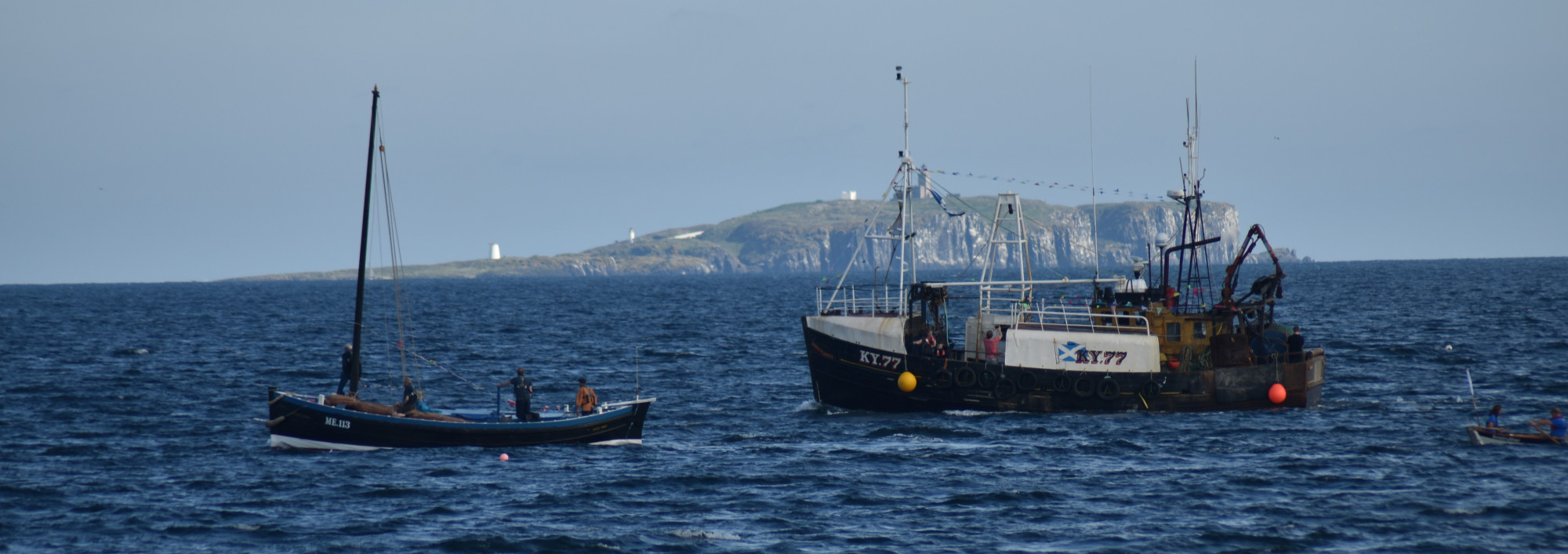

The Cellardyke Echo – 5/7/2017

1805

In the course of last week a fishing boat belonging to the town of Cellardyke on the East Coast of Fife was upset by a squall of wind, and the whole crew, consisting of six men, were unfortunately drowned. They have left three widows and thirteen young children altogether destitute.

(This was the Nancy ,  lost were Alexander and Thomas Scott, James Morris, David Rhynd, David Wilson and James Watson)

1830

Advert

A Number of Masons and Labourers wanted for the present harbour improvements at Cellardyke,

Apply to Mr Peebles, Anstruther Wester; or at the Work.

1836

The Royal Eastern Yacht and Regatta meeting, Firth of Forth

Patron – The King

Commodore – His Grace the Duke of Buccleuch & Queensberry……

Races …..

With the view to encourage the fishing and open boats of the Firth, prizes to four oared boats, with a steersman in each, and not less than 5feet beam, belonging to the following sets of Burghs and yowns on the shores of the Forth, will be awardee from a donation by Lord John Scott £5 to the first boat of Each set, £3to the second and £1 to the third, entrance for each boat 5s,

Areas

1. Stirling, Alloa, Kincardine, Culross, Grangemouth, Bo’ness

2. Limekins, Charlestown, Brucehaven, Torrie, South Queensferry, North Queensferry, Inverkeithing, St David’s, Aberdour

3. Burntisland, Kinghorn, Pettycur, Kirkcaldy, Dysart

4. West Wemyss, East Wemyss, Buckhaven, Leven, Largo

5. Elie, St Monance, Pittenweem, Cellardyke, Easter and Wester Anstruther, Crail ,Kilrenny

6. Dunbar, North Berwick, Aberlady, Prestonpans and Cockenzie

7. Musselburgh, Fishherrow, Portobello, Leith, Newhaven, Crammond.

A piece of Plate value 15 sovereigns will be given to six oared gigs rowed by gentlemen, four to start or no race.

A piece of Plate value 10 sovereigns will be given to four oared gigs rowed by gentlemen, four to start or no race.

A prize of 12 sovereigns will be given open sailing boats not exceeding 32 feet in keel, six boats to start or no race.

The sailing and rowing matches will take place in terms of the sailing regulations of the club, and the committee reserve the power to alter the days or hours of the above matches, in case of unfavourable weather or other unforeseen circumstances,

There will be a public dinner in the Royal Exchange Rooms Leith on Tuesday 14th July and half past six o clock; A Ball in the Hopetoun rooms, Edinburgh and distinguished patronage on the evening of Friday the 15th July, an Ordinary, in the Royal exchange rooms, Leith on Saturday 16th at 6.20 and public breakfasts each day at half past ten o clock. Tickets to the dinner ( including wine) 15s, to the Ball 5s, to the breakfast 2s.

1837

I have reported this distressing accident twice so I will not write the whole affair out again..

17 people were reported lost from the fishing boat ‘Johns’ on the annual pleasure trip to the May Island before the fleet left for the herring drave. Three boats had already landed safely but the ‘Johns’ bow struck a rock and the stern swung round and she broached and most of the casualties (who were young women and children), were washed into the sea. There had been about 70 people aboard a 45ft boat. This was a terrible tragedy which there was a public inquest and Skipper Sutherland was admonished as these numbers has regularly been transported on these boats to the May and the skipper had done everything that could be reasonably expected.

1840

A large shoal of herrings has been discovered between the Bell Rock and the Isle of May, and boats that have been fishing for them near the latter island have been uncommonly successful, considering the mode of fishing adopted. One boat came in today with 1000 an other with 600 and a third with 400, caught upon hooks or jiggers, as they are called. Fishing with the net will be commenced next month; and from the number of whales and sea fowl seen eastward of the May, a heavy fishing is looked forward to, at no distant day.

1841

To be sold by public roup, within the town hall of Cellardyke, Sat 17th July 1841, at 2 o clock in the afternoon, if not previously disposed of by Private Bargain.

That large tenement of three storeys, situated upon the Braeheads of Cellardyke and formerly a malt steading, having a malt barn upon the ground floor, and two excellent granaries above, each about 72ft long within walls, together with the large yard behind the same and likewise the kiln presently used as a barn a hay loft. As also that unfinished dwelling house of two Storeys on the north end of the property, and stable thereto attached.

The premises are conveniently situated and adapted for a fish curer. The malt barn and granaries could at once be used as a cooperage and a cellar for storing salt, and the kiln as a smoking house, while the curing yards would be of great extent, and would offer ample room for seds and other necessary erections. The dwelling house is substantially built and covered with blue slates, and could be finished at comparatively little expense.

There is easy access to the property with carts both on the south and north. There is also plenty of water upon the premises.

Further particulars from Archibald Williamson, ship-owner, Anstruther Wester, proprietor.

1842

Wick – A Cellardyke boat, commanded by Alex Pratt, brought on shore the highest take yesterday morning, and the skipper was led to believe that he was entitled to the highest premium awarded by the Chamber of Commerce here; but on inquiry, found it was reserved for native crews alone, who bring the first five crans ashore prior to the 16th of July, to encourage early fishing.

1849

Cellardyke – West Highland Fishing

Our boats which were prosecuting their arduous and laborious avocation at the west highlands left their fishing station there last Wednesday morning week. Two of them arrived home on the Friday evening following, having come by the northward passage, while the remaining one is yet prosecuting her voyage but the less dangerous yet more lengthened passage to the south. It appears from the report circulated by the hardy adventurers themselves that the western coasts of our Islands are not so redundant with treasures of the deep as our own less dangerous coasts. So startling intelligence will perhaps not be credited by those who have taken a lively interest in the scheme, yet it is nevertheless true; but perhaps this year might be an exception to former years. Although the fishing at Cellardyke has been prosecuted with unparalleled success this year, yet there are other years when not half of the money is engrossed, indeed, a considerable number of years since, it was in vain for the fishermen to attempt the capture of haddocks; they were so scarce. Although the fish generally keep their seasons with the strictest and minutest regularity, yet there are exceptions to every rule, and who knows but that the fishing next year might be prosecuted at the West Highlands with an abundant success? Keeping these things in view, we hope that the Highland destitution Board will not be discouraged at this slight blight having fallen on their noble and benevolent theme.

(The committee had engaged 3 boats from Cellardyke and 2 from St Monans regarded as the best fishermen and boats, to see if professional fishermen could kick start an industry in the impoverished West Highlands., they were sent in March, two to Badachro, near Gairloch and 2 to the North Coast of Skye and the fifth to the Island of Soa. To be tempted away from the lucrative home fishing, each Cellardyke man was paid 30s per week and half the fish sold, and each St Monans man 26s per week and half the fish for a three month contract. The weather over this period was very bad. It was difficult to judge if this was a success as there was no incentive for the men to work very hard at the fishing as they had an exceptional guaranteed income.)

1850

On Saturday week a pleasure boat belonging to a person at Dundee was dispatched to Leith in order to be sold. When she started she had three hands on board. Matter went smoothly until she had proceeded up the Forth as far as between Cellardyke and Anstruther, when, in staying, she missed stays, filled by the lee quarter and instantly sunk. The fishermen at Cellardyke and Anstruther having observed the vessel go down, launched their boats simultaneously and vied with each other to save the crew, two of whom were clinging to an oar. They brought them on shore with the utmost promptitude, when the exertion was made for their resuscitation. One of them a young lad, however has since died. Great praise is due to Mr James Fowler, Merchant, for his kindness to the crew and informing the owner.  Robert Thomson (Lost presumed drowned) and James Rollo saved, the young lad’s name has not been ascertained.

The Cellardyke Echo – 28/6/2017

1921

A large crowd gathered at the Waid Park on Saturday afternoon, when the second annual interschool sports organised by NO 7 Anstruther District School sports Committee were held in brilliant sunshine. The schools represented were – Kingsbarns, Crail Kilrenny Cellardyke, Anstruther, Pittenweem, St Monans, Arncroach and Carnbee. A special feature was the skipping rope exhibition with music organised by Mr P.C. Burt, sports master to the education authority. At the close Sir Ralph Anstruther presented the prizes to the winners, also the challenge cup to St Monans School with the highest number of points viz – 35. The runners up were Cellardyke with 21 points.

1922

Advert

Important preliminary announcement

During the night of 2nd May a serious fire broke out in the factory of Messrs John Martin & Co, Cellardyke makers of Ladies, Gents and Children’s ‘Martinco’ high class Oil silk and Oilskin waterproof coats.

Actual destruction by fire was confined to half-finished materials, but from adjoining departments thousands of finished garments and tens of thousands of self-coloured Cambric and Jap silks, which had not undergone any proofing process, as well as large quantities of coloured oilsilk (ready to be made up into coats) had to be hastily carried out and deposited on the ground at a safe distance.

These goods were unharmed by the fire, and only a few yards were touched by water but a portion was naturally soiled and put out of condition by the rough and hasty handling, and being thrown on the ground.

All are perfectly good for use, however and by arrangement with the insurance company and Messrs Martin.

We have secured for sale the whole of these practically undamaged goods amounting at market value to about £5000 and including the following :-

5259                     Bright finish, fashionable Coloured Oilskin coats, in boys, girls, ladies and gents sizes.

1000                     oilskin hats Sou’-wester to match

30 000 yards     6in wide coloured cambric or fine casement cloth.

2000      yards     Fine Coloured Jap silks two weights 38 inches wide

4000     yards     Coloured Oilsilk various colours, useful for hundreds of purposes.

There are now in the course of being delivered and marked off. It is hoped we shall be able to advertise the piece goods tomorrow.

Hunters (William Hunter and Co, Ltd) Wellgate, Dundee

Next advert 2 days later

 Fire at Cellardyke factory

Huge offers of Materials

All quite undamaged

At extraordinary low prices

30 000 yards of Cambric or superfine casement cloth, closely woven, perfectly pure suitable for overalls, dresses, children’s rompers, hangings and curtains, mattress covers, furniture covers etc. ( Some of it is  a little soiled at selvidges only and creased) Colours purple, grey, light tan, moss, green, saxe blue and black.

Regular value 1/9 ½; – Clearing price 7 ½ d per yard

300 yards superfine cotton taffeta, close fine weave highly mercerised finish; in nice shade of dark tussore, excellent for children’s frocks, casements, etc.

Regular value 2/3; Clearing price 1/ per yard

1300 yards coloured Jap silk, fine make, beautifully pure and soft. 38 inches wide. Colours crimson. Orange, Blue, brown, fawn, green, purple and black all perfect condition.

Regular value 4/6; Clearing price 1/11 ½ per yard.

3000 yards coloured oilsilk, beautifully soft and fine and absolutely waterproof. Can be machined or hand sewed like ordinary cloth into Ladies, gents, boys and girls coats, capes, little capes with hoods, children’s pants, waders, waterproof aprons, sheets, bathing caps, sponge bags, covers of all kinds and  numerous other purposes. (Coats made of this material sell at 50/ to £3.) Colours are light and dark green, light and dark brown, Mole, purple, navy, light fawn, tabac, claret, emerald and Crimson. 36 inches wide.

Regular value 5/ 11; Clearing price 1/ 6d per yard.

180 yards heavy silk, rubber proofed on one side for making coats etc. rich quality very light and strong. In Navy Blue and mid brown; only 36 inches wide.

Regular value 8/11; Clearing at 2/ 11d per yard.

Post orders carefully attended to, and, if over  10/ value, sent post free. Terms- cash with order. Stamps should not be sent for amounts over 1/. Patterns sent on request to those at a distance.

Third advert

5259 Oilskin coats, girls and boys sizes

Fine cotton, light weight oilskin coats, raglan sleeve. S.B. buttons, leather stayed, 2 outside pockets, sleeve straps, neck tab etc. with and without belts. Some are soiled but a rub with a wet sponge cleans them as new. (followed by a lengthy description of sizes and colours)

Ladies and gents now sold out with the exception of a few drivers heavy black oilskin coats worth £2 (at 12/6d)

1923

Damage to the extent of about £300 was caused by fire which broke out yesterday in a hay loft tenanted by Messrs A.& F Bowman, butchers, Cellardyke.

The outbreak was observed about 2 o clock, and the local fire brigade, under the charge of Bailie Bett, was soon on the scene. Willing helpers assisted in the endeavour to prevent the flames spreading to adjacent buildings, and after hard work this was accomplished. Meanwhile the livestock – a bullock and a number of pigs occupying the stalls beneath the loft were removed to a place of safety.

The loft, which held about two tons of hay and other material was completely gutted. The premises belong to Mr W Fortune, engineer, Cellardyke.

Municipal Comedy in the East Neuk of Fife

Effort to Amalgamate Three Burghs

When kings of old created Royal Burghs they evidently had no thought of the exigencies of the future, and did not foresee the difficulties which might arise.

Kilrenny, Easter Anstruther and Wester Anstruther have for hundreds of years been Royal burghs despite numerous efforts to make the three into one, each still stand alone, although a visitor would find it impossible to discover the burgh boundaries.

Geographically the three burghs are one and in the latest attempt to bring about an amalgamation Bailie Carstairs of Kilrenny, which includes Cellardyke has succeeded in getting the town council to appoint a committee to consider the proposal along with representatives of the other two burghs. It is expected that Easter and Wester Anstruthers will form committees and that a meeting will take place at an early date.

An Unknown Quantity

The population of Kilrenny is about 2560. Easter Anstruther 1150 and Wester Anstruther 560.

In Kilrenny the amalgamation would probably be carried by a small majority and the feeling locally is that ‘East’ would agree to the proposal, but ‘West’ is and unknown quantity. In the long run the burghs would gain by uniting, but at first one, or perhaps two of the three would probably lose.

Bailie McIvor, Wester Anstruther, who confessed that he had not yet seriously considered the pros and cons of the proposal, stated that the rates in his town were comparatively low, and everybody paid, but in Cellardyke it was a different matter.

Provost Cunningham, Easter Anstruther, is of the opinion that amalgamation should have been agreed a long time ago. The rates could easily be adjusted over a period of years and it would be better for everyone concerned.

Fighting to the last ditch

This view is common amongst the younger generation, who are quite prepared to support the amalgamations. Some of their elders, however, will fight to the last ditch to preserve their Royal Charters.

Bailie Carstairs when he laid the proposal before Kilrenny town council pointed out that at present no one of the three burghs had money to embark upon any big scheme. An 18 hole golf course was highly desirable, but while they were divided the present 9 hole would have to suffice. In many other ways progress was impossible under existing conditions. The harbour was the basis of the community’s interest in fishing, therefore it would benefit the community to keep the harbour in such a condition as would entice the drifters to use it.

A Gibertian Situation

There are, of course, other aspects of the question which might influence the citizens when they come to consider the matter which has been spoken of at intervals for nearly 20 years.

They might. For instance, agree with Bailie Carstairs and others that the present position is Gilbertian. There are three Provosts, six Bailies, and eighteen councillors to atten the welfare of fewer than 4000 people. One man however acts as town clerk for the three burghs. He is an up-to-date Pooh Bah. If instructed at a meeting of Kilrenny Town council to communicate with the Easter Anstruther Council he sends a letter to himself, and after the meeting of the Easter Council he replies to himself, and submits the letter to Kilrenny Town Council.

As Town Clerk of Kilrenny he might think amalgamation quite an excellent proposal but as Town Clerk of Easter or Wester Anstruther ……….!!!!!

On previous occasions when amalgamation has been discussed the negotiations have always broken down, and there are still many who will fight strenuously against it, but the feeling is that there is now a greater chance of success.

The Cellardyke Echo – 21/6/2017

1910

Just to let you see where the fleet were and some of the more notable landings of Cellardyke boats

17 June

Peterhead – Pioneer and Jasper – 50 Crans

Aberdeen – Carmi III and Guerdon 90 crans, Breadwinner and Eva 80 Crans,  Olive leaf and Scots Greys 60 Crans, Morning Star 45 Crans, Violet and Pride O Fife 30 crans

Fraserburgh – Maggie 90 Crans

Anstruther- Topaz 70 Crans

Wick – Rob the Ranter 100 Crans

18th June

Peterhead – Jasper 60 Crans

Aberdeen –  Daisy and Morning Star 90 Crans,  Pride of Fife 70 Crans

Anstruther –  Jeanie Woods 60-70 Crans, Celerity and Onward 30 – 35 Crans

21st June

Fraserburgh – Sisters 40 Crans

22nd June

Fraserburgh – Innergellie and Rob the Ranter 50 crans, Alices 40 crans

Abredeen – Olive leaf 50 crans, Maggies 40 Crans

24th June

Peterhead –  Anster Fair 60 Crans, Jasper of Cellardyke 25 Crans, Ina Cook of Cellardyke 20 Crans

1911

21 June

James Fortune, (54) draper died yesterday at his residence in Williamson Place, Cellardyke, after a lingering illness. Deceased took a great interest in public affairs and was a member of Kilrenny Town Council. He had long been a prominent figure especially in the religious life of the district. A strong supporter of the temperance cause, he was a member of the Baptist Church, and in all the agencies connected with that body was the head.

Deceased, who was highly respected throughout the whole of the East of Fife leaves a widow and grown up family. He had served his apprenticeship with ex Provost Thomson, Cellardyke, and after being for some time manager in the drapery of Messrs Robert Watson & Co., he purchased the business from them, which he has carried on successfully. He also purchased the business of Mr Philip Anderson of Anstruther and at the time of his death conducted both businesses.

The schools in Cellardyke and Kilrenny were closed for the summer holidays after the usual exhibitions of songs, drill etc by the children.

On Monday at the Burgh Police court, Provost Black and Bailie Buttars presiding. Alexander Moncrieff, fisherman, was fined 10s or 10 days for a breach of the peace committed on the previous Saturday. Accused, against whom there were several previous convictions libelled, was also ordered to find caution for £4 for his good conduct for the next 6 months.

1912

At Anstruther Easter Burgh Court- Alexander Millar, post boy , Anstruther Wester and John McRuvie, Fisherman, Cellardyke, pleaded guilty to having quarrelled with each other and created a breach of the peace. As there were previous convictions against them the Provost said the bench had great difficulty in deciding whether they would give them the option of a fine. The fine would be 7s 6d, or 5 days, and he warned them that if they came before that court again the probability was that they would not get the option of a fine again.

Cellardyke School which was to have been closed for the summer holidays on Friday week was closed yesterday owing to an epidemic of measles amongst the younger children. 

George Henderson Kirkcaldy, Butcher, Tollbooth Rd, Cellardyke was tried at Cupar yesterday on a charge of having on the 6th June, in the stackyard of Rennyhill Farm, Kilrenny, cruelly ill-treated a pony by striking it several blows on the head with an axe, felling it to the ground and leaving it to lie there suffering till it died.

The evidence showed that the accused had been driving along with his brother when the pony shied and te shaft of the trap penetrated its left side. Blood flowed profusely. The accused considered it mortally wounded and wanted to put it out of pain. He could get no one to shoot the animal. He got an axe and struck it on the head. The first blow glanced off the pony’s head, and the pony was alleged to have put down its head and nibbled the grass. The second blow felled the pony. The accused left it thinking it would never move again. Half an hour later the farm hands observed that the animal was still alive and it was shot by Mr Cairns Rennyhill.

Two Veterinary Surgeons held that the animal would be unconscious after the second blow, and consequently would suffer no pain.

Sheriff Hannay, in finding the accused not guilty, said he was to blame for not remaining to see that the job was done completely after felling the animal with that heavy axe. He thought he had displayed a certain amount of carelessness and callousness in the matter. His lordship observed that he was glad to learn from Mr Reid (Veterinary Surgeon) that the humane killer was increasing in popularity.

1914

24th June – (This seems an incredible landing possibly –  170 crans)

Wick-takes ranged from 170 crans the average being 40. Top shot was the Primrose (Cellardyke) Other craft having over 100 crans Provost (Burghead) resplendent (Portknockie) Nellie (Findochty), The Kilmany (Cellardyke) 60 Crans and Dreel Castle ( Cellardyke) 55 Crans

1915

List of casualties

19th June

1699 – Lance-Corporal W Anderson, 27 James Street Cellardyke, admitted Wimereux, gunshot wound – scalp (7th Black Watch territorials)

1695 – Private A.R Lawrie, 18 Shore Street Cellardyke – admitted Havre; gunshot wound left arm.

25050 Private D Mackenzie, Forthview Cellardyke admitted Chatham; wounded (7th Black Watch territorials)

Holiday Resorts

Anstruther and Cellardyke – Most Bracing Fifeshire seaside resort. Good bowling green, tennis Courts and Golf Course. For further information, apply to Secretary, merchants Association.

1916

Combination Poorhouse – A letter was read at a meeting of the Kilrenny Parish Council last week from Governor of the Combination Poorhouse, stating that owing to the increase of 75% in the cost of food and clothing there would be a corresponding increase in the scale of charges.

1917

Local Firms secure Government Contracts

Clothing – (Oilskin) R Watson & Co, Cellardyke

1918

House to let for the summer months, 2 sitting rooms, 3 bedrooms, Kitchen &c or 1 sitting room, 2 bedrooms use of Kitchen, 5 minutes’ walk from nice beach – Apply, Allan, grocer, Cellardyke.

The Cellardyke Echo – 14/6/2017

1900

At a meeting of the technical education committee held in Cupar yesterday, Mr J Budge, Wemyss Castle presiding satisfactory reports on the Cookery and Laundry Classes were submitted…. Her Majesties Inspector’s report on Cellardyke was as follows ;- ‘Cookery and Laundry work are taught with thorough efficiency. The importance of demonstration should not be underrated’

1901

Anstruther

Launch of a fishing boat – yesterday afternoon, Mr Miller launched a fishing boat which he has built to the order of Messrs James Muir and James Tarvit, Fishermen Cellardyke. The boat was named True Vine by Miss Muir, daughter of one of the owners. She is 68 feet over all with a beam of 20 feet 10 inches and a depth of 8 feet.

The shopkeepers of Anstruther and Cellardyke met on Monday and fixed the holidays for the 10th and 11th of July. The date of the excursion was fixed for the 7th August and the majority decided in favour of the day being held in Crieff.

Owing to so many of the fishermen being away in Shetland, the shopkeepers in Cellardyke observe each Wednesday as a whole holiday and close every night at six o clock. The drapers of Anstruther have decided to close at seven o clock every night except on Saturday, for the months of July and August.

1902

Launch – On Monday afternoon, Mr Miller launched a deep sea fishing boat built to the order of Skippers John and Andrew Watson. The extreme length was 68 feet, and the vessel was named Lily by Miss Peebles, a niece of the owners. The boat has been fitted out for all branches of the fishing, and her workmanship and model has given much satisfaction.

Mr Stephen Williamson formerly Member of Parliament for the St Andrews Burghs and subsequently the representative of the Kilmarnock Burghs, died yesterday morning at Liverpool. He was quite well early in the morning, but he was suddenly seized with apoplexy, and died almost immediately. Mr Williamson who was 76 years of age, was head of the firm of Balfour, Williamson and Company, one of the oldest mercantile houses in Liverpool.  Born in Cellardyke, he was educated at Anstruther and St Andrews. His firm did business in Valparaiso, Chili, and afterwards Mr Williamson established houses at San Francisco and Portland Oregon. His business life, outside of Britain was spent in Valparaiso. In 1880 he became Member of Parliament for the St Andrews Burghs which he represented until 1885, when he was defeated by Sir Robert Anstruther, Bart. The first count of the ballot showed an equality of votes, but on a recount the seat was awarded by a narrow majority to Sir Robert Anstruther. In 1886 Mr Williamson was elected to represent Kilmarnock Burghs in Parliament, as a follower of Mr Gladstone, but in 1895 he was defeated by Colonel Denny, the present member. While in parliament Mr Williamson took a special interest in fishery matters and in commercial questions generally. He was a member of the Scottish Fishery Board. On the Disestablishment question, when it was more prominent than now, he held and expressed strong views. His benefactions to his native place have been numerous including the gift of the Memorial United Free Church (Chalmers Church, the manse and a house for the Church officer) which is the leading architectural feature of the town, and along with another gentleman he provided Anstruther with a town hall… (Cellardyke Town hall along with David Fowler ex Cellardyke then of Adelaide… he also invested in steam trawlers, and set up many of the steam line fishing companies.. boats that some may recognise were named after his property, Glenogil, and Copely)

He was the eldest son of Archibald Williamson, his early business training was at Messrs Conolly and Smith, writers, Anstruther and then Mr Thomas Davidson’s , Writer Cupar.

1904

Stock for Shetland

A steamer arrived on Thursday to load stock for Shetland for Councillor Melville, Cellardyke. Mr Melville intends sending out 3000 barrels, besides salt &c to Balta Sound.

1905

A regrettable deadlock has arisen in Anstruther over a proposal to erect a memorial fountain of the Late Mr Stephen Williamson, who is well remembered as MP for the St Andrews Burghs for a number of years after the resignation of Mr Edward Ellice. Mr Williamson, as most people know, was a native of Anstruther and one of its most generous benefactors – as witness the Chalmers Memorial Church and the Town hall in Cellardyke – and a year ago his son, Mr Archibald Williamson, Liverpool, offered to erect a memorial of him within the burgh. The Harbour commissioners granted him for this purpose the site of the horse drinking fountain which was erected at the head of the West Pier by the feuars of Anstruther to commemorate the jubilee of Queen Victoria in 1887 and the introduction of a gravitation water supply. The proposal displacing of so important a memorial in order to make way for another has not unnaturally led to a good deal of popular opposition, and at a recent meeting of the Harbour Commissioners, Provost Black, Cellardyke, declared it would be a direct insult to the late Queen’s memory to remove the present fountain and replace it with a memorial to a private individual. On a division, three members voted for and against, and as the chairman declined to exercise his casting vote, matters have been brought to a standstill. Surely, however, Anstruther is not so destitute of sites and common gratitude that another suitable site cannot be formed somewhere for a memorial of one whose heart beat true to the place of his birth.

1907

Trial trip of the S S Primrose

The Steam Drifter Primrose built some time ago by Mr Miller Anstruther, and owned by Messrs Robert Melville & Sons , Cellardyke which has been engined at Leith By Messrs Cran & Co, underwent a speed and sea worthy trial in the Firth of Forth on Tuesday, when in a run from Leith to the Forth Bridge and back a speed of 11 knots was obtained, great satisfaction being expressed by the owners, who brought the vessels down to Anstruther on Wednesday where she is now being prepared for prosecuting the early herring fishing.

Launch of a Steam Drifter, On Wednesday Mr Miller successfully launched from his yard at the middle pier and steam drifter for a Cellardyke owner. The vessel is of the same dimensions as the former drifters launched at Anstruther this year, and as she left the ways the name of Venus was imparted to her. She will be towed immediately to Leith there to be engine by Messrs Cran & Co. Mr Miller has at present another drifter in the process of Completion, which has been built to the order of Skipper Robert Hughes, Cellardyke. As soon as the vessel is launched, keels will be laid for a trawler for the Belgian Government and for Skipper Henry Bett, Cellardyke.

The Cellardyke Echo – 8/6/2017

1889

This has been an eventful week in the fisherhomes of Fife, refitting boat and tackle for the Shetland seas. It has been especially so in Cellardyke, which is to send a hundred sail – Just one half of the herring fleet, but pittenweem shore is telling the same tale with twenty boats, and you so far get the echo at least in the five or six at St Monans. The principle is the same as in the Scottish Seas – that is the skipper, with his mate and perhaps another, provided with fifty to sixty nets, worked with the help say of three sturdy sons of the heather, known as half dealsmen. As a rule the crews will live Jack afloat – that is, on board of the boat fitted today with every comfort in the way of beds, cooking stoves, &c. and then, if it is ever to be summer at the Isles, it is when, as we heard one veteran tell, ‘I could see to read my big printed Testament on the deck at the turn o the nicht’ There will be two or three fife boats at the  leading points in the hundred Isles, but the principle leading points will be the Sound of Balta, so contiguous to the Herring Sea on which some crews, we observe, will drift, as in the English Coast – that is, with the top of the net kept like a wall with its beading of cork, while others seek the same end by stones along the foot of the lint, though in either case the nets will float within a fathom or two of the surface. Seeing there is little fear of any collision in these lonely seas. ‘I was sae gled tae get yer letter’ we heard a half-dealsman, springing as you may have seen as a St Bernard to his master, so as to sail on Monday, though others have yet so much to do at the triangles or with that tar brush that they will not be able to cross the bar on the outward tack till another week. ‘I hope’ writes one from mid yell, ‘that you will be with us as soon as you can’ bait was fished with so much success at the Haaf that a big shoal is evidently not far at sea. The quality is also very fine, and, according to latest news from the Lewis a few early cargoes would do well in the German Market.

A melancholy case of suicide happened at Stirling last Friday, but owing to the great reticence of the Police authorities and those interested in it, the details did not become known until Saturday. The person concerned was a young lady called Miss Christina Paterson Danks, She was a teacher at Cellardyke, and came to Stirling a few days ago for rest, staying at 13 Nelson place with a widow lady named McDowall. Miss Danks, who was 26 years of age, was, it I said, engaged to a young gentleman who lodged in the same house, and at whose desire she took up her residence in the town. Nothing peculiar was noted about her conduct, though she complained of sleeplessness. On Friday forenoon she went out walking, when she seemed to be in good spirits. On returning to her apartments Miss Danks lay down on a sofa. This was about two o clock, and was apparently the last time she was seen alive. At half past two Mrs McDowall heard a loud thud on the floor of the bedroom occupied by the gentleman previously mentioned, who was at the moment out attending to his professional duties. She straightway rushed to the room and noticed blood trickling under the door, which required a good deal of pushing before it opened. On stepping into the chamber the land lady found the doorway in a pool of blood. Mrs McDowall at first thought she had burst a blood vessel, and summoned assistance, a neighbour answering the call. Closer examination, however, revealed the fact that the unfortunate lady had cut her throat with a razor and was quite dead. Her fellow lodger was at once apprised of what had occurred. The deepest sympathy is shown towards him and Miss Danks’s relations in the distressing event that has suddenly overtaken them. There can be no doubt that the deed was done while the lady’s mind was temporarily unhinged through insomnia. As was to be expected the matter has caused a painful sensation in Stirling, where one of the persons connected with it is well known, and occupies a responsible public position.

1890

To Fishermen – To Fishermen

The only satisfactory Petticoat Trousers as a security against water are..

The Patent Keep-Me-Drys,

Sent post free for 3s 10d. Don’t miss this chance; this month only

And the best fishing float is

 The Patent Canvas Fishing Float

Manufactured only by

 Black and CO

Cellardyke Oilskin Factory, Fife

1893

CELLARDYKE. Alleged Furious Driving.— James Keith, fishcadger, pleaded not guilty at Cupar Sheriff Court on Wednesday to charge driving a horse and spring cart on 6th May in a furious and reckless manner along East High Street and Church Street, Buckhaven, the danger of the lieges on the street. His trial was fixed for Tuesday first.

The Cellardyke Echo – 31/5/2017

1883

The well-known burgh of Cellardyke is in the Parish of Kilrenny, but some distance from the parish church, causing inconvenience which has been long felt – the burgh alone containing a population of 2400. The whole population of the parish is somewhat above 3000, and the number has been about equally divided by the limits which have been adopted between the old parish and the new. The Church of Cellardyke was erected about two years ago and is capable of accommodating 800, already about one half of the sittings are let.

The Presbytery of St Andrews has fixed the 8th of June for the ordination and induction of Rev. Mr Ray to Cellardyke Church.

Temperance Breakfast in Edinburgh –  Rev Lewis Davidson of St Andrews , said that in the neighbourhood of Anstruther and Cellardyke the Gospel Temperance movement was receiving converts at the rate of 100 per week.

Farms to let

1-Kilrenny Mill extending to 142 Acres

2- Rennyhill &Kilrenny Mains extending to 335 Acres

The farms are in the natural possession of the proprietor, and are within a mile of the Market town and shipping port of Anstruther, where the joint terminal station of the East of Fife and Anstruther and St Andrews Railways is situated. The land is of first rate quality, capable of bearing all kinds of crops. The Steadings are commodious and well adapted for feeding stock. The mansion house of Rennyhill, offices and gardens are included in Rennyhill and Kilrenny Mains. The proprietor has right to Sea Ware in the harbour of Cellardyke and on the Shore of the Firth of Forth so far as bounding Kilrenny Mill.

Advert

The International Fisheries Exhibition, Edinburgh 1882

Gold Medal for Deep Sea herring Nets.

Silver Medal and Money Prize for deep sea fishing lines

Diploma for Excellence of Fishermen’s suits of Oilskin.

The above have been awarded to

Sharp and Murray, Cellardyke

They are now making stock to suit the trade with the very best material. Nets suitable for the Shetland Isles, mounted, barked and ready for sea; as well as Great lines, mounted and barked in cane sculls for mending, in all the sizes; in fact, every requisite required for the fishing industry, supplied at the lowest possible prices.

1884

For some time back the steam saw milling premises of Mr T Cormack, fishcurer and wood merchant, Cellardyke, have been undergoing alterations for the reception of additional barrel making machinery. These alterations have now been completed, and the machinery has just been fitted up, with very satisfactory results. It includes a trussing and end working out machine, and cleaning machine. The barrels are set up in the usual way in ordinary hoops, and heated on an iron cone in which the fire is placed, and which has an opening at the top. An advantage in this whole mode of firing is that the inside of the barrel, although slightly browned, cannot be burned. When the barrel is thoroughly heated it is placed under the trussing machine, wide end up and is pressed up in a spiral screw worked from the engine. One end being trussed, the machine is opened, the barrel reversed and again pressed up, the whole operation being done in less than two minutes. Mr Cormack has had machinery working for the last twenty or thirty years for making ends and jointing staves off the saw, and all barrel makers in Cellardyke district are supplied with jointed staves and cut in ends. One peculiarity of the staves prepared by Mr Cormack is that all, whether narrow or broad have the same amount of bulge and require a fixed number of staves in each barrel to give the necessary aggregate amount of bulge. The number of staves required for a barrel vary from 16 to 22 according to how they are cut, and a note of the number of staves required is sent out with each load of staves. The other manufacturers give a proportionate bulge to each stave. Mr Cormack (who is also a large fishcurer in Aberdeen) now has completed his barrel making machinery. From the billet to the finished barrel, all the hand labour is in the hooping only. He also has introduced wire instead of wooden dools for the ends.

1886

Owing to the heavy gales Monday and Tuesday the fishermen have suffered a great loss of gear, many of the nets when shot for bait have been torn to shreds.. Six Cellardyke boats left Anstruther last week to prosecute the herring fishing on the Irish coast at Kinsale.

1887

No engagements have as yet been entered into with the Cellardyke fishermen for the fishing in Shetland, which usually begins on 20th June. A number have been offered 10s per cran for 200 crans for a month, but have refused to lay out the expenses required in the fitting out for such small prices.

1888

On Wednesday the members of the Dundee and East of Scotland Photographic Society had their first excursion for the season. The route was the popular Fife Coast circular tour. Leaving Dundee at 7.45 the party, numbering 30 with eighteen cameras, made their first stop at Anstruther and driving to Cellardyke, a halt was made and numerous views of this quaint village were obtained under favourable auspice, the weather being perfect. Pittenweem and St Monans were next visited, and after due attention was paid to the views and the picturesque inhabitants at these places, train was again resumed for Largo where luncheon was purveyed in the Crusoe Hotel. Numerous ‘bits’ about the quaint village were obtained and the party reached Dundee at 6.20, after having exposed 150 plates, which will no doubt produce many charming views, representing only a tithe of what is to be seen on this interesting route.

The Cellardyke Echo – 24/5/2017

1880

A new friendly society has just been formed here under the name of the Cellardyke Fisherman’s Union and Benefit Society. According to the rules, which have a curious identity with those of the Odd-Fellows, none but fishermen may enter; but all such have an open door so long as they go in deep sea boats. The entry Money is only one shilling, and the payments two pence a week; but the promoters build on these a platform wide enough to provide for hurt and ailing members, and even to give permanent relief after ‘three score’ and to widows whenever rendered so by the dispensations of Providence . this is by no means a new experiment in the district; but it has been launched at a time when there is a loud knock at every door to provide, as heaven shall give the means for a possible day of trouble and distress; and it speaks well for the true Scottish heart of the community that already about one hundred have embarked in the Association. Economists will be no less gratified to hear that life assurance is taking such good root in Cellardyke, that within the last week or two some twenty are entered for sums ranging from £50 to £200. Simultaneous with all this, an active effort is going on for the relief of the widow and fatherless……. The total subscriptions at this date border on £100.

The magistrates of Kilrenny are still in doubt and difficulty about a pure water supply for Cellardyke. The other day saw them out on a tour of exploration in the uplands of the Parish when the visited the old mines at Pitcorthie and Carvenom, where like the ‘tappings’ of some mighty  cistern, the springlet sings gaily all through the longest summer day. Cool and chrystaline also, they are in this respect, in grateful contrast to the thick and muddy streams flowing beside them in ditch and brook, though their birthplace in the iron and other mineral strata forbids their use or adaption for the town. The complaints, especially in the west end of Cellardyke are, of course, increased and increasing as the drought advances, and the inconvenience and discomfort of the neighbours fully warrants the outcry which is to be heard upon the subject.

For sale

Valentines photographic views of Kirkcaldy, Burntisland, Kinghorn, Dysart, Wemyss, Elie, St Monance, Pittenweem Anstruther and Cellardyke.

Arbroath-The harbour – we have got a fresh addition to our fleet of large decked boats, which has been built at Anstruther by Mr. John A Millar boatbuilder. She is carvel built decked, and has all the latest improvements. Some idea of her size may be formed when we state that in ballast her draught of water is 5 ½ feet. She is owned by Mr. Alexander Beatie, is named the ‘Maggie’, AH 20. On Wednesday a number of Cellardyke boats arrived here and landed a quantity of small herring, which they had taken for bait for their great lines but had been unable to make use of owing to the gale. The herring were taken by cadgers who were selling them at ‘six a penny’., ( John A Millar Worked at the East End of Cellardyke from 1865 before moving to the Esplanade West Anstruther, in front of the White house, Yes….50ft boats built on the hammerhead at West Anstruther..)

The ‘Maggie’ is over fifty feet in length and is rather more than forty tons in builders measurement; but although as round as an apple in the sheer, she is as sharp as a wedge, where she has to cut her way through the ‘billows’ and we are persuaded that with a kindly breeze, the ‘Maggie’ will have no leeward berth in the race from sea. We are of course, not less convinced on this point, when we learn how she is to be fitted out with spar and sail, which are simply to the boat what the wings are to the seagull. To avoid detail, it is enough to remark that her foresail contains some 250 yards, or about thirty or forty more than is usual with a craft of her size- in fact, in those railway days, speed is not mote indispensable to a racing yacht than to a first class fishing craft, hastening home with the harvest of the deep. The fishing trade, however, is prospering in no common degree on the Forfar coast, as the ‘Maggie’ is the twentieth in the North Sea fleet off Arbroath. This is the sixth launch in the course of a twelve month by Councillor Millar, and we notice it with special interest and pleasure as the development of so inconsiderable branch of local industry, seeing that the ‘Maggie’ and her outfit with lead to the expenditure of not less than £300 on Anstruther Shore.

1881

Narrow escape of the 42nd Highlanders

Cellardyke shore was the scene of no little excitement and alarm on Thursday morning by the appearance of a large steamer amongst the rocks to the east of the harbour. At Times the fog – the evident cause of the disaster – was so thick as to conceal all trace of the vessel, but ever and anon the great black hull came into view, while the steam whistle was sounded and the alarm bell rung in a way that sufficiently told of the uneasiness on board. The vessel proved to be the troopship Holland, from Portsmouth, with the 42nd Regiment on board. The big ship had been seen by some crab fishers, and by means of their boat, a branch pilot, Thomas Cunningham, hailed the steamer, which,  favoured in the meantime the flood tide, was once more afloat and in deep water. The officers were evidently cautious, but an explanation having taken place, the pilot was invited aboard, and arrangements made with hi,m to guide the vessel to Leith, towards which she was now directed as swiftly as prudence in the continued density of the fog would permit. She was for about a quarter of an hour seemingly on the sand bank between the shore and the isolated rock known as the ‘basket’ and more than once the mist so rolled aside that the deck of the steamer could be seen crowded with children, but so thorough was the discipline, that there was not the faintest indication of confusion or precipitate hurray in the movements of those on board. The Holland arrived safely off Granton about half past twelve. The North British Railway good steamer Leviathan immediately proceeded alongside to disembark the baggage. The passenger steamer John Stirling proceeded alongside to disembark the troopers, but not having a gangway some delay was occasioned by her having to return for one. About two o clock the steamer again proceeded to the Holland and the troops embarked about five o clock. The bands of the 21st Hussars and the Edinburgh Artillery Militia were waiting in Granton, and accompanied the Highlanders up to Edinburgh.

At West Anstruther, Councillor Millar has launched two handsome clippers during the last nine or ten days. Both are distinguished by that graceful sheer and ‘eye sweet’ quality for which the Councillor’s boats are so justly admired, whether on the sands of Norfolk or the granite sea gates of the North.

The First Launch at West Anstruther took place on Friday, when the dashing craft, which is to the order of Mr. John Salter of Cellardyke was christened the ‘Pride of Fife’, her handsome sister found her destined element on Monday under the name ever sacred to grace and beauty, the ‘Lady of the Lake’. She is for Mr Alexander Davidson also of Cellardyke. Councillor Millar now has his hands free to proceed with a cruising yacht. Our Townsman Councillor Jarvis has just completed a first class boat on the lines for which he, as in the case of Mr Alexander Cunningham, obtained a silver medal at Norwich. She is in the meantime quite an attraction to the Forth, and opinions are as one amongst the old salts about her capabilities as a fast and powerful sea boat. She is to the order of Messrs. Thomas Anderson and Alex Murray we hear to be named the ‘Carmie’. The Councillor has two other first class boats on hand for the herring Drave – one and all for Cellardyke; but with this exception, as we have said, the trade is waiting for the ‘moving of the waters’ in that all important event of the fisher year. The Cellardyke fleet is to then number scarcely less than 180 boats, which will make the total outfit from the East of Fife not under 340 or so, being a decided advance on any other former effort of the coast.

The Cellardyke Echo – 17/5/2017

1877

On Friday morning a distressing accident occurred in Cellardyke, in the case of a little girl of 2 ½ years of age, the grandchild of George Anderson, farm servant, who was at play with another child of the household when her flying skirts, it is said, led to the overturning of a pot of boiling water which a minute before had been lifted down onto the hearthstone. The poor innocent fell into the scalding stream, and so terrible were the consequences that after lingering intense and hopeless agony she was mercifully released by the sleep of death within twenty four hours after the deplorable event.

1878

DR Phin on Cellardyke fishermen, at the opening of a bazaar at Anstruther, for the establishment of a new church at Cellardyke, The Rev, Dr Phin, who received a cordial greeting said – I am very much gratified by the remarks which have been made by my excellent friend Professor Christie, and it gives me extreme pleasure to be here today in compliance with his request. I may mention that my recollections of Cellardyke are not of yesterday. In my early life I lived in the house of my father, who was minister of Wick, and as far back as my memory stretches Cellardyke fishermen were ion the habit of coming down to Wick to prosecute the herring fishery. I recollect of their attendance at my father’s church, and I have pleasure in mentioning the good conduct they displayed in the midst of other fishermen.

Montrose

The fishing of the great line boats was almost a failure owing to a want of herring for bait. Two however succeeded in getting bait and had fair shots, A Cellardyke boat arrived yesterday with cod ling, and halibut and 1- crans of herring, which realised £30.

Arbroath

A Cellardyke boat arrived here yesterday with a very large take from the deep sea fishing, consisting of halibut, skate, ling and cod. The boat on its arrival at the fishing ground met with a large shoal of herring, six crans of which were bought in here. The cargo was sold to Mr John Noble, fish dealer for £21. This is the first arrival from the deep sea fishing this season.

Stonehaven

One Cellardyke boat put into Crawton and sold a shot of big fish &c to the Messrs Melvin for £29, the weather is squally with showers

(Crawton is three miles south of Stonehaven, The ruins of 23 houses and a school are all that survive of the coastal hamlet on the clifftop. In its heyday, 30 Crawton men fished 12 boats and the village had its own fish merchant. Following nearly 50 years of decline due to overfishing, Crawton was finally deserted by its last inhabitant in 1927)

Tuesday being observed in Cellardyke as the Queen’s birthday, Mr Thomas Thomson, Superintendent of the Forth Street, boot and shoe establishment in Cellardyke, accompanied by his son and eldest daughter, named Lizzie, some six years and a half old, went by rail to Edinburgh. The little excursionists were enthusiastic over the fair coast side. The day was beautiful and everything seemed to conduce to fill the party with delight, when just as the train was rushing away from Thornton Station the door of the carriage on which the little girl was leaning in her innocent glee flew open, and almost on the instant, to the indescribable terror of the passengers, she was cast headlong on the rails. The fate of the child appeared to be sealed. An express train was dashing up to crush the last wild hope of safety, and the distracted father in the agony of the moment was struggling to leap on the fatal brink also, when the approaching train was arrested in full career, as quickly as a master hand could curb a well-trained steed, and almost in the breath the gallant engineman placed the little martyr, as it seemed, safe in the hands of her overjoyed parent. Fortunately she had held so long on the door as to swing clear of the footboard and wheels of the carriage, but still under the circumstances, escape with life was little less than a miracle, her only injury being a slight cut on the head through the fall on the rails; but she returned to the home circle in Cellardyke the same evening, apparently little, if any, the worse of her exciting adventure.

1879

South Africa – Marriage

At the Presbyterian Church, Port Elisabeth, Cape Colony, on the 10th ult, by the Rev Robt. Johnston, F A K Devenish, son of T Devenish Esq, of Salt River, Beaufort West, to Marion Hudson Cormack, eldest daughter of Thomas Cormack, fishcurer, Cellardyke.

The value of the carrier pigeon has never been so signally proved in modern times as in connection with the herring fishery – that is, in bearing the message from the boats leagues away at sea to the merchant, who then knows how and when to dispose the fortunes of the day. The breed and training of the birds are consequently an object of no little interest to those interested in the trade; in fact, an Anstruther fish curing establishment the dovecot is becoming almost as comm0n an appanage as in a Scottish lairdship in the olden time. Experiments have been again and again repeated in the northern stations, but the most interesting as yet in the Forth have just been made by Skipper John Carstairs of Cellardyke. The first was on Monday week when the bird, with the message fastened by an elastic band to its leg, was slipped about two leagues seaward of the Isle of May. No watch had been kept, but the messenger and message were found safe in the dovecot in about an hour and a half after the time it had taken wing. The experiment was renewed in the cruise of the present week, when the pigeon was released at an offing fully fifteen miles from the island. The shadows of the morning were still hanging on the western hills, and not only so but the bird had begun to encounter the strong headwind with the bewildering fog which then hung like a curtain on land and sea. Other obstacles were in the way, but led by heaven’s own implanted instinct, the fair messenger clave through one and all, and was found nestling in its accustomed perch in Anstruther by noon day, or within five or six hours after being cast loose by Skipper Carstairs.

The Cellardyke Echo – 10/5/2017

1869

(It was in 1869 that the new KY registrations became compulsory to be marked on the hulls and the sails of the vessels.)

On Friday last the cruiser Vigilant of the Fishery Board Service detained several fishing boats and yawls belonging to Cellardyke, Pittenweem and St Monance, in consequence of their sails not being numbered according to the requirements of the Fishery Act of 1868. The Hon F B Primrose, the secretary of the board and Captain Macdonald, landed from the cruiser, and in company with Mr Gillis the Fishery Officer here had some conversation with our local fishermen here on the subject of the new law numbering their boats and sails. It was represented, to Mr Primrose, that painting the number on the sail had a tendency to injure the canvas; but Mr Primrose pointed out that was entirely a mistake, although it was quite true that if turpentine was used the sail would be more or less destroyed, but if white lead an oil only were employed, then instead of damaging it the paint would have the effect of strengthening and preserving the sail. Mr Primrose also intimated that in the event of any fishing boat being found at sea by the cruiser without a sail being numbered the full penalty – namely a fine of £20 each upon the master and owner of the boat, would be imposed, and that after Monday no boat would be allowed to leave the harbour unless the regulation was complied with. In reference to this matter, we may state that all the deep sea and other fishing boats, down to the smallest lobster yawl on this coast were duly numbered and registered by the 1st April, the appointed date, and we learn that the regulation as to numbering the sail is now equally observed.

1870

Sea labour has this week shown signs of a gratifying improvement. The strong East winds have enabled the deep sea boats to reach the mist distant fishing grounds, and how well they have adventured may appear in the fact that the largest of the Cellardyke fleet, under all sail, was 24 hours on the passage home, which would give a distance of 150 to 200 miles from the May. This week most of the 40 boats fishing from Cellardyke have been at the great line fishing, at which the takes have ranged from £8 to £22, but last week the fleet was at the haddock fishing, when the boats returned on Friday with a total catch of 30 tons, the takes being from 51/2 to 22 cwt, which sold from 6s to 12s per cwt.. This week two Cellardyke boats have left for the Herring Fishing at Barra. Two St Monance boats are succeeding moderately well at the Tiree cod fishing and at the Salmon Fishing on the Northumberland Coast, at which several Buckhaven and St Monance and one Cellardyke yawl are at present engaged, the success is reported to be far less encouraging than in former years.

1871

St Andrews – For some time back a regular warfare has been going on between the St Andrews fishermen and the parties authorised by the town council to sell the mussels at the scalps of the south side of the Eden, a good quantity of mussels have been taken away by the fishermen without being paid for, though it is said they offered 6d instead of 1s the basket, and on the refusal of this sum ‘helped themselves”. We believe a number of them will appear in Cupar Sheriff Court on the charge of theft… While we would not defend their conduct in all they have done, this is not to be wondered at, if we take into account the loss of time through rough weather they have had this last winter, and remember that in addition to the 1s charge for mussels, 2d is charged for cartage. When the fisherman has no wife he has to pay 1s for baiting the lines, making it 2s 2d of an outlay before the line is put into the boat at all. We know it is urged that boats from Cellardyke are able to pay the 1s; but then it must be remembered that these are large boats, and the mussels are only got for the purpose of catching other bait for the deep sea fishing; consequently they only bait once a week, while our fishermen require it daily.

David Brown who was convicted on Saturday in Cellardyke Court of committing breach of the peace and malicious mischief (found guilty and fined 10s 6d or 10 days) appeared before the Burgh Court of West Anstruther, he was charged with furious driving to the danger of the lives of the lieges on the High Street on the evening of Wednesday Last. He pleaded guilty and was convicted to a fine of 5s or eight days imprisonment.

1874

The Kilrenny School board met on Friday evening, Rev Christie presiding, A communication was read from Dr Taylor to the effect that the education board was of the opinion that, in order to make suitable accommodation for the parish, a new school to accommodate 200 pupils should be erected in Cellardyke. Mr Fortune Barnsmuir presented a memorial from the rate payers in the landward district of the parish, asking the board not to adopt this opinion on the ground there already existed the Accommodation required by the act, and stating that they would not pay any assessment for building a new School in Cellardyke. Provost Martin moved that the opinion of the education board be adopted, which was seconded by Rev Mr Grant. Mr Oliphant moved as an amendment that no additional school be built in Cellardyke on the grounds that it was Ultra vires of the board to assess the ratepayers for the expense. Mr Gray seconded the amendment, which was carried by a majority of four to three. The Minority protested and appealed to the education board.

1875

The fine farm house of Corn Ceres – the most picturesque homestead in the East Neuk- narrowly escaped being destroyed by fire. It appears that one of the chimney flues had taken fire, and that, all unperceived and unsuspected, the burning soot had lodged in the cavity of the double ridge till it had ignited the ‘tinder dry’ wooden grating overlying the gutter, which melting the lead, gave the flames ready access to the timber work of the roof. …… in a dense canopy of smoke and flame, veteran Cellardyke builder, Mr Andrew Duncan, ascended the roof and with all the vigour and agility of youth, stripped away the slates, when the flames being thus unbosomed to the copious stream of water, which resolute hands played upon them the fire was subdued just as the rafters had come within the devouring embrace.

Mrs Margaret Kay or Dishington, West Anstruther, for having a number of incorrect weights in her possession was fined a £2 penalty, James Bell, grocer from the same district received a similar sentence as did also William Black Watterston, baker , Cellardyke..

1876

One of the extraordinary incidents in the romance of the sea may well have been said to have occurred last week in the North Sea, in the capture of a formidable looking shark by the most primitive of all fishing implements – the hand line- It happened on board the deep sea going boat “Venus” skipper Peter Murray, just as the adventurous crew were wiling away and idle hour as they usually do at the fishing ground; but we ought to explain that the hand line of the sea is not a solitary hook of the coast, but a novel apparatus so terrible in appearance as to be not inappropriately named “a murderer” by our East of Fife Crews. But what is a murderer? Some curious reader may ask, and to solve any mystery, it may briefly be described as a long leaden plummet strung round with large hooks – in short, so barbed as to take a secure hold of anything or everything coming in contact with it. The apparatus is the more effectual that it is kept in constant motion in the same was as the ‘Jigs’ or dandy lines, only it is always made to strike the bottom, where it often proves a deadly snare to the cod, the halibut, and other deep sea fish, and that as readily without as with bait, provided lead and steel are kept silver like as possible, exactly on the same principle as the polished implement to catch young herrings. Such was the weapon in the fingers of the Cellardyke fisher, when in an instant the line seemed to become fast to an old wreck at the bottom – so dead and solid the weight. Friendly hands came to the rescue, and slowly and surely the gallant mariners raised the ponderous mass towards the surface. “What can it be?” asked one son of St Peter at another “ The sea serpent itself” observed a third, but if it had, the surprise of the crew should not have been more, when after a pull of over five and thirty fathoms from the bottom a tremendous shark arose alongside. Our sea heroes, however, were neither daunted nor in difficulties, but quickly applying boathooks and other serviceable weapons, they soon dispatched the monster, which was then hoisted into the boat and landed at Anstruther, where the extraordinary trophy excited no little attention and interest. It measured about eleven feet in length, and was fully eight in girth. While lying on the old pier it was purchased by Mr Thomas Cormack at the price of half a sovereign for the sake of the valuable oil yielded by the liver of the ‘scourge of the seas’.

The Cellardyke Echo – 3/5/2017

1864

An application was made to Anstruther Harbour Commission from Cellardyke Harbour committee for the use of their lighter for certain improvements contemplated to that harbour, which it was agreed to grant free of charge, but on the assurance she was brought back in good order.

1865

James Christie, a carter from Cellardyke was charged with having on the 10th February, assaulted Andrew Anderson, flesher, near Anstruther Easter with a walking stick, to the effusion of his blood, and serious injury of his person. The accused pled not guilty, but after proof had been led he was found guilty and sentenced to pay a fine of 30s or to go to prison for 20 days.

1866

Handsome donations – It has often of late been our pleasing duty to notice the splendid donations of Walter Hughes, Esq, to local institutions and charities. This week, however, so far at least as the public have had an opportunity of knowing, this noble minded gentleman has exceeded all his former benefactions. The recent boat disaster at Cellardyke having been brought under Mr Hughes’s notice, he visited that town the other day, with the special object of making himself acquainted with all the circumstances of the case. Having satisfied himself that the owner of the wrecked boat was worthy of his kindness, he, with a generosity which must challenge the admiration of all, agreed to present, at his own cost, the poor fisherman with a new boat of the largest size and to be constructed of the best materials. Mr Hughes also presented a number of poor persons in Cellardyke with handsome gratuities. Than this estimable gentleman, few have given with so liberal a hand to the relief of the poor and unfortunate, and many we feel well assured, are the blessings which grateful hearts here shower upon him for his numerable bounties.

(NB, the boat was built for Thomas Ritchie, it was built by Christopher Pottinger, the main boat builder in Anstruther. She was named the Pioneer,  launched in July 1866, she was very different from the standard  fifies, being ketch rigged, finer for’ard and fully decked, with a 20 inch high gunwale, the hope was she was to be faster and safer than the standard boats and that she would become the  new standard model. There were exciting comparisons but she was sold after only a few seasons and the fishermen returned to their tried and tested Fifie)

https://en.wikipedia.org/wiki/Walter_Hughes

1867

The late Burglaries in Cellardyke –  On Monday last, Mr Morrison, one of the Procurators’ Fiscal for the county of Fife, visited Anstruther for the purpose of making a precognition in reference to the late burglaries in Cellardyke, for the alleged committal of which James Batchelor, a labourer belonging to Arbroath, was apprehended in that place, and conveyed to Cupar Jail on Wednesday week. After precognoscing eight or nine witnesses in the Commercial Inn here, the fiscal went to Cellardyke, where besides examining several other witnesses, he made a minute inspection of the two shops that had been broken into. The result of the inquiry has not of course transpired, but is generally understood to confirm the suspicion as to Batchelor being implicated in the burglaries, for which he will probably be brought to trial at the next Perth Circuit, as a previous conviction is said to be recorded against him. So far as we can gather, the charge against Batchelor rest on the following data – About the beginning of last week, a woman – said to be a near relative – brought to one of the pawn broker’s shops in Dundee a pair of boots which were found to answer the description of those taken from Mr Gilchrist’s shop in Cellardyke. The authorities appear to have been at once communicated with, when the woman accounted for having the boots in her possession by stating that she had received them as a present from Batchelor, who in the meantime had gone to Arbroath, when, as we have already said , he was traced out and taken into custody. In pour report at the time of the burglaries, we stated that their perpetrator must have had a thorough familiarity with the premises, both of Mr Gilchrist’s and of Messrs Sharp and Murray. The circumstance that Batchelor wrought for some months as a labourer at the Union Harbour Works – during which time he lodged with a widow in Cellardyke – gave him an opportunity of acquiring this familiarity.  He had been discharged from the harbour works about the New Year, but on the day previous to the shops being broken in, which took place on the morning of the 19th March, he returned to this locality, and asked for employment at the harbour, which was refused. He called on his old landlady, but declined her offer for a bed for the night. At an early hour next morning, a man of Batchelor’s appearance asked and obtained a seat, in a hired machine which left one of our local inns for St Andrews. The very audacity and recklessness with which these burglaries have been gone about, appear to have thrown the authorities for nearly the last two months off the right scent as to the guilty party. An attempt is understood to have been made to implicate a party belonging to the locality in the case, but which has altogether failed. There can be no doubt, however that more than one was directly concerned, although no accomplice has as yet been taken into custody.

1868

This spring there are as many as forty four fine large boats engaged in the deep sea fishing from Cellardyke – the largest fleet ever fitted out for that enterprising fishing station, each of these boats is manned by a crew of 8 so that the number of able bodied fishermen belonging to Cellardyke must be upwards of 350. Besides these large boats about a score of yawls, manned generally by old men and boys prosecute the crab and lobster and hand line fishing from Anstruther and Cellardyke. The next station in importance is St Monans with 33 deep sea boats but these only have a crew of 6 or 7 men, and six smaller boats engaged in inshore fishing.. The fishing fleet of Pittenweem is 15 large boats and eight yawls.

According to all reports the storm or rather storms of last week in which most of the Firth of Forth fishing fleet was overtaken, when about sixty miles from the nearest land – was quite unparalled for severity and peril. Providentially all the boats have returned safe, but in many cases their escape is described as little else than a miracle, while in every other the utmost possible exertions had to be made, and no little privation endured, before the storm abated, or the friendlt port gave a timeous shelter to the tempest beaten and exhausted fishermen….. About dawn on Monday Morning the deep sea fleet numbering about 92 large boats from the various harbours of the Fife coast ( N.B 47 ft were the largest boats of the time but for the previous 5 years the new boats were being built at about 44ft as they were more versatile for several modes of fishing.) A gale sprang up about midnight from the NNW, which after blowing fresh for about 7 hours, the wind veered to the southward and then abated for during Tuesday, but on Tuesday night about 11pm a furious storm burst on the scene, at daylight – huge watery clowds swept like smoke athwart the murky sky, while all around the horizon the seething waters of the North sea – like a vast field of drifting snow – broke into foam and spray before the rushing tempest which nothing seemed able to withstand. Most of the boats not having completed the laying or drawing of their lines, and anxious about their safety, lay at anchor with soundings at 40 fathoms, but many under low reefed sails struggled hard to reach the land, which in many instances chanced to be the Moray Firth. Some of these crews however were fortunate to reach, Peterhead, Aberdeen, Stonehaven or even Auchmithie by Wednesday afternoon. They were able to find shelter during the height of the storm,, which occurred between 2 and 5 O clock in the afternoon, during which time it raged with a fury altogether unparalleled in the experience of the oldest fishermen. At that time there were no fewer than 50 boats at the distant ground, without the least shelter from the swoop of the hurricane. At that juncture everything depended upon the anchors, and ropes, so long as they remained secure the confidence of these resolute and daring seafarers remained unshaken, for although the spray might fall in drenching showers or an occasional billow break over the boats, yet these being now all decked and covered in the risk of swamping was much lessened.- indeed it is to this circumstance that the safety of many is to be attributed, for had the storm been encountered in open boats the consequences must have been deplorable in the extreme In the very middle of the gale several crews had to endure all the risk which followed on the breaking of their ropes, and had to make shift with their sails when it was scarcely possible for the smallest spread of canvas to stand against the resistless gale … battling and striving in this way for very life the fishermen continued at their arduous post until the abating of the storm towards dusk, when some of the boats farthest at sea experienced almost easy weather for about three hours or until midnight, when  a strong breeze sprang up suddenly from WNW. It is worthy of remark however as an interesting meteorological fact that the boats nearest the land had a continuance of the gale right up to a few minutes of the change of the wind to the quarter just stated.  Notwithstanding that the sea still continued to run very heavy, many of the boats availed themselves of the favourable change of wind to make for the firth of Forth, but others anxious to save their gear, remained at the fishing ground until the middle of the day when the weather so far moderated that they could resume the working of their lines.. The loss of fishing tackle, however has been very great, and must amount on the aggregate to a very large sum, as many of the boats have lost from four to 16 lines. Some of the boats reached ports in the north on Monday morning but many did not arrive from sea until Friday the last boat, that of John Gardner, only arriing at Anstruther on Sunday evening. In the case of the crews who reached Aberdeen &c, the anxiety of the relatives was soon allayed by telegrams, announcing their safety. The great bulk of the fleet being unaccounted for up to Thursday and Friday morning, caused the greatest uneasiness and distress amongst their families, and the last week will long be memorable amongst the fishing population for the agonising suspense and excitement which was everywhere exhibited on this painful occasion.  We have been told of many incidents of the storm, showing the hairbreadth escapes and extreme suffering of the crews — while the storm was raging at its fiercest, Mr Robert Dickson’s boat of Cellardyke broke her rope, leaving the crew no other alternative but to make sail, to prevent her from drifting broadside on to the sea. Sail was accordingly made and answering to her helm, the gallant little bark sped bravely oe’r the crested billows, while the straining sheet was promptly heeded by right willing and experienced hands, and all seemed passing well, when, by an unlucky lurch, the boat was found to have broken up near the keel, and through the rent in the plank thus made the water was rushing in so fast that it would be impossible to keep her afloat for any time. Nothing could be more critical and appalling – a sinking boat in a furious storm – but brave men never despair, and so with all dispatch a boar was torn away from the lining of the cabin and secured above the rent, which was further tightened by a stuffing of clothes of one kind or another, which answered the purpose so well, that the leakage was kept under by the pumps… A very narrow escape was also made by a Pittenweem boat – one of the very few undecked boats still employed at the great lines on this coast.. while in full encounter with the storm a large sea broke on board, and nearly swamped the boat, which was only cleared of water by the desperate exertions of the crew, who in their extremity bailed out with their provision kits. The crew of this boat, which belonged to Fergus Heugh, also suffered much of their bread and necessaries being saturated with salt water, until they were fallen in with and relieved by a Cellardyke crew on the following day…. We are also called upon to mention the valuable help given by the officers and chief boatmen at the Auchmithie Coast Guard Station, to the Cellardyke boat belonging to Mr Andrew Stewart, which had her sail very much torn and damaged by the gale, and which they thoroughly repaired without any compensation for the time and trouble so bestowed. A most praise worthy regard for the wellbeing of our fishermen was likewise shown by those in command of a large screw steamer, who offered all the aid in their power to Skipper Alex Fowler and crew as they were riding at the fishing ground. Those on board the steamer as they felt their own vessel tossed about by the warring elements, must actually have looked with astonishment and alarm at a solitary fishing boat riding out in such fearful weather almost in the middle of the North Sea, and we have no doubt that these feelings would give place to unmixed admiration for her brave and self-reliant crew, when after being civilly thanked for their kindness, their offer was declined.