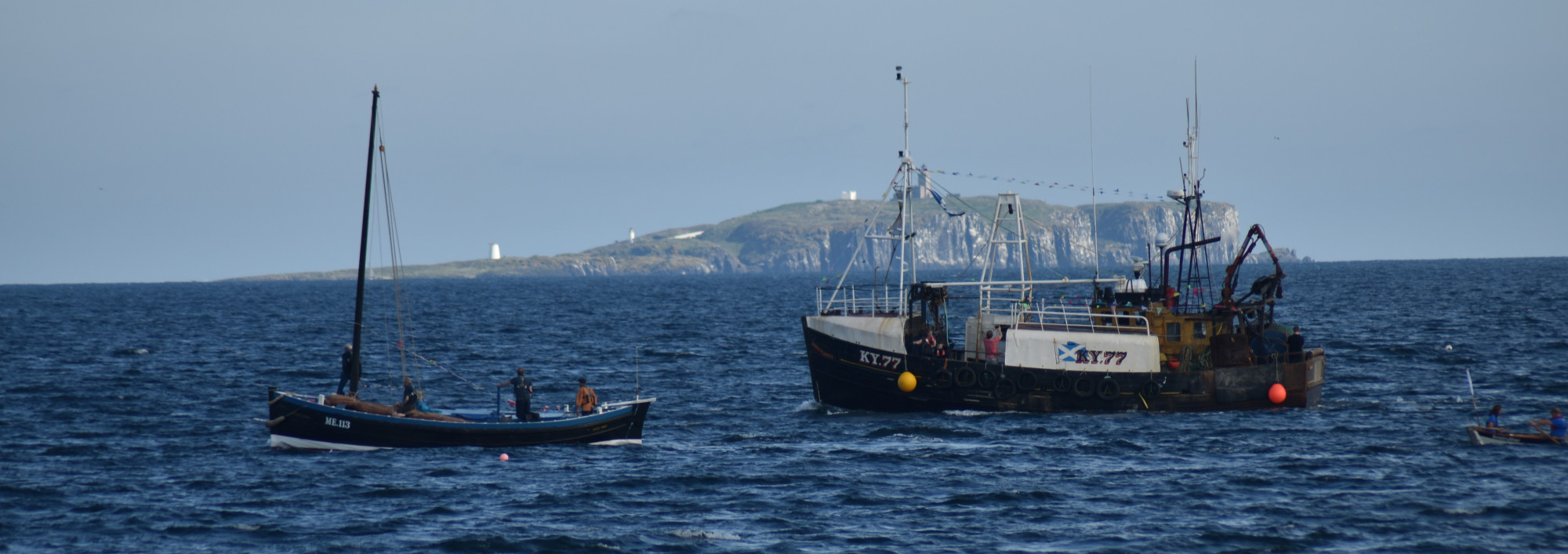


A wee extra one today
OPENING OF THE INTERNATIONAL FISHERIES EXHIBITION. The opening of the international Fisheries Exhibition was a brilliant and almost embarrassing success. There was, however, nothing Royal or brilliant about the weather. The thunder, lightning, and hail of the previous day had not, as some of the weather-wise had predicted, put a period to the wintry May from which we have suffered. There yet remained another gloomy rainy day, and that unfortunately was the date fixed for the State pageant at South Kensington. The outside demonstrations were in consequence not remarkable. The half-a-dozen Royal carriages which conveyed the Prince and Princess of Wales, their sons, and the officers of State from Marlborough House naturally drew many persons out into the rain, and, along the route, strings of flags were stretched at uncertain intervals overhead across the streets.. About 1500 police lined the streets under Colonel Labelmondiere and Superintendents Gernon, Dunlop, Harris, and Hamblin. The route was a long one, and alarming events have been too recent to permit of a lax police arrangement on each a day.
At eleven o’clock the scene in the entrance-hall led become exciting and dramatically picturesque. The eye at length became almost wearied with the succession of forms and colours passing before it, to mingle anon with the multitude in the court below the steps, or to remain in the entrance hall, presenting kaleidoscopic effects with every minute. The bands of the Grenadier Guards and Horse Guards Blue struggled through the crowds that rendered passing to the central promenade anything but easy. Then there arrived, jolly and neat as new pins, the 400 fishermen of Great Britain, who looked proudly upon the familiar nets and boats in the Sea Fisheries section, and marched on to take up their positions on either side of the corridor communicating from the great Sea Fishery Avenue to the Central Promenade. The naval volunteers fell in as a guard of honour, looking thoroughly in their element at such a time and place. The Coldstream Guards were drawn up outside. A score of the Queen’s watermen in their garishly quaint scarlet liveries, and each man armed with a scarlet oar held upright, entered. Then a posse of the Tudoresque persons, commonly called Beefeaters, passed on to the central promenade. One-and-twenty of the gorgeously panoplied Gentlemen- at-Arms, to whom the poet of honour was entrusted, soon put in a dazzling appearance, conspicuous above all by their snow-white plumes, golden helmets, rich uniforms, and fanciful halberds. Under command of the Bargemaster of the Fishmongers’ Company, twenty men in the comic garments worn by the hollers of Doggett’s coat and badge were posted in the building. The lads from the Arethuna, training-ship, assisted to redrees the balance of colour, which, in spite of the maritime nature of the entire business, inclined for a while considerably to military scarlet and gold, for, in addition to eminent military men, there were one or two lord -lieutenant and a boat of deputy-lieutenants from the City scattered about. By-and-bye, when the wearers of Windsor uniform and levee dress and the foreign Commissioners arrived, the scarlet was no longer a monopoly. The central promenade, reached by divers turnings, was the point towards which season and special ticket holders made their way as well as they could. The dais was at the upper end. Hard by was a roped-off section for the Foreign Ambassadors and most distinguished of invited persons. Next was a pen or enclosure in which certain gentlemen, whom business it was to see and hear for the outside public, were pressed together, as might not perhaps be altogether unbefitting the occasion, like sardines or herrings. The General Committee had their location next, and below them, extending in dense ranks on either side away to the orchestra 500 feet and more distant, were ladies and gentlemen who had at last a clear view of the procession as it passed up to the dais, and who but for the selfishness of a small crowd might have seen not a little of the ceremony itself. Sir Philip Cunliffe Owen, Mr. Trendell, and other officials did all they could to find seats for everybody, and if seats were not forthcoming it was not for want of will and energy on their parts. Unfortunately for the three or four thousand ladies and gentlemen below the General Committee, the most distinguished guests entered the promenade from the Norway Court, quite near the dais, and as a crowd of well-dressed persons would insist upon blocking up the gangway, which ought to have been kept clear throughout, the many were prevented from watching the arrival of celebrities. Musurus Pasha, on entering, was followed by Lord Colin Campbell in his plaid and kilt. Earliest of the Ministers was the Home Secretary, who was by-and-bye joined by Lord Aberdare. In their Windsor uniforms they contrasted well with the scarlet of the Marquis of Exeter’s Lord Lieutenant’s uniform, and the various foreign uniforms which blazed in the vicinity. Punctually at the appointed time there had arrived at the entrance hall the Duke and Duchess of Edinburgh, the Duke and Duchess of Connaught, the Duke and Duchess of Albany, the Princess Christian, the Duke of Cambridge, the Duke and Duchess of Teck, and Prince Edward of Saxe-Weimar. They were received by the Royal Commissioners, namely : The Dukes of Roxburgh., Northumberland, and Abercorn, the Marquis of Hamilton, the Earl of Ducie, Viscount Powerscourt, Lord Lovat, Sir John Rose, Admiral Collinson, Sir Samuel Wilson, Mr. Birkbeck, M.P., Professor Huxley, Mr. H. G. Calcraft, and Mr. J. H. Fordham, Prime Warden of the Fishmongers’ Company. The Prince and Princess of Wales and their sons arrived, as arranged, at noon, and were received by the distinguished Royal Company now waiting in the entrance-hall, And with all the honours due to their rank. The Duke of Richmond and Mr. Birkbeck M.P., were officially present at the reception as Chairmen of Committees. The little daughter of Mr. Sayer, a member of the Executive Committee, offered a bouquet to the Princess of Wales, who accepted the gift with a smile to the tiny maiden and her sisters. After a pause the procession was formed and put in motion. Down the British Sea Fisheries Court it advanced amidst general cheering from the enthusiastic spectators, who had seized upon every available standpoint. The frank, hardy fishermen the corridor, with their banners, and in their distinctive working dresses, differing according to the districts they represented, looked, what we know them to be, toilers of the sea, of whom any country might conscientiously be proud. Their flags showed them to have come from all parts of the British coast, Ireland, and Guernsey. The fishwives, it need scarcely be explained, had been the observed of all wherever they appeared. The Canadian and American courts, between which the procession passed, looked wonderfully well in their completed form. Half-past twelve had almost arrived before the echoes of trumpets and distant cheering in the building informed those who had been seated so long in the central promenade that the Royal party were passing down the Sea Fisheries Court, through the ranks of British fishermen, and Newhaven and foreign fishwives towards them. Mr. Barnby’s choir of 400 voices, and orchestra of seventy performers, gave the National Anthem as the Royal party entered. AlI present rose to their feet, and many helped on to their chairs. The cleared space in the centre was not wide enough to give due effect to the procession, but it was grandly imposing, and not soon to be forgotten. First came the contractor and architect, followed by the Superintendent of Works, the Executive Committee, Foreign and Colonial Acting Commissioners, her Majesty’s Commissioners, and the Lord Steward and the Lord Chamberlain, with their wands heralding the Prince and Princess of Wales. The other members of the Royal Family were in the following order: The Duke of Edinburgh, leading his little son, and walking with Princess Christian on his right arm; the Duke of Connaught and Duchess of Edinburgh; the ‘ Duke of Albany and the Duchess of Connaught; the Duke of Cambridge and the Duchess of Albany; Prince Albert Victor and the Duchess of Teek , Prince Edward of Saxe-Weimar, Prince George of Weiss, and the Duke of Teck. The Master of the Horse (the Duke of Westminster) and the Mistress of the Robes (the Duchess of Roxburgh), and the Royal Households brought np the rear of a truly regal procession. The chairs of state were placed upon the dais in a semicircle. On each side palms, ferns, and roses were arranged around the dais, which was o’er-canopied with maroon cloth, upon which the Royal arms were emblazoned The screen was adorned with tridents, and beautifully festooned with what seemed to be fine lace. The material was, however, exceedingly fine network supplied by Sharp and Murray, the well-known herring-net maker of Cellardyke..