

1862
Since Tuesday the weather has considerably improved, and the white or line fishing is now being regularly and actively prosecuted. A fair degree of success is being experienced—the takes generally ranging from to 130 dozen. The fish, however, still continue small size, considering which, fair prices are being realised. At this branch of the fishing, all our local or Cellardyke boats are exclusively employed, although many newspapers have included these amongst the trawlers who resort to St Andrews Bay. It is true, that when this mode of fishing was introduced about fourteen years ago, by fisherman from Rothesay, who practised it successfully in the “Traith,” several Cellardyke fishermen were the first to adopt in this locality what then seemed to be a profitable and legitimate system. Experience soon showed their error, and several years since it was voluntarily discontinued, and the whole of their trawling apparatus sold.
1864
Charles Bruce – Wick – Winter Stock included
Seaman’s Cellardyke Mufflers reduced to 1s 6d
1865
Monday evening (the market night) the annual soiree connection with Kennoway Total Abstinence Society was held the Parish’ Schoolroom— David J. Macfie, Esq. of Kilmux, President of the Society, in the chair. A service of tea, buns, and biscuits was given to the numerous company, after which songs, recitations, and music on the concertina, amused and delighted the audience………., the Rev. Hugh Stewart, of the Evangelical Church, Anstruther, spoke of the evils of intemperance, descanted on smoking and dram-drinking, and on the large amount of money spent in public-houses, which he denominated “pest houses,” calculated that the sum of £7000 is yearly expended for drink in these houses in East and West Anstruther and Cellardyke, apart from what is sold in licensed grocery shops, and which he considered under the mark, as one who knew the matter well had calculated the amount at £10,000. Mr Stewart spoke of the misery, wretchedness, and poverty which these drinking practices brought upon families and individuals, the destitution and raggedness they entailed and causing much ignorance by the want of education to children, with many other evils and mentioned examples which he had witnessed of the dire effects of drunkenness. …………..
1866
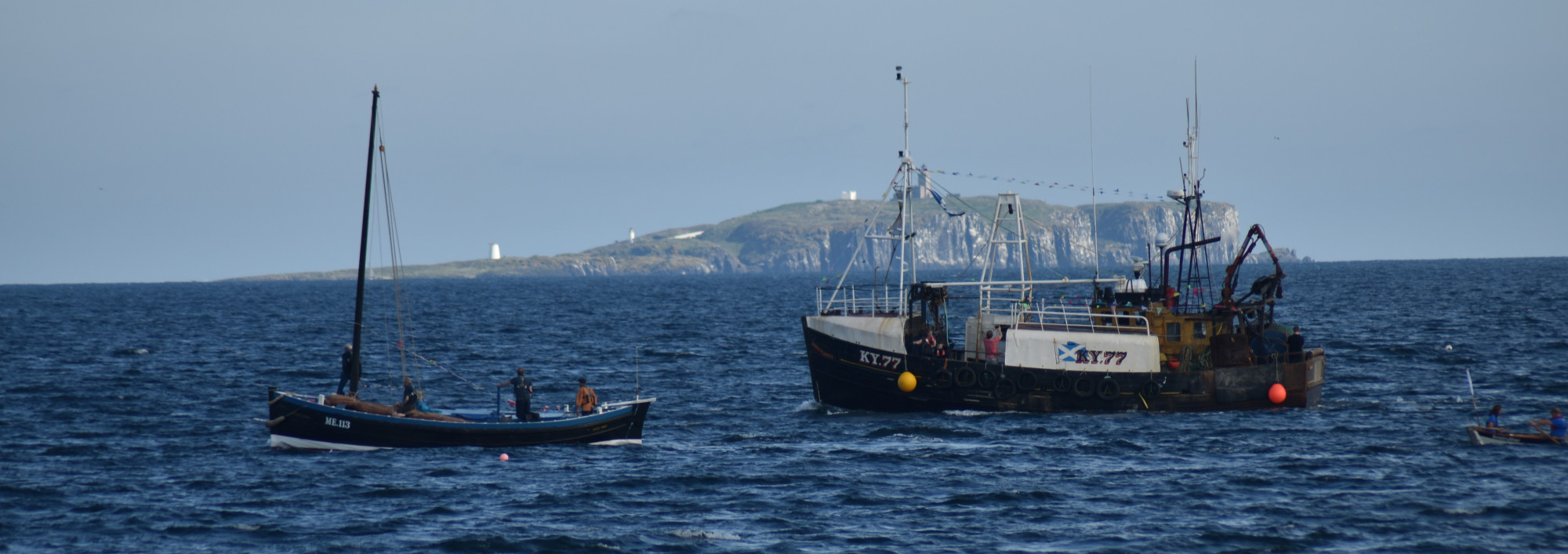
New Fishing Boat.—The other day our attention was directed to a fishing boat of large dimensions at present in course of construction at the east end of Cellardyke, which, for various reasons, not unworthy of a passing notice. This boat is decidedly one of the largest and finest specimens of her class, measuring about 47 feet in extreme length, 17 feet in breadth of beam, and 7 feet inches in depth. Like almost all the new Cellardyke boats, she will be decked over and fitted with the most improved appliances that have been devised for this description of fishing craft. We here speak in the future tense, for as yet she is only what is called ” her height,” that is, she has been all planked externally, while her interior fittings are still incomplete and untouched. Her design is a successful combination of those principles which insure speed, trustworthiness, and comfort, and altogether she promises to be a most handsome and efficient addition to the splendid fleet of fishing boats belonging to Cellardyke. What, however, invests the boat with peculiar interest is the circumstance that up to her present stage she is altogether the work of young man little more than 23 years of age. The builder’s name is Alexander Cunningham, and certainly from this fine specimen of his skill and ingenuity, his friends have, under providence, every reason to anticipate for him a career of no ordinary usefulness and honour the occupation to which he has devoted himself.
The Young Men Cellardyke -Those who are at all familiar with the young community of Cellardyke must often have been impressed by the quiet orderly deportment and high moral status of its young men. Unlike the same class on the other coast towns, who, on the expiration of their apprenticeships, have to seek another sphere for improvement or employment’s sake, the young men of Cellardyke generally remain at home not indeed from any want of spirit, but because the enterprise and success with which the fishing has been lately carried on gives ample scope for their ardour and resolution. It is to this circumstance that the influences of home and early education continue to exercise a power upon our young fishermen which could never have been the case, at least to the same degree, had they quitted their native district and gone forth into the world. Had those influences, indeed, been of vicious and degrading nature, they would naturally have moulded into their own repulsive shapes the character and conduct of the young men. But, fortunately for Cellardyke, they are far otherwise. In few places are Sabbath schools in a more flourishing condition; and as they are conducted by men conscientiously alive to the great responsibility of their position, they are agencies for good to extent which it is impossible overestimate. Meetings for prayer and religious exercise are supported in exemplary way by the fishermen, and these have been, and continue to be, important auxiliaries to the stated ordinances of grace for religion in the hearts of the community, upon whom the great revival movement has left a permanent mark. But in addition to the high impulses and worthy resolutions which Christian institutions —those noblest of all influences—cannot fail to inspire, there are lesser yet active agents in the way of improvement which we ought not to overlook. In Cellardyke there is scarcely family who not take in one or more weekly newspapers, which are carefully and even eagerly perused. The consequence is that when our fishermen assemble to wile away their leisure time in social intercourse, their conversation, a rule, is not the silly gossip and unmanly trifling which so often render such meetings “moral plague spots,” but an intelligent, and, We may add, a sound interchange of opinions on the great events which have the world for their theatre. Notwithstanding all that is sometimes asserted to the contrary, the broadsheet stimulates to more solid and detailed reading than its own contents. Cellardyke is a proof of this being the case, as their newspaper may be readily traced as the cause of the desire for and appreciation of general literature which now exists there, especially amongst the rising generation. But unfortunately the common opportunities for gratifying such taste are very far from being all that could be wished. That increased opportunities are called for, and that they would be taken advantage of if they were provided, is proved by the success of a most interesting experiment which was lately made by the opening of reading-room in the west end of the town. None know better than the enlightened promoters of that meritorious undertaking that it is far short of what is required; and none, we feel assured, would be more ready to give a helping hand to organise a scheme sufficiently extensive as include the whole community. A great step in advance could be made by the formation of a Fisherman’s Library, from which the books could be taken home and read in the family circle. There are gentlemen connected with Cellardyke who have dearer wish than to benefit their native town. These gentlemen, without doubt, would not be indifferent to such a promising scheme, which, however, must originate with and be to certain extent carried out in the locality, before an appeal ought to be made to them. With assistance like this in prospect, we hope soon to hear that steps have been taken the leading men of Cellardyke for the benefit of class who are so well deserving of their encouragement and help. We also ere long hope to hear of a movement being set forward for the establishment of a Young Men’s Christian Institute Cellardyke, where there is a peculiarly inviting field for its operation. The committee of this institute could also do great public service, by taking the management of popular lectures, readings, and other enterprises for the moral and intellectual advancement society. Where philanthropy has such promising sphere before it, we trust that loving hearts and diligent hands will speedily take up a work by which the most important and lasting service would be rendered to interesting and deserving class, who would gratefully embrace and appreciate these privileges.
Melancholy and Fatal occurrence. – On Monday evening, Anstruther harbour was the scene of a peculiarly distressing catastrophe, the particulars of which may be detailed as follows: – ln order to facilitate the turning or swinging of the steamer Forth – which is usually done before the vessel is moored at her berth- a small coble, manned by one of the porters, named David Mayes, is used for the purpose of running out lines and warps. The steamer was due from Leith on the evening in question about six o’clock, but it was fully more than half-an-hour afterwards until she was observed approaching the harbour, when Mayes went in his boat to discharge his ordinary duties. The night being extremely dark, and a gale blowing at the time from the westward, he availed himself of the assistance of John Brown, fisherman, Cellardyke, who accompanied him in the boat. As the Forth near the harbour, the steam was turned off the engine between the beacon and the piers; but, owing to the force of the wind, she entered at considerable speed. Mayes is believed to have stationed his boat at the ordinary distance from the west pier, but the steamer’s course, from the direction and force of the gale, was changed so much nearer to it. Brown, Mayes’ companion in the boat, warned him of their danger, but before he had time to use his sweeps or oars, the steamer was on them, striking the small coble with so much force in the middle to capsize her, or at least to sink her. The porter at the time was in the act of pulling the boat and Brown was standing with the line ready to throw on board the steamer when both were thrown into the water. In the excitement of that terrible moment the thoughts of Brown were instinctively concentrated on his own preservation, and it is therefore little marvel that he remembers nothing of his companion, who was never seen or heard of in life again. With all the wild energy of a drowning man Brown clutched hold of the stem of the steamer, with which he was dragged for fully more than hundred yards up the harbour. But at this point the engine was reversed, and as the steamer drew astern the poor fellow’s hands slipped away from the smooth iron stem, leaving him helpless and alone to struggle with the dark waters. At this critical moment, as the hand of Providence had been bared for his rescue, the coble, which had also been driven before the steamer, rose to the surface and came within his reach, by which he was enabled to support himself until assistance arrived from the shore. The accident was observed by several persons who were standing on the point the West Pier, and who shouted out what had happened to those board the steamer, but the noise of the storm prevented them from being heard, and thus the crew of the Forth were altogether unaware of the casualty. In the meantime all was the wildest excitement and commotion on shore. A cry was raised for a boat, and in a short time a yawl and, the long boat of the Hemaja were manned by crews of active and willing volunteers, principally composed of Cellardyke fishermen. With as little delay as possible, Brown, who continued to drift on the coble, was removed from his dangerous position and landed on the beach, when, although very much exhausted, he was able to walk home. The coble, on washing to the beach, was found to be not only uninjured, but the oars were still attached to the thole pin. So eager were those on the shore to join in the search for poor Mayes, that the coble was immediately cleared of water and manned for that purpose; but the most careful efforts that could be adopted proved altogether fruitless. The scene on the piers at this time defies description. As the startling occurrence passed from lip to lip, people hurried to the shore to increase the anxious agitated crowd, a large number being women, who gave, as is usual in such circumstances, very audible expression to their feelings. A peculiarly affecting incident was the presence of the wife of the unfortunate man on the pier, and her distress of mind while the anxious but vain search was going on may be imagined but never described. About four hours elapsed before the body was discovered by William Parker, lying partially under a fishing boat. Of course, no time was lost in digging it out, when the sad duty was performed of carrying it to the now desolate home. With the exception of a slight blemish above one of the eves, the body bore no marks violence whatever. The unfortunate who was thus unexpectedly and suddenly launched into eternity was in the summer of his manhood, and in the full strength and vigour of life. A widow and two children are left to mourn their bereavement of a loving husband and tender parent; but, if there is aught in human sympathy to assuage the stricken heart, theirs in unbounded measure is the compassion of the whole neighbourhood.