

1864
CELLARDYKE. Destructive Fire.—On Friday afternoon great excitement was caused here by the breaking out of an alarming fire in the house occupied by Mrs Jack, merchant, and others, and situated on the south side of the street, a little to the eastward of the Town Hall. The fire is currently attributed to some burning substance baring been ejected from the flue of heating apparatus belonging to Mr John Gilchrist, the immediate Trinity, and which had been wafted by the heavy gale then prevailing from the south-west upon the roof of the house, which was one of the few thatch ones that still remain in the town. About two o’clock smoke was seen issuing from the roof by the neighbours, who at entered the house, but at this time there was no appearance of fire in the interior. All the occupants were then absent from the dwelling, with the exception Robert Brown and his daughter, both of whom were in bed, the one from the infirmities of age, and the other from declining health. No time was lost in removing these helpless beings, and an attempt was also made save some of the effects in the house, but the rapid progress of the destructive element soon led to its being abandoned. Meantime a large crowd of men and women were energetically engaged in carrying and throwing water, of which there was fortunately an abundant supply, and using all other possible means to arrest the fire, but from the dry state of the thatch and the high wind, their exertions were for a time fruitless, and in less than half hour after the smoke was first seen, the roof fell in, carrying it the ceiling of the first floor, to which the flames had communicated. By the falling in of the roof the fire was not only more confined, but greater facilities were, at the sametime, given for subduing it, and the burning mass was soon after extinguished. Great uneasiness was for a time felt for the safety of the neighbouring properties, and number of the householders had begun to remove their furniture, &c. Nor were their fears without foundation, the adjacent house on the east side had more than once ignited, while in several others, the glass was fractured in the windows by the intensity of the heat, the burning embers being also swept in an alarming manner along the street by the furious wind. Indeed, had the fire taken place at a time when help was less plentiful, the consequences must have been widely destructive, as there was another thatch-roofed house, with a spirit and oil store, in the close vicinity, and nothing but the most active and persevering exertions prevented the fire from spreading its ravages. The house belongs to James Fowler, Esq., and consisted of two stories; but all that now remains of the first floor is some fragments of blackened walls. The tenants who have been rendered houseless by the calamity are Mrs Jack, a widow who has lost either by the fire or the means used to extinguish it, nearly the whole of her grocery stock, and the old fisherman Brown, with a lone woman the name of Walker, share with her the all but total destruction of her household effects. Much sympathy being widely expressed for these poor sufferers, who have thus been deprived of their all; and it is gratifying to state that some benevolent parties are to bestir in their behalf.
1866
ANSTRUTHER. An Uproarious Fisherman. —At the Burgh Court held here on Friday—Provost Todd and Bailie Brown on the bench.-Alexander Mackay, who has been for some time located in Cellardyke as a fisherman, pleaded guilty to having committed a breach of the peace, by being drunk and disorderly in the Eastgreen on the previous Monday afternoon, and also with having assaulted John Montidore, fisherman, William Parker, pilot, and others, at the same time and place. After receiving a sharp reprimand from the bench, he was sentenced to pay a fine of 21s or suffer twenty-one days’ imprisonment, in Cupar jail. The fine was paid.
Charge of Assaulting a Constable.—At an adjourned diet of the Burgh Court held on Saturday—Provost Todd and Bailie Pottinger on the bench – William Stewart, fisherman, Cellardyke, who was charged before the magistrates on Monday with having caused a disturbance in Robertson’s Inn on Saturday the 8th inst., and also with having assaulted Police Constable Strath at the same time and place, was again upon his trial. The panel having pleaded not guilty, Constable Strath—for whose evidence the case had been remanded —was called in and deponed to having been struck on the breast. The assault was also observed by Constable Thomson, but as he had left the locality and no other evidence being adduced, the court held that the charge of breach of the peace had alone been established and accordingly dismissed the complaint as to assault upon the constable as not proved. Stewart was sentenced by the bench to fine of 6d or seven days’ imprisonment in Cupar jail. He was also admonished to behave better in future, in the event of another appearance before this court, his punishment would be far more stringent.
1868
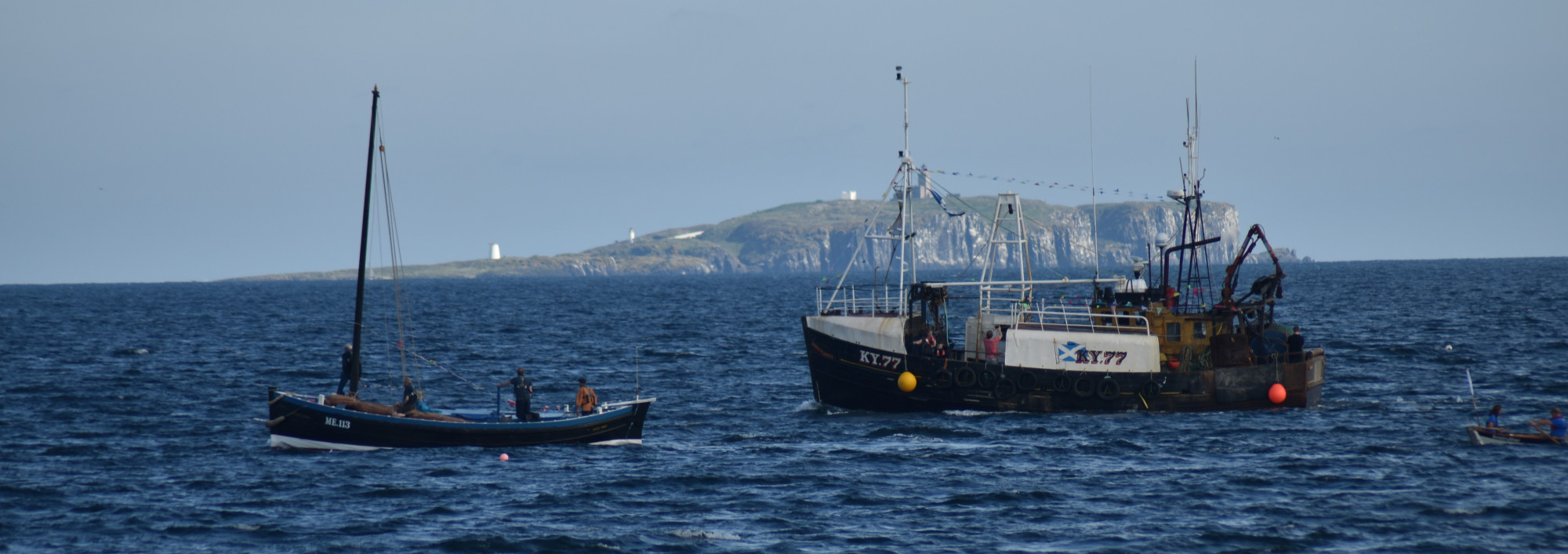
A smart staunch looking fishing vessel, on an entirely new principle has just been completed by Mr John Millar, boat builder Cellardyke, for Captain Macdougal, North Shields. She is a decked craft of the following dimensions; – 45feet long on the keel, 48 feet over all, 14 feet across the bilge (her broadest part) and 8 feet depth of hold; her measurement being 21 tons register. The vessel we understand, has been designed by and built under the direction of Captain Macdougal himself, who intends to employ her in the fishing according to the season on the coast of Northumberland. She has the long graceful lines and general outline of the Firth Fishing boats, but she differs essentially from them having her greatest breadth not as in their case at the gunwale or beam but at the bilge. We cannot give a better idea of this than stating that an ordinary fishing boat of the same length as the new vessel would measure fully three feet more over the gunwale, but rather less over the bilge. According to a well-known principle the somewhat cylindrical form which has been given to the hull will add much to its buoyancy, and enable the ship to stand up well to her canvas in a breeze of wind. The principle has indeed much to recommend it, although most of the ‘old salts’ may be disposed to favour that description of craft as being at once the most safe and weatherly, which, in many familiar phrase ‘keeps the gunwale’ the safety of the crew- who will be eight in number- when working the ship, is so far provided for by means of a low bulwark, while their comfort will be fully secured in two roomy cabins which have been fitted up as sleeping berths. She is to be smack rigged, with a jigger abaft, and by an ingenious contrivance the main mast can be lowered away in order that the vessel may ride easier in rough weather, or when lying at her nets. Altogether she is an exceedingly trim and yacht like craft, and appearances are much belied if she does not, when properly handled, prove a right fast and trusty sea boat. No expense appears to have been spared to make her as complete as possible, and both in point of material and workmanship, she reflects the highest credit on her promising builder, Mr Miller. She is so well advanced that she is expected to be ready for sea in a few days. We hope that she is destined to yield the highest satisfaction to her spirited and amiable owner, Captain Macdougal, and the success of this experiment may encourage him to extend speculation. Captain Macdougal who belongs to an old Anstruther family, has long and successfully held the command of foreign going ships of large tonnage, but we understand that he is now in the position to retire from the active duties of his profession, and betake himself as in this case to those enterprises, which at once afford employment and pleasure to minds habituated to activity and usefulness.
1869
Distressing Occurrence. – Saturday morning the inhabitants Cellardyke were thrown into a state of painful excitement by the rumour which proved only too true that old fisherman the seventy-fifth year of his age, of the name of James Wilson, had committed suicide under peculiarly melancholy circumstances. The unfortunate man lived in a house by himself, but one of his sons in passing had tried the door which he found to be fastened. Conjecturing what was very probable that his father was not yet out of bed, he went home, when his wife purposing some kindly office repaired to the old man’s house. The door had been unfastened in the meantime, and on entering what was her terror to see the unhappy occupant suspended by a small piece of line or ” buoy tow” from a joist in his back cellar. Her screams quickly brought the alarmed neighbours to her assistance, when the body was cut down, but although still warm, the vital spark was found to have for ever fled. (It would appear that the old man had unfastened his door soon after his son had left it; he had even busied himself in preparing his breakfast, and the kindling of the fire and the boiling the kettle had evidently been his last work before setting about the rash and melancholy act, which was to give such a painful end to a life already far beyond the span existence. What gives deeper pathos to this sad incident is the circumstance that his aged partner had only died about fortnight before She had been invalid for several years, but he had nursed and watched over her with the most devoted care and affection —willingly and cheerfully ministering day and night to her every comfort, and there can be no doubt, but grief pressing upon a mind already much weakened and broken by age, is the cause of the unhappy act. His family, as well the neighbours, were unremitting their sympathy, and on the two evenings previous to his decease he had attended religious meetings in the town. He had all through his long life sustained the character of a singularly quiet, steady man, and was held in the highest respect by all who knew him.
“What Drink —At a Court held in Cellardyke on Thursday—Provost Martin and Bailie Watson on the bench—the following cases were disposed of, Alexander Jack, fisherman, was charged with committing assault upon Thomas Bett, fisherman, on his own property at the foot of the old School Wynd on Monday last, and also with committing a breach of the peace at the same time and place, while under the influence of drink. The panel pleaded guilty, and was sentenced to a fine of 15s or fifteen days’ imprisonment.—A half-dealsman, the name of John Logan was then charged with committing assault on the person of George Watson, fisherman, in the house of his brother, and also with committing a breach the peace there on the previous afternoon. The panel, who had been taken into custody at the time, presented an exceedingly rueful appearance in Court, pleaded guilty, and was likewise sentenced to a fine of 15s or fifteen days’ imprisonment.—Both fines were paid. The fact is curious, as throwing some light the crime of the neighbourhood, that the last of the above cases was the ninety-ninth either before the magistrates or the Sheriffs, taken up by the local constable, P.C. Robert Sharp, during the two years past April that he has been stationed his present beat, which includes the three burghs—the Anstruther and Kilrenny and parts of the rural parishes of Carnbee and Dunino, but with scarcely an exception the offences belong to the towns.