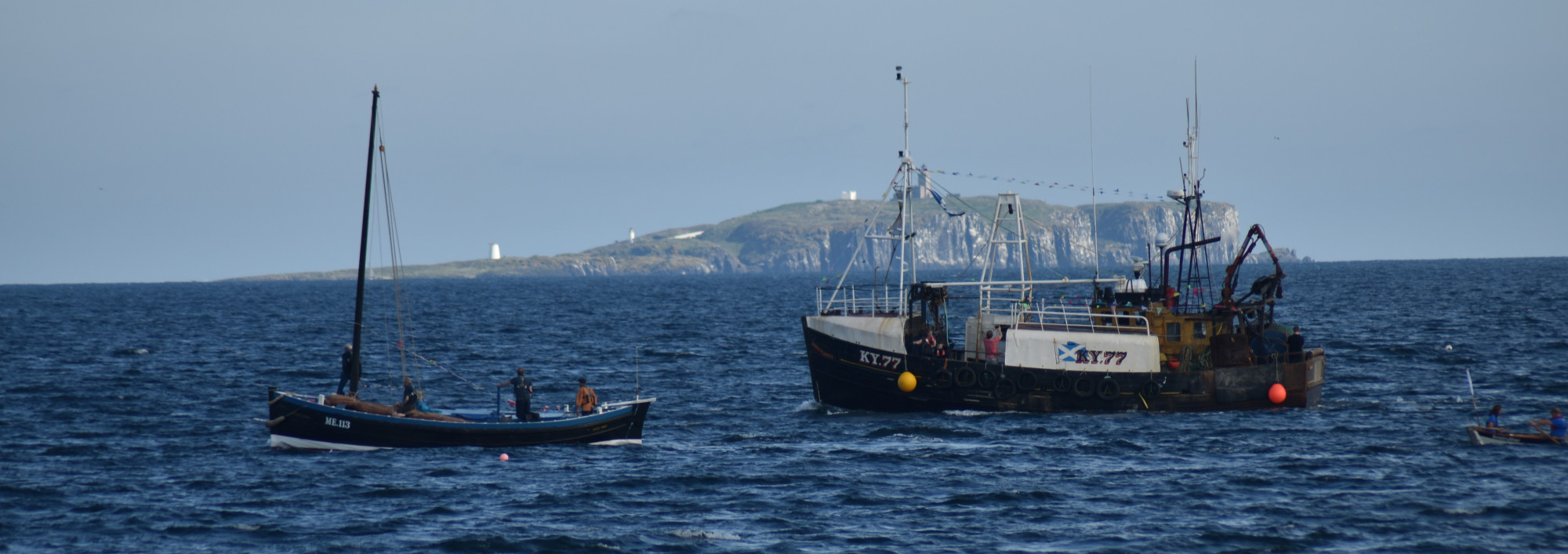


Some earlier newspaper reports from the town.
1826
FIFE FISHERIES, The northern herring fishery has been this year unsuccessful to a very distressing degree; and this is a branch of the business on which our fishermen are considerably dependant. They generally run in debt a little in preparing for it, and trust to the produce of it to enable them to clear off their accumulated engagements of the preceding year; and therefore the comfort and respectability of themselves and their families are very much influenced by its results. Now, of the whole boats fitted out around the Fifeshire coast, scarcely any have returned from the fishery with much more than half the ordinary produce. Theirs is a life of unceasing adventure, and though their apparatus and-boats are generally perfectly adapted to their intended purposes, still no attention or exertion can prevent their existence from being one of constant jeopardy. To starve or drown are the alternatives constantly threatening them.-
Their boats are light, buoyant, and large, and preserve a great degree of elasticity by wanting decks, and go smashing through seas which larger vessels dare not encounter. But their qualities require at the same time careful and long practised dexterity in the steersman; and their business is itself an intricate one, so that they require a long apprenticeship to the difficulties of their profession, and almost everywhere appear as a diligent caste, jealous of the alliance or interference of their neighbours. Their boats are in general manned by nine men when they go to the cod fishing in the deep sea, at the distance of from twelve to twenty miles from land; but the herring fishing being carried on much nearer to the shore, does not require so many, and their boats being then encumbered by their great spreading heavy apparatus of nets, do not afford their usual accommodation.- When, therefore, the period arrives, at which they proceed to their northern harvest, they are able to fit out about one- third more of boats for it, than are generally employed in the more hazardous occupation of the white fishery. The crew is generally reduced to six or seven, among whom the adventure is equally shared, and the boat or its proprietor receives a share equal to that of one man. The proportion of nets to be replaced each year is about a fourth or fifth of the whole. And even in years of average produce, the actual profit remaining after affording the means of renewing their apparatus for the next season is very small. There is no way by which- the deficiency of a season may be compensated, except by increased and more hazardous exertion during the winter season. And as their expenses and their risks are increased, the failure is not only distressing, but destructive to life. The whole boats issuing from the Fife shores may be estimated at one hundred and fifty-of which Cellardyke and Buckhaven afford forty each, and it is easily conceived that the distress occasioned by a failure so general, and to such an extent, must be severely felt, and widely spread. The cause of the failure was to a certain extent the despair of the fishermen. The herrings were later in -arriving, at their usual haunts. The boats which went farthest north fared best, and those belonging to Caithness have been reaping a rich harvest since the south country boats left them
1829
We understand from authority that the commissioners for the Herring Fishery are anxiously seeking to extend the interests of that important branch of national commerce, and have just contracted for improving fishing harbour at Cellardyke in Fifeshire, and erecting new harbour at the cove of Dunglass, in Berwickshire.
1843
Stormy Petrel.
A few mornings since a flock of these rare birds were found by a fisherman at the shore below Cellardyke entangled in net. They came shore during the night, and must have lost their way in the Northern Ocean during the thick weather had some time ago. These birds are seldom seen the Frith of Forth. About 15 or 20 live ones, and a great many dead ones, were sent to the College Museum, Edinburgh.
During the heavy storm of the 11th last, a pilot boat, belonging to Leith, the property of a person named Cook, was wrecked in the boat harbour in the Island of May. When the gale abated the light keeper put the crew on board of a Cellardyke fishing-boat, which in turn put them on hoard of one of the Dundee steamers, and they were landed in safety Granton.
1846
The weather still in a very unsettled state. The Cellardyke- fishermen had their sea on Friday last, but many of them scarcely got a haddock, some had two dozen, the highest ten dozen, but the generality of the boats had little or none.
1847
MARRIAGES. At Anstruther, on 5th inst., by the Rev. Mr Craig, Mr Robert Fowler, to Jessie, youngest daughter David Deas, Cellardyke.
1848
NOTICE IS HEREBY GIVEN, That, in virtue of the Powers contained in Act passed in the Third and Fourth Year of his Majesty King William the fourth intituled, “An Act to enable Burghs in Scotland to establish a General System of Police,” the Occupiers of Premises in the Burgh of Kilrenny, of the real Yearly Rent Value of Ten Pounds and upwards, are hereby required to meet upon Monday the Thirtieth Day of October current, at Twelve of the Clock, within the Town Hall in this Burgh, when the said Act shall be laid before the Meeting.
JAMES FOWLER, Chief Manager. Dated Cellardyke, October 1848.
1849
David Watson, a fisherman Cellardyke was charged with culpably, wickedly and recklessly throwing a quantity of boiling or burning tar upon the persons of Thomas Bella and David Wood, each about 9 years of age and both residing in Cellardyke, whereby they were seriously injured in their persons. He pleaded guilty, and was sentenced to pay a fine of £1, or undergo twenty days imprisonment.
My goodness david Watson throwing hot tar on two wee boys, hope they weren’t scarred. Poor stormy petrels, what a shame.