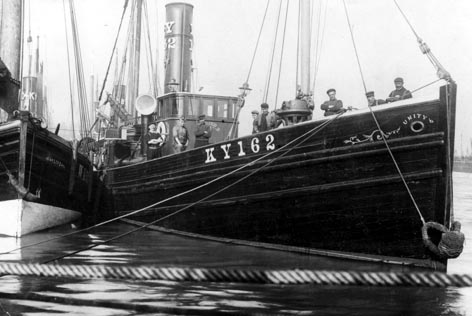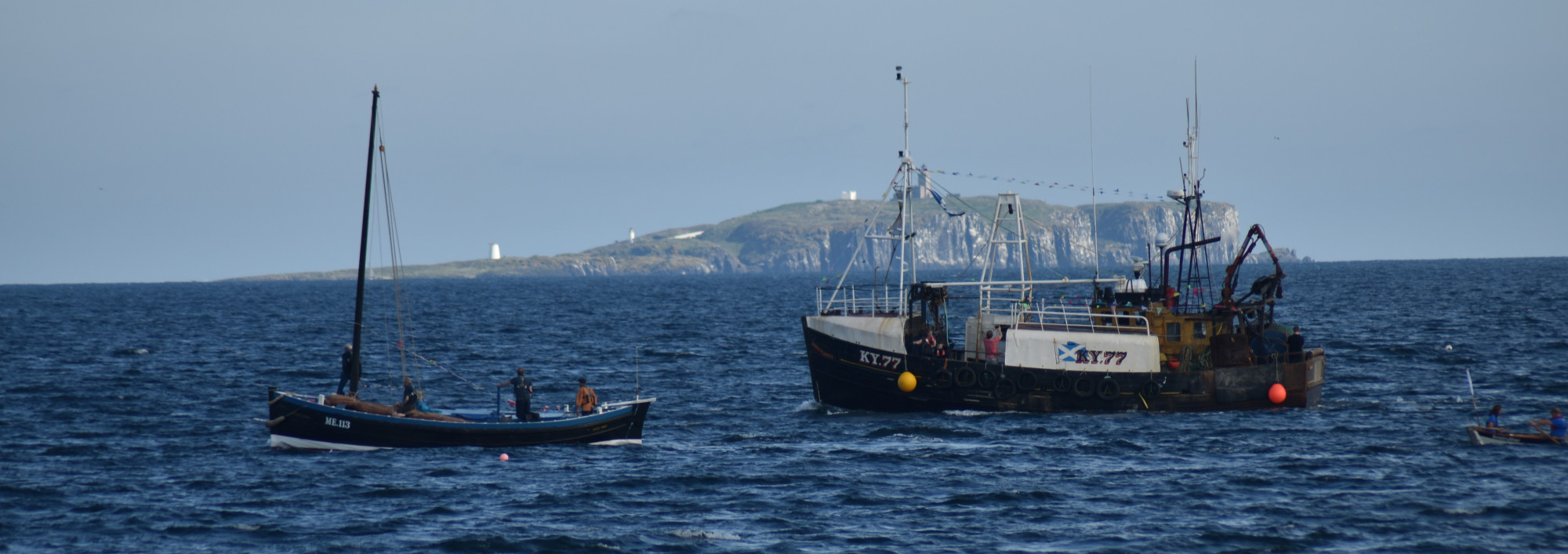

The Cellardyke Echo 12-8-2020

Cellardyke Echo this week, mainly fishing news. Big valuable catches but due to becalming the boats cannot get back into the harbour and the catches become ” over nights” and value drops dramatically, they’re only worth selling for manure or dumping.A few gales and close shaves for some boats, and the final article is a thunderstorm – sound familiar?

1880

Though the herring season is scarcely half run, an average harvest has been all but drawn from the fruitful sea. On the Caithness Coast, for instance, there are those of our local crews who have fished from three hundred to four hundred and sixty craws, and having thus got their errand our townsman, Mr John Watson, and his Cellardyke friend, Mr George Anderson, have sailed for home with colours flying like whalers when full ship from the Polar Seas. Several East of Fife boats have been equally fortunate on the Buchan Coast, but, as a rule, the fishermen have been much harassed in their long sea chase by light and baffling winds. Thus the youthful Cellardyke Skipper, John Brown, was so belated with a splendid haul of some ninety crans at Peterhead on Sabbath that his merchant refusing to take delivery, the herrings had to be scooped like so much waste into the sea; and the same cause has also largely interfered with the fishing all along the coast.

HERRING FISHING BOAT.—For Sale, the Cellardyke-built Boat, WK 808, 41 feet over all, with all her materials as she ran the sea this season, follows, viz.2 Fore Sails (one 160 yards, new this season), 2 Jibs (one new this reason), Mizzen 2 years old, Swings (one new this season), New Running Rigging, Anchors and Chain, Compass, Lanterns, Ac. Delivery to be made on 6th September. For particulars apply to A. Cormack, Fishcurer. Pulteneytown, Wick, 4th August, 1880.

Stonehaven

Two Cellardyke boats 337 and 83 KY. lost 46 and 40 nets respectively owing to the extraordinary quantity of fish enclosed in them, and the boat 83 KY landed 90 crans out of the nets that remained, besides giving a quantity of fish to other two boats. ; 15 crans made up her compliment and to sell the remaining 75 to the curer for 2s 6d per cran. The great calm on Wednesday and Thursday seriously interfered with the fishing operations, and several hundred of crans were carted to the Country for manure or put the sea as they were useless by being so long in the boats.

1881

On Saturday some of the largest shots of the season were landed. One consisting of 114 crans, fell to the Pulteneytown boat of which James Macbeath is skipper, and which fishes for Mr William Sutherland. Next to it was the Cellardyke boat, James Smith, skipper, which we lately mentioned as having landed 104 crans ; but on Saturday he delivered to Mr Begg a shot of 108 crans.

1882

The Fife boats by of their great offing were amongst the heaviest sufferers by the gale. One Cellardyke boat, the Medium, lost as many as 40 nets, and another, the Goldie, lost 23. Great anxiety was felt in Cellardyke for the safety of the Floral Star, which was known to be out in the storm, until a telegram from Aberdeen stated that she had arrived there.

Sudden Death.—Mr Thomas Fowler, merchant, Forth Street, Cellardyke, died very suddenly on Monday night. He was in ordinary health, and watched during the day with natural interest the fitting up of fine new shop for his growing trade; but towards eight o’clock he was seized with a violent haemorrhage, which was almost instantly followed by the closing scene. He leaves a widow and family to mourn his loss.

1883

Aberdeen

On Thursday Cellardyke boat (No 1249) William Smith, skipper, fishing for Messrs Sharp and Murray curers, of that place, arrived with her sails split. The crew report having experienced very heavy weather, and about, one o’clock on Wednesday afternoon, when they were about 4 miles off the Isle of May a sudden gust came down on the boat from the west and tore the foresail into shreds.

Our Peterhead correspondent telegraphed on Thursday – Several narrow escapes from drowning are reported. … another carvel-built boat, Pride o Fife  (KY, 1929) James Salter, master, was coming in last night, she was struck by heavy sea fourteen miles from land, which split the second board, next to the keel. The water came in so fast that besides the pump the crew had use buckets to keep her afloat. When she arrived the people on the quay were astonished, especially when she kept sailing up the harbour at a rapid speed, and ran up the slip.

Peterhead,

Thomas Stewart, “Goss,” fisherman, from Cellardyke, failed to appear for being drunk and incapable, and forfeited bail of 5s.

 Aberdeen

ACCIDENT TO A HERRING FISHING BOAT. This afternoon an accident occurred to one of the Kirkcaldy herring fishing boats while making for the harbour, but fortunately no one was injured. The boat to which the accident happened was the Margaret Morris, belonging to Cellardyke. She had full sail set, and was coming in the bay towards the harbour at a rapid rate, there being a strong breeze blowing from the north. When a short distance out from the Girdleness  a squall suddenly struck the boat, causing it to stagger and breaking the main mast five or six feet from the top. The broken portion of the mast with the sail attached fell into the sea. There was six of a crew on board, and several them were in the vicinity of the mast when the accident occurred, it is a fortunate circumstance that the gale carried the sheet with the piece wood attached overboard. A flag was at once hoisted a signal that assistance was required, and the crew set about getting the tackle hauled in. In a short time the steam tug Britannia arrived the scene, and a tow rope having been made fast to the craft, it was safely into the harbour.

1884

BOAT SWAMPED IN ABERDEEN BAY—RESCUE By a Fifeshire boat.—Between twelve and one o’clock on Saturday forenoon a small fishing boat, in which a man named James Gauld plumber, was fishing for mackerel, was seen to swamp in Aberdeen bay, about a mile from the point of the North Pier, in a north-easterly direction. The crew of the pilot boat No. 1 saw the occurrence, and proceeded to the drowning man’s assistance, as did also the steam tug Britannia. Before either the pilot boat or tug had reached the scene of the accident, however, the crew of the Cellardyke fishing boat KY.No. 78 (Christie. master), which happened to be returning from the fishing grounds at the time, having seen the disaster, bore down to the spot, and rescued Gauld, whom they found clinging to the boat, which bad been turned bottom up.

Fraserburgh Police Court

Philip Anderson. Cellardyke, was convicted on evidence of having thrown quantity of herrings into the harbour, and was fined 10s with costs of prosecution, 20s.

CELLARDYKE. Incidents of the Thunderstorm- Not a few casualties occurred in this district during the violent thunderstorm of Tuesday. Among them may be mentioned the destruction of a stack of hay on the farm of Pitkierie, which was set on fire by the lightning and completely consumed ; the ignition of the telegraph instruments in Cellardyke Post Office, which set on fire some papers which were laid beside them, but which were extinguished before the fire had got further hold ; the striking of the steeple of the new church in Cellardyke, where the only damage done was the displacement of some slates on the roof; and a slight derangement of the signal instruments at the railway station.

The Cellardyke Echo – 6/8/2020

The Cellardyke Echo – this week – I have reported on the White Cross incident before but this gives more detail. Alex Motion, I believe will have been Bill Motion the Banker’s father. Alex was the last of Cellardyke’s fishermen who sailed on a pure sailing fishing boat. He also was aboard the Thistle in 1904 when James Deas lost his two sons at Anstruther harbour mouth. – Thomas Murray must have been a good fisherman when sober as his fines were paid by his skipper.

1900

MERCHANTS’ HOLIDAY AND EXCURSION TO ABERFELDY. —Of the 500 adult tickets issued for this excursion only a very few remain, and these can only be had from the members of committee, Messrs Gray and Barr, Anstruther, and Bailie Butters and Mr Fortune, Cellardyke. The committee are also trying to arrange that family parties of 9 or 10 may secure a compartment, and request those intending to avail themselves of this arrangement to send the name of one of the party to any of the committee not later than Monday first. We understand the Railway Company have consented to run the morning train via Loch Leven and Glenfarg, returning via Ladybank, thus giving the excursionists a change of route for a considerable part of the journey.

MELANCHOLY FATALITY OFF ANSTRUTHER HARBOUR. CELLARDYKE FISHERMAN DROWNED. GALLANT RESCUES, A drowning fatality of a melancholy character occurred off Anstruther harbour on Saturday afternoon. The circumstances are as follows: – A number of the liners and trawlers, along with several fishing boats, arrived off the harbour shortly after noon. The tide was back at the time, and no entrance could be effected until well on in the afternoon. The White Cross, Skipper Parker, was one of the liners, and during the time of waiting the Skipper resolved to utilise the time by barking his nets. The small boat was sent ashore with several of the crew to procure a box of cutch. This having been obtained, several young lads got on board and went out to the liner. On the cutch being put on board, Skipper Parker asked one of the crew, named James Smith, (well-known as ‘ Skipper’) to row out in the small boat to the liner Isle of May, which was lying riding at anchor a few hundred yards further out, and bring back some herring baskets. Smith complied with the request, but asked that the liner should tow the small boat out a little bit. Those on board the small boat were Smith and Parker, two of the crew of the White Cross, and the following young lads: —Thomas Pratt, 10 years of age, West Anstruther; James Jamieson, 13 years, West Anstruther; David McRuvie, 9 years, Cellardyke; and Alex. Motion, 13 years, Cellardyke. The engines were started slow ahead, but the vessel had not gone far when the tow rope, which was fastened at the quarter, and also at the stern-head, slipped off the latter place, causing the small boat to swerve round, and strike the quarter of the liner. Smith was steering with an oar, and unfortunately in the lurch the boat gave he lost hold of it. The water flowed into the boat until it was almost filled, and the occupants went to one aide, with the result the boat overturned, and they were all thrown into the water. The tow rope was also broken. Smith was never seen again, and it is supposed he must have struck the liner with his head and been stunned. Two men on board the liner, named John Anderson and David McRuvie, divested themselves of most of their clothing and jamp overboard. Anderson caught bold of two boys David McRuvie, son of D. McRuvie, Cellardyke, and Thomas Pratt. He held to them, until McRuvie swam up and got hold of his son. Alexander Motion swam up to the liner and was hauled on board, while the young lad James Jamieson was caught by Alexander Parker, one of the crew of the White Cross. They were all got on board and afterwards sent ashore. By this time a crowd had collected on the piers, and assistance was ready. Several of the lads wore more dead than alive when brought to the pier, and artificial respiration had to be resorted to to bring them round. Two of the lads were carried to neighbouring houses, where they were attended by Dr Wilson, and after recovering somewhat were taken home, and have all since got well. Steps were at once taken to drag for the body of Smith, and operations were carried on till darkening without, result. On Sunday no less than seven boats were engaged in dragging, and one continued at the work until near nine o’clock at night, but unfortunately without finding any trace of it, and Monday’s operations were equally without result. Smith was 24 years of age, and was the support of his widowed mother, who resides at James Street, Cellardyke. The occurrence evoked many expressions of sympathy with Mrs Smith regarding the loss of her son. He was of a very cheerful and happy disposition, and was a general favourite in the community. In several of the churches on Sunday sympathetic references were made in the prayers and sermons to the fatality.

Cellardyke fatal Accident

On Saturday last a sloop-rigged pleasure boat, bound from Dundee to Leith, bad just passed the harbour of this place, and was about 200 yards from shore, when a squall of wind upset her. A number of boats immediately hastened to their assistance, and succeeded in picking up 2 out of the 3 which composed her crew, one of whom died shortly after. The body of the third unfortunate man has not yet been found. The survivor’s name is Rollo, about 65 years of age. The body of the man who died was decently interred in Kilrenny Churchyard. We have not heard his name, but be was about 18 years of age. A very great number of the inhabitants of Cellardyke and Anster followed the remains of the unfortunate young man to the grave.

A few days later

A memorial service was held in Cellardyke Church on Sabbath afternoon, when special reference was made to the murder of the King of Italy and the death of the Duke of Saxe Coburg by the Rev. Mr Ray, who preached most appropriate sermon from the words—“ Be ye also ready.” At the close of the sermon, the rev. gentleman made appropriate reference the drowning accident that occurred Saturday. Appropriate hymns were sung, and a most impressive rendering of the Dead March given upon the organ by Miss Anderson.

1901

EAST OF FIFE POLICE COURTS. A Burgh Court was held in the Council Chambers, Anstruther-Easter, on Monday forenoon—all the Magistrates being present. Thomas Murray, junr. fisherman, Cellardyke, was charged with having on Saturday evening 27th July, in Shore Street, Anstruther, behaved in a riotous drunken, and disorderly manner, cursed and swore, shouted and bawled, whereby a breach of the peace was committed and the lieges disturbed. Accused pled guilty.The Fiscal – This young man, I am informed, is very quiet and respectable when sober, but when he gets drink he behaves like a madman. He cursed and swore and challenged the lieges to fight. The police apprehended him, not on this charge hut on one which he was to be tried for at Cellardyke, and he had been in the cells since yesterday morning. He appears to have suffered very much judging from his appearance. How he came by the marks I do not know. The facts of the case are as stated in the complaint, but accused has unfortunately had rather a bad record. There are six previous convictions against him. The last one is in 1899–the rest I will not press – but I ask your Honours to take into account the 1899 conviction in consideration when you impose the sentence. Accused in being asked if he had anything to say, said he was very sorry.

The Provost—This Court fines you 15s or 14 days imprisonment. It is ridiculous that a young man like you should have 6 convictions against you in 10 years I think you should make up your mind to give up the drink, and I hope you will never taste it again. The fine was paid by accused’s skipper.

At a Court held the same forenoon at Cellardyke, Provost Black and Bailie Butters being the Magistrates present, the same man was charged with having on Saturday, 3rd March 1900, cussed and swore, used threatening and abusive language, and challenging the lieges to fight, by which a breach of the peace was created and the lieges disturbed. Accused pled guilty. The Fiscal—This is a case which was before your Honours on Friday 9th March, 1900, nearly 18 months ago, but accused at the time ran away. He turned up on Saturday end he was apprehended on Sunday morning and had been in the cells since then. No man need think that by running away they could escape from the law, because a record is always kept of these things. The facts were just as they were set forth in the complaint. Accused would have been brought up before their Honours before this, but it was not thought worth the expense to bring him from Aberdeen so the officials just waited for him to turn up. There were several previous convictions but the only one their Honours would need to take into account was the one in 1899.

Accused said he ran away because he had no money at the time. Provost Black –We are very sorry to see you here in such a position and in such a condition. The Magistrates have agreed to make the fine as lenient as passible – 15s or 14 day’s imprisonment. Bailie Butters—The Magistrates also consider it advisable to state that if you over come here again the probability is that you will not get the option of a fine. We are determined to put down these Saturday night disturbances. We hope this will be a lesson to you for the future. The accused’s fine was again paid for him, and the Court dispersed.

The gallery of Cellardyke Church which, owing to its flatness has been difficult to let to members, is to be raised 18 inches at the back, with a gradual slope to the front. The work, which is to be commenced this week, is in the hands of Mr William. Brown, joiner, Anstruther. It has been a complaint on the part of the members, especially during the evening services, that the frequenting of this place by young persons, whose conduct, seeing they were beyond sight of the officiating clergyman, was somewhat annoying to the regular worshippers.

About 10 o’clock on Tuesday morning, while a little boy named Alexander Gardiner Martin 9 years of age, son of James Martin, fisherman, James Street, was looking out of a garret window watching the arrival of his father’s boat, he overbalanced himself, and fell a distance of 20 feet. Several people passing at the time went to his assistance, and carried him into his mother’s house. Dr Wilson was soon in attendance and found that his right lower jaw had been severely injured, and several of his teeth knocked out, but no bones broken. Considering the height he fell and the hard pavement on which he alighted, it is a marvel that the injuries were not more serious.

The Cellardyke Echo – 30/7/2020

1895

Deceased Local Seamen. The following names occur in the list of deaths of seamen reported to the Registrar-General of Shipping during the month of June:-

Alexander Black (24), fisherman, Pittenweem, supposed to have been drowned through the capsizing of the fishing boat John and Betsy half a mile off Monance on 1st May last;

F. B. Millar (26), publican, Edinburgh, last residing at Pittenweem, who was drowned from the pleasure boat John and Betsy half a mile off St Monance 0n 1st May last;

Alexander Davidson (48), St Monance, last residing at 9 Rodger Street, Cellardyke, Fife, supposed to have been drowned, his vessel, the Lady of the Lake, being missing with all hands since 16th or 17th May, 1895;

John Moncrieff (30), 12 East Fort Street, Cellardyke, fisherman, line fishing boat Lady of the Lake, supposed to be drowned, vessel missing with all hands;

Adam Reid (52), fisherman, George Street, Cellardyke, also the Lady of the Lake, vessel missing with all hands ;

James Smith (27), fisherman, 31 Shore Street, Cellardyke, drowned at sea, also of the Lady of the Lake.

( Also lost at this time was William Motion (42) from David Watson’s fishing vessel Providence KY263)

1896

COALS! COALS!! COALS!!!

WILLIAM ROBERTSON, Agent for Bowman & Co., Muiredge Colliery, Can always Supply Household and all other kinds of Coals in Trucks, at Pit Prices. The Dunfermline Splint and Bagging Coals always in Stock. Orders left at William Martin’s, Tolbooth Wynd, Cellardyke, or at Dovecot Park, Anstruther, will be attended to.

FOR SALE, FISHING BOAT “Ivanhoe,” 45ft.., Clincher Built, Cheap. Apply to James Deas, Rodger Street,Cellardyke.

PROPERTY AND BUSINESS, IN CELLARDYKE, FIFE, FOR SALE. In consequence of the Retirement from Business of the Proprietrix. the PUBLIC HOUSE and DWELLING-HOUSE, No. 4 John Street, Cellardyke, with Yard and Garden behind, is offered for Sale by Private Bargain, along with the GOODWILL and STOCK IN TRADE.

The House has been licensed for the long period of 39 years, and there is no Hotel, and only one other Public House, in the Burgh. Entry will be given at Martinmas next. Feu duty nominal. The highest or any offer may not be accepted. For further particulars apply to H. B. MACKINTOSH & SON. Solicitors, Anstruther, or W. FORD & Son, Limited, Leith. Offers to be lodged with the former, who hold the Title Deeds of the Property on or before 10th August next.

Mr David Muir, Cellardyke, and Mr James R. Shaw, Glenshee, have successfully passed the Marine Board examination for first mates. These candidates were prepared at the Government Navigation School by Captains Wood and Low.

1897

THE FIFE FISHING FLEET. Of the large fleet of boats fishing from the port of Aberdeen at this season the usual considerable proportion hail from the “Kingdom of Fife.” They are mostly sailing vessels, manned by a lot of industrious, hard-working fishermen, who make the very best of their opportunities, and philosophically take what luck falls to them without too much grumbling or too great elation. Martin Gardiner, Cellardyke, skipper of the Vanguard, came in with a record catch. The Vanguard was many miles out sea, fishing in the midst of many other boats, when she struck a shoal of herrings that yielded 104 crans before she beaded for Aberdeen. Martin Gardiner’s good lack did not end with the mere possession of the catch, for he afterward, pocketed the fair return of I8s 6d per cran. Unlike many others engaged in the same industry, Fife fishermen are strict observers of the Sabbath. It is a fixed principle with every one of them that he must be in port on the Saturday, and he does not shift again from the quayside until Monday. There are just two trawlers from the Kingdom —the Faith and the Fifeness—and their movement, are likewise strictly confined to week days. For trawlers this is quite exceptional, for the vast majority of them come and go at all times. The Faith has been fishing regularly from the port of Aberdeen for long time, and she was never once known to go to sea on Sunday. At the Aberdeen Fish Market the Faith and the Fifeness are known by the name of the Saturday boats. Their movements can always be depended upon. They reach port with their first catch for the week either Wednesday or Thursday morning, and returning to sea again without delay, they are in port again with another haul by Saturday morning- In the course of the Saturday forenoon both boats will be found lying neat and clean for the Sunday lie-up.

1898

SUDDEN DEATH OF A CELLARDYKE FISHERMAN ON ANSTRUTHER PIER. —Last Saturday morning a very sad occurrence took place on the west pier, Anstruther. The yawl owned by Thomas Tarvit, named the Four Brothers, arrived from the herring fishing about half-past five o’clock in the morning. Mr George Moncrieff, East Forth Street, Cellardyke, one of the crew, while the boat coming into the harbour complained of being sick. As the boat was to be moored at once, and he would get home, nothing was done.  

On reaching the west pier at the steps, Moncrieff took hold of the rope and went on to the steps with the object of making the yawl fast. He climbed up the steps, but on getting to the top he suddenly fell down on the surface. Before the rest of the crew or any others could get to him he was dead, but means were at once taken to try and bring him round. Medical aid was summoned, but Dr Wilson’s services were of no avail. The body was conveyed to his house in Cellardyke shortly afterwards. The sad event excited a good deal of sympathy during the course of the day. Deceased was 66 years of age, and was held in great respect in the community. He was a quiet and inoffensive man, but was able to take a share in different movements for the prosperity of the fishing community. Heart disease, from which he was aware he suffered, was the cause of death. He had retired from the fishing some years ago, and only went to the yawl fishing a fortnight ago. His remains were interred in Kilrenny Church yard on Monday.

INNERGELLIE HOUSE AND THE FISH GUANO FACTORY.

The Provost read a letter from Mr McLaren, Innergellie, dated the 5th instant, in which he said that some time ago the Town Council gave certain instructions, based on Dr Nasmyth’s report, to Mr Cormack for carrying on the fish manure factory at the east end of Cellardyke. He had considered the fumes given off by the factory as a serious nuisance, and he should be glad to know if the recommendations had been given effect to, and the instructions carried out. Last year, Mr Campbell, Edinburgh, who occupied Innergellie House, raised objections to the fumes, and he wish to be satisfied that there was not to be the same complaint from the tenants whom he was expecting to take Innergellie House for the summer. He had replied to Mr McLaren to the effect that the Town Council were alive to the matter, and that far as they knew Mr Cormack was carrying out to the letter the recommendations of Dr Nasmyth, but that as yet they had not been tested. They would have to wait until the test was made to know whether the nuisance was removed or not. Bailie Butters – That is quite correct. I had a talk with Mr Cormack the other day, when he said that since he had not an opportunity of testing it. He has done everything he could to carry out the Doctor’s instructions.

1899

CELLARDYKE. Theft of Money.

On Thursday night last a theft was discovered to have taken place in the house of John Clark, junr. in Ellice Street. The circumstances are as follows:–The front window was discovered to have been broken, and it was thought the thief or thieves must have entered by it, but this supposition was shown to be groundless from the fact that the snib was all right, and a number of flower pots lying on the sole of the window had not been disturbed. They would have had to be removed before anyone could have gained entrance by the window. Nothing was touched in the room, but the party, who evidently knew the house, had gone to a box in which money was kept and taken £1 out one box, and 2s from another, but leaving 3s in it. A quantity of jewellery was also left behind. The boxes were again re-locked, and put in the places from which they had been taken. The police were informed as soon as it was discovered, and the theory is that it has not been committed by a stranger.

CELLARDYKE SCAFFOLDING ACDIDENT.—On Thursday night last week, while Mr Peter Elder and four painters were engaged painting the roof of the Parish Church, the scaffolding on which they were standing suddenly gave way. Two of the men were thrown into the gallery, and other two into the Church, All the men escaped without injury except Patrick Mclllgrew, who was severely bruised on the left side, and a bit of the skin of his right leg torn off. He is now all right again.

The Cellardyke Echo 22/7/2020

A few tragedies this week and a hen who could not have been very comfortable!

1885

Sad Occurrence on the Coast.—The old Cellardyke boat, ” Otway,” utilised, like several others, some time ago into a kind of keel, ran into Pittenweem on Friday morning, when the skipper, Robert Campbell, reported that he had lost his mate, Wm. Muir, about the turn of the night in the offing of Elie Ness. The little craft was on her way from Leith to Anstruther to re-ship cement for the Isle of May. All had gone well till, the skipper was trimming the foresheet, the unfortunate man was knocked over by the jibing of the mainsail. To throw oar and launch the dingy was only the work of a few minutes, but the generous endeavour was all unavailing, and he sank into a watery grave. Meanwhile the vessel was dragging before the wind, so that it was with no little exertion that the skipper himself regained the deck. By those who knew him, Wm. Muir is lamented as a quiet and useful man. He was over forty years of age— native of Orkney, but settled for some time in Leith, where he leaves a widow and five children to bewail his loss.

Among those present at the Lord Mayor of London’s banquet to the Lord Mayors and Provosts of the United Kingdom at the Mansion House, London, on Friday evening last week, was Provost Skinner, Cellardyke, who was officially styled “His Worshipful the Provost of Kilrenny.”

COLLISION IN ABERDEEN BAY—CELLARDYKE FISHING BOAT SUNK.—

At early hour this morning—between one and two o’clock—a collision of an alarming nature occurred in Aberdeen Bay between the steamer St Ronald, of this port, and the fishing boat Mizpah, KY, 2023, belonging to Cellardyke, of which James Cunningham is master. The boat, it appears, had been engaged in the prosecution of the herring fishing, and at the time of the occurrence had been returning from the fishing ground. The night was dark and a very a thick fog prevailed, so that navigation had to be managed very cautiously. The boat had succeeded in passing within the South Breakwater in safety, preparatory to taking the navigation channel, when several of the fishermen thought they descried a light bearing down their direction. Conjecturing that the belonged to a craft evidently making for the south they steered their boat well to the north of the channel, for the purpose of giving the stranger clear way. The bow of the steamer was shortly thereafter seen. As it appeared the fishermen at the time the steamer suddenly changed her course, this point it is rather difficult to say much with anything like certainty. However, this alleged change of course put the steamer directly in line with the fishing boat, with the result that before the fishermen had time to take their boat out the way the steamer was upon them. Immediately before striking the boat, the engines of the Ronald were reversed, so that, to a certain extent, the force of the blow inflicted upon the tiny craft was somewhat retarded. It was sufficient, however, to cut her to the water’s edge, and make the boat sink almost immediately. The crew had a narrow escape from drowning, and their safety was entirely due to the prompt measures taken by those board the steamer. Ropes were thrown to the fishermen, and after some time, they were all landed on board the St Ronald from where they were shortly afterwards transferred to the tug Bon-Accord and brought to port. The excitement on board the steamer was naturally very great among the passengers, in the darkness nothing like an accurate idea of the extent of the casualty could be gained. The exact point where the occurrence took place is about five hundred yards outside the North Breakwater. The following are the names the crew the fishing boat Cunningham (61), Cellardyke : Alexander Cunningham, Cellardyke; Alexander Gardiner, John Street, Cellardyke ; George Oliphant, Cupar-Fife ; James Main, Green, Anstruther ; Andrew Meldrum, Crail ; William Neil, Shore Street, Crail.

Divers were engaged in the morning trying to raise the sunken boat, but their efforts up the present time have proved futile.

It is asserted that at the time of the collision no lights were displayed the Mizaph.

1886

The Cellardyke herring boat, Alaska, numbered Kirkcaldy 332 arrived at Arbroath on Tuesday Morning. The Skipper David Davidson reported that at half past one o’clock on Tuesday Morning, when the boat was between the May Island and Bell Rock, Robert Watson, one of the crew, was caught by the weather rope, dragged overboard and drowned. Watson was about thirty years of age, unmarried and resided in Crail. (other reports say he was 20 years old)

One week later

CELLARDYKE FISHERMAN DROWNED OFF ABERDEEN.- While the fishing boat Pioneer, No. 1051, was making for Aberdeen Harbour Saturday morning George Henderson, 32 years of age, one of the hired men, who resided at Tolbooth Wynd, was knocked overboard by the lurching the boat. He floated on his back for a few minutes, and was rescued by the crew of an Inverness boat. Everything was done to restore animation, but without avail, Henderson expiring shortly after being taken out the water. He was married, and leaves a widow and one child.

1887

The annual holidays in Anstruther and Cellardyke are to be observed on Wednesday and Thursday next week. In the absence of the boats, business is extremely dull at present, in both towns. So much is this the case in Cellardyke that the merchants there, as in former years, have begun to close at six o’clock in the evening, and to observe each Wednesday as a whole holiday.

On Saturday an accident occurred at the harbour by which a boy named Stewart, about nine years of age, got one of his legs severely crushed. He was sitting on the pier with his legs dangling over the edge, when a boat, with the motion of the tide, jammed one of them between its gunwale and the pier. He was immediately taken to Dr McCallum’s where the bruised limb was stitched, then home to his father’s, James Stewart, Rodger St., Cellardyke.

Large Eggs

We have had handed to us for inspection two eggs, dropped by a hen belonging to ex-Bailie Brown, Cellardyke, which, on account of their size, demand a passing notice. One measures 6 ¼ inches in circumference, 4 inches in diameter, and weighs within a fraction of ¼ of a lb. The other is 6 inches in circumference, 4 inches in diameter, and weighs 3 ½ oz. The hen which acknowledges these eggs doesn’t lay often, but when she does lay she seems determined to make a good job of it.

On Monday the contractor made a beginning in laying the water pipes through the streets of Cellardyke. The commencement was made at the head of Tolbooth Road. So far the progress has been easy; but as advance is made along John Street and George Street it is anticipated that rock will be largely met with. As traffic just now is at a minimum, interruption won’t be so great it would have been any other season of the year.

1889

The row of old houses with the spacious new factory built a few years ago for Messrs Duncan & Black, net spinners, in the west end of Cellardyke, was exposed in one lot by the Commercial Bank, in virtue of a bond for £900, in the Town Hall on Monday. It was put up at the reduced upset price of £740, at which it was secured by Mr David Black, baker. The factory, it is said, coat £500, so that in view of the accessories this is a telling instance of the depreciation of property of late in the East of Fife.

The Cellardyke Echo 15/7/2020

1880

Water Supply. -The Police Commissioners Cellardyke having come to a resolution to improve the water supply, recourse has been had to boring, which is now being carried out on an extensive scale about 200 yards to the north of the new Mission Church. At depth of little more than 100 feet, and an outlay of scarcely £20, a spring has been struck which yields with little, if any, diminution, some 300 gallons hour; but it has been resolved to prosecute the work for another 50 feet, in the hope of reaching such a supply as would alleviate all possible fear with regard to this prime element of health and comfort for many years to come.

1881

Horse Killed at Cellardyke.—On Monday morning a horse yoked into a cart, and belonging to Mr Morris, Crail, backed right over the west pier on to the rocks below, and sustained such serious injuries that it had shortly afterwards to be killed.


Theft From a boat

On Wednesday afternoon, William Spice, 24 years of age, a native of Sittingbourne, England, was committed to prison at Falkirk, for late the previous night broken into the trunk of Skipper John Watson, the owner of the fishing boat “Prime,” of Cellardyke, and with having stolen therefrom about £18 in gold and silver, with which he absconded. The boat was homeward bound from the Irish herring fishing, and on Tuesday night put up at Grangemouth, where the theft was committed. Information having been lodged with the police, the thief was traced to Bo’ness, where he was arrested in a lodging-house, four hours after the theft, with the stolen money in his possession.


The employees of Messrs Robert Watson & Co., merchants and manufacturers, were on Wednesday kindly treated to an excursion by their employers. The company accommodated in four waggonettes were conveyed to Ceres, and afterwards walked to Craigha’ Den. The weather being favourable, the whole of those present spent a most enjoyable day, and returned in the evening highly delighted with their outing.


Self-Reliance. — A fine example of the old proverb, “Where there’s a will there’s a way,” has just been exhibited at Anstruther pier. A Cellardyke skipper, Mr David McKenzie, being satisfied of the superiority of the cutter to the yawl rig for his boat, set to work, and with his own hands effected the necessary transformation, first on the boat and then on the sails, wielding both hatchet and needle in a way that would have been no discredit to the respective trades. The old Union, as a trim little smack, has now sailed to Sandhaven for the season, where the saving of time and trouble, not to refer to the unspeakable gain in the way of safety, will at last, it is hoped; induce others to “go and do like- wise.”


1882

The fleet this season includes the finest and largest busts ever fitted out from the East of Fife. Amongst these being notably the dashing clipper Ruby, which was launched the other day Councillor Jarvis to the crier of the old Cellardyke skipper, Mr David Wilson. For the last thirty years boat-building has been carried on with on greater enterprise on the East coast than at the Brae of Anstruther; but the Ruby is beyond question the queen of the fleet. She is longer by a foot than any other built here, her dimensions being —length, 55; beam, 18; and depth of hold, 7 ½ feet; but, in addition to this, she also challenges attention by the fineness and symmetry of her mould. Councillor Jarvis has also contracted, not for a boat, but a regular deep-sea going smack to the order of another Cellardyke skipper, Mr Robert Cunningham.


Anstruther HarbourA letter, dated from Aberdeen, was laid on the table from a well-known skipper of Cellardyke, Mr Thomas Birrell, asking to be recouped for outlay of 27s; also, for detention and trouble by his boat, the “Four Brothers,” being bilged at her moorings on Sabbath week. Mr Birrell did not, or could not, specify the cause of the accident, and in view of this the Board agreed to hold over the letter for further consideration.


1883

SANGER & SON’S GRAND CIRCUS. —This circus, said to be the largest in the world, and certainly the most extensive ever seen in the locality, paid a visit to Anstruther on Wednesday. The number of horses, nearly all white or piebald, and in fine condition, is no less than 156, while in addition there are ten elephants and four dromedaries and camels, the employees connected with the establishment numbering 86. At mid-day a grand procession, headed by the splendid brass band, which plays exclusively on instruments manufactured by Messrs F. Beason & Co., 198 Easton Road, London, started from the Crail Road, and marched through Rodger Street, Shore Street, East Green, and a portion of Cellardyke. It was witnessed by large crowds of people, who were loud in their praises, the feat of driving forty horses four abreast being specially admired. At both performances there was a large attendance, many owning from a distance, and every one appeared to be highly satisfied with the entertainment provided for them. The equestrian feats of Miss Lavinia Sanger, Miss Lucia Carr, Mdle. Lillie Hartley, and Miss L Talliott, as well as the daring performances of Mr Claude Randall, were greatly applauded, while the performing horses introduced by Herr Hoffman were the objects of much admiration. Two novel features in the entertainment were the performing elephants and the snake charming of Mdle. Demajuta.


1884

Body Found- Extraordinary IncidentAs the flood tide was setting on the shore on Tuesday morning (the water meanwhile being as clear as crystal) some fisher lads standing on the east breakwater observed the body of a man floating, like a mass of seaweed, towards the harbour. It was a ghastly sight. Scalp and face, as well as the skin of the hands, had disappeared. The alarm having been given, a boat went out and landed the mournful relic. It was conveyed to the old packet office, where it lay under lock and key for investigation. That was scarcely begun under the eye of P. C. Martin when the body was identified as that of Peter Masterton, at one time a waiter in Dundee, who at Whitsunday opened a small confection shop in the old house so long the residence of Bailie Peacock a little to the west of Cellardyke Town Hall. There he resided with his wife and only child; but, as so often happens, the little shift does not seem to have realised his expectations. He is said to have become the victim of low spirits, though not so much so as to excite the alarm or misgivings of his family, whom he left three weeks ago. The rest is only conjecture. It is not known whether an unwary step or some fatal resolution hurried him to his fate. Under the impression that he had returned to Dundee, his family – comparatively strangers, as they are – made few, if any, inquiries concerning him; and thus the terrible discovery of Tuesday was the first intimation of the melancholy secret. He was about thirty years of age; spare, but well knit; and so pleasant and cheerful in his manners when in health as to make a very favourable impression on those who met him in his brief sojourn in the east of Fifeshire.


Anstruther – On the forenoon of Saturday last, a fine carvel-built fishing boat was launched from Councillor Jarvis’s building yard here. Her length was 51 ½ feet, and breadth 18 feet. The owner is Skipper David Corstorphine, Cellardyke, whose boat, it will be remembered, came into collision near the Bell Rock with another boat, belonging to Arbroath, on the 26th of March last. The boat which was launched on Saturday has been named “The Betsy.”

The Cellardyke Echo 10/7/2020

1875

RETURN OF FISHING BOATS FROM HOWTH. —The four Cellardyke fishing boats which were engaged at the herring fishing on the Irish coast have now returned. All the crews have fished well, that of Skipper Thomas Watson being highest with a sum of £160, the second bringing only £5 less. The success which has attended this trial is almost certain to induce a large number of the Cellardyke fishermen to proceed to Howth next year.

A large number of the fishing boats left for the north on Tuesday, and there was considerable stir about the harbour consequent on the assembling of a large number of people to witness their departure. The remainder of the crews, with one or two exceptions, left on Wednesday and yesterday. The number of Cellardyke boats to be engaged in the fishing this year is 155, but others have hired boats are wholly manned by Cellardyke fishermen, making the total 162, or slightly above last year. A very favourable commencement has already been made to the fishing in the north, and the local crews will doubtless as on former occasions participate in any success which may attend the principal fishing of the year.

1876

Alexander Mackay, a native of Sutherland but for some time employed in the fishing at Cellardyke, was charged before Kilrenny Magistrates on Friday with assaulting Mrs James Watson in her public house near the Tolbooth, and also with a breach of the peace at the same time and place, Sandy repelled the charge of assault, when evidence was led, in the course of which Mrs Watson, Mrs Murray, and Margaret Fowler detailed the circumstances of the case. From three statements it appeared that Mackay had refused leave the house, when Mrs Watson threatened to expel him with the poker, of which, however, she had been summarily disarmed by the brawny clansman After hearing parties the Magistrates found the charge not proved, but sustained that of breach the peace, and sentenced the panel to a fine of 10s 6d.

A boy named Muir, ten years of age, son of Jas. Muir, fisherman, was drowned at Cellardyke on Friday. He was engaged, along with a companion, in fishing from a large rock near the harbour, and while throwing out his hoe overbalanced himself, and was drowned before assistance could be procured. The body was recovered about an hour afterwards.

CELLARDYKE DEATH OF A WELL-KNOWN FISHERMAN.-Our fishing community has lost one of its most enterprising and successful members by the death of Skipper Andrew Henderson, which event took place last Saturday morning. The deceased was taken ill at Howth, where he was engaged at the herring fishing, and was obliged to leave his boat and come home, where, after suffering severely for several weeks, he succumbed to the painful disease with which he was seized. For a number of years past he was known as The King of the fishers’ in consequence of his crew being almost invariably the best fished in Cellardyke, and being a man of frank disposition, and of steady and of industrious habits, was well known and respected by all with whom he came in contact both here and at other fishing stations. He was only 46 years of age. Although the whole of the fishermen are at present in the north, his funeral was largely attended on Monday.

1877

Burgh Police Court. —At a Burgh Court held on Friday last, Andrew Smith carter, Cellardyke, was convicted of driving at a furious rate on the 16th June, and was fined 10s 6d. Alex. Wood, cabinetmaker, Cellardyke, and Robert Bell and John Cumming, ploughmen, Airdrie, pleaded guilty to committing a breach of the peace opposite the Royal Hotel, on the 23rd  June, and were sentenced to a fine of 10s 6d, and the others to 7s 6d . At a Court held at Cellardyke the same day, a woman named Elizabeth Watson was fined 5s for a breach of the peace in the village of Kilrenny.

The Kilrenny School Board have accepted contracts, amounting in all to about £1950, for the erection of a new school and teacher’s house at Cellardyke.

1878

Fifeshire Fisherman Drowned off Stonehaven —On Wednesday afternoon about 4 o’clock John Montadore, owner and skipper of the boat Jacobines, number 1378, from Cellardyke, while assisting to set the jib sail, tripped his foot, fell backwards over the gunwale into the sea, and although the crew did everything to assist him he sank and was drowned. The crew remained some time about the place, and then returned to the harbour. The authorities are investigating the case.

The New Mission Church Cellardyke— Description of the Plan, &c

The designs for this interesting new place of worship have just been submitted to the friends of the movement in the locality. The church, which we may remind our readers, to be erected on a sunny site on the Powcauseway Road, immediately opposite the new Public School, is in the form of cross, and in the pointed style of architecture. The front or west elevation exhibits a massive circle, some thirty-eight feet breadth and rather more in height, pierced a handsome three light window, and surmounted by the sacred emblem of our blessed faith. The gable is flanked on the north by well-defined porch, and on the south by a lofty tower, showing clock face on its three open sides, and with spire and weather vane springing from the embattled parapet, forty-five feet from the ground, the whole elevation being over sixty feet. The tower is also utilised as an entrance door and as stair to the gallery. The south wall, which is to be skirted by a new roadway, is relieved by the gable of the transept, pierced like the wall with pointed windows. The vestry is in the rear of the church, where there is also provision for a large hall or class-room for congregational work. Coming now to the interior, we find the pulpit on the east gable with the transepts —measuring between seventy and eighty feet from north to south – on either side, and having the spacious nave and gallery in front. From this point the fabric will have a decidedly imposing appearance, enhanced by the open timber roof, which like the more salient carpenter work has been treated with subdued but masterly taste. There are sittings for 800—650 on the floor, and 150 in the gallery. The architect is Mr Johnstone, of Dundee, and altogether the design seems admirably suited to the end view, namely to accommodate a large congregation so to participate with comfort and satisfaction in the services of the sanctuary. In all this Mr Johnstone had to regulate his pencil to a given outlay, but however fettered in respect of decoration, he has evinced a thorough appreciation of the resources of his noble art, not only in the treatment of details, but in the general outline, which is pleasing and even picturesque, though we trust, in justice to the design, that provision will be made in the contracts for a higher elevation, if not to the gable, at least ” to the heavenward pointing spire,” so as to save such after regret as that in the case of the Memorial Church St Monance, in which an otherwise happy imitation of brave old St Mary’s, of Northampton, has been so sadly ruined. As will have been seen from our advertising columns, another bazaar is to be held in Elie in aid of the building fund of the Cellardyke church, which will be in progress as soon as the preliminary arrangements can be concluded. The estimated expense, we may state, is about £2600. The Rev. Christie, Professor of Church History, has now removed to Aberdeen, but he and his amiable partner continue to take the same deep and unwearied interest in the scheme, which has been hitherto fraught with such signal encouragement and success.

The Cellardyke Echo – 2/7/2020

Cellardyke Echo this week,, Sam Bough’s visit produced a couple of paintings of Cellardyke which i’d love to see, one of these paintings was turned into the well known etching above ( sometimes the etching image is attributed to Sam Bough, but the way these things worked was that the skilled etchers would copy the paintings and then sell the etchings and therefore the correct attribituon is as below)

Cellardyke Harbour by Theophile Narcisse Chauvel after Sam Bough

1870

OPENING OF THE NEW HALL, CELLARDYKE.THE NEW FREE CHURCH HALL, CELLARDYKE, will be OPENED (D.V.) the Evening of SABBATH, the 17th inst., when the Rev. D. M’COLL, of the Bridgegate Church, Glasgow, will conduct the Services. Public worship will commence at a Quarter past Six o’clock.A Collection in aid of the Building Fund will be made at the Door, which it is hoped will be liberal.

1871

FISHING BOAT AND MATERIAL FOR SALE. To be Sold by Public Roup, at the House of JAMES GARDNER, Cellardyke, on SATURDAY the 15th July, at two o’clock p.m.,THE Decked BOAT “CHARM,” K.Y. 151, 44 feet long, 6 years old, with 2 Fore- Sails, 2 Fore-Masts, Jib, 2 mizzen-Sails, 1 Mizzen-Mast, 2 Booms, Spanker, 3 Chains, 3 Anchors, Riding Ropes, 8 Oars, 3 Boat Hooks, &c .Also, Upward 30 Barked nets, 4 or 5 White Do. with Pallets, Bladders, Corks, &c.Also, a quantity of corks, suitable for Yarmouth Fishing.NOTE. – The above Nets are all mended and barked, and ready for use.The Sale will commence with the Boat at Anstruther Harbour. Mr BONTHRON. Auctioneer.

1872

Cellardyke.Good Templar Festivities. – Last week was a blythesome and memorable one with the hardy fishers of the East Neuk in connection with this remarkable movement, which the meantime is drawing all hands and hearts to the temperance flag. On Friday last the ”Lifeboat” Lodge of St Monance, with a gallant crew of over 400-young and old-had a grand festive trip to “Keil’s Den” They took the rail so far as Largo, and it was an interesting sight to see so many stalwart sons of Neptune, with the buxom sisters of the brave old fisher town, strolling or sitting amongst the fragrant trees and flowers, and otherwise enjoying themselves amongst the sweet sylvan shades of this favourite retreat; and, altogether, the pleasures of the day seemed quite in harmony with the fanciful remark of the sentimental old tailor, who, when accosted by a neighbour, “Weel, Robert, hoo hae ye gotten on the day?, and .” enthusiastically replied, “Oh grand man – jist anither picture to hang up an’ mak’ the chamber wall o memory bricht forever”On the evening the “Guiding Star” lodge of this place celebrated its first anniversary by a fine procession of flags and music through the streets of Cellardyke and Anstruther, and thereafter by a festive meeting in the Free Church hall, which in both cases came in with overflowing success. The meeting was presided over by Brother Brown, W.C., who spoke in his usual earnestness and point; and the Rev Mr Grant of the Baptist Church; and Mr Patterson, the elect pastor of the E.U. Church, also occupied the platform great acceptance – the address of the latter being an ably-sustained allegory, after the manner of Bunyan’s Holy War, on the influence of drink as an enemy of the temporal and spiritual welfare of man. But “the speech of the evening” to use a familiar phrase, and in saying so we know we will be excused for any seeming invidiousness, was by one of our fishermen, Brother William Stewart who gave some revelations of his former career, in which he, as it were, lifted the curtain from that saddest type of wreck and misery, a drunkards home, and contrasted it with the ringing songs and mirth of the dram-shop, where, as one in the delirium of madness, the poor abandoned drunkard was ready to sacrifice day and night, all that was sweet and beautiful in life – heeding as little as the voice of the wind the sob of a broken hearted wife, or the cry for bread and mercy of famishing children – which he described with a graphic force and pathos that melted every heart. We would gladly have given a fuller report; but this, as in all kindred appeals, the words, however strong and touching were less eloquent than the emotion of the speaker, who closed his address amidst a deafening round of applause. The excellent young secretary, Mr Alex. Black, submitted some interesting statistics, from which it appeared there were at present 240 members of the lodge but the initiations had amounted to 290. The difference in these numbers was traced to a few defections from the cause, but mainly to the admission of fishermen from the north country, who, though they had left their “mother lodge” had on their return home, it had been gratifying to know, been pioneers of temperance; and in this way Cellardyke had been the parent of a strong promising lodge in a far distant part of the Sottish coast. The meeting was largely attended and the Proceedings were appreciated by all present.

1873

The Herring Fleet of 1873. —According to the preparations now so actively begun, the present season will see the largest herring, fleet ever sent afloat from the East of Fife. Cellardyke promises to contribute about 175 of the finest and largest boats to the Scottish herring squadron, and Pittenweem can muster over 50, while St Monance, that true spirit of progress which distinguishes her, soon will be able, if required, to send 105—making a total for the three stations of 335 first-class boats.

Artists in the East of Fife.—There are present many as five artists —including the distinguished landscape painter, Mr Samuel Bough, of Edinburgh—sketching various points of interest in the East of Fife. The favourite subject with all seems to be the romantic sea shore, where the busy fisher craft may be everywhere seen speeding along with dark, brown wings ; but the memorable and picturesque, wherever it may exist in the neighbourhood, is likely to have more or less of the attention of these interesting visitors.T

he Cost of a Boat Stance.–The old shipbuilding ground the beach Anstruther harbour was let by public auction, for wintering boats, on Saturday evening, when the six stances realised £3 each. This may appear a high price to give for the small area required to lay down a boat, especially when the boat stances at Cellardyke Green are to be had for some six or seven shillings but even rent of 60s the Anstruther stances are preferred, as, besides other advantages, the fishermen there save the cost of shifting with the engines, for which over a pound now charged, and another when the boat is beached or launched.

1874

ArbroathThere were launched yesterday from the boatbuilding yard of George Leslie, Old Shorehead, two fine, large carvel-built fishing boats, each 45 feet long, 16 feet broad, and about 7 feet deep. They are the first built here by Mr Leslie, though some of similar style have been built the late Shipbuilding Company. They are both sold, one to Mr John Doig, Cellardyke, and the other to Mr Thomas Webster, Broughty Ferry. The launching was effected by means of the steam-tug drawing them over the quay, there being yet no slip for the purpose. The whole was accomplished in safety.

The Cellardyke Echo 26/6/2020

1926

BUS COMPLAINTS IN CUPAR COURT. For allowing a ‘bus to overcrowded, Alexander ‘Cuthbert, motor driver, 22 Shore Street. Anstruther, was fined Cupar Sheriff Court yesterday. Thomas Gardner, Harbour Head Garage, Anstruther, was charged with having left the stance at St Andrews with a motor ‘bus at 4.18 p.m. instead of 3.30 p.m. or 5 p.m., contrary to the Omnibus Byelaws for the county.  He was also charged with having failed to have the number of the ‘bus and the name of the licensing authority painted in conspicuous position on the ‘bus. His plea of not guilty was tendered on the first charge and of guilty on the second. Both charges will be dealt with on June. Alex. Hodge, Shore Terrace, Cellardyke, was fined 10s for acting as conductor of a ‘bus without being licensed for the purpose.

1927

In Cupar Sheriff Court Tuesday, before Sheriff Dudley Stuart, Charles Graham Smith, farm manager. Cuplahills, Balmullo, admitted a charge of having, on the St Andrews – Anstruther public highway, driven a motor car in a reckless manner, and collided with a motor cycle driven by Duncan McIntyre, shop manager, 13 George Street. Cellardyke. R. N, Robertson, solicitor, Cupar, said the windscreen accused car was obscured, and when was going slowly round a bend, came upon some ducks crossing the road. As the ducks were slow, he swerved over to pass behind them, and a motor cyclist came round the bend, and went over to the other side to avoid him. Accused also swerved, and the two collided. The Sheriff, imposing fine of £2, said it all went to show that a motorist should never to his wrong side, even to avoid ducks. (Laughter.)

1928

New Company

Robert Watson & Co Ltd – 11 George Street Cellardyke. Capital £15 000, in 10 000 preference and 5000 ordinary shares of £1 each. Private Co to acquire the business of waterproof manufacturers carried on by Robert Watson & co at Cellardyke, and Newburgh, Fife. Subscribers. David Mitchell waterproof manufacturer, Glendower Anstruther and R Watson waterproof manufacturer Brackness Anstruther.

1931

Making Our Fishermen’s Gear

THE MODERN WAY OF HOW FIFE LASSIES OBTAIN THEIR GRACE :

THE WONDERS OF “CARSTAIRSES’ FACTORY.” By Mrs A. R. Rowlands, Cellardyke.

” What big balloons, mummy !” shrieks the city child as he points an excited finger at the huge globes crowning a lorry load of fishing gear which was being driven down to the boats in preparation for the drave,” or summer herring fishing. Those gaily painted spheres which often cause much speculation among towns folk paying their first visit to a fishing port, are the “pallets” floats, buoys, or “cows,” as they are called in some districts, used for supporting the drift nets, and also for indicating the location of the nets in the water. To our grandfathers, those well finished, easily handled, and indispensable items of a fisherman’s equipment were unknown. The pallets of a past generation were made not of foiled canvas, like those of to-day, but of sheepskins. The wool having been first removed, the pelts were soaked in lime water for period of fourteen days, being thus thoroughly cleansed. The hides were then dried the sun before subjection to a further few days’ “steeping” in strong solution of salt and water. After a second drying in the sun, the skins were cut in circular shape in readiness to receive a good coating of tar on both outer and inner surfaces. This operation rendered them strictly water and air tight.

The Old Way

After a visit to one of the best equipped and most modern of our pallet making factories, I not unnaturally inquired from an experienced old fisherman, “How did you fill the ‘ bows ‘ before the invention of compressed air machines?”

“Blew them up wi’ oor breath,” was the laconic rejoinder.

“You would need- good pair of lungs,” I retorted, sensing fun at my expense.

“Weel, ye see !” continued the pawky old salt, tilting his cap, while he scratched his ” pow ” reflectively. “If ye didna hae enough wind, ye taen the bellowses.”

The pioneer of the canvas pallet was the late Provost Black, Cellardyke, whose factory “wast the toon ” has, within recent years, been acquired by Messrs A. & W. Myles. The large modern erection of John Martin & Co., Ltd., in Cellardyke is known throughout the East Neuk o” Fife as “Carstairses’ Factory.”

The large and extensive premises erected within recent years at the top of the Urquhart Wynd are devoted not only to the manufacture of fishing gear, such as pallets, but also to the making of fishermen’s oilskins; that is, their heavy coats, “sou-westers,” and frocks.” The last-mentioned are these chemise-shaped garments which cover their wearers from the neck to well below the knee.

 Let it not be supposed that only useful, unromantic “oilskins” are made in this factory. In the warehouses and showrooms hang hundreds of the daintiest and most delicately coloured silk oilskin coats, fit wear for the fairest ladies in the land.

When Tar Was Scarce

Near the huge- entrance gates the hum and babble of many girlish voices greet us. Entering the large yard, we pass wide open doors through which the summer air enters.

On our way we catch glimpse of youthful forms swaying, and busy arms moving to and fro as their owners tend to their machines. There is no need to wonder whence Anstruther lassies obtain their graceful figures and erect carriage. Our observation tells us that their day’s work provides all the necessary figure forming and “slimming exercises.

Two or three pairs of bright eyes smile at us, and several rows of white teeth flash a greeting as their possessors revert once more to their tasks. The modern pallets have been for many years made of oiled canvas. The divisions, shaped like a quarter of an orange, are firmly sewn together with strong thread before the article is handed over to the oilers.

Before the war, oiling of “pallets” was unknown, tarring being the uniform process During the war-time, owing to the scarcity of tar, oiling was adopted, and this method having proved more satisfactory has been retained.

The pallets are first turned wrong side out and completely and carefully oiled inside, after which they are hung in the drying shed to dry. After a further coating of oil and a second drying thev are turned to their right side ready for the broding machine.

Coloured Buoys

The ” brod or board is that circular piece of wood which fits like a lid exactly into the opening of the pallet. The rim of the ” brod is firmly lashed to the pallet with strong twine by the broding machine.

On the ” brod ” is a strong handle through which passes the hole for the rope which binds the float of the net and bored through the ” brod ” is also a small round aperture for the insertion of the air-plug.

The finished or ” broded ” pallet, having now been removed from the broding machine, a coating of oil is given to the outer surface. A further time is spent the drying-room before final coat is bestowed. T

he pallet is now ready to receive its ” top-dressing ” of paint; a special group of girls being detailed off for this branch of the work.

Many years ago Scottish fishermen preferred an all-black buoy; English buyers were the first to use the pure white pallet, which, since its introduction, has become first favourite in the fishing world. Preference for the white buoy is due to its visibility in the pitch blackness of a starless night.

It is quite common, however, to see gaily painted pallets—red, blue, and even green—clustered like huge balloons beside fishermen’s gear. Buoys in olden times were uniformly round in shape. With the development of the canvas float, they became orange shaped.

Recently, however, the pear-shaped pallet has been copied from those used by Dutch and German fishermen.

The Air Plugs

The buoys, all painted and ready for sale pendant in a very flabby condition in the factory stock room, present quite different appearance from those inflated globes which will in due time float the nets.

We have’ already noticed in the “brod” or lid that tiny round hole for the reception of the air plug, which forms a small but indispensable part of the pallet.

A tiny cone-shaped article is this plug, made of stout white cord wrapped with tow. While examining the neat little accessory, our attention is drawn to the machine used in its manufacture.

We are shown a cord drawn taut between two clamps of a machine beside which is a bundle of tow and a jar of tar. The girl in charge seats herself and sets the machine in motion; taking a few strands of the tow, she weaves them deftly at the right hand end of the cord, which is now revolving rapidly, at the same time coating them liberally with the tar, which is used not only to bind the strands together, but also render the plugs strictly waterproof.

By means of a few strokes of a peculiarly shaped knife, the machinist forms the plug, drawing the thickness from right to left, thus obtaining the cone shape.

When the exact shape and size is obtained, the worker immediately adds further strands of tow for the formation of another plug, and so on until the complete length of cord has been used. The line of plugs is then detached from the machine and is neatly clipped asunder into its several sections ready for use.

The Hot Plate

We now turn aside to where at long tables, and with hard brushes, girls are oiling pieces of canvas which, by their shape, we know to be fisher men’s overalls.

Later we notice the finished garments hanging in the store room; we have seen others like them covered with herring scales, enveloping their owners as they trudged up the pier on a cold morning during the “winter herring.”

In another department, a long steel topped table arrests our attention; we touch it gingerly amid amused smiles from the onlookers; it is hot, in fact, too hot for our comfort.

This, we are informed, is the hot plate; its use is presently explained to us.

A web of crimson-hued oiled silk is lying near, and close at hand are buckets containing a mixture; we are told that a coating of this liquid is first applied to the oiled silk before the latter is rolled over the hot plate. In this way all stickiness is removed from the oilskin used in coat making.

Having passed through ” kilns ” or drying rooms, and visited stock rooms, wherein hang rows upon rows of pallets, fishermen’s oilskin frocks, coats, and ” sou-westers,” we come to a little room in which is a line of porcelain basins with bright nickel taps, each bearing the well-known letters ” H ” and ” C.”

Opposite the basins is row of presses or wardrobes, where the girls hang their outdoor garments. We have seen these girls at work, wearing heavy oilskin, aprons, their fingers coated and sticky with tar. We notice them later going to meals with all traces of toil removed. Here, the workers have both the means and the opportunity of making themselves clean and smart before appearing in public.

D’ye Want a Dook?

Within the nearest shed a large tank of paraffin is making its presence felt; its purpose is doubtless to remove all superfluous tar from the plugs before they are fitted into the pallet brods.

“D’ye want a dook?” queried the damsel in charge, waving her hand suggestively towards the tank and its oily and uninviting contents. There is another, and as yet unexplored territory, where woollies of every shade, size, and design are made. Many golfer on our classic Scottish links wears a pullover of intricate pattern knitted by Cellardyke lassies in “Carstairses’ Factory.”

The Cellardyke Echo 17/06/2020

1920

CELLARDYKE WAR MEMORIAL. At a public meeting the inhabitants of Cellardyke held on Saturday evening it was unanimously resolved to adopt the recommendation of the Memorial Committee that a monument be erected on Kilrenny Common to the fallen belonging to the parish.

The monument is to stand 23 feet high and has been designed Mr Murdoch! Kirkcaldy. Sufficient funds are in hand to erect the suggested memorial.

1921

Summer Quarters to Let

1 room, 2 beds, own key, August, G. Elder. 17 Dove Street, Cellardyke.

1922

St Andrews

MOTOR LAUNCH TRIPS. Mr Muir, Cellardyke, asked for permission to make motor launch trips and to hire from 5 to 7 rowing boats on the beach. After consideration the Town Council in Committee recommended that the necessary permission should be granted Mr Muir on payment of a sum of for the season; that the boats should be inspected by Councillor Wilson, and that Mr Muir should be allowed to put shed to hold the boats, lines, etc., at position to be approved by the Burgh Surveyor, The Council approved of the recommendations.

1923

Up-to-date Civic Enterprise – Cellardyke is becoming more popular as a health resort, and in order to make the district attractive as possible to ‘visitors the Town Council have formed themselves into a Town Improvements Committee. Incidentally the Council also have in view the reduction of the rates from the profits of their ventures.

A Badminton club formed during the winter months, proved very successful, and is “still going strong,” and the latest project is the construction of a putting green, which was formally declared open for play by Provost Mitchell. The putting green one of the largest to laid out in the district, being 18 holes in extent. Situated to the east of the “town’s green” it lies close to the edge of the beach. An exceptionally large crowd was present when Provost Mitchell, declaring the green open, said the object the Town Council had in view was one which, he thought, would appeal to all the ratepayer of the town, vis., the raising of funds for the benefit of the old burgh. (Applauses) Mrs Mitchell, wife of the Provost, played the first ball, and long line of patrons formed up for game. Two pripes—the gift of Provost Mitchell were competed for, and the green was very busy up to late hour.

1924

LOSS TO EAST NEUK COMMUNITIES. Provost Cunningham’s Public Services.

The East of Fife is poorer by the death Mr Thomas Cunningham, Provost of Anstruther Easter, which has taken place at his residence, Glenogle, suddenly. Mr Cunningham had recently recovered from a severe attack of influenza, and had resumed his daily duties. Saturday he was going about as usual, and appeared to be in good health. While dressing for church on Sunday forenoon, however, he had a sudden attack of faintness, and took to bed. Medical aid was summoned, and it was considered that the attack would pass, but about midnight he collapsed, death being due to heart failure.

Mr Cunningham will be much missed in the district, especially by his many fisherman friends. A native of Cellardyke, he was brought up in the fishing community, and he had a wide knowledge and experience of what was beneficial to the men of the sea. This knowledge was always available to all who desired it. In business Mr Cunningham had many interests. He was founder and senior partner of the firm of T. Cunningham & Sons, ship chandlers, Anstruther, and also was connected with the firm of Cunningham & Davidson, -fish salesmen, Aberdeen and Anstruther. In addition his firm did an extensive coal trade with the local steam drifters, for many of which they were managers.

Public Work.

While he was an exceptionally busy man, Mr Cunningham devoted a good lot of his time to public work. For 26 years he was a member of Anstruther Union Harbour Commissioners, and along with the Provosts of Anstruther Wester and Kilrenny was chairman ex officio. Mr Cunningham was elected a member of Anstruther Easter Town Council in May, 1915, and in December, three years later, was appointed Provost, and after the last election was unanimously re-elected to that post.

Kind-hearted and leal, many of the poorer people of the burghs will mourn his loss as a benefactor, as Mr Cunningham was always to the forefront when a helping hand was needed.

He was a Freemason, being member of Lodge Ayle (No. 95), Anstruther, but in recent years he did not take any active part in the work of the Lodge. Provost Cunningham’s chief recreations were cycling and angling. Only about a week ago he was enjoying his favourite sport at Balmonth Water Works.

Provost Cunningham was a prominent member of Chalmers Memorial Church, and was ordained an elder several years ago. Deceased, who was 64 years of age, is survived by his widow, two daughters, and one son. Another son. George, paid the supreme sacrifice while serving with the 7th Black Watch in France.

1925

Fife Workers and Employers. When we hear so much of capital versus labour it is a pleasure to put on record that there are firms in existence who have the interest of their workers at heart. It is an equal pleasure to know that there are workers who appreciate such interest, and show it in practical form.

The employees of an oilskin factory Cellardyke had their annual outing the, other day to Blairgowrie. Being desirous of advertising the firm’s production, each worker made an oilskin hat for her chum. Most were gaily coloured, and the makers allowed their fancy to rove in design. There were big hats and little hats, hats plain and hats pretty, hats novel and hats grotesque. But this was not enough to attract attention, the girls constructed umbrellas, and printed on them ” Buy your oilskins at ……………….& Co’s.” The morning was appropriate for oilskins, but the day brightened up, and the energetic lassies returned full of happy memories of a pleasant outing, and satisfied they had done their bit to bring work to their employers and themselves.

The Cellardyke Echo 10/6/2020

1885

Aberdeen—Accident to Two Fishermen. —Yesterday afternoon the fishing boat KY 1593 (Brunton, master) was towed into Aberdeen the Granite City tug. The boat, which had been struck a squall some distance off the land, had her foremast broken, so that she was practically disabled. By the falling of the foremast two of the crew were badly hurt, one having his arm broken, while the other had one of his legs seriously injured. The boat, which belongs to Cellardyke, was her way from that port Shetland for the prosecution the herring fishing.

This boat is Jimmy Brunton’s Jessie KY1593

For Sale, Boat “Catherine Fowler” of Cellardyke, 42 feet long, with two Foresails, and otherwise found for sea ; also quantity of superior Nets. Apply Bailie Smith, Cellardyke.

Andrew Robertson, young Cellardyke sailmaker, about nineteen years of age, pleaded guilty to street bawling in drink near Mr Morton’s bakery the other night. After a pointed warning by Bailie Darsie, he was also fined in 7s 6d.

IMPORTANT TO FISHERMEN. FOWLER’S “ANTI-FOULING PAINTS’. ‘THESE Class of PAINTS are invariably used for Ships, and Fishermen will find it to their advantage to use them, as they will prevent Destruction to the Boats’ Bottoms by Fouling. They have also the advantage of adhering to and even drying immediately on a damp surface. To be had in all colours, price 5 ½ d per lb. BLACK VARNISH, also for Boat Painting, One Shilling per gallon. ALEX, MARR’S, Grocer, Cellardyke.

SOUTERS PATENT NET HAULER, ” KING FISHER,” Is the most Powerful and complete Net handling Machine yet invented. Price, with Wheel, Guard, &c., £7 10s. Sole Agent for Fife ALEX, MARR, Cellardyke.

1886

An Aberdeen curer has engaged almost a dozen Cellardyke boats to fish at Unst, Shetland, at 12s per cran for 100 crans in June, and 16s per cran for 250 crans up to the middle of July.

Capture of a Shark. —On Saturday the Cellardyke boat James Ritchie Welch took into Anstruther a large shark, which had been caught by the great lines the deep sea. The shark measured 11ft. 6in in length, and was visited by large numbers of people. It was sold for 7s 6d to Mr Cormack, fish curer.

1887

Al the Burgh Court of East Anstruther on Saturday, all the Magistrates on the bench, the young Cellardyke fisher, Alexander Watson, was charged with a breach of the peace by using bad and insulting language, specially towards Police Constable Martin and White, while under the influence of drink on the midnight of Saturday the 14th May. He pled guilty, and was fined 7s 6d.

BOATS for SALE, 12 feet long, suitable for SHETLAND, or other purposes. Cheap. J. MILLAR, West Anstruther.

BREAD! BREAD! BREAD:

PATENT GRANULATED WHITE MEAL BREAD, made from Squire’s Patent Yeast, extracted from Malt.

We are not to present any of this bread to Doctors to assist us in getting up Testimonials, as it speaks volumes for itself. No household should be without it. Half Loaf, 2 1/2d each. To be had of JOHN MORRIS, Baker. 1 Shore Street. Cellardyke, And DAVID GUILLAN, Baker, 66 James Street, Cellardyke. Orders punctually attended to.

New Lifeboat for Anstruther. – A meeting of the Lifeboat Committee for Anstruther and Cellardyke was held on Saturday to consider an offer made by the parent institution to provide a new and more modern lifeboat for Anstruther, instead of the present Admiral Fitzroy. It was unanimously agreed to accept of the offer, and to increase the size of the shed for laying up the boat when not required. Lieutenant Beddowes made his annual inspection of the station, and with a number of fishermen exercised the boat in the Forth.

1888

The death is announced as having taken place at Langside, Glasgow, of Captain James Rodger, a native of Cellardyke, and last surviving son of the late Captain David Rodger. Like his four brothers, Captain James began life in a fishing boat, and like them also took to the ocean trade. He was long and well known as a successful captain in the American and Pacific trade. His brothers were Captain Alexander, who developed the China tea trade, Captains Thomas and Robert, who were well known and highly respected in shipping circles. After retiring from the sea, Captain James Rodger was employed for many years as ships’ husband to the famous Liverpool firm of Williamson, Milligan, & Co. A few years ago he retired to live in Glasgow, and has just passed away at the age of 84. He is survived by three daughters. The Captain took a keen interest in the affairs of the district, and was always glad to learn of the prosperity of the natives of the East of Fife.

1889

THE SAILING OF THE FIFE FLEET TO SHETLAND. This has been an eventful week in the fisher homes of Fife refitting boat and tackle for the Shetland seas. It has been especially so in Cellardyke, which is to send a hundred sail—just one-half of the herring fleet, but Pittenweem shore telling the same tale with twenty boats, and you so far get the echo at least in the five or six at St Monans’. The principle is the same in the Scottish seas— that is, the skipper with his mate, and, perhaps, another, provided with fifty to sixty nets, worked with the help say of three sturdy sons of the heather known in this way as half-dealsmen. As a rule the crews will live like “Jack Afloat ” —that is, on board the boat fitted to-day with every comfort in the way of beds, cooking, stoves, &c., and then, if it is ever to be summer at the Isles, it is when, we heard one veteran tell, ” I could see to read my big printed Testament on the deck at the turn o the nicht.” There will be two or three Fife boats all the leading points in the hundred isles, but the principal rendezvous will be the fiord like Sound of Balta, so contiguous to the herring sea, on which some crews, we observe, will drift as in the English coast—-that is, with the top of the net kept like wall with its beading of cork, while others seek the same end by stones along the foot of the lint, though in either case the nets will float within fathom or two of the surface, seeing there little fear of any collision with ships in these lonely seas. “I was sae gled tae get yer letter,” we heard a half-dealsman, springing you may have seen a St Bernard to his master, as to sail Monday, though others have yet much to do at the triangles with the tar brush that they will not be able to cross the bar the outward tack till another week. “I hope,” writes one from Mid Yell, that you will be with us as soon you can.” Bait was fished with much success at the Haaf that a big shoal is evidently not far at sea. The quality is also very fine, and, according to latest news from the Lewis few early cargoes would well the German market.

John Keith, a fish-cadger from Cellardyke, was charged with a contravention of the Police Act, having foolishly left his horse and cart in Abbey Street, while he himself went home to Cellardyke in the train. For this extraordinary conduct, John had to table five shillings, or suffer three days’ imprisonment.