
The Cellardyke Echo 4/6/2020

1880

FOR SALE, DORKINGS— Dark and Silver Cocks and Hens, and Dark Brahmas—all of them Prize Winners; cheap. T. Thomson, CELLARDYKE.

FISH TEINDS ANSTRUTHER HARBOUR.

Nothing has been done to carry out the proposal to buy up the fish teinds, for which the Cellardyke fishermen are held to liable to Admiral Bethune as superior of Kilrenny. The price as fixed upon was £1500, but the old arrangement of holding the teinds tack from year to year is likely in present circumstances to be adhered to. No fish are landed in Cellardyke, but in virtue of an old covenant in the days of Cardinal Beaton, the obligation pay the teind follows the fishermen to Anstruther, where with this extraordinary exception it has long been a dead letter —that is, it is never asked from or paid by any other, whether neighbours or strangers.’ Anstruther boats being thus not liable, it is not unlikely but that the question at no distant day will come up for decision, as to how far Cellardyke fishermen if on board of these are liable to their laird for this old world burthen.

The Coming Herring Fishing at ANSTRUTHER. —Great hopes are already being entertained on the coast with regard to the chances of the coming drave in the Forth. In Pittenweem and Cellardyke many of the crews are so engaged as to be at liberty to choose between Aberdeen or Stonehaven or their own homes; but at St Monance some twenty thirty crews are content to rest their fortunes with their native sea. Some of these boats are accepting local engagements at such rates 20s a cran and bounty for the usual complement of 200 crans ; but, as a rule, the crews would seem to prefer the market of the day—that is, to be free to choose their own port and merchant as circumstances may decide. Several stranger crews are also to have branch stations one or other of the harbours of the districts, and if we believe the old salts wise in such matters, the appearances are such as amply to justify the active preparations which are going on by sea and shore.

The Cellardyke boats have safely returned this week from Shetland, where they are understood to have made a remunerative season, though their gross earnings have been equalled, if not more than equalled by others on the coast.

1881

Pittenweem Boat Amissing. The shore of Pittenweem is the scene of no little agitation and alarm over the unaccountable absence of one of the deep sea going boats, to wit, the Isabella and Jane, Robert Peebles master. She sailed for the fishing ground three weeks ago, but instead of returning the Forth she and the Cyprus Cellardyke found a market at Aberdeen. Both boats sailed from the Dee on Monday fortnight to resume the errand of the sea, but the violent gale which sent back the Fife boats to the Firth broke upon them. Sea and wind rose in the wild conflict, and all was hid in the darkness of the storm, but the Cyprus returned to the shore, although her crew were unable to see or hear aught of the other boat. The sequel is all doubt and mystery. Every possible inquiry has been made, but the answer has been ever the same weary and disappointing one, and hence the wild fear and misgivings which we grieve to say has settled on every heart. The boat was one of the finest of her class, but the seventh hand was not on board, being one of the two sons of the skipper, and was, it is said, detained on shore through illness.

Large Delivery of Herrings. — Yesterday morning several of the Cellardyke boats fishing for herring bait in the North Sea, were so successful that they ran to the Forth with their takes.

Perhaps also they were decided in this course by the shift of wind to the north-east, but be that as it may not a few had from five to ten crans and upwards. The best fished bore away for Newhaven and elsewhere, but others arrived at Anstruther pier. The herrings were small, about 300 in a basket, but they were in fine condition, though they only realised the nominal price of 1s per 100.

Cheap Fish Dinners.- ln the end of last week the fish supplies at Anstruther exceeded the demand for the first time this season, we had almost said the possibility of consuming them, as halibut, which the other day were esteemed a bargain at three or four shillings a stone, were now of less value than an ordinary ling or cod. They were retailed at the Cross at a penny or three halfpence a pound, but these prime dainties – as heavy as a man could conveniently carry – were bought or sold at the pier at from ninepence to one shilling or less. The consequence was that the poorest families on the coast enjoyed all the luxury of a lord in a halibut dinner on Sunday, and that to an extent, we learn, altogether unapproached in the annals of the shore.

ROUP OF CELLARDYKE BOAT STANCES. THESE BOAT STANCES will be Exposed, to LET, by Public Roup, SATURDAY, 25th June 1881.

Roup to commence at Harbour Beach at 7 0 clock Evening. Mr BONTHRON, Auctioneer

Wanted offers to haul down those boats lying on Cellardyke towns braes. Offers to be lodged with Provost Watson on or before the 16th instant.

1882

Two urchins, in their “teens,” to wit, James Cuthbert. West Anstruther, and Mitchell Doig, Cellardyke, were charged with quarrelling and fighting, and being convicted were sentenced to a fine of 10s, or ten days in jail.

Same story “Urchins and teens” or “fisherman and fireman”

At a Burgh Court held on Saturday, Mitchell Doig, fisherman, Cellardyke, and James Cuthbert, fireman, West Anstruther, were charged with committing a breach of the peace in Rodger Street between nine and eleven o’clock on the evening of Saturday, the 20th May, by conducting themselves in a riotous and disorderly manner and fighting with each other. Doig pleaded guilty, but Cuthbert denied the charge. After hearing the evidence, the Magistrates found the charge proven, and fined the panels 103 each, with the alternative of ten days imprisonment.

Andrew Scott, carter, Cellardyke, was found guilty of contravening the Turnpike Act, and was fined 1s, with 7s 6d expenses.

The six Cellardyke boats are now expected every day from Shetland. Like the rest of the fleet they have had indifferent success, but the local boat at the Kinsale herring fishing is understood have had a full share in prosperity.

The other evening as a young lad, named John Mitchell, was in the act of minding a cart belonging to Mr Henderson. flesher, Cellardyke, his foot slipped. Seemingly nothing could have been more casual; but it was seen that he had broken his leg, by which, apart from the suffering, he will be disabled so long from work.

Our townsman, Councillor Jarvis, has just completed two handsome fishing boats, numbers 122 and 123 respectively, in the building yard. Their tonnage and size is exactly that of old creers, in which the Men of Fife used to fish at Lerwick and Stornoway just three hundred years ago.; but, of course, their smart clipper-build forms a curious contrast to the unshapely, if well fastened, arks of the ancient fathers. Councillor Jarvis has also on hand one of the largest fishing craft ever constructed on the coast. She is about five and fifty feet long, and is at least forty tons by shipwright measurement. Her maiden cruise will be to the herring drave, but she is fitted so as to fish in all waters, where, from her beautiful lines and powerful build, we are sure she will be no laggard when the waves are dancing to the whistling breeze. She is to the order of the veteran Cellardyke skipper, Mr David Wilson, but the family, we believe, likewise share in the gallant venture. The two others are also for Cellardyke owners.

(One was for Skipper John Stewart (Stevenson). is 46 feet in length, and was named “Benevolent.’ The other was for Skipper George Moncrieff (Watson), is 47 feet in length, and was named “Endeavour.” Benevolent KY 2044, Endeavour KY2052 were launched on the 23rd June)

1883

Shetland Times – Advert

INTERNATIONAL FISHERIES EXHIBITION, EDINBURGH. 1882, Cold Medal for Deep-Sea Nets. Silver Medal and Money Prize for Deep-Sea Fishing Lines. Diploma for Excellence of Fishermen’s Suits Oilskins. The above having been awarded to SHARP & MURRAY, CELLARDYKE, they are now making Stock to suit the Trade, with the very best material.

Nets for the Shetland Isles, mounted, barked, and ready for sea; as well Great Lines, mounted and barked in Cane Sculls or Maunds, ready to bait. Barked Cotton in skeins for mending, in all the sizes: in fact, every requisite required for the Industry, supplied at lowest possible prices.

1884

CELLARDYKE. WINDING up of the relief fund,  A special meeting of the trustees of that fund, which originated with the memorable disasters to the North Sea fleet in the spring of 1880, was held on Saturday. The sitting included the Rev. G. S. Anderson (Chairman), Treasurer Thomson, ex-Provost Watson, Mr Sharp, and Mr Brown. According to the treasurer’s report, the sum of £34 9s had been expended in the relief of the widows and orphans in the course of the year, leaving a balance on hand of £6 1s 6d, which it was agreed to allocate as follows:—Widow Andrew Muir, £3 5s.; widow Andrew Brown, £l8; the children of Andrew Fleming, 19s ; and widow Gardiner, 9s 6d. The mission of the Committee having been thus fulfilled, it was agreed to dissolve. A cordial vote of thanks was passed to the Chairman and to Treasurer Thomson for their ungrudging services in a truly labour of love. It deserves notice that previous to the report no less a sum than £190 10s 6d had been expended among the six widows and fifteen children who have been the weekly recipients of the fund from first to last.

The Cellardyke Echo 27/5/2020

1875

APPRENTICE WANTED to the DRAPERY it BUSINESS: Apply to PETER THOMSON, Cellardyke.

GEORGE MACKAY, CORK MANUFACTURER, beg to intimate that he has REMOVED from John Street, Cellardyke, to more Central Premises in Shore Street, Anstruther, and in thanking his numerous Customers for the support he has received. He assures them of his intention to continue sending out first-class Articles. CORK SHAVINGS for Lighting Fires, 6d par Bag.

This week, four Cellardyke boats left for the Irish coast to be engaged at the herring fishing at Howth. None of the Cellardyke fishermen have hitherto engaged in this fishing, but should these pioneers be successful, it is probable that a considerable number will make a trial on that coast next year.

CELLARDYKE. Police Commission.—At a meeting of this Board held on Monday, Donald Ross, labourer, was appointed scavenger and lamp-lighter, his wages being filed at 20s per week.

THE KILRENNY HEARSE SOCIETY.— meeting of this Society was held in the Town Hall  of Cellardyke on Friday evening to consider a remit from the committee with regard to the proposal for new hearse. George Watson, inspector, was called to the chair, and with characteristic point and expression explained the circumstances of the meeting. The recommendation of the committee that a new and serviceable hearse ought substituted for the mean and dilapidated vehicle now in use, was then submitted. Mr Skinner, merchant, Skipper Thomas Birrell, and others supported the proposal, as being one urgently called for, not only as necessary improvement but also to relieve the community from the reproach of the remains of those they loved and mourned borne to their last resting place by a rusty and tawdry carriage, like the old hearse, which was simply a scandal to the country side, and far inferior in appearance to the parish hearse of the humblest rural district. Skipper Robert Murray objected to the proposal, and emphatically hinted that the new hearse was wanted, not for the honest fisher folk of Cellardyke, but to meet the wishes of certain “Athenians,” or lovers of change, for its own sake, in and outside the parish. The feeling of the meeting, however, was with the suggestions of the committee, which were consequently approved of, and instructions given to consult with one or more carriage builders in order to ascertain the cost of a new hearse. The Kilrenny Society had its origin the exciting days of the ” resurrection men,” when its leading object was secure the grave against robbery by means of the well-known “mortsafes” strong iron cages locked to sleepers which embraced the coffin ; but after this laborious contrivance with the sister societies in almost every parish, have become only memories of the bygone times. The Association here referred to is carefully cherished for the sake of the carriage so often in use bear the dead from the populous sea town of Cellardyke the ancient “God’s acre” of Kilrenny. The hearse is indeed an antiquarian relict, and is more than’an nucleus of the old family carriage of Methven, Earl of Kellie, who gave it as a gift to the parish during the ministry of the Rev. James Brown. The sable sides were made terrible with skulls and crossbones by the grim humourist, Painter Bain ; but however interesting the reminiscences, few, dare say, will regret the resolution which has discarded the unshapely and worn-out old vehicle, which a society like that of Kilrenny, with membership of some four hundred, can with little sacrifice adequately replace in accordance with the tastes of the times.

At a Justice of Peace Court held on Tuesday—James Bell, grocer, West Anstruther, pled guilty to having had a number of light weights in his possession, and was fined £2 ; and William Black Waterston, baker and confectioner, Cellardyke, was fined in a like sum for a similar offence.

1876

SHIPWRECKED FISHERMEN AND MARINERS’ ROYAL BENEVOLENT SOCIETY. The committee having heard through their honorary agents that the towns of Cellardyke and Str. Monance, in Fifeshire, had lost in one blow 37 of the flower of their sea-going men, leaving 19 women widows and 72 children orphan*, and that a local fund was being raised to help these destitute ones, resolved to head the list of contributions with £150.

Fifteen Cellardyke boats left this week for Howth to be engaged in the herring fishing there. From Pittenweem the number is 20, and from St Monance 7. Altogether between 60 and 80 crews from the Anstruther district, which includes the stations from St Andrews to Buckhaven inclusive, will prosecute the fishing on the Irish coast.

EAST OF FIFE MUTUAL INSURANCE BOAT CLUB. THE Directors are now prepared to receive PROPOSALS for Policies. Applications to be made to Mr George Sharp, merchant, Cellardyke, Secretary and Treasurer. Cellardyke, 28th April 1876.

1877

DERELICT TOWED INTO HARBOUR.

The abandoned galliot, which been so frequently reported of late in the North Sea, was fallen in with some six leagues the offing of St Abb’s, about noon Thursday, and towed into Anster harbour by the two Cellardyke boats, the North Star, Skipper John Gardiner, and the Economy, Skipper John Watson. The voyage was critical one, the wreck, though timber laden, was waterlogged that her decks were washed every wave. Her main mast was cut away to a stump, and her foremast, though still erect, was naked as a finger post; but the wind being fair, she was safely berthed within the piers about ten o’clock Friday morning, some twenty-one hours after being taken into tow. When first seen by the Fife boats, in the fishing trip of the previous week, she was about ninety miles to the seaward of the May, where she appears to have been thoroughly stripped of her gear and stores by the French luggers. So complete had been the plunder, or the ravage of the waves, that name board and everything had disappeared that could tell the port or designation of the vessel. The fate of her crew is no less a mystery, but she has been evidently weeks adrift in the course of Baltic traders and fishing craft, so that the poor mariners were in all probability saved from the wreck if, indeed, the disaster was not the consequence of collision with another ship, her broken stern has led some to believe. The hulk, however, is that of a galliot of about hundred plus tons burthen, packed like egg from stem to stern with Norwegian pine wood in staves for dry ware casks and barrels, which are being unloaded by the salvers in good condition, though the battered wreck is only much firewood. The salvage will little more than recompense the two crews for their exertions and sacrifice of time ; but apart from all questions of prize money, they have, it will be allowed on the coast, done good service in removing obstruction so fraught with danger and disaster, especially after nightfall, to those sailing the North Sea. The hull and cargo, of course, are in charge of  the Deputy Receiver Wrecks, Anstruther.

At Cellardyke, Mr Brown is making good progress in the formation of Rodger Street. Shortly after Admiral Bethune agreed to feu the ground, two of the sites were taken up, and the buildings, which consist of a single and a double house of two storeys each, are now well advanced, and when completed will give accommodation for 12 families. Mr Thomas Fowler, merchant, is to be the proprietor of the single house, and the other is being built for Messrs Robert and George Ritchie. Messrs Mitchell Doeg (Pratt) and John Doeg (Smith) have also secured sites, and Mr Brown is to build thereon another double house. More of the feus will, it is expected, shortly be taken up. In George Street, Mr Wallace, builder, Anstruther, has erected a new house of two storeys and attics for Mr James Brunton. The masonry is completed, and the joiner work, which is being executed by Mr John Jameson, Pittenweem is well advanced. In George Street, the old tenement formerly belonging to Mr Peter Murray, Williamstown, and which was purchased by Mr Henry Stevenson, is to be taken down, and a new and commodious house of two storeys and sunk cellars built by Mr Brown. In connection with these operations, we hear that Mr Brown has obtained a lease of the old quarry below Kilrenny Manse, and from which the stones used in building the manse and Kilrenny Church were obtained. It has not been in operation for nearly 60 years, but as the depth is about 40 feet an almost unlimited supply can be obtained at comparatively small expense.

1878

The steam fishing boat Onward also arrived on Wednesday afternoon, and landed a fair cargo, the sum realised being close on £21. The crews of these report the weather at sea as having been stormy, and it is considered probable that many of those at sea would not have cast their nets on Tuesday night, which would account for their non-arrival. So far as we have heard, the number of Cellardyke boats to be engaged in the herring fishing at Howth this year is only three, two of which left last night

1879

It is pleasing to observe that a marked improvement has taken piece in the health of the Coast. Scarlatina and other epidemics scarce linger on the threshold, but a fatal case of a sebrile nature occurred in Cellardyke on the Sabbath, in the death of a child of seven years, the daughter of Mr David Boyter.

Shetland, Fishing. —All the south country boats have now left here except the two hailing from Cellardyke, which have been remarkably fortunate all through the season.

The Cellardyke Echo 21/5/2020

1870

NATIVES of Anstruther in Australia

 David Murray, son of William Murray, of Adelaide Lodge here, has we learn from Australian Papers been elected a member of the legislature of South Australia. There were four candidates, and one of Mr Murray’s opponents was Mr D Fowler, son of James Fowler, Esq, Cellardyke, who was next to him in the number of votes polled.

On Monday last, a sheriff officer arrived here from Cupar for the purpose of executing a warrant, at the instance of his creditors, for the apprehension of Thomas Paterson, a confectioner who lately commenced business in Cellardyke. Paterson appears to have got an inkling of the Cupar functionary’s intended mission to the east coast, and resolved, in order to avoid all disagreeable intimacy with him, to take a day at the yawl fishing. He accordingly went out in a boat in the forenoon to enjoy the sweets of the ocean breeze. The beagle, along with an assistant, called repeatedly at the house and shop of the truant, but could never see or get any satisfactory knowledge of his whereabouts, until six o’clock in the evening. He was then about to start homewards without any prospect of being able to accomplish his mission, when, in taking a look at the new harbour, he overheard some persons conversing about the Cellardyke confectioner having gone out to fish in a small boat along with a certain other party. At this he no doubt pricked his ears, and resolved to await the boat’s return, which it did about nine o’clock in the evening, landing at West Anstruther pier. The officer, of course, and a considerable crowd of persons, made it a point to be present to welcome him on his return front the sea voyage, and the boat had no sooner touched the pier than he swung himself aboard and at once captured the runaway. He was conveyed at once to St Andrews, en route to Cupar.

A boat’s crew, belonging to Cellardyke,  a few days ago fell in with a number of deed sheep floating out at sea east of the of May. The carcases were brought onshore and proved to be wholesome food. They had been washed overboard from the Leith end Baltic steam traders, the Dresden and Vistula, which during the late gale lost about 900 sheep and cattle. A life buoy, narked “Gibraltar” was also picked up, and is supposed to have belonged to the steam tug of that name, ran into and sunk near Dunbar.

1871

Property in Cellardyke for sale to be by private bargain, that commodious front dwelling house in East Forth street, and the flesher’s shop adjoining, with cellar and garden ground, belonging to Mr George Henderson, flesher, Cellardyke. offers to be lodged with Messrs Smith & Cook.

HOLIDAY. The annual Queen’s birthday holiday was observed in Anstruther, Cellardyke, and Pittenweem yesterday, when business was generally suspended. The weather was very unfavourable, rain falling very heavily up till nearly four clock in the afternoon, and the number of persons who left the town to visit other places was far less than in former years

1872

WRECK- The wreck of the schooner Maori,’ of Montrose, which sunk some time ago between Fifeness and Crail, was exposed for sale in the Golf Inn here on Wednesday. There was only one bid for the wreck, and it was knocked down to Mr Alex. Cunningham, Cellardyke, for £5. The long-boat belonging to the vessel was also sold, the purchaser being ex-Bailie Gay, at the low sum of 32s 6d. Bailie Bonthron, Anstruther, officiated as auctioneer.

WANTED, a Stout LAD, as an Apprentice to the Boatbuilding Trade. Apply to J. A. MILLAR, Cellardyke.

IMPROVEMENTS IN CELLARDYKE. During the last twenty or thirty years, reforms and improvements- social, political, and scientific – have been the order of the day. The East of Fife burghs have been no exception to this general movement, and we have on various occasions noticed improvements as they have been effected in the district; but it may perhaps not be uninteresting in these dull times to refer more particularly to those which have taken place in the prosperous and important fishing place of Cellardyke. Before these improvements were projected, the state of the town was far from being creditable to the inhabitants, although it was perhaps not worse than some of the other fishing towns along the coast. Part of the Lower Street was at that time laid with round bullets, and at many places it was almost impassable for carts. The first improvement was the lifting up of these bullets and the substitution of a macadamised road. A few years ago part of the east end of the town was paved with Carlingnose stones, and at present a considerable portion of the street to the west of the town hull is being laid in the same way, and when this is finished, the only parts remaining unpaved of the principal street will be small portions between the town hall and the Urquhart Wynd and at the west entrance to the town, which it is expected will also be done as soon as the state of the funds at the disposal of the Police Commissioners will permit. The old system of having outside projecting stairs to houses prevailed to a considerable extent in the burgh, but these have been nearly all removed, as well as many obstructions end buildings jutting out upon the pavement. This has more especially been the case since the passing of the Act which put the management of the affairs of the burgh again into the hands of the ratepayers, whose selection of representatives has done them great credit. For the improvements which we have briefly alluded to, the community is undoubtedly mainly indebted to Provost Martin, and his colleagues in the Magistracy, Bailies Sharp and Watson, who have taken advantage of every opportunity not only to improve the condition of the burgh, but also to forward the interests of the inhabitants in every way. As instances, we need only point out the raising of the Post Office to a money order office in 1889 and to a telegraph office last year, and also to the appointment of a new letter-carrier—all matters of importance to the community, and the concession of which were entirely due to the praiseworthy exertions of the Provost and his colleagues. The great increase in the population has also led to the erection of a large number of new houses and the enlargement of others. In 1763, the population. of the parish was 1348 ; but in 1790, when a census was taken at the instance of Sir John Sinclair, who got it done by the ministers of the various Scottish parishes, in order to tarnish materials for the Statistical Account of Scotland, it had decreased to 1080 ; and in 1801, when the first official census was taken, to 1042. Since the beginning of the present century, however, it has steadily increased until last year, when the population, including that portion of the parish situated within the parliamentary burgh of Anstruther- Easter, was 3050, being an increase of nearly one third during the 70 years. The number of houses has also increased from 205 in 1801 to 310 in 1871, and at the latter date on an average each house was occupied by two families, or nine individuals. The population of the burgh is about 2500, of which 426, or about one sixth, are fishermen. Among the new houses which have been erected during the last twenty years are the large tenements in Dove Street, in the neighbourhood of the harbour, the fine block of houses known as East Forth Street, extending from Mr George Henderson’s to the New Free Church Hall, Ellice Street, and West Forth Street. In the last mentioned, Mr Wallace, builder, Anstruther, is at present finishing four new houses, while a little further west Mr Guthrie, Crail, is engaged in putting up three more for Mr Ritchie, fishcurer. The site to the west of Mr Ritchie’s houses is also to be built upon immediately, so that there will be additional accommodation in a short time for sixteen families. Many other minor improvements have also taken place in the taking down of old houses and rebuilding of new ones, which have all tended to improve the appearance of the burgh. In regard to sanitary matters, the Local Authority, have been active in their endeavours to remove all nuisances, and lately the Police Commissioners adopted several clauses of the Lindsay Act, which will extend their powers in this respect.

1873

Dispute about Public Property. A curious misunderstanding has just come to issue between the Town Council and the fishermen respecting the foreshore at the harbour, which has been an everyday topic of lively and anxious debate for some time past. As the point, however, is beset with some local peculiarities, few prefatory remarks may not unwelcome to our readers. Both a burgh of Regality under its early superiors, the Archbishops of St Andrews, from Patrick Graham to John Hamilton, and a Royal Burgh ever since the youthful days of King James, the town of Kilrenny or Cellardyke has, like other Scottish burghs, had an undoubted right to “all vacant ground,” including the foreshore, which with the harbour was formally ceded by charter to the inhabitants by its first lay master, John Bethune, nearly 300 years ago. From time immemorial, however, the fishermen had been in the habit—which was any winter night in the days of the old storm-swept harbour—of hauling their boats upon the beach without leave being asked or granted, and so matters remained till at a comparatively recent period, when it was resolved by the Burgh Managers with the consent of the fishermen to let the foreshore for yearly payment as wintering place for boats. Subsequently, however, the Managers gave the charge of the foreshore to the fishermen who were and are represented, we may say, by what is called the “Teind Committee,” that is, four of their number who lease the tithes of Kilrenny from Admiral Bethune, and for which £50 has been for some time annually paid. The Teind Committee, from some curious mistake, had thought they were bound to keep up the harbour, and it was avowedly with the view that a fund might be set aside for this purpose that the foreshore was surrendered by the Burgh authorities, who, however,  have always let the ground without question as fishcuring stations. In this position the case remained till at meeting in June last when the Council resolved, on the motion of Provost Martin, to resume possession of the foreshore. The authorities were induced to take this step from a strong sense of public duty, the language on the occasion being that “the Town Council were the trustees of the community, and such could not and ought not as faithful guardians give up any part of the town’s property.” It was specially resolved, however, that the rent raised from the foreshore should be exclusively devoted to uphold the harbour and its approaches; but as the old saying has it, ” There are always two at a bargain making,” and on their part the Teind Committee seem to have taken offence that the constituents, the fishermen, had neither been consulted nor recognised in the arrangement. ” We, and our fathers before us,” said they, have had a free right to the beach ; and though we may agree to pay for it amongst ourselves, yet it is so far like a bargain in a family, which other party has a right interfere with or disturb.” Accordingly the Committee, as usual, gave notice that the foreshore would be publicly offered for set on the last Saturday of May; but the Council at once accepted the advertisement as a declaration of war, and that spirit, we may say, prepared to vindicate the burgh rights. At least so we may infer, as at the meeting on Saturday the Council resolved, unless the Teind Committee resiled from the intended proceedings to apply for interdict from the Sheriff, and bring the case to a legal issue. But fortunately for the interests peace, this extreme course was avoided by a suggestion from Bailie Watson, who is also the secretary of the Committee, to adjourn the meeting till the evening, in order to allow time for an amicable understanding being come to. The Committee, which consists of Skippers Robt. Brown, Jas. Cunningham, Alexander Watson, and George Moncrieff, with their worthy secretary, were fully persuaded of the justice of the claim made on behalf of the fishermen, but out of enlightened regard for unity and peace, they resolved to withdraw the advertisement and stop the intended auction rather than allow the town to be divided by any profitless and unseemly strife. At the adjourned meeting held the same evening, the Town Council frankly accepted the concession by the tacksmen, and agreed to take no” further action in the meantime. The money, however, realised by the auction of the foreshore last summer still lies unappropriated in the bank, and as the question may be said to be merely postponed rather than decided it presently stands, itis earnestly to be hoped that some fair and permanent arrangement will be speedily come to. It is obvious that Provost Martin and his colleagues are in this matter acting from a high sense of public duty, and that the difference, or rather misunderstanding, with the fishermen must be to them a source very much pain and regret; while, on the other hand, the hardy mariners, who all but represent the community, have an undoubted ” use and wont” right to vindicate and defend; but still, in those privileged times, when the fishermen may be said “to have the haft and blade in their own hand” in the election of the burgh rulers, think that the spirit of prudence and moderation will gradually bring about the proper solution of the question without the costly and vexatious agency of the law.

The Cellardyke Echo 13 /5/2020

1890

One of the Cellardyke boats which have been fishing at Valencia on the south coast of Ireland, a distance of 600 or 700 miles from here, arrived home on Tuesday morning after a good passage. The crew report that owing to so many dog-fish it was impossible to give the fishing at this station a fair trial, but the other two boats were to remain for a week or two longer and endeavour to earn something. It seems there were plenty of fish; but the swarms of dogfish prevented them being caught.

1892

The Cellardyke boat Fifeshire KY 43 put into Elie on Thursday morning and the skipper reported that while tacking to the storm late on Wednesday night near Carr Rock, at the mouth of the Firth of Forth, George Anderson (Tarvit), belonging to Cellardyke, was struck by the sail and knocked overboard. A heavy sea was raging at the time, and he was never seen again. He was 37 years of age, and leaves a widow and two children.

At Leven Police Court on Monday, before Bailie Crabb, James Keith, fishcadger, Cellardyke, was charged with conducting himself in a riotous manner at the station, on 26th March, whereby a breach of the peace was caused. He pleaded not guilty. James Irvine stated that prisoner went into the agents room, sat down, and coolly lighted his pipe. He refused to go out when asked, and gave witness nothing but insolence. He tried to remove him, and both landed in the ash pit. He then got assistance and ejected him. Keith cross-examined witness, and tried to prove he didn’t know the waiting room, but failed to do this. Introducing irrelevant matter, he was sharply pulled up by the Magistrate, and insolently retorted that he was questioning witness. Prisoner said he did not know the waiting room any more than the cart that was not made, Walter Nicol corroborated generally the first witness’ statement, and further that Keith went into the agent’s room again about 5 minutes after being put out. He came to the station about 7.30 and couldn’t leave till 9.9. He was very drunk. Prisoner again essayed cross-examination, but was told by the Magistrate he had no right to ask such questions as he was putting. Constable Pottie said between 7 and 8 o’clock a messenger came to the police office complaining that James Keith was at the station, and had taken possession of the agent’s room and was knocking the chairs about. He went up but could not see him, then went back at 9 o’clock, and found him, he was then using bad language. When challenged by witness, prisoner lifted his foot and said a good kicking was what witness needed, and be would do it. John Mann and Thomas Jack then took hold of him and held him back, and he continued to curse and swear and conducted himself in a most disgraceful manner.

Prisoner (to Fiscal)—Did you hear these fellows (the witnesses) contradict each other, and they were there all the time?

Fiscal—Not at all—one of them went away at 9 o clock;  but you will have witnesses.

Prisoner to witness — have you any cause to touch me? yes. Did you hear me swear? Yes,  Will you say what I said? No, certainly not; unless the magistrate asks me.

Prisoner—No; I suppose no! D’ye ken what ye should be dae’n? ye should be writin’ novels.

The Magistrate – Come, come, that won’t do!

Prisoner— I’ll see better intae this case. If I was drunk, why did the Railway Company let me intae their carriage?

The Fiscal—You’re not charged with being. drunk.

Prisoner— No ; ye’re feart tae dae’ it?

The Fiscal—H are you any witnesses?

Prisoner—Yes; I have three ; bet they’ll no come doon.

This closed the evidence. The magistrate – well this case has been clearly proved. 20s or 14 days Prisoner – but is hisnae been proved tae me.

Magistrate –  You have nothing to do with that at all.

Prisoner – aweel, ye’ll hear mair aboot it! As james would not or could not stump up he was detained. Preparing to leave fir the station the prisoner, probably uplifted with the honour of being one of His Majesty’s boarders for a short time, demanded a cab in which to proceed to the station. This, unfortunately, was not at hand, but his attendants, anxious not to deprive him of his dignity, were hurriedly searching for a two wheeled barrow to accommodate him, when fortunately a suitable conveyance turned up, and was at once requisitioned. Prisoner’s face at once lightened up on seeing it, and he took his seat with a solemnity befitting the occasion. The want of springs was but a slight discomfort compared to the coal dust with whioch he was nearly choaked before reaching the station. James no doubt repented his stubbornness shortly afterwards, as on attempting to light his pipe as a solace to hide his wounded feelings, he was promptly ordered to put it out, which he reluctantly did.

1893

A Cheap Lot —On Saturday, the fishcuring premises belonging to Mr Sharp, Australia, situated in Shore Wynd, at the east end of Cellardyke, were exposed for sale in the Hall. This is the second time the property has been put up —on the first occasion, only £20 being offered, while the reserve price was £8O. On Saturday, Mr John Morris offered £25, and at this figure they changed hands. The premises are badly situated for fishcuring purposes, and will probably be demolished and the site used for building purposes.

Tonight – Tonight

 A NICHT Wl’ TANNAHILL

CELLARDYKE TOWN HALL LECTURE on the POET TANNAHILL by the Rev. ROBERT TURNBULL, Berrowfield Parish, Glasgow.

The following songs, illustrative of the Lecture, will be sung ‘Gloomy Winter’s non awa’ ‘London’s Bonnie Woods awl Braw’: ‘ the Braes o Balquhither’  “Jessie, the Flower Dunblane’ ‘Thou Bonnie Wood o’ Craigielee” ‘The lass o’  Airenteenie’.

Chair to be taken at 8.15.

Admission—Front Seats, 1s Back Seats, 6d.

LETTERS TO EDITOR. THE VALUE OF THE TAY MUSSELS. TO THE EDITOR OF THE DUNDEE COURIER. Sir, —I notice St Andrews Town Council have been told by a Tayport expert that one of their mussels worth three of the Tay mussels. As a mussel agent and practical dredger of twenty-one years’ standing, I deny this. A few years ago some Cellardyke fishermen kept account of their takes caught with mussels from the Eden, the Clyde, and the Tay. The heaviest and best takes were those got with the Tay mussel. The Tay mussel is the best in Scotland. Cultivated mussels are heavier, but are generally too fat and do not cling to the hook, and they are not so sweet and appetising baits for fish as the wild mussel. The difference is like the difference between a cooked tame duck and a cooked wild duck. The Tay mussel, besides being sweet, is tough, and seldom parts from the hook.— lam, &c., William Dutch. Ogilvie Street, Tayport.

1894

Yesterday afternoon three of the four Cellardyke and missing fishing boats arrived Anstruther. The one about which nothing has been seen or heard of since she left early on Monday week is the James Ritchie Welch, Cellardyke, skipper James Smith (Hamilton), and crew of six. Hopes are still entertained that she will turn In safely.

SAFETY OF THE MISSING FIFE BOATS. The Smiling Morn, of Cellardyke, was reported from Aberdeen yesterday morning, while the Resolute, Betsy Hughes, and Minniehaha, of Pittenweem, all arrived in the Firth in the course of the day. The crew of the latter state that they saw the J. R. Welch working her gear on Sunday, and she was expected every moment. The Glengarry had not been seen since Saturday, but as she was then lying at her lines there is no doubt felt that she will also put in an appearance shortly. As was anticipated, they had held on to the great- lines in order to save them, and the storms gave no chance to haul until Sunday. The gale was accompanied with dangerous counter seas, and but for the skill and experience of the crews it is question- able if such a happy report would now fall to be recorded.

THE MISSING FIFE BOATS. The last of the missing Cellardyke fishing boats have arrived at Anstruther with the crews all safe. Some of the fishermen report very narrow escapes from the heavy seas which swept over the boats, while others had few provisions, and were living short allowance. All the boats have now been accounted for.

The Cellardyke Echo 6/5/2020

1935

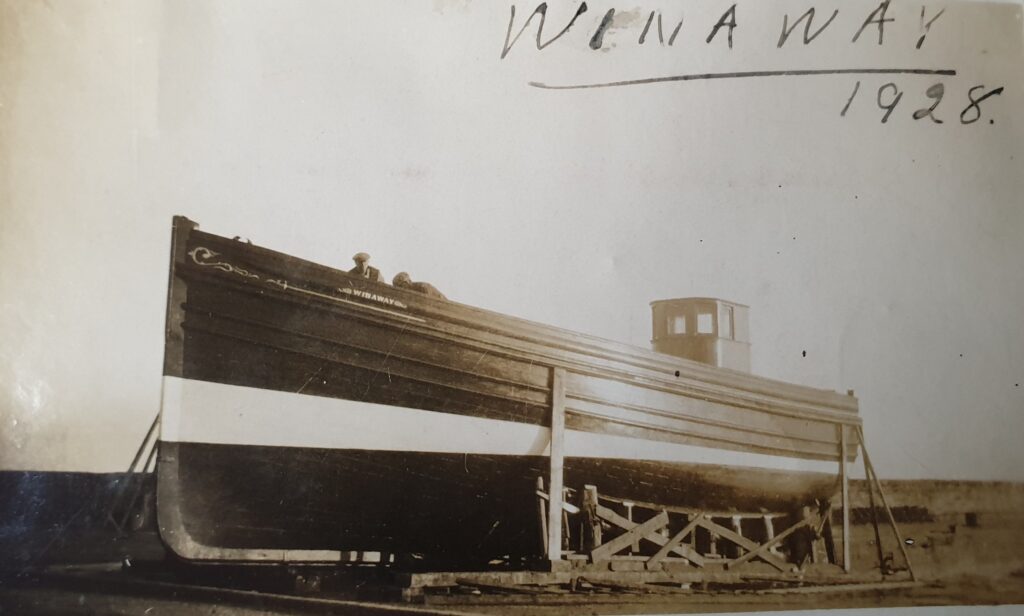
Winaway KY 279, being built at the East Shore Anstruther, By Alexander Aitken’s yard in 1928

PRESENTATION TO CELLARDYKE MAN. An interesting ceremony took place in the recreation room of the General Motor Carrying Co., when Mr Alex. Hodge, Cellardyke, a member of the staff, was presented with a clock on the occasion of his marriage to Miss Margaret Meldrum, Crail. The presentation was made by the manager, Mr Thomas Gardner, and .Mr Hodge suitably replied.

GIFT TO CELLARDYKE CHOIR MEMBERS. On the occasion of their marriage Mr James Donaldson and Miss Agnes Boyter, two members of Cellardyke Parish Church Choir, were presented with a silver tea service by the choir.

Dundee Minister’s Farewell.

 To-Morrow Rev. David Dick bids adieu to Clepington Parish Church Dundee, to-morrow, where he has been for nearly nine years. He leaves for Torthorwald Church, Dumfriesshire, next week. He has been honoured by various organisations in the church during the course of the week.  A native  of Cellardyke, Fife, Mr Dick was at one time assistant in Clepington Church, went in 1924 to temporary work at Constantinople, later was assistant in Dunblane Cathedral, and from there was recalled minister in charge Clepington.

1936

The fishing ports on the East Fife coast are enjoying a boom in boatbuilding. The Royal Sovereign is in course of erection in Cellardyke Harbour to the order of Provost Carstairs, of Anstruther.

1937

GOD’S LAWS “DRAGGED THROUGH DUST”

Speaker and Sabbath Observance

Christian Endeavour’s Council of Youth Meeting

The intrusion of the Sabbath on the pretext that it was meeting the demands of progress and education was commented on a speaker at the Council Youth meeting of the annual Convention of the Scottish Christian Endeavour Union Y.M.C.A., Dundee, to-day.

There was large attendance of young people.

Rev. James Hall, the new president occupied the chair. Welcoming the young people Mr Hall said in school days they were taught the three R’s —reading, writing arithmetic, and to-day the addresses various speakers on ” Jesus Christ, Lord ” were dealing with reading, recreation, and relationship.

 Miss Jean Bett, Cellardyke, who dealt with reading said it was one of the greatest factors of character building, so they should not read just anything that they came across at any time. There were conditions to-day which they called improvement simply because they were not what they were in the last generation. For instance they had seen God’s laws dragged through the dust. The Sabbath had become a day on which anything could be done. …………………….

The celebrations at Anstruther and Cellardyke began with a joint church service in Chalmers Memorial Church, in the afternoon, local ministers officiating.

A fancy-dress parade is to be held tonight, and at 9.30 p.m. a bonfire at the East End, Cellardyke, will be lit by Miss Louisia Murray, White House. A fireworks display on the east pier and a dance in Anstruther Town Hall will follow. To-morrow a free entertainment will be given to school children and old age pensioners in the Regal Cinema.

1938

BOATBUILDING BOOM—Boatbuilding yards in East Neuk of Fife, at Anstruther and  St Monance, are busy with new construction for the summer season. A new motor vessel, 50 feet long, of the cabin cruiser type, is being built at Cellardyke. (Unfortunately this was no boom this was the last vessel ever to be built at Cellardyke)

1939

The death took place at his residence, Navarre. Crail Road, Anstruther, on Tuesday of Captain Thomas Scott Laverock. Captain Laverock, who had been in failing, health for some years, was a native of Buckhaven. He was engaged on steamships of various lines. Leaving the sea about 40 years ago, he became a partner in the firm of John Martin & Co., manufacturers, Cellardyke, retiring from business in 1922. It his 76th year he was well known in the burgh. He was session clerk of Chalmers Memorial Church for many years. He was also a former member of Anstruther Union Harbour Commission and of the old Kilrenny Parish Council. Captain Laverock is survived by his wife and two daughters. The elder is married to Mr M. Norwell Ireland, Inspector of the National Bank, and the younger is the wife of Mr M. M. Dow, of Hood & Walker, ironmongers, Cupar.

1941

“Equipment” for Ministers Whether minister’s books in his manse ranked for war damage insurance purposes as private chattels or as professional equipment was asked by Rev. J. R. Lee, Cellardyke. at a meeting of St Andrews Presbytery yesterday. Mr Lee said special provision was made for the equipment of doctors, dentists, solicitors and other professional men. A minister’s equipment had to include more than a Bible. It was pointed out the rate of premium was higher for professional equipment than for private chattels.

1942

At Pittenweem W.R.I. Miss Jeanie Galloway gave a resume of the federation meeting at Cupar.

A demonstration on the renovation of felt hats was given by Mrs Dick, Cellardyke.

A musical competition with a romantic setting and composed by Councillor Miss Hutchon, accompanied to music by Mrs Keay, was won by Mrs A. Duncan and Miss M. Hughes, equal. Mrs Keay was soloist, and accompanist was Mrs J. Wilson. Tea hostesses were Mrs Tod, Mrs Boyter. Mrs D. Chapman, Mrs Hughes (Reid), and Miss Pettigrew. Councillor Miss Hutchon presided, and Miss Juliet Galloway proposed thanks.

Pupils Want Hairtrim Holiday

Fife Headmaster’s Complaint

 A letter from Mr David R. Nairn, headmaster, Cellardyke School, which came before the Anstruther School Management Committee, complained girls of 12 in East Fife were asking time off school to keep appointments with the hairdresser. The mother of girl had come to school and used abusive language to himself and the girl’s teacher because had refused her permission to go to the hairdresser. It was becoming quite a practice. War-time restrictions were creating a spirit of restlessness, and some parents were taking advantage of the conditions.

A letter from the clerk of the committee had had a salutary effect on the mother this case.

Attendance officer reported a girl of five had only 35 per cent, attendance. When the child’s father was at home she attended regularly, but as soon as he went back her attendances dropped off. It was a case of a feckless mother who liked to keep her child beside her .

 A member was delegated to visit the home.

1943

WELSH COAST DISASTER SURVIVOR. — Sergeant Maurice Jetten , 23-year-old son of Mr Albert Jetten  H M . Customs, 13 George Street, Cellardyke , is one of the two survivors of the disaster to two barges off the Welsh coast , when 81 Naval ratings and Marines lost their lives . Sergeant Jetten , who is in hospital , was eight hours in the water before he managed to clamber over rocks to the shore.

1944

Cellardyke, Crail, Elie, Pittenweem and St Monance schools will be utilised this year for camps for scholars coming from Glasgow area for potato harvesting. Arriving on September 2 they will remain for two weeks.

1945

 A 15 year old Cellardyke boy, who pleaded guilty to a fairly serious offence and had previously appeared in court, was sent to Dysart Remand Home for examination by an psychologist.

1946

THREE FIRSTS FOR ART COLLEGE Three of the five first prizes in the competitions of the Royal Incorporation of Architects in Scotland, judged in Aberdeen, were won students of the School of Architecture in Dundee of Art. They are:-

Incorporation Prize (£l5) John T. Burton. 4 Elm Street. Dundee; Lorimer Prize (£lo)—William L. Stuart, 11 Gannochyedge. Perth; ” Quarterly Essay Prize (£l5) —William T. Jack, East Shore, Cellardyke.

William J. Clarke, 22 Blinshall Street, Dundee, was awarded a certificate of honourable mention in the competition for the Lorimer Prize.

The subject for the Incorporation Prize “An Undenominational Monastery.” The Lorimer Prize is awarded for the best sketches from ancient or modern buildings. The title of Mr Jack’s essay was “The Fishing Villages o£ Fife”

1949

VESSELS For Sale

FAST motor boat, 20 ft. x 6 ft., splendid V 8 engine, double skin; nearest £100. May, 83 George St., Cellardyke. Fife.

FOR immed. sale, ex m.b. Winaway (KY 279), marine semi-Diesel engine, 48 h.” 4-cylinder, complete with reverse gear, pumps, propellers, and shaft. Spares—3 cylinders, 1 piston, 1 propeller, spare cone and drum, 12-volt dynamo; all usable. Parties, from T. Cunningham Sons,

The Cellardyke Echo 29/4/2020

1883

COLINSBURGH CONCERT. –On Friday evening last, in the Schoolroom here, a very enjoyable concert was given by the Anstruther and Cellardyke Glee Club. Part songs, glees, solos, duets, &c., constituted the programme, all of which were given in a creditable manner. The piano was ably presided at by Miss Buist, Elie.

International Fisheries Exhibition. –Twelve Cellardyke fishermen have been selected from whom to choose four representatives to visit the forthcoming Exhibition in London, They are expected to absent a fortnight, and their expenses are to be paid.

1884

The fishing boat Anapira of Cellardyke put into Leith on Friday with  fish for the market, had on board a shark, about 4ft long which had been caught in the Firth of Forth.

A SALVAGE CLAIM.

About the beginning of last month we reported that the KY boat (No. 1453), Cellardyke, had got one of her masts damaged, and that she was towed up the river by the stream tug Storm King. For this a salvage of £2O has been claimed by the Tug Company. This claim, we understand, is to be resisted, on the alleged ground that, in the circumstances, it is quit unwarrantable, as the boat had entered the river, and was in no danger, and that, therefore, the tug was not entitled to anything more than an ordinary pilotage, which would amount to about 15s. Similar heavier claims have been made upon two Ferryden boats, and should this case go into Court it will excite a good deal of interest.

St Andrews

Mr Miller, boat builder, has made a name for himself among the fishing class. The “Fisher’s Friend” launched by him some weeks ago seems to have taken the eye of the fishermen, and a boat belonging to Cellardyke leas been sent to him to be refitted. The craft is afterwards to be engaged at the Shetland fishing. Mr Miller has two small boats on the stocks, and an order has been given fur the building of a large boat.

1885

On Tuesday morning an act of cruel vandalism was discovered at the fine shop being fitted up by Provost Skinner in the west end of Cellardyke —the frame of the plate glass windows being cut and destroyed, seemingly by a hatchet used over night with no sparing hand. In the course of Saturday night some party, actuated by the same cowardly spirit, lifted a superior drill plough, belonging to Mr Cairns of Kilrenny Mill, and threw it over the steep brae or bank at the Golden Strand, where it lay broken to pieces.

Scottish Sea Fisheries Association. A meeting of the Scottish Sea Fisheries Association was held in Aberdeen on Tuesday —Mr Murray, Cellardyke, presiding. It was decided that the constitution the Association should be such as to embrace, not only fish curers, but fish merchants, and also fishermen and all others interested in the prosperity and the development of the sea fisheries. ……. A long series of recommendations for the proper conduct of the fish trade was resolved upon These included one to the effect that the dates for commencing the curing of herrings for export should be the 20th May for the Hebrides, 20th June for Shetland, 13th July for Orkney, and 20th July for East Coast of Scotland. Another of the recommendations dealt with the size of baskets and the uniform hour of receiving delivery of herrings—twelve o’clock of the date of catch. It was also recommended that herrings shall not be shorter than 8 ½  inches as delivery fish :

1886

CELLARDYKE. BURGH COURT. —A Burgh Court was held on Tuesday—Bailies Martin and Smith on the bench—when the following cases were disposed of :—Breaking School Windows—George Salter, Alexander Hodge Moncrieff, and Thomas Smith, three young lads, were charged with wilfully and mischievously breaking several panes of glass in the Infant School windows by throwing stones, on Thursday the 8th inst. All the boys pled not guilty. Three young lads were brought forward in support of the charge, and all agreed that the accused threw stones and broke the windows The boys had all been playing truant at the time. The Fiscal said it was very painful for the Magistrates to have to sit in judgment on so young boys. Nevertheless property must be protected. The boys had evidently got beyond the jurisdiction of the parents, and he suggested the application of the birch rod, as any other punishment would be no punishment to the children but only to their parents. Bailie Martin, in finding the charge proved, said it appeared to be the opinion of the Cellardyke boys that when any building is uninhabited they were at liberty to break the windows. Considering their youth, and seeing they did not know much better, they had agreed only to fine them 2s 6d, but if any other boys came up they would be punished in a different way. They would be taken to some prison and whipped. He did not know whether the School Board would make the parents put in the windows or not. They had nothing to do with that. He also warned them against playing the truant, for if they had been at school the offence would not have been committed.

Assault and Breach of the Peace —Alexander Pattie, carter, was charged with assaulting Thomas Peattie, baker, by striking him a severe blow on the face with his clenched fist, on Tuesday the 16th March. He was also charged with committing a breach of the peace at same time and place. There were five previous convictions against accused, who pled guilty to assault, but denied the breach of the peace. This plea was accepted by the Fiscal, who said it was very distressing to see so young a man with such a record of crime. He hoped he would take warning, or he would get beyond the jurisdiction of the Magistrates altogether. Pattie was fined 25s, or a month’s imprisonment.

1887

Fife Fishing Boats for the Lewis.

ln the chequered prospects of the Forth it will excite little surprise that two Cellardyke and four Pittenweem boats are about to proceed to the Lewis. ’At one time this fishing was in no little repute on the Fife Coast, but this is the first attempt to revive It for many years. A start is to be made early in the week, but far as we hear no engagement will be entered into till at Stornoway or Barra. Moray Firth friends, however, have been busy writing to the effect that not a few boats are engaged there at 15s for May and 20s for June—i.e., per cran with £2O of bounty. With so little encouragement none of the Fife boats have returned to the Irish seas or to the white fishing at Shetland, but several continue to rendezvous with more or less success at Shields.

1888

A FISHERMAN AND HIS WIFE FINED FOR ASSAUlT.—Before Provost Martin and Bailie Sharp a Burgh Court on Saturday, Robert Watson, fisherman, and his wife (Betsy Keay), were charged with assaulting Catherine Sutherland wife of Alexander Wood, and also with committing a breach of the peace. The complaint bore that on the 10th instant, in a back court off George Street, Mrs Watson abused Mrs Wood, and seizing hold of her by the head pushed her up against a wall, which injured her. On going into her house Watson met her, and lifting his foot kicked her severely on the legs. Both then created a disturbance by shouting all sorts of names to Wood. A plea of not guilty was tendered, and three witnesses gave evidence which bore out the facts stated in the complaint. Mrs Wood said after the assault two doctors attended her who said that her hench had been very much inflamed by the severe treatment she had undergone. One previous conviction was recorded against Watson for assaulting the same woman in 1885, for which he was then fined 10. 6d. Provost Martin said the fine ought to be 12s 6d on this occasion after having been previously convicted, but the Magistrates had decided to inflict a penalty of 12s 6d in all, of which Watson would pay 10s, and his wife 2s 6d. He hoped they would be more careful in future. The fines were paid.

Three Cellardyke boats sailed last week for Stornoway, via the Caledonian Canal. They have both nets and lines on board, the herring fishing will not begin till the 15th prox. A little squadron is being equipped for the Kinsale fishing, and others are making ready for Howth, &c.

1889

Yesterday the large fishing boat Glenroy, of Cellardyke, arrived at St Andrews Harbour, and reported the loss of one of their crew, named James Boyter, about eight o’clock yesterday morning, twenty-three miles east the May. The unfortunate man had overbalanced himself and fallen overboard, and before the boat, which was going about six miles hour, could brought up to him, he had become exhausted and been drowned.

The Cellardyke Echo 23/4/2020

1875

THE LAST OF A ROMANTIC CAREER IN CELLARDYKE.

As the worshippers were returning from church on Sabbath week “an ancient mariner” breathed his last, whose strange history commands more than passing obituary. The subject of our notice, perhaps the oldest fisherman on the Fife shore, is worthy David Wilson, who has been gathered to his fathers at the patriarchal age of fourscore and three. He was born in the ever memorable year 1792 at Brownhills, the glorious sea shore of St Andrews. His father, a specimen of the Scottish cottar, was foreman, on the farm ; but the ” hairst rig” or the green knows in the landscape, had no charms for the dark-haired herd-boy compared with the flashing main, with the ships coming and going like “things of life and light” and so one evening, when only twelve years of age, he left his father’s roof-tree to begin life as a sailor. His first floating home was the little bluff Kirkcaldy smack, the ” Maggie Lauder,” which in those days was thought big enough to charter London; but though no drudge or dog is kicked about like the cabin boy of coaster, David stuck with hero’s heart to his first love till by lucky chance improved his situation on board an over sea trading brig belonging to Dunbar, While voyaging in this craft he was one stormy day thrown from the top-gallant yard into the sea, where be manfully buffeted for a weary hour and a quarter with the hungry billows before he could be rescued, more dead than alive; but notwithstanding all such stern experience and his mother’s tears, the young rover remained true to old Neptune, and on the first opportunity extended his voyages by joining the gallant old “Advice ” of Dundee in a whaling cruise to Greenland. These were the stirring days of the French war and the press-gang, when the British sailors had often much reason to fear a friend as foe, and so it happened one September day with the crew of the old whaler, who, instead of the wistfully hills of Scotland, saw the dreaded war brig ” Pickle” cruising like a wolf their track. Wilson and his comrades did not need to be told her errand, and, as the only hope of escape, the old ship was instantly trimmed under all sail right before the freshening breeze. As quickly up flew top-gallant and studding sail on the brig, which followed in the chase like a hound the heels of a wild boar, rising gale swelled the broad mainsail of the old hulk till tack and sheet” snapped again, and her huge bones were fairly foam and spray, and yet after all her fleet pursuer proudly ranged alongside. “Round to,” thundered the captain through his speaking trumpet from the quarterdeck ; but David, who was at the helm, only grasped the wheel with a firmer hold, and, with “no surrender” stamped on every feature of his manly face, kept the ship steady to her course, while the seamen, handspike in hand, by way of ruse, drove the honest-hearted St Monance master and the other officers into cabin, to save them from the serious consequence of disobeying orders from king’s ship. Being thus defied, the brig was next steered across the bows of the whaler, to bar her further flight, but on swept the whaler like a maddened bull, straight to assault, and the cruiser’s helm was just put down in time avert collision. “Round to, or I’ll shoot you,” again thundered from the quarterdeck; but even the ship boy, tired with the wild enthusiasm of the moment, waved defiance from the yard-arm. The insulted Captain was furious with rage, and shotted guns were opened upon the fugitive ship. “Whizz, whizz,” flew the deadly shower, but the courageous steersman never flinched from his post. Though one bullet and then another struck the spoke from his hand, he quickly seized another, and kept the gallant old craft bounding before blast till sail and rigging was riddled by cannon shot, and the disabled hulk lay the mercy of the cruisers, who completed the capture point of the cutlass. The intrepid steersman was, of course, was regarded as the head mutineer, and such was treated or rather ill-used by the commander, who appears to have been quite unworthy of the uniform of Nelson or Coddrington. He was ordered under irons till he and his comrades could be tried for mutiny on the high seas, for so the ruse on Captain Adamson of the “Advice” was held to be, so with this terrible purpose the brig was now steered for the Thames. David also incurred the unbridled vindictiveness of the Captain in all its by refusing answer certain questions which would have established the serious crime with which he was charged, and the poor sailor lay day and night with six-feet iron bar across his legs and his hands riveted the ring bolts, but in this woeful plight one day he found a true and unexpected friend. This was one the brig’s crew who sheltered his disgraced head as a London lawyer in the King’s service, and who had just been punished for some misconduct by the Captain, towards whom, consequence, he cherished the bitterest hate. the counsel of this new friend, the simple young mariner pled so well before the court in London, that was held to be innocent of mutiny, but at the same time he was forced to enter the King’s service on board the “Pickle,” though had the satisfaction see his enemy, the Captain cashiered for cruelty and conduct unworthy of a British officer. On board the war-brig David was so distinguished as a brave and expert sailor that he was in a fair way of obtaining promotion through the high opinion of his officers, when he and his boat’s company resolved to desert the ship, which he accordingly did one night at Jersey, where he also joined a packet holding a letter of marque and trading to the Mediterranean. While crossing the Bay of Biscay this vessel was captured by two French privateers, who soon after put into port with their English prisoners. The unfortunate sailors were driven like herd of cattle into an ancient church, where, on a scanty truss of straw, they lay down for the night; but some revengeful hand fired the litter, when the old sanctuary speedily wrapped in flames. Old David lived to tell the scene which followed, when, William Tennant says,

“Pinnacle cam’ doon and tow’r,

And Virgin Maries in a shower

Fell flat and smashed their faces.”

From this burning pile the prisoners were marched by their angry guards to an inland citadel, where they experienced all the horrors of French captivity, till one day the thunder of the British cannon in Wellington’s glorious march to Paris opened the doors of their dungeons to the weary captives. At the peace he returned home his mother, who had taken up home in Pittenweem, where the truehearted Scottish widow, like many a brave sister in adversity, earned honest crust spinning yarn for herring nets. Every Scottish whaler knew the story of his dauntless stand at the helm of the “Advice” but he was gratified hear that his Dundee friends had sent sis jacket, having one pocket a bullet extracted from the wheel, and another a yet weightier gift to his poor parents in Fife; but for a time his unceremonious leave-taking of the King’s service made the East Neuk little else than a hiding place. Eventually, however, his Cellardyke bride induced him to settle there, and take to life as a fisherman, as which he has had his own share of the varied fortunes of that arduous calling; but if his tide has had its own and manifold ebbings and flowings, he ever bravely sustained his part, and now at the end of the last farewell leaves behind him a name which will be long and kindly remembered on the old Fife shore

Vessel Dismasted near the May Island.

On Tuesday afternoon, two fishing boats arrived at Anstruther harbour, having in tow the smack Emu, of and from Falmouth to Arbroath, in ballast, which had lost her foremast early the same morning. The master reports that while about twelve miles to the eastward of the May Island, with a fresh breeze blowing, the vessel struck heavy sea, which caused the forestay to snap, and the mast thereafter broke over a little above the deck. About three hours after the occurrence two fishing boats, belonging to Cellardyke and St Monance respectively, made their appearance, and, as above stated, towed the Emu into the harbour. No agreement was made with the fishermen, and the amount salvage will probably be settled arbitration.

1876

SALE OF FISHING NETS, &c. To be Sold by Public roup at the Harbour. Cellardyke, on SATURDAY, 22d April, at Four o’clock Afternoon.

A Quantity of FISHING NETS &c consisting of 18 Black and 6 White Nets. 3 Small Lines. Pallets, Ropes, Corks, etc., which belonged to the late Robert Stewart. Mr BONTHRON, Auctioneer.

DWELLING HOUSE IN CELLARDYKE TO BE SOLD BY PRIVATE BARGAIN.

ALL and WHOLE. that DWELLING HOUSE of Two Flats, situated opposite the harbour of Cellardyke, and Small Piece of GROUND at the back thereof, and recently occupied by the late Mrs Helen Brown and others. Offers will be received by PHILIP OLIPHANT, Solicitor, Anstruther, till 1st May 1876.

BOATBUILDING YARD AT CELLARDYKE TO BE LET

To be LET, on Lease for Four Years and a half, from Whitsunday first,

THE BOAT-BUILDING PRENIISES, situated near the Harbour of Cellardyke, presently occupied by Mr John A. Millar. The Building, shed, and Fittings, Saw Mill with Engine, and Plant, may be taken at a Valuation

Further information may be obtained from Mr John Philip, Polton East mains Lasswade, or at his office Junction Street Leith, or David Cook Solicitor Anstruther, with either of whom Offers may be lodged on or before the 1st May next, Anstruther 4th April 1876

1877

THE NAMES OF THE NEW STREETS

At a meeting of the Police Commissioners on Tuesday it was agreed that the name of the new street, the first houses of which are in course of erection at the back of Forth Street, should be named Rodger Street, in honour of Captain Rodger, Glasgow. The roadway running east and west at the same place was named School Road.

HONOUR TO A TOWNSMAN. —On Tuesday evening last, the employees of Messrs Cairns, Ainslie. Co., Leith Walk, Edinburgh, assembled in the house of Mr John McKinnell, Lorne Street Tavern, to do honour to Mr Robert Skinner, son of Mr James Skinner, merchant, Cellardyke, on the occasion of his leaving the employment of the above firm, and commencing business for himself.

1878

The Kilrenny Magistrates had three new applications before them, two for small beer licenses, the one by Margaret Doig, spinster, residing in Dove Street, and the other by Mrs Christian Jack, widow in Shore Street, Cellardyke—the third being for a transfer of the public house the Harbourhead, so long and successfully kept by Mr John Marr, to his new tenant, Mr Richard Webster. Provost Watson and Bailie Brown presided. Margaret Doig’s application, being of the nature of transfer from her father, was granted; but Mrs Jack’s was refused, the Provost remarking that such beer shops were only in too many cases harbour for young men, where they learned those drinking habits which only too often adhered to them for life. Mr Webster supported his application by the most flattering testimonials as to character; but Provost Watson said that he remained unaltered in his resolution of last year, and that as then he thought that the eight licensed houses retained in the burgh was quite sufficient, if not more than sufficient, for the population, which, assumed at 2500, was licensed house to every 300 inhabitants. For these reasons, he repeated, he could not be consenting party to the transfer, and Bailie Brown having concurred, the application was rejected.

Skipper Alex. Keay was the first of the Cellardyke fleet to arrive, and his cargo, consisting of about 28 stone of halibut, 41 ling, 156 cod, 18 big skate, and a few small skate and codlings, realised £41, which was the highest sum obtained this week.

1879

One Cellardyke crew has proceeded to Kinsale, and a number of others are to embark in the herring fishing at Lewis. Mr John Harrow, the representative of Messrs Holmes & Son, Berwick, this week engaged five Cellardyke boats to fish at Stornoway from the 19th of next month until the end of June. The terms, we hear, are £10 of bounty and £1 of arles, with 17s per cran for 50 crans landed in May, and 21s per cran for 100 crans in June, it being in the power of the merchants to take delivery of a larger quantity in each month at these rates if they choose.

The Cellardyke Echo 23/4/2020

1880

MELANCHOLY OCCURRENCE TO A CELLARDYKE FISHING BOAT. The Cellardyke deep sea going boat Garland, Adam Watson master, arrived early hour yesterday morning Anstruther, and reported the loss of one of the crew, and the miraculous escape of others, during the gale. The crew were work on their big lines Wednesday when the storm rose upon them that they were forced to leave their gear and flee for shelter to the land. Thus close reefed the Garland was steering towards Aberdeen when she was struck by towering billow, which swept the deck and hurled two the crew overboard. They were both young and powerful men, one Thomas Watson, the son of Thomas Watson, (Martin) was observed but for a minute, and then disappeared for ever in the boiling abyss. His companion was more fortunate, and caught hold of the spar which another of the crew had thrown to his hand; but those in the boat were scarce in a better situation at this terrible moment. The same fatal sea had broken the leg and otherwise seriously injured John Stewart, and thus disabled, or rather helpless, in that furious tempest, nearly an hour elapsed before the crew could succeed in tacking the boat to save their all but exhausted comrade clinging to the spar with the last grasp of despair. The long interval between the casualty and the arrival of the boat also tells its own tale of the fury of the gale, as every effort had been made to afford help at the earliest moment to the injured men. A touching incident then occurred as the young widow, as usual with the mothers and wives of our fishermen on the occasion storm, was waiting on the pier to welcome one, alas she was never to meet again. Thomas Watson, than whom a more gallant and true-hearted fisherman was not on the Scottish shore, he was about twenty-seven years of age, and has left a widow and one orphan child. A strange fatality would seem to hang over the Fife coast, as this is the fifth fisherman Cellardyke drowned since the opening of the present year. Disasters were long and lamentably common by the swamping of the boats in a heavy sea. But this danger thing of the past since the introduction of a deck on deep sea craft; but as they are not provided with bulwarks rails, this very source of safety to the boats is new peril the crew, who have thus scarcely more protection than if standing on a naked ledge of rock washed by every wave. Taught, however, by such terrible experiences of the necessity of a rail guard, the fishermen of the coast are now adopting the expectant of fitting iron stanchions to the gunwale, to attach chains ropes for this purpose during storm.

No fewer than six crews are at present fitting out from Cellardyke for the herring Drave at the Western Isles. With so little to encourage them while working the big hook at home, no one can wonder at the remarkable exodus which in early summer, as in late autumn, is scattering our Fifeshire boats all over the coast of the empire. The little squadron in question is to sail as soon as the gear been put in order and stowed under hatches. They steer through the Canal to the Clyde and theme to the Lewis, where a new and rather curious feature has been introduced into the fishing engagements of the season. It helps, however, to check the risk or “gambling element,” which enters only too largely into Scottish fish curing. There are manifold cases where £5O and more of bounty money has been paid to a crew who have not fished five crans of herrings, but to guard against any such anomaly in future our Fife crews are engaged on the now recognised rule by which the engaged bounty in full is only paid after the usual compliment of two hundred cram. Thus less herrings means less bounty, till in the event of such a possibility as the catch being limited to ten crans the crew would receive like number of pounds and no more by way of premium or bounty. The current price is 20s a cran, and the recent discovery of herrings in the open sea holds out, it is said, the most tempting prospect of an early and successful at the Hebrides.

We continue to hear good reports from the Shetland Isles. No one requires to be told of the unexampled wealth of the northern seas, but the improved system of fishing Introduced by the Cellardyke crews is being attended with splendid success. Their hauls are all the talk In Lerwick; nor is their toil in vain, as with the harvest at the very door, they receive fully 6s the hundredweight for cod and ling, which, however, are denuded of their head and entrails before delivery to the merchants. Halibut is also finding its way to the fresh market, and the state and prospects of the Fife crews are said to be all that their best friends can wish.

1881

The East of Fife and the National Fishery Exhibition in Norwich.—The telegram announcing that the jurors, after three days’ deliberation, had awarded the premium of for the best steam fisher to our townsman, Councillor Wm. Jarvis, was received with little satisfaction by his neighbours and friends. The Forth was a trice decorated with bunting, and the feeling of the hour was almost akin to a local jubilee. The prize has been awarded for the model of craft of about fifty tons, with elliptic stern and lines like a yacht, fitted with steam propeller so as to obtain a speed of about thirteen knots an hour. The Councillor also obtained a silver medal for the model of fishing boat of the ordinary scale and construction, but with an auxiliary screw; and the same honour has been assigned to another townsman. Mr Alexander Cunningham, for a miniature of the handsome boat he is now building for St Andrews owners Cellardyke shore. It is likewise fitted up with the working model of an engine, and is otherwise complete in all the appurtenances and fittings of a deep sea fisher. It interesting note that all these models are rigged with fore and aft sails, which is likely, in a very short time, to supersede the luggers of to-day. The other local exhibits are the model a steam fishing smack by Councillor Millar, West Anstruther, and that of Fifeshire herring boat Mr Alex. Thomson. The locality is likewise honourably represented Messrs Martin, Cellardyke, who obtained a diploma for their fisher apparel, and Messrs Sharpe and Murray, who secured a bronze medal for their oilskins and another for their cured herrings.

As steam trawlers are being gradually introduced on the coast, steam fishing-boats most in short time called into requisition on the Scotch coast. Mr. Jarvis’ model steamer will meet the requirements at drifting, long-line, and, if need be, trawling, for though the latter branch of fishing industry is not liked by Scotch fishermen still the time appears to have come when they will have to adopt it. It will be satisfactory to our Scotch friends to know that the jurors of fishing-boat models took into conference with them Mr. Murray of Cellardyke, a gentleman well conversant with the requirements of the Scotch coast.

1882

BODY FOUND. —The body of the young Cellardyke fisherman. Alex. Gardiner, who perished at his father’s side in the offing on the 10th Feb., or about ten weeks ago, was found in the trawl net of the St Monance boat ” Branch,” Thom Watt, master, on Friday morning. The interment took place in Kilrenny Churchyard on the following day, when a very large company of friends and neighbours joined in the last mournful rites over this lamented young fisherman

AN EVENTFUL LIFE STORY.—Softly, as when an infant sinks to rest on its mother’s bosom, the father, Mr John Doig, of Cellardyke, passed away on Friday morning, having all but completed his eighty-fifth year. The fisher towns of Fife have many an adopted child, but our patriarch came of a stock who have worked net and line in the old home for at least six generations. But let us pause over his interesting story—the living register, so to speak, of the events and changes in the little world around us. He was the contemporary of no fewer than six parochial ministers, having been born in the last years of the fiery but eloquent William Beat, when the population of the whole parish was scarcely one thousand, or about a third of the inhabitants to-day of Cellardyke. His schoolmaster was poor Peter Davidson, who, when dismissed as dominie of Kilrenny, taught in a dingy cellar, crowded to the door with rosy urchins, whom he kept in order by the unsparing use of the lash, which, indeed, was considered at this time in all the schools of the coast as ” the only secret of good government,” as Dr Chalmers and Professor Tennant knew to their cost. Peter sank so low that he could not afford a watch, but he fell on a strange device to measure the heave-out of his pupils. Fastening a button by a piece of cord to a nail, and setting it a-twirling as the door shuts, woe betide the hapless youth if it ceased to do so before his return. Like his father, John grew up for the sea, his first adventure being to Wick in the herring boat “Janet,” just six and twenty feet long. They had fifteen nets in all, but they fished two hundred barrels, at 8s a cran—” a capital drave’ in those days, as the old veteran liked to tell when speaking of the splendid harvests of recent years. In the course of time he sailed his own boats—the “Thistle,” for instance, spoken of in her day though but four and thirty feet long ; and the ” Providence,” built in 1838, when she was as much talked of at the bulwark as the three and fifty feet clippers of the present hour. Thus manifold have been the changes that have taken place in the equipment of the sea, but we are not sure if the coast is represented to-day by a better or braver race than the old fathers, as when the two Cellardyke boats weathered the admiral ship to windward of the Bell Rock—that admiral being our sailor King, William the Fourth, who told Sir James Black years after how cleverly he had been beaten by the Scotch cockleshells, be compared them to the floating castle under his command. Our old friend was one of the most quiet and sedate of men, but it was with him, as with the ancient Highlanders In war, “lambs in the camp, but lions in the field,” for we have heard it from childhood that a more resolute and fearless hand never held a tiller when the black squall was wildest on land and sea. He also knew as few had done the perils of the storm. He was one of the survivors of the ill-fated “Flora,” which was capsized in the offing off Balcomie Castle In 1819 as detailed in the History of Cellardyke.” He had, however, a still more miraculous escape on the 15th December 1858. It was on the occasion of a fearful storm, when additional moorings were needed for the fishing fleet in Anstruther harbour So he was engaged with the pilot boat when, the current running stronger than in a mill stream, carried him amongst the breakers, roaring like a whirlpool beyond the piers. The first sea filled the boat to the gunwale, and there, at the mercy of the great crested breakers, he was left to struggle without a single oar or Implement of rescue. A wild cry rose on the shore, “Can nothing be done to save him?” shrieked a crowd of wives and mothers, but the bravest could only shake his head and turn away in despair. Not so the intrepid fisherman, who was face to face with it all. “I felt God to be very near me. and that I would be saved,” he has told us, and buoyed up with this unconquerable hope, he struggled on, striving with all his might, though only with a bit of plank, to keep the boat before the waves as they one by one rolled high overhead. So the wrestle went on, but he seemed only to escape one danger to encounter another, especially when he approached the beetling rock, to leeward. No one thought, however, of a landing, no often did he disappear in the towering surf; but at last the boat, as if shot along by a giant arm, was thrown upon the strand. The wave, black as the grave, rolled back as if to return with redoubled strength to claim its victim, but in that Instant a dauntless band of young fishermen, sprang forward, and with the crash of the tempest drowned for the moment in the deafening cheer that rose by one impulse from the assembled hundreds, pulled the boat and our hero beyond the reach of the breakers. Such are some of the reminiscences of the interesting veteran who has just gone from his place, as when some ancient tree falls by the wayside. His venerable spouse led the way some years ago to the narrow house; but to the last he was soothed and comforted by the children and grandchildren, whom he has, been privileged to see grow up to honour and usefulness around him.

The Cellardyke Echo 8/4/2020

1870

Anstruther – Two sharks were brought ashore here by a Cellardyke boat late on Saturday night last. One of these was a very small one, not measuring more than 40 inches in length. The other, however, was a large monster of about 14 or 16 feet in length from snout to point of tail, while its girth was fully three yards. It had four rows of sharp pointed teeth in the upper jaw. It was captured by the boat belonging to William Watson (Smith). Its body had got somewhat entangled among their great-lines far out at sea. On the boat making up to the spot a work of some difficulty began as to its capture. Some coils of tackling were got round its body, when it was hoisted on board and brought ashore in a live state. It was sold by auction on Monday morning, and bought by Provost Todd for 35s. More than two barrels of liver were taken out of this monster. The remains were then handed over to a cadger, who, after filling up the vacuum caused by the extraction of the liver with straw, and sewing up the seam, took it away to exhibit in some of the inland towns. Another shark was landed yesterday morning, but of less size than the above, the length being only about six feet, and the girth three feet.

A few days later in another paper

Last week we reported the capture of a shark 14 feet long by Cellardyke crew, and of its subsequent sale for public exhibition. The adventure has turned out quite success; for, having been taken to Cupar, it was visited in the course of Wednesday and Tuesday by about 1200 persons, young and old. On the following morning it was trucked to Edinburgh, where it attracted the attention of the first savans of the city. Through the kindness of one of these the exhibitors were furnished with a certificate giving the technical name of the fish, which is known to naturalists the Greenland shark, or sagmuus borealis, and stating further that it was one of the largest ever landed on these shores. After being exhibited in the High Street on Friday and Saturday, where it was visited by upwards of 2000 persons, it was purchased on the latter evening at the price of 30s, at the instance of Professor Archer, for the Industrial Museum.

1871

Apprehension of a Lunatic.—On Thursday last, James Small, a well-known individual of weak intellect, belonging to Cellardyke, was taken into custody for his violent and threatening conduct towards Mrs Margaret Myles, and the other tenants in the house in which also resided by himself. He was about sixty years of age, and through life had been treated with great forbearance in consequence of his unhappy mental condition, and latterly the authorities the parish of Kilrenny were disposed to be more indulgent, from the already high rate of the Parochial assessment ; but “Bidley,” as Small was familiarly designated, having recently become very fatuous and dangerous, it was felt be public duty place him in secure confinement; and the necessary medical certificate having been obtained, he was removed charge of one of the attendants to the County Lunatic Asylum at Springfield on Saturday.

1872

The Oldest Couple the East Neuk.—The parish Kilrenny, so far we are aware, can boast the oldest couple in the district—the venerable pair being Mr William Baldie, in his eighty-third year, and his yet more aged spouse, now in her ninety-first year, and who have lived in wedlock for the long period of sixty-two years. Time’s ploughshare has cut many furrow deep on our patriarch’s hoary cheek, and the snows of these long winters lie thickly on his manly brow, but nevertheless his broad shoulders bear up bravely under the burthen of years, and every sunny day sees him busy in the large market garden feued in 1766 by Saunders Gardiner from the heiress, Ann Bethune, of Balfour and Kilrenny, but of which old William has been for many years the tacksman. Mrs Baldie, however, though still retaining the use her faculties to a wonderful degree, has latterly been unable to leave her bed. It is at once interesting and curious to look back upon the remarkable changes that have occurred in the long lifetime of this worthy couple. As the girl Helen Small, and in her native place of St Monance, Mrs Baldie could well remember the time when the big granary-like house between the Coal Wynd and the sea was the consecrated Burgher Kirk,’ whither every Sunday crowds of pious worshippers repaired, though the children the town thought or cared for no one else but the little uncouth-looking boy crutches, that came all the way from Anst’er with his ” doose” father and brothers, that all knew so well as “cruiket legs,” though in afterlife as the learned professor and eminent poet William Tennant. The fields on the East of St Monance now only echo the ploughman’s song,  but her young eyes saw them clad with the gigantic trivances for working and shipping the Pittenweem coal-field. “You have opened the largest works in Scotland” said a visitor one day to Sir John Anstruther “Maybe but it’s a black bargain for three of the bonniest lairdships on the Forth” barked the grin and sullen Sir John. But how could the magnificent end otherwise than in ruin? “Our ‘ overseers will do nothing but drink or sleep,” complained the able English mining Engineer at the head of the works. “Do the best you can; they are councillors, if I discharge them I lose their votes;” and so to keep up the old Tory influence of the Anstruther Family, one of the finest coal mines in the county had to be abandoned – crushed to death by the political jobbery and corruption of the times.  The recollections of the aged husband are equally romantic. He was the son an Anst’er shoemaker, who perished in a peculiarly affecting manner at Cellardyke harbour. It was during a herring fishing, and on attempting to reach the shore the boat struck the rocks and all on board with the exception of one were drowned almost at their own doors; but the Anst’er shoemaker’s fate was the saddest of the crew. Some gallant bystanders rushed through the breakers and dragged him near the beach that his feet struck the ground, “Leave now and save the rest,” he cried, but he had scarcely been left alone when a huge billow burst upon him, sudden and remorseless a hungry beast springing its prey, and was crushed to death or drowned on the very brink the sea. The fatherless lad had early shift for himself, and so one day while a mere child, he travelled the hill to herd cows at Kingsmuir—not the pleasant green upland of the present day, but a wild muir covered with whins and black heather. So miserable, in fact, was the estate about seventy years ago, that William’s master, honest Geordie Baynes had about hundred acres which scarcely yielded subsistence for two cows, and for whic he only paid a rental of 5s and one fat hen a year; but Fife agriculture boasts in prouder triumph than the improvement of Kingsmuir, which is now yielding its gallant proprietor an annual rent roll of fully £1000. But notwithstanding the manifold blasts that assailed him the boy grew up into the strong and self-reliant man and he at last settled down in charge of the small farm on the Priory lands of Pittenweem, which rejoiced in the name of Waterless from the wells springs having been cast off by the drainage of the coal mines. Here he remained for the long period of his thirty years during which his face became as familiar as his little cottage by the roadside, so famous in its day for “jolly collier sprees,” having, in fact, been built for a public-house when the mines were opened in 1768. The old house, however, has been swept away, but the venerable couple still survive cheerful and contented after their long and chequered pilgrimage, for gladness and sadness must strangely mingle where births and deaths have often fallen like light and shadow under the rooftree; but all, we are sure, that hope that they continue to be spared, “so that hand in hand ” they may solace and comfort one another as they travel down the hill of life.

1873

On Thursday evening the boat of Skipper George Fowler of Cellardyke arrived from the deep sea with a take of about fourteen cran of herrings, which was bought by Mr Hall for 53s a cran, but a considerable quantity were immediately after resold for bait at the rate of £4 a cran, which may be called ” turning the penny.”

1874

The Steamer “Forth”

NO offers for this steamer which was some time ago advertised for sale, have yet been received, and it is likely that a special meeting of the shareholders will be held soon to consider what is to be done. It was considered that if the Forth could have been sold, a handy screw steamer might have been got sufficient for the goods traffic, and thus the passage would have continued for the benefit of traders ; but some other suggestion will have to be made if an offer is not soon received for the Forth. Some repairs which were found necessary last week prevented the sailing of the steamer after Monday, and by the end of the week some of the provision merchants had run short of stock, so much so that it is said there was scarcely, a pound of butter to be obtained in Cellardyke on Saturday evening. The largest cargo of spirits for a considerable time was landed on Monday, so that the efforts of the Good Templars do not appear to have much effect on the consumption of the ‘barley bree.’

UNRULY FISHERMEN

A  Burgh Court was held here on Friday last—Bailies Darsie and Bonthron on the bench. Alexander Robertson, fisherman, Cellardyke, and Lockhart Horsburgh and Alexander Gay, fishermen, Pittenweem, were charged with having committed a breach of the peace in Shore Street in the afternoon of Wednesday the 26th ultimo. The two latter pleaded guilty, but Robertson tendered a plea of not guilty. Horsburgh and Gay were fined 5s each, and the case against Robertson went to proof. Lockhart Horsburgh deponing that on the day in question Robertson followed him and Gay. There was a squabble opposite Mrs Forrester’s, another opposite Mrs Addy’s, and another further east. Robertson followed them all the way from Mrs Addy’s, and they could not get clear of him. He wanted to strike them. In cross-examination, witness said he was singing a song in the public house, and Robertson wanted to strike him because he thought he was making a fool of him. He took him by the cuff of the neck, and pulled the buttons of his jacket. He thought Robertson struck him in Mrs Forrester’s but he did not remember much about it. Robertson said the witness used some kind of language—he thought it was Italian. Witness further said Robertson followed them seeking a glass of whisky, and they took pity upon him and gave him one. Alexander Gay corroborated the previous witness, and said Robertson struck Horsburgh on the street. Robertson begged for a glass of whisky, and they took him into Mrs Forrester’s, and gave him one. Witness denied that Horsburgh struck the panel. David Pringle said he saw the panel and the two previous witnesses fighting on the street. They came out of the public-house and went up to Robertson, who took off his jacket. David Brown said he did not see any fighting, but words were passing between Robertson and the two others. Robertson was found guilty, and sentenced to pay a fine of 10s

The Cellardyke Echo 25/3/2020

1896

On Saturday while some boys were amusing themselves, one of their number named George Anderson, son of George Anderson, fisherman, John Street, Cellardyke, fell off a rock into the sea the same time breaking his leg. Dr Wilson was called in and set the injured limb. The boy is now progressing satisfactorily.

Addition to the Fishing Fleet

 Last week there was launched from Mr Millar’s building yard in St Monans a large fishing boat built the order Messrs Corstorphine & Co., Cellardyke. The boat, which was named the Unity as she left the slip, is 62 feet in length, and fitted with all the latest appliances, including steam for hauling the gear.

THE LATE MR CORMACK, CELLARDYKE. A sad feeling of gloom was experienced in the district on Tuesday morning when it became known that Mr Cormack, Cellardyke, had died somewhat suddenly overnight. The rumour was scarcely credited at first as it was known that Mr Cormack had been seen attending to his business as usual the previous forenoon, when he was in Anstruther. Unfortunately, the news was too true, and the expressions of regret heard on all sides were universal. It seems Mr Cormack had not been feeling very well for some time back, but in accordance with his quiet and reserved nature, he did not complain. On Monday afternoon, however, he had a bad attack, and Dr Ferguson, his medical attendant, was called in, when it was found that along with heart disease he was also suffering from congestion of the lungs. Everything possible was done, and towards eleven o’clock in the evening he rallied so much that it was considered lie had got the turn. Before midnight, however, another attack ensued, and he succumbed to it at ten minutes past twelve in the morning. By his death, the presence of a well-known, highly respected, and familiar figure has been removed. Mr Cormack was a native of Eyemouth where he initiated into the fishcuring trade by his father. He came to the East of Fife in the end of 1849, and immediately set up an establishment at the east end of Cellardyke, with a branch at St Mornas, which latter he carried on for twenty years or more. Being possessed of considerable energy and push, and with excellent business qualifications, he soon developed his business not only in regard to the curing of fish, but also in the other branches of the trade. He started a sawmill in which he did a good business for a long number of years, and afterwards he was the first to introduce machinery in the making of barrels. By its means he turned out enormous quantities of fish barrels and boxes every year, and his business in this connection very extensive all over Scotland and England. But it was in the buying of fish on Anstruther piers that he was facile princeps, and his loss in this respect will be greatly felt for many a day to come. For a long number of years he has been regarded as the heaviest and best chaser of fish in the district, and the fishermen assured themselves of a good market when Mr Cormack was at hand. He was a general favourite among the fishermen and his brother fishbuyers, his quiet but genial temperament along with his business integrity and honourable dealings gaining for him the respect and regard of all with whom he was brought in contact, and among whom there is keen regret at his death. The heavy and incessant claims of his business did not deter Mr Cormack from finding time to take his share of public work. He served several terms on the Town Council, and also on the School Board, in which his common sense and practical experience stood him in good stead and were of considerable advantage to the interests of the community. In politics, Mr Cormack was a lifelong staunch Liberal, although he did not take any prominent part in party politics. He was a great admirer of Mr Gladstone, and gave always hearty support to the interests of the Liberal party. He was a dissenter in religion, and has been connected with Anstruther U.P. Church since its start in 1855. He was a member of the Relief Church before that. Mr Cormack was twice married, and is survived by his second wife and large family, the whole of them grown up, one of the sons being connected in business with him for some time lately. He was 72 years of age, having been born in 1824. The funeral takes place this afternoon to Kilrenny Churchyard at 1.30, and it is expected to be largely attended.

1897

23rd

The fisherman employed in the steam liners at Anstruther came out on strike yesterday. The point at issue between the fishermen and the directors of the companies is about the bait. The fishermen claim that when they catch their own bait they should be paid 50s per week for each vessel. The skippers are agreed to sail the vessels until the end of June without the these terms, and with only the privilege of selling whatever surplus bait they have over. On Saturday all the fishermen signed a paper which was submitted to the several directors of the different companies, and the skippers had a meeting with the directors. The demands of the men were refused. A mass meeting of the fishermen was held in Cellardyke Town Hail. The proceedings were private, but the decision unanimously arrived at was that, the gear be lifted out of the liners until the directors gave in to their terms or made an offer. The strike affects about a dozen steam liners.

26th

The Fishermen’s Strike. —At a mass meeting yesterday afternoon in Cellardyke Town Hall, the Anstruther steam line fishermen refused to accept the terms the directors. These were to offer the fishermen 20s for each baiting during the eight months they catch their own bait, relieve them of any share paying the engineers’ and firemens’ wages all the year round, and to divide the money derived from the surplus bait equally between the fishermen and shareholders. The fishermen demand instead per baiting and the surplus bait, or 40 per baiting and the surplus bait to be divided equally.

1898

PROPERTIES IN CELLARDYKE FOR SALE BY PRIVATE BARGAIN. To be sold by Private Bargain, the following PROPERTIES in CELLARDYKE belonging to MISS CRAWFORD, Seafield, West Anstruther, and others :-

1. SHOP presently unoccupied, DWELLING HOUSE of Two Storeys, presently occupied by Messrs Wood, Sutherland and Hodge, situated in George Street, Cellardyke. The Premises are Commodious, and the Shop is suitable for a Grocer, Baker, or other similar business. There is ample cellarage at the back.

11. DWELLING HOUSE in John Street, occupied by Robert Thomson and another. Full particulars can be obtained from H. B. Macintosh, Solicitors, Anstruther, Offers may be lodged on or before THUR DA Y, 31st March 1898.

1899

A QUANTITY of FISHING GEAR, belonging to MICHAEL Doig, juor., consisting of Nets, Bows, Messenger Rope, Great Lines, &c., will be Sold by Rublic Roup on Saturday, 8th April, at 38 West Forth Street, Cellardyke.

Report on repairs to Cellardyke Harbour. On the 9th and 17th February, I examined the above harbour and shore protection walls at public green, with a view to strengthening and rebuilding same so as to ensure no further en croachment by the sea. The damage during the recent storm has been such, that a sum of at least £1200 over and above the £400 already subscribed, would be required to rebuild the harbour and restore it to its former condition in a thoroughly substantial manner.

1/4/2020

1840

CELLARDYKE

ALARM FROM FIRE. – On last Saturday night, the inmates of a house here were alarmed by part of the woodwork being on fire. It became ignited from the heat of the furnace of a boiler in an adjoining house making the stones of the partition red hot. There is no doubt it would have soon communicated with the garret had it not been discovered in time, and the requisite means used for its prompt extinction.

1842

Cellardyke. Melancholy Event. On Tuesday, a fishing-boat, belonging to Cellardyke, with a crew of eight men, was upset a few miles to the eastward of the Isle of May. Only one of their number was picked up, the other seven met watery grave. What renders the occurrence the more distressing is the circumstance that most of the sufferers have left widows and large families to lament their loss.

(The Boat was the Lord Melbourne and the Skipper Henry Reid)

1848

ST MONANCE.

THE WEATHER AND THE FISHING.—The weather has been good the whole of the week, but the success of the fishermen has been very unequal. Those at the haddock fishing have caught little. Several of our crews, however, who have tried the nets for herring. got bait, and caught cod ; one crew succeeded pretty well on Saturday, having caught ten crans of herrings at the May Island, which they sold to the Cellardyke fishermen for bait, and with it they proceeded far east into the German Ocean, and fished for halibut, cod, skate etc, Another of our crews caught five crans on Saturday morning. The former crew sold to the Cellardyke at 45s. per cran.

(that is a huge amount of money for a cran of herring, especially for bait, the white fish prices must have been very good)

1851

Sequestrations

James Wallace, Sailor, lately residing Cellardyke, present prisoner at Cupar, to be examined in the courthouse, Cupar 2nd May at 10 o’ clock.

1854

Commercial Movements. Rumours of war may produce temporary suspension of business in the great legislative assembly of the nation, but no such effects appear visible in the commercial movements on this coast, remotely situated apart from the theatre of hostility. According to the gossip of last week, the crew of strange boat having picked up salmon nets on the high seas, carried it into the port of Cellardyke, and disposed of the capture, after which they are reported to have entered vigorously on the transaction of business with an old acquaintance, named John Barleycorn; and so intimate did they become with the treacherous old villain, and so ardent in their brilliant gratulations, that one of the nautics in a vehement gust of affection, tumbled down in a state of utter insensibility, the one spirit having apparently dislodged the other. His comrades then had no alternative remaining, but to shoulder their unconscious companion, and re-embark for the purpose of proceeding across the great stream to their own locality, that their associate might enjoy the resuscitating influence of his native atmosphere.

1856

AUSTRALIAN MAILS.

PASSAGE MONEY £14  AND UPWARDS.

BLACK BALL LINE

BRITISH AND AUSTRALIAN ROYAL MAIL PACKETS.

Under Contract carry her Majesty’s Mails in 65 Days,

Sailing from Liverpool on the 5th of each Month,

FOR MELBOURNE,

 Forwarding Passengers by Steam to all ports in

AUSTRALIA, TASMANIA, and NEW ZEALAND at Ship’s Expense.

Ship.                                            Tonnage.      Capt.                       DATE

JAMES BAINES                         2515                McDonnell        April 6TH

LIGHTNING                                2090              Enwright           May 6th   

SCHOMBERG                            2600              Forbes               June 6th  

OCEAN CHIEF                           1092               Tobin                  July 5th

MARCO POLO                          1625               Clarke                Aug. 5th   

DONALD McKAY                     2594              Warner              Sep. 7th  

OLIVER LANG                           1299               Mundle              Oct. 5.

CHAMPION OF THE SEAS      2470              M’Kirdt              Nov. 5.

The above Line is composed of

THE LARGEST, THE FINEST AND FASTEST MERCHANT SHIPS IN THE WORLD

And have been built by the most celebrated builders of day, including McKay of Boston, and Hall of Aberdeen. They are commanded by men who have already rendered themselves famous; and their equipments and accommodations are unequalled by any line of ships afloat. Freight and Passage apply to the Owners

JAMES BAINES, & CO., 6, Cook Street, Liverpool;

ROBERT STEWART, Meadowside, Dundee,

J. JEFFERS WILSON, Advertiser Office, Kirkcaldy,

JAMES HOWIE, St Andrews.

THOMAS BROWN, Cellardyke, Anstruther,

J & R. DEWAR, Crossgate, Cupar-Fife.

(£14 in 1856 → £1,517.66 in 2020, so prices are comparative with flying today in 18+ hours as a pose to 65 days sailing)

1858

On the placid bosom of the fertile stream, the numerous boats have been observed under the azure sky, wending their way to their respective destinations, bearing valuable draughts of herrings, huge codfish, gigantic halibut, and skate of prodigious dimensions. One of the monstrous flats measuring fully seven feet by five and-a-half, was captured and landed last week by Mr John Murray of Cellardyke, which mightily attracted the wondering gaze of the curious public. This must have been quite a match for the notable flapper or skatefiah, which is said to have been substituted by a certain blacksmith as a gable for his workshop. Here we observe that there is gold in the Forth for the persevering diggers, as well as in the far distant regions either of the eastern or western world. And any one boat’s company can expiscate forty pounds from the subtle element in one day, this can by no means be considered a despicable nugget; and this during the last week has not only been realized, but in numerous instances considerably exceeded. Indeed, some of our coast skippers have, within the last three months, extracted gold from the saline depths amounting to £100 in round numbers. And it perhaps not generally understood that all fishing enterprise is exempted by Act of Permission, from the moultering operation of every exchequer impost. But it must be remembered that in searching for gold, whether on earth or ocean, there is much of lottery in the process, whatever be the means employed, and numerous blanks withal.

1859

DEATHS.

At Cellardyke on the 24th ult., Margaret Fletcher, relict of the late David Corstorphine, aged 84. Friends will please accept of this intimation.