The Cellardyke Echo – 29/5/2019

1897

SCHOOL BOARDS. Kilkenny.-The second election ordered by the Education Department took place in Cellardyke on Saturday. The contest was between four burghal and four landward candidates for the controlling power on the Board. The polling took place amid a good deal of excitement, nearly 400 voters out of 610 going to the poll. The result was declared at nine o’clock as follows – John Butters, merchant, Cellardyke, 637 ; Peter Thornson, draper, Cellardyke, 539 ; James Leslie, manufacturer, Cellardyke, 445; Alexander Black, manufacturer, Cellardyke, 411; John Hutton, farmer, Kilminning, Crail, 136 ; H. G. Lawson, farmer, Firtbfield, Anstruther, 135 ; John Dobie, blacksmith, SpaleField, Anstruther, 122. Unsuccessful —John Paton, jun., farmer, Blacklaws, Anstruther, 113. The result is a victory for the burghal representatives, all of whom were on the old Board.

At Anstruther Police Court the, Johnston Smith and David Davidson, jun , both residing in Cellardyke, failed to appear to answer charge breach the peace, and warrants were granted for their apprehension.

1899

Deputation of Trawl owners –

The Prime Minister subsequently received a deputation representing the interests of line fishermen, who urged on his Lordship the desirability of extending the limit of territorial waters from three to thirteen miles, and of giving instruction to the British delegates to the forthcoming convention of the North Sea Powers  in favour of extending the distance from the shore within winch trawling should he prohibited. Among the delegates who appeared was Mr George Darsie, for  St Monans and Anstruther Harbour Commissioners; and the following bodies were represented by resolution —Pittenweem Town Council, Buckhaven commissioners of Police. Fife County Council, and Crail and St Andrews Parish Councils.

A deputation, organised by Mr Jas. Johnston, and comprising several hundred fishermen which included Wm. Hutton. Largo; Wm. Kinnear, Pittenweem ; John Murray, St Monans ; James Hughes, Cellardyke; Alex. Glen and Wm Glen, St Andrews. A large number of Members Parliament joined the deputation.

Lord Salisbury was accompanied by Mr Ritchie, Lord Balfour Burleigh. and Mr Brodrick, as well as Mr Anstruther.

Mr Campbell, Convener of Banffshire, handed to the Premier a memorandum in which it was stated that whereas fifteen years ago line fishermen were able make at least 20s per week  during the winter white fishing season, they are not able now make average more than from 10s to 12s per week. Of the total value of fish landed in Scotland last year, amounting about £2,000,000. about three-fourths of this amount, £1.500,000, must be placed to the credit of the line and drift-net fishermen. The local authorities interested had been induced to come before his lordship in the belief that, unless trawling were  so regulated as to insure that the stock food fishes in the bays and firths and waters immediately off the coasts Scotland should not seriously diminished, and that, if means were not taken to secure that line and drift-net fishermen shall permitted pursue their avocation without incurring serious loss of fishing material, the prosperity of not only the white line fishing, but the great herring fishing industry, would  be affected.

1900

DEATH OF ANOTHER VOLUNTEER AT THE FRONT. News has been received that Private .James Bayne, son William Bayne, baker, Cellardyke, has died of pneumonia at Bloemfontein. Private Bayne was one of the contingent of volunteers for South Africa. He left with the unit of the Fifeshire Rifles. 6th V.B. Black Watch, who were stationed at St Andrews early in February. Deceased was about twenty-five years of age, and was a general favourite with his comrades.

Relief of Baden-Powell. The reception of the news of the relief of Mafeking was received in Anstruther and Cellardyke with great rejoicings. At the harbour every vessel was gaily decorated, while the steam liners started whistling with the utmost gusto. On all the churches and other public buildings flags were hung, while the number of private houses that were decorated (particularly in Cellardyke) beat anything ever seen before. On the Sunday mention was made from several pulpits of the event, and a large crowd visited the Post Office to see if any official intimation was shown from the window.

1901

PERTH. Excursion from Anstruther. – Early Saturday a large party in connection with Cellardyke and Anstruther Gospel Temperance Union visited Perth, and as the weather conditions were favourable the excursionists enjoyed themselves heartily. There were about 350 persons who took advantage of the trip.

Handsome gift from Mr Williamson, ex-M.P.- Since the institution of the Anstruther and Cellardyke Nursing Association, Mr S. Williamson, Liverpool, ex – M.P. for 8t Andrews Burghs, has contributed a donation of £20 yearly to the funds. To ensure that the donation should paid for many years to come. Mr Williamson has invested the sum of £500 in Chilian bonds, which will ensure yearly interest of £22.

Mr S Williamson Liverpool has forwarded a donation of £5 to the funds of the Cellardyke branch of the Boys Brigade and sir Ralph Anstruther has given £1

Homecoming of te Local Volunteers

Private Grubb of the Black Watch, one of the three local volunteers who have been at the war, arrived in Anstruther on Friday night and was accorded an enthusiastic reception by a crowd numbering between 3000 and 4000. Private Grubb was officially welcomed by Captain Wilson, Surgeon-Lieutenant Fergusson, Lieutenants Brack and Murray. On reaching the outside of the station gates the local company of volunteers along with the pipe band formed into processional order and marched through Anstruther and Cellardyke on to Crail road stopping at Rustic Place where Private Grubb was carried shoulder high into his mother’s house

1902

ST ANDREWS. J.P. Court.—ln the absence of David Ross, fish hawker, Cellardyke, yesterday, who was charged with driving a spring cart one dark night without lights between Crail and Anstruther, the Bench, after hearing witnesses for the prosecution, fined accused £1, with 18s 9d of expenses. Ross failed to appear at last week’s Court, and a warrant was granted, and yesterday again he failed to put in an appearance.

The Sheep-Worrying Nuisance –  Fife Farmer Exonerated.

Andrew Dingwall, farmer, Caiplie Farm, Kilrenny parish, was charged—before Sheriff Armour at Cupar yesterday—with having, on May (1) on a field on Caiplie Farm shot at and destroyed a dog belonging to Wm. Myles, carter, John Street Cellardyke; (2) assaulted Wm. Myles, presented a gun his person, and threatened to shoot him. He pleaded not guilty, and was defended Mr J. E. Grosset, Cupar. Accused admitted shooting the dog, and on oath said he had suffered very much from dogs hunting his sheep. He denied threatening to shoot Myles. When he saw there was to be a disturbance he went into his foreman’s house, and Myles and another man waited outside, and invited him to come out and be killed. The Sheriff found the accused not guilty of both charges, remarking that the witnesses for the prosecution were the real disturbers, and it might have been better had they been in accused’s place.

The Cellardyke fishing boat Jane and William (skipper, Robert Meldrum) arrived at Anstruther on Friday night with one of the crew named George Murray (Geddes) suffering from smallpox. After being seen by Dr Ferguson, he was removed Ovenstone Hospital, and all precautions taken to prevent the spread of the disease. It is supposed that Murray had been in contact with some of the cases.

The Cellardyke Echo 22/5/2019

1890

 One of the Cellardyke boats returned from Valentia on the south coast of Ireland, this week and reports that owing to the swarms of dogfish they were unable to carry on the fishing.

Theft – A tall and rather respectable-looking man described as Wm Macdonald, pedlar, was placed at the bar of Cellardyke Burgh Court yesterday accused of stealing a door key. He pleaded guilty. A touching appeal was made t0 the pity of the bench by the presence his wife and children in court, this may explain his lenient sentence, 5s  or – seven days in Dundee jail. He preferred to go to prison.

A Warning – Boys Sent to Prison. – Three urchins – Alexander Laurie, Wm. Smith, and Peter Murray were placed at the bar of the Burgh Court yesterday – Provost Martin and Bailie Williamson on the bench – accused of wilful mischief, in so far as they smashed the sills and other- injured Cellardyke Public School. They pleaded guilty, when after a pointed reprimand by the Provost, the first two panels were sent, as to be a warning to others, a couple of days to Dundee jail without the option of a fine. The third, Murray, being under fourteen years of age, was fined in 5s, or ten hours in prison, but the fine was paid.

Sad Death of a Native of Cellardyke.—No little regret was felt in the East of Fife over the tidings on Monday of the melancholy fate of Private Alex. Gardener, who was drowned at sea along with another comrade of the Gordon Highlanders. The two bodies, as was stated yesterday, lay at the bottom of the water-logged boat which was towed into Aberdeen on Saturday. He was the second son of Mr James Gardener, carter, West Forth Street. He served his time a tailor with his uncle in Pittenweem, and then enlisted all but seven years ago. His period of service, indeed, expired in a couple of months or so, when he fondly expected to return to the unrestrained comforts outside the barrack room, doing his best in the meantime acquire experience as a cutter. He was about five-and-twenty years of age, and leaves a widow and two children. He passed furlough in Cellardyke some five years ago.

A NEW FISHING COMPANY.

The one topic in fishing circles this week is the proposal to own and fit out trawlers in Cellardyke. David Murray, of St Ayles, is said to be sanguine of success view of the great doings—as they are said to be—at Aberdeen, where six new vessels are being built in addition to the eighty steam vessels already in the enterprise. It is true that only eight years have elapsed since the ricketty old Trawler steamed in and out of the bay. But, Mr James Johnston told his hearers, as one of the deputies of the Fishery Board, in Anstruther Town Hall the other week, the harvest – however great in the meantime -is only, at the most, for year and a day. Bank after bank, as he proved, was already clean ever a broom swept the barn floor. It is the same story in the Forth. In the autumn of 1848, when Tom Deas tacked in the offing of St Monance steeple in his old, brave boat, with the battered mainsail, to trawl for the first time in the Fluck Dub, he and his men could not draw the net for the multitude of fishes. But we all know how soon it was otherwise. The record is the same to-day, or, in the words of the eloquent Fife skipper, “The steam trawl is in no idle words the besom of destruction in all waters.” This fact is fully recognised in Cellardyke. We give the rumour for what it is worth, but it is said that Mr Stephen Williamson, M.P., is willing to advance on the experiment. There little likelihood any Fife skipper being entangled, as Mr Johnston would fav, in the undertaking. In Cellardyke, we said the other week, the sentiment is growing from day to day in favour what experience has proved be the most serviceable and remunerative of all fishing craft, namely a steam liner. “It’s no fishers but carters we want,” a trawl owner told a son of St Peter. But it is otherwise with the steam liner fishing with net and line, as in the case the North Sea fleet to-day.

1893

The body of Thomas Fowler Mason, fisherman, Crail, 28 years of age, who was drowned off Crail by the capsizing a yawl on 9th March, has been found in the water by a Cellardyke fisherman, who was at the crab fishing.

1894

St Andrews

Robert Keith, fish cadger. Cellardyke, was charged with a contravention of the Roads and Bridges Act, by driving his fish cart without lights. He pled guilty, and was fined 10s, or three days, with 6s expenses. – David Keith, jun., was implicated in the same charge, and was fined 4s, or two days, with 6s expenses.

1895

MISSING CELLARDYKE BOAT. The Cellardyke boat Lady of the Lake ( Alexander Davidson, Master) is now, says a correspondent, regarded as having foundered in the gale of the previous week with its crew of seven men. In addition there was a man washed overboard from another boat.  These have left seven widows and 27 children unprovided for. An effort is being made to raise a fund for their relief. H.M.S. Niger made at thorough search for the boat last week, and picked up some floating gear which belonged to several other boats. She saw nothing of the missing boat or its gear. At a meeting at Cellardyke, on Friday night, called by the Provost with the view of relieving the distress of the sufferers, it was announced that the Shipwrecked Mariners’ Society had voted immediate grant of £30 towards the local relief fund.

( Also lost at this time was William Motion (42) from David Watson’s fishing vessel Providence KY263)

1896

FISHERMENS DISASTER FUNDS. There has just been issued a return of unexpended balances funds raised to provide for dependants of Scottish fishermen drowned at Sea. It is proposed that, the existing disaster funds should be consolidated into a Central Disaster Fund for Scotland and a bill is to be promoted in Parliament to this end. The return was granted at the request of Mr Munro Ferguson, M.P. The return shows that the East Coast Disaster Relief Fund had date of last report (15th March, 1895) 155 beneficiaries and unexpected balance of £24,250;

Dunbar Fishing Boat “Tweed” Disaster Fund, beneficiaries, and £652 unexpended; …………… Fisherrow Boat Disaster Fund. 22 beneficiaries, and £913 unexpended; East of Fife Fishermen’s Widows’ Fund, 21 beneficiaries, and £1100 unexpended ; Widows’ and Orphans’ Fund, boat “Brothers,” Largo 9 beneficiaries, and £199 unexpended; Cellardyke Disaster Fund, 27 beneficiaries, and £566 unexpended;……….. The return was agitated for the Edinburgh and Fish Trade Association, and now the association has been asked by Mr Fergusson to put any proposals they may now have in regard the balances the credit of the different funds into writing.

The Cellardyke Echo – 16/5/2019

1862

House Accommodation.- In the course of the past week, several public spirited gentlemen of this locality purchased a small field at the west end of Cellardyke, for the purpose of house-building. In financial point of view, there is little doubt of the success of the speculation, in proof of which we state that at last term the proprietor of a house then readily obtained £4 of yearly rent for each of several single apartments of ordinary dimensions. In the present case, however, the motives are higher order, the scheme having been solely entered into in order to remedy as far as possible the urgent necessity there exists for additional house accommodation in that flourishing but overcrowded community.

For the past week the results of the fishing have on the whole been encouraging. At the great lines most of the boats were successful, and large takes of fish were secured. The quantity landed here, however, was inconsiderable, owing to the dissatisfaction entertained at the prices offered by our local buyers. The fortunate crews were thus induced to seek an improved market at Aberdeen, Montrose, &c. Crab-fishing, which is this season very extensively prosecuted on this coast, there being about twenty-three yawls so engaged at Anstruther and at Cellardyke,

FIRST CASE OF DEPOSITION” OF A SCHOOLMASTER UNDER THE NEW ACT.

On Monday last week the case of Mr Jas. Fleming, parochial schoolmaster of Kilrenny, who was charged with various instances of immoral conduct, was tried in Cupar before Sheriff Mackenzie. A petition had been presented against the respondent …………. The petitioners in this case were the minister and heritors of the parish, and the complaint set forth that for a considerable time back the respondent, Mr Fleming, had been addicted to the immoderate use of intoxicating liquors, and several specific occasions were founded on, which will appear in the evidence, a very full report of which we now give. ……………

Alex. Greig, schoolmaster of the burgh of Anstruther—l have been schoolmaster of the burgh of Anstruther since November 1844. I know Mr James Fleming of Kilrenny. I remember schoolmasters’ dinner on 28th July 1860. It was the occasion of the annual meeting of schoolmasters in connection the Presbytery of St Andrews. We dined in the Royal Hotel, Anstruther. Mr Fleming did not dine with us, he came in after dinner, and remained with us until the break-up between seven and eight o’clock. I don’t recollect whether when he came in he had the appearance of having had drink. He sat down and had some drink, but did not exceed three tumblers. It would be about four o’clock when he came in. When we broke up at eight o’clock he came to my house, where he stayed for a few minutes. I had to go to Kilrenny, and he accompanied myself and another gentleman, Mr Webster, schoolmaster of Crail, in the direction of Kilrenny. We met Mr Philip Oliphant on the road between Anstruther and Kilrenny. We also met Mr Webster, assistant minister of Kilrenny, Mr Smith, minister the U.P. Church, Austruther, and Mr Stewart, Independent minister in Anstruther. That was the only evening in the summer of 1866 on which I met these gentlemen on the road. I made the remark when we met the Rev. Mr Webster, ” Fleming, there’s your minister.” Cross-examined by Mr J. M. DOUGLAS —Mr Fleming spoke in the hotel that night. He spoke remarkably well, and notice of this was taken by several brethren. I considered him quite sober; also while he was in my house and when I left him at Kilrenny.

Mr Douglas – l was at the funeral of Mrs Mackie at Kilrenny in January last. I saw Fleming, but I saw no appearance of drink on him. He was walking, and there was snow and ice on the ground. By Mr Nicholson—l rode, and only spoke to him at the assembling of the funeral. I was passing hastily when spoke, and was looking out for a conveyance the time.

Mr Philip Oliphant, writer, Anstruther—l have known Fleming for some years. I remember meeting him on the road to Kilrennv in company of Mr Greig, of Anstruther, and Mr Webster, of Crail. They were walking, and it was about eight or nine o’clock the evening. I saw them from some distance, and they were arm in arm when I came up to them. The centre one attracted my notice; that was Mr Fleming. He was going very unsteady, and his limbs very feeble under him. He was quite unable to walk steadily, and was leaning on the other two. It was that appearance that attracted my notice. Fleming had his arms in those of the other two. Fleming’s face and whole appearance betokened that he was the worse of drink. I gave a very significant bow to Greig, and very shortly afterwards I spoke to him about it. That was the only time I over recollect of meeting those three parties. I was the Sacrament m Kilrenny on the Sunday in June last, which was the 16th. I was officiating as an elder on the occasion I was standing at the end of the tables, and passed me having the appearance of a person the worse of drink. I asked whether he communicated that day, as I thought he was not a state for that.

By the SHERIFF—His face flushed, and was very red, and he swerved from one side to the other. Witness continued – My object in putting the question above was because I did not think him in a fit state to communicate I don’t think he went forward to communicate, out cannot positively say.

Cross-examine I almost sure Fleming had his arms in those of Mr Greig and Mr Webster. His face is not always high coloured. Some have red faces and some pale, as may be seen by your own, Mr Douglas.

By the Sheriff— His face was very much flushed on both occasions. I decidedly think he was tipsy on the occasion at the church, and also on the other occasion.

The Rev. Alex. Webster, Gilmour Place. Edinburgh-—I was assistant minister in Kilrenny in 1860. I left in the end of September, or thereabouts. I knew Mr Fleming, the schoolmaster of Kilrenny, and I remember taking a walk with Mr Smith and Mr Stewart in the summer of 1860, between Kilrennv and Anstruther. That was a month or two before I left. There were other two with him, one of whom was Mr Greig. It was about eight or nine o’clock in the evening. Mr Fleming was the middle, between the other two, and did not seem to be walking very steadily. Whether he required support or not, he was getting it. So far as I recollect, he seemed to be walking unsteadily even with the support he was getting. His countenance was more flushed than usual, and I considered him to be tipsy. He saw me passing, and recognised me in peculiar way; he lifted his hat in extravagant manner, and made it vibrate in the air. This was altogether out of his usual way of recognising me. That was the only time I met these three persons together.

By the Sheriff— He was not in the habit of taking off his hat to me ; he never did it before or since.

…….

Rev. F. G. Sandys Lumsdaine, of Innergelly, deponed…………..I remember being Mrs Mackie’s funeral on the 5th of January 1861. I saw Mr Fleming there, and passed close to him as the funeral was going to the church. He was tipsy. I smelt drink on him, and he was staggering from one side of the road to the other, as drunk men do. He was taking what is called the breadth of the road. The funeral, I think, was about noon. ……….

Thomas Melville, shoemaker, Kilrenny -l have known Mr Fleming for some years, and I saw Mr Fleming at Mrs Mackie’s funeral, about twelve o’clock, just after the hearse had left for the funeral. It was my impression that he was not in proper state to go, owing to drink, and I advised him not to go. He did not say anything, but went down to his own gate, and I saw afterwards that he went to the funeral. Mr Westwood and I went with him the length of his own door. I considered him tipsy, and he was staggering a little.

William Westwood, shoemaker, Kilrenny, deponed —I remember of Mrs Mackay’s funeral in January. I saw Fleming coming out of James Butler’s gate before the funeral  and smelt drink upon him. It was then a few minutes past twelve o’clock. I saw him after that going up the street to the funeral. He was flushed and staggering. It was my opinion that he was the worse of drink. He did not stagger ” awfu’ sair,” but did so a little.

David Butters, gardener at Innergelly, deponed—l was at Mrs Mackay’s funeral on the 5th January last year. I saw Fleming there. He was tipsy. ….. He was staggering.

David Ritchie, shoemaker, Kilrenny gave similar evidence

Mrs Nicholson, Kilrenny, depones—l remember seeing Fleming in Kilrenny in May 1861 with a crowd of boys around him. Magdalene Ford came and called me out to see him, and I saw him standing against the wall and the boys were laughing at him, and I made him go to his own house, it was a shame for him to go on in that way. He was speaking to the boys, and I suppose that was what made the boys laugh. I can’t say he was fou, but I think he was the worse of drink. My reason for saying that was that the boys were laughing at him, and that a man in his coat should standing in the public that way. He never spoke back when I said it was a shame to him, &c. I got him to go into the house. He was speaking to the boys when I came up. …..

Mr J. M. DOUGLAS —When does a man begin to get the worse of drink Perhaps it was something very funny he was saying. Witness in cross-examination said that she spoke to him a few minutes before. He said he was giving a good advice to boy; I said he had better take the good advice to himself.

The Sheriff—There’s not a woman in Scotland but can say whether a man speaks if he was drunk. Witness only replied that she had already told what he said.

…… Mrs Margaret King, or Mayes—l remember seeing Fleming outside of his own gate on a Saturday night at the end of May 1861. He was surrounded with boys, and they were making game of him. One of them, Thomas Melville, was playing on a flute, and he was pretending to dance. He was not very able to dance, and I think he was in a state of drink. ……..I saw him week or two after that; he was holding by his own garden dyke. It was between six and seven o’clock at night. I thought he was the worse of drink  he was walking ” braid side on,” but I never saw him let go his hold of the dyke…..

 Harriet Murdoch, teacher of the female school, Cellardyke—l was in the Parish Church Kilrenny at the sacrament on the 16th   June last year. I sat in the same seat with Mr Fleming that day. To all appearance there was something wrong with him. I should say he was tipsy. I can’t say I smelt spirits on him, but he was the worse of drink. His conduct was unbecoming. I sat next to him, and he was very impolite. He offered me lozenges, which I did not take at first, but that was not the impoliteness. He leaned against me, I thought, purposely. When I would not take the lozenges, he gave me a knock with his elbow on the side. ……..

 James Westwood, farm servant, Kilrenny—l remember seeing Mr Fleming coming out of James Butlers’ house, Kilrenny, in the end June last year. There had been a meeting heritors that day, and it was after the sacrament at Kilrenny. He had the appearance of being the worse of drink. At least, if I had been as bad I would have thought myself the worse of drink. He staggered a good deal, and it would be between seven and eight o’clock night. It’s no easy saying when folk’s fou, but I thought him more than tipsy; pretty far on. ……….

 Thomas Mayes, farm servant, saw Fleming coining out of Butler’s close between seven and  nine of the evening, after the heritors’ meeting in June. He was staggering like fou man. This was after Kilrenny sacrament, lie was steadying himself by the dyke as he walked, but he still staggered. Margaret Robertson, residing in Kilrenny –   I saw him on another occasion, I think somewhere about the end of June. I saw him then look over his window. There were two men at his door, and it was evening, but daylight. Mr Fleming came out to his door, and the men went into the house with him. He afterwards camo out to the garden gate. He was staggering, and I thought there was something wrong which caused him to stagger. He pulled a flower and gave it to the two men, and they went away.

Thomas Wilson, son of Andrew Wilson, Kilrenny —I saw Mr Fleming about June last year down in our garden, which is next to James Butter’s garden. It was in the evening, but it was daylight. Mr Fleming was very much the worse of drink. Unless he had got hold of a clothes-rope, he would have been on his side; he would have tumbled.

…………………………

The Sheriff having heard parties’ procurators, and considered the complaint, and answers, and proof: Finds it to be proved that the respondent, James Fleming, been guilty of immoral conduct, in so far he was in state of drunkenness— First, in the town of Kilrenny, on or about the day January 1861, the occasion his attending a funeral that town; Second, front of the schoolhouse in Kilrenny, on or about the 18th of May 1861, presence of a number of the inhabitants Kilrenny, including children ; Third, in the town of Kilrenny, on or about the 16th of June 1861, being the sacrament Sunday in that parish, on which occasion he was intoxicated, and conducted himself an improper manner in church; and. Fourth, in the town of Kilrenny, on or about the 26th of June 1861, being the day on which the heritors of the parish met and considered the conduct of the respondent, who was sent for, and the views of the meeting intimated to him, on the evening of which day was very much the worse of drink : and therefore deprives the said James Fleming of the office of parochial schoolmaster of the parish of Kilrenny: Finds the complainers entitled to payment out of the rogue money of the county of Fife of the expenses properly incurred by them in the proceedings connected with the complaint; allows an account of these expenses to be given in, and remits the same to the auditor of the Sheriff Court to tax and to report.; and decerns. . (Signed) D. Mackenzie.
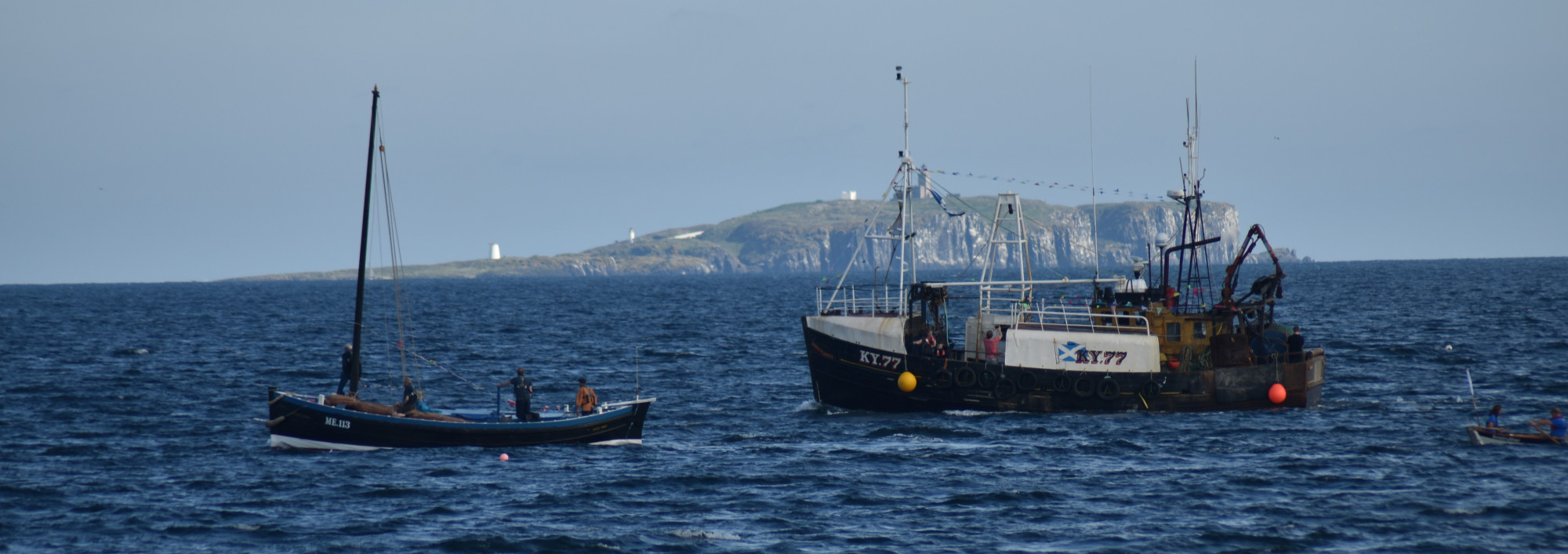

The Cellardyke Echo – 8/5/2019

1901

Shetland Addition Fishing Fleet.-The fishing boat Concord, of Cellardyke, has been purchased by Mr Wm. Stewart, Mid-Yell. She is 53 feet of keel and fitted with steam capstan. The Concord will be engaged at the early herring fishing here.

1902

The Coronation,

At a public meeting at Cellardyke on Friday night, a committee was appointed to arrange for treats to the old people and school children, and to have a bonfire the evening. On the suggestion of Mr Ray, the same committee was authorised make inquiries into getting a public park for the community as a permanent memorial of the coronation of King Edward VII.

1903

LLEGAL TRAWLING OFF FIFE COAST. SMART SENTENCE. To-day—before Sheriff Armour —at Cupar, Edward Hayward, 16 Hamilton Crescent, Leith, master of the steam trawler Chancellor, Granton, was charged with having illegally pursued trawl-fishing within the three-mile limit of the Firth of Forth. Accused pleaded guilty to being inside the three mile limit, but pleaded thick weather. Mr J. K. Tasker, Cupar, pleaded for a lenient sentence. The Fiscal said that while Hayward had frankly admitted the contravention thought, it right to point out that that was the third time he had been before the Court similar charge. The Sheriff said he had great hesitation in not inflicting the full penalty. £100 after what he had heard of his previous convictions. The sentence would be a fine of £6O, or sixty days. His Lordship ordered the forfeiture of the gear. CHARGE AGAINST A CAPTAIN. Oswald Rivell, 26 Park Avenue, Dundee, master of the trawler Stork, Dundee, who was cited to appear to answer a similar charge, tendered a plea, of not guilty, and was defended by Mr C. J. Bisset, solicitor, Dundee. Mr Mackenzie, chief officer of the Fisherv Board cruiser Minna, gave evidence that while cruising in the Firth of Forth on the day in question he observed, when off Cellardyke seven trawlers over a space of two miles, between the May Isle and Fifeness. Ten minutes later he made out the name of one the trawlers, which was the Stork, and she was working her starboard gear. He distinctly saw the Stork trawling one and a quarter miles within the Isle. THE DECISION. After hearing further evidence, both for the prosecution and the defence, the Sheriff found the charge proved. In respect that it was the first offence, said would make the penalty light as he could- £30, or twenty-one days’ imprisonment. The gear was forfeited.

WRECKAGE OF HISSING BOAT IDENTIFIED . The boat’s yard picked up about a month ago by the Granton steam  trawler Retriever in the North Sea , sixteen miles east by south half south from  the Bell Rock , and landed at Granton, has now been identified by friends from Anstruther as belonging  to the fishing  boat Brothers, of Cellardyke , which foundered in September last during stormy weather when on  a passage  to the Firth or Forth  from the Aberdeen herring fishing , all the crew being lost .

1904

Language that Could Not Repeated. —On Saturday—before Provost Dalzell and Bailie Reiddie—Robert Deas, fisherman. Cellardyke, was convicted of a breach of the peace committed in Shore Street. The Procurator-Fiscal said accused’s language was such he would not care to repeat. As it was Deas’ first appearance the Bench imposed a penalty of 15s, or ten days’ imprisonment.

PITTENWEEM. The Launch of a Fine New Fishing Vessel. The Nil Desperandum, a deep sea sailing liner, built by Mr Fulton, and sold by him Messrs W. Murray and Carstairs, Cellardyke, was launched on Saturday afternoon Of attractive design and excellent workmanship, the craft’s dimensions are:—Length, 70 feet; breadth of beam, 21 feet; and depth hold, 8 feet. The christening ceremony was performed by Miss Bella Carstairs daughter of the owner. After being fitted with ail the latest appurtenances, including steam capstan, she starts for the early herring fishing.

1906

On Monday evening music was discoursed in the Common the Cellardyke Gospel Temperance Brass Band, which marched from Cellardyke. The turnout being unknown, there was not the crowd which would have been expected. The Band, which progresses very well, discoursed several pieces with great feeling and harmony.

Weak Milk Prosecutions

Quite a batch of dairymen from Anstruther district appeared before Sheriff Armour at Cupar Sheriff Court on Tuesday charged with selling milk under the standard required by the Food and Drugs Act. The first case called was that of John Richardson, dairyman, Rodger Street, Cellardyke, who was charged with having on 30th May ( date is confusing as the  article is 12th May) , sold to John Macrae, sanitary inspector, St Andrews, a quantity of milk that contained not more than 2.75 per cent of milk fat. He pleaded guilty, and Mr T. Davidson, solicitor, Cupar, stated on behalf of the accused that the only explanation that could be offered for the low quality of the milk was that he had recently changed the feeding of his cows. He had begun to feed them compound cake, so it was possible that it might have lowered the quality slightly. The Fiscal (Mr H. H. Brown) said one peculiarity in the case was that both the milk fat and the non-fatty solids were below the standard. Ha was himself inclined believe that the weakness of the milk was due to feeding material. A modified penalty of 15s was imposed. David Leslie, dairyman, Milton Mill, was then arraigned on similar charge, the milk in this case being certified to contain only 2.18 per cent of milk fat. A plea of guilty was tendered, and Mr Davidson said he would like to call his Lordship’s attention to the fact that the sample taken from the can after the milk cart had finished its journey and there was only very small quantity left. After the jolting long journey the milk was always poor,  in fact it turned to a certain extent to butter by the jolting, and the fatty solids adhered to the edge of the can. The Sheriff – Then the customers furthest away from the dairy have very bad chance. (Laughter.) Mr Davidson said the milk was never sold out not altogether. In this case the customers had been all supplied, and the accused was on his way home. A similar penalty of 15s was imposed. John Scott, dairyman, Chesterhill, then admitted having by the hands of his son sold in George Street, Cellardyke, some milk in which the percentage of milk fat was only 1.56. Mr Davidson pointed out that the analyst gave the non-fatly solids as being very much in excess. He thought that showed there was no adulteration. The Fiscal—lt would point lather adulteration with skimmed milk, because skimmed milk contains ell the non-fatty solids. Mr Davidson said the milk in this case also was sold when the cart had reached the very end of the journey. When examined the can was found have deposit of butter and milk fat around the foot of it. The accused had frequently had samples of his milk taken, and there was never anything wrong with it. The Fiscal said the analyst thought it was half skimmed milk. Sentence of a fine of £1 was passed. In the case of Henry Wilson dairyman, Crawhill, who admitted selling weak milk to the inspector in James Street, Cellardyke, on 30th April, said accused had recently had a good deal of trouble with his cows. Three of them had died, and the sample was taken shortly after the calving time of some of them. As in the two preceding cases, the milk was supplied at the end of the journey; in fact, it was practically the last dregs ID the can. His Lordship modified the penalty to 15s.

The Cellardyke Echo – 1/5/2019

1890

Rothesay Chronicle

SUPERIOR FINISHED BUCK WATERPROOF COATS, LEATHER BOUND. HALF DOUBLE. Carriage paid to any address 48 inches long, 9s: 50 inches, 9s 5d; 54 inches 11s,

Patent Fishing Floats,

Prices on application. To had only from BLACK & CO.

Note the Address— BLACK & CO., CELLARDYKE FACTORY, CELLARDYKE, FIFE

Dundee

Auction Sales

This day

IN THE OLD STEEPLE AUCTION ROOMS,

8 SOUTH LINDSAY STREET.

IMPORTANT AND EXTENSIVE SALE,

BY AUCTION, OF A GROCER & PROVISION MERCHANT’S STOCK-IN TRADE.

AGATE BEAMS AND SCALES,

BRASS WEIGHTS, SCOOPS,

SHOW CANISTERS, TEA CHESTS, AND UTENSILS, COUNTER, SET SHUTTLES, &c.

(Belonging the Trust Estate of Alexander Imrie, Provision Merchant, Cellardyke ; Removed and Sold by order Hugh Hayes Watson, Esq., of Messrs Ford & Co., Accountants, Shore Terrace, the Trustees).

JAS. A McLEAN has, been favoured with Instructions to Remove end Sell the above Stock. within his Rooms, 8 South Lindsay Street, Friday first

1892

AnstrutherTown Council. —Provost Anderson reported at the monthly meeting the Council Tuesday evening that Mr R. Williamson, Cellardyke, had received the contract for laying the concrete pavement on the new iron footbridge between the two burghs. The price was £18 10s.

1894

Ten fishing boats missing. Considerable anxiety is felt in Cellardyke and Pittenweem at the absence of ten deep sea fishing boats, which left for the fishing ground this day week. A severe storm was encountered about 200 miles from land, but all are accounted for but ten – five from each Port. Six steam liners which left Anstruther this morning took away extra provisions to give the missing crews if sucesssful in coming across them. There are seven men in each boat, and if no word is received by the evening, the Fishery Board is to t send a cruiser in search of them in the North Sea.

Two days later

All the Cellardyke and Pittenweem fishing boats have now been accounted for, the last two arriving in Anstruther late last night. The fishermen report very narrow escapes from the mountainous seas which swept over the boats, while others had almost exhausted their provisions and were living on short allowances since Sunday.

1895

North Shields

The herring fishing season this year is rather later commencing than usual. About score or so of the Scotch boats, with the familiar K.Y. marked on their brown sails, and hailing from the picturesque ” wee fishing villages of St. Monace, Pittenweem, and Cellardykes, are at present to be seen the river ; but the proper Buckhaven fleet has not yet put in an appearance, and until their arrival the season cannot said to be begun. It is hoped that better luck will attend the boats in the forthcoming season than they experienced last year. The word “luck” used designedly, for although the season of 1894 is memorable as one of the worst in memory, so far as Shields alone was concerned, yet the records of other fishing ports on the coast indicated that there was no extraordinary scarcity of fish in the North Sea. Our ill-fortune still remains rather mystery.

1896

WANTED Immediately. Tailor, Good General Hand, Must be able to Machine. Apply Thomson, Cellardyke.

This and the preceding week in the corresponding period of last year were marked by heavy shots of fish from both line and sailing boats, but save for the arrival of the former, last week was almost blank, and this week has every appearance of being equally uneventful. By one of those fancies which often attack communities nearly the whole sailing fleet is aiming at the fresh markets at Aberdeen or Shields. Formerly they devoted the greater part of their attention to the home market, but this has been left unreservedly to the steamers. Eight of them came up on Friday and Saturday, and most of the fish was put out on the latter day. The quotations were — Cod, 13s to 26s per score; ling, 30s to 40s; halibut. 2s 4d to 4s 6d per stone; aund skate, 1s each. At these rates the tidy hauls  landed by the liners realised as follows: — Tennant, £58 ; Maggie, £56 ; Fairy, £55 ; Edith, £51; Coplev. £46; Rob, £43; Glenogil, £39; St Adrian, £18. The East Neuk ran into Aberdeen, where £27 was grossed.

The news from the south was to the effect that little had been done, the shots being landed rather late in the week to catch the fancy prices which go far to make the fishing profitable for those fortunate enough to get the first chance of the merchants.

Thirteen Cellardyke boats left for Stromness and Scrabster this week, and four for the south.

1900 The article which lead to my extensive research on the East Neuk Boatbuiolders

Launch of New Fishing Boat.—Boatbuilding Arbroath has for considerable time past been in a somewhat dormant state. A month or two ago, however, an Anstruther firm leased the boatbuilding yard beside the patent slip, and yesterday launched their first boat constructed in Arbroath. The boat in question is named the Ina Cook, and was built by Messrs John Millar Son. boatbuilders, to the order of Mr Andrew Henderson, fisherman, Cellardyke. The boat is carvel built, and is 68 feet long, with a 20ft beam. It is fitted with every modern improvement, and contains sufficient accommodation for the crew, besides having every facility for the storage of fish. The boat intended in the first instance for herring fishing operations, but will afterwards in for the white fishing. The boat took the water gracefully, and as she left the slips she was christened by Miss Bella Millar, daughter of the builder, by the usual ceremony of breaking bottle of wine over the boat.

(Christina (Ina) Cook was the daughter of the Cooks of Cook and Macintosh Solicitors, I can only assume they part financed the vessel to have her named in such a way)

The Cellardyke Echo – 23/4/2019

1871

An Interesting Meeting.—A public meeting of the boatskippers of Cellardyke was held in the end of last week, to consider a representation from two brothers Largo, for aid to repair their boat, which had been wrecked in that harbour during the late storm. It was stated to the meeting that the brothers had bought the boat only a week or two ago in Cellardyke for £36, but that before she had brought in return of a penny this accident had occurred, which would entail an outlay of about £30 to make her again seaworthy—and as this sum, added to the large purchase price, was simply beyond the means of the unfortunate owners, it was hoped that under the circumstances the fishermen of Cellardyke would with their characteristic kindness give some tangible token of their sympathy and goodwill. The meeting, after hearing a full statement of the case, did not consider it of such a nature as to invite relief—it was not like the cry of the widows and the fatherless—the plea of old age and want, or peradventure of some luckless brother overtaken distress or infirmity and cast all unbefriended and in danger of total “shipwreck on life’s stormy sea.” It was no doubt cruel disappointment to the two young men concerned, but still with youth and strength on their side, the meeting hoped that, grappling their present difficulty with true Scottish spirit, they would soon be floating again on the full sea of prosperity. The meeting consequently resolved unanimously not to give the representation any countenance.

1872

SHIPWRECK ON THE ISLE OF MAY. Another of those severe tempests, which will so long darken the memory of the spring of the present year, occurred on Wednesday night, when a gale, seldom equalled from the same direction raged without intermission from the northward, though sheltered by the situation of the coast. Our shore has happily in a great measure escaped the fury of the storm. The Isle of May, however, has been the scene of a shipwrecking disaster; but though the vessel is total wreck, we are glad to state that the crew have all been saved. The unfortunate ship is the three-masted schooner ‘Matagorda,” of Aberdeen, which sailed from Burntisland with a cargo of coal for Dantzic. Sheltered by the north shore, the schooner had a pleasant voyage along the Fife coast; but as soon as the friendly land was cleared, at the mouth of the Forth, the storm was encountered in all its fury. But confident of the weatherly qualities of their gallant craft, which, even with her heavy coal lading, bore herself like a sea gull in the storm, the crew bravely struggled on their course, but while endeavouring to tack to windward of the Isle of May, the Matagorda was struck by a heavy sea when coming to the wind, the act of staying, and being equally unfortunate in their attempt to wear, she was driven ashore on the north-east side of the island. Providentially, the disaster occurred 9.30, or about half flood, and to this circumstance the crew are largely indebted for their escape, for had the schooner struck at low water, or on a less shelving part of the shore, the poor sailors must have shared the fate of many a gallant crew, at spot peculiarly fatal in the old annals of shipwreck. The vessel was seen lying a dismasted wreck on the storm swept island in the grey light of Thursday morning from the Fife shore, when, with the view or gathering information about the ship, and also in the hope of succouring the unfortunate crew, a Cellardyke fishing-boat, with the veteran pilot Mr Thomas Cunningham, Skipper Alex. Watson (Lyall), and other gallant men on board, hoisted sail from Anstruther harbour, and returned with particulars of the wreck about noon, leaving the crew busy in trying to save the material of the vessel. The Matagorda was under the command of Captain Allan, and had six of a crew. She belonged to Messrs George Milne & Co., Aberdeen, and was built in 1537, being 153 tons register.

1873

NEW METHOD OF HERRING FISHING. The Fishermen of Cellardyke have introduced a new system of fishing herrings in the Scottish seas, which may be expected to mark a new era in the development of this great branch of national industry. The system in itself cannot said to be new, as it has been practised for many years on the Norfolk coast, where instead of sinking the net some three or four fathoms in the northern waters, it is floated close to the surface so as to prevent the possibility of any of the fish from escaping over the head rope. This was tried by one of our Cellardyke crews simply by way of experiment last week, and succeeded so well that in one instance at least about a barrel of herrings were caught in a single net while the rest of the drift, numbering some eighteen, floated in the ordinary way were almost without a scale. We ought, perhaps to have stated before that the herrings caught on the deep sea banks at this season, or in Summer are what are called in a feeding state, and so are totally different at the spawning time, when they seem to rush blindfold on destruction, or against whatsoever comes in their way. On the contrary at this season they instantly dart from any appearance of danger, or as worthy Skipper Pratt graphically described them the other day, “They’ve een like candle an flee like lichtnin’ through the water” and thus our hardy crews often see a fine appearance of fish, and are yet tantalized to find that not a single herring has been taken in the nets. Observers have long been baffled to explain the habits of the herring; but under particular circumstances they sport upon the surface, and are caught both in both in daylight and in the dark, as the crew of the Cellardyke boat “Janet and Margaret”,” Skipper Watson, cast their nets one day about noon amongst a shoal of herrings, and by throwing stones amongst the fish succeeded in driving about two barrels into the nets buoyed at the surface, while some crews  fishing alongside, in the usual manner, did a not draw a single herring. Encouraged by these results all the crews fitted one or more of their nets as at Lowestoft; and last Saturday saw Cellardyke busy from one end to the other with the necessary preparations, but it goes to show the precarious nature of the fisherman’s calling, that while some crews were this week so lucky to draw in the grand Sea lottery a prize of five and even eight crans by the new system, other crews were indebted for their success to the under floated drift, but this was the exception to the rule, and notwithstanding the risk from passing vessels, our fishermen are not likely to neglect a discovery which promises to open up an inexhaustible bait supply for the deep sea fishing. After supplying their lines, a number of the crews returned this week with a surplus of from one to seven from seven crans which were sold by auction and otherwise, from 4s to 9s a cran, but, apart from being so long on board the boats, these herrings are in such an immature condition that they were of little or no value for human food, though they are simply indispensable to the success of the cod and halibut fishing

The Cellardyke Echo – 17/4/2019

1867

Bailie Pottinger, we may state, has deservedly earned the distinction of being accounted the leading boatbuilder on the East Coast; but in addition to the boats supplied by him, several others have been acquired by Cellardyke fishermen. Since 1855 or during the last 12 years bailie Pottinger has built no fewer than one hundred and twenty boats or fishing vessels, so different in bulk as to range from thirty six to sixty feet in length, the sum total of the measurement of these boats is 4521 tons OM. Eighty seven of the boats were for Cellardyke alone, their united tonnage being 3507 tons OM.  The remaining thirty three were for different parts of Scotland with a united tonnage of 1014 tons.

1868

Serious Accident to a Fisherman.—On Tuesday morning, as the Cellardyke fishing-boat, of which Mr James Murray is skipper and owner was returning from the great line fishing ground, a very serious accident occurred to one of the crew, named Alexander Jack. It appears that the mainmast was being set, preliminary to making more sail, when, this was being done, the pitching of the boat in the seaway caused the mast to spring from the “step” in which it rests, upon the contiguous boarding, when the crew proceeded to make an effort to restore it to its proper place. Jack was assisting in this operation, when the mast rolled over and crushed him against the edge of thwart. His body in this dangerous position being made to weight of the heavy spar, the effect was most deplorable, as, besides being fearfully bruised, his collar bone and nearly all the ribs on one side were broken, some of these being in two places, the sufferings of the poor man were most acute and severe, as the accident occurred about twenty miles seaward of the Bell Rock, when many hours necessarily elapsed before land could be reached. When the boat at length reached the harbour, no time was lost conveying the poor sufferer to his house in Cellardyke, where he was promptly attended to by Dr Jamieson. Notwithstanding the extreme severity of the injuries he sustained, hopes are still entertained of his recovery, although at present he lies in such precarious condition as to lead to the greatest anxiety for his safety.

Curious Surgical Operations.-

The other day a rather curious operation in surgery was performed in a certain fishcuring yard in the west end of Cellardyke, which equally invites attention from the singularity of the process and the rare success which followed it. As everybody may know, dissection and anatomy are carried on much more extensively in a curing yard than in even the College of Surgeons, but in either place the case which now claims attention is, and would have been, peculiar although nothing more than the patent. It is quite a familiar phrase in speaking of anything curious, whether it be biped or quadruped, to say it is a rara avis, but in this case, as in so many others, it would not have been exactly accurate, as it was no strange bird,  but a fine domestic hen, which came under treatment. Tappie, it seems, was a prime favourite in the family of the worthy curer, because of that great virtue of her kind that she almost daily added to the comforts of the breakfast table. The ills of life men and hens are many and great, for Tappie was lately seized with distemper which everybody said was a hopeless case, as doctors always say when their prescriptions fail. Meanwhile appearance of Tappie seemed fully to bear out their wise though dismal forebodings, for instead of being capital type of well-conditioned matron, she day by day dwindled away into walking skeleton, very near to the end of its journey. The Cooper of the curing yard seeing the distressed condition of the poor fowl, determined to make effort, if possible, to save it. “Desperate diseases require desperate remedies” became his motto for the nonce, and, acting upon it, he coolly proceeded to examine the patient, and, concluding from the swollen appearance of the breast, that something was wrong with the stomach, he whetted his knife, and then by a dexterous incision, first of the skin, and then of the membrane of the bag, laid it open. This diagnosis proved correct, as a large, hard ball of matted grass was found in the interior, which, on being extracted, and the incisions closed up, seemed to be followed with a magical result. No sooner was the operation over than the hen flapped its wings, and gave every indication of restored health and spirits. In a day or two Tappie became perfectly convalescent, and is now in such condition as to pipe the praises of the ingenious piper who so successfully assumed the character of professor of surgery.

1869

THE SUTHERLAND GOLD DIGGINGS.

Amongst the visitors lately to Kildonan was David Murray Esq., the well-known merchant of Cellardyke, who being in the north on business, took the opportunity of examining this now celebrated locality. Mr Murray’s opinion is of practical value from his personal knowledge of the gold fields Australia, and this experience inclines him to believe that if the present restrictions were removed and a properly organised system of working adopted, the industry of the searchers would in all likelihood bring its reward. At the time of Mr Murray’s visit the ground was comparatively deserted, but the approach of a milder season was causing a large influx of people to the neighbourhood.

Man Amissing

 On Thursday the steam lighter Hemaja, employed at the Union Harbour returned from a trip to North Queensferry blue stone quarries, when the crew reported that Robert Anderson, a seaman, belonging Cellardyke, who had charge of the lighter, had not been seen since Monday night. According to their statement, the vessel, which sailed from this place early in the morning, had gone into Granton so that some repairs might be made on the steam pipe, which, having been completed, and the steamer ready to continue the voyage up the Firth, Anderson, who is said to have had £6 in his possession, went on shore to clear the vessel at the dues office. He was last seen about half-past seven in the evening, and not returning after the short time that was required for the errand, his two companions gradually became alarmed, and made inquiries for his safety. As the time wore on these inquiries became more anxious, and a search was made on shore, and the harbour near where the steamer was lying was also dragged, but all to no purpose, as no trace whatever could found of the missing man. Seeing that there was no hope of finding him, the steamer sailed from Granton Wednesday morning, and arrived here, as we have said, with her cargo, on Thursday about noon, when the circumstance, as was be expected, caused the greatest uneasiness amongst Andersons friends.

1870

Cellardyke. A Curious Superstition.-

The fishermen of the now prosperous community of Cellardyke, on the Fife coast, were at one period sorely troubled with a curious superstition regarding swine. Nothing could be more unlucky, in their estimation, than to meet one or more these animals, or, to hear the word “swine” uttered aloud when trudging along the harbour on their way to sea. The evil omen was pretty sure to be followed by loss of fishing gear, and it was shrewdly supposed that all was not fish that came lo their lines these occasions. In latter times the evil effects could be averted simply by taking hold of a bit iron. On questioning the fishermen as to the origin of this singular superstition, I was told was just “tin old freight,” but they had known instances of some of the old men believing it. I think its true origin can be traced to the Scriptures, and will be found in the miracle wrought in the country of the Gadarenes, when the evil spirits being commanded to come out of the men, entered into a herd of swine, and the whole herd ran violently down a steep place into the sea, and perished in the waters. This miracle the monks could easily turn into a slavish instrument to serve their own purposes; and when better times came round, those knaves had to fly their rookeries, what is more likely than that this superstition, so closely interwoven with the fisherman’s every-day life, should still linger on, when the causes which gave it birth had long been forgotten?

The Cellardyke Echo – 9/4/2019

1860

THE REVIVAL MOVEMENT FIFESHIRE.

The awakening at Cellardyke still continues to progress in the most satisfactory manner. The meetings are crowded, and numbers of inquirers, both old and young, present themselves every evening. At Pittenweem there has been a movement among the young people attending the Sabbath schools, which last week assumed a more decided character. A visit was paid last week to St Monance by some of the Cellardyke people, the effect of which was instantaneous. Crowded meetings have been held every night since…

Revival Movement. St Andrews—It was announced at the end of the week that at least two of the converted fishermen from Cellardyke were to address audiences in the old Fishers’ School on the afternoon and evening of Sabbath last. For some reason or other not yet explained, they did not however make their appearance at cither service, and the crowds assembled, especially in the evening, had, under their evident disappointment, the high privilege of listening to the valued ministrations of Mr Monroe, the indefatigable local coast missionary stationed here.

Leven – Revivals. —On Sabbath evening last, three fishermen from Cellardyke, took part in devotional exercises in the Free Church here, and gave an account of the progress of the revival movement in the East of Fife. The church was densely crowded, and their statements showed that much good had resulted from the movement.

1861

Ferryden

The scarcity of all kinds of fish during the last six weeks has been unprecedented. Various reasons have been assigned for the falling off in the supply; but the prevalent belief is that our fishermen themselves are at fault, and that they are not so persevering and industrious as their brethren in other places. They maintain that there is unusual paucity of fish the coast; but that assertion has been far refuted by the arrival here of two heavily-laden Cellardyke boats, the crews of which received the sum of £40 for their previous night’s fishing. Of late, a large majority of the fishing population of Ferryden have been depending chiefly upon the charity benevolent individuals for support.

1863

In Cellardyke, two houses have been erected by the Building Company, what may regarded as model plans for fishermen’s dwellings, as not only his own and family’s comfort have been carefully attended to, but ample storage has been provided for the materiel of his vocation as well. The Company have named their property Ellice Street, in honour of the worthy M.P. for the St Andrews Burghs.

Several boats are this season proceed to Stornoway, to prosecute the herring fishing, which, for the past year  or two, has proved so successful. The greater facilities which this district affords for prosecuting the fishing, as also the superiority its markets, from the number and enterprise of its curers over the rest the Firth, are many and obvious. Frequently, in consequence of these advantages fishermen from other localities have been desirous of removing here, but the difficulty of obtaining houses has hitherto proved insurmountable. Amongst the many applicants for the new houses in Cellardyke were several from Buckhaven.

Launch – on the afternoon of Saturday last, a large boat designed for the deep sea fishing, was launched by Mr. C Pottinger ship and boat builder. The ceremony of naming the vessel was performed by a youthful daughter of her enterprising builder, and amidst the resounding cheers of the numerous spectators the ‘Alexandra’ glided smoothly into her future element. She is a trim weatherly-looking craft, with long sharp lines; but her bottom, to adapt her for our shallow harbour is flatter than the Yarmouth Luggers, on the model of which she has been constructed. The tonnage is over sixty, old measurement. She is to be manned with a crew of ten Cellardyke fishermen, under the command of an experienced and energetic skipper and from the active manner with which the necessary preparations are being advanced, it is expected she will be ready for sea in the course of a week or two. In the meantime she is to be employed in the great line fishing on our own coast, but in the autumn she is to be dispatched to Yarmouth to prosecute the herring fishing.  The vessel is owned and fitted by a company of local gentlemen; and should the scheme- which is altogether of a tentative nature- be successful, others of a similar description will shortly follow.     

1864

FISHING LUGGER FOR SALE- THE “ALEXANDRA,” now lying in Anstruther  harbour. Launched 1863, Register Tonnage 27 64-100, Length 56 2-10 Breadth 17, Depth 5 9-10, Draught of Water 6 feet 3 inches. Carvel built!  Well found, and Sails very fast [3904

For further particulars, apply to Messrs. Sharp and Murray, Cellardyke, near Anstruther, Scotland

Montrose

Shipping.—The schooner Hero, of Whitby, Captain Hall, from Middlesbro’ for Tain with a cargo rails, was assisted into this port on Saturday last, in a leaky condition, by a Cellardyke fishing boat, for which assistance £20 has been paid. The vessel had to unload in order to get repaired. She the property of the captain, and, we believe, not insured.

1865

Stonehaven

Large “Takes” of Fish.—Three south Firth fishing crews came to our harbour on Tuesday with excellent “takes” of deep-sea fish.—Ling, skate, turbot, &c. —which were speedily bought up by a local curer. We wonder our fishermen do not follow the example of these Cellardyke men, who, we have no doubt, by the enormous quantity these three boats landed, have netted well on to £100 by their venture.

1866

Anstruther Burgh Licensing court

Mr Oliphant submitted to the bench a memorial, signed by thirty one boat Skippers -of Cellardyke, petitioning the magistrate, to permit one public house on the shore to be opened during the night for the sale of spirits for the benefit of fishermen returning from the sea.  Mr Oliphant ably supported the memorial by showing that such a privilege was sanctioned by the public houses act he also stated that the arrangement had been tested and found to work satisfactorily at Buckhaven, Newhaven &c After giving the memorial their favourable consideration the court remitted the matter to the clerk, who was instructed to inquire and report on the working of the practice elsewhere.

WANTED, a Good second hand Sewing MACHINE, State Maker’s name and lowest cash price. Apply to John Martin, Waterproof Clothing Manufactory. Cellardyke.

The Cellardyke Echo – 3/4/2019

1902

Proposed East of Fife Boat Insurance Company.—A representative meeting of fishermen from Cellardyke, Pittenweem. and St Monans, was held in Cellardyke Town Hall on Saturday night, when it was unanimously agreed to form local Boat Insurance Company on the joint-stock principle, with capital of £10 000, of which £5000 in £1 shares will be subscribed in the meantime. From a preliminary canvass of the three towns, £2625 had been raised, and it was resolved that each skipper of a boat should ask his crew to join and take shares, so that the concern might be wholly, or nearly so, a fisherman’s company. It was agreed to give the fishermen and others another fortnight to become shareholders.

WANTED. Causeway-Layers to pave two streets in Cellardyke; Start Work Immediately. Apply Personally Cellardyke, Fife, New Streets Works.

1903

Anstruther Rangers bagged the Martin White Cup. Cellardyke Bluejackets gave them a red face for it, but it was seen when the teams lined that the trophy really lay between the first and second elevens. Some of the latter promoted into the first string would strengthen it. The Rangers’ triumph has kindled the heather the east of Fife, and to cross the path of the victors will involve the transgressors in a heavy reckoning.

1904

RUN DOWN BY A GUNBOAT. INQUIRY INTO FIFE FISHERS’ DEATHS. CELLARDYKE AND CRAIL MEN DROWNED.

Sheriff Armour and jury at Cupar to-day heard evidence in two fatal accident inquiries, one on the sinking of a fishing boat in the North Sea by H.M.S. Speedwell. This was the first case, and the evidence led showed that Robert Smith, fisherman, James Street, Cellardyke, Anstruther, while engaged fishing three miles east of Crail in the boat Cornucopia, of Cellardyke, about four o’clock on the morning of Saturday, 25th February, was accidentally drowned in consequence of the boat having been run into and sunk by His Majesty’s ship Speedwell.

The second inquiry was connection with the death Andrew Cunningham, junior, fisherman, 34 Shoregate, Crail, who was accidentally drowned while fishing on board the fishing boat Ten Brothers, of Crail, in the Firth of Forth, half a mile from the harbour at Crail. He was accidentally washed overboard by a wave which passed over the boat. In both cases formal verdicts were returned.

1907

ANSTRUTHER. The trial trip of the steam drifter The Maggies, belonging to the Messrs Gardner Cellardyke, took place from Anstruther on Monday afternoon when a crowd of 200 people had a pleasure sail round the May Island and Bass Rock. The drifter maintained speed of ten knots, and the owners were highly delighted with her.

Launch at Anstruther – Mr Miller, yesterday afternoon launched a steam drifter to the order of Skipper George Anderson, Cellardyke. This is the fifth vessel launched since last August, and other three are to be built. The drifter was named Integrity by a niece of the owner. The dimensions are the same as the others. 85 feet in length, 18 feet beam, and depth of hold 9 feet. The engines are being made by Messrs Cran, Leith

1908

An enquiry into sourcing water for St Andrews suggested that it could come from Dunino reservoirs and the following question was raised…

Mr Wilson, K.C., cross- examining, asked witness if he knew that in connection with the net factories at Cellardyke an enormous amount of water was used . Witness said that using a domestic water supply for washing nets seemed to him a curious waste of public money. Why (witness continued ) should they not wash their nets with the bad water which was so prolific there ? (laughter) Mr Wilson—We need not argue about that .( laughter)

Another report

THE OBJECTORS Referring to the opposition of the various objectors, counsel said that the County Council had an interest in Dunino special water district, which was on the proposed St Andrews water system below the Lochty reservoir. The population of the special district was only 134. It was really a clause opposition. (Counsel for The County Council, Mr John Wilson, here dissented.) Continuing, Mr Scott Dickson said the serious opposition was from the burgh of Kiirenny, which included the fishing town of Cellardyke, There were also petitions from the three adjoining burghs, Anstruther Anstruther-Wester and Pittenweem. The main point here was that north of the watershed the flow was towards St Andrews; below, was to the south, the flow was down to the Firth of Forth. All the area 8t Andrews proposed to take was upon their own side —the north side of the watershed. The water on the north side naturally and physically belonged to St Andrews, and unless there was a very special reason no community outside that area should be allowed to take the water away. Kilrenny’s population was stationary, and so were the populations of the other opposing burghs. St Andrews was quite willing that Kilrenny should keep certain water which was used in Kilrenny’s Balmonth reservoir, though St Andrews thought that that water, to a large extent, would, if left alone, have gone into the Lochty burn. They were also willing to let Kilrenny take water which would find its way into the Dunino barn. The Balmonth area was ample for Kilrenny’

1909

RELIGIOUS REVIVAL IN CELLARDYKE.

During the last few weeks a remarkable series of evangelistic meetings have been held the Cellardyke Town conducted by Mr and Mrs Cowe, of Fraserburgh, assisted by some of the local ministers. The result has been surprising, all the meetings being largely attended, and a wave of religious fervour aroused.

There has been no artificial and unnatural excitement, or extravagant displays of religious mania, but a deep feeling which was always manifest at all the meetings. Since the commencement of the Mission over persons have passed through the inquiry” room.

 The present situation recalls similar experiences which have been undergone this district. In 1860 and again in 1874 there were revivals in Cellardyke which left their effects for many years, and it is maintained that the present revival will prove as beneficial as the previous ones.

1910

A representative meeting of the fishermen Cellardyke, Pittenween, and St Monans, was held in the Council Chamber, Cellardyke, on Saturday. Mr J. Duncan Millar, M.P. for the Andrews Burghs, was present, and took part in considerable discussion on prominent fishing questions. The principal item was connection with the regulations issued the Board of Trade, compelling skippers or second hands steam drifters and liners to obtain a certificate of competency or an authority to act in such capacities. The fishermen maintain that the application of the regulations will inflict hardship upon them, as cases may occur in which the skipper and owner of drifter might not be allowed step aboard his own boat, even although he had many years of practical experience in his trade. Mr Millar, who has been taking an active Interest the matter, urged that deputation should be sent to the Board of Trade, and the desirability of adopting this proposal was remitted a Committee.

COMPANY MEETING

UNITED FISHING BOAT INSURANCE COMPANY (LIMITED) , ANSTRUTHER . —The shareholders met at the annual’ general meeting, held in Cellardyke on Saturday evening. The company has again had a successful year. The profits earned for the year are £1087, 5s 9d, and of this sum the directors propose to place to reserve £918, 10s. 9d. (bringing the reserve fund up to £2528, 8s. 2d), and recommend a dividend to the shareholders of 6 % per cent. The report was adopted, and directors appointed in place of those who retired.

1912

LAUNCH OF DRIFTER FOR CELLARDYKE.

Messrs A. Hall and Co. launched from their yard at Footdee a fine new drifter to be used in the herring fishing at Cellardyke. The vessel, which the order of Mr Martin Gardner and Sons, was named the Plough. She is 86 feet in length, 18 feet inches beam, and 10 feet in depth [moulded). The vessel will engined with the usual type of triple expansion engine, and to have a boiler working at 130 lb. per square inch.

A number relatives and friends were present the launch, and were afterwards entertained at the office of the builders at a cake and wine banquet. Amongst these present were Mr Martin Gardner, sen., and Mr Martin Gardner, jun., Mr Bonthron, fish salesman, Messrs John Thomson and Henry Gardner, Cellardyke, Alexander Walker and William Webster, Aberdeen; Mrs Martin Gardner, Mrs T. Gardner and two daughters, Mrs J. Gardner, and Miss Lizzie Gardner, performed the launching ceremony. Representing the firm were Messrs Donald McIntosh and A G. Emslie. Mr McIntosh proposed “The King,” and also “The ship Plough and her owners.” Martin Gardner, sen., suitably replied. Mr J. Bonthron proposed “The health and the success of the builders,” and McIntosh replied. Mr McIntosh then proposed health of Miss Lizzie Gardner, daughter Mr Martin Gardner jnr. Her father replied. A gold bangle, case, was presented young lady as memento of the occasion.

1913

FIFE SKIPPER’S SMART PERFORMANCE SAVES TWO BOATS FROM GOING THE ROCKS AT EYEMOUTH. Sheriff Armour  Hannay, at Cupar yesterday, gave judgment in the salvage actions, raised by James Hutt, fisherman, St Monans, skipper of the steam drifter Lizzie Hutt, and others, against John Watson, fisherman, George’s Street, Cellardyke, skipper of the steam drifter Pride of Fife, and against Robert Davidson, fisherman, Shore Street, Cellardyke, skipper of the sailing fishing boat Guide Me, for £430 and £100 respectively for salvage services rendered in Eyemouth Bay September 4. 1912. The defence was that the services rendered were towage services, customary for Fife fishermen to render to each other when their vessels were in difficulties. His Lordship finds as a matter of law that the services rendered by the Lizzie Hutt were salvage services; assesses the same at £250 in case of the Pride of Fife and £50 in the of the Guide Me respectively; apportions the total sum of £300 as follows:—£150 to be paid to the owners, £50 to the skipper (James Hutt), and £100 to the remaining eight of the crew in equal shares, and accordingly; refuses the motion to apportion the aforesaid sum of £300 between the services; rendered in saving life and those rendered in salving property. Pursuer gets expenses on the higher scale. In the note attached to the interlocutor; his Lordship says:—”Or September 3, 1912,, the sailing fishing boat Guide Me of Cellardyke, was towed into the anchorage at Eyemouth Bay in a helpless oondition with split foresail. She anchored under the lee of the land, but shortly afterwards the rope which was attached to the anchor broke, and she began to drift towards the Hettle Scar rocks. “The steam drifter Pride of Fife, also from; Cellardyke, was coming into the roadstead,  and was hailed for assistance. She came, and, with the Guide Me in tow, steamed to the weather side of the anchorage, and both vessels then let go their anchors, this time, Guide Me using a chain. Both began to drag, and by the time the Lizzie passed them they were close to the Scar rocks and in a position of great danger. ” I have accordingly no difficulty holding that the services rendered by the Lizzie Hutt were salvage services, and I would add they seem by the evidence to have been performed in a smart and seamanlike manner by the skipper, James Hutt.” For pursuers—Mr T. D. Murray, solicitor. Anstruther: for defenders—Mr James Brown, Messrs Mclntosh & Watson, Anstruther).

The Cellardyke Echo – 27/3/2019

1870

CELLARDYKE. Crab Fishing.- Although the season for this fishing has arrived, the start, it is expected, will not be made for fortnight yet, owing to the extreme coldness of the weather. The fishermen of Crail and Kingsbarns have commenced, but as yet have caught nothing, The engaged price this year is 1s 4d a dozen, 3d above last year’s rate. There are upwards of a dozen yawls fitted out for here, and as many in Anstruther, all owned by old fishermen whose day has now gone for long sea voyages, but whose failing strength and ripe experience is still utilised in the training of their youthful crews—the fishermen in embryo of a year or two hence.

1871

The Herring Harvest.—In the course of last week no fewer than 2000 barrels of herrings were landed at Anstruther; 1200 at St Monance; and about 500 at Pittenweem, giving a yield for the East of Fife of some 3700 barrels, which, added to the previous take of the season, gives a grand total of 24,000 barrels – a result so gratifying as to make the spring fishing of 1871 by far the best in the history of this fishery. There were only about 150 boats on the coast last week—nearly the whole being local crews – as the Buckhaven men lost the harvest in celebrating the royal marriage. Skipper Thomas Birrell, of Cellardyke, landed last week in three takes nearly 130 crans; indeed, on Friday the harbour, with the many boats laden with herrings that glanced like silver in the sunlight, and with the stir and bustle in packing and carting them to the railway station, presented such a picture life and animation to recall all the glories of the ” Auld drave” that did so much enrich the coast better days. On this occasion, however, the fishermen have gained comparatively little from the large takes ; and if rumour speaks truly the buyers still less, for though the herrings only sold at the pier from 5s to 10s barrel, yet so poor were the sales in some of the English markets that many packages did not realise the cost of carriage. A curious illustration of the fluctuating character of the fishing may here be related. The chief reason for prosecuting the herring fishing thus far in the season is to procure bait for the cod fishing, and last week yielded, of course, an abundant supply, but owing to a severe gale which drove the boats back from the sea on Monday morning, the crews had to dispose of the herrings as being too old and tainted for their purpose, when they were sold for manure 6d the basketful, but next morning the demand was so eager for fresh herrings that they reached as high  as £2 10s per cran, while only a few days before boatloads could have been bought for less than a sixth of the money.

1872

Curious Story of Fisher Yawl.—One of the busiest of the little fleet that sunrise every morning swarm like bees from Anst’er pier to gather honey the shape of crabs and lobsters, is antique-looking boat, which has now sailed the seas for nearly 90 years. She was cradled in one of those old grey Norwegian seaports, which a thousand years ago launched those grim red-painted warships that, with an open-mouthed dragon for figure head, and packed full with hungry pirates swept more dreadful than the hurricane along the Scottish seas; but the world had mightily charged, and Mr Shirra’s prayer on Kirkcaldy sands had blown the last pirate visitor, Paul Jones, out of the Forth, by the time the little skiff was cast ashore as the long boat of foreign galliot wrecked at Montrose more than eighty years ago. Dr Tennant describes the folks of Crail hurrying on the Anst’er Fair as:

“Some are flushed with horns of pithy ale,

And some are fierce with drams of smuggled gin;

While to augment his drouth, each to his jaws

A good Crail capon holds at which he rugs and gnaws.”

For the purpose of catching these very capons of which the poet like everybody else was so fond, the skiff was brought to Crail, where, after many a lucky fishing day at the “hirst,” she was sold to “Skimfie” that is the little rock-girt creek of Cellardyke After much rough usage, and being well known for twenty years as the face of the famous town drummer, the boat once more returned to about the time when “partans,” instead of being caught only for fish bait, and when a dozen of “big taes” could be bought for the bairns for a single penny, were beginning to be worth sending the market; but after tarrying for a time in the East Neuk, she came back again to Cellardyke, when curious enough, master and boat were almost of the same venerable age  Her owner was Mr Robert Anderson, the Father of Cellardyke – when she became so much of a favourite through the kindly indulgence of worthy veteran, that she was christened the “Boys’ Delight,” though from her peculiar construction she was better known, as sometime happens with well as boats, by the nickname of the “KittlekeeL Here we may explain the usual method of fishing crabs, which in the case of a small boat is done some grey-bearded fisher, assisted by two or three boys who are allowed the produce of their own particular creels. The old fisher thus receives his share, net divided and sub-divided as at the herring fishing, but in full, to use one of the singularly pithy phrases of dear old Robert’s, “It’s my ain pie Jock” After a faithful companionship of twenty years, the skipper, who still rejoices in hale old age at the patriarchal years of 86, sold the boat to Mr Alex. Jack with whom the little ark appears to be lucky as ever, and being in good repair, ” the oldest boat” on the coast is likely “to ride the ford” for years come.

Cellardyke. Sale and Exposure Property.

A few years ago a house in Cellardyke was scarce to be had for “either love or money;” and if one happened to be let, it was nothing unusual for dozen inquiries to be made after it, and, as a matter course, the competition for property was equally intense; but of late the tide has very much slackened, and in not a few cases the supply would appear to exceed the demand. This is particularly true with regard to the sale of houses – several of which have been again and again exposed without obtaining a buyer. On Saturday, however, a large old property, consisting of a two storeyed tenement, with small house attached, sometime occupied as a reading-room, and situated to the west of the Tolbooth – which has been for a considerable time in the market – was sold by public auction for £225- being an advance of £15 on the upset price – to Mr James Skinner, merchant. This subject formed the last of the once extensive property of the late Capt. Henderson of Anstruther, the sale of which, within the last three or four years, has led to the erection of so many fine commodious houses on sites either vacant or covered with ruinous buildings belonging to occupations which, as in the case of the maltster, no longer exist in our community. Two new houses belonging to Mr Smith, writer, were also offered their situation in Dove Street at the upset price of £250 each, but offer was made. The fact curious, showing the rapid and rather unparalleled extension Cellardyke, that it was only in 1855 that Mr Smith offered the Dovecot Park, now the site Dove Street, for feuiug purposes, but within the last fifteen or sixteen years accommodation has been provided for about forty families, while in East and West Forth Street  within the same period the increase has been more than doubled, though the key to lay open the altered demand is to be found less in the extent of the building, remarkable as this has been, than in the pressure of the times.

1873

…As in so many other cases the boats are advancing in price, though builders appear to think that contracts are unremunerative, owing to the great rise in price for wood and iron. The cost of a first class boat is thus perhaps fully ten percent more than it was last spring; but Mr Jarvis of Anstruther, who is a favourite builder, sold a splendid new boat the other day, to Skipper John Salter of Cellardyke, for the respectable sum of £135 , including, however some iron fittings.

1874

The crew of one of the Cellardyke fishing boats caught a large shark while engaged at the deep sea fishing. The fish measured nearly 14ft in length, and it was sold to one of the local curers for 31s It was afterwards purchased by a speculative Glasgow auctioneer.

1875

THE CELLARDYKE FISHERMEN AND THE ALLEGED DEPREDATIONS FRENCH CREWS.

The fishermen of Cellardyke recently sent memorial the Fishery Hoard, representing that while they were prosecuting the herring fishing on the east coast of Scotland last season, they had been obliged at times to abandon their nets from stress of weather, and that these occasions bad been used by large vessels, especially French luggers, to take possession of the nets by means of their small boats ; and praying that, if possible, the use of small boats by such vessels might be prohibited, and the protecting gunboats ordered to cruise more at sea than they do, A reply has now been received from the Hon. B. F. Primrose, Secretary the Board, in which he says :

 I am directed to explain to the petitioners that the use of small boats by vessels sea, especially by the French fishing luggers referred to, cannot prohibited by any statute of the British Legislature, they being foreigners, with their own rights and privileges upon the high seas, and not subject the jurisdiction of Parliament except when they come within the three mile boundary, and then only convention ; but the crews of these vessels are liable to punishment for using their boats for the purpose of theft if it can be proved upon them. With respect the gunboats the commander have instructions to cruise for the carrying out their superintendence, and do cruise; but for them to cruise in bad weather when the fishing boats are driven off the fishing grounds must depend upon the fitness and power of the vessels to cope with the weather, and must in every case be left to the discretion of the commanders responsible to the Admiralty for the safety of their ships, and their conduct of the service committed to them. The Board, however, will not fail to let the commanders of gunboats know before next fishing season what is stated in this petition as to the loss suffered by British fishermen, and the alleged cause of it, and urge them to all in their power to watch against such causes complaint, and check any malpractices at the fishing grounds which exist and can detected It is right that the petitioners should know that last year as in every previous year, French fishing vessels, against the crews of which complaints were made of having stolen nets, were searched by the British cruisers, but none of the missing nets were found them ; and that, besides this, they were also sometimes searched by the cruisers of their own nation, the commanders of which evinced an anxious desire aid in the detection of depredations, and the presence of their countrymen on the coasts of Great Britain should be attended with injury to the native fishermen.