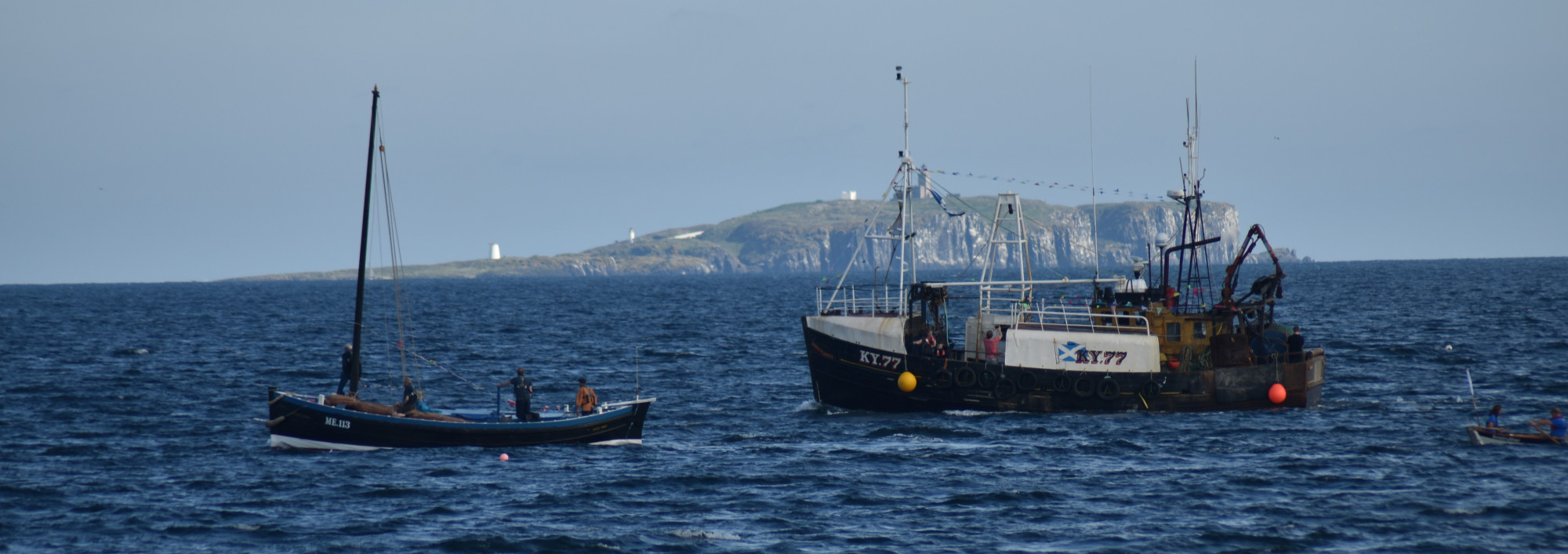

The Cellardyke Echo – 8/8/2019

1890

The Scottish herring sea has not been so hopeful at the end of July for the last ten years. This is never so true as with regard to the size, &c, of the shoals. A friend made the run of the coast to Berwick on Tuesday. All was bustle again at the pier. The buyers, who follow the shoals like the gannet, now at Yarmouth, now at Anstruther, are in the meantime at Berwick, but he was told by one veteran, ” I’ll take chance of the oil, Bailie, and cure every fin.”‘ Owing to the storm’ only four of the Eyemouth fleet were at sea, but with the key to the Edinburgh market in the hands the trade, the price was high as 7s a basket The Fife boats are doing well Shields, although the towage makes far the most expensive port on this side the North Sea. One salesman says that the outlook has seldom if ever been bright in the Tyne. Several of KY. fleet have likewise met with remarkable success in the North. With one Cellardyke skipper it was little else than a toss up to continue at Wick, but in the interval he fished so well to remit £65. We were told at St Monance of cheques of £50 to £100. One grizzly sea dog at the Granary End assured us ” there was never sae mony bawbees afore at Pittenweem in the month of July.” Cellardyke has had its own share in the fortunes of the sea. No snowball ever so gathers a herring shot, but the rumour is on every lip of remittances of £70 to £150. The success, however, is by no means general. Some experienced skippers have hardly as many shillings. As an instance in point, one skipper had a take of fifty crans, while another within hail was actually clean. There has also been serious loss of tackle. Thus messages are to hand every day post and telegraph for the wives to set out by the first train to mend the nets. True it is “a fisher’s wife, an eident life,” for the errand to-day is often no pleasant one in view of the crush at the fishing stations, where, we said last week, lodgings are at such a premium that the stores are being fitted up as a kind of barrack rooms. As yet little or nothing has been done the Firth, but in its palmiest days success was only expected with August. Thus as many as 200 boats would lie from day to day on the sands of Crail till the signal gun was fired on the eve of Lammas. A shoal of bafferts or stinkers are nightly at play, but so far only a few baskets have been fished in the offing. It was curious see the scramble by the cadgers so that the price rose to 5s, or it may be 7s a basket. The Guiding Star, of Pittenweem, tacked to Anstruther about midnight on Tuesday with 41 crans, which were bought by Mr Thomas Dunsire at 13s a cran. The galliot arrived at Anstruther with a cargo of 90,000 cubic feet of staves consigned Mr Cormack. This will make the cooperages ring in view the low stocks both north and south. We hear of few sales, but holders are not disposed to take less than 4s.

1 week later

The Cellardyke boats at the Northern stations are reported be doing very well, a good number having already upwards of £200 to their credit.

1891

The inquiry into fishing vessels lights was held in the Town-Hall, Fraserburgh yesterday. ‘The inquiry was conducted behalf of the Board of Trade Mr Noel Malan, Inspector of Fisheries, and Captain Edward Chichester, R.N. Mr Bums, Inspector of Customs, and Lieutenant Haggard, R.N., divisional officer Coastguard, were also present. Ten fishermen attended, and those who did attend were brought from their work. …… George Watson. Cellardyke, said he worked both lines and drift net, and had been 25 years master of a boat along that part the coast They never used more than one light, but on their own part of the coast in the south Firth they used two, and they thought it was a very good plan. Their lights were fixed to stanchions, 3 feet and 10 feet high. It was, he said, quite possible to have them 10 feet high, but it was easier and better have them lower. They had to fix on the light before they got it up. This was sometimes very difficult to do when the boat was rolling. The higher light was forward, and the second one was about midships.

In answer Mr Malan, said only some trawlers tried to clear the nets, and only some of them carried proper lights. On the whole, and speaking from 20 years’ experience, he was strongly of opinion that two lights were best. None of the boats he met there carried two lights, and he only followed the custom there.

1892

The new premises in course of erection for Thomas Swinton, baker in George Street, Cellardyke, was the scene of a serious accident on Monday. The previous tenement is now demolished, while the different walls, &c., are being repaired. The builder, Mr Laurie, along with an apprentice named James Spence, was employed at the oven, and in digging near the foundation of a wall upon which a high brick wall had been erected it suddenly collapsed, and buried both under the debris. The other employees were speedily at the spot, and both were extricated, but Spence was insensible. He was bleeding freely from two wounds in the head, but Laurie, although suffering from pains, especially in the side, was able to walk. A carriage was speedily procured for them, and Spence was taken home to Pittenweem, where Dc Cumming, presently acting for Dr Flaxman, was called. The lad’s head was deeply cut, and the doctor stitched the wounds. It is hoped that both, with a few days’ quiet, will be able to resume their work.

1893

Fraserburgh Police Court. (Disobeying berthing master.) At this court yesterday—Bailie McCocnachie on the bench George Murray, skipper of the fishing boat K.Y. 71, of Cellardyke, was charged with a breach of the harbour bye-laws by refusing to remove his boat from one berth to another when ordered to do so by assistant berthing master. Accused denied the offence but was convicted evidence. The magistrate spoke in severe terms to the accused, and fined him 10s with the alternative of 5 days in jail.

COLLISION AT SEA. NARROW ESCAPE OF HERRING BOAT. A serious collision occurred between a steamer and a herring boat off Aberdeen this morning. About two o’clock the cobble Alice, of Cellardyke (KY. 1676, John Bett, master), was lying at the fishing grounds, about 20 miles off Aberdeen, when all at once a large steamer ran close astern of her and carried away part of her mast. The steamer was the Rita, Copenhagen, bound for Fraserburgh in ballast. At the time of the collision tbe Alice was flying her signal lights, and it is supposed that the man on the look-out on the Rita had given the wrong directions the man at the wheel. As soon as the captain the Rita became aware what had happened he ordered a boat to be lowered, and the steamer lay aside the damaged craft till the whole of her nets had been hauled. The steamer then towed the Alice into Aberdeen bay, and did not leave her till a tug from the harbour came out and took her in charge. The captain of the Rita paid the charge for towage.

1895

Fatal Accident at Sea —Fisherman Killed. —On Tuesday afternoon the KY. boat Providence, 263, at present engaged in the herring fishing at Aberdeen, put into the harbour with the body of David Moncrieff, one of the crew, who had been fatally injured at sea. The particulars of the sad accident appear to that at about ten o’clock in’ the morning the skipper, David Watson, gave orders to push out the boom of the jib-sail, when a gust of wind swung the boom round, and, striking Moncrieff on the head, squeezed him against the side of the boat, killing him almost instantaneously. Moncrieff, it is understood, was about 30 years of age, and leaves behind a widow and child, at present residing at Footdee. Deceased was a native of Cellardyke.

The Cellardyke Echo – 25/7/2019

1890

Accident to a Fisherman at Aberdeen.—On Friday a somewhat serious accident occurred to Robert Murray, skipper the herring fishing boat Morning Star, of Cellardyke, KY 9. The crew were proceeding to the fishing ground, and while going down the channel the boat was run into by one of the local craft returning to the harbour. Murray was standing on the bow of his own boat with cork fender in his hand to lessen the force of the blow, and while doing so his left leg got entangled with a rope hanging from the boom of the colliding boat. He tried to extricate himself, but this could not be done in time to prevent the limb being broken. The Morning Star returned to the harbour, and Murray’s injuries were attended to.

Arbroath

FISHING BOAT STRANDED. While the fishing boat, Gem of the Ocean  KY 1953. Cellardyke, (David Reid, skipper), was leaving the harbour on Friday morning last for the herring fishing, she drifted the rocks at Danger Point. Several other boats went to her assistance and endeavoured to pull her off, but the tide was receding and they were unsuccessful. She remained fast for number of hours, and her nets and fishing gear were brought ashore as to lighten her. The boat was successfully floated with the afternoon tide, and it was then found that she had sustained little or no damage.

1891

DEATH OF MR GEORGE GOURLAY THE HISTORIAN OF THE EAST ‘ NEUK OF FIFE.

By the death of Mr George Gourlay, stationer Anstruther, which took place at his residence, High Street, East Anstruther, on Wednesday, the East Neuk of Fife has lost one of its best known and most respected inhabitants. Though moving in a humble sphere of life, Mr Gourlay attained to great local fame as an author, and his name has become pretty well known in the literary world. He w born in Pittenweem on 12th January, 1832, and at his death was in the sixtieth year of his age.

His father. Mr Andrew Gourlay, was a bookseller and bookbinder, and carried on business tor upwards of sixty years in Shore Street, Anstruther. George was the eldest son of the family, and when as a lad he was much about his father’s shop, where he acquired a taste for reading. After finishing his education, he was apprenticed to the trade of a shoemaker. His own inclinations lay in a different direction; he would have preferred to have followed his father’s business, but in a fishing town on the coast of Fife at that time the book trade was far from being a lucrative business. He was never well adapted for following the trade of shoemaker, as he suffered from infancy from defective vision. He served his apprenticeship, however, and worked for a time as a journeyman, and also partly on his own account. Getting tired of a sedentary life, he obtained a situation as supercargo on board a small vessel, the James Bain, which plied between Elie and Leitb. Though these voyages were short, and the vessel never ventured beyond the Firth of Forth, yet the experience he gained of the sea and seafaring life were of practical value to him in after life. He continued in this situation for two years or thereby, when he returned to Anstruther, and sat down to the shoe- maker’s stool once more. Shoemaking was but a poorly paid industry, and with the physical defect under which be laboured his earnings were but small. The trade was not congenial to his tastes, although the quiet sedentary nature of the occupation was very favourable for mental reflection. While working at his trade he began to contribute to the press, and the weekly penny newspapers then beginning to grow popular, the idea struck him that he might add a little to his income by retailing them. Meeting with good encouragement in that line, he conceived a novel idea. He had a small wooden house constructed, and set on wheels. This he fitted up as a book and newspaper stall. Every morning he took up his position at the pier, and vended his literary wares amongst the fishermen, and at night the stall was wheeled back to his house and stored safely away. He was now in his real element. He found ample leisure to read and think, and, besides mingling daily amongst the fishermen, he became familiar with their habits of life and peculiar traits of character. Old salts whose life-voyage was drawing to a close would come down to the pier and sit in the sun, and there they would spin their yarns, and recount the adventures and hardships they had experienced. Mr Gourlay was an attentive listener to the ” old sailors’ yarns, and these he stored up in his memory, which was remarkably retentive. About this time he began to contribute to the local press. His first essay in literature was a series of stories and traditions of the Fife coast. A sympathetic paragraph on the death of Dr Black, a much-respected medical practitioner of Anstruther, which Mr Gourlay wrote for one of the Fifeshire newspapers, attracted considerable attention. He afterwards became a local correspondent for the Dundee Courier and the Weekly News, a position he filled with painstaking ability up to his death. The business carried on in the house on wheels never rose to be a very paying concern. After two years he took a shop in the High Street, and about this time also he got married, and the necessity for pushing business became more urgent. His wife proved a true helpmeet. She thoroughly sympathised with his tastes for reading, and proved very helpful in his literary labours. In early life he read much but as years wore on his sight became weaker and weaker, till he could only read and write with difficulty. Reading was a necessity, and his wife had a taste in that way, and she always read whatever book her husband wished. Mr Gourlay was a keen antiquary and a lover of history, and in regard to all that pertained to the history of his native county he was looked up to as an authority. In the course of his life he collected a splendid library, comprising many valuable and rare works. What was read to him he never forgot, and if anyone wanted a reference or a quotation they had only to ask Mr Gourlay, and he would recite the passage, and tell them the title and page of the book where it was to be found. Dr Rogers, of London, obtained much valuable information from Mr Gourlay, and they often corresponded together, but they never met but once.

In 1879 Mr Gourlay published his first work “Fisher Life, or the Memorials of Cellardyke ad the Fife Coast.” The book was well received of the public and the press. At the Edinburgh. Fisheries Exhibition Mrs Gourlay had a stall, on which she sold what remained of the edition. The fisher people crowded round the stall, crying to one another, ”Here’s Geordie Gourlay’s book, man, we maun buy it.” The book is now out of print, and much sought after by collectors, A series of papers entitled “People and Places about the East Neuk ” were contributed by Mr Gourlay to the columns of the Weekly News. These he afterwards collected and published by Messrs W. & D. C. Thomson, Dundee, under the title of “Old Neighbours, or Folk Lore of the East Neuk ” His last work, ” Anstruther, or Illustrations of Scottish Burgh Life,” was published in 1888. All these works are highly interesting, and are full of quaint and pawky stories, old legends, and the reminiscences of the hardships and dangers of life, to which the hardy fishermen of our coasts are subjected. The last mentioned works are still on sale. One great peculiarity of Mr Gourlay’s mental capacities was his memory. While acting as local re-porter he took no notes. He listened, and so gifted was his power of concentration that he would return from even a stormy Town Council meeting and dictate to his daughter, who acted as his amanuensis, a full and correct report of the proceedings. It was his habit when he heard a good story to come home and get it written down at once, and then the copy was laid aside so carefully and methodically that he could lay his hand on it at any time.

His love of antiquarian research amounted to a passion. In the course of his life he has collected copies of the inscriptions and epitaphs on nearly every tombstone in every kirkyard in Fife, from Burntisland on the south to Newburgh on the north, and all along the coasts. This may appear to some to have been a mere “hobby,” but there is a purpose in it notwithstanding. The work was laboriously and carefully performed. He made pedestrian excursions to the various kirkyards, accompanied by some of his family or friends, whom he employed to do the copying. Latterly, his eldest son, William, was his companion in these excursions. With an exercise book in his pocket, a few biscuits for luncheon, they would start off on long pilgrimages to distant burial places. Often the stones were so overgrown with moss or so broken and decayed that they were scarcely legible. But nothing daunted the letters were scraped out with a knife, or, failing that, an impression was taken by “rubbing.” Many curious and quaint specimens of tombstone, literature were thus stored up, from which Dr Rogers and others have been supplied. But the collection of- these epitaphs had another advantage— it gave him a complete knowledge of the people of Fife, landed proprietors, and others, which often proved useful as references in his literary work.

In all municipal matters he took a deep interest, but though often requested to allow himself to be nominated for the Council his modesty was too great to accept the honour. But in all points of difficulty he was invariably consulted, and to no one else could then apply for more authentic information. Mr Gourlay was- engaged on another work on Fifeshire, which he has left unfinished. He has also a vast collection of notes on all sorts of folklore and such literature, which might be valuable. But his work is over. He took ill about a month ago, but though his friends thought it was only a slight indisposition at first he gradually grew weaker and weaker. Still no serious consequences were apprehended. His mind was as clear as ever, and even up to the week before his death he continued to dictate para- graphs for his daughter to write to the Weekly News. On Wednesday last a change set in, and about three o’clock in the afternoon he passed peace- fully away. Mr Gourlay was a member of the Established Church, and was a true, earnest Christian, but though often urged he always declined to take office in the Church. He has left a widow and three sons and a daughter, for whom great sympathy is felt in their sore bereavement.

The Cellardyke Echo – 18/7//2019

1872

Questions as to Public Property in Cellardyke. —One of those delicate questions as to public right, which have involved the Scottish burghs into so many costly and vexatious law pleas, has just been discussed in Cellardyke but as some misunderstanding may exist on the points issue, we may be pardoned for making a few remarks by way of explanation. The burgh property of Kilrenny was granted in 1614 in a charter David Bethune, the then lord of the barony, in which the harbour of Cellardyke, with the vacant ground, roads, &c, were given by him to the town, exactly in the same way as Sir William Sandilands gifted away about the same time similar privileges to St Monance, and Sir William Anstruther some years earlier to Easter Anstruther. Cellardyke has been “clipped” of one-half of her sea braes, which were her chartered right as far as the Golden Strand;” but the town’s right to the vacant ground  at the harbour has never been disputed, though a number of years ago the managers of the burgh, on sound reasons of expediency at the time, surrendered the space in question to the Teind Committee—that is, a number of the fishermen who are chosen from amongst themselves to manage the fish tithe tack between themselves and the superior, Admiral Bethune of Balfour House. When the surrender was made the “harbourhead” was of little or no value as burgh property, and was only an endless source of dispute amongst the fishermen; but these days of big herring boats it draws an annual rent of fully £15. There would seem, however, to have been some confusion of opinion to whom the harbour really belonged. The old charter, and the fact that, as in I819, the Town Council let the ground for curing herrings, clearly proved it to be the property of the burgh; but on the other hand the pier has been kept in repair by the Teind Committee as if the superior had the same right to the harbour as to the teinds. There was thus certain risk of the shore being lost to the fishermen and the the inhabitants generally, in time it would have been claimed by the tacksman of the teinds, who, for that matter, might be in direct opposition to them ; but happily any such untoward result has been prevented by the enlightened and public-spirited resolution of the Town Council, who, at the suggestion of Provost Martin, agreed at special meeting on Friday, to take possession of the ground as integral part of the burgh property. In some admirable remarks on the bounden duty of the Council to keep an ever watchful and jealous eye on the rights and privileges of the community, the Provost said that it would only be justice to the fishermen —after they had expended such a large sum on the maintenance of the harbour— to devote the rents of the ground in question to the same exclusive purpose, or to the improvement of the beach, in order to lessen the undue fatigue and exertion pulling up the boats. This very judicious proposal was also warmly assented to by the Council, and there is now every reason to hope that what might have been the fruitful source of heartburning and litigation, has been arranged to the lasting interest and advantage of the fishermen of Cellardyke and  other inhabitants of the burgh.

1873

The Herring Fleet of 1873. —According to the preparations now so actively begun, the present season will see the largest herring, fleet ever sent afloat from the East of Fife. Cellardyke promises to contribute about 175 of the finest and largest boats to the Scottish herring squadron, and Pittenweem can muster over 50, while St Monance, that true spirit of progress which distinguishes her, soon will be able, if required, to send 105—making a total for the three stations of 335 first-class boats.

Artists in the East of Fife.—There are present many as five artists —including the distinguished landscape painter, Mr Samuel Bough, of Edinburgh—sketching various points of interest in the East of Fife. The favourite subject with all seems to be the romantic sea shore, where the busy fisher craft may be everywhere seen speeding along with dark, brown wings ; but the memorable and picturesque, wherever it may exist in the neighbourhood, is likely to have more or less of the attention of these interesting visitors.

The Harbour Works.—’The reconstruction of the eastern breakwater is now fairly in progress, and the ponderous diving bell belonging to the Fishery Board which was removed from the Anstruther works to make some repairs in the entrance of the Albert Dock at Leith, is once more in action, having been brought down the Forth in the trim fishing craft of Skipper Alexander Brown, of Cellardyke. The bell is about six tons in weight, and its removal or rather launch from the Board’s store to the dock crane for shipment till it was fairly ” housed” on the platform at Anstruther, was accomplished from first to last without single ” hitch.” No time has been lost in resuming deep water operations, and the divers are night and day work both by the bell and the apparatus in clearing away abed for the monster concrete blocks which are lying ready for submersion, while others are being moulded as fast strong and willing hands can overtake the interesting and important work. There are now about fifty men at the work, which is being superintended in every stage by Mr Philips, inspector, under the engineers of the Board.

Scarcity of Men for the Herring Fishery.— Besides our own hardy sons of St Peter, about thousand men are required for the herring boats of Cellardyke, Pittenweem, and St Monance. Not few of our Fife labourers and tradesmen are to be found so employed, but the large proportion of the men are Highlanders and Islesmen, with good sprinkling of the sons of St Patrick, who, to use a rather favourite saying, “like to tak’ a sea hold for the benefit of health and the purse.” In these days, however, of high wages, some may doubt the prudence of leaving work on shore for risk on the sea; but then, on the other hand, the prospects of the herring fishery were never so encouraging, and halfdealsmen especially had never the same chance of success as the present time. ” Och, its blessed relase from the slow of the factory, exclaimed an Irishman rejoicing one day in the fresh sea breeze, while many cautious Highlandman will tell you he buttons his pocket on the nine or ten sovereigns, or perhaps more, he may have earned by the season, ” It’s just a Godsend for the rent and the cauld winter,” and apart from mere gain we know many a decent and intelligent villager worn to the bone by the toil and sweat of the summer field or crushed and cramped by unhealthy labour, who has recruited for years both his strength and spirits ” by six weeks at the drave.” Under these circumstances, and with every expectation of an abundant season from the immense shoals descried at sea, there is little doubt that sufficient number of men will be forthcoming, though it is very much to be hoped that all that purpose to “reap the harvest of the sea” will, the season is early, be soon on the ground, and thus prevent any chance of delay and disappointment in filling up the berths.

The Cellardyke Echo – 11/7/2019

1870

ANSTRUTHER. Prosperous Gas Company.—The annual general meeting of the Anstruther and Cellardyke Gas Company was held in the Town Hall on Wednesday evening—Mr Thomas Foggo in the chair. There was a small attendance of the shareholders. After the minutes of the various meetings had been read, the Secretary submitted the report of the directors, which showed the income for the year £1084, the discharge as £813, leaving balance of £271, out of which they recommended dividend of 8 per cent., with a reduction in the price of gas of 3d per 1000 feet, or from 6s 6d to 6s 3d.

The white fishing having closed for the season the shores of the East of Fife are now from morn to eve the same eager and active scene in the way of preparing for the herring fishing, which the comfort and well-being of the fishermen so much depends. Already many of the boats have left for Peterhead, and others will daily follow they complete their preparations for the north, which are being hurried on with all manner of expedition. Much labour, however, is now saved to the fishermen this busy season by the use of the traction engines belonging to Mr Gilchrist’s steam cultivators, and these are at present busily at work in launching the large boats at Cellardyke The fine dry weather is also enabling great progress to be made in fitting on the nets and other gear, and everything is going on well for an early trial at this all important venture.

1871

LEFT HIS HOME, on 26th June, JOHN WALKER, Taylor. Was last seen in St Andrews on his way to Cellardyke, Information regarding him will be thankfully received at 101 Nethergate, Dundee.

HOME PICTURES FROM THE EAST OF FIFE. Surely the merry season in all the year is the gladsome Lammas time ; it is the harvest of land and sea. Yes all day long, in the sweet sunlight, the farmer is bringing home the golden grain, and abroad, in the crimson and gold of the beautiful even tide, the fisher is drawing forth the silver spoils of the no less fruitful wave.

You see yon gray steeples by the sea, that, like hoary -warders, have raised their heads through sun and rain for nine hundred years ; you see you storm-battered harbours covered with tangles like the ancient rocks, and piled up as rudely as if the old builders had wrought in an age before man had come to use either the chisel or the trowel. But long before all these- by every sandy and shingley nook along the green old shore —there would come in the season, looking in the distance like the bank in the bosom of the sea wind, hosts of fisher ships —the Dutchman in his stiff galliot, the Frenchman in his long pinnace, and the haughty English crew in their deep-waisted smack, with many a native fisher besides in his dancing coracle, light boats made only of wild beasts’ skin fastened a frame of wicker-work. The herdmen of Abraham and Lot strove on the plain until their masters had to go, the one to the right and the other to the left. How, then, could these old fishers—men of different tongues and different complexions, without a single bond of union between them, but, like the old enemies of France in England, suckling hate with their mother’s milk— meet here in peace It could not be; and so we know the sea often rang all night long with the noise of battle, and the tide in the morning bestained with blood, until the strong hand at last gained the mastery.

“For why, because the good old rule

Sufficeth them ; the simple plan

That they should take who have the power,

And they should keep who can.”

A battle would take-place at any moment, either on the beach or in the ships; but the old chroniclers tell us that the fewer herrings the more bloody heads, or that the more barren the seas the greater were the wrongs and the robbery. Though after all the storm scud never flew so fast, but now and then there would be a gleam of light making everything bright and beautiful where it fell. It happened this way holy men, wasted and weary in body, but with hearts strangely strong and full of fire, would seek out these far fisher gatherings, and preach to them of Calvary and the Cross till the hearts of the people would be so strangely melted with their sacred eloquence, that they would bring gifts to the altar of God, and there all night long, on their knees and tears, pray to sweet St Mary for grace to live and love all men as became her children.

Such is the fisher life on our shore, on which the light of history first breaks it is a glimpse of what the world was in the dark ages, but let us hasten to our own happier and more peaceful times. Across the little streamlet from the chapelle” of the Royal Bruce, half hidden in the dirt and litter of a dung-stead, is the blue stone cave, where the first Archdeacon of St Andrews —the blessed St Monan—laid down the cross to take the crown of martyrdom, being here butchered by the Danes while in the act of his devotions one thousand years ago. The place was christened with the saint’s name, and has prospered ever since; and at the present day we have a thriving fishing community of about 2000 souls, who contribute above a hundred herring boats to the ingathering of the wealth of the sea. About two miles east along the coast is the great brown cloven rock with its springlet of crystal water, where St Fillian, who gave his days and nights to writing the Scriptures, found refuge in his wanderings from the storm and the rain. The monks told many wonderful miracles of this holy man; such as that heaven so loved him for his blessed work that his right hand shone night and day with a light more beautiful than a waxen candle ; and that it was he who gave King Robert and Scotland the deathless victory of Bannockburn; but many changes have been wrought about this venerated spot.

Men look with curious wonder at the grand old Abbey Wall of St Andrews ; but the monks of Pittenweem had a no less stately defence for their ancient monastery. In the days of our great-grandfathers, however, tower and archway were torn down that a quarry might be found to build a pier and retaining walls for a coal company, but the project ruined everybody connected with it, though the late Mr Lyon, the historian of St Andrews, would have told you that this was just the fate of all such sacrilege.  Still since the days of these self-same monks, fishers have been found increasing in Pittenweem; but however curious and romantic their history may be like that of their neighbours of St Monance, are naturally invited to turn to the greatest of our fisher beehives namely, Cellardyke —as affording for our narrative at once more scope and variety the ordinary experiences of everyday life. Let us endeavour, then, to give a glimpse of the inner life of a Scottish fishing town, cross the white door step any point of the long street, which, notwithstanding many busy feet, has not yet lost the snowy hue of the Sabbath, and enter the cheerful and substantial-looking apartment. You may see a glossy-headed maiden, with swift-moving fingers weaving the long rents or making good the torn fragments of a herring net. She sings merrily to her work, till all in moment, perchance, the song dies her lip, and the blush mantles deep on cheek and forehead. Would you know the mystery that thrills her heart? Well, her old friends Maggie and Jessie are so happy in houses of their own, and somebody told her only the other night that at the end of the drave it would be her turn too. Girls resting on sofas, with nothing in the world to do but work crotchet and turn the pages a novel, may, and often do, at such times give themselves to no end of moonshine and dreams; and, after all, Hope never , paints more beautiful pictures, or colours her scenes with more crimson and gold, than to the eyes of the lover and bride, whatever or wherever her sphere may be. But the daily task at this season of our fisher maiden is too difficult and complicated to allow her judgment to swing wrong for want balance. Think of this: the herring net on which she is busy, and which is sadly rent and tattered, sixty yards long and about ten yards deep, and is composed of no fewer than 388.800 inch squares, every one of which she is expected to make complete, and the texture of which, in the case the light cotton nets so much in ‘favour in the early deep sea fishing, has almost the fineness of sewing thread. The blood came to our maiden’s cheek, as her heart beat with quicker pulsation at the thought of the great future before her; but her fingers and her song are as busy as before when an eager step bounds the stairway. She knows it to be the footfall of a cherished companion. “Will she have heard the news who can have told her?” already asks our maiden at her heart as her friend springs into the apartment; but the mystery is soon explained. Maggie s heart is running over with delight, but no less at times with doubts and fears ; her sweetheart also has pressed her into a promise of marriage at the end of the fishing, and more than half -a-dozen lasses besides are sure to be proclaimed if it “only turns out a good drave,” continued the anxious Maggie. “Oh, how I wish oor folk wud dae weel this year, its sair thing to gang the gither wi’ little; at least that’s what Tam’s  minither says noo, though if a’ be true that’s said in Cellardyke she was ance as as ither folk for a the boats and hooses she has this day. Our maiden has stopped her work first to rejoice and then to sympathise with her friend, and lastly to confess that she is in the very same interesting position herself. “I hope wi’ a’ heart,” continued the bride, “the boats will bring in plenty o’ herrin’; but neither him nor me are tae fret aboot it, we’re to do the best we can; and, as he says, if it rains the tae day it’ll maybe be fair the next; an’ aftera’, what is life without love?. And mind, Maggie, yon bonny words in Kilrenny kirk the ither Sabbath, turning up my book at njcht I see that Willie has marked the place, I like to read them for somebody’s sake: Except the Lord build the house, they labour vain that build it : except the Lord keep the city, the watchman waketh but in vain. It is vain for you to rise up early, to sit up late, to eat the bread of sorrows : for so he giveth his beloved sleep.'” Maggie heard the beautiful passage read with heartfelt devotion, but as she rises to go, she cannot restrain the great wish with which she is evidently filled night and day—” Eh ! what a blessin’ a guid drave wud be.” You hear the coast merchant, the shoemaker, and the mason, constantly repeat the same sentiment, and describe the benefits of a prosperous herring fishing, with the consequent ruin of the district if failure. But the cry can never move the heart so much as when we hear it from the industrious fisher community, to whom it is not merely a thing of gain, but a matter of bread, which concerns, as we see, in the most vital manner the joys and happiness of the year ; and to whom, the first instance, it entails an amount of toil and sacrifice which no other class is called upon to bear, and which, as in the case of the present long failure of the home fishing, must be met year after year however fruitless the return may be; but you cannot turn your step without seeing that the preparations for this season is the absorbing work of the fisher household. This is especially seen in that curious busy operation —the “barking” of the nets—but this phase of fisher life like the going to sea of the boats, we must refer to another chapter.

The Cellardyke Echo – 3/7/2019

1865

CELLARDYKE. The Late Boat Disaster

The total subscriptions for the sufferers by this calamity now amount to £338 1s. Captain Corstorphine of Pittowie has sent a cheque for five guineas, accompanied by the following letter, addressed to Messrs Sharp & Murray

Kingsbarns, 23rd June 1865.

Dear Sir, When a boat belonging to St Monans was lost on June 1863 I collected a fund for the education and outfit of about twenty children who were rendered destitute  by that sad disaster. The judicious application of this money by the Rev Mr Foggo justifies me in contributing five guineas from the remaining balance towards the collection now being made at Cellardyke for a similar purpose, and which I hope may be no less instrumental in educating and advancing the many children now fatherless by this deplorable calamity.

1866

Capture ofTwo Sharks.—Off the coast during the last two or three days, the white fishing has been very productive, large takes of skate, ling, and cod having been made. Yesterday afternoon, one of the deep-sea fishing-boats brought to the harbour two monsters of the deep in the shape of brown sharks. The one measured from nine to ten feet in length, and the other, a formidable-looking creature, from twelve to thirteen feet. From ten to a dozen good-sized codlings were taken from the stomach the one, and a splendid halibut from that of the other. Both sharks were brought to Dundee and disposed of to a dealer, who will doubtless make a good profit by the disposal of the oil from both fish, and will also add a handsome addition to his gain by exhibiting the carcases of the ugly and voracious fish to those who have never seen a shark before. We believe that both of the sharks were taken by Cellardyke boats somewhere on the coast off Peterhead, and were not that they took the bait so far from land, we would advise bathers to beware, for the largest of the brutes taken yesterday would have thought no more of snapping at a man’s leg than it would of swallowing an ordinary sized codling.

1868

Exposure of Property.—On Saturday last, the small dwelling-house, with yard attached, at the west end of Cellardyke, belonging to the trustee on the bankrupt estate of Thomas Tarvit, fisherman there, was exposed for sale public auction in the Town Hall of Cellardyke. The property was put at the upset price of £120. which was successively reduced to £100, but no offer was received and the sale was adjourned sine die. In this, and in other cases, it would appear that the demand for property is decidedly on the decline in this neighbourhood, owing, no doubt, to the general depression which has followed the recent failure of the fishing.

1869

Local Fishing Fleet.— The number of fishing boats of all kinds registered under the provisions the Fisheries Act of last year, belonging to Cellardyke, including the few owned in Anstruther, is 176. Of these 26 are yawls of from two to five tons, and having a length of keel from fourteen to twenty four feet. The remainder represents the herring fishing fleet of the present season, with the addition of three four new ones not yet finished. These 150 boats are from fifteen to twenty tons, and have a length of from thirty-three to forty-seven feet. There are fifty-one first-class boats which the Act defines to be those of fifteen tons and upwards.

Valuable Ground. —On Saturday last the vacant ground the beach of Cellardyke harbour was let by public auction for boat stances, for the ensuing year. The ground belongs to the superior of the burgh, but the tacksmen of the Teinds have the right to occupy and sublet it, although this the first time it has been done- so publicly, the stances having hitherto been taken by the first comers and paid for almost at will, some paying 15s for the season, and some nothing at all. The ground affords room for four stances with the probability of a fifth. There was a large attendance and from the first the bidding was keen and general. The first stance was thought by some to extravagantly high at 57s, but the other three rose to 60s each.

Sudden Death.-A melancholy instance of uncertainty of life occurred at Cellardyke on Tuesday last in the case of Mrs Murray, the respected mother of Mr David Murray, the well-known manufacturer and merchant. Mrs Murray had been in her usual health, and was engaged in some household duties, when in the course the forenoon she went over to a neighbour’s and complained of passing giddiness. She immediately afterwards sank into insensibility, when she was conveyed to her own house and medical attendance sent for, but although every care and attention was bestowed on the aged sufferer, she never rallied, and expired in the course the afternoon. In the opinion of Dr Macarthur death had resulted from disease of the heart. Mrs Murray was well advanced in life, and had been for several years widow, her husband, Mr Thomas Murray, having long acted as one of the managers of the burgh. She was connected with some of the oldest and most respected families in Cellardyke and she occupied a high place in the esteem and affection the community.

The Cellardyke Echo – 29/6/2019

1861

Arbroath – Boat Building.—This branch of nautical architecture is being prosecuted here with more success than what it ever was ; the builders, Messrs Garland and Sutherland, being highly patronised. In their yard, at present, is a splendid specimen of their work, a large boat, beautifully modelled and fastened, measuring 47 feet in length by 14 of beam, for Cellardyke fishermen.

Nine Cellardyke boats arrived at Montrose on Tuesday, with their takes, which amounted in all to about 30,000 of the largest and finest haddocks that were ever offered for sale.

1862

A grey shark, 18 feet in length, was captured at Cellardyke, few days ago in the act of swallowing a cod caught in some lines.

On the forenoon of Monday last, as carter belonging to Cellardyke, named David Imrie, was driving a cart loaded with mussels to Pittenweem, the horse, when within a short distance of that place, became very restive and unmanageable. While attempting to seize hold of the bridle, he was unfortunately thrown the ground, the horse at the same time starting forward; one of the wheels of the passed over his body, crushing him very severely. He was conveyed home as promptly possible, and surgical assistance obtained, when it was ascertained that he had received very serious internal injuries. He still lies in a very precarious condition, but hopes are entertained of his recovery.

New Net Factory. – It is gratifying to learn that the business of this place is to be considerably increased in the building of a net factory by the indefatigable firm Messes Sharp and Murray, general merchants. The site of this building is to be at the back the town. There is no doubt that this will be great boon to the fishermen, as they will have a constant supply of nets, and in all probability a much cheaper rate than at present

1863

The Coming Drave. —As the season is now rapidly approaching, preparations are at length being made for the forthcoming herring fishing. The large amount of stock which has accumulated from the deficient fishing of the last two seasons, has rendered comparatively little addition necessary this year. Owing to this cause considerable number of coopers belonging to the locality had to remove, or to betake themselves to other employment during the winter and spring, very few being at work except such as were required to prepare the white fish for market. The cooperages, however, are again showing signs of activity, and at the present there are over sixty men and apprentices in the employment of the several curers Anstruther and Cellardyke. We may also state that in several cooperages manual labour has been lessened to some extent, by machinery being used in the dressing or preparing of the staves and ends. In the Messrs Welch’s steam sawmills, Pittenweem, machines for this purpose have been long and successfully in use, and more recently they have been fitted up the premises of Mr J Cormack, Cellardyke, and Mr Forbes, of this place—the latter gentleman, by the way, using a windmill a motive power. The stock of this season will probably be the largest ever provided in the district; and notwithstanding the discouraging prospects of the trade, there seems no abatement of enterprise on the part of curers. As indicating the present unsatisfactory state of the herring market, it may be stated that a cargo of herrings sent from here to Ireland were lately sold, and only realised a return to curers of little more than half the price which they had paid to the fishermen. Fortunately, however, the greater part of the fish cured here last season were sold at remunerative prices, previous to the fall of the Stettin and other continental markets.

This season the white fishing has proved very successful—the supplies of fish being much larger than for many years past. In former times the drave was regarded the fisherman’s harvest, but this year or two past the line fishing has not been the least fruitful source of his income. As showing the enterprise with which this important branch of local industry is now conducted, also of the large outlay required, the following particulars respecting it may not be uninteresting. __ At present there are thirty-eight large boats belonging Cellardyke engaged in this fishing, all of which are nearly new, having been built within the past three or four years. They are from forty to forty-five feet in length, with breadth of beam of about fifteen feet, and their sails —the colour and shape of which are so well known —measure altogether over 300 yards. For the most part, they have been built in the locality, and cost, when fully ready for sea, about £140, The boats are manned with a crew of eight fishermen, each of whom is provided with lines to the amount of twelve ties, or taes, in local parlance—a tie being 144 yards in length, and having 120 hooks attached to it. The lines belonging to boat’s crew thus reach to nearly eight miles, and were those of the whole fleet united together, they would extend to over 300 miles. In addition to these, several crews continue carry their great lines to sea, which was done regularly by the whole fleet few weeks since. A great line consists of nine ties, of the same length as the other, and as forty-one boats were then going to sea, the total stretch line then exceeded 550 miles. At this period of the year, the boats proceed so far to sea as be generally fishing from fifty sixty miles to the north-east of the Bell Rock. To supply the necessarily large demand for bait, about twenty tons, or 230 bags, of mussels are weekly received, from the Clyde -four bags, or fully a quarter of a ton, being used by a crew for each trip the fishing ground, two which are commonly made in the week. Amongst the many indications of progress made in the course of a few years, it is gratifying to remark that the fisherman’s comfort has been largely augmented, the boats having been fitted up with bunks, or small cabins, provided with cooking stoves and sleeping berths. Many improvements have recently, too, been introduced, by which his labour has been materially lessened and facilitated.

The Cellardyke Echo – 19/6/2019

1892

STONEHAVEN. . The Police Commission held its monthly meeting in the Council Chambers on Monday night—….. Mr Craig moved “That notices be posted up within the burgh that offenders under section 261 of the Police Act, so far an persons using obscene and abusive language to the annoyance of persons passing along the streets, would be prosecuted.” He said that there had been considerable complaints of this nuisance on the streets, not only by natives, but by visitors also. Indeed, he knew visitors from Cellardyke who would not come back because of it.

1894

THE HERRING FISHING AGITATION. MEETING AT ABERDEEN. The agitation in favour of postponing the opening the East Coast herring fishing has reached Aberdeen, and a mass meeting of stranger crews was held at Point Law this forenoon. There was an attendance of from 200 to 300 fishermen. ………… The Chairman explained that the meeting had been called in consequence of telegrams received from Peterhead and Fraserburgh, the men there wishing have the fishing postponed for a week. Telegrams had been sent from these places to Torry on Saturday, asking the opinion of the Aberdeen fishermen, but no reply bad been sent; ….. At Peterhead matters had come to standstill because the shots that bad been landed were sold for 6d, 1s. and as low as 9d, he believed. The same state of matters prevailed at Fraserburgh – the fish were so immature it would be far harder catch fish and get nothing for them. He requested a resolution from the meeting the subject…………..Mr Alex. Cunningham, Cellardyke, said it would be rather an awkward thing, now that they were the ground, to make a repetition of the last strike. It was evident that all the fishermen were not of one mind on the subject, and for his part be could not see his way to move a resolution in favour of postponing the opening. ……….

1895

Dundee Courier Summer Outings

….. Now comes Cellardyke, whose wonderfully imposing name gives no  idea of the dignity of the village itself. Right round a curved bay lie the red houses, up and down the streets go picturesque figures of strapping maids and stalwart men in the blue garb of the fisherman, for Cellardyke is a fishing village, and the produce of the sea is to be seen on every hand in the fish spread out in heaps on racks of wood to dry in the sunshine.

A painful shock was occasioned in the East of Fife on Tuesday by the intelligence that Mr David Edie, farmer, Cornceres, had died suddenly that morning on the public road between Kilrenny and Anstruther, while on his way to catch the 7.45 south train from Anstrutber. He arose in the morning in apparent good health intending to go to Edinburgh, where he had consigned some fat stock. When walking down to the Station, he suddenly fell opposite Cellardyke Manse. An Anstruther man noticed him, and ran to his assistance; but Mr Edie only drew one long breath and expired. The body was taken into Mr Ray’s (the minister’s) house, and Dr Wilson who was immediately sent for, found life extinct. This sudden death has cast a great gloom over the district, where the deceased was so well known and so much respected.

1896

North Shields

Amongst the great line Crews a stroke of luck attended the Vine. Catching the early market, Skipper Henderson laid out his fish to so good an advantage that £49 was realised. (This is Daniel Henderson of my house who was later lost on the Bernicia)

In the same article

On Thursday another craft was launched at Leith. She was christened the “County of Fife” by Miss Sprouts, daughter Major Sprouts, Stravithie House. – (This vessel was skippered by Andrew Henderson  nephew of Daniel who bought my house  after Daniel was lost. In this boat he broke all landing records for line caught fish in her first month at sea)

Several Cellardyke crews have been for weeks at Lowestoft, and the highest has not yet got £20. The theorists are telling that a change of wind is required; a northerly breeze would in their opinion send in the shoals, and though one can take this idea for what it is worth, the skippers mean to hold on for a time yet, and give the venture a fair trial.

At Cellardyke Court, Tuesday, Robert Keith, carter, Cellardyke, was charged with having, on the 23rd committed a breach of the peace, and assaulted Walter Millar, farm servant. Accused pled not guilty; but was convicted on evidence, and there were three previous convictions against him Provost Martin warned him that if appeared again would sent prison. He was fined fined 7s 6d.

1897

Yesterday afternoon the Cellardyke fishing boat Reliance arrived off Crail, and the crew reported that during a heavy gale at sea on Wednesday night the skipper, Anstruther Moncrieff was washed over- board and drowned. He was 50 years of age, and has left a widow and three of a family. ( Harry Watson names him as James Moncrieff, )

Death of Provost of Kilrenny.- Mr John Martin, Provost of Kilrenny, died at his residence in Anstruther at an early hour yesterday morning. He had been connected with the public life of Kilrenny burgh for upwards of 50 years. He was a native of Cellardyke, and while still young man was chosen as a manager of the burgh. He continued a manager from 1846 to 1868, when, the passing of the Municipal Elections Act, the burgh was restored to its municipal status, and was returned at the top of the poll for the new Council and unanimously elected Provost. With the exception of two terms – six years -he had been Provost ever since. In religious and philanthropic work he was ever foremost. On account of his death yesterday the bunting displayed in Cellardyke for the Diamond Jubilee was displayed half-mast high. He has left widow and a daughter, who left South Africa week ago to see her father.

1899

Kilkenny School Board. – At a special meeting on Friday night it was agreed to devote £8 for prizes to Cellardyke School, and to order a new piano for the school. Some discussion arose as to the grants under the new Code, and ultimately it was agreed spend a considerable amount on concreting the east part of the playground and also on new furniture.

The Cellardyke Echo – 12/6/2019

1911

A general start was made herring fishing here yesterday, when a fairly large fleet left for the fishing grounds. Towards night there was heavy north-east, breeze, and few of the smaller-sized boats returned without shooting. To-day three boats arrived with an average of 20 crans, the best shot being 30 crans landed the Ruby, Cellardyke. They were obtained from 22 to 45 miles east, of the May Island, and those got on the nearer grounds were of exceptional quality for the season. Prices were from 7s 6d to 10s per cran. A start, was made with curing for the Continental markets.

1912

FRASERBURGH, Thursday. To-day close 4000 crans herrings were delivered 230 boats Fraserburgh. The fishermen obtained remunerative prices, the range being from 22s to 26s per cran. Quality good. The Golden Strand, of Cellardyke, and the Glenogil, Cellardyke, had each 50 crans.

PETERHEAD, Thursday.—Total 6000 crans was landed to-day by 260 boats, equal to the satisfactory average of 25 crans. Nearly all the big catches fell to the credit the local drifters. The KY. sailboat Columbia turned out 50 crans. Prices ran from 16s to 20s 9d per cran.

1913

PETERHEAD, Friday.—Deliveries totalled 4000 for 100 vessels. Highest shot, 120 crans, the local drifter Expert; Peterhead drifter Pride Buchan, 110 crans; Rothesay Bay, Cellardyke. 100 crans, drifter Azarael. Pittenweem, and the sailboat Refuge, Kirkcaldy, 75 each; and the drifter Restless Wave, Pittenweem, 45 crans. Quality rather mixed. Prices from 18s to 34s per cran.

1914

CELLARDYKE. —Kitchen, 2 beds, own key; July, August.—E. Watson, 30 Rodger Street.

SCOTTISH GALLANTRY AWARDS’ At its monthly meeting in London yesterday the Committee the Royal Humane Society made the following awards in cases from Scotland; … TESTIMONIALS……… Thomas Watson, Dove Street, Cellardyke, for his prompt, action in saving a lad who fell into the sea while fishing from the Basket Rock there May 22:

Kilrenny School Board – Wanted – Male Certified teacher for Supplementary Class of Cellardyke School. Singing and drawing essential, navigation desirable, commence 1st September salary, £110 rising £5 annually to £130. Applications with one copy testimonials to C H Maxwell, Solicitor Anstruther by 27th inst.

1915

PRESENTATION TO YOUNG CELLARDYKE HERO. In presence of the Town Council, David Black (15), son of Mr George Black, baker, Cellardvke, was presented with silver watch from the Carnegie Trust, Hero Fund and the parchment of the Royal Humane Society for having, on 21st April, rescued a nine year-old lad from drowning. Provost Black, uncle of the lad, presided, and Mr Hugh H. Souter, depute town clerk, made the presentation.

THREE CELLARDYKE TERRIRORIALS WOUNDED

 Information has been received that Lance Corporal W. Anderson, 7th Black Watch. James Street. Cellardyke, has been wounded in the head, and is in hospital at Boulogne.

Private Adam Lowrie, Shore Street. Cellardyke, of the same Company, has received a wound in the left arm.

Private Alex. Boyter, another comrade, has sustained severe wounds in the face, and is now in Birmingham Hospital

Missing Soldiers

MURRAY.—Lance-Corporal James, No. 27776, 1st Canadian Expeditionary Force, 15th Battalion. F Company, 3d Brigade. Officially reported wounded ’22d April in France. News of him will be thankfully received by his parents. Father, Mr Robert Murray, 4 Rodger Street, Cellardyke, Fife.

1916

CELLARDYKE BLACK WATCH MAN KILLED. Intimation was received in Cellardyke yesterday that Private Alexander Boyter, Black Watch, has been killed in action. The deceased, who was 25 years of age, served his apprenticeship as a plumber with Messrs Gray & Pringle, Anstruther, and was afterwards engaged as a stoker on drifter. He was in the Territorials. It is a year to-day since he was home last. Deceased was the second son of Mr Thomas Boyter, fisherman, Rodger Street.

( Thomas Boyter was later blown up on the Fishing Boat janes in 1917)

CELLARDYKE STOKER ON INVINCIBLE. BFLIEVED TO BE AMONG THE LOST.

James A Moncrieff, son of the late Mr David Moncrieff, fisherman, and Mrs John Gardiner, Forth Street. Cellardyke, was a stoker on board the Invincible.

 In reply to a telegram inquiry, Admiralty stated it was to be feared Moncrieff was among the lost, his name not being included in the list of survivors.

Moncrieff was among the first join the colours shortly after war broke out, and was engaged in the naval battle off the Falkland Islands. He was home on leave a month ago. Previous to enlisting he was an engineer on a trawler. He was years of 22 age, and his stepfather. John Gardiner, is on patrol service. His brother David is in the Flying Corps in France.

1917

Wounded

Royal Scots

Parker 27919 J, Cellardyke

Black Watch

Nicol 290636 G, Cellardyke

1918

Prisoners of War

Pte, Alex Stevenson, Black Watch, Cellardyke, also wounded in the arm

Wounded

Scots guards Watson 12832 A, Cellardyke

1919

FLOATING MINES IN THE NORTH SEA Cellardyke skippers of drifters returned from the fishing grounds at the end of the week report the presence of large number of floating mines in the North Sea. As many as live were seen by the crew of the drifter Maggie, which caused the skipper to alter his course.

Honours

Distinguished Conduct medal

290604 Pte J Birrell, 14th Btn Royal Highlanders. T.F, Cellardyke

The Cellardyke Echo – 5/6/2019

1911

A general start was made herring fishing here yesterday, when a fairly large fleet left for the fishing grounds. Towards night there was heavy north-east, breeze, and few of the smaller-sized boats returned without shooting. To-day three boats arrived with an average of 20 crans, the best shot being 30 crans landed the Ruby, Cellardyke. They were obtained from 22 to 45 miles east, of the May Island, and those got on the nearer grounds were of exceptional quality for the season. Prices were from 7s 6d to 10s per cran. A start, was made with curing for the Continental markets.

1912

FRASERBURGH, Thursday. To-day close 4000 crans herrings were delivered 230 boats Fraserburgh. The fishermen obtained remunerative prices, the range being from 22s to 26s per cran. Quality good. The Golden Strand, of Cellardyke, and the Glenogil, Cellardyke, had each 50 crans.

PETERHEAD, Thursday.—Total 6000 crans was landed to-day by 260 boats, equal to the satisfactory average of 25 crans. Nearly all the big catches fell to the credit the local drifters. The KY. sailboat Columbia turned out 50 crans. Prices ran from 16s to 20s 9d per cran.

1913

PETERHEAD, Friday.—Deliveries totalled 4000 for 100 vessels. Highest shot, 120 crans, the local drifter Expert; Peterhead drifter Pride Buchan, 110 crans; Rothesay Bay, Cellardyke. 100 crans, drifter Azarael. Pittenweem, and the sailboat Refuge, Kirkcaldy, 75 each; and the drifter Restless Wave, Pittenweem, 45 crans. Quality rather mixed. Prices from 18s to 34s per cran.

1914

CELLARDYKE. —Kitchen, 2 beds, own key; July, August.—E. Watson, 30 Rodger Street.

SCOTTISH GALLANTRY AWARDS’ At its monthly meeting in London yesterday the Committee the Royal Humane Society made the following awards in cases from Scotland; … TESTIMONIALS……… Thomas Watson, Dove Street, Cellardyke, for his prompt, action in saving a lad who fell into the sea while fishing from the Basket Rock there May 22:

Kilrenny School Board – Wanted – Male Certified teacher for Supplementary Class of Cellardyke School. Singing and drawing essential, navigation desirable, commence 1st September salary, £110 rising £5 annually to £130. Applications with one copy testimonials to C H Maxwell, Solicitor Anstruther by 27th inst.

1915

PRESENTATION TO YOUNG CELLARDYKE HERO. In presence of the Town Council, David Black (15), son of Mr George Black, baker, Cellardvke, was presented with silver watch from the Carnegie Trust, Hero Fund and the parchment of the Royal Humane Society for having, on 21st April, rescued a nine year-old lad from drowning. Provost Black, uncle of the lad, presided, and Mr Hugh H. Souter, depute town clerk, made the presentation.

THREE CELLARDYKE TERRIRORIALS WOUNDED

 Information has been received that Lance Corporal W. Anderson, 7th Black Watch. James Street. Cellardyke, has been wounded in the head, and is in hospital at Boulogne.

Private Adam Lowrie, Shore Street. Cellardyke, of the same Company, has received a wound in the left arm.

Private Alex. Boyter, another comrade, has sustained severe wounds in the face, and is now in Birmingham Hospital

Missing Soldiers

MURRAY.—Lance-Corporal James, No. 27776, 1st Canadian Expeditionary Force, 15th Battalion. F Company, 3d Brigade. Officially reported wounded ’22d April in France. News of him will be thankfully received by his parents. Father, Mr Robert Murray, 4 Rodger Street, Cellardyke, Fife.

1916

CELLARDYKE BLACK WATCH MAN KILLED. Intimation was received in Cellardyke yesterday that Private Alexander Boyter, Black Watch, has been killed in action. The deceased, who was 25 years of age, served his apprenticeship as a plumber with Messrs Gray & Pringle, Anstruther, and was afterwards engaged as a stoker on drifter. He was in the Territorials. It is a year to-day since he was home last. Deceased was the second son of Mr Thomas Boyter, fisherman, Rodger Street.

( Thomas Boyter was later blown up on the Fishing Boat janes in 1917)

CELLARDYKE STOKER ON INVINCIBLE. BFLIEVED TO BE AMONG THE LOST.

James A Moncrieff, son of the late Mr David Moncrieff, fisherman, and Mrs John Gardiner, Forth Street. Cellardyke, was a stoker on board the Invincible.

 In reply to a telegram inquiry, Admiralty stated it was to be feared Moncrieff was among the lost, his name not being included in the list of survivors.

Moncrieff was among the first join the colours shortly after war broke out, and was engaged in the naval battle off the Falkland Islands. He was home on leave a month ago. Previous to enlisting he was an engineer on a trawler. He was years of 22 age, and his stepfather. John Gardiner, is on patrol service. His brother David is in the Flying Corps in France.

1917

Wounded

Royal Scots

Parker 27919 J, Cellardyke

Black Watch

Nicol 290636 G, Cellardyke

1918

Prisoners of War

Pte, Alex Stevenson, Black Watch, Cellardyke, also wounded in the arm

Wounded

Scots guards Watson 12832 A, Cellardyke

1919

FLOATING MINES IN THE NORTH SEA Cellardyke skippers of drifters returned from the fishing grounds at the end of the week report the presence of large number of floating mines in the North Sea. As many as live were seen by the crew of the drifter Maggie, which caused the skipper to alter his course.

Honours

Distinguished Conduct medal

290604 Pte J Birrell, 14th Btn Royal Highlanders. T.F, Cellardyke

The Cellardyke Echo – 29/5/2019

1897

SCHOOL BOARDS. Kilkenny.-The second election ordered by the Education Department took place in Cellardyke on Saturday. The contest was between four burghal and four landward candidates for the controlling power on the Board. The polling took place amid a good deal of excitement, nearly 400 voters out of 610 going to the poll. The result was declared at nine o’clock as follows – John Butters, merchant, Cellardyke, 637 ; Peter Thornson, draper, Cellardyke, 539 ; James Leslie, manufacturer, Cellardyke, 445; Alexander Black, manufacturer, Cellardyke, 411; John Hutton, farmer, Kilminning, Crail, 136 ; H. G. Lawson, farmer, Firtbfield, Anstruther, 135 ; John Dobie, blacksmith, SpaleField, Anstruther, 122. Unsuccessful —John Paton, jun., farmer, Blacklaws, Anstruther, 113. The result is a victory for the burghal representatives, all of whom were on the old Board.

At Anstruther Police Court the, Johnston Smith and David Davidson, jun , both residing in Cellardyke, failed to appear to answer charge breach the peace, and warrants were granted for their apprehension.

1899

Deputation of Trawl owners –

The Prime Minister subsequently received a deputation representing the interests of line fishermen, who urged on his Lordship the desirability of extending the limit of territorial waters from three to thirteen miles, and of giving instruction to the British delegates to the forthcoming convention of the North Sea Powers  in favour of extending the distance from the shore within winch trawling should he prohibited. Among the delegates who appeared was Mr George Darsie, for  St Monans and Anstruther Harbour Commissioners; and the following bodies were represented by resolution —Pittenweem Town Council, Buckhaven commissioners of Police. Fife County Council, and Crail and St Andrews Parish Councils.

A deputation, organised by Mr Jas. Johnston, and comprising several hundred fishermen which included Wm. Hutton. Largo; Wm. Kinnear, Pittenweem ; John Murray, St Monans ; James Hughes, Cellardyke; Alex. Glen and Wm Glen, St Andrews. A large number of Members Parliament joined the deputation.

Lord Salisbury was accompanied by Mr Ritchie, Lord Balfour Burleigh. and Mr Brodrick, as well as Mr Anstruther.

Mr Campbell, Convener of Banffshire, handed to the Premier a memorandum in which it was stated that whereas fifteen years ago line fishermen were able make at least 20s per week  during the winter white fishing season, they are not able now make average more than from 10s to 12s per week. Of the total value of fish landed in Scotland last year, amounting about £2,000,000. about three-fourths of this amount, £1.500,000, must be placed to the credit of the line and drift-net fishermen. The local authorities interested had been induced to come before his lordship in the belief that, unless trawling were  so regulated as to insure that the stock food fishes in the bays and firths and waters immediately off the coasts Scotland should not seriously diminished, and that, if means were not taken to secure that line and drift-net fishermen shall permitted pursue their avocation without incurring serious loss of fishing material, the prosperity of not only the white line fishing, but the great herring fishing industry, would  be affected.

1900

DEATH OF ANOTHER VOLUNTEER AT THE FRONT. News has been received that Private .James Bayne, son William Bayne, baker, Cellardyke, has died of pneumonia at Bloemfontein. Private Bayne was one of the contingent of volunteers for South Africa. He left with the unit of the Fifeshire Rifles. 6th V.B. Black Watch, who were stationed at St Andrews early in February. Deceased was about twenty-five years of age, and was a general favourite with his comrades.

Relief of Baden-Powell. The reception of the news of the relief of Mafeking was received in Anstruther and Cellardyke with great rejoicings. At the harbour every vessel was gaily decorated, while the steam liners started whistling with the utmost gusto. On all the churches and other public buildings flags were hung, while the number of private houses that were decorated (particularly in Cellardyke) beat anything ever seen before. On the Sunday mention was made from several pulpits of the event, and a large crowd visited the Post Office to see if any official intimation was shown from the window.

1901

PERTH. Excursion from Anstruther. – Early Saturday a large party in connection with Cellardyke and Anstruther Gospel Temperance Union visited Perth, and as the weather conditions were favourable the excursionists enjoyed themselves heartily. There were about 350 persons who took advantage of the trip.

Handsome gift from Mr Williamson, ex-M.P.- Since the institution of the Anstruther and Cellardyke Nursing Association, Mr S. Williamson, Liverpool, ex – M.P. for 8t Andrews Burghs, has contributed a donation of £20 yearly to the funds. To ensure that the donation should paid for many years to come. Mr Williamson has invested the sum of £500 in Chilian bonds, which will ensure yearly interest of £22.

Mr S Williamson Liverpool has forwarded a donation of £5 to the funds of the Cellardyke branch of the Boys Brigade and sir Ralph Anstruther has given £1

Homecoming of te Local Volunteers

Private Grubb of the Black Watch, one of the three local volunteers who have been at the war, arrived in Anstruther on Friday night and was accorded an enthusiastic reception by a crowd numbering between 3000 and 4000. Private Grubb was officially welcomed by Captain Wilson, Surgeon-Lieutenant Fergusson, Lieutenants Brack and Murray. On reaching the outside of the station gates the local company of volunteers along with the pipe band formed into processional order and marched through Anstruther and Cellardyke on to Crail road stopping at Rustic Place where Private Grubb was carried shoulder high into his mother’s house

1902

ST ANDREWS. J.P. Court.—ln the absence of David Ross, fish hawker, Cellardyke, yesterday, who was charged with driving a spring cart one dark night without lights between Crail and Anstruther, the Bench, after hearing witnesses for the prosecution, fined accused £1, with 18s 9d of expenses. Ross failed to appear at last week’s Court, and a warrant was granted, and yesterday again he failed to put in an appearance.

The Sheep-Worrying Nuisance –  Fife Farmer Exonerated.

Andrew Dingwall, farmer, Caiplie Farm, Kilrenny parish, was charged—before Sheriff Armour at Cupar yesterday—with having, on May (1) on a field on Caiplie Farm shot at and destroyed a dog belonging to Wm. Myles, carter, John Street Cellardyke; (2) assaulted Wm. Myles, presented a gun his person, and threatened to shoot him. He pleaded not guilty, and was defended Mr J. E. Grosset, Cupar. Accused admitted shooting the dog, and on oath said he had suffered very much from dogs hunting his sheep. He denied threatening to shoot Myles. When he saw there was to be a disturbance he went into his foreman’s house, and Myles and another man waited outside, and invited him to come out and be killed. The Sheriff found the accused not guilty of both charges, remarking that the witnesses for the prosecution were the real disturbers, and it might have been better had they been in accused’s place.

The Cellardyke fishing boat Jane and William (skipper, Robert Meldrum) arrived at Anstruther on Friday night with one of the crew named George Murray (Geddes) suffering from smallpox. After being seen by Dr Ferguson, he was removed Ovenstone Hospital, and all precautions taken to prevent the spread of the disease. It is supposed that Murray had been in contact with some of the cases.