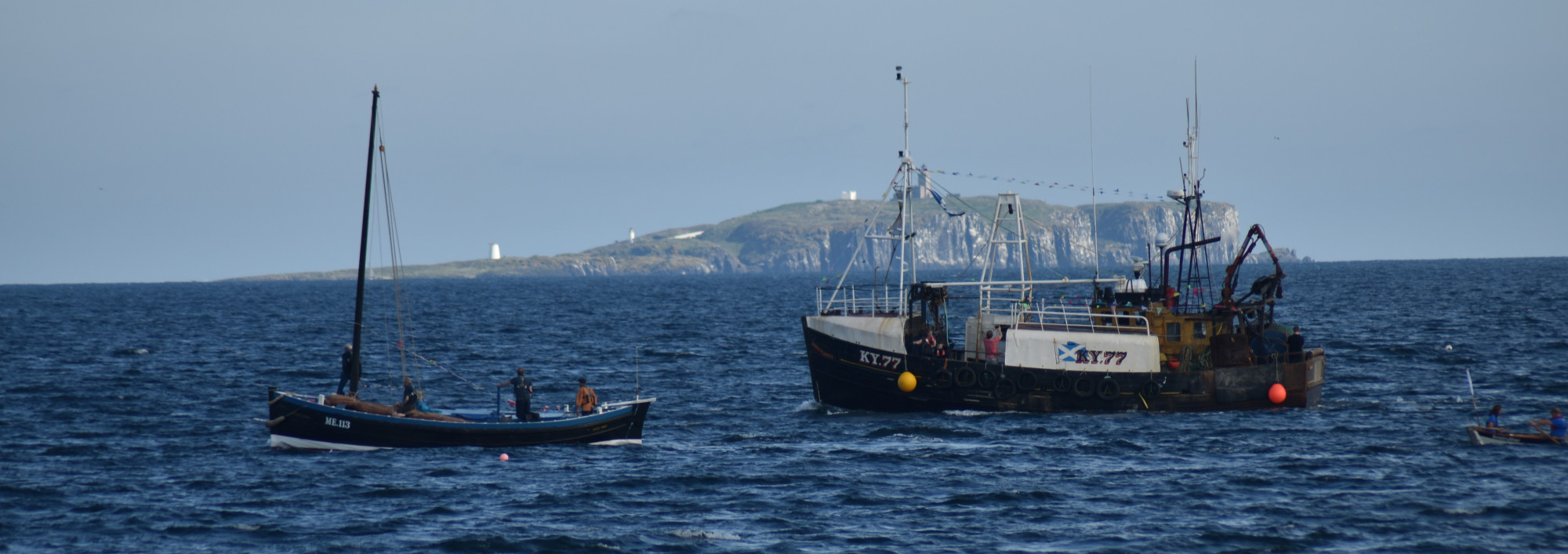

The Cellardyke Echo – 18/4/2018

1901

Football

Anstruther refused to be damped by mere rain on Saturday in presence the match Crail Union v. Cellardyke Bluejackets, in the semi-final the Burgh Cup. It revived the rivalry of fifteen years ago, but of course it was in name only, none of the players ever met before. A stubborn fight was waged, and right up to the finish was the issue open.  Only a little more skill goal, and Cellardyke would have done the ‘trick’. It was there the Union youths beat them.

Census returns

Anstruther-Wester.—The returns show the population to be 558, against 593 in 1891, decrease of 35. In the burgh the figures are 476, and in the landward part 82. The males have decreased 25, and the females by 10.

Pittenweem.—The population is now 1907, against 1991, a decrease of 84. the burgh the population is 1859, and in the landward part 48.

Crail.—The total population is 1531, made of 1087 in the town, 428 in the landward part, and 16 on the island of May. Compared with 1891, there is a decrease of 82. the figures then being 1613.

Kilrenny.—ln Cellardyke the population is 2353, against 2429—decrease of 76; in village of Kilrenny, 189, against 181—increase 8; in landward portion, 242. against 279—decrease of 37; and in Anstruther, easter portion of parish, 150. against 109—increase of 41. The net decrease is 64.

On Sunday morning, the steam liner, Anster Fair, caught fire in the coal bunker. Fortunately the smoke issuing was noticed in time, and the fire extinguished before damage to any extent was done.

The only craft engaged at the harbour meantime are the steam liners, whose shots last week ranged from £30 to £66. The value of fish landed at Anstruther for the last month £5473, showing decrease of £5381. For the quarter, the total was £33,051, decrease, £3284.

Boys’ Brigade Church Parade. The recently-formed Boys’ Brigade paraded at Cellardyke Church on Sunday forenoon, when an excellent sermon was delivered to them by the Rev. Mr Ray, chaplain, on ‘the necessary qualifications of a soldier’. The day, unfortunately, was very wet but, notwithstanding, there was a fair muster of the lads. The officers in command were—Captain Black and Lieuts. Rorie and Watson. On retiring, collection was made in aid of the funds of the Brigade.

Last night. Private Mair, 1st Gordon Highlanders, was the recipient-of a watch, chain, and purse sovereigns from his fellow townsmen and friends in the surrounding district Cellardyke Town Hall Councillor Black presided.  Provost Thomson made the presentation. Private Mair said the hardest work was when fighting continuously for twenty-one days.

Honouring a South African Hero. —The Town Hall, Cellardyke, was on Saturday evening the scene of one of the most hearty and enthusiastic meetings held in the district for some time. The occasion was a desire the part of his many friends to pay honour to a returned soldier, and express gratitude that, notwithstanding numerous engagements, he had escaped without scratch. Private Moir, who served in the Chitral campaign and received the medal, re-joined the famous Gordons in 1898, and in November 1899 left with the 1st Battalion for South Africa. The meeting, which was a crowded one, was attended by both sexes, and was presided over by Provost Thomson, who was accompanied on the platform most of the members of the Council and the presentation committee. A letter of apology from the Rev. Mr Ray, who has taken an active interest in the presentation, read as follows

Dear Provost,—l regret exceedingly it will be impossible for me to be present this evening in the Town Hall to rejoice with my parishioners over the return from the field war of Private Moir. One of our and world-famed Gordons. Everywhere the officers who have come home have been received with enthusiasm and honour, and if the officers, why not the rank and file? Why not the common soldiers. Have not their bravery and endurance fighting qualities been the admiration of the world, and has not their conduct compelled even those who hate us to sing their praises? It is true that in certain quarters attempts have been made blacken their character, but in every instance those attempts have failed and covered with disgrace, not our soldiers, but the men who ventured make them. I hope Private Moir will tell his fellow-townsmen the story of his experiences in South Africa with the same fullness he related it to me a few days ago at the manse, and that he will not forget to say in public what be said to about the moral behaviour of his fellow soldiers. With best wishes for a pleasant and enthusiastic meeting,—Believe me, yours faithfully, James Ray.

The Chairman said they all regretted the absence of Rev. Mr Ray from the meeting. At the same time they were very thankful to him for the letter. He (the Chairman) expressed his gratitude that they had turned out in such large numbers to show their respect for their follow-townsman. He called upon Councillor Black to make the presentation. Mr Black, in an interesting speech, said had great pleasure in asking Private Moir to accept this handsome silver lever with gold chain and appendant, along with a purse of sovereigns. The amount collected altogether was £23 ls 8d. (Cheers.) The sums ranged from 3d to 10s. He asked Private Moir to accept the gifts as a token of the respect and esteem in which he was held by his fellow townsmen. (Cheers.) Private Moir, on rising to reply, was met with perfect storm of cheering, the audience striking up “For he’s jolly good fellow.” He had, said, been in many a tight battle, and was proud to hear they had taken such interest in him He thanked them sincerely for their magnificent presents. He would always remember their kindnesses and their gifts, but he valued them more when thought how proud his old mother would be when she knew. (Cheers.) With regard the war, they had come through a great many hardships; but he was always ready to go back again and do his duty, as every good soldier ought to. (Cheers.) Messrs Rosie and Moncrieff, with the pipes, and Miss Melville, piano, gave several selections, after which the Chairman said the music of the pipes had inspired their guest with more of the famous Gordon courage, and was now prepared to give them some reminiscences of the campaign. (Cheers.) In the course of an interesting speech Private Moir said they landed in South Africa in November. They were taken right up country, being entrained three days and three nights. On Monday, 10th December, they reached Magersfontein, and at three o’clock went out with the naval guns to commence the battle. He proceeded to give an account of their march to Pretoria, including the Cronje. The speech,. Private Moir’s first attempt at public sneaking, was interspersed with anecdote, and was highly appreciated. While refraining from anything like a criticism of the officers, he could not help paying a high compliment to Lord Roberts, who was worshipped by his men. Something of the hardships endured by Private Moir and his companions maybe imagined when it is stated that for four months he wore the same shirt; and when he reached Pretoria he had half a shirt, part of a tunic, and a pair of boots. The usual fare was biscuit or two biscuits a day. After Mr James Wood hail sung “The old soldier,” Mr Watson, solicitor, jocularly advised Private Moir to go round the district and give some of his experiences, taking collections for the War Fund. (Applause.) After the usual vote of thanks, an enthusiastic meeting brought to clone with the singing of the National Anthem. The watch was supplied by Andrew Donaldson, Anstruther, and bore the following inscription ; Presented, with a purse  of sovereigns, to Private James Moir, of the 1st Battalion Gordon Highlanders, by the inhabitants his native town in token their respect for him as man and a soldier, as well as their joy at his safe return from South Africa. Cellardyke, 20th April 1901.”

Hockey Dance.—A highly successful dance under the auspices the recently formed Anstruther Hockey Club was held in the Cellardyke Town Hall on Friday evening. The arrangements, which were under committee of ladies, were every way complete

Mr Jordan, the world’s champion draughts player, paid a return visit to Anstruther last week, when notwithstanding the fine weather and numerous outdoor attractions, he was met by a fair number of local exponents of the “silent game.’’ During the evening, Jordan played about 90 games, winch he won, the other 10 being drawn.’ The successful players who managed to draw were— – Constable Wilson. Anstruther, 2; David Wilson, Cellardyke, 2; William Mathers, James Ferguson, and D. Gravity, St Monans, 2 each. At the close, Mr Jordan was heartily thanked fur his exhibition.

The Cellardyke Echo – 10/4/2018

1891

At  a Burgh Court in Anstruther yesterday two young lads from Cellardyke, named Thomas Corstorphine and Peter Murray, were charged with stealing 2s 6d from the till of the shoe shop Shorn Street occupied by Messrs Kerr on the 4th inst. Corstorphine pled guilty, but Murray denied the charge. From the evidence it appeared that Corstorphine went into the shop, and before the assistant had time name he had reached over his hand and lifted the 2s 6d. On the assistant making his appearance he coolly asked change for the 2s 6d which was refused. Missing 2s 6d from the till, the assistant watched the movements of Corstorphine, who was joined by Murray, and after they had gone into several other shops he got them persuaded come in. He sent for the Police and Corstorphine confessed that he had stolen the money, and Murray that had changed it in a grocer’s shop. One them had ls 6d and the other ls. Murray was found not guilty and Corstorphine was fined 5s or 5days in jail.

The Fishing Industry Anstruther and Cellardyke.—An attempt has been made in Anstruther and Cellardyke to revive the fishing, which for the past three or four years, has been in state of severe depression. In Cellardyke so serious has been the loss that many of the fishermen have left the district and sought employment in other occupations elsewhere. It is computed that in Cellardyke alone there are 60 empty houses, where five years ago one was not to be had for love or money. The particular method adopted for the revival of this industry is the formation limited liability company to purchase steam liners to fish principally at Anstruther. Every encouragement has been given to the project, and already representative committee has been appointed to ascertain the working expenses and cost of the liners, and the amount of capital which can raised in the district. It is considered that steamers of about 80 feet in length, and drawing from 8 to 9 feet of water, could be accommodated in Anstruther harbour, and it is likely that one or two of these dimensions will purchased.

1892

SHARP & MURRAY , Merchants and Fishcurers , Cellardyke , having executed a TRUST DEED for behoof of their CREDITORS In favour of the subscribers ALL PARTIES having against the said Firm and the Individual partners thereof are requested to lodge the Same , duly verified , with him, on or before 14th April 1892 ;  and ALL PARTIES INDEBTED to the said Firm of the Partners thereof, are requested to make payment to him within the like period . _________ JOHN GUTHRIE , Solicitor , Anstruther .

A meeting of fishermen and others interested in the formation of a second limited Steam Line Fishing Company for the East of Fife was held on Saturday night—Mr James Leslie presiding. It was reported that the idea of forming the Company had started among the fishermen, who recognised the necessity there was of getting steam- boats. Their proposal was to raise sufficient money to build two vessels at a cost of fully £4000, and that of the crew of each boat three in each should subscribe five or more shares of £10 each share in order to give them a personal interest in the venture. Already six Cellardyke fishermen had come forward and subscribed five shares each. After discussion all present were formed into a Committee to try and float the Company, and Messrs W. Bonthron, A. Black, Thomas Cunningham, John Porter, and James Leslie were appointed a Sub-Committee to canvass the district, and outside of it well, for subscriptions, the result to be reported to another meeting to be held in fortnight.

At Cupar, on Thursday – before Sheriff Spiers – Mr Henry Butters, draper St Andrews appeared for public examination in his bankruptcy.

Bankrupt deponed – I commenced business in St Andrews in May 1890. For 20 years previously I was employed in the shiop now occupied by Provost Ramsay, Cupar. In May 1890 I purchased a drapery business in Market Street, St Andrews from Mr E Turner for £1375. I had at that time £100 of my won. I did not pay the stock in cash, but by bills, which were renewed from time to time……… I have lost about £700 in two years….. I account for this loss by the fact that the stock was over valued by £300 or £400….. My brother, John Butters, merchant, Cellardyke is a creditor. I got fishing gear from him, he sent me regular invoices and he got goods from me. I am due him £44 16s 6d. He got a carpet and a rug from me on Monday 29th February, and he took it away with him to save carriage. The carpet is marked down to him in my books………

Liabilities £2147 3s 6d, assets £1566 14s 5 ½ d deficiency £580 8s 10d..

Fire in A Shop- Shortly before ten o’clock on Tuesday night fire was discovered to have broken out in the grocer’s shop in George Street, Cellardyke, belonging to W. Sutherland. The fire got good hold of the counter, but by the aid of buckets water it was extinguished before a great deal of damage was done.

1893

FISHING BOAT ASHORE NEAR BAMBUBGH. During the dense fog which prevailed Thursday morning, a Scotch Fishing boat, the Glengarry. K.Y.95, Davidson (skipper), hailing from Cellardyke, ran ashore near Monk’s House on the coast between North Sunderland and Bamburgh. The boat had about 30 score of big fish, which were sold by Mr J Ross auctioneer, for £12 2s 6d. The fish and gear were landed at North Sunderland by cobles. It is not expected the boat will have sustained much damage, as she lies on a sandy bottom.

1894

For some time past great difficulty has been experienced in the procuring of bait both for the small line and great line boats belonging to Aberdeen. On many occasions during the last two months several of the steam-liners were on this account unable to proceed to sea for days, and even weeks, and the loss resulting from this is considerable. Most of the herring used by the steam-liners comes from Cellardyke and Peterhead, and the herring is mostly caught by small boats which in any stress of weather cannot proceed to the fishing grounds, the consequence is that when easterly winds raises the sea neither the Peterhead nor the Cellardyke boats venture out, thereby throwing the steam-liners out of employment. In the hope of remedying this state of matters, several kinds of bait, including liver and crimps, were tried, but all proved defective, and the only alternative remaining was to pay enormous prices for mussel bait coming from the north coast of Ireland, Port Glasgow, and Holland. For the last few months an innovation has been made by using the sea-worm or “lug,” which are taken from the shores of the Beauly and Cromarty Firths; and for the purposes of matching haddocks and codling, this bait has proved very successful. Both among the Footdee and Torry fishermen, a strong opinion is held that something must be done in the near future to remedy the existing difficulties in the procuring of bait.

DUNDEE STEAMER ASHORE ON THE MAY. During the dense fog which hung over the firth all night the Jasper, 1800 tons burden (Captain Douglas), belonging to the Gem Line, Dundee, ran ashore on the South Ness of the May early yesterday morning. She was steaming from Dundee to Burntisland in ballast, when, to the surprise of all, she struck between two and three o’clock. A breeze from the north-east prevailed at the time, but it failed to lift the fog, through which the crew declared even the powerful electric light of the May did not penetrate.

A number barges are presently landing the usual supply of coal, and lookout stationed on one of these vessels corroborates the report that it was impossible to see anything, the first notice he received of the vicinity of the steamer being when she fired a rocket. He immediately aroused his companions, and they proceeded in the direction of the signal, when they discovered the crew of the Jasper scrambling ashore over the rocks. Jill the crew reached land without mishap. When daylight broke they returned the steamer for their effects. The Jasper had been making water, and as the result of rapid survey they found she was already considerably damaged. A heavy swell roiling from the sea had shaken her severely. The Cellardyke pilot landed the mate at Anstruther in the forenoon, when the accident was telegraphed to Dundee. The Jasper is fully insured.

1895

At present this week bids fair to be worse than the previous, when out of forty boats a dozen had from £2 to £14, while the section which proceeded to Shields for the season had also few pounds amongst them. But, if the boats so failed in the errand, the steamers were as signally successful. The coast was soon acquainted with the Glenogil’s  £131 shot, and on Friday again an interested crowd gathered to watch, as score after score of ling was laid on the pier from the Anster Fair. Soon the quay was gleaming with apparently unlimited supply of ling, the shot being composed, with the exception of a few turbot, of these fish. They realised about £90, but it is undoubted that had they been landed 0n the preceding day, magnificent was Skipper Birrell’s total, it would have been eclipsed. The gross reached £99 The Maggie came up with the same tide, and had £66, while the Rob, which steamed past as the other shots were selling, had £35 at Newhaven. A telegram from Skipper Parker announced that the Bernicia had earned some £73. So keen were some of the steamer men to catch Lent that on Friday two liners left to obtain supply of bait in Aberdeen, and be ready to start for the Pentland Firth on Monday. The others left just after midnight, and by daybreak on Monday would be half-way to the distant banks. The gale upset all calculations, and in place of Anstruther being alive with boats and steamers, the harbour is almost deserted. One pleasing item to hand a telegram from Shields intimating that the Bernicia had above £70 to reward a fortunate trip. No word is to hand of any of the Anstruther liners except the Glenogil, which ran in on the turn of the tide. She was seen to be well fished, and the skipper’s calculation that fully seventy score was board wrought a transformation. The long quay became crowded with men and carts, and as fast the fish were put out they were rouped and posted to the station. Cod began at £2, but 30s was the general price. There is the prospect of the stuff despatched on Thursday night getting into the markets with Good Friday, and consequently of their being moderate competition for each lot. Fully £100 had been realised, and some ten score of fish are yet to come out, so that the gross total will run to about £120. The yawl crews had some rare chances this week. In spite of the gale on Tuesday nothing would deter the sea dogs from venturing, and with 18s waiting them for each box of prime haddocks, and 10s for small, they considered they were fairly rewarded. At Pittenweem on the following afternoon the price was 9a to 12s. On Thursday afternoon the last built of the Anstruther liners, the Copley, returned from Leith, her engines, &c., having been put on board. She will commence work in few days, Skipper D. Wood being her captain.

1896

Lent week was a blank so far as the Cellardyke sailing boats were concerned, only one crew (Skipper .lames Moncrieff) being at sea by Monday, and getting the market, when £43 was grossed. The rest of the crews had dropped the nets, and were fitting out for the great-lines in earnest, their programme including the necessary outfit to tide over a spell at Scarborough or other English ports. 37 boats left with this intention on Monday, and as up the present none have returned it is evident the skippers have not seen reason to alter their course. The fleet will distributed between Scarborough, Shields, Hartlepool, and Aberdeen. The liners had also bigger markets than Anstruther in view, at least those of them which were able to get back before the all-important festival. The lucky crafts were the Hibernia, £134; the Pioneer, £129; Copley, £75; Edith, £44; East Neuk, £31; and Rob, £60, selling at Anstruther; the Maggie, £45, and Glenogil. £65, going into other marts. Prices early in the week were 80s and so on per score, but after the rush was past they rapidly declined. The Anster Fair, while working near the Orkneys, had the misfortune to lose all her gear, and came home clean. All the boats are at sea. The St Monance men were busy running up the firth, with takes of £12 to £18. At Largo couple of big boats are plying the haddock lines, 18 22 boxes being their reward on the inner grounds last week.

March. 1896.                     March, 1895.

 Anstruther District,        £5902                                  £3473

Anstruther                         £3283                                  £1094

Pittenweem,                     £481                                     £658

St Monance,                     £602                                    £411

Crail and Kingsbarns,     £43                                      £2

Value for District, March,             1894      £4001

1893      £9084

1892       £5501

1891       £3828

A number of Cellardyke boats are being prepared for the early fishing Scrabster, the crews counting upon leaving for the North in the opening week of May. Two Buckhaven crafts are destined for Kinsale. All haste is being shown in getting the outfit complete for a start within the next few days.

1897

Annexed is sketch of the Public School of Cellardyke. The school formerly consisted of one storey, but second storey has been added.

CELLARDYKE PUBLIC SCHOOL. The reopening of this building is to be an event of some importance in the community, and the Board is endeavouring to carry out the opening with fitting ceremony. Dr Dunn, Her Majesty’s School Inspector, is to declare the school open to-morrow. It was on his recommendation that the extension was begun, and this has been done according plans by Messrs A. & A. C. Dewar, architects, Leven, who are to be complimented on the splendid work they have done. The entire school has been remodelled and the accommodation doubled. The roof, which was formerly array of pinnacles, has been taken off and more substantial air imparted the erection by the addition of another storey, and a wing in the west gable, the roof being surmounted with five exhaust ventilators, while three gables form the main feature. The difference in colour between the old and new stonework has been met the redressing of the former. Several other difficulties were got over in the same practical way, and the school is now second to none in the Kingdom in appearance. The interior is splendidly finished. The accommodation on the ground floor is one large classroom, 39 feet by 33 feet, for infants, holding 160 pupils ; another 33 feet 20 feet, holding 66 ; and other two 26 feet by 21 feet, for infants, holding 60 each. At the back will two large cloakrooms, 17 feet by 16 feet, and the entrance to the staircase to the upper floor. On the first floor there will be five large rooms for an average of 60 pupils. It also contains two large cloakrooms and a staircase at the back. The contractors are—Messrs J. & D. Lawrie, mason; John Forrester, joiner; T. A. Dalzell, plumber; R. Williamson, plasterer; R. Arthur, Dundee, slater: J. Rodger, Colinsburgh, painter; and Messrs Mackenzie & Moncur, heating apparatus. Mr J. Adamson. Pittenweem, made an efficient clerk of works. Thanks to the excellent manner in which the building has been planned, the working the school will be easily accomplished. The playground has been enclosed with a wall and railing.

1898

On Friday evening a grand concert was held in Cellardyke Town Hall in aid of the cleaning fund of the hall. Provost Thomson presided over a large audience.A long programme was sustained Misses Borthwick, Edinburgh, and Duncan. St Monance ; Messrs Linskill, St Andrews ; J. and A. Hanning, Edinburgh ; Black, Thomson, and the orchestra the East Fife Musical Association.

1899

In the East of Fife the winter herring fishing has been prosecuted with great success so far as the quantity landed is concerned. The total catch has been close 15,000 crans, the highest since 1893. A new feature in the fishing has been the curing the herrings, the first time this has been done, and the curers received remunerative prices from the Stettin markets. The prices have ranged from 4s to 30s per cran, the latter sum being given for baiting purposes. The steam liners and trawlers have done extremely well, and one liner is credited with having an average of £100 per week since the New Year. Two the fleet of liners have been sold, one to a Shields firm and the other to a Dundee firm, but the latter is still manned by a crew of Cellardyke fishermen.

The Cellardyke Echo – 4/4/2018

1886

Interesting Presentation.—Mr William Smith Melville, fisherman, Cellardyke, sent lately to the reading room of Holy Island a copy of his book, entitled “Lights and Shadows of a Fisher’s Life,” in recognition of the kindness of the people to him and his fellow-townsmen, when they took refuge on the Island from that memorable gale of the 19th  November, 1875, in which it will be remembered there was great loss of life among the Fife fishing fleet coming home from Yarmouth and Lowestoft. He has received the following reply from the Vicar of Holy Island: “The Vicarage, Holy Island, Beal, March 7th, 1886.—My dear Sir,—l received book safely, and with pleasure I have read it and enjoyed it. Our fishermen remember you well. This night, when our service was over, I mentioned your gift, and read your letter from my pulpit. Our men were much pleased at your thoughtfulness. I am sending a book of mine which will interest you in the history of the Island. Wishing yon every blessing and God speed in your labours, I remain, ever faithfully yours, F, Keeling.” The book referred to is “Lindisfarne or Holy Island; Its History and Association,”

Also on the literary note –  being advertised in the papers

“People and Places in the East of Fife” by George Gourlay

No VIII the Old Fisher of Cellardyke – Electioneering a hundred years ago

1887

The East of Fife fishing boats encountered a severe thunderstorm yesterday afternoon at sea. The fishermen arriving at Anstruther harbour this morning report that the storm was the most severe they had experienced for some time. Large hailstones fell while the storm lasted, while lightning flashes were exceedingly vivid and thunder peels very terrific. Great damage has been done, while serious injuries have been afflicted on several fishermen.

The boat Alexander 111 ME ( David Coull Skipper) of Ferryden was proceeding up the Forth between one and two o’clock when she was struck by lightning, the bolt seems to have struck the ring on the top of the mast and running down, hit Charles Coull and William Mitchell. Coull’s injuries were most serious, his clothes on the right being entirely burnt off him. His whole side and face are much discoloured. His sea boot had to be cut off and his stocking was singed to a cinder. The whole crew were affected and in their confusion mistook the lights of Cellardyke houses for Anstruther Harbour lights, and as a result the boat ran ashore west of Cellardyke Harbour, where she will likely become a total wreck. The injured men were taken ashore in small boats and conveyed to the house of Councillor Morris, where they were attended to by Dr Mc Callum.

A Cellardyke Boat also ran to Montrose for shelter.

1888

The weather on Monday was far from inviting, nevertheless the harbour bar was as busy a beehive as the boats put to sea. At the Carr Rock, however, the north-east gale was encountered with such a fury that one and all were glad to tack again for the harbour. All next day it was a wild lookout as vessel after vessel drove through sleet and rain under double-reefed topsails, to St Margaret’s Hope, but on Wednesday the storm abated that the fleet left their moorings. A heavy surf continued to run on the banks, but crew after crew cast their nets to fish herring bait in an offing 50 to 100 miles to east of the May. Being thus belated, however, they did not return till the end of the week. Several of the Fife skippers fished last week with the silver hook, as the saying is, at the Tyne. In particular, one plucky young skipper of the J. R. Welch, of Cellardyke, realised not less than £36 for six score of cod, ling, &c. One the local crews has just launched the Four Brothers to fish the haddock, as of old, on the banks. “We’re baiting twelve ties tae a hand” heard one devoted matron say, but who, if the rumour is true, will not have the poorest “deal” in the town on Saturday night; indeed, it is not unlikely that others may be so afloat on an early day. A beginning is being made to east and west in the crab and lobster fishing. We visited the Castleyard in the middle of the week, but it was only to hear a general growl over the times. ” Daein!” said one veteran with tremendous squirt, “wha ever heard o’ onything daein’ in frost winds ; wrocht thirty creels for six partans.” Nevertheless this was better than Cellardyke bulwark, where the orator was bemoaning his hard fare with only a single crab. Some tidy hauls are being fished by the inshore fleet with Kelly ower the kirks- in fact, if you believe the greybeards, the codling and the flounder have not been so plentiful for years, which they rightly trace to the prohibition of the steam trawl this side the May. The well-known Fife skipper, Thomas Birrell, left Thursday en-route to a new enterprise—-viz., to develop the crab and lobster fishing on the shores of the Moray Firth. It is not the least interesting feature of the “spec” that the veteran is, with the agency of the railway and the telegraph, to send his own catch from day to day to market.

1889

A considerable quantity of billet wood, with the fragments of deckhouse, was washed ashore Saturday between Caiplie and Cellardyke. Most of it was so split amongst the rocks as to be useless, except, perhaps, for lobster pots. It was supposed by the pilots to have been swept from the deck of the galliot which was seen running the Firth the previous day with the loss of mainmast and jibboom.

Kilrenny Town Council.—At a meeting this Council on Friday night it was intimated that the Government grant in aid of diaturnpiked roads was £11 11s. The bond for the loan of from the Public Works Loan Commissioners for the water works was submitted and signed. The money has been granted at fraction under 5 per cent., and is to be repayable in 40 years by half-yearly instalments on the annuity principle. It was resolved to lay a drain from Caddie’s Burn to Ellice Street along West Forth Street.

A meeting of Cellardyke merchants was held last week to take into consideration the railway rate charges. Provost Martin presided, and upwards of twenty merchants were present. The Chairman explained the proposed maximum charges of the Railway Companies, and pointed out how it would seriously affect and hamper the fish traffic. If the rates were raised any higher they would simply be prohibitory. He had not got all the full statistics yet, but so far as he could see it was proposed to increase the rates for fish from Dundee to Glasgow from 21s 8d to 25s 3d per ton, to the English towns from Anstruther, where the most of their winter herrings were sent, the rates were proportionately higher, and this, he need not tell them, would be a great hardship to the fishing community. After several other members had spoken, a Committee was appointed—Mr A. Marr, convener —to frame a protest against the proposed increase of the rates to the Board of Trade, to get the proper statistics from Anstruther to London, Birmingham, Manchester, and Leeds, and to compare them with the rates now charged. Councillor Melville said he could scarcely imagine the Railway Companies to be so foolish to increase the rates. They would just be “cutting their own girds” to do so, and put a stop to the fishing traffic from this district. The rates were heavy enough at present without making any increase.

The Cellardyke Echo – 28/3/2018

1881

Sad Tidings. — Intelligence was received here the other day that Captain James Webster, of the ship Mary Stenhouse, of and for Liverpool from Calcutta, had died on the 16th January in the Indian Ocean, where his body was consigned to a sailor’s grave, James Webster was a native of Cellardyke. He served his time as a carpenter in Dundee before taking to shipboard, where his success is another illustration of what a sailor’s destiny may be. He was about fifty-five years of age, and has left a wife and family to mourn his loss.

1882

Call Declined.—we understand that the Joseph Low, assistant, Edinburgh, has on consideration declined the call to the Mission Church, Cellardyke.

New Fishing Boats. —The other day the Cellardyke deep sea fleet had a handsome addition built by Mr Miller, St Monans, for Mr James Cunningham. She is named the Mizpah. At Pittenweem, the first of the two boats ordered from the builder in Eyemouth also arrived in the end of the week, She is one of the finest of her class, and is to the order of Mr George Heugh.

1883

Comparatively little has been done this week at the North Sea fishing. For several nights, though the search was sometimes engaged in by a hundred boats, herrings have been so scarce in the Forth to fall far short of the needs of the coast; in fact, up to Thursday morning only eight takes had come under the auction hammer at our quay, the value being from £6 to £43. The demand, however, continues active, as appears from price—cod selling at 2s 6d and ling 4s each, whilst halibut are at least 10s per stone. It invites notice here that haddocks have been seldom so plentiful on the Fife coast, in particular a Cellardyke yawl landed fifty dozen of these sweetest of all sea dainties the other morning, the lines having been cast with skellie to St Ironic, a haddock haunt famous in the fishing annals of Fife for the last three centuries. The seven boats forming the Cellardyke squadron this season to Shetland lsles sailed on Friday, but a slant of wind forced them to take shelter in Peterhead. Resuming the voyage they had again to seek shelter, this time at Fraserburgh, whore they are now waiting for a fair breeze to waft them on their distant cruise.

1884

Sailor’s’ Outfitting House.—Large Stock of Best Oil Clothing (Martin’s, Cellardyke,). All Clothing made to order. Ready-Mades in stock, D Ross, 23 Dock Street. Dundee

DAVID MURRAY OF CELLARDYKE. The Fish Trades Gazette gives a portrait of Mr David Murray, of the well-known firm of Sharp & Murray, Cellardyke, along with notice from which we take the Following

Mr Murray belongs to one of the oldest seafaring families in the East of Fife. Inheriting their enterprise, Mr Murray, in 1852, left the fisher-boat to join the expedition organised his uncle, Capt. Alexander Rodger (subsequently so well known for his ocean clippers), to the gold fields of Australia. The party consisted of sixteen Individuals, and loud and long were the huzzas when they embarked in the steam-packet which was to convey them so far on the journey. Those were the days when everybody believed that the philosopher’s stone had been found at last. Our adventurers went Ballarat with the throng, but their Scottish wit soon enabled them to see-that gold gathered elsewhere with less sacrifice than at the diggings. Turning by a kind of instinct to the seaside, Mr Murray kept his hands busy and his eyes open for a time in the Coastguard service, till lucky chance, as the world says, placed him in the position of captain and part owner of a smart little schooner hailing from Williamsburgh. Here his energy and vigilance soon gained the confidence of the leading merchants that the vessel was almost in constant commission to lighten their ocean packets; but a terrible misfortune gave a new turn his destiny. The schooner was lying at anchor in the river, when a careless steersman caused a collision. The young captain so far averted the peril, but his leg was so fearfully crushed that it had to be taken off below the knee. He was scarcely convalescent, however, when we find him the managing partner of new store in Williamsburgh, which for the first time dispensed the comforts and elegancies of the old home this part of the colony. Not long after, however, the fretting wound induced him, at the urgent solicitation of his friends, to embark for Scotland to consult the doctors as the one hope of recovery. He was thus staying under the old roof-tree in Cellardyke when an unexpected message one night led to an interview with the late venerable Mr Fowler, who announced his intention to retire; and wished the young friend of whose energy he had heard so much succeed him in the business which he had so wonderfully developed in his long and busy life. Uniting himself to partner who in Mr Sharp was eminently fitted, only by his experience as an accountant, to fulfil the position of “Chancellor” the firm, Mr Murray found a sphere from that day fitted above all others to give scope and exercise his talents. His early experience not only enabled him to supply but to anticipate the requirements of the staple industry of the coast, so that the firm was soon lengthening its stakes, as the saying Is, all directions. Fish-curing was also extensively engaged in, and this connection was ere long developed so to become kind of handmaid to the establishment fashioned under his own eye in Australia, where by-and-by their “tins” of herring and other dainties of the Scottish sea made the name the firm familiar as household word in the farthest corner the Bush. Notwithstanding all this, however, their exports continued to embrace every description fishing gear, and, just as one step leads to another, they were induced in 1862 to build a very considerable net-weaving establishment in Cellardyke so as to meet the special orders more and more pressing with every mail. Thus launched as general merchants —fish curers, net and oil-cloth manufacturers—the firm has long maintained a foremost place in the seafaring enterprise of the coast.  Mr Murray’s fine open face is, and has long been, familiar in the round of the herring harvest at the busy quays Yarmouth, the stately piers of Aberdeen, the wind-swept sands of Buchan, or the romantic shores of Baltic Ultima Thule, as in the streets of Anstruther and Cellardyke, where the firm have their head-quarters, and enjoy the respect and confidence that so naturally belong to the leading traders and largest employers labour in the district. More than twenty years ago Mr Murray floated a local company to build and equip a North Sea fishing craft with more than one of the salient improvements of which we hear so much to-day. Like others the van of the trade, he is an earnest advocate for the abolition the herring brand, as being from his own experience a reproach the statute book thus far in the nineteenth century.

Stonehaven – Remarkable Escape from Drowning.—A strong south-south-westerly mile was blowing here during the morning of Thursday last, and the sea was running very high, being driven into “clean smoke” by the force of the wind. A number of boats belonging to Cellardyke put in during the day for shelter, some of which were unable to haul their lines after the storm commenced and had to abandon them. The crew of the Endeavourer, KY. 2052 (George Moncrieff, skipper), report the providential escape of one of their number from drowning. While about two miles off Crawton Ness some additional sail was being pat out, when a lad, named Michael Pratt, who was assisting in the work, was struck by the foreyard and knocked overboard. Another the crew, named Peter Muir, observing what had happened, threw a rope to Pratt, and a coil of it happening to go round his neck, he was towed along with the boat through a heavy sea. Pratt also managed to get hold of the rope with his hands, and attempts were made to pull him aboard with a boat-hook, but each time his clothes gave way, and he was in imminent danger of being lost. Ultimately a rope was passed round one of the lad’s legs, and in this way be was hauled on board. Pratt, who was very much exhausted when landed, was taken house in the Old Town, where he was attended by Dr Edmond.

The Cellardyke Echo – 20/3/2018

1880

Chalmers’ Centenary.—This celebration took place on Wednesday. The procession, mustering at 2 p.m. at the Lifeboat House, to the number of at least five hundred the seafaring men of Cellardyke, and preceded by the members of the Harbour Board and Lifeboat Committee, walked four abreast to the music of the Volunteer Band to the scene of the ceremony of handing over the life rail and lighthouse, dedicated by the donor, Miss Hannah Harvie, to the memory of Dr Chalmers. Provost Anderson made suitable acknowledgment, and proposed three cheers for Miss Harvie and also to Mr Ellice, M.P., for his interest in the harbour, which were responded to with ringing enthusiasm. All day long the town and harbour had been all in a flutter with dancing streamers. Every fishing craft in particular had their colours drawn up to the masthead, so that what, with the cheers of the assembled thousands, the boom of the signal gun, and the ringing of the fine new fog bell, the scene was perhaps the most stirring and brilliant ever witnessed on the shores of the East of Fife. The afternoon was observed as a holiday by trader and tradesman, and a public meeting was held in the Town Hall of East Anster. Provost Anderson was called to the chair, and a number of addresses eulogistic of the great Free Church leader were delivered in the course of the evening.

On Saturday evening the fishermen of Cellardyke were invited by the beat of the drum to meet with Mr Lindsay Bennett in the Town Hall.  On the speakers going to the meeting, it was found that the hall was taken possession of by Mr Watson, Chief Magistrate of the burgh, who backed up by a number of youths, and several supporters of Mr Williamson, who declared they would not allow the meeting to be held, the ground of their refusal being that the Chief Magistrate had not been informed of the purpose for which the meeting was called, that the hall was a public hall, and Mr Bennett had no right to hold any hole and corner meeting there for the fishermen. The latter, who number nearly four to one of the constituency of the burgh, were indignant at this interference with their right to meet and confer together, and with much violent language, accompanied with dangerous jostling and pushing down the staircase leading to the hall ensued. In the end an adjournment was made to the adjoining school room, where nearly 200 fishermen assembled, and where the speakers were allowed to address the meeting without further molestation.

Principle Tulloch, who was received with applause, said he saw no reason why the fishermen should not be allowed to meet and confer with Mr Bennett or and other public man, and trusted that the electors would appreciate the attempt that had been made to prevent their meeting from participating in the free interchange of opinion, for which it was designed. Alluding to the present state of affairs in the burghs, the learned Principle repudiated the statement that he had made a personal attack upon Mr Williamson. He had attacked Mr Williamson’s principles and his tactics, but he had not attacked himself, although it had pleased certain organs of the press to say so. Mr Williamson had said that the vote of any fisherman was as good as that of Principle Tulloch, and why should it not be so? He (The Principle) was the last man in the world to challenge the right of the fishermen to act in this matter entirely as they deemed fit; but he challenged the right of any man to put himself before the constituency, under what he (the  Principle) considered false pretences. He knew that Mr Williamson was pledged t Disestablishment; and in proof of this the principle directed the attention of those present to a letter that had appeared in that day’s papers, signed by Professor Baynes of St Andrews, a gentleman who, as an Episcopalian, was of all men in the world quite aloof from Presbyterian differences. In 1878, Mr Williamson had, at a private interview with the Professor made no secret of his opinions on the Church question, and voluntarily assumed the attitude of an extreme and aggressive disestablishment candidate. (Applause)   the description of the meeting continues on for several paragraphs explaining why they think Stephen Williamson supports Disestablishment which is separating the Church of Scotland from The State (a bill was eventually passed in 1929). ……………………The Principle said   ‘If they wished to overthrow the Church, they would vote for Mr Williamson; but if they had any respect for it, and feeling that it should continue to shelter them and their children the they would vote for Mr Bennett (Loud Applause)

………. At the close a fisherman proposed a hearty vote of thanks to Principle Tulloch for his trouble in coming down from St Andrews and explaining a question on which they on the coast stood in great need of knowledge. The meeting then quietly broke up, but as the carriages of the speakers drove away several youths followed, and well-nigh blinded one gentleman with handfuls of sand.

A letter describing the events

The fishermen of Cellardyke are very much in the position of the often quoted individual who, to his own surprise “awakened up one morning find himself famous.” The other day no fewer than three candidates for Parliamentary honours came “a-wooing” them; and Saturday saw no less a distinguished personage than Principal Tulloch, with’ Professor Birrell and other Andrews friends on the political platform in the interest of Mr J. Lindsay Bennet, who was also present on the occasion. It appears that the Town Hall was asked and granted to Mr Bennet’s friends for a ‘‘public meeting,” but in the afternoon the invitation was limited by tuck of drum the fishermen. In the meantime, however, it had been whispered from east to west that St Mary’s was to send a delegation to the coast, and the hint was not lost on the ardent following the other candidate. Remonstrance and opposition, is true, was offered to their entrance, but Provost Watson defied all such restraint by taking his stand on the top of the stairs and calling out “Come up gentlemen, come up  it is a public meeting.’ A noisy and exciting scene followed in the hall, for so completely had the friends of the other candidate stolen a march upon Mr Bennet’s friends that a cheer was raised for Mr Williamson. Eventually, however, some resolute fishermen cleared the hall hurling the Anstruther visitors in no ceremonious fashion down stairs, and the Infant School being also at this time secured an adjournment took place from the smaller building. The fishermen now took the matter in their own hands, and marching up in body, they not only took possession of the schoolroom, but sentinels were posted outside to prevent the entrance of any and all others. Here the chair was taken by the Rev. Mr Anderson, the minister of the parish, when Mr Bennet, Principal Tulloch and the Rev. Murray, East Anstruther, addressed the meeting. Bailie Brown, a member of the Free Church, questioned the Principal about the plebiscite, but on the whole the several speakers obtained an appreciative and even enthusiastic reception. The Principal and his friends then drove to Crail, where they also addressed a meeting, with the Rev. Mr Reid, Parish Church, in the chair; but here the arrangements were such to render it impossible to repeat the ‘rowdyism’ at Cellardyke.

The Cellardyke Echo – 14/3/2018

1872

Burgh Court

Two cases were before Provost Todd and Bailie White on Thursday, namely, Alex. Trail, carter, Cellardyke, who was charged with an assault upon Alex. Smith, better known as “Sandy Ba ‘” in the Mason’s Tavern on the evening of Saturday, the 17th inst. He pleaded not guilty, but proof having been adduced the charge was found fully proved, and be was sentenced to a fine of 10s, or ten days’ imprisonment. In passing the sentence the Provost characterised the case as a “drunken row which all the parties would be to blame”. The next case was that of Alex. Pottie, also Cellardyke carter, who was charged with furious driving along the Shore, and which he pleaded guilty and was sentenced to fine of 7s 6d, or eight days imprisonment—the Provost at the same time administering a sharp reprimand on the dangerous practice furious driving, especially when, as he said, there was no occasion to do so.

1873

Novel Housebuilding. Mr John Gilchrist, of the Cellardyke Steam Boot and Shoe Works, is at present erecting handsome edifice on the celebrated concrete principle on the fine corner opposite the Tolbooth of our thriving sister burgh. The novel erection is 33 feet long, 21 wide, and 22 high in the front wall, and is to embrace an elegant and commodious shop on the ground floor, with neat family apartments above; and as it has swept away the mean and incongruous subjects which so long disfigured the locality, Mr Gilchrist’s enterprise has effected one of the most decided improvements ever carried out in Cellardyke.

1874

A singularly touching instance of family affliction has just occurred in the death of Miss Grace Watson daughter bailie Robert Watson, merchant, who succumbed to a subtle and malignant disease after a  very few days illness, on Friday last. Miss Watson has been verily cut down like the of early summer-being only in her twentieth year and it gives a deeper touch of pathos to her affecting story that she was within a few weeks of becoming the bride of an amiable young man, who was recently associated, as a partner business with her respected father. This lamented young woman belongs to one of the oldest and most esteemed families in Cellardyke, many of whose members have been remarkable in no ordinary degree for their exalted qualities of head and heart ……

1877

The other day, the Cellardyke deep sea going boat “Southern Cross,” Skipper Alexander Fowler, was at the cod fishery some leagues seaward of the May, a strange boat was espied running the same track, and her nefarious errand was only made too intelligible by the irritating discovery that the fishing gear had apparently been raised to the surface means of small grappling irons, and then deliberately stripped hook by hook, the piracy being ended taking away about two thousand yards of the gear, which was likewise cast adrift to the mercy of the storm. The matter is at under investigation by Gillis, of the Fishery Board.

Early on Wednesday morning one of the Cellardyke fishing boats was overtaken by the storm while at sea, and during a heavy squall three of the crew were washed overboard. The skipper and another man were with much difficulty rescued by the remainder of the crew, but a lad named Robert Doig, aged about 18 years was drowned.

1878

Disaster to Fishing Boat.-Early on Friday morning, as the Cellardyke boat “Six Brothers,” Skipper John Dickson, was entering the harbour, she was struck with the squall, which threw her so far to the leaward at the very instant of weathering the fairway that she came into violent collision with the eastern breakwater. It was a critical moment for the boat and crew, but fortunately the harbour was gained, though not without considerable damage to the former, which in particular, had five or six of her bow planks crushed in by the collision.

1879

New Fishing Craft.— It speaks well for the enterprise of the fishers of Fife that, notwithstanding an occasional ebb in the fortunes of the sea, the orders for new and improved fishing craft were never so spirited as they are to-day. Our district building-yards are ringing merrily with a new squadron for the coming Drave, and we farther learn that two of our Cellardyke skippers, Messrs George Barclay and Adam Watson, have entrusted their commissions to Mr Whitehead, of Fraserburgh, who is so successfully developing in the north the fine sea lines, for which the Eyemouth fleet are so justly renowned. All this activity is the natural and spontaneous result of the seaward chase, which is now firing the Scottish coast, and which but yesterday, as it were, has opened up new and boundless resources wealth and prosperity, whether with regard to the white or herring fisheries. Thus the favourite boats few yean ago are being sold at whatever sacrifice for the sake of others more suited to the times. We even hear of staunch drave boats, like the “Watsons,” of Cellardyke, being sold, tackle and all, for the nominal price of twenty-five pounds or so, and the crack clippers at the last cruize are being laid aside for no other reason than that they are unequal in respect of size for the burthen and the race. As yet the movement has only to do with the dimensions of the boat; but we hear interesting experiment at the instance of Skipper Robert Montidore, who is to rig out his new boat on the principle of the Penzance luggers, the value of which can be realised by seafaring readers when we say that it is expected to reduce the big mast, say from fifty-three to forty three feet in length, which will lessen, if it does not altogether remove, one of the most constant perils of our Scottish fishermen. We also observe a new expedient in the way of ballast, for which, amongst its hundred purposes, concrete is being used by Skipper Key in the outfit of the “Comfort,” launched the other day at Pittenweem. The concrete is being filled in as kind of packing between the timbers, and will, least, leave more berthage for gear and cargo. In reference to the grand question of steam fishing, its Introduction appears to be as distant ever in the East of Fife. The experiment of the Leith sisters the “ Onward ” and “Advance,” have by no means favoured the principle; but we may State here that our townsman, Mr John Millar, boatbuilder, has of late given the subject much consideration, and so far the result may be fairly accepted the best solution of the difficult problem. Mr Millar, it may be explained, contemplates the application of the screw to a smart North Sea racer, say of fifty feet or upwards, in which the machinery, being placed amidships would serve as ballast, and render the craft as lively as a duck in any weather. The grand obstacle however is the expense. This indeed is limited to £600, or scarcely more than the half of the steam fishers of Leith; but as fishing associations are not in repute in the sea homes of Fife, and as none of our Skippers are likely to take so large a hazard in the meantime at least on their own shoulders, the enterprise, as we have said, is still a shadow of the future, though it is understood that if any fisherman of recognised experience would engage a superintendent the requisite capital could be once subscribed by those otherwise persuaded of a harvest success..

The Cellardyke Echo – 6/3/2018

1856

Craignoon Habbour.—Mr Stephenson, engineer, who arrived here has commenced to make a survey of the site, and draw a plan the proposed harbour at Craignoon.

1858 two reports of the same storm… the second I have just selected the Cellardyke part but the full report was over a 100 words long

The winter herring-fishing partially revived since the late stormy weather, there being pretty good takes on Friday and Saturday last. The price per cran is still high; and it is much to be regretted that the weather has so much interfered with the pursuits of the fishermen. Accident.—We understand that on Saturday morning last, a boat returning from the fishing, and said to be manned by the folks of the “Lang Town,” was accidentally run down by another boat. We are glad to say that no loss of life occurred, one man only having his leg severely hurt. The boat, with all its apurtenances, is lost; and such a loss is great, considering the time, labour, and the expense attendant on the fitting out of even a fishing boat. We learn that the injured man is slowly recovering.

COAST OF FIFE.—Elemental Commotion …………… The fishermen resumed their precarious enterprise with considerable success, having secured draughts various magnitude, which realised excellent prices. But on Friday night the atmosphere resumed its impassioned fury, threatening destruction to all exposed to its impetuous current. One boat came in violent collision with another, and sent her slap-dash to Davie Jones’ locker. But with praiseworthy activity, the imperilled crew were rescued from a premature grave in the caverns of the deep. In consequence of the accident, however, a man belonging to Cellardyke is reported to have sustained severe fracture of one of his legs; and it seems truly miraculous that a much greater amount of mischief has not been the result of such sudden and frightful tornado, which continued shifting from one point of the compass to another. The wind continued to blow with increasing violence during the whole of Saturday, imparting a wonderful change of appearance to many objects in the visible creation, whether animate or inanimate. Even brace of accomplished ladies (the daughters of Lord), were observed exerting all the agility of their limbs in pursuit of their exquisite bonnets, which had leaped from their heads, and wore flying before them like Gilpin’s hat and wig, and making much more progress than their denuded pursuers, until intercepted by some convenient obstruction. It was verily killing sight to behold the lovely, the well-cultivated tresses wildly streaming in the wind. ………….

1860 – on the week after the Baptist church is getting stripped out

ESTIMATES WANTED, FOR ERECTING a CHAPEL and VESTRY at East Green, according to Plans and Specifications which will be shewn James Fowler, Cellardyke ; by whom Offers will be received to the 20th inst. Information will also be furnished by Mr J. Hall, Architect, St Andrews. Anstruther, March 7, 1860.

1862

On the forenoon of Friday last, as an aged fisherman, named Doig, belonging to Cellardyke, was proceeding homeward, he was overtaken two spring-carts following close on each other. The first, jostling against him, threw the unfortunate man to the ground, when the other, which was heavily loaded, almost instantly passed over his body, crushing him severely. Surgical assistance was promptly in attendance, and hopes are entertained of his recovery. The case is being, investigated into the authorities.

Snow-Storm. —On Sunday afternoon the wind, which on the former part of the day had been from the westward, accompanied with occasional slight showers of rain, suddenly veered round to the northeast, and shortly after snow began to fall, and in a few hours the ground was covered to the depth of five or six inches. Such an unexpected change of weather subjected our fishermen to a very great amount of trouble and inconvenience, as their nets usually lie on the fields from Saturday to Monday, order if possible that they may be thoroughly dried. Many of them, therefore, on returning from church, wore under the necessity of having to proceed to the removal of the exposed netting—an operation which, from their being so deeply imbedded in the snow, and in the very disagreeable state of the weather, was only accomplished after much difficulty and exertion.

1865

James Christie, carter, from Cellardyke, was charged with having, on the 10th February, assaulted Andrew Anderson, flesher, near Anstruther Easter, with a walking stick, to the effusion of his blood, and serious injury his person. The accused pled not guilty, bat after proof had been led he was found guilty, and sentenced to pay a fine of 30s, or prison for twenty days.

1866

It has often of late been our pleasing duty to notice the splendid donations of Walter Hughes, Esq., to local institutions and charities. This week, however, so far at least as the public have had an opportunity of knowing, this noble minded gentleman has exceeded all his former benefactions. The recent boat disaster at Cellardyke having been brought under Mr Hughes’ notice, lie visited that town the other day, with the special object, it is said, of making himself acquainted with all the circumstances of the case. Having satisfied himself that the owner of the wrecked boat was worthy of his kindness, he, with a generosity which must challenge the admiration of all, agreed to present, at his own coat, the poor fisherman with new boat of the largest size, and be constructed of the best materials. Mr Hughes also presented number of poor persons in Cellardyke with handsome gratuities. Than this estimable gentleman, few have given with so liberal a hand to the relief of the poor and unfortunate, and many, we feel assured, are the blessings which grateful hearts here shower upon him for his innumerable bounties.

(This boat was to be the experimental Pioneer built at Pottinger’s yard in Anstruther)

1867

Alleged death from an overdose of Chlorodyne- On Wednesday considerable excitement was caused in the west end of Cellardyke by a report that an old woman of the name of May Davidson, the widow of the late James Pringle, labourer, had died from an overdose of Chlorodyne. On enquiry, however, it appears that this rumour is without foundation and that the deceased, who is about 85 years of age succumbed to a fit of palsy.

1868

We understand that an amicable arrangement has been come to with respect to the loss of the Cellardyke boat, (Marimne KY 433), by the owner of the barque Danubio (which ran the boat down), consenting to pay the claim of £160, compensation for the loss sustained by her owner, Mr John Watson, Cellardyke, with further sum, said to be £12, to the crew, to make for the loss of clothing and other effects belonging to them, and which were not saved.

A Disorderly Patlander.— Before the Summary Criminal Court of Cupar on Wednesday— Substitute Taylor on the bench— Martin Brogav an Irish labourer, was charged with having committed a breach of the peace in the house of Christina Lillie or Salter, Cellardyke, and also with having broken several panes of glass in the said house on the previous evening. Brogan pleaded guilty, and was sentenced to pay a fine of 20s or fourteen days’ imprisonment. The fine not being forthcoming he was removed to jail

1869

During the week the fishermen of Cellardyke have made considerable progress in registering and numbering their fishing boats, as required by the recent order of the Board of Trade. In this novel and therefore embarrassing duty, the fishermen have found a valuable friend in William Gillis, Esq., fishery officer, who has most kindly given his experience and help in filling up the forms required by law. The changes caused by the new system are somewhat curious, as instead of beginning at Buckhaven, as was the case before, the first numbers have been issued for Cellardyke boats, when K.Y. No. 1 is to appear on the boat of Skipper John Gardiner, and where an advanced number like 651 is to be replaced by a primary 5. About 100 Cellardyke boats have been already numbered, and we trust that no time will be lost by the fishermen in complying with the order, as no boats in the case of neglect will be allowed to sea after April.

The Cellardyke Echo – 28/2/2018

1827

Five boats, belonging Crail, Cellardyke, and St. Monance, near this place, fishing on Saturday, were overtaken with the storm, and none of them have reached home. The crews may amount to from 20 to 30 men.

1838

On the night of Saturday last, we were visited with a very severe gale of wind from the eastward, and the damage done upon the Coast has been very great. The wind was accompanied a heavy fall of snow, and the roads were for a second time this season blocked up. On Sunday the storm raged with equal violence, and there being a stream-tide the sea broke upon the shore with great force. The new building on the south pier at Cellardyke harbour is almost totally destroyed, and several hundred cart-loads of stones, which composed the centre part of the pier, are now lying in the middle of the harbour, which is of course useless. A few years ago about £1700 were expended in improving the accommodation for the boats of this thriving fishing station, but we are sorry to say to little purpose, the basin never having been a safe shelter from the sea any wind, although in good weather the boats were generally moored in it.

1844

Herring Fishery.— During last week this branch our fisheries was prosecuted with success unexampled for a number of years. ……….On 15th 100 boats out; average take nine crans—price 10s. 6d. On the 16th the average was eleven crans a boat—price The quantity landed this day exceeded 1,000 crans. On the 17th the boats returned well fished. The weather has been favourable, and the fish of good quality. They are caught about a mile from Cellardyke shore.

(For those of you who do not know a Cran is about 1000 herring, just over 37 imperial gallons or a cured barrel of fish. So on the 16th Feb 1844 over 1 million fish were landed, caught within a mile of Cellardyke)

1845

INTIMATION IS HIEREBY GIVEN, in terms of Act of Parliament, 1st George, IV., cap. 37, by the CORPORATION of the MASTER and ASSISTANTS of the TRINITY HOUSE of LEITH, of ReCALL of the LICENSES of the following persons who were Licensed by the said Corporation to act as SEA PILOTS, viz.,-

LEITH. …………. KIRIKALDY. Robert Moys. SAINT ANDREW’S. George Wallace (dead, supposed about 1841.) EYEMIOUTM. George Willis, James Dougall. BURNMOUTH. Alexander Martin, Robert Johnston. CELLARDYKE. Alexander Cunningham, James Murray…………..

1848

CELLARDYKE. A public meeting of the fishermen was held in the Town Hall, here, Tuesday week, to consider memorial containing objections to the Dunbar Harbour Dues Assessment Bill, now pending the House of Commons, various clauses of which are very unjust and oppressive to the whole of the fishing population on the Frith of Forth…..

1850

Petitions to Parliament from the Magistrates and Council of the burgh, and from the Sabbath School teachers in Anstruther and Cellardyke, in favour the total cessation of business throughout the entire- post-office department on the Lord’s-Day, have been forwarded to Mr Ellice, MP, for presentation. Thirty-five names were adhibited the teachers’ petition.

1853

The following persons were tried before Mr Sheriff Grant during the “past week:—William Watson (Sime) and John Watson (Sime), fishermen, residing in Cellardyke, were both charged with assault to the effusion of blood. They pleaded guilty, and were sentenced to pay a fine of 15s, or suffer 15 days’ imprisonment. Fine paid.

1854

Australia.-William and Philip Black in company with three Cellardyke men, named Boyter, Henderson, and another whose name did not hear, had tried the fishing in Geelong Bay, and were earning from L.3 to L.6 per day which leaves the diggings in the shade. The fish caught are represented to be thick and short, about the size of half-cod. The fishermen there had kept their trade as much secret as possible but now, that the East of Fife men have got hold of it, the trade will soon be opened, and this occupation will be more congenial to them than the diggings.— Pittenweem Register.

1855

DISASTERS ANSTRUTHER HARBOUR. We are sorry learn that the storm which raged with much violence, and widely, last week, hat inflicted great damage on the fishing-boats in Anstruther harbour. In addition to the Cellardyke boats, there were many stranger boats in the harbour attracted the herring-fishing, now being prosecuted along the coast. The fishermen disliked the appearance of the weather on Wednesday evening, and only a few boats went to sea—the rest, numbering somewhere about 140, having on board their nets and other fishing-gear, remained at anchor the harbour. About nine o’ clock the wind rose, and about twelve o’clock,  it blew a gale, which, from one to three o’clock, increased till it blew a hurricane. When the storm was at its worst, it was high water, and the wind, being from the south west, blew directly into the mouth the harbour. The boats soon began to drag their anchors, and, drifting against each other, were in a body dashed against the quay of Shore Street.  Many of the fishermen were present, and soon all of them, aroused from their beds, by the drummer announcing that their boats were adrift, crowded the quays; but the great seas rolling into the harbour, the blinding spray, and the howling wind, paralysed all their efforts, and left them only to look helplessly 0n, as their boats, grinding against each other, and hurled against the quay, were stoved in, or went to pieces before their eyes. There were indeed a few cases bold successful daring, where the parties, flinging themselves into their boats, skilfully steered them from the crash. There also were cases of hairbreadth escapes. One man was washed off the east quay, but was fortunately got hold of; another would have been crushed between his boat and the quay help had not been at hand. When day dawned the harbour presented a scene of such wreck and disaster as the oldest inhabitant had neither seen nor heard of. Crushed against or upon each other, and jammed against the quay, like a scared flock of sheep on a steamer’s deck, lay almost all those boats that rode so freely at sunset. It was found that while few escaped quite unscathed, there were forty-two boats so damaged that would cost from £8 to £40 each to repair them, and that, too, exclusive of the loss by nets torn and damaged. One boat was literally smashed, and had to be lifted over the wall in fragments. It is calculated that many hundreds of pounds must expended before all those damaged boats can proceed to sea. But that even is not the extent of the loss. The winter herring fishing now at in its commencement—it lasts but a week or two—and this disaster has spread a gloom over our fishermen generally, as well as crippled, quite disabled, many of them for this season’s fishing. We learn that nothing is now spoken but Craignoon Harbour; and the idea of a  low water harbour (here with a safety-basin was ardently desired before, that wish has, by this disaster, been now fanned into an enthusiastic determination to have It accomplished.  Its necessity seems to equally felt by fishermen from Newhaven, Buckhaven, and all along the coast, they express their readiness give pecuniary assistance.

Additional one for entertainment 02/03/2018

24th Feb 1887

FISHERMEN IN BAD COMPANY.— Arbroath – At the Police Court this morning, William Donald, hairdresser or flaxdresser; Mary Ann Murray Winton or Donald, his wife; and a young woman named Mary Bates or Thoms were charged with keeping disorderly house at No. 11 Lordburn yesterday afternoon. They pleaded not guilty-. John Morris, fisherman, belonging to the Vesta, of Cellardyke, said was in the house kept by the accused yesterday afternoon. He was taken to the house by the two women. While there some drink was consumed, and he had been robbed of £3 in notes and some silver money. Robert Mair, another fisherman belonging to the Vesta, said he was also in the house. He could not say how he got there, he having been the worse of drink at the time. Jessie Duirs or Haft, residing 11 Lordburn, said Mrs Donald brought the two men her house and afterwards took them away again. Both men were under the influence of drink at the time. She had never before seen any strangers in the house occupied by the accused. Constable Webster deponed that one of the fishermen informed him last night that some money had been taken from them in Donald’s house. Witness went the house, and found Donald and his wife there, both being the worse drink. Mrs Donald said that Bates had got £2 and some shillings from one of the fishermen. Bates was not in the house, he found her in a house in Gravesend much the worse for drink. Inspector Johnston deponed that he recovered £1 of the stolen money in a public-house in Keptie Street. The people in charge of the shop informed him that Donald had paid for some drink with a £1 note, and that Bates, who was with him, had taken possession of the change. This was all the evidence. Mr McNeill, addressing Donald, asked where he got the £1 note. Accused—From Bates. Mr McNeill —Were you not surprised to see her with so much money? Accused—l knew she was getting it, one of the fishermen had told her he was going to take her to Cellardyke and marry her. (Laughter.) The Bailie found the charge proved, and imposed a fine of 15s in each case, with the alternative of fifteen days’ imprisonment.

The Cellardyke Echo – 20/2/2018

1925

OILSKIN F ACTORY IN CELLARDYKE FOR SALE

There will be re-exposed- to Public Roup within the Town-Hall, Cellardyke, on Wednesday  4th Match, at 2pm

That extensive OILSKIN FACTORY in JAMES STBEET , CELLARDYKE long occupied by A Black & Co including Slops and Office

REDUCED UPSET PEICE,  £ 250 … Feu-duty, nominal

1926

FUND FOR BATHING POND CELLARDYKE. Provost Mitchell, who presided at the monthly meeting of Kilrenny Town Council, reported that he had received sum of £15, the proceeds of a whist drive organised townspeople on behalf of a fund being raised for the construction of a bathing pond at Cellardyke.

An application on behalf of the 4th Troop Dumbarton Boy Scouts for permission to camp on Kilrenny Common during Glasgow Fair fortnight was granted.

1927

DYSART TOWN COUNCIL.

WATERPROOFS FOR TOWN EMPLOYEES. The Council approved minute of the Streets Committee authorising the Burgh Surveyor to accept the offer of Martin, Cellardyke, to supply the town employees with six oilproof suits, and one oilproof jacket, at the price of 17s 7d per suit.

For having carried eleven passengers in excess of the number which his vehicle was constructed to carry, James Stevenson, ‘bus driver, 25 James Street, Cellardyke, was fined £1.

A fine of 10s was also imposed on Martin Gordon, ‘bus driver, Burnside Terrace, Cellardyke, who admitted having on 30th January wilfully interrupted and hindered the free passage of a motor ‘bus driven by Donald Duncan, Wellesley Road, Methil, and failed to keep to his proper side of the road to allow the vehicle to pass.

1928

CROWN SALMON FISHINGS-TO LET.

THE COMMISSIONERS OF CROWN LANDS are prepared to receive TENDERS for a LEASE of the SALMON FISHINGS in the Sea extending  from the Pier at the southern end of Cellardyke Harbour in the Parish of Kilrenny to Fifeness in the Parish of Crail in the Firth of Forth in the County of Fife , Particulars and Forms of Tender may be obtained- on application to the SECRETARY OFFICE OF COMMISSIONERS OF CROWN LANDS , 1 WHITEHALL ; LONDON

(Spot the mistake in this advert)

THE CLUB RALEIGH The all-steel bicycle

No deposit from 13/9d a month or cash from £7 5s

Built to the specification, of 1,000 clubmen. Supplied with any variation you like –  a bicycle that expresses your personality.

With Clipper Speed tyres, Brooks’ saddle, low bracket, drop-out hubs, etc., etc.

Send ‘ for the special Club Raleigh leaflet from:

W Band,  Crail Rd, Anstruther

W Fortune, Tollbrook Rd Cellardyke

SHARE FISHERMEN’S INSURANCE EAST NEUK VIEWS SCHEME WITH FAVOUR

A meeting of importance to share fishermen was held in Cellardyke Town Hall on Saturday evening, when Bailie W. Carstairs presided. Mr Hadden, of the Scottish Board of Health, was present, and gave the fishermen an outline of a proposal to bring share fishermen into the National Health Insurance scheme. Mr  Hadden said they would all recollect that in 1912 and 1913, when there was a proposal afoot to bring in share fishermen to the scheme, it was decided that they were not to be admitted into National Health Insurance. Perhaps that was a regrettable decision, and he hoped that that evening they would not allow anything that had happened in the past to prejudice the present case.

The Contribution. There had been great changes in the situation since 1912, and now the general feeling was that share fishermen would like to be admitted into the scheme. ……………A contribution would be fixed at 1s 6d per week, during such time a share fisherman was employed, and the general contribution covered health and contributory pensions. No one could be a member one without the other.

 Benefits.

As regards benefits to share fishermen, there was difficulty to be met so far as they were often away from home. If, in such circumstances, they required medical treatment, they would receive such treatment from the doctor whatever port they happened to be at. Then there maternity benefit 40s per week, payable after 42 weeks’ contributions to the wife of a share fisherman. A sickness benefit was payable after 26 weeks’ contributions the rate of 9s per week for 26 weeks. When he had been two years insured sickness benefit would go up to 15s per week. A man would be entitled under these circumstances 15s per week for the first 26 weeks and 7s per week thereafter. ………… The widows’ fund pension was  payable to the widow of a contributor once he had been under the Insurance Act for 104 weeks and had paid 104 contributions. If he died immediately after he had paid 104 contributions his was entitled the pension. ………. The widow’s pension was 10s per week. It was entirely independent of any means which the widow might be left might earn, and that payment of 10s per week wont on until the time of her death, provided she did not remarry. Then, for every child under years of ago the widow would receive 5s per week for the eldest and 3s per week for each other child under the age of 14 years. If the child chose to go to school for the full period until he was 16 years of ago the pension was still payable for the child at the same rate. ………..( further lengthy description of the clauses)

…………… . A  show of hands was taken give indication of the feeling Cellardyke on the matter. A majority of the meeting favoured proposal for National Health Insurance for share fishermen, only three being against.

OFFICIAL NOTICE. PROPOSAL TO CHANGE A SHIP’S NAME. , We—JOHN MUIR Cellardyke and WILLIAM CUMMINGS WILSON Whitley Bay-HEREBY GIVE NOTICE. That in consequence of unsuitability have applied the Board Trade, under Section the Merchant Shipping Act, 1894. In respect of our ship CRAIGHALL. of Kirkcaldy,  Official Number 145547, Gross Tonnage 95.4,  Register Tonnage 39.44, heretofore owned by Samuel Chapman, Senior; Samuel Chapman, Junior; Frederick Chapman, and Benjamin Chapman. Fish Docks. Grimsby, for permission to change her name to “SPES AUREA,” to be registered in the said new name at the Port Kirkcaldy as owned by John Muir and William Wilson. Any objections to the proposed change sent to the REGISTRAR-GENERAL OF SHIPPING AND SEAMEN, Tower Hill, E1, within Seven Days from the appearance this advertisement. Dated at Anstruther this Fourteenth Day February, 1929. JOHN MUIR. WILLIAM CUMMINGS WILSON.

The Cellardyke Echo – 13/2/2018

1910

CELLARDYKE FISHERMEN AND THE BAG NET. At a largely-attended meeting fishermen, held in Cellardyke Town hall on Saturday night, a petition to the Fishery Board asking for abolition the bag net fishing in the upper reaches of the Firths Forth and Tay was submitted. It was stated that that method fishing resulted in the destruction of young herring, and was very injurious to the great winter herring fishing in the Firth Forth. Most of the fishermen present signed the petition, there being general agreement that the bag net fishing was harmful, not only to the herring fishing, but also the white fishing. It was also agreed to form a Fishermen s Association for the purpose securing better protection from the Government from the depredations of the trawlers. The petition will be supported fishermen from Dunbar and Eyemouth to Broughty Ferry and Ferryden

1911 – The discussion still holds the headlines

EAST FIFE “FISHERMEN DESIRE REFORMS; Delegates appointed at a meeting of fishermen held in Cellardyke Town Hall on Saturday evening—Provost Black presiding—to attend a conference of the East Coast Fishermen s Protection Association to be held in Edinburgh were instructed to press for the abolition bag-net fishing, for the imposition of a 13 mile limit for trawlers, and for the abolition of Sunday fishing carried on by English fishermen.

1913

FIFE FISHING BOATS REFLOATED. The fishing boats Andrews, of Cellardyke, and the motor boat Mary Duncan of St Monans, which went aground in foggy weather, were refloated last night. The Andrews sustained very little damage, but the Mary Duncan wan badly holed, and sank aft, being taken to St Monans harbour.

1914

FIFE FISHERMEN ARE NERVOUS ABOUT DOGS.

CELLARDYKE BUTCHER SUED.

In giving judgment in an action of damages raised by Alex. Smith, coal merchant, Cellardyke, against Geo. Kirkcaldy, butcher, Cellardyke, for injuries sustained by his five year-old daughter through being bitten by a collie dog, Sheriff Armour Hannay, Cupar yesterday, said he had great sympathy with the pursuer. He was satisfied the little girl had met with an injury, and he was quite willing to assume it was from the bite of a dog.

The whole question was—What dog did it? There was absolutely only the girl’s story about that. It was easy to suggest to children what the answer should be, and then, of course, they adopted that. Seeing the hour at which the girl was bitten was not given, that must be used rather against the pursuer.

It was all very well to say the dog was destroyed, and that an offer was made to pay 17s 6d in respect of medical attendance. He thought the destruction of the dog was a very proper thing. As for the offer, the defender, he supposed, like all sensible men, wanted to keep out of Court. His Lordship assoilzied the defender, and gave him half expenses.

During the proof. Mr T. D. Murray, Anstruther, for defender, asked Mrs Kirkcaldy if there was any reason for her keeping a ferocious dog? She replied in the negative, and added it would have been against one’s business to have kept a vicious dog.

Mr Murray —Are not fishermen pretty nervous about beasts?

Mrs Kirkcaldy—l should think they are.

1915

The women of Cellardyke Parish Church have forwarded to the soldiers and sailors 536 pairs of mittens, 110 pairs of socks, 42 pairs of hose-tops, 36 belts, perseys, 15 shirts, 11 mufflers, 9 knitted jackets, 6 nightshirts, 2 bed jackets, and 2 dozen handkerchiefs.

1916

Robert Ray, B.Sc., son the minister of the parish, is at present home from Africa. Mr Ray’s intentions were to join the Army, but, owing to his knowledge of chemistry, his services have been enlisted for munition-making. Mr Ray had a brilliant career in science St Andrews University, where he also gained fame as one of the most expert of hockey players.

GLENGARRY MINISTER FOR CELLARDYKE. At a meeting of St Andrews Established Presbytery, held in St Andrews yesterday, the necessary documents in connection with the translation of Mr Lee, minister at Glengarry, to the parish of Cellardyke were submitted and approved. The induction is to take place at Cellardyke 28th February. The Rev. Mr Ellis, Elie, will preside, and address the minister and congregation.

1917

Divorce cases

Evidence was heard and decree of divorce pronounced on the ground of infidelity in an  action , at the instance of David Hutchison Barclay , formerly fisherman , 1 7 John Street , Cellardyke , Fifeshire , now a private in the Black Watch , against Cecilia Miller or Barclay , 43 Nicolson Street , Pulteneytown, Wick

1918

DEATH OF CELLARDYKE NONAGENARIAN. Mrs Black, wife of the late Mr David Black, baker and biscuit manufacturer, Cellardyke, has passed away at the residence of her son, Provost Black, Cellardyke, at the age of 92. A native Andrews, Mrs Black was daughter of the late Mr Alex. M’Bean, and was the last survivor of all the children who were enrolled scholars on the opening day the Madras College. She always retained her interest in that school, and some years ago presented a medal to the girls’ class of physical culture. She retained all her faculties to the last.

Burials,

On Naval Service, Alexander Swanston Corstorphine aged 19, 2nd son of David Corstorphine, St. Abbs House, West Forth Street, and grandson of the late Alexander Swanston,-Eyemouth, killed at sea, Jan. ,18th, while mine-sweeping operations. Burial took place at Kilkenny Churchyard, Cellardyke. Much respected and beloved by all who knew him.

1919

For Sale, by Private Bargain. BAKING PREMISES at 55 JAMES STREET, Cellardyke, lately occupied by D. Black Son, consisting of Bake house with Ovens good condition, Lofts, stable &c., and Dwelling- Houses occupied by Margaret Watson, Robert Watson and Agnes Watson. Rental. £22. Feu-Duty Nominal.

The Commodious DWELLING-HOUSE. 53 JAMES STREET, Cellardyke occupied by William Woodward. Rental, £16. Feu Duty Nominal.

( N.B Agnes Watson mentioned above was the widow of Thomas Watson Skipper of the Bernicia and daughter of Daniel Henderson of my house, also lost with the Bernicia)

 More meetings regarding trawling, but obviously the question about access to British territorial waters was being debated at the end of WW1.. 100 years later Brexit and UK Territorial waters.

Demand for Closing of Firth. On the grounds of a continued food supply and the dependence of fishermen and their families on this industry for a living, it is contended that the Firth Forth should be closed to trawlers. The whole question of the territorial limit is, of course, an international one, and cannot be dealt with other than such. But in the North of Scotland, where, it is pointed out, the fishermen have already taken action, the representation made has this point clearly in view and is made accordingly.

At a largely-attended meeting of the fishermen at Lossiemouth recently a resolution was unanimously adopted, and a coy forwarded to the member for Elgin Burghs, Sir Archibald Williamson, Bart., who, by the way, has close lineal connection with , Anstruther and Cellardyke, urging that the British delegates to the Peace Conference will insist the Moray Firth and all bays and firths each country within fifteen miles of its coast being secured as territorial ; waters, with exclusive control each country in its own territorial waters with regard to fishery matters.

KYLE OF LOCHALSH, Friday.—Fifteen boats arrived to-day with an average of 16 crans. The quality was fairly good. The best shots were got west of Cape Wrath. Prices were from 98s to 108s per The Corona, Cellardyke, had 100 crans; Fairy Know, Buckie, 80 crans; and Celi Verna, Peterhead. 50 crans.