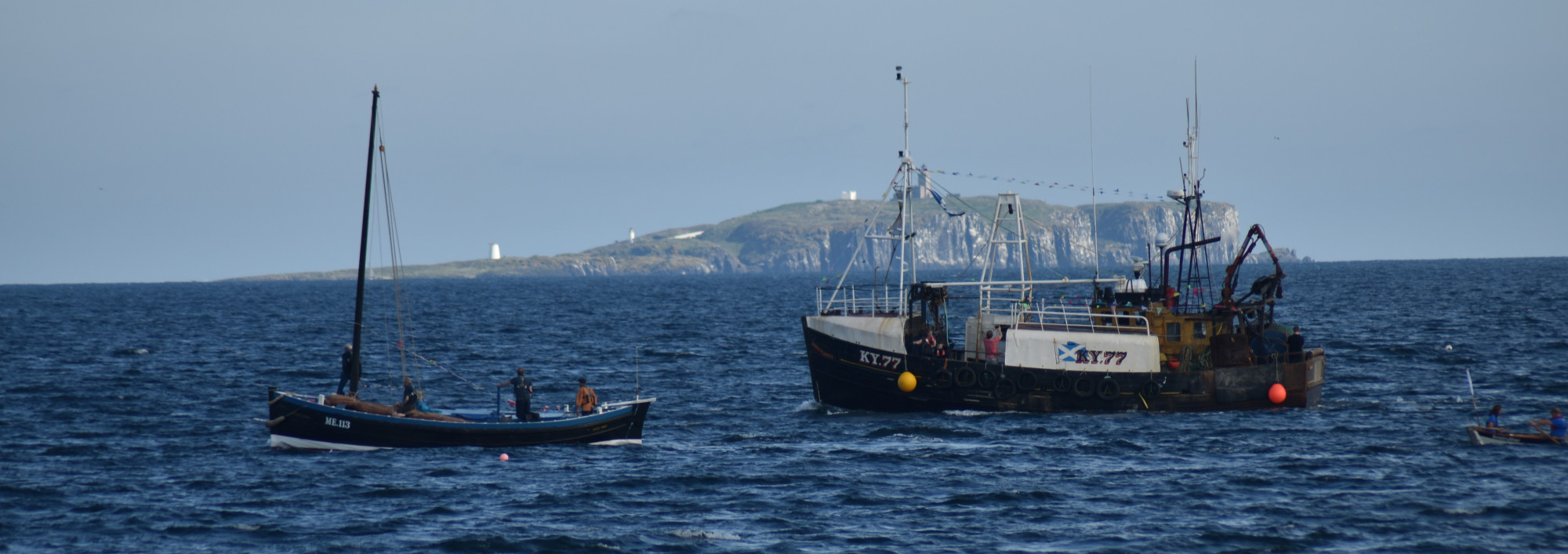

The Cellardyke Echo – 6/2/2018

A wee extra one today

OPENING OF THE INTERNATIONAL FISHERIES EXHIBITION. The opening of the international Fisheries Exhibition was a brilliant and almost embarrassing success. There was, however, nothing Royal or brilliant about the weather. The thunder, lightning, and hail of the previous day had not, as some of the weather-wise had predicted, put a period to the wintry May from which we have suffered. There yet remained another gloomy rainy day, and that unfortunately was the date fixed for the State pageant at South Kensington. The outside demonstrations were in consequence not remarkable. The half-a-dozen Royal carriages which conveyed the Prince and Princess of Wales, their sons, and the officers of State from Marlborough House naturally drew many persons out into the rain, and, along the route, strings of flags were stretched at uncertain intervals overhead across the streets.. About 1500 police lined the streets under Colonel Labelmondiere and Superintendents Gernon, Dunlop, Harris, and Hamblin. The route was a long one, and alarming events have been too recent to permit of a lax police arrangement on each a day.

At eleven o’clock the scene in the entrance-hall led become exciting and dramatically picturesque. The eye at length became almost wearied with the succession of forms and colours passing before it, to mingle anon with the multitude in the court below the steps, or to remain in the entrance hall, presenting kaleidoscopic effects with every minute. The bands of the Grenadier Guards and Horse Guards Blue struggled through the crowds that rendered passing to the central promenade anything but easy. Then there arrived, jolly and neat as new pins, the 400 fishermen of Great Britain, who looked proudly upon the familiar nets and boats in the Sea Fisheries section, and marched on to take up their positions on either side of the corridor communicating from the great Sea Fishery Avenue to the Central  Promenade. The naval volunteers fell in as a guard of honour, looking thoroughly in their element at such a time and place. The Coldstream Guards were drawn up outside. A score of the Queen’s watermen in their garishly quaint scarlet liveries, and each man armed with a scarlet oar held upright, entered. Then a posse of the Tudoresque persons, commonly called Beefeaters, passed on to the central promenade. One-and-twenty of the gorgeously panoplied Gentlemen- at-Arms, to whom the poet of honour was entrusted, soon put in a dazzling appearance, conspicuous above all by their snow-white plumes, golden helmets, rich uniforms, and fanciful halberds. Under command of the Bargemaster of the Fishmongers’ Company, twenty men in the comic garments worn by the hollers of Doggett’s coat and badge were posted in the building. The lads from the Arethuna, training-ship, assisted to redrees the balance of colour, which, in spite of the maritime nature of the entire business, inclined for a while considerably to military scarlet and gold, for, in addition to eminent military men, there were one or two lord -lieutenant and a boat of deputy-lieutenants from the City scattered about. By-and-bye, when the wearers of Windsor uniform and levee dress and the foreign Commissioners arrived, the scarlet was no longer a monopoly. The central promenade, reached by divers turnings, was the point towards which season and special ticket holders made their way as well as they could. The dais was at the upper end. Hard by was a roped-off section for the Foreign Ambassadors and most distinguished of invited persons. Next was a pen or enclosure in which certain gentlemen, whom business it was to see and hear for the outside public, were pressed together, as might not perhaps be altogether unbefitting the occasion, like sardines or herrings. The General Committee had their location next, and below them, extending in dense ranks on either side away to the orchestra 500 feet and more distant, were ladies and gentlemen who had at last a clear view of the procession as it passed up to the dais, and who but for the selfishness of a small crowd might have seen not a little of the ceremony itself. Sir Philip Cunliffe Owen, Mr. Trendell, and other officials did all they could to find seats for everybody, and if seats were not forthcoming it was not for want of will and energy on their parts. Unfortunately for the three or four thousand ladies and gentlemen below the General Committee, the most distinguished guests entered the promenade from the Norway Court, quite near the dais, and as a crowd of well-dressed persons would insist upon blocking up the gangway, which ought to have been kept clear throughout, the many were prevented from watching the arrival of celebrities. Musurus Pasha, on entering, was followed by Lord Colin Campbell in his plaid and kilt. Earliest of the Ministers was the Home Secretary, who was by-and-bye joined by Lord Aberdare. In their Windsor uniforms they contrasted well with the scarlet of the Marquis of Exeter’s Lord Lieutenant’s uniform, and the various foreign uniforms which blazed in the vicinity. Punctually at the appointed time there had arrived at the entrance hall the Duke and Duchess of Edinburgh, the Duke and Duchess of Connaught, the Duke and Duchess of Albany, the Princess Christian, the Duke of Cambridge, the Duke and Duchess of Teck, and Prince Edward of Saxe-Weimar. They were received by the Royal Commissioners, namely : The Dukes of Roxburgh., Northumberland, and Abercorn, the Marquis of Hamilton, the Earl of Ducie, Viscount Powerscourt, Lord Lovat, Sir John Rose, Admiral Collinson, Sir Samuel Wilson, Mr. Birkbeck, M.P., Professor Huxley, Mr. H. G. Calcraft, and Mr. J. H. Fordham, Prime Warden of the Fishmongers’ Company. The Prince and Princess of Wales and their sons arrived, as arranged, at noon, and were received by the distinguished Royal Company now waiting in the entrance-hall, And with all the honours due to their rank. The Duke of Richmond and Mr. Birkbeck  M.P., were officially present at the reception as Chairmen of Committees. The little daughter of Mr. Sayer, a member of the Executive Committee, offered a bouquet to the Princess of Wales, who accepted the gift with a smile to the tiny maiden and her sisters. After a pause the procession was formed and put in motion. Down the British Sea Fisheries Court it advanced amidst general cheering from the enthusiastic spectators, who had seized upon every available standpoint. The frank, hardy fishermen the corridor, with their banners, and in their distinctive working dresses, differing according to the districts they represented, looked, what we know them to be, toilers of the sea, of whom any country might conscientiously be proud. Their flags showed them to have come from all parts of the British coast, Ireland, and Guernsey. The fishwives, it need scarcely be explained, had been the observed of all wherever they appeared. The Canadian and American courts, between which the procession passed, looked wonderfully well in their completed form. Half-past twelve had almost arrived before the echoes of trumpets and distant cheering in the building informed those who had been seated so long in the central promenade that the Royal party were passing down the Sea Fisheries Court, through the ranks of British fishermen, and Newhaven and foreign fishwives towards them. Mr. Barnby’s choir of 400 voices, and orchestra of seventy performers, gave the National Anthem as the Royal party entered. AlI present rose to their feet, and many helped on to their chairs. The cleared space in the centre was not wide enough to give due effect to the procession, but it was grandly imposing, and not soon to be forgotten. First came the contractor and architect, followed by the Superintendent of Works, the Executive Committee, Foreign and Colonial Acting Commissioners, her Majesty’s Commissioners, and the Lord Steward and the Lord Chamberlain, with their wands heralding the Prince and Princess of Wales. The other members of the Royal Family were in the following order: The Duke of Edinburgh, leading his little son, and walking with Princess Christian on his right arm; the Duke of Connaught and Duchess of Edinburgh; the ‘ Duke of Albany and the Duchess of Connaught; the Duke of Cambridge and the Duchess of Albany; Prince Albert Victor and the Duchess of Teek , Prince Edward of Saxe-Weimar, Prince George of Weiss, and the Duke of Teck. The Master of the Horse (the Duke of Westminster) and the Mistress of the Robes (the Duchess of Roxburgh), and the Royal Households brought np the rear of a truly regal procession. The chairs of state were placed upon the dais in a semicircle. On each side palms, ferns, and roses were arranged around the dais, which was o’er-canopied with maroon cloth, upon which the Royal arms were emblazoned The screen was adorned with tridents, and beautifully festooned with what seemed to be fine lace. The material was, however, exceedingly fine network supplied by Sharp and Murray, the well-known herring-net maker of Cellardyke..
The Cellardyke Echo – 31/1/2018

1892

In the Justice of Peace Court on Saturday, James Scott, fisherman, Monans, was charged with failing to provide efficient elementary education for daughter Andrina. An attendance order was granted.  George Doig, fisherman, Cellardyke, pled guilty to failing to comply with an attendance order granted against him for his boy, who had not been at school since June last. He was fined 2s 6d with £1 1s 6d of expenses. An attendance order was granted against David Corstorphine, fisherman, Cellardyke, for his boy.

1893

SAD FATAL ACCIDENT IN FIFE. Anstruther Cross was the scene of a melancholy Accident yesterday afternoon, when James Gardiner, crofter, Cellardyke, was fatally injured by his cart his wheel passing over him. He had been at Cameron Bridge for draff, distance of fifteen miles, for which he had left at four in the morning. It is surmised that the long seat in the keen air had so far numbed him that on his descending from the cart with the intention of giving his horse drink at the fountain he fell. The cart wheel passed right across his chest. Those who observed the accident were naturally stunned, but their fears somewhat diminished when he rose and lifted the hay bag on which he was seated, and which had fallen at the instant. The next moment he again fell, and gradually lost consciousness. He was carried into the house of Mrs Clark opposite, where about half-an-hour after expired. The body was conveyed to his house in Tolbooth Wynd, Anstruther. The event created a painful sensation, and much sympathy is felt for the bereaved wife and young family of six, the eldest about 13. He was 56 years of age.

FIFE FISHERMEN AND THE IRISH FISHINGS. The Commissioners of the Irish Fisheries held an inquiry at Cellardyke Town Hall to-day into the early fishing on the south Irish coast. John Smith, fishcurer, Pittenweem, was the first witness. He said he had been in the habit of going to Kinsale for 22 years. His views were that the herrings caught in May were equally as good as those caught in June, if not better. If the fishing were put back to June fish-buyers would not go there, as it would not pay them. William Lindsay, fisherman; David Wood, Alexander Gardner, and David Watson all fishermen, Cellardyke, gave evidence, and all agreed that the best time to commence the fishing was 1st May. If put off till 1st June, there would no use of the Scottish fishermen going there. The dogs and sharks generally set the herring and mackerel away in June. None of the witnesses had ever seen large quantities of under-sized mackerels caught.

1895

The nets, fifteen in all, that were brought into Berwick by some fishing boats on Saturday afternoon have been identified the property’ of John Wood, Cellardyke, Fife. The coastguard has taken charge of the nets.

1897

St Andrews Police Court – On Friday before Bailie Murray, Robert Keith, fish Hawker, Cellardyke was fined 21s or 14 days for being drunk in charge of a cart on a public thoroughfare.

1898

MR ANSTUUTHEH’S ADVICE TO YOUNG FIFE FISHERMEN.

A social meeting of the Cellardyke Fishermen’s Union and Benefit Society was held in the Town Hall, Cellardyke, on Saturday evening. Provost Thomson presided over large attendance, including Mr H. T. Anstruther, M.P., who was the principal Speaker.

Mr Anstruther strongly urged the young fishermen to come forward and join, and participate in the benefits which the Society bestowed. A great deal had been said within recent years, notably on political platforms, about old ago pensions, and he believed there was a real desire on the part every political personage of any position whatsoever to bring about consummation of the desires the people in that direction. ……………. But there was another matter would like to mention. He held the opinion very strongly indeed that the Firth Forth did not do its duty to the Royal Navy. Down in the coast Devonshire, where the natural instincts and traditions the people were exactly the same as in Cellardyke fishermen from generation to generation, there was hardly village which did not send its complement boys every year the training brigs the of Royal Navy. (Applause.) And if, as he was often told, the fishing was not remunerative, and if it did not hold out to the younger members this community the same inducements in point of profit, and even of livelihood, it did to the older men, why not turn their thoughts towards that splendid service, that magnificent navy, whose review the Prince Wales on the last Saturday June was the wonder and admiration, and, thought, the envy of many a Continental nation (Applause.) Why should not the younger members the Community turn their attention to that for career! He spoke feelingly not only because he had a brother now, he was glad say a commander in the Royal Navy, but because he knew what a splendid career it was. It might that the Conservative instincts, which was always predominant among those who had been fishermen from generation to generation, were rather against parents putting their boys that career. But after all the fishing population was the back- bone of the navy, and he hoped they would consider this matter. (Applause.) A programme music was rendered during the evening, and the usual votes thanks were given at the close.

An unusually large number of properties in Cellardyke have recently come under the auctioneers’ hammer, not always, however, with the result of changing owners. The other day the property lately occupied by Mr David Pratt, Rodger Street, was put up for sale. Mr Millar, Falside, offered £261. At the same time the extensive fishcuring premises belonging to Mr David Keith were put up, when Mr Millar offered £300. In each case there were reserved bids, and consideration the offers was held over. The range of dwelling-houses off George Street, known as Sharp’s Close, was exposed for sale, but failed to secure offer.

A CELLARDYKE DIAMOND WEDDING. Ex-Bailie Robert and Mrs Brown, West Forth Street, Cellardyke, celebrated the 60th anniversary their wedding on Wednesday evening. They were made the recipients of illuminated addresses from the Kirk-Session and Deacons’ Court of Chalmers Memorial Church, from the Young Men’s Guild, and from the Band of Hope, along with a purse sovereigns. The Bailie is a native of Fisherrow, but came to Cellardyke when quite a young lad. He prosecuted the fishing until 17 years ago, and was one the most successful fishermen of Cellardyke. He was member of the Kilrenny Town Council for several terms and acted as one of the Magistrates for a number of years. He has been connected with the Free Church since the Disruption, and was ordained elder in 1845 an office he still continues hold. Mr and Mrs Brown are still hale and hearty, and able to move about. The sketch is from photo by Mr J. S. Ireland, Anstruther.

The Cellardyke Echo – 23/1/2018

1870

Two very affecting instances of the uncertainty of life occurred in Cellardyke on Thursday morning. Christian Black, wife of Mr Anderson Lothian, was attending a religious meeting in the Town Hall, when, as Mr Martin, evangelist from Glasgow, was engaged in prayer, she fell down in a fit of palsy. She was carried to the house of Widow Watson, which under the hall, where she died in about ten hours afterwards. The other case was that of Helen Robertson, wife of Mr Andrew Ringan, shoemaker, who was found dead in bed by her son in the morning. Her partner, who is about eighty, was sleeping by her side, and his feelings on wakening, may be conceived but never described. Both of the deceased were about seventy years of age.

An Interesting and Venerable Supper Party. —It is doubtful whether in the length and breadth of the land, even at this festive season, a more interesting party has encircled the social board than at the annual supper given by Thomas Cormack Esq., of the Cellardyke Steam Mills, on the occasion of engaging the boats for the crab fishing.

As everybody acquainted with the coast is aware, this fishing is conducted by aged men no longer able for the toils and fatigue of the deep sea, and consequently the meeting of Friday evening was really and truly gathering of the fathers of Cellardyke. This will appear more strongly when we state that seventeen of the old fishermen entertained on the occasion had an average age of almost seventy years, their united age giving a grand total of 1185 years. Two of our patriarchs, both in their eighty-fifth year had, however, to have their share sent to their own homes, but the others were all able to take place round the well plenished supper table, duly spread in Mr Cormack’s large and comfortable office. Singular enough the oldest of the company, Mr Mitchell Doig, who is in his seventy-seventh year, is also the oldest of four brothers, all of whom were present. The very youngest of the party had faced no fewer than threescore winters, and as may well be inferred where the voyage has been so unusually long and protracted on life’s stormy main, very many and strange were the memories which could talked over by these “ancient mariners” when, as on the night in question, they came to compare ” log books” together. We do not know all the subjects that were discussed, but we feel assured that none could be more interesting than if the hoary old fishers told of the experiences of their youth in the eventful times of the great French war, those stirring days when a friend was sometimes more to be feared than enemy or storm, because more frequent than either was the gun-brig or the pressgang that lurked about—silently and stealthly the wild beast for its prey—to drag the young fisher from his home. Full often at these times has the gallant little boat been trimmed with nicest care to out speed the dreaded cruiser, while, like the old castles in the troubled days of history, every fisher house had its secret or concealed place of retreat ready against the coming of the yet more ruthless gang, that would rob the household its pride and stay. With tales like these to tell, or the queerer, though not less momentous incidents of peace to discuss, there was no fear that the conversation would grow dull, or flag in interest, and neither did it, for nothing could exceed the cordial and animated enjoyment which \ marked the meeting from beginning to end. Mr Cormack had a seat at the head of the table, and  his kindness and urbanity contributed in no small degree to the happiness and pleasure of his venerable guests, whom, we trust, will be spared to join on more such blithesome occasions in wishing all health and prosperity to one so every way worthy of their  gratitude and esteem.

1871

Serious Accident at Sea.— About daylight on Friday morning last, an accident of a very serious nature occurred at sea, to Mr Charles Anderson, the skipper and owner of one of the Cellardyke deep sea-going boats. The crew were busy in casting their fishing lines, when the foresail tore away from the yard, in consequence of which it was found necessary to lower the mast that the damage might be repaired. This was being done when, unfortunately, the halyards slipped, the heavy mast fell on Skipper Anderson, who was standing near the stern of the boat, crushing him down on the platform or “after sheets” with such terrible violence to break one of his legs below the knee; but more fearful still, the body being at the same time doubled together, it fractured the ribs from the breast bone, and otherwise inflicted injuries of the most serious internal nature. The crew made every possible effort to release him; but in the stormy state of the weather, with the disabled boat rolling in the sea way, an interval of intense anxiety to them, and of inexpressible agony to the poor sufferer, necessarily elapsed before the mast was secured, so to enable Skipper Anderson to be lifted out in safety. The fishing lines were thrown adrift, and sail made for home; but the storm in the meantime having become more furious and contrary, it was not until nearly twenty hours after he had been struck that the boat reached Anstruther harbour. This was about four o’clock on Saturday morning, when the unfortunate man was once conveyed home, and Dr Macarthur sent for; but though everything has been done that skill and attention could suggest, still, owing to the fearful nature, of his injuries, aggrieved much by the constant tossing of the boat in the tempest, the poor sufferer continues in the most exhausted and precarious condition.

A few days later

In an early hour on Saturday morning, Skipper Charles Anderson, of Cellardyke, who was so cruelly crushed by the fall of the boat’s masts during the sea storm of Friday week, died of his injuries after an interval of the most intense suffering and agony. He was about 47 years of age, and leaves seven children, five of the orphans being still unable provide for themselves. Seldom, indeed, has the pathos and mystery of life been so sadly illustrated in the case of this stricken household. About three ago, and within fortnight of each other, two fine daughters were swiftly cut down in the bloom of early womanhood; and few months ago, the mother also passed to the “narrow house,” in whose cold embrace five of her twelve had been already laid. Skipper Anderson was one of the most extensive and successful fishermen of his native town, and his melancholy and untimely fate has elicited all sides the deepest expression of sympathy and regret.

1872

FISHING BOAT DASHED ON ANSTRUTHER PIER—EXCITING SCENE. During the severe gale from the south-west on Thursday morning the safety of the few daring crews that had ventured to sea in the face of the gathering tempest was the subject of great anxiety on shore, and many must have passed sleepless night listening, with trembling hearts, to the roaring waves, but, happily, they all regained the shelter of the harbour without harm, with the exception of the herring fishing boat belonging Skipper _ William Easson, of Buckhaven. The tide was ebbing fast, but there was still water enough the harbour about eleven o’clock in the forenoon, when the boat was seen to tack for the shore. The gale was now at its height, and driven before the resistless hurricane, the tops of the dark mountain waves were everywhere torn into sheets of foam, giving to the shore all the appearance of a vast field drifted snow, except where the tangled skerries rose like black specks through the yeast like spray, while away the offing the sail was seen tossing and reeling like willow bush in the gale. The skilful horseman knows by a glance the well-handled steed; and in the same way, and long before a landsman could have foreseen the danger, the Cellardyke fishermen saw it was time to prepare for the worst, and so the cry “launch the lifeboat” sent in an instant a hundred willing hands to the work of dragging the boat to the harbour, where, being manned with the same matchless promptitude volunteer crew, with Skipper John Pratt coxswain, the noble little craft, with her gallant rowers, sped like a dove on the errand of mercy— breasting the waves as graceful as swan, while a thousand faces on the shore brightened with the thought that, happen what might, help and deliverance were near at hand. In the meantime, the stranger boat had reefed her sail and was ploughing towards the harbour, while the waves were ever and anon leaping so high above the gunwale as to hide the crew from the excited spectators who lined the piers. The boat was evidently under too much canvas, and many a warning signal was waved and many a friendly voice raised the cry, “Lower the sail; keep her more away” to the sea ; but engulfed, as it were, in a whirlpool, and with the halyard block unfortunately refusing to do its office, the poor crew were unable to control the onward speed of their boat dashing along like a runaway horse, till, as approached the pier, treacherous sea struck her on the starboard quarter, when, whirling from her course, she seemed to dart like an arrow upon the surf-beaten bulwark of the east pier. A wild cry rose from the shore as the boat struck the bulwark, and at another time few broken planks, and the harrowing sight of dead men might have been the mournful record of the disaster; but, providentially, active and willing hands were ready, and ropes having been thrown and fastened to the boat, she was dragged into the harbour, seemingly from the very jaws of destruction. Though thus anticipated the work of salvation by their gallant townsmen on the pier, we ought to state that every effort was being made by the brave fellows in the lifeboat. The stranded boat is the Harmony, of Buckhaven, and she appears to be greatly damaged, her stem being driven in with the force of the collision against the pier, and her framework is also much shattered. She had on board about four crans of herrings. The Cellardyke fishermen deserve the greatest praise for their humanity and bravery in the case.

The Cellardyke Echo – 16/1/2018

1865

William Gardner, a fisherman from Cellardyke pled guilty to having assaulted his brother, and a married woman, and also having committed two separate acts of breach of the peace on the evening of 31st December and morning of 1st January and was sentenced to pay a fine of 30s or to go to prison for 30 days.

1866

Female Employment in the East of Fife. Poets and day dreamers have conceived a charming picture of woman’s sphere and work in the social economy when they assign to her the domestic circle and leaving her there to shed light and happiness 0n the hearth and hearts of her stronger brothers. ……. In Anstruther and the adjoining towns, where the fishing is carried on to the greatest extent, the employment of the industrious females is more identified with that important branch of local industry. Apart from the summer drave, when a prosperous fishing day and the high premiums offered for workers tempt forth most of the fairer portion of the community to assist in the curing operation, very considerable amount of employment afforded to females by the prosecution of the line fishing. In the several fish curing premises in Anstruther and Cellardyke alone many seventy women are engaged in preparing the white fish for market. Of course, their employment very uncertain and precarious, as it is altogether determined by the success of the fishermen. We cannot illustrate our remark better than by stating that in the course of the winter their earnings will sometimes rise to 10s per week, while for days and weeks their services are never required in the curing yard, and they are paid the rate of 2d the hour for the tune they are employed, of course, the exchequers then will be down to zero. No doubt the work in those fish curing yards, if not very severe, is rough and unwomanly, is markedly demonstrated – very masculine nature of their habiliments. Their work too, is generally carried on at the most unseasonable hours, especially at the haddock fishing, when they are often employed over midnight. Yet. in passing tae scene their labour, one is often surprised to hear the mirth that is going on amongst them for the silent echoes of the lone midnight hour will often be wakened up by the ringing laugh that follows the ready or, perchance, will be tilled with the melody rich voices joining in some favourite song, or it may be the grander and more solemn swell the hymn of praise.

1867

In the course of the week, four luggers have arrived from Scarborough, for the prosecuting of the great line fishing. …..About three or four weeks ago, one of the deep sea-going Cellardyke boats was out at the fishing, a part of the lines were drawn and taken away south side crew. All that the Cellardyke crew could learn of the strangers was the number their boat. The assistance of Mr Gillis, the very efficient fishery officer of the district, having being applied for, and obtained, that gentleman, with nothing more than the number of the boat to direct his inquiries, lost no time in requesting the custom-house authorities Leith for information relative to the ownership of the boat. This having been obtained it was found that the boat belonged to Prestonpans. A letter was accordingly sent the owner demanding restitution the lines, which were immediately sent to Leith for conveyance thither by the steamer, and in due course the Cellardyke crew regained possession of their lost gear

Sometime ago we reported that the smack War Hawk, of Pittenweem, had been fitted out as a trawler. That speculation, however, well as her great line fishing cruises, have proved a complete failure, and the vessel and her gear are now for sale. The great line fishing has been commenced by the Pioneer, of Cellardyke, but with little success that little more than 30s was realised for the fishing trip. The vessel sailed on Saturday morning, and returned two days afterwards ; but although she was thus at sea while the coast was being swept by the late severe southerly storm, her crew report that they experienced comparatively little the gale until they neared the land.

1868

The boisterous and unsettled state of the weather since the New Year has had corresponding influence upon the prosecution of the fishing. On such occasions, however, as the boats have reached the fishing ground, fair returns, as a whole, have been obtained for the season. Seldom, indeed, in recent years has the haddock fishing been carried with so much success at this date as on Monday. One Cellardyke crew landed as many 201 dozens, while several, others had from 150 to 200 dozens. The fishing ground which has been principally resorted to since the year began is about three hours’ sail from and with the Island of May bearing in north and by west direction ; but in the fall the year it was much nearer, being within the “reefs,” as the banks lying about six or seven leagues from the May are called by our fishermen. It is interesting fact, as showing the migratory habits of the haddock, that the close of the summer herring fishing no fish were to be had where they are now so plentiful. Looking back at the haddock fishing of the present season and comparing it with recent years, we find in the result a complete refutation of that common subject of alarm the over-fished theory, or that our coasts once rich in “finny” treasures are erelong destined to exhaustion. The experience of this season, however, is an emphatic contradiction of this gloomy opinion, as a very productive haddock fishing has been made on ground which was supposed to have been ” harried” some twenty years ago.

The remarkable rate of settled weather which was enjoyed in the late autumn was of course equally beneficial for sea and land. It has enabled the fishing to be followed with a regularity rarely possible on this coast, as an instance of which it may be stated that the number of trips made by the Cellardyke deep sea-going fleet since the Lammas fishing will average about forty, while last year it only reached to some twenty-seven times. … With railways extending everywhere, it was fondly hoped that the price of fish would be maintained; but in the course of the last three or four months our fishermen have had to sell the largest and finest haddocks at 10d or 1s per dozen —the average price for the season not being more than 1s 1d per dozen. Thus it is that the clear earnings of the fishermen are fully one-third under the season’s average, and this is the case, it ought to be recollected, when all the common necessaries of life are so much increased in cost. …. the Cellardyke men are likely to remain at the haddock fishing for a week or so longer, or until the prospects of the herring fishing improve.

1869

Owing the succession of heavy winds from various quarters, the white fishing this coast has been almost an entire blank during the present week. This enforced leisure, however, has not been idly spent by our fishermen, who have been busy making ready their nets, and completing preparations for the herring fishing, which will shortly be the great work of the season!

This season our local fleet has been increased by the arrival of three Findochty boats, which are to fish at Anstruther during the herring season. These boats reached Anstruther in the course of last week and some curiosity has been felt about their peculiar model, which is that of the well-known Buckie boats. They are decked all over, but, notwithstanding this provision, the crews prefer to lodge on shore. Some years ago, two or three north-country boats resorted here at this season, but their poor success led to the venture being given up. What however, may be considered more interesting than the arrival of these strangers, is the settlement in Cellardyke of a crew of fishermen from Sunderland. Their boat with the household effects on board, reached Cellardyke on Thursday.

After being detained on shore for most the week, the boats ventured to sea on Friday, when they met with a degree of success quite unprecedented in this quarter. With very few exceptions the takes of haddocks ranged from one ton upwards. In the case of one crew, that Mr James Smith (Fowler), the take actually weighed 39 cwt., which, we believe, is the largest shot haddocks ever landed in Anstruther or Cellardyke. It is estimated that over 50 tons of fish were landed by the deep-sea going boats from Cellardyke on Saturday last. The fish were first-class quality, and sold at the ruling price of per 10s cwt.

The Cellardyke Echo – 9/1/2018

1852

The Union sloop, Alan, of and for Peterhead from Newcastle with a cargo of coals, was stranded this morning at Cellardyke to the Eastward of the Harbour of Anstruther; Crew saved. She had missed stays, and drifted ashore, notwithstanding that her anchors were thrown out to prevent it. She is expected to be got off.

1853

On Monday evening last the Sabbath Schools in this burgh and neighbourhood held their annual meeting in the Free Church here—Mr Fowler, Cellardyke, in the chair. There might be about 400 children present, besides numerous attendance of parents and others interested in the young. Reports of the various schools, five in number, embracing a variety of interesting statistics, were read; and appropriate and excellent addresses were afterwards given by the Rev. Messrs Gregory and Meikle, conveying suitable instruction to the young and old, and also encouragement to the teachers to persevere in their labours. Looking on the broad field of youthful and happy countenances the area of the church presented, one could not help thinking—here is field containing gems richer far than all the gold regions of Australia, offering to the earnest and successful teacher—the spiritual digger—a rich and satisfying reward.

ANSTRUTHER.—Shipwrecked Fishermen and Mariners’ Royal Benevolent Society.—the books of this branch of this charitable institution having just been closed for the year 1852, we are enabled to give, the following as the result of the year’s operations. The annual membership fee 2s. 6d., and ninety fishermen and thirty-four mariners enrolled themselves, yielding the society £15 10s. The relief granted was more than usually high. Grants were made to twenty-four members, amounting to £31 8s. 7d. —of which relief to the extent of £3 7s. was given to the crew of the “Union” of Peterhead, wrecked off Cellardyke ; £3 10s. to two mariners wrecked at the whale fishery; £5 10s. to three fishermen who lost their boat and sails by the November high tide and storm; and £19 Is. 3d. to fishermen to enable them to replace lost nets and lines.

1854

The fourth annual soiree of the Anstruther, Cellardyke, and Kilrenny Juvenile Abstinence Society, was held in the U. P. Church Monday last week. The chair was taken by Mr H. B. Mackintosh, President of the Society, and after prayer and praise, the Chairman said that the flight of another year had brought them together again, …….Fifty new members had been added, and the number now on the roll was 550. There had been two summer excursions, and the monthly meetings had been kept up with interest; but, indeed, the cause was equally prosperous over all the world, and that in a short while public opinion would be so much in favour of abstinence that it would quite the fashion to be an abstainer. Mr Andrew Gilchrist then gave an address on the ” Poisonous Effects of Alcohol on the Human System,” and delighted the audience by reciting a piece of “appropriate and original poetry…… Mr Fowler of Cellardyke rose to present a testimonial from the juvenile abstainers to Mr Mackintosh, who about to leave this locality for Coupar-Angus. It consisted of a very handsome silver inkstand….. Mr Mackintosh had to thank the young collectors, but, above all, his warmest thanks were due to the young hearts who had so freely parted with what was to each of them a large sum of money, that they might give him this silver inkstand, as proof of their love. But he did not need this to convince him that they loved him, for every day proof of it met him on the streets in their sweet smiles and sparkling eyes……The Rev. Mr Kerr then addressed the children on “The importance of each of them thinking that he had a work to do, and how he was to do it,” and, after a parting address by the Chairman, this interesting meeting was closed by pronouncing the benediction.

1855

Enclosed berths from £16 16s 0d

Liverpool ‘Black Ball’ Clipper Packets

This line since its establishment has Conveyed more passengers to Australia than any other in the Kingdom, and no ship belonging to it has ever put back or met with any accident involving loss of life, not withstanding they have  made the quickest passages on recored, namely

Marco Polo         –             

First Voyage 5 Months 21 days

Second Voyage 6 months

Third Voyage 6 Months 4 days

Lightning            –

From Melbourne   63 days

These ships have all been constructed by the First Builders of the day including McKay of Boston and Hall of Aberdeen.

For terms of Passage , Freight &c apply to the owners

James Baines & Co Liverpool

Or to

Robt Stewart- Dundee

J.Jeffers Wilson – Kirkcaldy

James Howie – St Andrews

Thomas Brown – Cellardyke

J Dewar-  Cupar

1856 – John O Groats Journal

Cellardyke—Energetic Fishermen.—Cellardyke is one of the busiest towns on the coast of Fife, and its people about the most enterprising. It is not long since, they finished a dock which cost them no small siller, and now, as will be seen from the report in to- day’s paper, they are determined to have a harbour, and it does one good see the right royal independent manner in which they about it They do  not stand and beg of Hercules or any other power, but they say let us in the first place show what metal we are made of—let assess ourselves first, and show that we deserve to succeed ; then let us apply to the Fishery Board, and others interested, for the quota they are willing to give to the undertaking—a mode of proceeding which we have scarcely ever yet known fail, and therefore I have unbounded faith in the success of this scheme. The undertaking a heavy one, and their unanimous and hearty resolve to try it, to do their best deserves all praise. But although the undertaking is heavy, the object is admirable, and worthy of a long pull, a strong pull, and pull altogether;  and if that is given which, from the spirit manifested at the meeting, we will have doubt it will, its I success is certain, and the advantages to Cellardyke incalculable. We, therefore, cordially and heartily I with the project good speed, and commend all interested in the district.

1857

THE CRAIGNOON HARBOUR PROJECT.—ANNUAL PUBLIC MEETING.  A public meeting of the inhabitants of Cellardyke was held the lnfant School last Tuesday evening, for the purpose of receiving a report of the progress made the committee during the year, and resolving on future proceedings—James Fowler, Esq., chief manager, in the chair. The Chairman called on Mr Mackintosh, the secretary, to read the resolutions adopted at the public meeting held 20th December 1855, in virtue which the scheme was then organised and this meeting now held. He also read minutes of meetings of committee and correspondence during the year. Mr Martin read his audited account

 Weekly contributions from fishermen, £378      3s           0d

Donations,                                                                     £2           0s           0d

Bank Interest,                                                               £7           4s           6d

Total                                                                                 £387     7s           6d

Expense of survey, and boat for surveyors, . . . £24          3s           6d

Other expenses                                                            £4           8s           6d

Leaving a balance in favour of the scheme. .       £358      15s         6d

The Secretary then read the Report by the Committee as follows

“On 2oth.December 1855, the fishermen of Cellardyke, in public meeting assembled, unanimously resolved to adopt measures for the erection of a low water harbour at Craignoon, and for the carrying out of the resolutions then adopted, appointed your committee, who, in now resigning their trust into the hands of their constituents, beg to report their proceedings during the year. .

“ The meeting of the 20th December having been fully reported in the Cupar papers, 600 copies thereof were purchased, a copy handed in to each house in Cellardyke, and copies sent to influential parties connected with the district. A wide interest thus excited in the efforts being made.

On 29th December 1855, Cellardyke was divided into four districts, and committed to the charge of eight collectors, who were instructed to uplift weekly the contributions agreed to be paid by each skipper. The collectors most regularly and efficiently discharged this duty

“On the  night of 6th January 1856, a sudden and heavy gale destroyed boats and nets in Anstruther harbour to the amount of £725. The committee took immediate advantage of that circumstance, and opened a correspondence with Edward Ellice, Esq., M.P. for the burgh, who recommended a memorial to the Board of Fisheries for a survey of Craignoon, and for assistance. A memorial was at once drawn up and signed 369 fishermen in Cellardyke. A similar memorial in favour of Craignoon was drawn up, and having been signed 1243 fishermen, residing in the towns of Dunbar, North Berwick, Cockenzie, Prestonpans, Fisherrow, Newhaven, Buckhaven, Pittenweem, St Andrews, Broughty Fern-, Auchmutty, and Ferryden, both petitions were transmitted to the Board of Fisheries. The Board immediately granted a survey, on condition that the promoters should pay £20 towards its cost. A public meeting was called, and the consent of all interested cordially granted.

Mr Stevenson, the Board’s engineer, visited Cellardyke in March last. The committee met with him, and fully explained the wants and wishes of the fishermen ; and the survey was proceeded with.

“On 13th June last, the committee received from the Hon. B. F. Primrose, Secretary to the Board of Fisheries, a plan by the Messrs Stevenson, engineers to the Board, of a low-water harbour at Craignoon, which would embrace space of nine acres, and the erection of which would cost £27,000. The committee met, and having maturely considered the plan and report, were unanimously of opinion that, while the report as to the site was favourable, yet the estimated cost was so much above their expectations and beyond the means of the fishermen of Cellardyke, that unless Government should give a very liberal grant, or the plan be very materially modified, the project must be altogether abandoned; and deputation was appointed to wait on the secretary and engineers to the Board, to state these facts and make suggestions. The deputation accordingly waited on these officials in Edinburgh, and were cordially received. The result of the interview was that modified plan could be produced, which would reduce the estimated cost of the harbour to £21,000; hut this plan the engineers were not inclined to recommend, and the promoters were advised rather to carry out the larger sketch its integrity and to press Government for a grant sufficiently large to complete it. The result of this conference was communicated to a general meeting of the inhabitants, held in June last.

A correspondence was opened with Admiral Bethune of Balfour the superior of the burgh, with the view of interesting him in the harbour, and a deputation waited upon him in August last. He received the deputation very cordially, and expressed himself favourable to the erection of a harbour suitable for all the wants of Cellardyke.

In August last the special Commission appointed by Government to examine and report on the Board of Fisheries and the Harbours in Scotland, visited Cellardyke. Your committee had special interview with the Commissioners, and placed in their hands memorial detailing the rapid increase of the fishing- trade, and the want of harbour accommodation and shelter- and urgently pressing the claims of Cellardyke for Government assistance. The Commissioners also visited and inspected Cellardyke Harbour and Craignoon, and the committee gave them all necessary information. The Commissioners’ report will not be made public till Parliament assembles.

On the 5thinst. the committee met, when the Treasurer reported that, after paying all expenses incurred, there was a balance in bank to the credit of the fund of £358 15s. 6d. ” The committee then considering that this meeting is to finally resolve whether the scheme of collecting funds for a new harbour is to be continued or abandoned, agreed to recommend to the contributors, that in respect no definite report has yet been made the Government Harbour Commissioners, and as no Government aid need be expected, unless fishermen show their worthiness to be helped by helping themselves, and as the abandonment of the present machinery would be equivalent to the abandonment of the entire project of low-water harbour —the scheme be continued for another year, a committee and collectors appointed, and a certain weekly rate be paid by each fisherman. (Signed) “James Fowler, Chairman.”

The Chairman then made few appropriate remarks the present position of the scheme, and read extract from the Scottish Press regarding the Commissioners’ forthcoming report on harbours, and the probability that aid may be pretty extensively given. Various parties having expressed their opinions the following resolutions were moved, seconded, and unanimously and with much applause agreed to:— “

1.” Resolved— That this meeting having heard the committee’s report of their proceedings during the past year, is fully satisfied with the diligence with which the trust committed to them has been discharge J, and that the thanks the subscribers and whole community are due to the Chairman, Secretary, Treasurer and Collectors, and to the several members of Committee for their gratuitous labours.

2. Resolved— That as the necessity for harbour accommodation and shelter is becoming daily more urgent, that the resolutions adopted December 1855 for the erection of a low water harbour, be still adhered to during the current year, I and that the rate to be paid weekly by each skipper 3s. or 4d. per share.

3. Resolved—That the committee shall consist of all the skippers of line boats and the following gentlemen:—James Fowler, chairman; H. B. Mackintosh, secretary; and John Martin, treasurer.”

The meeting was largely attended as the monstre meeting of fishermen in December 1855; not one dissentient voice was raised; and the enthusiasm in the movement for a low-water harbour, instead of having weakened, appears to have very considerably increased If success does not follow, the fault will not be with the fishermen of Cellardyke. The usual complimentary votes having been passed the meeting separated.

We don’t know anything more gratifying than the above report. The inhabitants of Cellardyke, in their unanimity and determination, have given lesson greatly needed by many other localities, and which in their own case cannot fail ultimately to secure the important object they have in view.

The Cellardyke Echo – 3/1/2018

1937

Epidemics of flu and mumps are of increasingly serious nature Anstruther. The fishing fleet, however, not badly affected and it is expected that several boats will start to the winter herring fishing to-night. The epidemic of mumps is giving cause for alarm at Cellardyke School, where over 100 pupils, about a third of the roll, are absent from this cause. There are only 30 cases of flu.

At Waid Academy the rector stated today that 104 pupils, 25 per cent, of the school, were absent through illness. While a big proportion of these absentees was due to mumps, he said, the greater proportion are absent from influenza.

1938

For Sale, by Public: Roup, within the TOWN HALL, CELLARDYKE, on WEDNESDAY, the 12th day January 1938, at 11 o’clock Forenoon, ALL and WHOLE that TENEMENT, Number 57 GEORGE STREET, CELLARDYKE, in the United Burgh of Kilrenny. Anstruther Easter and Anstruther Wester, and County of Fife, consisting of Two Dwelling-Houses, the House on the lower flat being, until recently, occupied by Peter Queripel, and the House on the upper flat being occupied by Stephen Barclay, together with Washing-House, Cellars, and other Offices, and the Ground pertaining to the said Tenement bounded said whole subjects as follows, viz.:—On the north or north-west by George Street; on the east or north-east by subjects belonging to Mrs Lucy Shirreff; on the south or south-east by the seashore; and on the west or south-west by subjects belonging to Mrs Elspeth Motion. UPSET PRICE—£225.

1939

VERDICTS IN HARBOUR ACCIDENTS. The jury returned formal verdicton the deaths of two men who died from injuries received at Aberdeen Harbour in public inquiries held at Aberdeen Sheriff Court. The first inquiry was on the death of Mr Thomas Flett, dock labourer, 23 Virginia Street, Aberdeen, who died almost instantaneously when he fell from staging while assisting to discharge a cargo at Aberdeen Harbour. …………… Mr John Cunningham, fisherman. 63 John Street, Cellardyke, Anstruther, Fife, died as the result of a hand injury received when his hand was crushed between a ship berthing at Aberdeen Fish Market and the quay. His hand had to be amputated, and he died from a crushed fracture of the right hand and septic infection.

1941

A director of Messrs Robert Watson & Co-, Ltd., oilskin manufacturers, Cellardyke, has retired after being with the firm for 43 years- He is Mr David Mitchell, Glendower, Anstruther, and he was presented with a gold watch by the employees. Another presentation at Cellardyke was to Mrs Gardner, George Street, who received a cheque in recognition of her long service with the same firm. She has worked there for 50 years, and is carrying on.

1943

Provost Carstairs, Anstruther has received from Cellardyke Public School (per Mr Blair) £6 for Fife Branch Red Cross Society, and for Fife Prisoners of War Fund, and £1 1s from Mrs Nairn, Commercial Schoolhouse, Dunfermline, for Fife Branch Red Cross Society.

1944

A whist drive and dance in Pittenweem School in aid of the Red Cross Prisoners of War Fund, and organised by Mr J. Watt and Mrs Horsburgh, realised £55. ………… Mr Blair, Cellardyke, gave a short address on the work of the P.O.W. fund promoters. Provost J. Lawson gave address and moved thanks. Mrs Blair (next-of-kin representative the fund) handed over the prizes. A dance followed to music by Brand’s band.

1945

New Year’s Honours List

Acting Chief Boom Skipper James Muir, Cellardyke Fife.

Offers Wanted – for fast motor cruiser, 28ft x 6ft, cabin saloon, Bentley racing engine, speed approx. 28-30 miles per hour, some work to do, May, 83 George Street, Cellardyke

1946

The recent slight outbreak of paratyphoid fever in East Fife coast area was traced to a girl who was selling ice-cream in a shop in Cellardyke. This was stated Fife Public Health Committee at Cupar Friday by Dr G. Matthew Fyfe, County reply Mr H. H. Edie, Cornceres, Anstruther. The girl herself had the trouble in mild form, got better, but was still carrying the germs and infected the ice-cream. A fair number of people who consumed ice-cream on particular day got the infection. The doctor agreed with Bailie William Fleming, Anstruther, that the shop in question was very clean. The Committee agreed to express dissatisfaction at the reply which had been received from the Department Health regarding the observations made by the M.O.H. on the Dried Egg (Control Use) Order, 1945, and the need for fixing a standard for ice-cream. The Department stated the Food Minister had decided it was not appropriate to prescribe any standard for ice-cream. One reason being that so far as ingredients were concerned it could only prescribe very low fat content. It was agreed to raise the matter with the County Councils Association.

1947

East Fife was hit by one of the fiercest gales for many years. At Cellardyke, tiles and slates were ripped from roof-tops, and street lamp near the harbour was wrenched from its wall brackets. Anstruther had a spectacular display, giant breakers hurling spray 40 feet above the outer pier. East Fife fishermen have been unable to put to sea this year.

1948

East Fife fishermen decided yesterday to recommend to their national association that the maximum price for herring should be increased from 89s 10d to 98s per cran.

The decision was  taken at Anstruther yesterday, when the problem of reconciling prices with the rising costs of gear was discussed at the annual meeting of the East Fife branch of the Scottish Herring Producers’ Association.

Mr W. Meldrum, St Monance, who proposed the increase, said the price herring in the second year of the war was 98s. Since then prices had come down, whereas the price of gear had increased by 300 per cent. ……….Mr M. Gardner, Cellardyke, said a “fleet” of ropes had increased in price since the beginning of the war from £25 to £105, and a net, formerly £16, was now costing between £36 and £46.

1954

BUSINESS NOTICE NYLONS: guaranteed invisible repairs, per stocking. Mrs Scott, 28 James Street, Cellardyke, Anstruther, Fife.

1966

A FIFE line fisherman has died In the Icy waters off Faroe on his first trip of the New Year. He was Mr Robert Duncan (5I), a member of the crew of the Kirkcaldy registered Line-fishing boat Silver Chord, which operates from Aberdeen. News of his death was broken yesterday to his family at Cellardyke. He was married, with one child. Mr Duncan Is understood to have fallen overboard. His shipmates managed reach him but were too late to save hm. He was dead when they got him back on board. . Skipper James Muir headed the Silver Chord into the Faroese port of Trangisvaag to report the tragedy.

It was expected that the Silver Chord would calling for home with Mr Duncan’s body —but It was uncertain last night If she had been able get under way.

Confirming the tragedy, spokesman for the vessel Aberdeen agents said he was unable to give details the accident or the ships likely movements. He had had difficulty in making telephone communication with Trangisvaag.

The Cellardyke Echo – 27/12/2017

1930

CHILDREN’S CANTATA AT ANSTRUTHER. An enjoyable children’s concert in aid of Cellardyke Improvement Committee’s funds was held last night in Anstruther Town Hall —Provost Readdie presiding. Among the interesting and humorous items submitted was an operetta by T. Maskell Hardy.

The following took part: —Peter Roy, showman; Margaret Watson, king; Iris Palmer, queen; Douglas Keay, tinker; Gladys Nicolson, Chinaman; Catherine Smith, Jap; Peter Murray, sailor; Margaret Carstairs, sailor. The assistants were Alex. Laing and Jim Doig.

Action songs were also given, and community singing by the audience was a feature.

CELLARDYKE GUILD SALE OF WORK. Cellardyke Church Women’s Guild sale of work realised over £85. This sum will be used to defray the cast of new heating apparatus and other church improvements.

A “welcome home” Was  given to  Anstruther fishermen last night, when the local Burns Club treated them to a supper and musical entertainment in Cellardyke Town Hall.

There was a large company presided over Mr C H. Maxwell.

Details of an important scheme, which would be undertaken the council under the unemployment grants proposals, were submitted at a special meeting of Anstruther Town Council last night.

Bailie Crooks said that it was likely that a grant would obtained for the scheme for the institution of sewer outfalls and also for demolition and road work at George Street and Dove Street, Cellardyke.

There was no chance, however, of getting grant for the work to be done the repair of the sea wall at the east end. This work was considered purely maintenance, and could not figure as a grant subject. The council decided to undertake the repair of the whole of the wall provided the grant was obtained.

1932

DISORDERLY CONDUCT AT ST MONANCE

Three Cellardyke men were fined by Hon. Sheriff Lumsden at Cupar yesterday for disorderly conduct.

They were Alexander Myles, carter. 9 James Street; Mitchell Anderson, joiner, 2 Fowler Street, and John Marr Braid, carter, 33 Shore Street —all of Cellardyke. admitted that on 4th December on Station Road, St Monance, opposite the bus stance, cursed and swore and committed a breach of the peace; and (2) within the ex-servicemen’s hut, St Monance, assaulted James Fyall, son of, and residing with. James Fyall, fisherman. Rose Street. St Monance, and threw the contents of a lemonade bottle his face.

All three admitted having in the same place shouted and bawled and committed a breach of the peace.

Mr George Brander. Procurator Fiscal, said there had apparently been a dance on that night, and accused were annoying the other dancers. His lordship imposed a fine of 15s on Myles and 7s 6d each of the others.

BOAT-BUILDING IN CELLARDYKE BOAT-BUILDING is booming in Cellardyke. Down at the harbour and in the streets there is no unusual activity. The town wears that pre-occupied demeanour, habitual to her after the close of the Yarmouth fishing. And the population is—to all appearances —quietly and methodically engaged in preparing for the coming “winter herring.” Nor is there anything secret or sinister about the new “industry.”

Through the efforts of the Ratepayers’ Improvement Association, a large pond has recently been completed “east the toon,” beside the famous Cardinal’s Steps. This pond, which, I understand, is the largest of its kind in Fife, is to be formally opened early in the New Year as a yachting pond. During the summer months it will be used for swimming.

A “Model Boat Club” is presently in process of formation. Nearly every man, young and old, is interested, and every day we see a boat-laden procession going pond-wards. In garrets, cellars, back shops, and by cosy firesides in the winter evenings, every “man body” in the town, from the youthful schoolboy to the aged “Dey,” is busily engrossed in making “model boats.”

Each dainty vessel is perfect in every detail, and thus reflects the greatest credit on the skill, ingenuity, and patience of her builders. There is no flaw in her exquisite workmanship, no error in her dimensions.

With white sails set, she awaits that thrilling moment when, carried proudly thither in the arms of her builder, she is launched not only into her native element, but also into strenuous competition against her sister ships. It is charming sight to see the tiny craft, sails all taut, darting through the wind-ruffled wavelets of the pond, responding, as it were, to the shouts of encouragement from admiring and enthusiastic spectators, some of whom in their excitement run the risk of toppling into the water.

“THE FIFIE” At the first casual glance the boats seem to differ only in size and colour.  A closer scrutiny reveals the fact that each has been designed from either of two models. The “Fifie ” type, which has no connection with our old friend of the Tay Ferry, is modelled on the lines of the  old-time fishing boat.She has two masts and carries jib, main, and mizzen sails. Her direction is controlled by the weight of her keel and the manipulation of her sails. The yacht models, on the other hand, have been designed to take the path of least resistance. As they cut through the water, their long, slender, graceful lines are easily discerned. Their complement is one mast and four sails, fore jib and aft-jib, main-sail and top-sail, and they are directed by a rudder.

AN OLD AMBITION

The new bathing and boating pond has been the result of the united efforts of Cellardyke Ratepayers’ Improvements Association to foster the spirit of enterprise and to supply by artificial means that something lacking in the natural endowments of their burgh.

The “Dykers ” are well noted as a keen-witted, far-sighted, and progressive community; it has long been their ambition to make their clean and caller town valuable asset to her inhabitants. They are now endeavouring not only to cater for their own requirements, but also to minister to the needs of those who spend a brief annual holiday on their shores.

YOUTH ROUSED

This new “industry” or “hobby,” as some may term it, has awakened the interest of Cellardyke youths. It has roused their latent ability and stimulated their ambition, for not only must they emulate their experienced elders, they must also attempt to surpass them by exhibition of workmanship superior to that of the “old-timers.”

Although the spirit of rivalry is abroad, it is a friendly and kindly spirit. Each man tries to outvie his neighbour in the production of “champion racer.”

Well and merrily, therefore, may the bonny boaties speed, their billowing sails filled by the sportive winds of the Forth.

1933

An explanation of the new Unemployment Insurance Bill in relation of fishermen was given by Provost Carstairs, Anstruther, at large meeting of fishermen in Cellardyke Toun Hall. Mr Jack Graham, who was a member of the deputation which recently visited the House of Commons, presided.

Mr David Christie, fisherman, 26 Rodger Street, Cellardyke, has been appointed chief coxswain of Anstruther lifeboat in succession the late Mr Martin Gardner. Mr Christie has been member of the lifeboat crew for a number of years, and has acted recently as bowman. He has been connected with the fishing industry all his life, and is recognised as a skilful and capable seaman. . Mr M. Gardner (Thomson), skipper of the Acorn, has been appointed bowman in succession to Mr Christie.

CELLARDYKE SAILING CLUB OFFICIALS COMPETITION WINNERS. At the annual mooting of East Fife Model Sailing Club, Cellardyke, the following office-bearers were appointed: Commodore, Dr D. C. Wilson; vice-commodore, Mr James Bett; hon. secretary, Mr David Reid; hon. treasurer, Mr A. O. M. Bett; committee-Messrs David Mitchell, James Laing, Wilson Allan, William Smith, James Stewart, Martin Sutherland, George Brown, David Scott, Thomas Murray, and James Williamson, jun. In the final of the Mitchell Cup competition, with Dr D. C. Wilson as umpire, and Mr James Bett as starter, the winners were: —27 in. and under—Adrian Lowrie 30 in. and under —Alex. Rodger, jun.: 33 in. and under —Alex. Rodger, jun.; 36 in. and under —Vice-Commodore James Bett; over 36 in. —Martin Sutherland. 113 models were entered.

1934

CELLARDYKE DONATIONS TO CHARITY. The employees of John Martin & Co., oilskin manufacturers, Cellardyke, have raised the sum of £85 for charitable purposes during the past year. This sum, which includes the proceeds of various whist drives, has just been disbursed as follows: Edinburgh Royal Infirmary. £25; Dundee Royal Infirmary. £25; Anstruther and Cellardyke Nursing Association £20- Edinburgh Sick Children’s Hospital, £5- Local Ambulance Fund, £5; Lifeboat, £5

The Cellardyke Echo – 20/12/2017

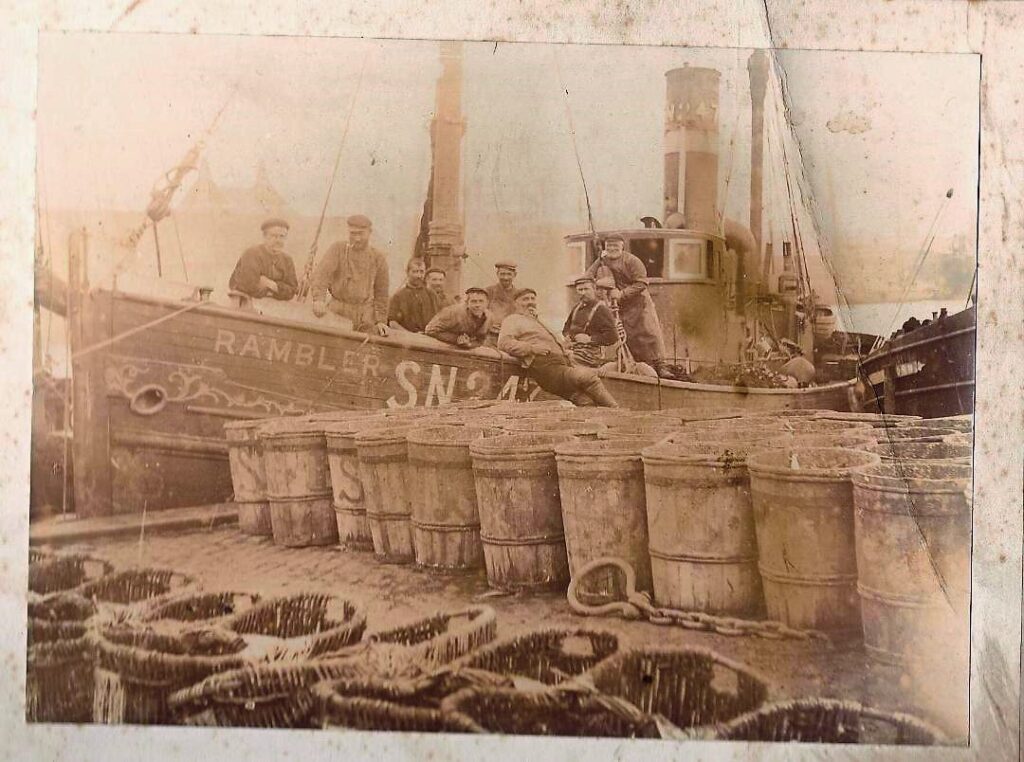
This week’s Cellardyke Echo will begin with a story that came to light with another of Susan Cathcarts photos.. This one a fantastic photo of the steam Liner and drifter the Rambler SN 247 which was built in Blyth in 1898.

The Rambler was bought by brothers John and Robert Stewart (grandfather of Ian Stewart who became a founder member of the Rolling Stones) approx. 1904

They had decided to buy a newer boat than the one they were working and came across Rambler. Before a deal could be struck, John Stewart was taken ill with flu and confined to bed. He had misgivings about The Rambler…feeling it didn’t have much protection for its crew in poor weather and intended speaking to his brother to persuade him it wasn’t the boat for them.

However, Robert went ahead and bought the boat without consulting John.

Robert Jnr (nephew to Robert Snr and son co owner, the above John Stewart and Mary Ann Bett, Born 13th Jan 1884 at 24 James Street,) was a deck hand on the boat and one of the first trips to Yarmouth he was washed overboard and drowned, on the 11th of Nov 1905

John blamed his brother for the loss of his son and two brothers never spoke again.

Although Robert’s death was on the 11 Nov it was reported in the newspapers this week. I had not noticed Robert’s loss a Cellardyke one before as the vessel was recorded as Shields owned, she retained her Shields registration until she was lost in 1918 struck by a mine.

1905

SCOTTISH BOATS HOME FROM ENGLISH FISHING. FISHERMAN’S SEASON. THE TOLL OF VICTIMS. The last of the Scottish boats left Yarmouth and Lowestoft during the past week for home, and the English fishing for 1905 has ended so far the North British fleets are concerned. …….Compared with 1904, the crews have come back to Scotland with practically doubled earnings.. ….. The Scottish fleets at Yarmouth and Lowestoft numbered just over a thousand sail, and out of all this large flotilla moving to and fro almost daily it is satisfactory to record that only six boats have been lost. These were the Breadwinner, of Peterhead, which sprang leak and foundered; the Kirkcaldy boat The Prior, which was sunk by collision with the Peterhead boat Johanna Petrie; the Wick boat Fruitful, that was wrecked on the North Sand in a gale while making Yarmouth harbour; the Banff boat Pomegranate sunk by the Aberdeen steamer Hogarth off Lowestoft; the Macduff boat Maggie Ann, wrecked Lowestoft; and the Port Gordon boat Industry, sunk by a steamer in the North Sea while homeward bound. The Scottish death-roll has been sad one, and the sea claimed a full toll of victims from the fishermen who venture on the deep ………….. Among those who are now numbered with the dead have been John Eason, drowned from the Kirkcaldy boat Children’s Friend; James Taylor, drowned from the Jennie Taylor, Fraserburgh; William Milne, drowned from the Buckie boat Lady Seafield; Skipper Hendry, drowned from the Port Gordon boat Industry; George Muir, of the Banff boat Fidelity, who died

in Lowestoft Hospital; Robert Stewart, drowned from the Rambler, belonging to North Shields; and, worst of all, the seven, hands lost from the Banff boat Pomegranate, which was run down Scottish steamer while homeward bound recently off Lowestoft.

1922

The steam drifter Camperdown, which belonged Skipper James Muir. Cellardyke, has been sold to Mr Reid, fisherman Buckie

1924 ( returning to the photo of Black’s oilskin Factory and later Crisp factory it appears in the paper this week too)

OILSKIN FACTORY AND DWELLING HOUSES IN CELLARDYKE FOR SALE.

There will be exposed to SALE by Public Roup, within the Town Hall. Cellardyke, on Wednesday, 31st December, at 2 p m .unless previously disposed of by private bargain,

  1. Those extensive PREMISES in JAMES STREET. Cellardyke. Long occupied by Alex Black & Co: as a Net and Oilskin Factory. The buildings include -floor areas of 1200 square yards, Drying Floors, Paint Shop, Stores, and Sewing and Cutting Rooms. There is also a good Saleshop, Office, Storerooms and Engine-House. &c. All equipped with the usual fixtures. – There is Steam power and Heating Plant, and 10 sewing and cutting machines. The Premises are well situated and adapted or the trade, or could be-sub-divided for other purposes, immediate occupation. – – – LOW UPSET PRICE, £ 550. Feu-duty nominal.
  2. That Modern DWELLING-HOUSE. No. 29 James Street, Cellardyke, adjoining: above Factory, containing-6 Apartments with Bathroom (H. & C). Kitchen. Offices and Garden all in Excellent Order. Immediate Occupation

Assessed rental in late Owner’s occupation was £17.

UPSET PRICE. £550. Feu-duty nominal. For further particulars apply to GUTHRIE & MAXWELL. Solicitors; Anstruther Who hold the Title Deeds and Articles of Roup.

The accounts in connection with Cellardyke municipal putting green show a credit balance of £51 16s 7d. This was reported to Kilrenny Town Council, and it was resolved to credit the Common Good account with £40 and place the balance on deposit receipt.

A vote of thanks was accorded to Bailie Bett, convener, for his service in connection with the putting green. Bailie Bett intimated that he wished to be relieved of the work, and Councillor Thomas Gardner agreed to take his place.

Applications were submitted for the post of town officer and hall keeper for Cellardyke. It was agreed to include the duties of scavenger, and to appoint the present scavenger, Mr Christopher Moir, 22 James Street, Cellardyke, at wage of £2 weekly, with house free of rent and taxes.

NEW DIRECTORS OF CELLARDYKE SAVINGS BANK. Mr Robert A. Fowler, chairman, presided at the annual meeting of depositors of Cellardyke Savings Bank. Mr H. Watson, Anstruther, joint manager, submitted an abstract of the transactions for the year, which showed a considerable increase the deposits. Messrs James Buttars, Alex. Myles, and T. S. Laverock were elected directors in room of those falling to retire. The following appointments were made:—Chairman, Mr R. Fowler; joint managers, Messrs A. C. Mackintosh and H. Watson; cashier, Mr Lawrence Smith.

1926

SUCCESSFUL CELLARDYKE CHURCH BAZAAR. £670 was realised at Cellardyke Parish Church bazaar, which was held the Town Hall. Anstruther. The bazaar was opened by the Rev. W. L. Levack, Belmont, Glasgow, formerly Leuchars. The money was required for the building of a church hall. Mr Levack said it was forty-three years ago since Cellardyke Parish Church came into being, and great work had been done since then. It would impossible to carry on the many organisations unless they had adequate accommodation.

1927

Mr and Mrs George Keay Shore Street, Cellardyke, have celebrated their golden wedding. A happy family gathering assembled in Town Hall to congratulate them. Their family includes five daughters, all of whom were present at the celebration. There are 22 grandchildren and two greatgrandchildren. In addition to a purse of sovereigns, Mr and Mrs Keay were the recipients of numerous gifts.

George Hodge Melville, fish-curer, “Croma,” Cellardyke, was convicted on evidence, in Cupar Sheriff Court on Tuesday, of having, on 29th August, on the Guardbridge -St Andrews public highway, driven a motor car in a negligent manner, failed to keep a proper look-out in front, and caused the car to down Charles Grubb, coal merchant. 2 Albany Place, Andrews, and injure his right arm. Grubb said he was walking close to his own side

1928

A change of diet was the explanation offered at Cupar Sheriff Court to-day in a charge under the Sale of Food and Drugs Art 1875, and the Sale of Milk Act, 1901. The case was one in which James Carstairs farmer, Clephanton Farm, parish of Carnbee, was charged that, on 7th November, in James Street, Cellardyke, he sold by the hand of his son one pint of “sweet milk to Robert Just, 15 Lamond Street, sanitary inspector for the St Andrews District, which milk was not genuine sweet milk, as it contained less than 3 per cent of milk fat.

 Mr N. Robertson. Cupar, solicitor for accused, tendered plea of guilty, and said that the milk contained 2.73 per cent of milk fat instead of the requisite 3 per cent

The explanation given was that at the time this contravention was committed the cows had been put a kind of turnip known the mammol turnip, which was a sort of soft watery turnip. The weather was too wet for him to carry good turnips from his land for the cows, and he had to rely on a supply of these turnips. He had also taken the cows off hay. The milk had not been tampered with at all. Dudley Stuart imposed a fine of 40s.

1929

OFFICIAL NOTICE—PROPOSAL TO CHANGE A SHIP’S NAME,

I. A. N. CUNNINGHAM, of Anstruther, hereby give Notice that, in consequence of change of ownership and family reasons, I have applied the Board of Trade, under Section 47 of the Merchant Shipping Act, 1894, in respect of my ship SD ALICES KY 210, of Anstruther, official number 125,259, gross tonnage 84.03 tons, of register tonnage 35.15 tons, heretofore owned by- Henry Bett, Shore St., Cellardyke; Agnes Bett. West Forth St., Cellardyke; Davina Bett, Rodger St., Cellardyke, for permission to change her name to ” DAWNAWAY ‘ to be registered in the said new name at the port Anstruther as owned by James Davidson, 30 Rodger St., Cellardyke; Robert Davidson, Dove St., Cellardyke; Alex. Davidson, West Forth St., Cellardyke; W. W. Carstairs, West Forth St., Cellardyke; A. N. Cunningham, Harbour Head, Anstruther.

( Interesting that Willie W Carstairs’ (later Provost Carstairs)  boats that he invested in all had ‘away’ as part of their name.. Winaway, Onaway, Dawnaway and Gleanaway)

Two Cellardyke boys who obtained cigarettes from an automatic machine by means of a piece of copper which they found upon the beach were admonished by Sheriff Dudley Stuart at a Juvenile court yesterday.

Both lads admitted that they inserted a piece of copper into the shilling slot of an automatic cigarette machine at the door of the shop, 12 Rodger ‘Street Anstruther, occupied by William Leslie, tobacconist and thus obtained a packet of cigarettes, which they stole. On their behalf, Mr R Davidson, solicitor, stated that the boys had just left school, but were unemployed. It was only a piece of mischief, as want the cigarettes to smoke

The Cellardyke Echo – 13/12/2017

1901

A model small boat race was to have taken place at Cellardyke yesterday afternoon among the fishermen but, the wind having died away, tor race was postponed until the New Year.

1904

Before Bailie Ritchie at the Police Court on Monday, George Radley, carter, Balfour Place, was charged with having, on Monday, 12th September, at Bridge Street, sold to David Brown, fish hawker, James Street, Cellardyke, a driving whip, which had found Monday, 29th August, at the Links near the R. and A. Clubhouse. He pleaded not guilty, but the Magistrate, after hearing evidence, found the charge proven, and imposed fine of £1, with the option of five days in jail.

1905

There was an impressive scene at Torry on Saturday afternoon when the funeral of John Burgoyne, aged about 30 years, fishery officer, under the Fishery Board of Scotland, at the Bay of Nigg Fish Hatchery, and of the brothers Andrew and Wm. Henderson, aged about 20 and 16 years respectively, sons of Mr and Mrs John Henderson, Menzies Road, Torry, took place. The greatest sympathy has been manifested in the community with Mr and Mrs Henderson in the loss of their two sons, who perished as the result of the wreck of the trawler Star of Hope, on the rocks at Collieston early on Tuesday morning, as also with Mrs Burgoyne, who has been left with a sixteen months-old son, and the attendance the seafaring class at the funeral was very large, a company of between 500 and 600 following the two hearses…….. The chief mourners were Mr John Henderson (father), his brothers Andrew Henderson and Mr Leslie Henderson. His nephew Mr Alexander Henderson, his six brothers-in-law from Cellardyke Robert Montador, Mr James Dick, Mr John Smith, Mr James Watson, Mr Robert M’Cruvie, and David Brown. Beautiful wreaths were sent from, among others, Mr Andrew Walker, owner of the ill-fated Star of Hope, and Mrs Walker, Holburn Road, Aberdeen…….

1907

Lord Salvesen yesterday closed the record and ordered proof in two actions by Peter Lindoe ship owner, Haugesund, Norway, owner of the screw steamship Adria, against William Geddes, 13 East High Street, Portgordon, owner of the fishing boat Strathlene of Portgordon, Banff, and William, Reid,11 James Street, Cellardyke owner of the boat Elsie Reid. Kirkcaldy. The pursuer sues each of the defenders for £65. The pursuer’s vessel was leaving Peterhead harbour at 1.50 p.m. on 26th June, 1907, when it is said, notwithstanding that she, by whistling, gave warning that she was preparing to leave, was run into by the defenders’ boats, one after the other, and sustained damage on the port bow. The boats, it is maintained, entered the harbour against the signals from those on the pierhead. The fault averred is careless navigation and want proper seamanlike care.

The defenders deny that the Adria’s whistle was blown, and say that no notice was given to them by signal or otherwise that harbour entrance was blocked. Owing to the configuration of the harbour of Peterhead it is impossible for anyone approaching from the eastward to see the entrance till, they are close to it, and the entrance is very narrow. The fault, it is therefore maintained, was part of those in charge of the Adria.

1908

Several Cellardyke fishermen spoke at an enquiry about the use of the seine net for catching herring by Newhaven fishermen (this method is described and is what later became known as the ring net)

Philip Gardner, fisherman, Cellardyke, said there was a great waste of immature herrings at Newhaven. The fishermen always followed the fish up the Forth, and followed them down to the spawning grounds . He had never fished higher up than Kinghorn Ness. It was in January they went up the Firth, and later on they came down to opposite Anstruther or to the Mav Island and the Carr. The great success which had attended the winter fishing in the last four years might be accounted for by the fact that the boats were larger, and fishermen used double the quantity of nets than they did before.

1913

Under the auspices of the Dundee Technical College Navigation School and the Fife and Kinross Secondary Education Committee, navigation classes have been opened for fishermen from Cellardyke and Pittenweem. The classes are under the management of Captain Johnston, of the Dundee Navigation School, and assistant. The attendance of fishermen at the enrolment at Cellardyke was 34 and at Pittenweem 30.

1914

The body of Robert Davidson, fisherman, Cellardyke, was found drowned in Kilrenny Mill Burn, at the east end of Cellardyke, yesterday. It conjectured that Davidson was attempting to cross the burn, which was in flood, by means of some stones, one of which must have given way, with the result that he had fallen forward and struck a stone. There was deep mark on his forehead. Deceased was in his 71st year, and leaves a widow and family of seven—four sons and three daughters.

In the Peterhead Sheriff Court yesterday— Sheriff Laing on the bench—proof was led in action at the instance of James Muir (Keay). Fowler Street, Cellardyke, Fife, registered owner of the steam drifter Innergellie, KY604. John Muir, Shore Street; George Keay (Reid), Shore Street; David Corstorphine, Dove Street; George Smith, Fowler Street; William Muir, James Street, all of Cellardyke; and Alexander Reekie, fisherman, St Monans. all in the county of Fife; against Andrew Whyte, Alexander Stephen Whyte, Andrew Whyte, jun., and Robert Whyte, all of Frederick Street, registered owners of the steam herring drifter Resolute, FR. 536, craving the court to pay the sum £102 3s 7d for loss and damage sustained by pursuers’ vessel on the 15th October, 1913, while she was lying moored in the usual fashion the river at Yarmouth, when the defenders’ vessel, it was alleged, came up the river and recklessly ran into the Innergellie striking her on the side abreast of the fish hold. As result of the collision the Innergellie sustained damage, the cost of repairs of which was £24 2s 1d; and pursuers’ vessel was prevented from proceeding to the fishing on 15th October, when additional loss was incurred amounting £78 1s 6d.

1916

Thirty-three years ago the late Mr Stephen Williamson, M.P., along with Mr James Fowler, London, acting on the expressed wish of the latter’s then recently deceased father, Mr David Fowler, of London and Adelaide, presented to Cellardyke the fine Town Hall, which has proved so useful a centre for the municipal and social life of the community. We have now to mourn the loss of the joint donor, Mr James Fowler, who died on 5th inst. at Dyxcroft, Rottingdean. He was director of the well-known firm of D. & J. Fowler, Ltd., of London, Adelaide and Perth, Australia, and was the only son of Mr David Fowler, who with his brothers, Messrs James and George Fowler, all sons of the late Provost James Fowler, Cellardyke, founded the firm in the early ’fifties of last century.

1918 Weekly casualty list………… Wood 290657 R (Cellardyke)

The Cellardyke Echo – 6/12/2017

1886

The meeting for thanksgiving, which it has been for number of years the custom to hold on the return of the fishermen from the South, was held in the Hall, Cellardyke—the Rev. G. MacAlpine presiding. The hall was filled, and the meeting was taken part in by Messrs Thomas Smith, Robt. Montador, Wm. Watson (Boyter),John Birrell, and Wm. Watson (Smith).

The annual concert of the Anstruther and Cellardyke Cricket Club came off on Friday evening. The artistes were a quartet party and comedian from Edinburgh. The audience, unfortunately, was meagre, and the drawings will not pay expenses. The assembly which followed the concert was excellently attended, and is the best the Club has had. Mr G. Shepherd’s quadrille band from Edinburgh furnished the music

1887

A grand bazaar in aid of the building fund of Cellardyke Manse was held in Anstruther Town Hall on Friday and Saturday. The proceedings were inaugurated with no little éclat on Friday forenoon in the presence perhaps of the largest and most fashionable gathering that ever assembled on a like occasion in the East of Fife, …………….. Mr Anstruther, M.P., who was cordially, or rather enthusiastically received, spoke in the most appreciative terms of the object of the- bazaar. He also alluded to Mr Ray’s success, the church, in his three years’ ministry, having increased from fifty to over three hundred members………….. The business of the day teas now begun, and continued at the several magnificently furnished stalls with so much spirit that the sale closed about 10 p.m. with drawings to the amount of £330.

1888

Nearly the whole of the Cellardyke boats which have been fishing from Lowestoft and Yarmouth have returned. The season has been a most unremunerative one, and about half of the eighty boats have not cleared expenses. The highest fished boats have realised from £150 to £200, but the great majority have only netted fro £60 to £80, while a few are as low as £10. The average will not exceed £70, the lowest it has been for a long number of years. The winter herring will not begin until another fortnight yet.

Unrequited toil. “I’m waitin’ for my faither,” sobbed the little urchin on the pier, where he had been shivering for hours in the rain. So it was to east and west, but the last of the fleet is now safe in the harbour— the Alaska on Sabbath, and the Magdalene Hughes on the ensuing day.  It is the same weary tale from first to last. A father and two sons in separate boats had only 18s 6d to the fireside, and not one, but hundreds were still more unfortunate. All over the Scottish coast as a whole, indeed, this is the poorest voyage in the record the fishing. The hapless veteran, George Smith, of St Monance, perished Lowestoft bar, with the sail set for home, but otherwise we may say with all thankfulness to Heaven our hardy mariners are once again with safe and well. All accounts agree the unexampled severity of the weather. “I never saw the like o’ it,” said the veteran with a touch grey his haffits. “There were six wrecks 0n the sands when we left Yarmouth to cross the Wash, with the spray flying like spindrift. We took Sunderland with the anchor towing astern, so as to be ready for the worst. A lull saw us at sea again, but it was to encounter the gale blowing so fiercely that sea and sky seemed to meet; she danced like a curlew amongst the foam when the big Zulus were lying like broken winged geese in the wind. We were glad take shelter a second and third time in the run—by far the stormiest, as I have said, of my two twenty voyages to Yarmouth. With little or rather no inducement to uncoil hook and line for the haddock fishing, the skipper and his men are everywhere busy for the coming drave. Thus at every turn eident fingers are knitting the snow like wreaths to the head rope as to be ready with the first signal of herring life in the Forth. It is early, no doubt, but we hear of this and that trial without a single scale, but it would appear that the cod and its congeners are flitting in considerable numbers on the coast, from the success which has now and again attended the experiments at St Monance. The Onyx and the Twins had their white nets on board in the first of the week, and this is likewise the case on the other side of the Billowness, but as a rule little is to be expected till Christmas, when the English buyers begin to hover like gannets on the scene., The inshore fishing has been resumed this week, not a few of the veterans being only once or twice at sea during the month of November. We regret to observe that the haddock shoals are still as light as ever, while the returns are so low in the of the consignments to Glasgow as not to exceed 7s a  basket. “Grumble, wha wadna grumble?” exclaimed an honest matron the other day at the Braid Wynd, “no sae muckle as the ootgie for bait, and bairns wheenging for a piece.” An East of Fife Magistrate visited Aberdeen this week, and was not a little astonished to find 30 steam vessels engaged in the fishing. Some were at work with that most pernicious of all implements, the trawl, but with many, if not most, it was with hook and line. One vessel with both landed a take that realised £80, but what arrested the attention of our visitor most all was find the fishermen laying their boats on the beach in order to form little clubs or associations for the hire of a steam liner. Indeed, the success of these vessels was so marked that every possible effort is being made to increase the fleet. He himself was asked to report on the North Sea boats on sale in the East of Fife. We may here observe that it was the day and night study of the late Mr Christopher Pottinger to construct an engine and propeller such principle that it could be fitted to these boats, at a cost not to exceed £100 to £150, to solve the problem in all save the expense, but he died with the conviction that the day would come when the Cellardyke fleet would be fitted with steam. He was convinced, from what he knew of the intelligence of the skippers of Fife, that they could be their own engineers, and this opinion just been curiously borne out in the experience of Captain Peter Muir, of the Fulmar, who mastered the secret that he could work the engine of the vessel in a fortnight. With, this, however, is pleasant to observe the enterprise in the kindly old ways the coast. A dashing little clipper was launched Saturday week by Mr Gardiner, Stonehaven, for another of the Catterline crews employed by the well-known St Monance merchant, Mr William Mather. She is quite a model of her class—sharp as a wedge, but so wide in the beam so as both to sail well and row well, as the greybeards like to say. She is named the Annie Mather, in honour of the beloved one of Mr Mather’s household. He was unable to be present, and this was the one cloud, so to speak, in the jubilee, but his place was well taken by his eldest son, who is deservedly favourite with one and all in the romantic little Village of Catterline.

1890

St Andrews – In consequence of the rough weather, the fishermen have not been able to get out for several days. Yesterday, however, the weather was favourable, and all the boats went off to the fishing ground. They returned in the afternoon. Some the boats had had a remunerative fishing, while others were less fortunate. Unlike the fishermen in St Monance, Pittenweem, and Cellardyke, those at St Andrews have a plentiful supply of bait. The mussels on the South side of the Eden belong to the town, and they are supplied to the fishermen at a rate somewhat less than that accepted from outsiders. Last year the town, after supplying the local fishermen, sold between £200 and £300 worth of mussels for bait to fishermen from the North and elsewhere. The fishermen at the coast should at once apply for bait to Andrews.

1892

Thomas Anderson, Fisherman Cellardyke was fined 10s 6d for assaulting PC wright – Mrs Murray (Blyth) , Cellardyke for assaulting her sister , was mulcted in a fine of 7s 6d. Both Fines were paid.

1894

At a conference of Cellardyke fishermen this week Skipper John Carstairs was appointed a delegate to the East Coast Fishermen’s Conference to be held at Aberdeen on the 22nd inst. The delegate was instructed to vote for the close time of the herring fishing to extend from the end of April to the 10th of July. Skipper Gardener held it was high time the fishermen of Scotland were uniting to prevent everything being taken from them. It was once possible to get a living at their own doors, but now long voyages had to be made, and the trawlers were working Saturday and Sunday. The Fife fishermen were being forced to compete with them on the Sunday or lose their situations. The old Scottish respect for the Sabbath, he added, was fast dying out. The delegate was instructed to bring up the subject at the conference, along with other questions.

1896

The fleet of Cellardyke boats, which have been fishing at Yarmouth and Lowestoft, arrived home on Friday. The takes for the ranged from £170 to £300.

Grocer and Wine Merchants Business for sale

The subscribers invite offers for that well established business presently carried on by Mr William Walker 25 James Street, Cellardyke.

The Stock, which will amount to about £100 to be taken at mutual valuation.

The turnover in spirituous liquors has averaged about 285 gallons, the rent for the premises is £26 per annum and a lease for a period of years may be arranged.