The Cellardyke Echo – 20/05/2021 – Issue 287

1880

BROTHERHOOD IN CELLARDYKE.

A new Friendly Society has just been formed here under the name of the Cellardyke Fishermen’s Union and Benefit Society. According to the rules, which have a curious identity with those of the Odd-fellows, none but fishermen may enter; but all such have an open door as long they go in the deep-sea boats. The entry money is only one shilling, and the payments two pence a-week; but the promoters build on these a platform wide enough to provide for hurt and ailing members, and even give permanent relief after “three score,” and to widows whenever rendered so by the dispensations of Profidence. This is by no means new experiment in the district; but has been launched at a time when there is a loud knock every door to provide, as Heaven shall give the means for a possible day of trouble and distress; and it speaks well for the true Scottish heart of the community that already about one hundred have embarked in the Association. Economists will be no less gratified to hear that life assurance is taking such good root in Cellardyke, that within the last week or two some twenty are entered for sums ranging from £50 to £200. Simultaneous with all this, active effort going on for the relief of the widow and the fatherless. Mr Robert Davidson, in his district of John Street, has collected £8 9s ; while Provost Watson and Mr Black, amongst the neighbours of Forth Street, have raised £12 0s 6d, and the other sections of the town are expected to be overtaken this week with no less substantial tokens of Christian sympathy and regard. The appeal is a touching one, and the public heart is vibrating to it; but special thanks are surely due to Mrs Murray, ST Alye’s Crescent, for her untiring devotion in the paths of the Good Samaritan. The total subscriptions this date in the hand of Mr Peter Thomson, treasurer, border on £100.

The Magistrates of Kilrenny are still in doubt and difficulty about pure water supply for Cellardyke. The other day saw them out on a tour of exploration in the uplands of the parish, when they visited the old mines at Pitcorthie and Carvenom, where like the “tappings” of some mighty cistern, the springlet sings gaily all through the longest summer day. Cool and crystalline also, they are in this respect, in grateful contrast to the thick and muddy streams flowing beside them in ditch and brook, though their birthplace in the iron and other mineral strata forbids their use or adaptation for the town. The complaints, especially in the west end of Cellardyke are, of course, increased and increasing as the drought advances, and the inconvenience and discomfort of the neighbours fully warrants the outcry which is to be heard upon the subject. In this, however, they are not alone – so far as the pure element goes, the inhabitants of Anstruther are in no better plight, though none but the housewife may know the sacrifices that have been made over kettle and tub. Sharing then as they do the same pressing wants, had almost said in those days of typhoid or worse – the same urgent peril – it is obviously the duty of the authorities of both towns to unite in the spirit, and for the object suggested at late meeting Provost Halson Anderson as to meet by some well-considered scheme, the necessity of both towns.

1881

New Fishing vessel- -Important Improvements

Our townsman. Mr Alexander Cunningham, will launch in a day or two the largest fishing boat yet built to the order of a Fifeshire fisherman. She Is built on the lines of the model which obtained the Norwich award of medal to her builder, and is about 53 feet in length, 17 in beam, and over 30 tons Is measurement. Her cabin is designed with a special eye to the comfort and convenience of the crew, who, instead of cooking and sleeping it the same dingy cockpit are as snugly berthed as in any ocean liner. The stowage of gear or cargo is no less ingenious and complete; but the most salient feature of “Our Queen.” as she is to be christened is her rig, which is to be on the fore and aft principle so long advocated by the friends of the fishermen. The insuperable difficulty, as it proved on a recent occasion, of unshipping the mast when at the drift, has been met by a simple but effective arrangement. From the first, however, there were those who saw no great impediment in this matter, if only from the fact that the spar is about one third or so lighter as compared with one for such a boat rigged in the ordinary way with lug sail and jib. The sails, of course will be worked with an immense saving in tell and danger, and it will now be possible to hoist a flying topsail so as to take advantage of a light or summer breeze, when without it the reef points would be rattling idly on the sluggish folds. The bravest of the shore have perished while ” dipping the sails,” as it is called, but Mr Cunningham has another claim on the regard of the coast -to wit, in the safety rail, or bulwark, with which the smack is fitted. It will not soon be forgotten in Cellardyke how boat after boat came in, in the course of last year, with one or more of the gallant crew washed away in the storm, but, as a special preventative, a knee deep rail is built over the gunwale, which gives to the deck all the appearance and security of a first class sea trader. The smack is otherwise a superior specimen of her class, in respect both of material and workmanship. She is one of several orders to our coast builders from St Andrews, her owners being the Messrs Black, who, with characteristic energy, are to join in those branches of the fishery which have done so much of law to develop the wealth of the Scottish sea.

The first launch at West Anstruther took place on Friday, when the dashing craft, which is to the order of Mr John Seller, Cellardyke, was christened the “Pride of Fife.” Her handsome sister found her destined element on Monday, under the name for ever sacred to grace and beauty, “The Lady the Lake.” She is for Mr Alexander Davidson, also of Cellardyke. Councillor Millar has now his hands free to proceed with a cruising yacht. Our townsman. Councillor Jervis, has completed a first-class boat on the lines for which he, as in the case of Mr Alexander Cunningham, obtained a silver medal in Norwich. She is in the meantime quite an attraction to the Forth, and opinions are as one amongst the old salts about her capabilities fast and powerful sea boat. She is to the order of Thomas Anderson and Alexander Murray, and to, we hear, to be named the “Carmi.” The Councillor has two other first-class boats on hand for the drave –one and all for Cellardyke; but, with this exception, we have said, the trade is waiting for the “moving of the waters” in that all-important event of the fisher year. The Cellardyke is fleet then to number scarcely less than 180 boats which will make the total outfit from the East Fife not under or 340, being a decided advance on any former effort of the coast.

1882

At a Burgh Court held on Monday–before Provost Anderson and Bailies Darsie and Graham—Alexander Macleod, labourer, residing in Cellardyke, was charged with offences within the meaning of the 251st section of the General Police Act, in so far as, between the hours of one and Iwo on Sunday morning, he did conduct himself in a riotous and disorderly manner by shouting and bawling; and also with having destroyed a pail while in one of the police cells. After some hesitation he pleaded not guilty. From the evidence of Police-constables Spark and Martin, it appeared that while patrolling Shore Street on the morning in question they came upon Macleod lying in the street drunk, and Spark knowing where he lodged endeavoured to get him home. He, however, threw himself from them, and lying down on the street commenced to roar at the pitch of his voice and tried to kick the constables. He was then handcuffed, and despite his struggles was removed to the cells. Here he continued to make a great noise, and apprehensive that he might do himself some injury his hands were handcuffed behind his back. In this position he managed to get hold of a pail, which he destroyed by repeated knocking on the door. Having nothing to say, the Magistrates imposed the modified penalty of is7s 6d, with the alternative of seven days’ imprisonment.

The Cellardyke deep-sea going boat, “James and Agnes,” has just been sold by Skipper Smith to Captain Joseph Moss for the sum, as the story goes, of £147. Captain Moss is well known in the Forth, seeing that instead of laying his fishing snack at the end of the season like his neighbours on the beach he used to fit her up as a kind of packet in the coasting trade. She had been a French pleasure yacht in her day, and a finer sea-boat did not weather St Nicholas Gap till she went to places in the midnight gale the other month on the English coast. Captain Moss and his crew all but found a grave in the raging sea, but, with the courage of a true sailor, he is to begin the world again with his Fifeshire boat. She sailed the other day for Yarmouth, there to be fitted out for the North Sea drave, in which her crew will engage, not on the old feudal system, which still continues like a rusty relic of the past to enslave the beachmen, but on the “share and share alike principle” of our Scottish fishermen, whose example, as well as the good seed of the temperance mission, is, as we see, here proving no mean leverage amongst the fishermen of the south.

1883

The International Fisheries Exhibition, Norwich

… The show drift nets and other deep-Sea fishing tackle is large, and the nets differ from each other in appearance very little except in the size of the mesh. Wonderful progress is shown to have taken place even in the of this kind of thing, and the different varieties on view easily open for those who hold strong opinions one way or the other the controversy as to the size of the mesh. The leading exhibition, either English or Scottish, in the department of nets, lines, and fishing appliances of all kinds, are Messrs Sharp A Murray, Cellardyke, who base a most artistically arranged stand, a net with cured herrings being hung from poles as it would be suspended in the sea. The stand is very attractive, and few would have imagined without seeing it, the novel and pretty effects in the way of decoration which Means Sharp and Murray have accomplished with no other material than nets. The net with the herring in the meshes just they are caught has naturally been an object interest and the stand has a complete collection of deep sea fishing gear of all kinds.

On Wednesday night the large steamer “Queen,” of the Leith and Shetland steamships, called at Anstruther harbour about five o’clock. to take, in a cargo of barrels from Messrs Sharp & Murray, Cellardyke. In less than an hour and a half fully 1,500 barrels were packed away, and the steamer had sailed for Fraserburgh to take in another cargo there, and thence to proceed to Shetland. The pier was a scene of great activity for the time being, a large number of spectators being present, who apparently watched with evident interest the work as it was carried on. The steamer, which took on board a similar cargo here last year, is the largest that has ever been in Anstruther harbour. A good number of passengers (relatives of the fishermen who have gone from this quarter), left with the “Queen” for Shetland.

1884

CELLARDYKE CRICKET CLUB. (To the Editor of the Record.) I was glad to see in your paper of last week that the Cellardyke Cricket Club had got started once more. The young men of this Club deserve every encouragement to go on with this manly end healthy exercise. But the question is, how can they go on when they haven’t a public park, or a park of their own to play in, where they can have every freedom? Why can’t the Magistrates of Cellardyke and Anstruther go hand in hand and purchase a park, where the young men of both towns could enjoy such healthy exercises as cricket and football? There is scarcely a town now but has its cricket field or bowling green. Elie, Leven, Crail, and St Andrews have their links, and Cellardyke and Anstruther can’t even boast of a cricket field. No doubt there’s a lawn tennis club, but it’s only those and such as those who are members of it. Numerous are the letters which have been published in your paper about the young men standing at street corners, but what else can we expect? There is no attraction to take them elsewhere. Numerous though the letters have been, they have failed to stir up the Magistrates to procure a remedy for this evil. Let them rent a park, say Bankie Park, or the park behind Union Place, where there would be ample room for cricket, football, bowling, and quoits, being freely indulged in. This, I think, would be a capital remedy. What I could say to the Cricket Club is to go on and persevere. Let your eleven practice often together. Challenge the Pittenweem and Colinsburgh Cricket Clubs to play a match, and charge so much for admission into the field, which would greatly help to increase your funds. I wish the Cellardyke Cricket Club every success.- I remain, yours truly, ALPHA.

The Cellardyke Echo – 14/5/2021 – Issue 286

1876

The fund which Sir Robert Anstruther originated, and which owes so much of its success to the ardour which he threw into the preliminary steps, for the relief of the widows and children of the Cellardyke and St Monance fishermen lost at sea in the dreadful gales of November now reaches £7235, ( a figure equivalent to £853,730 today) a figure which the most sanguine supporter of the movement never anticipated. The public have thus shown in the most practical and handsome manner their sympathy with the bereaved, and the only danger now to guard against is the fostering of a spirit of dependence on the liberality of others on the part of those who prosecute so dangerous a calling as fishermen. As of the outcomes of the calamity is the formation of a Boat Insurance Club, those who neglect to take advantage of this means of protecting themselves and their families against loss cannot expect that the public will be so liberal in the event of any similar catastrophe, and the moral now sought to be conveyed is that fishermen like other classes should take a rier advantage of the benefits of insurance.

The largest capture of fish for this season has this week landed at Anstruther harbour, and was secured by the crew of skipper James Brunton, belonging to Cellardyke, who bad been at the deep sea fishing. The catch comprised 51 saithe, 39 ling, 101 halibut, 130 skate, and 600 cod; total, 925 fish all in prime condition. The halibut alone were sold at £39 and the whole catch realised the goodly sum of £63.  (£63 is the equivalent of £7434. today)

1877

Hearse Society.

The annual meeting of the members of Kilrenny Hearse Society was held in the Town Hall on Saturday – Mr George Watson presiding. Mr Baldie, the treasurer, read a statement of the accounts, from which it appeared that the receipts had amounted to £91 and the expenditure to about £97. It was agreed to continue the entrance fee at 2s 6d, but that the yearly levy should be doubled and the hire of the hearse raised.

CLASS FOR SIGHT-SINGING.-It will be seen that Mr Brechin, the well-known teacher of music reading, is to form a class here this evening in the Town Hall. We trust it will be well attended, as it is seldom that such an opportunity occurs of requiting a competent knowledge of this art.

On Friday morning a distressing accident occurred in Cellardyke, in the case of a little girl of two-and-a-half years of age, the grandchild of Mr George Anderson, farm servant, who was play with another child of the household, when her flying skirts, it is said, 1led to the overturning of a pot of boiling water which a minute before had been lifted down on the hearthstone. The poor innocent fell into the scalding stream, and so terrible were the consequences that after lingering in intense and hopeless agony she was mercifully released by the sleep of death within twenty four hours after the deplorable event.

1879

STONEHAVEN. LOSS OF NETS BY FISHING BOATS. The boat No. 1527 K.Y., of Cellardyke (James Smith, master), put into Stonehaven late Tuesday morning, and reports having been caught in the gale on Tuesday morning, about 60 miles S.E. by S. off Buchanness. The gale burst on the boat with such violence that she was driven from the drift, and lost 22 new nets. The Ann, of Cove, and the Sunbeam, of Aberdeen, also put in yesterday morning, both having been driven from their drifts, the former with the loss of twelve and the latter of ten nets. The nets recovered were greatly damaged.

Boat Picked Sea —As the Cellardyke deep sea going boat “Polar Star,” Martin Gardiner master, was on the homeward run last week, the crew observed a shallop or skiff adrift in the waves some sixteen miles beyond Fifeness. The skiff was taken shore and given up to the acting receiver of wreck. Her length is about fifteen feet, but she has evidently had service while on duty as the longboat some foreign vessel, the name of which, however, is obliterated.

A Burgh Court held in Cellardyke on Thursday morning—all the magistrates being on the bench—when an unfortunate young man, of imbecile intellect, named Hector Maclean, was charged with committing breach of the peace in his father’s house, during which he had brandished an open razor and also sharp axe to the terror of the inmates, and likewise with assault in far that be scratched the hand of Constable Forsyth, who had been called in to quell the disturbance which had taken place on the previous day. The unhappy lad pleaded guilty, and was sentenced to fine of 20s or 20 days in jail. The bench were also agreed as to the necessity of placing the poor prisoner under permanent restraint, particularly after the father, old Hector Maclean, had made a declaration to his hopeless fatuous condition, when Mr Thomas Brown, the inspector of the poor, was sent for, but we understand that the nature of his detention, whether as prisoner or patient, will rest with the medical examination which will take place in course in the county jail.

It is pleasing to observe that a marked improvement has taken piece in the health of the Coast. Scarlatina and other epidemics scarce linger on the threshold; but a fatal case of a sebrile nature occurred in Cellardyke on Sabbath, in the death of a child of seven years, the daughter of Mr David Boyter

There are no news of any particular interest elsewhere; but betides the ten or eleven Cellardyke crew, at distant fishing grounds, other two have left this week for the herring drave at Howth.

The Cellardyke Echo – 6/5/2021 – Issue 285

1871

Anstruther. Furious Driving.

At the Burgh Court of West Anstruther on Monday-Bailies Darsie and Dougal on the bench

David Brown, who was convicted on Saturday in Cellardyke, was charged with furious driving to the danger of the lives of the lieges on the High Street on the evening of Wednesday last. He pleaded guilty, and after receiving a suitable admonition from Bailie Darsie, he was sentenced to a fine of 5s, or eight days’ imprisonment.

A lover in Burgh Court

The magistrates of Kilrenny held a court on Saturday, when David Brown, carter, Anstruther, appeared before them charged with having committed a breach of the peace, and also with malicious mischief, at the house of Thos. Pringle, cooper, on the previous Monday evening. According to the evidence adduced, the panel was in the habit of paying his addresses to a young woman residing in the house, but on the evening in question he had been so much more the devotee of Bacchus than of Cupid, that the attempt to reach his ” ladye love’s bower” he had fallen on the stair, which had there and then become to him the friendliest couch, but in trying, we may presume, to find out the softest place in the steps, he had attracted the landlord, Thomas Pringle, to the spot, who in attempting to dislodge him with a poker had to some degree tasted the truth of the old proverb, ‘It’s best to let sleepin’ dogs lie,” for Brown, after disarming his assailant, had raised such an outcry as alarm the whole neighbourhood, and by way of finish up had smashed in two panes of the landlord’s windows. The panel pleaded not guilty, and tried to throw the blame on Thomas Pringle for using the poker, but after hearing the witnesses, the magistrates found the charge fully proven, and sentenced Brown to a fine of 10s 6d, or ten days’ imprisonment.

Harbour Commission.

The monthly meeting of this Board was held on Monday evening – Provost Todd in the chair. The minutes of last meeting were read, but those of interim special meeting were reserved as strictly private. The treasurer then submitted his usual statement of the monthly revenue of the harbour, being for the period from 21st March to 20th April, according to which the various receipts had yielded a total of £68 5s 0 1/2d, being an increase of £7 10s 8d as compared with the corresponding month of last year. The Board then made the usual arrangements for the letting of the curing and boat stations. The treasurer then reported that the “pauls” used in beaching the boats on the west shore were to great extent unserviceable, when he was instructed to have the same renewed or repaired, as might be found necessary. The treasurer also reported that Skipper William Watson (Jack), of Cellardyke, had landed his fish at that harbour, and then driven the same for sale on the quay here, but unlike the other skippers in such a case, he refused to pay the ordinary fish rates on the ground “that it was a new thing,” and not competent for the Commissioners to levy the dues. The Clerk read the provisions of the Harbour Act as to the levying of the dues, by which it was declared that all goods were chargeable whether ” shipped or unshipped, received or de livered,” on the piers and other works of the harbour. The meeting was of opinion that Skipper Watson’s objection was fully and explicitly met in the latter definition. The Clerk suggested a prosecution, but Bailie Sharp said that this was quite unnecessary, as he would take opportunity to meet with and explain the matter in a friendly way to Skipper Watson, and this course was unanimously approved of.

1872

Cellardyke – Disturbing the Peace

Thomas Lindsay, sometime a shoe maker, but present fisherman in Pittenweem was placed at the bar of the Bailie Court on Saturday last, charged with having committed a breach of the peace, by being drunk and disorderly, and with threatening to fight with Robert Moncrieff fisherman, about the midnight of Saturday, the 13th ultimo, to which he pleaded guilty, and after reprimand by Provost Martin, was sentenced to a fine of 10s 6d, or ten days in jail. We may state that for some time past it has been habit of young Pittenweem scamps to parade the streets of Cellardyke, insulting the peaceful neighbours and trying to instigate a quarrel with all and sundry hey met. It is no rare thing, indeed, for the solemn silence of the Sabbath morning to be interrupted by their drunken shouts, and with such blatant doggerel chorus as

 “Our game shall be,

Down with the Dykers as we go,”

and various encounters had actually occurred; but the salutary severity with which, as in this case, our public spirited magistrates have dealt with offenders, will, there is reason to believe, effectually scotch out the nuisance.

Nine Cellardyke fishing boats left this week to prosecute the herring fishing at Barra, on the west coast. Some of them are engaged at 9s per cran for this month,. And 16s for the remainder of the season, and the others at 15s per can for the whole time.

1875

The East Anstruther Bailies held Criminal Court on Tuesday last, when Robert Christie, carter, Cellardyke, pleaded guilty to having committed assault on Alexander Carmichael, also carter in Cellardyke, during some contention about “turns” on the pier the previous Wednesday, which he pleaded guilty, and was sentenced to fine of 7s 6d. James Thomson, another hopeful knight of the whip, from the Queen of fishing towns, was charged with furious driving along the west end of the High Street on the Fest-day. Thomson pleaded that he was no more guilty than his neighbours, but on the evidence Constable David Gordon and Bailie Robert Brodie, he was convicted of the charge and sentenced, as in the case of his towns fellow, to a fine of 7s.

THE RESULT OF A DOG FIGHT.

At a Burgh Court held here on Tuesday—all the Magistrates being present—Margaret Inglis or Wilson, a widow, and Agnes Wilson, her daughter, were charged with assaulting Jacobina Scott or Montodore, wife of John Montodore, fisherman, on the 28th ult. They pleaded not guilty, and five witnesses were examined on each side, from whose evidence it appeared that two dogs—one of them belonging to Montodore and the other to the accused – had been fighting on the street below Montodore’s house, and in order to separate them Mrs Montodore threw a pitcher containing some water at them. The panels alleged that the pitcher was thrown at Mrs Wilson, and on Mrs Montodore coming to the street she was attacked by the panels, one of whom tore her ‘ mutch’ off her head. The dogs meanwhile continued their battle, the result being that one of them got an eye nearly torn out. The Magistrates found the charge proven, and fined them 3s 9d each. The case, which lasted nearly an hour, attracted a large audience of men and women.

Alarming Fire at Cornceres

The fine farm house of Corn Ceres- the most picturesque homestead in the East Neuk, narrowly escaped being destroyed by fire on Tuesday week. It appears that one  of the chimney flues had taken fire, and that, all unperceived and unsuspected, the burning soot had lodged in the cavity of the double ridge till it had ignited the ‘ tinder dry’ wooden grating overlying the gutter, which, melting the lead, gave the flames ready access to the timber work of the roof. Happily at this crisis a burning smell was felt by a domestic, who at once gave the alarm to the people of the farm, who, by lucky chance, were work in the thrashing mill, when willing hands lost no time in crowding to the rescue. Strength and zeal, however, might have been all unequal to arrest the progress of the fire, which was now rising in a dense canopy of smoke and flame, the veteran Cellardyke builder, Andrew Duncan, ascended the roof, and with all the vigour and agility of youth, stripped away the slates, when flames being thus unbosomed the copious stream of water, which resolute hands played upon them, the fire was subdued Justas the rafters had come within the devouring embrace. Bring thus in time the damage was restricted the section the roof where the fire originated; but under the circumstances much praise is due to the farm workers, both men and women, for their brave and willing aid. Nor should we forget to state that the preservation of the beautiful homestead was largely due to the presence of mind and well-directed exertions of David Gray, Esq., Rennyhill, who, by singular good fortune, chanced at the time to be calling on his brother, Mr William Gray, the respected farmer of Corn Ceres .

The Cellardyke Echo – 29/4/2021 – Issue 284

1916

An Old Offender.

A Cellardyke fisherman named John McRuvie was brought before Provost. Readdie, at a Police Court in Anstruther on Friday, charged with having, on the 16th inst.. in Shore Street, conducted himself in a riotous and disorderly manner and challenged several persons to fight. He admitted the offence. and it was stated by the Procurator-Fiscal (Mr Masterton) that there were eight previous convictions recorded against the accused, who, however, had been trying to reform, it being four years since he was last before the Court. The accused stated that he was sorry at what had happened, but unfortunately he had taken too much drink on this occasion, and had so far forgotten himself. The Provost said that he was pleased to know that the accused had been endeavouring for some time to lead a better life, and it was to be regretted that he had not continued to do so. In the hope that this would be a warning to him, he imposed a lenient sentence of a fine of 7s 6d, with the alternative of five days’ imprisonment. The fine was paid.

Believed the Sergeant.

Too much faith in the powers of recruiting sergeants appears to have been the responsible factor in bringing David Reid, 13 Dove Street, Cellardyke before Hon. Sheriff David Osborne, at Cupar, last Thursday. He was charged with having failed to report as a reservist under the Military Service Act.

Mr T. W. Davidson, solicitor. Cupar, stated that he had advised the accused to plead guilty. The facts were that this man suffered from a serious affection of the eye; he was very nearly blind. About six months ago he met a recruiting sergeant in St Monans, and had a conversation in regard to joining the Army. This recruiting sergeant looked at his eye, and told him it was no use his attesting and as a result when he got the first notice he paid no attention. When the second was received, the accused’s father went to the Clerk to the Kilrenny local Tribunal, and asked for a form on which to appeal on ground of infirmity. The Clerk he in was informed, refused to give him an appeal form on the ground that it was too late. The accused was afterwards arrested on his way to work, and on being brought up at Cupar tendered a plea of not guilty. Having been arrested when he had no money on him, and having no time to arrange, he was imprisoned for one night in Dundee Prison before he (Mr Davidson) could wire the money for his bail, and have him liberated. Hon Sheriff Osborne said he would impose no penalty, but would hand the accused over to the military escort.

Another War Victim.

Though no official intimation has yet been received, it would appear that, Cellardyke has another to add to its already long list of natives who have made the supreme sacrifice. Mrs John Wilson. Shore Street, recently sent a letter to her son, Sergt Geo. Wilson, of a Canadian contingent located “somewhere in France,” and this has been returned from the General Post Office, London, with the bald announce-1 men on it, “Killed in action; location un-, known.” It must be admitted that this, is a very unfeeling way in which to intimate such a sad event, and Mrs Wilson is naturally very much upset, and in a state of suspense awaiting further particulars It would seem that Sergt. Wilson was in the same company of the contingent as Private Alex. Moncrieff (Doig), also a Cellardyke lad, whose death was announced last week, and it is presumed that both were killed in the same action Sergt. Wilson, who was 47 years of age and unmarried, served his apprenticeship as a plumber and tinsmith with Messrs Gray & Pringle, Anstruther, and went to Canada some three years ago. He was getting on well there, and was among the first of the Canadian contingents to enlist after the outbreak of war. He was an exceptionally fine young fellow, and before proceeding abroad was an enthusiastic local Volunteer. He was also a member of the Chalmers’ Memorial Church, and the, second son of Mr John Wilson, fisherman, who has other two sons in the Colours, both on patrol service, John in the Dardanelles and David off the coast of Ireland. Deep sympathy is felt with the bereaved family, and it is to be hoped that more definite information will soon reach them.

1917

SOCKS, TO THE BLACK WATCH.

Mrs Munro. The Schoolhouse, has received the following letter in acknowledgment of what has been sent by the Women’s Work Party of Cellardyke:

“DEAR MADAM.

We received today three boxes containing 317 pairs of socks addressed to Captain Munro. As Captain Munro is at present away from the Battalion, the boxes were opened, and the socks will be distributed throughout the Battalion. For this magnificent gift we beg to convey to yourself and those who so kindly helped the sincere thanks of all ranks. Such splendid socks are always greatly appreciated. Assuring you of our deep gratitude.—Yours faithfully, H. Sutherland, Lt. Col.. Commanding Black Watch.” His many friends in the district will regret to learn that Captain Munro has been very ill with trench fever, and is at present undergoing treatment in a hospital at Le Treport. France.

In all 503 pairs of socks and a number of mufflers, etc.. have been sent out from Cellardyke  since February…

A Gordon Highlander who was intimately associated with Cellardyke has made the supreme sacrifice, in the great push in France  his wife having received a letter on Monday from the chaplain (Rev. Malcolm’ Macleod), stating that her husband. Private Andrew Hallcrow, was killed in action on 10th inst. In the letter it is stated further that “his, remains were buried with some of his comrades in a spot which they had gained from the enemy. Your husband was a good and faithful soldier, and served the cause for which we fight well. His supreme sacrifice was not all in vain, but it is very hard, and I pray for you in your great loss and loneliness. May the Lord comfort and help you. I am sure that He will He promised.”

Private Hallcrow was a native of Sandwick. Shetland, and was a cooper to trade. He was working at his occupation in Aberdeen when the war broke out, and enlisted at once in the Gordons, a regiment that has been very severely hit in the great campaign. He was only about 27 years of age, and was greatly respected for his exemplary disposition. He leaves a widow and son, for whom much sympathy is felt in their bereavement. Mrs Hallcrow, now resides with her mother, Mr. Pattie. John Street.

1919

SELLING NEW BREAD.

Cellardyke Baker Fined £7.

A plea of guilty was tendered in Cupar 1 Sheriff Court this afternoon on behalf of Alexander Neilson, master baker, Cellardyke, who was charged with having sold a 2-lb. loaf that had not been baked 12 hours previously.

Mr J. K. Tasker, his agent, said Mr Neilson was doing just as everybody else was doing – selling new bread. He believed in Dundee and elsewhere it was the common ‘ practice to sell new bread. Hon. Sheriff Osborne said the regulations were still in force, and heavy fines and been inflicted quite recently. He could not accept a plea of ignorance. The sentence could be a fine of £7, or thirty days’ imprisonment.

(I thought this was a strange law and looked it up – here’s what I found- )

During the First World War, British food supplies were affected by a number of factors: poor harvests at home and abroad; reduced food imports as a result of enemy action; and decreased manpower due to workforces being siphoned off by the military. By May 1917, the Minister for Food warned the Cabinet that feeding the country after September would be ‘a difficult problem’.

Action needed to be taken. With wheat and other cereals suffering from acute shortages, the supply of bread, a nationwide staple, was of specific concern. The government launched a propaganda campaign encouraging bakers and housewives to use potatoes to bulk out their loaves and commanded that commercial bakers could only use ‘standard flour’, a mix that contained more of the grain that, during peacetime, would usually be discarded.

As a further measure, the Ministry of Food and wider government made attempts to influence consumption, as well as production, by introducing the Bread Order in 1917. This regulation made it illegal to sell bread until 12 hours after it had been baked. According to The Times, the government realised that stale bread was ‘more nutritious’ and would be consumed 5% less than fresh bread.

The Cellardyke Echo – 23/04/2021 – Issue 283

1915

FORENOON SERVICE AT KILRENNY CHURCH. SCENES IN BUILDING AT PRESBYTERY’S INQUIRY.

Animated scenes were witnessed in the Parish Church of Kilrenny yesterday, when the Presbytery of St Andrews visited the church and conferred with the parishioners the ” vexed question ” of the services held in the church

At Kilrenny the minister (the Rev. George S. Anderson) attends at the church at the usual hour of forenoon service, and his contention is that no one attends. The only service of the day at Kilrenny is held at two o’clock in the afternoon. Before the congregational conference the Presbytery conferred with the minister and the Kirk Session in private. At the parishioners meeting the Presbytery desired to know why their injunction of two years ago calling upon the minister and Session to hold a forenoon service had not been complied with.

About one hundred parishioners were present, ladies predominating, the male members, mostly fishermen, being away from the district.

“A Piece of Nonsense.”

The Rev. John Turnbull, St Monans, moved that they proceed to inquire individually at any members who cared to make statements in regard to the situation.

The Rev. Dr Baxter said that that was absolutely impracticable, and a piece nonsense. .

The Rev. John Turnbull —I rise to speak.

Rev. Dr Baxter—You have no right to speak. (Laughter.)

The Rev. Mr Turnbull’s motion was carried.

The Rev. Mr Murray—The position amounts to this—Do you prefer an afternoon to a morning service? (Cries of “Yes,” and dissension from two ladies, one of whom exclaimed, ” The minister told not to come in the forenoon.”)

The Moderator —This most important. We should have the statement of these ladies on oath. Mrs Jane Rodger, East Pitkerrie, was then put on oath, and declared that on several occasions she turned up to the morning service. She had been a member of the church for sixteen years.

Did Not Want a Service.

Following on one of the occasions on which she was present at the forenoon service, the minister came to her house and asked not to come in the forenoon. He said that the Cellardyke folks did not want a service in the forenoon, they had their houses to tidy up, and the dinner to prepare. (Uproar.)

The Moderator —This disgraceful conduct must cease. Mrs Rodger, continuing, said the manner which Mr Anderson conducted the fore noon services last summer was such that it was impossible for her follow him.

Mrs Janet Wilson alleged that she had seen the Rev. Mr Anderson turn people away from the church door. These people, she said, had come to attend the forenoon service.

Miss Robina Reid, (George Street) who was also put oath, said she was member of the choir, and after the Presbytery’s injunction to hold a forenoon service Mr Anderson had written to her and the other members of the choir re questing them to attend. The church precentor, Mr Reid, corroborated the statement of Miss Reid.

The Rev. Dr Baxter moved that they put the question to each of the parishioners which of the services they preferred.

The Rev. Dr Playfair, St Andrews, moved that that be not done, and his motion was carried. . ,

The Rev. Dr Baxter asked that his strong dissent be recorded

The Moderator then pronounced the benediction. Angry scenes ensued, and for a time the parishioners refused to leave the church.

The members of Presbytery retired, and deliberated in private.

KILRENNY FOLKS DECLARE THAT THE MINISTER REQUESTED THEM Not To Attend the Forenoon Service. (BY OUR SPECIAL CORRESPONDENT.)

“Kilrenny’s makin’ a braw name for itself, but maybe we’ll get things put richt noo —an’ no’ afore time.”

The speaker was one of Kilrenny’s oldest inhabitants, with whom discussed the “kirk or kail” question within the shadow the picturesque old church, with its little God’s acre, where lie the sturdy ancestors of the present villagers.

His remark suggested that the present situation in regard to the vexed question of ” forenoon or n0 forenoon” service was the sequel to long-standing complaint, and my inquiries in that direction brought to light many events having a direct bearing upon the question now being so eagerly debated. The aged parishioner with whom I conversed has followed the events in the history of the Auld Kirk, and his retentive memory helped considerably in probing the deadlock which has provoked so much comment far beyond the bounds of the parish.

Discontent at Its Height.

While the harmony in the congregation has never been disturbed to such extent as at the present moment, it is quite evident that discontent has been prevalent for a long time. Now it seems to have reached its height, and, as I have pointed out, only the most tactful and masterly handling of this complicated problem will prevent what will undoubtedly prove most unfortunate and vexatious disturbance of church activity in a parish noted for the zealousness of its church attenders.

The congregation just now is unquestionably divided, and he will indeed be a diplomat of the first rank who can effect a real amicable and lasting settlement between them.

Will the Presbytery tackle the task? Much downright hard thinking will have to be done, and I venture to suggest that a most important duty for those charged with the work will be to visit Kilrenny, as have done, and take pains to become acquainted with the undercurrent of affairs. Evidence of great value is to be had, although there is 0n the part of the villagers a disinclination to stand in splendid isolation as the guide of the Presbytery. Already the evidence of two of the members is in possession of the Presbytery, but neither of the statements made on oath 0n the occasion of the Presbyterial visitation withdrew the veil upon many important points in this regrettable dispute.

Five Years Absent from Church.

For example, the head of one household declared that he has not set foot in the church for the last five years although he is, to the best of his belief, still a member the church, in respect that has’ not ” lifted his lines,” nor has he, he says, been interrogated to the reason for his prolonged absence from the church in which up to that point he had sat all his days.

A Presbyterial investigation of the whole facts of the case at Kilrenny is desired by the members, and in justice to all parties would most assuredly be a wise step.

The handling of the deadlock must of necessity be a patient and careful undertaking, for it will be found that opinions in Kilrenny are rock-like in their fixity. And the breach widens with time.

Cross-Currents.

An outwardly calm and contented parish, Kilrenny surprises the stranger with its crosscurrents and discontent, “for ‘ and “against” aspect is everywhere to be encountered, and indeed so keen has the controversy become that the war has been completely shelved—save for a passing reference to the latest development in the great conflict in which, by the way, many sons of the parish are playing a noble part.

“Thrums” for its “window” is quite outdone in Kilrenny. Those douce folks attending the forenoon service are conscious of their progress to kirk being observed from cover of a curtain, and this consciousness is made all the more leal from the knowledge that the “afternoon section” is subjected to same scrutiny some two and a half hours later. This will afford some idea of the intense interest being manifested in the “kirk or kail ” question.

An Element of Comedy.

To the outsider there is an element of comedy in the dispute. To hark back to the history of few years ago, it should explained, to meet the requirements of this scattered parish a quoad sacra church was established in Cellardyke, the object in view being to cater to the wants the members residing in that section of the parish.

But how has the plan operated’ Certainly not in accord with the result anticipated its promoters. Every Sunday, for the afternoon service be it noted, a large number of the church-going walk to Kilrenny to worship in the “auld kirk” as though the newer edifice at their own doors was non-existent. And, on the other hand, not a few of the Kilrenny folks find their way either to Cellardyke or Anstruther.

That is a situation which is, to say the ‘least of it, a bit of a puzzle. And just why it should be  so must, the villagers say, be investigated by the Presbytery if church affairs in the parish are to be put upon a satisfactory footing. As matters stand at present, they are certainly quite contrary to what was expected when the desire for quoad sacra from Kilrenny was granted.

“Tae bide in Kilrenny and gang tae worship in Cellardyke,” said a villager to me, “and bide in Cellardyke and gang Kilrenny tae worship is a queer wey o’ things, but nae doot a’body has their reason.” This is the state of affairs, and certainly gives much food for reflection, even allowing for the sentimental aspect of attachment to the auld kirk of Kilrenny.

The Minister’s Mission.

Why is it that the forenoon service at Kilkenny is so sparsely attended? I set myself to find answer to this question, and travelling to East Pitkerrie, outlying part of the parish, interviewed Mrs Jane Rodger, who with her husband is a member of the church.

Mrs Rodger, at the Presbyterial visit to the congregation, was put on oath, and made statement in which she declared that the Rev. George S. Anderson, the minister at Kilrenny, had called upon her and suggested that she should not come the forenoon service.

“Do you prefer forenoon service?” I asked her.

“Well,” she replied, “I have always been accustomed to it, and when I knew that the church was open for one I attended.”

“How often did you attend?”

“Four or five times. I took the children with me, and they remained for the Sabbath School. ” I think was after the fifth Sunday that Mr Anderson called. After chatting with my husband he- rose, and just as he was leaving said to me, ‘ Oh, Mrs Rodger, I would prefer that you would not come to the forenoon service. You know the Cellardyke folks do not want a service in the forenoon, as they have their houses to tidy and the dinner to prepare.

Kail and Kirk.

“That was all, but I understood from his remarks that it was plain hint that he did not want to have forenoon service.”

‘”Can you manage to tidy your house and prepare the kail?”

“Oh, yes; quite easily. I thought it was a strange remark for a minister to make, generally they are very anxious to encourage people to come to church. After that I remained away from the forenoon service, and after what happened at the meeting last week I do not intend to go back again. What I told the Presbytery was the truth, and nothing but the truth. I made the statement of my own free will, and the words were not put into my mouth.

” Was the forenoon service well attended?”

“No. On one occasion there were thirteen bairns and seven grown-up folks, and on other Sundays there weren’t so many. One Sunday I remember the congregation comprised the minister’s wife and housekeeper and two visitors. There seemed to be a difference between the forenoon service and that of the afternoon, and, to tell the truth, the experience one Sunday didn’t leave me with any great desire to go back. I, all events, felt unsatisfied somehow, and you must bear mind that Mr Anderson is, as a general rule, a very able arid interesting preacher. However, I continued to go until I was requested to stay away.

“Bell for the Empty Kirk.”

After leaving East Pitkerrie I called at a house in Kilrenny, where I gleaned information which was not volunteered to the Presbytery. Once more it was put me that Mr Anderson had dissuaded people from attending the forenoon service.

“What the minister said to me,” said the party interviewed, “was, ‘I know you’ll hear the bell ringing, but you need not come out to church, as there won’t be anyone there.’

‘ Will you be there?’ I asked, and he replied, ‘Oh, yes; but nobody else comes.’

” It struck me being strange well as amusing that a minister should go out of his way to discourage attendance at church.

” As the result of that conversation the family now attend church in Anstruther. The Kilrenny bell tolled every forenoon, and we remark to one another, ‘ There’s the bell for the empty kirk.’ “

The attitude of those absenting themselves from Kilrenny Church is summed up in this way, ” If we’re not wanted at the forenoon service, then we’ll stay away altogether.” This will show how seriously many of the villagers have taken  the matter to heart.

A Feathered ” Orchestra.”

Kilrenny Church would delight the eye of the artist viewing it from the brow of the hill. It’s elevated site sets it out in relief against rural scenery, and the pigeons which flutter around where once a clock recorded the passing hour —rude Boreas some years ago played havoc with the ” nock,” and its repair and reinstatement have been indefinitely postponed—add a pleasing note to , picturesque scene.

These self-same pigeons frequently take it upon themselves to supply accompaniment to the singing, but the unromantic beadle —is a beadle ever romantic? —does not see the beauty of this impromptu orchestral effort, and leaving his seat to put a check on the zeal of the feathered congregation, his vigorous ‘ shoo ‘ the signal for a regular uproar up where the ‘ dim religious light’ battles with the darkness. Forenoon or afternoon, it is all the same with the pigeons; the church is their shelter, their home, and from it not a regiment of beadles will alienate them. A sermon in contentment and complete harmony in themselves!

Minister Calls For a Vote.

At the service on Sunday the minister (the Rev. George S. Anderson) requested those of his congregation who desired a forenoon service to stand. Only one did so. On a similar request being made with regard to an afternoon service those present again showed their unanimity by rising  as one man. Excluding children. 190 stood up in favour of the present afternoon service, while only one voted in favour of a forenoon diet.
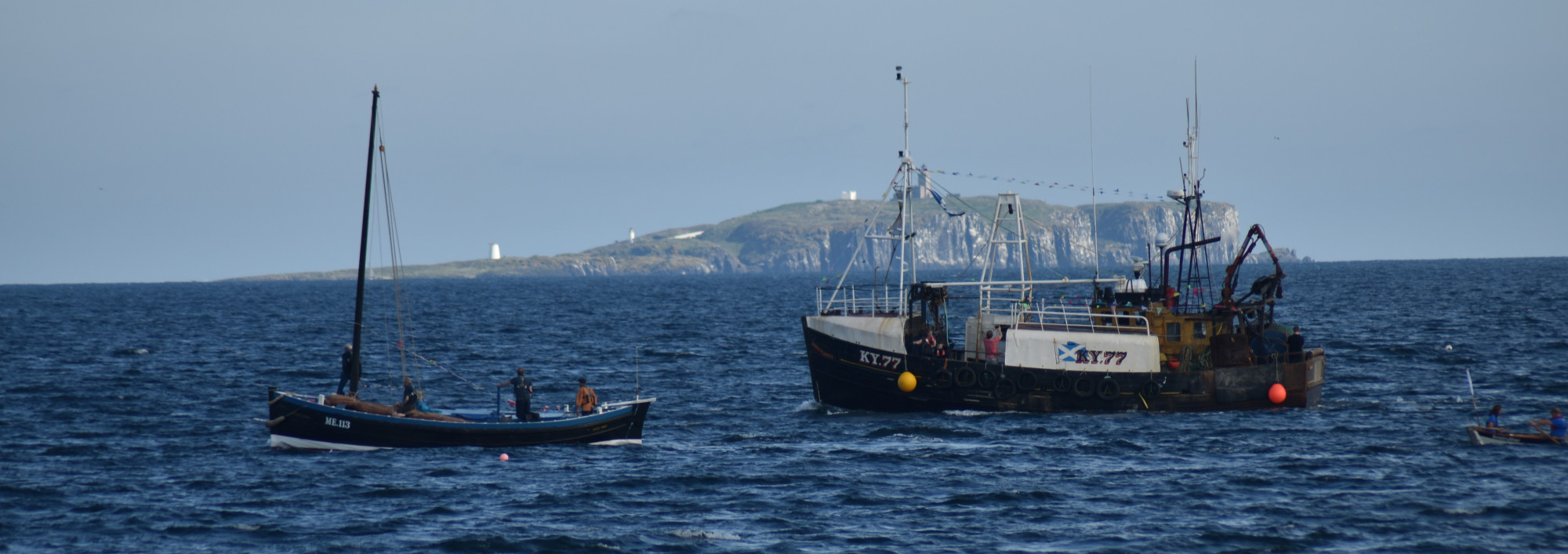

The Cellardyke Echo – 15/4/2021 – Issue 282

1910

NO FURTHER CONCESSIONS. A deputation of Scottish fishermen had an in interview with Mr Tennant, the Parliamentary Secretary to the Board of Trade, in London on Thursday with reference to the operation of the new regulations issued by the Department relating to certificates for skippers of fishing boats. The districts represented were Cellardyke, Anstruther, Pittenweem, the Firth of Forth, and the Moray Firth. The deputation was introduced Mr Duncan Miller, M.P., and accompanied by Mr Sutherland, M.P.; Captain Waring, M.P.; Mr Leicester Harmsworth, M.P.; and Mr Munro, M.P.

The regulation to which the members of the deputation directed special attention was the following—A fisherman who has served as skipper or second hand for a year’s fishing in a steam sailing liner or drifter of tons gross and upwards, and can produce evidence as to his genera good conduct, may be granted authority to act skipper or second hand on liners or drifters. For the purpose of obtaining an authority only one man can recognised as skipper and one second hand on each liner or drifter during any particular fishing year.

It was urged by the spokesmen of the deputation that the second hand on board fishing vessels had never been recognised by the Scottish fishermen. The crew of a fishing vessel which had sailed for a season or two stood on equal terms, and were considered equally capable of taking charge of a liner or drifter if the skipper was disabled. The concession they asked the Board of Trade to grant was that a second hand on a fishing boat should not be recognised as having any higher authority than any other member of the crew with the same experience. It was further pointed out that, if a skipper should happen to sell out his share a fishing vessel to the second hand, the latter was not granted an authority to act as skipper without going for an examination. This was held to be great hardship to many experienced fishermen who might not have the necessary education to pass the examination, but who were perfectly well qualified to navigate a vessel

The views of the deputation were expressed by Skipper Murray of Cellardyke; Mr J. Ogilvie, Pittenweem; and James McNaughton, of the Moray Firth Fishermen’s Association, and others.

Mr Tennant, in reply, said the anxiety of the Board of Trade was to safeguard the fishing industry, stimulate it, and foster its interests to the best of their ability. He believed the action which had been taken by the Department would be of lasting benefit to the whole of the marine interests of this country. Safety was the main consideration which they had in view the regulations which had been issued by the Board of Trade.

There had been one or two misconceptions with regard to the effect of these regulations. With the desire of meeting the fishermen in the fairest possible spirit, the Board had made very considerable concessions, and very large alterations in the regulations. With regard to second hands, they had made concession to the effect that man who had been acting in that capacity could come up for examination after he had served six months in a capacity subordinate to the skipper. They had relaxed that regulation further, and said that those men who had five years’ service and who were over 21 years of age .should be allowed come up for the examination at any time after the five years. The examination was of the simplest kind, and should have no terrors for men so well educated as their own countrymen were. The examinations were such, he believed, they could pass with ease. The “authority,” which was granted by the Board of Trade, was authority for a man to act in the capacity in which he had been acting. They could not expect the Board to give a man authority to act in a capacity in which he had not been acting. It was not possible demand to make that they should give authority to act as skipper to a man who had only acted in subordinate capacity. If he had acted in the capacity of skipper the position was changed at once, and the regulation provided that a man who had acted skipper and who passed the simple examination would be entitled to an authority from the Board of Trade. ….

BRIDE’S TRAGIC DEATH, sad story of the tragic fate of a bride elect comes from Cellardyke. Early yesterday morning a young woman, Elizabeth Thompson, 31 years of age, left her bed her father’s house, and, wrapping some clothes around her, walked the beach, and was later found drowned. On the family rising she was missed, and her body was found some hours afterwards. She was to have been married on Friday, and all the preparations had been made. On Monday she was busy making arrangements for the wedding, and was in spirits. No reason can be assigned for the act.

1911

MOTOR ENGINES IN FISHING BOATS. Year by year the chance of the sailing drifter in the herring fishing has decreased. They have been cut out by the steam liners, so that only the winter herring fishing has been left to them. In no business at the present day can a living be made upon an uncertain harvest of a few months in twelve. It pays no one for valuable boats to be laid up for the greeter portion of the year. It has long been recognised that the oil engine, or as more popularly described “the Motor” would eventually give these sailing boats a new lease of life. Anstruther has seen several attempts at applying the oil engine or motor to the sailing drifter, and owing to the very qualified success obtained a few years since the fishermen have been somewhat backward in trying the more recent engines, which undoubtedly have developed in a marvellous manner. The fact that something had to be done, and the success attained at other ports seem to have at last stirred and awakened the Anstruther and Cellardyke fishermen to realise the capabilities of the motor, and that by its adoption the sailing drifter need no longer play second fiddle to the steam drifter, at least so far as sharing out money is concerned. The Sunbeam, ML.16 takes the lead at Anstruther, as the first boat to be fitted with the modern motor, and to Messrs R. & W. Anderson of Cellardyke, as owners of the boat, belong the credit and enterprise of taking a step that will have an immense effect on the well-being and future of Anstruther as a fishing port.

A first run with the motor was made with their boat on Thursday, which partook somewhat of the nature of a holiday excursion. It says much for the motor that although it had been turned round for the first time for half an hour only the previous day, a good run was made to the May Island and back, with what must have been a record in number of passengers. By a misunderstanding the oil fuel supplied to run upon was of a class that had not been previously used with the engine. Indeed up to a year or so ago, such oil was considered quite unsuitable for the motor. In several respects it required different adjustments to the American and Russian oil usually used. Owing to this the full power of the engine was not available. To those who were not aware of the circumstance this was disappointing, while on the other hand it demonstrated very clearly that it took a 1 lot disarrange the motor’s digestion, and that whatever you gave it in the shape of oil it would make the best of it. On Friday another run was made with a strong wind blowing, and s bit of a sea running, in fact the movement was sufficient for one man who boasted of being a blue water sailer succumbing, and being a sadder and for the time a less talkative man. It was a day to thoroughly test the motor, and as the skipper said just out of harbour he was going to do it. The motor came through in flying colours, the boat travelling at a speed that ensured it being well up to the guarantee of 7 ¼  knots in smooth water. In fact notwithstanding the sea and wind and the heavy use of the rudder, the speed of the boat was very much over that of the previous day in a quiet sea; and some of the crew were heard to say, “As fast again.” it was made evident that when the Scotch oils particular requirement were known, and the engine adjusted accordingly, there would be no difficulty in using this oil. The Sunbeam being a very heavy, very full fore, and in fact a bad boat to drive, the trial must be considered eminently satisfactory.

The engine, which is a “Parsons’ Fisherman” with the machinery was supplied and fitted by P. E. Weyman of Pilgrim House, Newcastle on Tyne, who first introduced the motor to Eyemouth boats, and who has probably put in the majority of motors in the east coast drifters so far. It may be of interest to say that the Annie Mearns of Montrose recently fitted with a similar motor made the journey in a heavy sea and wind from Blyth to Montrose at an average speed of over 7 miles as taken by the log and confirmed by the distance, the course being outside the Farne Islands, it being too rough to go inside. Two more Cellardyke boats are being fitted with the same motor, the Harvest Home and Jasper.

1912

On Saturday afternoon a test was made of the new pipes recently laid between Balmonth reservoir, and the foot of the March. All seemed to go well at first, but on Sunday forenoon a burst occurred at the top of the March, near the St Andrews road, which occasioned a considerable flooding in the March ground and surrounding fields. Fortunately, the burst was soon discovered, and the supply screwed off at the reservoir.

1913

YARMOUTH COLLISION CASE. Captain A- Wood. J.P., nautical assessor in the Technical College, Dundee, has just issued his decision collision case off Yarmouth on 29th October, 1912, between two Cellardyke drifters, Carmi III and Guerdon, which were insured in the same company. Both vessels claimed for loss of fishing, and the company offering £135 lie money, left the two skippers to settle who was at fault in the collision. To determine this, the skippers agreed to refer the case to Captain Wood, who after hearing evidence, found that the Guerdon alone was blame for the collision.

1914

At a meeting of Kilrenny School Board last night, a letter was read from Mr Barbour, Headmaster of Cellardyke School, resigning his position, owing to the operation of the age limit. Mr Barbour has been in Cellardyke School for 36 years

Addressing the annual meeting the Cellardyke branch East Coast Fisheries Association on Saturday Mr. Bertram. Central hon, secretary, severely criticised the fishery authorities’ for spending so much on what was called scientific research. They had spent £150,000 on scientific research, and a greater farce one never heard of. Such research might be an educative force for those engaged in it, but it did absolutely nothing to promote the interests of the fishermen. There were too many scientists on the Fishery Board and too few practical men. During the past ten years the number of fishermen in Scotland had decreased by about 7000, and, in face of that, scientific research was of mighty little use. What they required was not scientific research, but definite legislation to protect the vital interests of the fishermen.

The Cellardyke Echo – 8/4/2021 – Issue 281

1900

RESIGNATION OF THE PARISH CHURCH ORGANIST.—Mr Pattison, the organist of the Parish Church, has sent in his resignation on account of want of time to attend the practisings. A successor is being advertised for.

The measles continue to spread, and a number of new cases have broken out this week. Kilrenny School was closed for a week on Friday, the attendance having been affected to a slight extent by the epidemic. So far there has only been one fatal case in Cellardyke, one little girl having died last week with it.

Last Friday evening, while a young boy, the only son of Mr Downey, George Street, was playing at the harbour, be fell over the pier on to the concrete. He seems to have been unconscious for some time before he was discovered. On being taken home, and medical assistance procured, it was found that he had sustained concussion of the brain, but no outward wound. He remained unconscious for some time, but gradually recovered, and is now all right again.

The annual social meeting of those attending the bible class and prayer meeting in connection with the Parish Church, took place on Thursday evening of last week in the Town Hall. There was a very large gathering present, the hall being well filled. After an excellent tea, the Rev. James Ray delivered a short address, in which he stated that the subjects of study at the bible clams meetings during the winter were the books of Esther, Ruth, and Jonah, and that a pleasing feature of the session was the presence of a larger number of the young men of the congregation than they had had for some years back. The busy winter fishing and other causes had latterly hurt the attendance at the prayer meeting, but on the whole he had great reason to be thankful, and his earnest prayer was that God would bless his labours among them. Thereafter a long programme was proceeded with. The bible class choir, under the able leadership of Mr John Hepburn, rendered several part songs with much taste and fine expression.

1901

The annual Licensing Court was held on Tuesday at 11 o’clock forenoon—Provost Thomson and Bailie Butters presiding. The Clerk read a hates from Inspector Maiden, St Andrews, reporting that he had made a careful inspection of the licensed premises in the burgh. Those of Mrs Gardiner, John Street, consist of a dwelling house of 2 rooms about 12 feet square, with a fixed bed in each room, and a washing house and cellar underneath, which could be reached by a hatch door in one of the rooms and by a trap door from the lobby. He found no groceries, and Mrs Gardiner informed him that she had not kept any groceries for several years. The excisable liquors in the house comprised 7 pints of porter, 12 pints of beer, several bottles of whisky, and a jar containing a small quantity of whisky. A son and daughter reside with her. The continuing of this license when no pretence was made to carry on the business of a grocer or general dealer called for the serious consideration of the Magistrates.

Mrs Gardiner was asked what she had to say to the remarks of the Inspector, and replied that she did not keep groceries, and lived in the house where she sold her liquor.

The Provost —The Magistrates, including Bailie Williamson, who is unable to be present, have considered this report, and are unanimous in deciding that unless you make such alterations on your house as will meet the requirements of the Court, and also keep groceries, your license will be withdrawn.

Mrs Gardiner said it was as old house, and was not worth repairing. She had been in it 6 years, and no alteration made in that time.

The Provost- It is quite out of place to have a dwelling house used as licensed premises, and it is for you to say whether you are to agree to make the necessary alterations.

Bailie Butters – l suppose we cannot grant the license to be used as a dwelling house at the same time as a licensed house.

The Provost – No, it must be pure and simple a shop where the business is carried on. The dwelling house may be above, but you cannot occupy the premises used as a place of business as a dwelling house. It becomes a question whether the house is to be repaired or her license renewed.

Bailie Butters – She would require to gut out the place downstairs, and fit is up in a modern style. As Mrs Gardiner said she could not alter her premises and would not keep groceries the license was withdrawn.

She then left the Court, but shortly afterwards returned and said she could make arrangements for living upstairs, but she could not make any alterations or keep groceries.

Bailie Butters – Without the alterations the premises would not be suitable.

The Provost— In addition you must keep groceries. As she would not make this promise, the Magistrates adhered to their decision. The other four licenses, one public house and three licensed grocers, were renewed, the report of the Inspector being of a very satisfactory character.

1902

The boys of this Company were dismissed for the session on Tuesday night. It was decided that the annual trip would take place next month if forty or more boys expressed their willingness to attend. There are 49 boys on the roll and on Tuesday night 22 were present.

Rent your gas Cooker 1902

1903

NOTICE IS HEREBY GIVEN, that any DOGS found straying in Fowler’ Park, Back of Cellardyke, will be SHOT. This has been rendered absolutely necessary on account of Sheep having been worried.

1905

RUN DOWN BY A GUNBOAT.

INQUIRY INTO FIFE FISHERS’ DEATHS.

CELLARDYKE AND CRAIL MEN DROWNED. Sheriff Armour and jury at Cupar to-day heard evidence in two fatal accident inquiries, one on the sinking of a fishing boat in the North Sea by H.M.S. Speedwell. This was the first case, and the evidence led showed that Robert Smith, fisherman, 43 James Street, Cellardyke, Anstruther, while engaged fishing miles east of Crail in the boat Cornucopia, of Cellardyke, about four o’clock the morning of Saturday, February, was accidentally drowned in consequence of the boat having been run into and sunk by His Majesty’s ship Speedwell. The second inquiry was connection with the death Andrew Cunningham, junior, fisherman, 34 Shoregate, Crail, who was accidentally drowned while fishing on board the fishing boat Ten Brothers, of Crail, the Firth of Forth, half a mile from the harbour at Crail. He was accidentally washed overboard by a wave which passed over the boat. In both cases formal verdicts were returned.

1906

Major Scott Davidson of Cairnie inspected the Cellardyke Boys Brigade on Friday night last week, and was made the recipient of a silver cigarette case by the Brigade for the kindness be had shown them.

Mr John Mackay, Cellardyke, has been appointed skipper of the motor boat Pioneer, which is again been fitted out for the herring fishing on the west coast at Barra, to which she is to sail at the beginning of next month.

FOR Sale, the YAWL, 18 feet long, the Glanner, lying on Slip at Cellardyke Harbour. The Boat and Fittings are all in good order. Apply to ROBIRT WEBSTER 34 Rodger Street, Cellardyke.

1907

The trial trip of the steam drifter The Maggies, belonging to the Messrs Gardner Cellardyke, took place from Anstruther on Monday afternoon when a crowd of 200 people had sail round the May Island and Bass Rock. The drifter maintained speed of ten knots, and the owners were highly delighted with her.

Launch at Anstruther.- Mr Miller yesterday afternoon launched a steam drifter to the order Skipper George Anderson, Cellardyke. This is the fifth vessel launched since last August, and another three are to be built. The drifter was named the Integrity by a niece of the owner. The dimensions are the same as the others – 85 feet length, 18 feet beam, and depth of hold 9 feet. The engines are being made by Messrs Cran, Leith.

The annual treat of the old people of the town took place in the Town Hall on Saturday night, there being a very large attendance. The gathering was under the auspices of five Associations, the Young Men’s Christian Association, Gospel Temperance, Good Templars, and the Christian Endeavours of the Parish and Baptist Church.

1909

At North Shields on Monday, the Smiths’ Dock Co., Ltd., launched a steel drifter to the order of John Gardner (Ritchie), Cellardyke. The drifter which is built to 100 A1 at Lloyds, is 82 ft. keel, by 18 ft. 6 ins. beam, and 9 ft. 6 ins. moulded depth. She is designed for the line and herring fishings, and is fitted up with all the latest improvements. The boat presents a handsome model, and, on leaving the slip, was gracefully christened the “Lily and Maggie ” by Miss Elsie Harvey, adopted daughter of Mr and Mrs Arthur M. Reid, North Shields. The drifter is expected to be engined and ready for sea in about ten days’ time.

The Cellardyke Echo – 1/4/2021 – Issue 280

1935

ANCHORED AT MAY ISLAND

Port Seton Skippers Fined

FATHER AND SON CHARGED

The trial took place at Cupar Sheriff Court yesterday of Thomas Donaldson , skipper of the motor fishing boat Cockenzie Lass , and Thomas Donaldson , jun ., his son , skipper of the Mary , both residing at 9 Seton Place , Port Seton , They were charged that between 7 . 30 p.m. and 9.45 p.m., on March 7, about one hundred yards east of May Island , being within the exclusive fishery limits and on ground where net fishing was actually going on ( 1 ) They anchored their boats ; ( 2 ) placed the boats in such a way as to interfere with fishermen who had already commenced their operations and caused damage to the herring drift nets of the boat Winaway in the charge of John Muir Gourlay fisherman , 14 East Forth Street , Cellardyke; ( 3 ) the boats , being under 150 feet in length and anchored , they failed to exhibit the regulation white lights visible all around the horizon for a distance of one mile . Evidence was led at length and in the course of the examination of the first witness the Fiscal dropped the third charge. The first charge was found proved and each accused was fined £3. The Sheriff said the second charge involved a conflict of evidence as to the cause of the damage to the nets, and had not been proved.

DRIFTED TOWARDS RING-NET BOATS

Gourlay, in evidence, said he was part owner and skipper of the Winaway. He had shot his herring nets, and drifted towards the ring-net boats. He came so close to them that he had to shout, “Get ahead out of our way, and let us haul in our nets.” He thought the ring-net boats were working, and he called out, “You know you can’t ring there when we are hauling our nets.” One of the ring-net boats was anchored down and the other boat was made fast to it. Witness’s nets were fouled by the anchor rope. He cried to the ring-net boat to slip their anchor, and they replied, “If we slip it we will lose it.” “Better lose your anchor than destroy my nets” he said.

The ring-net boats were showing navigation lights. He had 12 nets destroyed, costing £11, 7s. 6d. Captain J. Wright, Fishery Board officer, said the Cockenzie Lass and the Mary had no right to be anchored where they were.

Cross-examined, he said he would not like to say that there was a-feud between ring and drift-net fishermen. There was certainly a lot of feeling between them, and on the 16th of next month an inquiry was to be held into the matter. He was certain the damages to the nets was done by the Cockenzie Lass and the Mary.

“TRESPASSING”

For the defence, Thomas Donaldson, sen ., said he heard the Winaway say , ” Wellspring, ahoy, you are tearing our nets .” The Wellspring replied, “You are tearing your nets yourself. They are fast to the ground. “The Wellspring lifted her anchor and the nets were round her anchor chain. If he had known that there were any drift-net boats about he would not have anchored. Cross-examined, he said he never had a net over that night. He never thought the Winaway’s nets were so close to the May Island. Most of the damage was done before the nets came to him. He put down his anchor in order to have a cup of tea, intending to start if anything were doing.

Sheriff Dudley Stuart-Did it ever occur to you that you were trespassing?—No. I thought it was anchorage ground there. Are drifters forbidden to fish there? Donaldson said he could not answer. Wm. Thomsonone of the crew of the Cockenzie Lass, said the nets came upon them “that quick that we could do nothing.” No damage was done to the nets by his boat’s anchor. Thomas Donaldson jun. said there were about 30 ring-net boats anchored at the-May that evening.

Sheriff Dudley Stuart, in announcing his decision, said he did not propose to take-any notice of the controversy between ring-net and drift net fishermen. ‘

(The start of the enquiry a few weeks later)

SEINE-NET FISHING INQUIRY FIFE SKIPPERS’ EVIDENCE

A public inquiry for the purpose of ascertaining whether or not the byelaw; relating to the seine net fishing the Firth of Forth should be confirmed by the Secretary of State for Scotland was continued today in Parliament House, Edinburgh. The inquiry is conducted by Sheriff R. H. Maconochie, K.C. The case for the fishermen who support the byelaw is being conducted by Mr W. A. Murray, K.C., and Mr T. P. McDonaid, instructed by Alexander Morrison & QC, W.S., Edinburgh, and G. Martin Gray, solicitor, Aberdeen. The ring net fishermen, who object to the byelaw, are represented by Mr R. Morrison, advocate, instructed by Allan McNeil &- Sons, W.S., Edinburgh, and Mr David Chapel, solicitor, Arbroath. When the proceedings resumed to-day the courtroom was again well filled with fishermen.

William Watson, skipper of the motor boot Sunbeam, in examination, said he was fishing within three miles’ radius at Fife Ness last month. He put out anchor nets and went ashore. When he returned the following morning he found eight buoys left out of 23. The buoys were stabbed or cut. He said was quite possible for ring net fishers to keep clear of anchor nets during the night, as they had good enough lights to see the nets were there.

“Willful Damage.”

In his view the damage was wilfully and maliciously done.

David Smith, of Cellardyke, skipper of the Violet Star, said while the ring nets caught all sizes herring, the drift net caught only the mature herring. In his view was not possible for drift net fishing and ring net fishing to be carried on together without causing damage. If continued the result would be that the drift net fishing would be cleared out of the area.

The ring net boats fished only in fine weather, and then they caused a glut the market and prices came down.

Alexander Doig, Cellardyke, master of the motor boat Orion, his evidence stated that some of his anchor nets were damaged by ring-netters in the bay at the east end of Cellardyke. He lost. 18 nets, and it would take £40 to replace them. There was no doubt, he said, that the damage was done by ring-net fishermen who took off the buoys and allowed the nets to sink.

Skipper James Hughes, Pittenweem, of the motor boat Economy, said that ring nets usually fouled the drift-nets. Both types of nets were used in the Forth, and, as far he was aware, prosperous returns could not made on either.

1936

ANSTRUTHER HARBOUR RULE BROKEN FISHING SKIPPERS’ CONTRAVENTION

Entered Port Against Flag Signal

Fishing skippers from Fife and northern ports were charged before Sheriff Dudley Stuart to-day with breaches of the regulations pertaining to Anstruther Harbour.

The charges against them alleged that they failed to regulate their vessels (steam drifters and motor boats) which had a draft exceeding seven feet according to the direction of the Harbourmaster at Anstruther in bringing them into harbour on various dates in March at flood tide when the red flag was showing on the West Pier Lighthouse.

The prosecutions were under the Harbour Docks and Piers Clauses Act, 1847.

Accused were John Muir, West Forth Street, Cellardyke; Alexander Muir, John Street, Cellardyke; Joseph Wilson, James Street, Cellardyke; Charles Foreman, skipper of the Peterhead drifter Renown; George Anderson, skipper of the drifter Lemnos; George Herd, skipper of the steam drifter Cloverdale; John Sutherland, skipper of the motor fishing boat Benison, and James Brunton, James Street, Cellardyke. Pleas of not guilty were advanced on behalf of Alexander Muir and Charles Foreman and their cases were continued until 5th May.

Warning to Others.

Mr R. C. Davidson, solicitor, Cupar, who conducted the prosecutions on behalf of the Anstruther Harbour Commissioners, said that he did not ask for a severe penalty and suggested that the expenses should be paid the accused. Those prosecutions were being brought as a warning to others. The regulation was enable smaller boats to get into the harbour first, congestion occurring when all the boats tried to get in at once to land their catches.

Those who pleaded guilty were each ordered to pay 25s expenses. Similar charges against John Donaldson, skipper of the motor boat Daisy; Joseph Campbell, skipper of the motor boat Fountain; Andrew Anderson, Abbey Wall Road, Pittenweem, were withdrawn.

John Muir said that there were a lot of boats going before him, and not one of them was pulled up, and they thought that they were entitled to go in as well them. He said that at all the ports he had been if the flag was against them no boats could get in. He then asked if the harbourmaster had any right to “cry” in any boat. Joseph Wilson said they were all coming in with the red flag up. They did not know how they were working with the harbourmaster.

“Pushed Into Harbour.”

Then the case of Charles Foreman was called, his Lordship read a letter From foreman, which was to the effect that he was pushed into the harbour by the weight other boats. Accompanying this letter was medical certificate stating that Foreman was unfit to appear. His Lordship reminded the Court of his comments on such a certificate a week ago, and said “Again I say that this certificate is not according to form. It is not on soul and conscience.”

He treated the letter as a plea of not guilty, and continued the case until 5th May, along with Alexander Muir. On behalf of George Anderson, Mr David S. Shaw, solicitor, Cupar, said that all the other boats were doing it, and this man also did it. Mr Shaw commented that the man who broke the rule and got into the harbour first got his catch away early. It was the custom most harbours to hoist flags indicating the depth of the water in the harbour. The exception was at Anstruther, where only a red flag was hoisted when no boats could come in. A similar explanation was advanced Mr Shaw on behalf of Herd, and, referring to Sutherland’s case, Mr Shaw said that he was close into the harbour and did not have sufficient time to stop his boat.  He drew up at the harbour mouth, lay there for an hour, and watched other boats coming in against the red flag. He saw a man whom he was sure was the harbourmaster signalling him in, and then came into the harbour.

1939

The Boat Tavern had been up for sale in 1938 and in 1939 John Wilson Spirit dealer 16 John Street Cellardyke was granted the licence for the public house at 14 John Street.

The Cellardyke Echo – 26/3/2021 – Issue 279

FIFE COAST WRECK

TRAWLER ASHORE OFF MAY ISLE – CREW RESCUED BY ANSTRUTHER BOAT

A plucky rescue was effected early on Saturday morning the skipper and crew of the Anstruther motor fishing boat Winaway.

The Aberdeen trawler Ethel Crawford, owned by R. W. Lewis, went ashore on the North Ness, May Island, and was badly holed.

The crew of the damaged vessel drew attention to their plight by burning their bedding, and clever seamanship on the part of the Winaway’s crew resulted their rescue.

They lost all their belongings.

The crew of the Ethel Crawford were: —George Baxter, skipper; John Baxter, mate; Redvers Sim, second fisherman; John and Edward Taylor, deck hands; John Stephen, chief engineer; John Riddoch. second engineer; Jas. Fyfe and Jas. Stewart, firemen—all Aberdeen; and Andrew cook, Buckie.

 STRUCK A REEF.

The Ethel Crawford left Granton about halt-past one on Saturday morning for the  fishing grounds at the Shetlands. While endeavouring to keep clear of the Anstruther fishing fleet the vessel went too near the Isle of May, and struck a reef on the Nor’ Ness.

She was badly holed, and, realising the seriousness of their plight, the crew immediately sent up signals of distress by burning their bedding as flares.

The Winaway answered the signals, but was unable to come alongside the trawler owing to the heavy seas.

A line was thrown from the Anstruther boat to the Ethel Crawford, whose small boat was then launched and the crew transferred to the Winaway, three at time.

LOST EVERYTHING.

The crew were unable to rescue their clothes and lost everything. Great credit is due to the seamanship the skipper and crew of the Winaway, who left their nets and went immediately to rescue of the trawler’s crew.

The crew of the Ethel Crawford were landed at Anstruther and taken to Mr A. N Cunningham, who, in turn, brought them to Mr H. Watson, joint hon. secretary of the local branch of the Shipwrecked Fishermen’s and Mariners’ Society.

The crew were fed, and those who were in need of clothes were also provided for. Some of men had no boots. They were also given railway passes to take them to their homes in Aberdeen and Buckie.

MODEST SKIPPER.

In an interview with a “Courier and Advertiser” representative, Mr John Gourlay, 14 East Forth Street, Cellardyke, the skipper of the Winaway, was inclined to make light of the gallant part he and his men played in rescuing the stranded crew.

Modestly he remarked “We only did what any other boat would have done in the circumstances.” Skipper Gourlay said noticed the distress shortly before four o’clock.

“The first indication we got that anything was wrong,” said, “was when we saw huge flare.

“At first I thought it was a boat on fire, but I saw steam rising I assumed it must be the trawler which we had noticed previously. We were about three-quarters of a mile away, but within a short time were near enough to take off the crew.

DEEP IN WATER.

“The Ethel Crawford’s stern was deep in the deep water, and the crew had no time to rescue their belongings. Most of the crew were in their bunks; they had to come away in whatever they were wearing.

“One man had working suit and a good suit of clothes lying beside, him. In his haste he grabbed at one of the suits and happened to be the working suit.

“One man had an oilskin coat with him and another a cap, and many of them needed fresh clothing.” It is feared the Ethel Crawford has become a total loss.

BUCKIE MAN’S STORY OF WRECK

“Awakened by Grinding Shock”

Andrew Wilson, the cook of Ethel Crawford, interviewed the “Courier and Advertiser” at his home in Buckie, where arrived on Saturday night, described the wreck and the rescue.

“About one o’clock on Saturday morning the trawler left Granton for the fishing grounds,” he said, “and the crew went to bed. We were rudely awakened by a grinding shock which brought us on deck to find had run upon the tail of May Island.

“We were the weather side of the island, and heavy seas were breaking.”

Mr Wilson went on to relate how they burned flares of bedding and paraffin till they got an answer, half hour later.

The vessel was making water rapidly, the level in the engine-room rising to the fires.

“Three Anstruther herring boats were seen approaching. These boats had cut adrift from their herring nets and rushed the rescue.

“One boat, the Winaway, venturing as near as was safe, managed to cast a line aboard the trawler, which enabled a stout rope to be passed between the two vessels.

“One small boat was then launched, and were transferred three a time to the Winaway. We abandoned the trawler just as we stood,” concluded Wilson.

1931

FISHERY BOARD FOR SCOTLAND -CELLARDYKE MAN’S APPOINTMENT

Official announcement has been made of the membership of the reconstituted Fishery Board for Scotland consequent upon the death of the chairman, Mr D. T. Jones, and other changes.

The King has been pleased, on the recommendation of the Secretary of State for Scotland, to approve the appointment of Mr George Hogarth, secretary to the Fishery Board for Scotland, to be a member and chairman of the Board during His Majesty’s pleasure, in the place of Mr D. T. Jones, C.8.E.. F.R.S.E., deceased.

His Majesty has also approved the appointment of the following to be members of the Board for a period of five, years from January 21, 1931:

Mr William Lyon Mackenzie, K.C., Sheriff of Ayrshire (legal member and deputy chairman):

Mr D’Arcv Wentworth Thompson, C.8., M.A., D.Litt., F.R.S., Professor of Natural History, St Andrews University (scientific member);

Sir Malcolm Smith. K.B.E.. Leith;

Mr William W. Carstairs, Cellardyke, Fife;

Mr W. J. Merson (fishcurer.), Provost of Buckie; and

Mr George Slater, C.B.E. (fishcurer), Aberdeen.

The last three are new members. The New Chairman. Mr George Hogarth, who has been selected to succeed Mr Jones, is a native of Edinburgh, where he was born in 1879. He was dux of the Royal High School, and entered the Civil Service as a member of the staff of the Estate Duty Office in 1899. In 1912 he was transferred to the Fishery Board for Scotland with the appointment of chief clerk. Since 1920 he has acted as secretary to the Board, a position to which he was promoted when Mr Jones, the former secretary, was appointed chairman.

No intimation has been made as to the appointment of a new secretary to succeed Mr Hogarth.

Bailie William W. Carstairs. Anstruther, is sole partner in the firm of John Martin & Co., manufacturers, Cellardyke. The son of a Cellardyke fisherman, he entered John Martin & Co.’s employment in minor capacity, and has now become sole proprietor of the business, which gives employment to about 180 workpeople. Bailie Carstairs recently designed a new motor drifter which contains many novel features, and in which an exceptional interest has been taken by the fishing industry. It is claimed for this new boat that her cost is much less than a new wooden or steel drifter, while she can carry the same fleet of nets.

1932

HOUSING SCHEME AT CELLARDYKE

At the monthly meeting of Anstruther Town Council, Bailie Cook, convener of the Housing Committee, submitted plans of the proposed new housing scheme Fowler Street, Cellardyke. The scheme consisted of two blocks of four houses each and two blocks of two houses. The committee recommended that two-roomed bungalows be substituted in place of the cottage type proposed previously. The Council approved of the plans. With regard to the fencing round the gardens it was resolved to obtain estimates the cost of the erection of a wire fence and a brick wall and consider the alternative prices next meeting. The Council agreed to install gas boilers instead fire places in the small bedrooms of the flatted houses.

1933

WHIST DRIVE AND PRESENTATION AT CELLARDYKE. Under the auspices of Gardner’s Motor Service. Anstruther, whist drive was held in Cellardyke Town Hall, when Mr Hughes, Pittenweem, and  Miss Jeanie Smith, West Anstruther (both employees), were presented with a mantelpiece clock on the occasion of their approaching marriage. The presentation was made by Mr T. Gardner.

The cardmaster was Mr W. Brown, and the prizes were handed over by Mrs T. Gardner to the

The East Neuk’s Grand Old Man of the Sea By MRS A. R. ROWLANDS

When ye see the May Licht a abune the tap o’ the highest wave ye’re safe to mak’ Anster harbour”  was the storm-lore imparted by an old-time mariner to his son now a well-known Cellardyke skipper.

Nowhere on the coast of the Fifeshire peninsula is there such a dangerous rock bound shore as that washed by the Forth, and lying between Fifeness and Kincraig Point, Elie.

 Hence the reason for one of earliest lifeboats relegated to “The Kingdom” being stationed at Anstruther.

It has fallen to Mr John Jack, James Street, Cellardyke, to have this unique experience of spending eighty three years of life in connection with the district lifeboat ,he has he proudly asserts served on three such boats,  and it is now his sole ambition to assist at the launching of the fourth, the new motor lifeboat which is shortly to supersede the present sailing-vessel.

In 1880 Mr Jack “signed on” as one of the crew of the Admiral Fitzroy. This vessel was succeeded by the Royal Stuart which in turn gave place to the present vessel the James and Mary Walker.

The Launch of the last-named boat was unparalleled in the annals of lifeboat history, for she slipped from her cradle with sails unfurled and billowing in the breeze. Contrary to the expectations and outspoken criticism of the spectators, she took to the water as gracefully as one of our “sea maws.”

Anster’s Four Coxswains

Anstruther’s lifeboats, from their earliest have proudly vaunted their four coxswains who hold simultaneous office. These four concurrent appointments were made so that, though the others might be absent at the various “fishings, one man at least, should be at home to “carry the boat.”

During the winter herring season only were the four coxswains together available for duty. To prevent friction arising during this period, a superintendent coxswain was appointed to take full control of the boat.

A rock-bound coast and lee-shore upon which the south-east wind vents its full and direct fury renders the waygoing of the lifeboat a peculiarly difficult and dangerous venture. Before reaching the open sea, she must accomplish the well-nigh impossible task of crossing the harbour bar, and rounding the point of a pier hidden by clouds of spray.

She must then tack round and approach the distressed vessel from the weather-side, that is with the wind in her favour.

A lifeboat is destined for the preservation, not for the casting away of lives; it is the prerogative therefore of the coxswain to determine whether or not he shall risk the safety of his boat and crew in going to the rescue of a doomed vessel. Should the crew volunteer along with him, then he puts out to sea, and it stands to the honour and credit of the lifeboat crews that no man ever withdraws. It is indeed only after repeated attempts at rescue that any of our lifeboats have ever failed in their objective.

Beating Berwick to it

An example of coxswain and crew’s persistence and daring was given many years ago when a local vessel, the Providence, while making for the home harbour, was caught in a sudden stupendous gale. Disabled by a broken mast, and with her anchor caught on the Isle of May cable, she was cast on the rocks of the Billow Ness, where, buffeted by the breakers, she was in imminent danger of being dashed to pieces.

At half-past one in the morning the James and Mary Walker responded to the warning gun; but so high were the Cellardyke mountainous seas that the harbour bar became an insurmountable barrier. Thrice the lifeboat essayed to reach the open Firth, and her third attempt was almost disastrous, for she was caught the grip of the waves and dashed to the back of the pier.

The report hereafter arose that the North Berwick lifeboat, launched from a weather shore and having in consequence a following wind, was proceeding to the scene.

“Gin the Berwick lifeboat taks aff thae men, it’ll be slur on Cellardyke fishermen a’ their days,” commented a bystander on the pier.

“Wha’ll volunteer along wi’ me, an’ I’ll gang fourth time!” bawled the coxswain above the storm.

In response the crew once more manned the lifeboat. This time she succeeded reaching the stranded vessel; “standing by in case assistance was needed.

The gale, however, somewhat abated its force, and the Providence having rigged a jurv-mast, and having also fortunately cleared her anchor, made Anstruther harbour in safety.

Her encounter with the back o’ the pier cost the James and Mary Walker four holes her hull

“ . . . an’ a Newfun’lan’ Dug “

“It’s gey queer,” commented the old fisherman, “that when the gun roars out its warning call to the lifeboatmen, it’s either the mirkest oor o’ the nicht. or else the tide’s at its lowest ebb.”

It was in the ” wee sma’ oors ” of the morning that the summons came to rescue a steamer cast ashore on the rocks below St Monans’ Kirk. In extreme haste the boat was launched, and sore was her strain against the storm before she drew alongside the trapped vessel.

It was with much gusto that Mr Jack related how, during her hurried launch, the boat caught the side of her carriage and almost ripped off her rudder, ” but,” he finished with evident pride, “they took aff eighteen men an’ a Newfun’lan’ dug. We jaloosed, ye ken, that there wis something wrang wi’ the boat, but we jist keepit her gaun; when we got hame we had look at her, an’— her rudder wis nearly a’ torn awa’.”

Mountainous seas driven by furious gales against a lee-shore; piers and seadykes hidden by the spume and spray of the breakers; handful of weatherbeaten fishermen, and a gallant boat turning a determined bow to the elements, setting out to quest her way amid the tumultuous billows—these are the scenes recalled by an old man’s tales.

Eyes dimmed by eighty-three years’ vigil sparkle once more, and the voice resumes its old-time timbre as the veteran relives past days.

Always Second Cox.

Many speeches of congratulation have been made, and many messages sent to our Grand Old Man of the Sea but none has given him more pleasure than the letter sent by our member for East Fife, Mr J. Henderson Stewart.

“An’ it’s in his ain haund o’ write,” said the recipient as he fondled the cherished missive before handing it over again to the safe keeping of “the wife.”

“But I never was coxswain,” was the conclusion of Mr Jack’s narrative.

“Ay,” he added slyly, nodding at his beaming consort on the opposite side of the hearth, ” I wis aye on the lifeboat, jist the same as I am at hame, second cox.” JOHN JACK

1934

CELLARDYKE FISHERMAN’S DEATH INQUIRY.

A formal verdict was returned at Cupar yesterday in an inquiry into the death of Thomas Anderson, fisherman, 7 Dove Street, Cellardvke, who on 7th February fell overboard from the fishing boat Just Reward in the Firth of Forth, about a mile north of May Island.

It was stated that after Anderson had fallen overboard he was seen in the water 25 yards away, but he disappeared, and, despite the fact that the searchlight was put and a life-belt thrown, there was no trace of the deceased. The vessel searched for about an hour.

DUNDEE OFFICERS HONOURED RESCUES FROM BURNING LINER

Awards from French Government

Awards for gallantry to Dundee, Monifieth, and Cellardyke ship’s officers are announced.

At Liverpool Town Hall this week the Lord Mayor presented diplomas and medals behalf of the French Government to Captains Kershaw and Owens of the Liverpool steamers Mahsud and Contractor, and to officers and members of the crews.

The awards are in recognition of their gallantry in rescuing over 260 persons from the new French liner Georges Phillipar when she was destroyed by fire on 16th May 1932.

Among recipients of the awards are:— Third Officer J. S. Richardson, of the Mahsud, who resides Penninah, Monifieth (diploma and silver medal first class); Mr T. M. Gardner, of 18 Fowler Street,. Cellardyke (diploma and silver medal of” second class);………………….

The Cellardyke Echo – 18/3/2021 – Issue -278

1860

ESTIMATES WANTED, FOR ERECTING a CHAPEL and VESTRY at East Green, according to Plans and Specifications which will be shewn James Fowler, Cellardyke ; by whom Offers will be received to the 20th inst. Information will also be furnished by Mr J. Hall, Architect, St Andrews. Anstruther.

The next article appeared in Local Papers, The Scotsman and this version was extracted from “The Star of Gwent” Cellardyke hits the news in Wales.

Some excitement is at present occasioned in the small town of Cellardyke, in the East Neuk of Fife, by the breaking out of the revival movement. Meetings are held every night, which are protracted to late hours, and at which all the signs of the revival movement are exhibited. At these meetings there have been various instances of prostration, and wailings and moanings are heard proceeding from the audiences, who assemble in small groups in the various corners of the room, each group engaging separately in devotional exercises, which are in instances conducted by mere boys and girls who have been suddenly “converted.” One or two of the clergymen in Anstruther, the adjoining town, are encouraging the movement; but others are trying to put down all exciting meetings. While an improvement is admitted to have taken place in the habits of a portion of the population by the movement, it has been apparently attended by the same painful effects as have been observed in other quarters. One girl is said to be permanently affected in her mind, and scenes have occurred on the streets which are by no of a creditable character, such as small groups of girls going about the street telling those persons they met that they had “found peace noo,” and ethers singing with great vehemence matches of hymns

A few days later

The Revival Movement. – The religious awakening in this place, which we noticed last week, still continues, though in a somewhat subdued degree. Meetings still continue to be held every night in every available place, and during the day clergy and some others go through the different houses to impart religious knowledge. The evening meetings are all presided over by some of the ministers, and the greatest caution has been taken to keep down all undue excitement, though we question the policy of the plan adopted at some of the meetings of allowing some of the “new converts,” as they are called, to address the audience and relate their religious experiences. The readiness and zeal with which these individuals step forward to address their fellow sinners is somewhat remarkable, as also the prayers they will offer up in the presence of some hundreds. New-born zeal is always impetuous, however, and we only sincerely hope that the light they confess has been imparted to them will be of abiding nature, and bring forth fruit. It cannot be denied that much good has been done, and there is a great apparent reformation in the lives and conduct of some who formerly held quite different character. Since the movement began, there has been marked increase in the attendance at all the churches, and apparent attention to the teachings of the ministers. Another pleasing feature in it is its catholicity, for in the same meeting were to be found Established. Free, U.P., Baptist, and E.U. ministers and elders, all labouring for the same end, and each in turn taking part in the proceedings. We are sorry to learn, however, that a schism, or rather inclination to inculcate sectarian views and doctrines, has arisen among the clergy themselves, to the grief of those who looked upon the movement favourably. It is a pity that such should be the case, when so much apparent good was beginning to appear. During the first of this week, a great number of strangers have paid the place a visit, to witness for themselves the working of a religious revival; and some of the fishermen themselves have gone as deputations to other towns, far and near, with a view of exciting them to a similar demonstration. One practical proof of the good that has been done, we cannot help relating. A certain man, now in business on his own account, has, since the revival-commenced, paid the employer with whom he learned his trade a visit, and refunded the sum of 30s which he said, he had appropriated in small sums to his own use while an apprentice, and the reason given for this “confession of the conscience” was, that could not now remain a Christian until he had it off his conscience.

1861

The Herring Fishery.— The following letter has been addressed by Mr Methuen to the Secretary of the Board of Fisheries: Leith, 13th March, 1861. Sir, —The illegal destruction of herring fry is as great this morning at Newhaven as usual, since illegal nets have been permitted by the Hon. Board of Fisheries Regulation of 3d Jan., 1861, whereby millions of young herring fry have been, and are being, destroyed. I find it is of no use requesting the members of the hon. Board to go to Newhaven any morning to see the destruction of young herring fry and herrings of all sizes in myriads, this illegal destruction still continues under the cognisance of yourself, the hon. Secretary of the Board, and of your two commanders and forty armed men. With twenty-six officers of the Fishery at your beck, and with all this force, which you keep lying snugly in Granton Harbour, or cruising without orders, instead of enforcing the Acts of Parliament, our valuable fisheries are being destroyed. If you, the appointed secretary and protector of the herring spawn and fry, and seizer of all illegal nets, give liberty to fish contrary to the Acts of Parliament, I ask you and the hon. Board how the fisheries can be expected to produce full-grown herrings to Crown brand at 4d per barrel, to pay your expenditure of about £14,000 per annum? And, the branding system is expected to be self-supporting, by 4d per barrel charged on full-grown herrings, I ask it can be expected to do so when you make regulations to destroy the young herrings (and by this you scatter and disperse all other fish) ? This morning, I am told, an Edinburgh fishmonger has bought all the cod brought into Newhaven at 5s to each. I recollect, when no garvie herring fry fishing was allowed, I cured thousands of cod at 3d and 4d each, caught between Burntisland and Kincardine, on which ground not a cod is now to be got; and at the great cod emporium of Cellardyke, the cod fishing, instead of three score for a boat’s fishing, has dwindled down to about half a dozen cod; and as to haddocks, your permissive destruction has driven the haddocks from their usual haunts —insomuch that the patience of the fishermen from Berwick-on-Tweed to Caithness put to the severest test by poverty and want that ever existed (exclusive of the towns in the Forth, who are benefited by illegal fishing, and the large herrings also having been driven from their usual haunts.) I do not wonder at your being still to learn, as it appears— by your going in the cutter trawling for herring spawn, instead of seizing Illegal nets, by which myriads of young herrings have been daily destroyed under your very eyes—you have forgot the lesson you ought to have learned years ago, by trawling spawn off Ballantrae ; so that you seem never to have got practical knowledge of our fisheries. We have the highest authority for stating that any house thus divided against itself cannot stand, I am, &c., James Methuen. Hon. B. F. Primrose, Secretary, Board of Fisheries, Edinburgh,

1862

On the evening of Saturday last a concert of vocal and instrumental music, under the patronage of the officers of the Third Fifeshire Volunteers, was given in the Infant Schoolroom, Cellardyke, by the brass band of that corps and other local amateurs. Shortly before the proceedings commenced the band promenaded the town, playing a number of lively airs, which excited quite a sensation, and added in no small measure to the interest of the occasion. The programme consisted of a judicious selection of humorous and sentimental songs and popular tunes of the day; and its several pieces were given with much taste and spirit, and appeared to be very gratifying to the very numerous auditory, which, of course, was mostly composed of the seafaring portion of the community. It were invidious to particularise where all were entitled to the warmest commendation, both on account of the disinterestedness of the performers and the excellence of their performance. We may mention, however, that the duet of ” Row well, my boatie,” by the Messrs Williamson, was received with marked favour, and encored. Several songs Messrs Hay, Thomson, and Bertie, were also greeted with hearty approbation.

1863

On Friday last week, Cellardyke boat landed here a shark, which they had caught on their great line. It measured nine and a-half feet in length, and was nearly five feet in girth. It was purchased by Mr Todd, fishcurer, for 10s—being only valuable for its liver. On the previous day, another Cellardyke boat captured one much larger. It also had become entangled in the lines, and was brought to the surface of the water and secured with considerable difficulty. The crew, however, were unable to take it on board of their boat; and after extracting two basketfuls of the liver, the carcase was abandoned. They were both of the blue species, rarely found in the Firth; but which, at the distant fishing ground now resorted to by our boats are not unfrequently met with.

1864

As one of the Cellardyke boats, of which Mr George Barclay is skipper, was prosecuting the great line fishing last week, large shark of the blue species was captured on the hooks. With some difficulty the “scourge of the seas” was taken on board the boat and landed our harbour on Saturday last, when it excited very general curiosity. It measured 9 feet inches in extreme length, and weighed 5 ½  cwts. The fishermen received 15s for it from Thomas Cormack, fish-curer, Cellardyke, who purchased it for the liver, which yields oil of considerable value.

1865

James Christie, carter, from Cellardyke, was charged with having, on the 10th February, assaulted Andrew Anderson, flesher, near Anstruther Easter, with a walking stick, to the effusion of his blood, and serious injury his person. The accused pled not guilty, but after proof had been led he was found guilty, and sentenced to pay a fine of 30s, or prison for twenty days.

Cheap Loaves.—An extraordinary spirit of competition present exists amongst the bakers here and Cellardyke, in consequence of which the fine 4lb. loaf was reduced Wednesday week from 5d to 4½d, and the following day from the latter rate to 4d. We understand the object of the party who was the first to move in the matter, is to suppress the retail trade, and bring the baker into direct connection with the consumer of his bread. With the lowest quotations of flour at 31s 6d per sack, it is not, however, to be presumed that the public will long enjoy the benefit with which they are in the meantime being privileged.

The Anstruther Harbour Commissioners Clerk reported that Lieutenant Bainbridge, of the Coastguard, had had an interview with the Cellardyke fishermen in reference to procuring a life-preserving or Manby’s Apparatus at this harbour, but that the Board of Trade, in answer to their application, had intimated that, these apparatuses being supplied at Elie, Fifeness, and St Andrews, they deemed the supply sufficient for the coast. The Lieutenant advised the fishermen keep on board their boats a sufficient number of life buoys and cork jackets, as being most serviceable in cases of danger, and being more use them than Manby’s rockets, which, in the case of fishing boats, might turn out lather disadvantageous than otherwise to them. The fishermen appeared concur the recommendations made them.

1866

FIFE. IN CONSEQUENCE of the Short Hour Movement, and the rise in Journeymen’s Wages, the Master Tailors of Elie, Monance, Pittenweem, Anstruther, and Cellardyke, have agreed to Raise and Equalise the Price of Garments they make up from ten to twelve per cent., on and after the First Day of March, 1866.

WANTED, a few JOURNEYMEN SHOEMAKERS to Rivet and do Pegged Work Apply to John Gilchrist Cellardyke, Fife.

TO WOODCUTTERS. WANTED, ESTIMATES for Cutting Down and Dressing a few Acres of Wood at Lochty in the Parish of Carnbee. Fifeshire. The Wood may be seen on Monday, April 2nd, on application to Mr David Gibb, Farmer, Over- Carnbee; and Offers must be sent in not later than Friday, April 6th, to Thomas Cormack, Anstruther. Cellardyke Saw Mills,

1867

At Burgh Criminal Court held here on Monday—Provost Todd and Bailie Brown on the bench -James Gardiner, boat skipper, Cellardyke, was charged with having caused, along with Michael Trainer, an Irish labourer, and James Dick, fisherman, Cellardyke, disturbance in Mrs Forrester’s inn on the evening of Saturday. the 23d ult. The panel pleaded not guilty. When evidence was called for the prosecution, Mrs Forrester, the keeper of the inn, deponed that at the time and place in question, James Gardiner entered her house and caused a disturbance with Trainer, who had been previously sitting perfectly quiet. William Pattie, carter, and John Driver, mason, gave evidence that a brawl had taken place between Trainer and Dick, the former saying that all the Cellardyke fishermen were “rogues;”’ but that Jas. Gardiner no way conducted himself in improper manner. Other two witnesses were called, but they failed to make an appearance. The bench, therefore, held that the indictment was not proved, and the panel was accordingly dismissed from the bar. The result of the trial appeared to give great satisfaction the large audience, as it called forth a general burst of applause, which, of course, was immediately suppressed.

The Late French Fishing Exhibition.—ln compliance with the general invitation which was issued to the fishing interests in this country by the promoters the International Fishery Exhibition Boulogne-sur-Mer in 1866, for specimens of British cured fish, fishing implements, gear, 4c., Messrs .Sharp & Murray, general merchants and manufacturers, Cellardyke, sent thither samples their fishing lines and cotton nets. In the course of the last few days this enterprising local firm have had the satisfaction of receiving an official communication from M. Paillard, the president of the commission, announcing that articles transmitted them to the Exhibition had obtained honourable mention, and at the same time paying handsome compliment to the superior quality and make up both the lines and netting. This flattering recognition and acknowledgment of the excellence of the Cellardyke specimens is the more gratifying from the fact that those specimens were not, as is usually the case, specially made for the Exhibition, but were simply fair average sample of the fishing gear commonly supplied Messrs Sharp & Murray, and which is so deservedly in the highest requisition the leading stations on the east coast.

Daring Cases of Burglary.—On Tuesday morning two places of business in Cellardyke—the one the shop of Mr John Gilchrist, shoemaker, the other being the extensive mercantile premises of Messrs , Sharp & Murray—were discovered have been broken into during the night some party or parties in most daring and deliberate manner. In both cases a similar method was adopted to obtain entrance, from which, with other circumstances, it would appear that the same individuals, or it might be the same gang, had been the perpetrators. Mr Gilchrist’s shop, which contained a large and miscellaneous stock of groceries well as of boots and shoes, is on the middle flat of the building, but is level with the street in front. The burglars, however, had without much difficulty climbed up the windows of an apartment communicating with the shop, when they had obtained an entrance by lifting the under sash, the bolt or fastening of which they had removed by smashing in pane of glass. Once inside the thieves appeared to have made a deliberate survey of the premises, of course, with the view of obtaining money, but fortunately, with the exception of three or four shillings worth of coppers, in the till all the money had been removed when the shop was closed on Monday evening. The burglars, however, were resolved not go away empty handed, for besides emptying the till they also carried of about six pounds of tobacco and three pairs of women’s boots, least so far as Mr Gilchrist or his employees are aware. In breaking the pane of glass one of the thieves would appear to have cut his hand severely, as marks of bloody hand were left on various parts of the shop-fittings and floor. The fact that the shop had been broken into was first discovered about six o’clock in the morning by Peter Campbell, the foreman of Mr Gilchrist’s shoemaking establishment, who gave the earliest notice of the occurrence, for although Mr Gilchrist resides above the shop, on either side of which there are also dwelling houses, nothing whatever was seen or heard of the thieves. One thing however is certain, and that is they must have been familiar with the locale of the premises, for their first attempt to enter the shop was made forcing open the insecure door of a cellar, which communicates with the flat above by trap door, but which they found impossible to open from some casks being piled upon it.

In the case of Messrs Sharp and Murray’s premises the thieves obtained entrance, as we have said, in a precisely similar manner. They likewise showed here familiar knowledge with the neighbourhood, by selecting part the building where they were least likely to be detected. Their point of ingress was one of the west windows of the large southern wing, which runs parallel with the west pier of the harbour, and which they found easy ascent from the roof of adjoining outhouse. To still a greater extent than in the former case the thieves were disappointed in carrying off money booty, for as the door leading to the front shop was firmly fastened up, they were unable to find their way beyond the store. Their attention appears to have been drawn to some bottles of vinegar, which they had no doubt eagerly seized at first, in the belief that they were brandy, but in finding out their true contents they left them behind. Three or more large cheese, however, proved more tempting, and these, with a tin of marmalade, were carried off. The cheese would seem to have been sufficient burthen for the thieves, for after consuming about two pounds of the jelly, they cast the tin away about two hundred yards from Messrs Sharp and Murray’s door. The police constable was communicated with as soon possible both cases, but notwithstanding the most careful inquiries no clue can found as to who are the guilty parties. Indeed, beyond the marks the blood in Mr Gilchrist’s shop, and tracks of heavy boot, with hob nails in the sole, in the neighbouring ground, no other trace would seem to exist of the burglars, except the loss they have occasioned.

1868

Industrial Exhibition – Wick

Fisheries …. Mr Charles Bruce showsthe only samples of oil clothing manufactured in Wick. Messrs J. Ireland & Son, Buekhaven, Fife have forwarded some of their nets for exhibition, and Mr John Martin, Cellardyke, shows a large number of lines, twines and samples of oil clothing

The Board of Trade Barometer.—We understand that an official notification has been received, to the effect that the barometer which was supplied to this place some years ago by the Board of Trade through the Board of Fishery, will be removed soon as the barometer which has been presented to the Cellardyke fishermen by the lady donor of the lifeboat is erected in the gable of the lifeboat-house. The intimation giving the notice of the removal of the barometer states that these instruments are simply given “loans.” and not as gifts, by the Government, and that they fall to be removed as soon any locality in possession of them comes to have another by private donation or otherwise, the object of the authorities in removing the barometer in such case being that it may be fitted in a locality not as yet provided with them, in order that meteorological observations may be as extensive and complete over the coast possible. As this barometer is acknowledged to be one of the best of its class, it is much to be regretted that the locality should lose the benefit of it, and this is more especially the case when it is considered that if a site had been selected for the new barometer accordance with the wishes of its benevolent donor and the feelings of the Cellardyke fishermen, to whom the gift was made, no such unfortunate issue would have taken place. It only remains to be hoped that effort will yet be made by our fishermen to have the barometer placed, in Cellardyke, and so retain the present one in Anstruther.

1869

Registering of Fishing Boats. – During the week the fishermen of Cellardyke have made considerable progress in registering and numbering their fishing boats, as required by the recent order of the Board of Trade. In this novel and therefore embarrassing duty, the fishermen have found a valuable friend in William Gillis, Esq., fishery officer, who has most kindly given his experience and help in filling up the forms required by law. The changes caused by the new system are somewhat curious, as instead of beginning at Buckhaven, as was the case before, the first numbers have been issued for Cellardyke boats, when K.Y. No. 1 is to appear on the boat of Skipper John Gardiner, and where advanced number like 651 is to be replaced by a primary 5. About 100 Cellardyke boats have been already numbered, and we trust that no time will be lost by the fishermen in complying with the order, as no boats in the case of neglect will be allowed to sea after April.