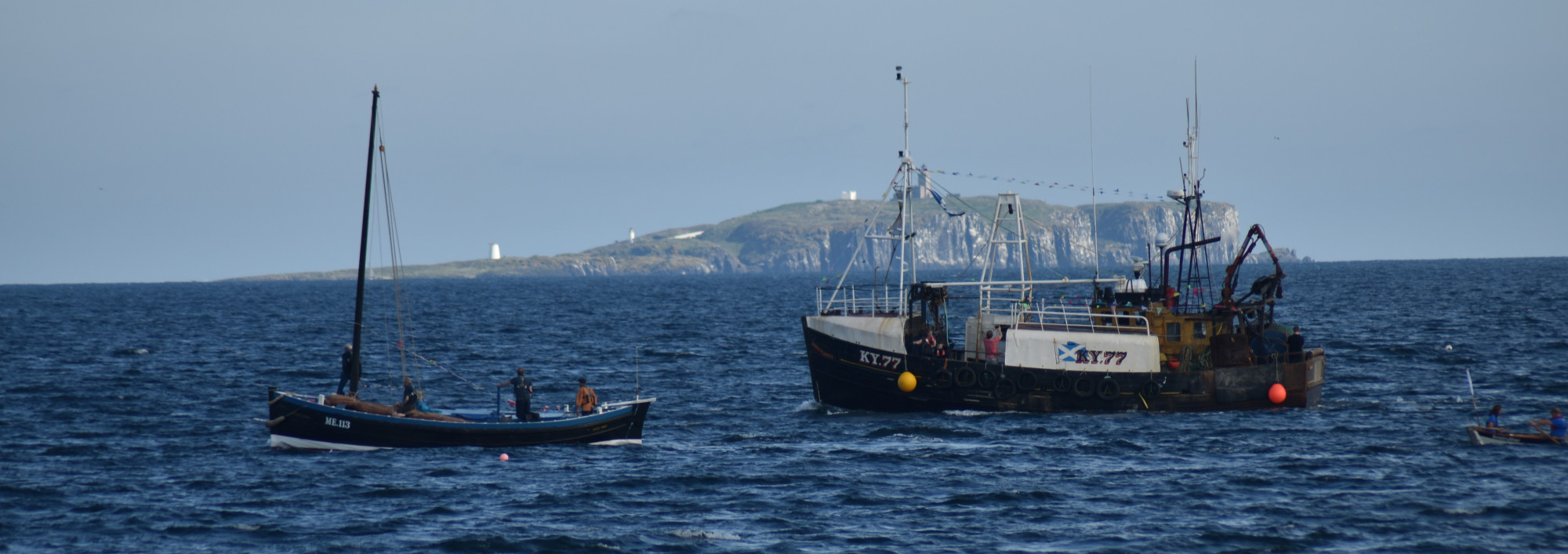


The Cellardyke Echo 23/4/2020

1875

THE LAST OF A ROMANTIC CAREER IN CELLARDYKE.

As the worshippers were returning from church on Sabbath week “an ancient mariner” breathed his last, whose strange history commands more than passing obituary. The subject of our notice, perhaps the oldest fisherman on the Fife shore, is worthy David Wilson, who has been gathered to his fathers at the patriarchal age of fourscore and three. He was born in the ever memorable year 1792 at Brownhills, the glorious sea shore of St Andrews. His father, a specimen of the Scottish cottar, was foreman, on the farm ; but the ” hairst rig” or the green knows in the landscape, had no charms for the dark-haired herd-boy compared with the flashing main, with the ships coming and going like “things of life and light” and so one evening, when only twelve years of age, he left his father’s roof-tree to begin life as a sailor. His first floating home was the little bluff Kirkcaldy smack, the ” Maggie Lauder,” which in those days was thought big enough to charter London; but though no drudge or dog is kicked about like the cabin boy of coaster, David stuck with hero’s heart to his first love till by lucky chance improved his situation on board an over sea trading brig belonging to Dunbar, While voyaging in this craft he was one stormy day thrown from the top-gallant yard into the sea, where be manfully buffeted for a weary hour and a quarter with the hungry billows before he could be rescued, more dead than alive; but notwithstanding all such stern experience and his mother’s tears, the young rover remained true to old Neptune, and on the first opportunity extended his voyages by joining the gallant old “Advice ” of Dundee in a whaling cruise to Greenland. These were the stirring days of the French war and the press-gang, when the British sailors had often much reason to fear a friend as foe, and so it happened one September day with the crew of the old whaler, who, instead of the wistfully hills of Scotland, saw the dreaded war brig ” Pickle” cruising like a wolf their track. Wilson and his comrades did not need to be told her errand, and, as the only hope of escape, the old ship was instantly trimmed under all sail right before the freshening breeze. As quickly up flew top-gallant and studding sail on the brig, which followed in the chase like a hound the heels of a wild boar, rising gale swelled the broad mainsail of the old hulk till tack and sheet” snapped again, and her huge bones were fairly foam and spray, and yet after all her fleet pursuer proudly ranged alongside. “Round to,” thundered the captain through his speaking trumpet from the quarterdeck ; but David, who was at the helm, only grasped the wheel with a firmer hold, and, with “no surrender” stamped on every feature of his manly face, kept the ship steady to her course, while the seamen, handspike in hand, by way of ruse, drove the honest-hearted St Monance master and the other officers into cabin, to save them from the serious consequence of disobeying orders from king’s ship. Being thus defied, the brig was next steered across the bows of the whaler, to bar her further flight, but on swept the whaler like a maddened bull, straight to assault, and the cruiser’s helm was just put down in time avert collision. “Round to, or I’ll shoot you,” again thundered from the quarterdeck; but even the ship boy, tired with the wild enthusiasm of the moment, waved defiance from the yard-arm. The insulted Captain was furious with rage, and shotted guns were opened upon the fugitive ship. “Whizz, whizz,” flew the deadly shower, but the courageous steersman never flinched from his post. Though one bullet and then another struck the spoke from his hand, he quickly seized another, and kept the gallant old craft bounding before blast till sail and rigging was riddled by cannon shot, and the disabled hulk lay the mercy of the cruisers, who completed the capture point of the cutlass. The intrepid steersman was, of course, was regarded as the head mutineer, and such was treated or rather ill-used by the commander, who appears to have been quite unworthy of the uniform of Nelson or Coddrington. He was ordered under irons till he and his comrades could be tried for mutiny on the high seas, for so the ruse on Captain Adamson of the “Advice” was held to be, so with this terrible purpose the brig was now steered for the Thames. David also incurred the unbridled vindictiveness of the Captain in all its by refusing answer certain questions which would have established the serious crime with which he was charged, and the poor sailor lay day and night with six-feet iron bar across his legs and his hands riveted the ring bolts, but in this woeful plight one day he found a true and unexpected friend. This was one the brig’s crew who sheltered his disgraced head as a London lawyer in the King’s service, and who had just been punished for some misconduct by the Captain, towards whom, consequence, he cherished the bitterest hate. the counsel of this new friend, the simple young mariner pled so well before the court in London, that was held to be innocent of mutiny, but at the same time he was forced to enter the King’s service on board the “Pickle,” though had the satisfaction see his enemy, the Captain cashiered for cruelty and conduct unworthy of a British officer. On board the war-brig David was so distinguished as a brave and expert sailor that he was in a fair way of obtaining promotion through the high opinion of his officers, when he and his boat’s company resolved to desert the ship, which he accordingly did one night at Jersey, where he also joined a packet holding a letter of marque and trading to the Mediterranean. While crossing the Bay of Biscay this vessel was captured by two French privateers, who soon after put into port with their English prisoners. The unfortunate sailors were driven like herd of cattle into an ancient church, where, on a scanty truss of straw, they lay down for the night; but some revengeful hand fired the litter, when the old sanctuary speedily wrapped in flames. Old David lived to tell the scene which followed, when, William Tennant says,

“Pinnacle cam’ doon and tow’r,

And Virgin Maries in a shower

Fell flat and smashed their faces.”

From this burning pile the prisoners were marched by their angry guards to an inland citadel, where they experienced all the horrors of French captivity, till one day the thunder of the British cannon in Wellington’s glorious march to Paris opened the doors of their dungeons to the weary captives. At the peace he returned home his mother, who had taken up home in Pittenweem, where the truehearted Scottish widow, like many a brave sister in adversity, earned honest crust spinning yarn for herring nets. Every Scottish whaler knew the story of his dauntless stand at the helm of the “Advice” but he was gratified hear that his Dundee friends had sent sis jacket, having one pocket a bullet extracted from the wheel, and another a yet weightier gift to his poor parents in Fife; but for a time his unceremonious leave-taking of the King’s service made the East Neuk little else than a hiding place. Eventually, however, his Cellardyke bride induced him to settle there, and take to life as a fisherman, as which he has had his own share of the varied fortunes of that arduous calling; but if his tide has had its own and manifold ebbings and flowings, he ever bravely sustained his part, and now at the end of the last farewell leaves behind him a name which will be long and kindly remembered on the old Fife shore

Vessel Dismasted near the May Island.

On Tuesday afternoon, two fishing boats arrived at Anstruther harbour, having in tow the smack Emu, of and from Falmouth to Arbroath, in ballast, which had lost her foremast early the same morning. The master reports that while about twelve miles to the eastward of the May Island, with a fresh breeze blowing, the vessel struck heavy sea, which caused the forestay to snap, and the mast thereafter broke over a little above the deck. About three hours after the occurrence two fishing boats, belonging to Cellardyke and St Monance respectively, made their appearance, and, as above stated, towed the Emu into the harbour. No agreement was made with the fishermen, and the amount salvage will probably be settled arbitration.

1876

SALE OF FISHING NETS, &c. To be Sold by Public roup at the Harbour. Cellardyke, on SATURDAY, 22d April, at Four o’clock Afternoon.

A Quantity of FISHING NETS &c consisting of 18 Black and 6 White Nets. 3 Small Lines. Pallets, Ropes, Corks, etc., which belonged to the late Robert Stewart. Mr BONTHRON, Auctioneer.

DWELLING HOUSE IN CELLARDYKE TO BE SOLD BY PRIVATE BARGAIN.

ALL and WHOLE. that DWELLING HOUSE of Two Flats, situated opposite the harbour of Cellardyke, and Small Piece of GROUND at the back thereof, and recently occupied by the late Mrs Helen Brown and others. Offers will be received by PHILIP OLIPHANT, Solicitor, Anstruther, till 1st May 1876.

BOATBUILDING YARD AT CELLARDYKE TO BE LET

To be LET, on Lease for Four Years and a half, from Whitsunday first,

THE BOAT-BUILDING PRENIISES, situated near the Harbour of Cellardyke, presently occupied by Mr John A. Millar. The Building, shed, and Fittings, Saw Mill with Engine, and Plant, may be taken at a Valuation

Further information may be obtained from Mr John Philip, Polton East mains Lasswade, or at his office Junction Street Leith, or David Cook Solicitor Anstruther, with either of whom Offers may be lodged on or before the 1st May next, Anstruther 4th April 1876

1877

THE NAMES OF THE NEW STREETS

At a meeting of the Police Commissioners on Tuesday it was agreed that the name of the new street, the first houses of which are in course of erection at the back of Forth Street, should be named Rodger Street, in honour of Captain Rodger, Glasgow. The roadway running east and west at the same place was named School Road.

HONOUR TO A TOWNSMAN. —On Tuesday evening last, the employees of Messrs Cairns, Ainslie. Co., Leith Walk, Edinburgh, assembled in the house of Mr John McKinnell, Lorne Street Tavern, to do honour to Mr Robert Skinner, son of Mr James Skinner, merchant, Cellardyke, on the occasion of his leaving the employment of the above firm, and commencing business for himself.

1878

The Kilrenny Magistrates had three new applications before them, two for small beer licenses, the one by Margaret Doig, spinster, residing in Dove Street, and the other by Mrs Christian Jack, widow in Shore Street, Cellardyke—the third being for a transfer of the public house the Harbourhead, so long and successfully kept by Mr John Marr, to his new tenant, Mr Richard Webster. Provost Watson and Bailie Brown presided. Margaret Doig’s application, being of the nature of transfer from her father, was granted; but Mrs Jack’s was refused, the Provost remarking that such beer shops were only in too many cases harbour for young men, where they learned those drinking habits which only too often adhered to them for life. Mr Webster supported his application by the most flattering testimonials as to character; but Provost Watson said that he remained unaltered in his resolution of last year, and that as then he thought that the eight licensed houses retained in the burgh was quite sufficient, if not more than sufficient, for the population, which, assumed at 2500, was licensed house to every 300 inhabitants. For these reasons, he repeated, he could not be consenting party to the transfer, and Bailie Brown having concurred, the application was rejected.

Skipper Alex. Keay was the first of the Cellardyke fleet to arrive, and his cargo, consisting of about 28 stone of halibut, 41 ling, 156 cod, 18 big skate, and a few small skate and codlings, realised £41, which was the highest sum obtained this week.

1879

One Cellardyke crew has proceeded to Kinsale, and a number of others are to embark in the herring fishing at Lewis. Mr John Harrow, the representative of Messrs Holmes & Son, Berwick, this week engaged five Cellardyke boats to fish at Stornoway from the 19th of next month until the end of June. The terms, we hear, are £10 of bounty and £1 of arles, with 17s per cran for 50 crans landed in May, and 21s per cran for 100 crans in June, it being in the power of the merchants to take delivery of a larger quantity in each month at these rates if they choose.

The Cellardyke Echo 23/4/2020

1880

MELANCHOLY OCCURRENCE TO A CELLARDYKE FISHING BOAT. The Cellardyke deep sea going boat Garland, Adam Watson master, arrived early hour yesterday morning Anstruther, and reported the loss of one of the crew, and the miraculous escape of others, during the gale. The crew were work on their big lines Wednesday when the storm rose upon them that they were forced to leave their gear and flee for shelter to the land. Thus close reefed the Garland was steering towards Aberdeen when she was struck by towering billow, which swept the deck and hurled two the crew overboard. They were both young and powerful men, one Thomas Watson, the son of Thomas Watson, (Martin) was observed but for a minute, and then disappeared for ever in the boiling abyss. His companion was more fortunate, and caught hold of the spar which another of the crew had thrown to his hand; but those in the boat were scarce in a better situation at this terrible moment. The same fatal sea had broken the leg and otherwise seriously injured John Stewart, and thus disabled, or rather helpless, in that furious tempest, nearly an hour elapsed before the crew could succeed in tacking the boat to save their all but exhausted comrade clinging to the spar with the last grasp of despair. The long interval between the casualty and the arrival of the boat also tells its own tale of the fury of the gale, as every effort had been made to afford help at the earliest moment to the injured men. A touching incident then occurred as the young widow, as usual with the mothers and wives of our fishermen on the occasion storm, was waiting on the pier to welcome one, alas she was never to meet again. Thomas Watson, than whom a more gallant and true-hearted fisherman was not on the Scottish shore, he was about twenty-seven years of age, and has left a widow and one orphan child. A strange fatality would seem to hang over the Fife coast, as this is the fifth fisherman Cellardyke drowned since the opening of the present year. Disasters were long and lamentably common by the swamping of the boats in a heavy sea. But this danger thing of the past since the introduction of a deck on deep sea craft; but as they are not provided with bulwarks rails, this very source of safety to the boats is new peril the crew, who have thus scarcely more protection than if standing on a naked ledge of rock washed by every wave. Taught, however, by such terrible experiences of the necessity of a rail guard, the fishermen of the coast are now adopting the expectant of fitting iron stanchions to the gunwale, to attach chains ropes for this purpose during storm.

No fewer than six crews are at present fitting out from Cellardyke for the herring Drave at the Western Isles. With so little to encourage them while working the big hook at home, no one can wonder at the remarkable exodus which in early summer, as in late autumn, is scattering our Fifeshire boats all over the coast of the empire. The little squadron in question is to sail as soon as the gear been put in order and stowed under hatches. They steer through the Canal to the Clyde and theme to the Lewis, where a new and rather curious feature has been introduced into the fishing engagements of the season. It helps, however, to check the risk or “gambling element,” which enters only too largely into Scottish fish curing. There are manifold cases where £5O and more of bounty money has been paid to a crew who have not fished five crans of herrings, but to guard against any such anomaly in future our Fife crews are engaged on the now recognised rule by which the engaged bounty in full is only paid after the usual compliment of two hundred cram. Thus less herrings means less bounty, till in the event of such a possibility as the catch being limited to ten crans the crew would receive like number of pounds and no more by way of premium or bounty. The current price is 20s a cran, and the recent discovery of herrings in the open sea holds out, it is said, the most tempting prospect of an early and successful at the Hebrides.

We continue to hear good reports from the Shetland Isles. No one requires to be told of the unexampled wealth of the northern seas, but the improved system of fishing Introduced by the Cellardyke crews is being attended with splendid success. Their hauls are all the talk In Lerwick; nor is their toil in vain, as with the harvest at the very door, they receive fully 6s the hundredweight for cod and ling, which, however, are denuded of their head and entrails before delivery to the merchants. Halibut is also finding its way to the fresh market, and the state and prospects of the Fife crews are said to be all that their best friends can wish.

1881

The East of Fife and the National Fishery Exhibition in Norwich.—The telegram announcing that the jurors, after three days’ deliberation, had awarded the premium of for the best steam fisher to our townsman, Councillor Wm. Jarvis, was received with little satisfaction by his neighbours and friends. The Forth was a trice decorated with bunting, and the feeling of the hour was almost akin to a local jubilee. The prize has been awarded for the model of craft of about fifty tons, with elliptic stern and lines like a yacht, fitted with steam propeller so as to obtain a speed of about thirteen knots an hour. The Councillor also obtained a silver medal for the model of fishing boat of the ordinary scale and construction, but with an auxiliary screw; and the same honour has been assigned to another townsman. Mr Alexander Cunningham, for a miniature of the handsome boat he is now building for St Andrews owners Cellardyke shore. It is likewise fitted up with the working model of an engine, and is otherwise complete in all the appurtenances and fittings of a deep sea fisher. It interesting note that all these models are rigged with fore and aft sails, which is likely, in a very short time, to supersede the luggers of to-day. The other local exhibits are the model a steam fishing smack by Councillor Millar, West Anstruther, and that of Fifeshire herring boat Mr Alex. Thomson. The locality is likewise honourably represented Messrs Martin, Cellardyke, who obtained a diploma for their fisher apparel, and Messrs Sharpe and Murray, who secured a bronze medal for their oilskins and another for their cured herrings.

As steam trawlers are being gradually introduced on the coast, steam fishing-boats most in short time called into requisition on the Scotch coast. Mr. Jarvis’ model steamer will meet the requirements at drifting, long-line, and, if need be, trawling, for though the latter branch of fishing industry is not liked by Scotch fishermen still the time appears to have come when they will have to adopt it. It will be satisfactory to our Scotch friends to know that the jurors of fishing-boat models took into conference with them Mr. Murray of Cellardyke, a gentleman well conversant with the requirements of the Scotch coast.

1882

BODY FOUND. —The body of the young Cellardyke fisherman. Alex. Gardiner, who perished at his father’s side in the offing on the 10th Feb., or about ten weeks ago, was found in the trawl net of the St Monance boat ” Branch,” Thom Watt, master, on Friday morning. The interment took place in Kilrenny Churchyard on the following day, when a very large company of friends and neighbours joined in the last mournful rites over this lamented young fisherman

AN EVENTFUL LIFE STORY.—Softly, as when an infant sinks to rest on its mother’s bosom, the father, Mr John Doig, of Cellardyke, passed away on Friday morning, having all but completed his eighty-fifth year. The fisher towns of Fife have many an adopted child, but our patriarch came of a stock who have worked net and line in the old home for at least six generations. But let us pause over his interesting story—the living register, so to speak, of the events and changes in the little world around us. He was the contemporary of no fewer than six parochial ministers, having been born in the last years of the fiery but eloquent William Beat, when the population of the whole parish was scarcely one thousand, or about a third of the inhabitants to-day of Cellardyke. His schoolmaster was poor Peter Davidson, who, when dismissed as dominie of Kilrenny, taught in a dingy cellar, crowded to the door with rosy urchins, whom he kept in order by the unsparing use of the lash, which, indeed, was considered at this time in all the schools of the coast as ” the only secret of good government,” as Dr Chalmers and Professor Tennant knew to their cost. Peter sank so low that he could not afford a watch, but he fell on a strange device to measure the heave-out of his pupils. Fastening a button by a piece of cord to a nail, and setting it a-twirling as the door shuts, woe betide the hapless youth if it ceased to do so before his return. Like his father, John grew up for the sea, his first adventure being to Wick in the herring boat “Janet,” just six and twenty feet long. They had fifteen nets in all, but they fished two hundred barrels, at 8s a cran—” a capital drave’ in those days, as the old veteran liked to tell when speaking of the splendid harvests of recent years. In the course of time he sailed his own boats—the “Thistle,” for instance, spoken of in her day though but four and thirty feet long ; and the ” Providence,” built in 1838, when she was as much talked of at the bulwark as the three and fifty feet clippers of the present hour. Thus manifold have been the changes that have taken place in the equipment of the sea, but we are not sure if the coast is represented to-day by a better or braver race than the old fathers, as when the two Cellardyke boats weathered the admiral ship to windward of the Bell Rock—that admiral being our sailor King, William the Fourth, who told Sir James Black years after how cleverly he had been beaten by the Scotch cockleshells, be compared them to the floating castle under his command. Our old friend was one of the most quiet and sedate of men, but it was with him, as with the ancient Highlanders In war, “lambs in the camp, but lions in the field,” for we have heard it from childhood that a more resolute and fearless hand never held a tiller when the black squall was wildest on land and sea. He also knew as few had done the perils of the storm. He was one of the survivors of the ill-fated “Flora,” which was capsized in the offing off Balcomie Castle In 1819 as detailed in the History of Cellardyke.” He had, however, a still more miraculous escape on the 15th December 1858. It was on the occasion of a fearful storm, when additional moorings were needed for the fishing fleet in Anstruther harbour So he was engaged with the pilot boat when, the current running stronger than in a mill stream, carried him amongst the breakers, roaring like a whirlpool beyond the piers. The first sea filled the boat to the gunwale, and there, at the mercy of the great crested breakers, he was left to struggle without a single oar or Implement of rescue. A wild cry rose on the shore, “Can nothing be done to save him?” shrieked a crowd of wives and mothers, but the bravest could only shake his head and turn away in despair. Not so the intrepid fisherman, who was face to face with it all. “I felt God to be very near me. and that I would be saved,” he has told us, and buoyed up with this unconquerable hope, he struggled on, striving with all his might, though only with a bit of plank, to keep the boat before the waves as they one by one rolled high overhead. So the wrestle went on, but he seemed only to escape one danger to encounter another, especially when he approached the beetling rock, to leeward. No one thought, however, of a landing, no often did he disappear in the towering surf; but at last the boat, as if shot along by a giant arm, was thrown upon the strand. The wave, black as the grave, rolled back as if to return with redoubled strength to claim its victim, but in that Instant a dauntless band of young fishermen, sprang forward, and with the crash of the tempest drowned for the moment in the deafening cheer that rose by one impulse from the assembled hundreds, pulled the boat and our hero beyond the reach of the breakers. Such are some of the reminiscences of the interesting veteran who has just gone from his place, as when some ancient tree falls by the wayside. His venerable spouse led the way some years ago to the narrow house; but to the last he was soothed and comforted by the children and grandchildren, whom he has, been privileged to see grow up to honour and usefulness around him.

The Cellardyke Echo 8/4/2020

1870

Anstruther – Two sharks were brought ashore here by a Cellardyke boat late on Saturday night last. One of these was a very small one, not measuring more than 40 inches in length. The other, however, was a large monster of about 14 or 16 feet in length from snout to point of tail, while its girth was fully three yards. It had four rows of sharp pointed teeth in the upper jaw. It was captured by the boat belonging to William Watson (Smith). Its body had got somewhat entangled among their great-lines far out at sea. On the boat making up to the spot a work of some difficulty began as to its capture. Some coils of tackling were got round its body, when it was hoisted on board and brought ashore in a live state. It was sold by auction on Monday morning, and bought by Provost Todd for 35s. More than two barrels of liver were taken out of this monster. The remains were then handed over to a cadger, who, after filling up the vacuum caused by the extraction of the liver with straw, and sewing up the seam, took it away to exhibit in some of the inland towns. Another shark was landed yesterday morning, but of less size than the above, the length being only about six feet, and the girth three feet.

A few days later in another paper

Last week we reported the capture of a shark 14 feet long by Cellardyke crew, and of its subsequent sale for public exhibition. The adventure has turned out quite success; for, having been taken to Cupar, it was visited in the course of Wednesday and Tuesday by about 1200 persons, young and old. On the following morning it was trucked to Edinburgh, where it attracted the attention of the first savans of the city. Through the kindness of one of these the exhibitors were furnished with a certificate giving the technical name of the fish, which is known to naturalists the Greenland shark, or sagmuus borealis, and stating further that it was one of the largest ever landed on these shores. After being exhibited in the High Street on Friday and Saturday, where it was visited by upwards of 2000 persons, it was purchased on the latter evening at the price of 30s, at the instance of Professor Archer, for the Industrial Museum.

1871

Apprehension of a Lunatic.—On Thursday last, James Small, a well-known individual of weak intellect, belonging to Cellardyke, was taken into custody for his violent and threatening conduct towards Mrs Margaret Myles, and the other tenants in the house in which also resided by himself. He was about sixty years of age, and through life had been treated with great forbearance in consequence of his unhappy mental condition, and latterly the authorities the parish of Kilrenny were disposed to be more indulgent, from the already high rate of the Parochial assessment ; but “Bidley,” as Small was familiarly designated, having recently become very fatuous and dangerous, it was felt be public duty place him in secure confinement; and the necessary medical certificate having been obtained, he was removed charge of one of the attendants to the County Lunatic Asylum at Springfield on Saturday.

1872

The Oldest Couple the East Neuk.—The parish Kilrenny, so far we are aware, can boast the oldest couple in the district—the venerable pair being Mr William Baldie, in his eighty-third year, and his yet more aged spouse, now in her ninety-first year, and who have lived in wedlock for the long period of sixty-two years. Time’s ploughshare has cut many furrow deep on our patriarch’s hoary cheek, and the snows of these long winters lie thickly on his manly brow, but nevertheless his broad shoulders bear up bravely under the burthen of years, and every sunny day sees him busy in the large market garden feued in 1766 by Saunders Gardiner from the heiress, Ann Bethune, of Balfour and Kilrenny, but of which old William has been for many years the tacksman. Mrs Baldie, however, though still retaining the use her faculties to a wonderful degree, has latterly been unable to leave her bed. It is at once interesting and curious to look back upon the remarkable changes that have occurred in the long lifetime of this worthy couple. As the girl Helen Small, and in her native place of St Monance, Mrs Baldie could well remember the time when the big granary-like house between the Coal Wynd and the sea was the consecrated Burgher Kirk,’ whither every Sunday crowds of pious worshippers repaired, though the children the town thought or cared for no one else but the little uncouth-looking boy crutches, that came all the way from Anst’er with his ” doose” father and brothers, that all knew so well as “cruiket legs,” though in afterlife as the learned professor and eminent poet William Tennant. The fields on the East of St Monance now only echo the ploughman’s song,  but her young eyes saw them clad with the gigantic trivances for working and shipping the Pittenweem coal-field. “You have opened the largest works in Scotland” said a visitor one day to Sir John Anstruther “Maybe but it’s a black bargain for three of the bonniest lairdships on the Forth” barked the grin and sullen Sir John. But how could the magnificent end otherwise than in ruin? “Our ‘ overseers will do nothing but drink or sleep,” complained the able English mining Engineer at the head of the works. “Do the best you can; they are councillors, if I discharge them I lose their votes;” and so to keep up the old Tory influence of the Anstruther Family, one of the finest coal mines in the county had to be abandoned – crushed to death by the political jobbery and corruption of the times.  The recollections of the aged husband are equally romantic. He was the son an Anst’er shoemaker, who perished in a peculiarly affecting manner at Cellardyke harbour. It was during a herring fishing, and on attempting to reach the shore the boat struck the rocks and all on board with the exception of one were drowned almost at their own doors; but the Anst’er shoemaker’s fate was the saddest of the crew. Some gallant bystanders rushed through the breakers and dragged him near the beach that his feet struck the ground, “Leave now and save the rest,” he cried, but he had scarcely been left alone when a huge billow burst upon him, sudden and remorseless a hungry beast springing its prey, and was crushed to death or drowned on the very brink the sea. The fatherless lad had early shift for himself, and so one day while a mere child, he travelled the hill to herd cows at Kingsmuir—not the pleasant green upland of the present day, but a wild muir covered with whins and black heather. So miserable, in fact, was the estate about seventy years ago, that William’s master, honest Geordie Baynes had about hundred acres which scarcely yielded subsistence for two cows, and for whic he only paid a rental of 5s and one fat hen a year; but Fife agriculture boasts in prouder triumph than the improvement of Kingsmuir, which is now yielding its gallant proprietor an annual rent roll of fully £1000. But notwithstanding the manifold blasts that assailed him the boy grew up into the strong and self-reliant man and he at last settled down in charge of the small farm on the Priory lands of Pittenweem, which rejoiced in the name of Waterless from the wells springs having been cast off by the drainage of the coal mines. Here he remained for the long period of his thirty years during which his face became as familiar as his little cottage by the roadside, so famous in its day for “jolly collier sprees,” having, in fact, been built for a public-house when the mines were opened in 1768. The old house, however, has been swept away, but the venerable couple still survive cheerful and contented after their long and chequered pilgrimage, for gladness and sadness must strangely mingle where births and deaths have often fallen like light and shadow under the rooftree; but all, we are sure, that hope that they continue to be spared, “so that hand in hand ” they may solace and comfort one another as they travel down the hill of life.

1873

On Thursday evening the boat of Skipper George Fowler of Cellardyke arrived from the deep sea with a take of about fourteen cran of herrings, which was bought by Mr Hall for 53s a cran, but a considerable quantity were immediately after resold for bait at the rate of £4 a cran, which may be called ” turning the penny.”

1874

The Steamer “Forth”

NO offers for this steamer which was some time ago advertised for sale, have yet been received, and it is likely that a special meeting of the shareholders will be held soon to consider what is to be done. It was considered that if the Forth could have been sold, a handy screw steamer might have been got sufficient for the goods traffic, and thus the passage would have continued for the benefit of traders ; but some other suggestion will have to be made if an offer is not soon received for the Forth. Some repairs which were found necessary last week prevented the sailing of the steamer after Monday, and by the end of the week some of the provision merchants had run short of stock, so much so that it is said there was scarcely, a pound of butter to be obtained in Cellardyke on Saturday evening. The largest cargo of spirits for a considerable time was landed on Monday, so that the efforts of the Good Templars do not appear to have much effect on the consumption of the ‘barley bree.’

UNRULY FISHERMEN

A  Burgh Court was held here on Friday last—Bailies Darsie and Bonthron on the bench. Alexander Robertson, fisherman, Cellardyke, and Lockhart Horsburgh and Alexander Gay, fishermen, Pittenweem, were charged with having committed a breach of the peace in Shore Street in the afternoon of Wednesday the 26th ultimo. The two latter pleaded guilty, but Robertson tendered a plea of not guilty. Horsburgh and Gay were fined 5s each, and the case against Robertson went to proof. Lockhart Horsburgh deponing that on the day in question Robertson followed him and Gay. There was a squabble opposite Mrs Forrester’s, another opposite Mrs Addy’s, and another further east. Robertson followed them all the way from Mrs Addy’s, and they could not get clear of him. He wanted to strike them. In cross-examination, witness said he was singing a song in the public house, and Robertson wanted to strike him because he thought he was making a fool of him. He took him by the cuff of the neck, and pulled the buttons of his jacket. He thought Robertson struck him in Mrs Forrester’s but he did not remember much about it. Robertson said the witness used some kind of language—he thought it was Italian. Witness further said Robertson followed them seeking a glass of whisky, and they took pity upon him and gave him one. Alexander Gay corroborated the previous witness, and said Robertson struck Horsburgh on the street. Robertson begged for a glass of whisky, and they took him into Mrs Forrester’s, and gave him one. Witness denied that Horsburgh struck the panel. David Pringle said he saw the panel and the two previous witnesses fighting on the street. They came out of the public-house and went up to Robertson, who took off his jacket. David Brown said he did not see any fighting, but words were passing between Robertson and the two others. Robertson was found guilty, and sentenced to pay a fine of 10s

The Cellardyke Echo 25/3/2020

1896

On Saturday while some boys were amusing themselves, one of their number named George Anderson, son of George Anderson, fisherman, John Street, Cellardyke, fell off a rock into the sea the same time breaking his leg. Dr Wilson was called in and set the injured limb. The boy is now progressing satisfactorily.

Addition to the Fishing Fleet

 Last week there was launched from Mr Millar’s building yard in St Monans a large fishing boat built the order Messrs Corstorphine & Co., Cellardyke. The boat, which was named the Unity as she left the slip, is 62 feet in length, and fitted with all the latest appliances, including steam for hauling the gear.

THE LATE MR CORMACK, CELLARDYKE. A sad feeling of gloom was experienced in the district on Tuesday morning when it became known that Mr Cormack, Cellardyke, had died somewhat suddenly overnight. The rumour was scarcely credited at first as it was known that Mr Cormack had been seen attending to his business as usual the previous forenoon, when he was in Anstruther. Unfortunately, the news was too true, and the expressions of regret heard on all sides were universal. It seems Mr Cormack had not been feeling very well for some time back, but in accordance with his quiet and reserved nature, he did not complain. On Monday afternoon, however, he had a bad attack, and Dr Ferguson, his medical attendant, was called in, when it was found that along with heart disease he was also suffering from congestion of the lungs. Everything possible was done, and towards eleven o’clock in the evening he rallied so much that it was considered lie had got the turn. Before midnight, however, another attack ensued, and he succumbed to it at ten minutes past twelve in the morning. By his death, the presence of a well-known, highly respected, and familiar figure has been removed. Mr Cormack was a native of Eyemouth where he initiated into the fishcuring trade by his father. He came to the East of Fife in the end of 1849, and immediately set up an establishment at the east end of Cellardyke, with a branch at St Mornas, which latter he carried on for twenty years or more. Being possessed of considerable energy and push, and with excellent business qualifications, he soon developed his business not only in regard to the curing of fish, but also in the other branches of the trade. He started a sawmill in which he did a good business for a long number of years, and afterwards he was the first to introduce machinery in the making of barrels. By its means he turned out enormous quantities of fish barrels and boxes every year, and his business in this connection very extensive all over Scotland and England. But it was in the buying of fish on Anstruther piers that he was facile princeps, and his loss in this respect will be greatly felt for many a day to come. For a long number of years he has been regarded as the heaviest and best chaser of fish in the district, and the fishermen assured themselves of a good market when Mr Cormack was at hand. He was a general favourite among the fishermen and his brother fishbuyers, his quiet but genial temperament along with his business integrity and honourable dealings gaining for him the respect and regard of all with whom he was brought in contact, and among whom there is keen regret at his death. The heavy and incessant claims of his business did not deter Mr Cormack from finding time to take his share of public work. He served several terms on the Town Council, and also on the School Board, in which his common sense and practical experience stood him in good stead and were of considerable advantage to the interests of the community. In politics, Mr Cormack was a lifelong staunch Liberal, although he did not take any prominent part in party politics. He was a great admirer of Mr Gladstone, and gave always hearty support to the interests of the Liberal party. He was a dissenter in religion, and has been connected with Anstruther U.P. Church since its start in 1855. He was a member of the Relief Church before that. Mr Cormack was twice married, and is survived by his second wife and large family, the whole of them grown up, one of the sons being connected in business with him for some time lately. He was 72 years of age, having been born in 1824. The funeral takes place this afternoon to Kilrenny Churchyard at 1.30, and it is expected to be largely attended.

1897

23rd

The fisherman employed in the steam liners at Anstruther came out on strike yesterday. The point at issue between the fishermen and the directors of the companies is about the bait. The fishermen claim that when they catch their own bait they should be paid 50s per week for each vessel. The skippers are agreed to sail the vessels until the end of June without the these terms, and with only the privilege of selling whatever surplus bait they have over. On Saturday all the fishermen signed a paper which was submitted to the several directors of the different companies, and the skippers had a meeting with the directors. The demands of the men were refused. A mass meeting of the fishermen was held in Cellardyke Town Hail. The proceedings were private, but the decision unanimously arrived at was that, the gear be lifted out of the liners until the directors gave in to their terms or made an offer. The strike affects about a dozen steam liners.

26th

The Fishermen’s Strike. —At a mass meeting yesterday afternoon in Cellardyke Town Hall, the Anstruther steam line fishermen refused to accept the terms the directors. These were to offer the fishermen 20s for each baiting during the eight months they catch their own bait, relieve them of any share paying the engineers’ and firemens’ wages all the year round, and to divide the money derived from the surplus bait equally between the fishermen and shareholders. The fishermen demand instead per baiting and the surplus bait, or 40 per baiting and the surplus bait to be divided equally.

1898

PROPERTIES IN CELLARDYKE FOR SALE BY PRIVATE BARGAIN. To be sold by Private Bargain, the following PROPERTIES in CELLARDYKE belonging to MISS CRAWFORD, Seafield, West Anstruther, and others :-

1. SHOP presently unoccupied, DWELLING HOUSE of Two Storeys, presently occupied by Messrs Wood, Sutherland and Hodge, situated in George Street, Cellardyke. The Premises are Commodious, and the Shop is suitable for a Grocer, Baker, or other similar business. There is ample cellarage at the back.

11. DWELLING HOUSE in John Street, occupied by Robert Thomson and another. Full particulars can be obtained from H. B. Macintosh, Solicitors, Anstruther, Offers may be lodged on or before THUR DA Y, 31st March 1898.

1899

A QUANTITY of FISHING GEAR, belonging to MICHAEL Doig, juor., consisting of Nets, Bows, Messenger Rope, Great Lines, &c., will be Sold by Rublic Roup on Saturday, 8th April, at 38 West Forth Street, Cellardyke.

Report on repairs to Cellardyke Harbour. On the 9th and 17th February, I examined the above harbour and shore protection walls at public green, with a view to strengthening and rebuilding same so as to ensure no further en croachment by the sea. The damage during the recent storm has been such, that a sum of at least £1200 over and above the £400 already subscribed, would be required to rebuild the harbour and restore it to its former condition in a thoroughly substantial manner.

1/4/2020

1840

CELLARDYKE

ALARM FROM FIRE. – On last Saturday night, the inmates of a house here were alarmed by part of the woodwork being on fire. It became ignited from the heat of the furnace of a boiler in an adjoining house making the stones of the partition red hot. There is no doubt it would have soon communicated with the garret had it not been discovered in time, and the requisite means used for its prompt extinction.

1842

Cellardyke. Melancholy Event. On Tuesday, a fishing-boat, belonging to Cellardyke, with a crew of eight men, was upset a few miles to the eastward of the Isle of May. Only one of their number was picked up, the other seven met watery grave. What renders the occurrence the more distressing is the circumstance that most of the sufferers have left widows and large families to lament their loss.

(The Boat was the Lord Melbourne and the Skipper Henry Reid)

1848

ST MONANCE.

THE WEATHER AND THE FISHING.—The weather has been good the whole of the week, but the success of the fishermen has been very unequal. Those at the haddock fishing have caught little. Several of our crews, however, who have tried the nets for herring. got bait, and caught cod ; one crew succeeded pretty well on Saturday, having caught ten crans of herrings at the May Island, which they sold to the Cellardyke fishermen for bait, and with it they proceeded far east into the German Ocean, and fished for halibut, cod, skate etc, Another of our crews caught five crans on Saturday morning. The former crew sold to the Cellardyke at 45s. per cran.

(that is a huge amount of money for a cran of herring, especially for bait, the white fish prices must have been very good)

1851

Sequestrations

James Wallace, Sailor, lately residing Cellardyke, present prisoner at Cupar, to be examined in the courthouse, Cupar 2nd May at 10 o’ clock.

1854

Commercial Movements. Rumours of war may produce temporary suspension of business in the great legislative assembly of the nation, but no such effects appear visible in the commercial movements on this coast, remotely situated apart from the theatre of hostility. According to the gossip of last week, the crew of strange boat having picked up salmon nets on the high seas, carried it into the port of Cellardyke, and disposed of the capture, after which they are reported to have entered vigorously on the transaction of business with an old acquaintance, named John Barleycorn; and so intimate did they become with the treacherous old villain, and so ardent in their brilliant gratulations, that one of the nautics in a vehement gust of affection, tumbled down in a state of utter insensibility, the one spirit having apparently dislodged the other. His comrades then had no alternative remaining, but to shoulder their unconscious companion, and re-embark for the purpose of proceeding across the great stream to their own locality, that their associate might enjoy the resuscitating influence of his native atmosphere.

1856

AUSTRALIAN MAILS.

PASSAGE MONEY £14  AND UPWARDS.

BLACK BALL LINE

BRITISH AND AUSTRALIAN ROYAL MAIL PACKETS.

Under Contract carry her Majesty’s Mails in 65 Days,

Sailing from Liverpool on the 5th of each Month,

FOR MELBOURNE,

 Forwarding Passengers by Steam to all ports in

AUSTRALIA, TASMANIA, and NEW ZEALAND at Ship’s Expense.

Ship.                                            Tonnage.      Capt.                       DATE

JAMES BAINES                         2515                McDonnell        April 6TH

LIGHTNING                                2090              Enwright           May 6th   

SCHOMBERG                            2600              Forbes               June 6th  

OCEAN CHIEF                           1092               Tobin                  July 5th

MARCO POLO                          1625               Clarke                Aug. 5th   

DONALD McKAY                     2594              Warner              Sep. 7th  

OLIVER LANG                           1299               Mundle              Oct. 5.

CHAMPION OF THE SEAS      2470              M’Kirdt              Nov. 5.

The above Line is composed of

THE LARGEST, THE FINEST AND FASTEST MERCHANT SHIPS IN THE WORLD

And have been built by the most celebrated builders of day, including McKay of Boston, and Hall of Aberdeen. They are commanded by men who have already rendered themselves famous; and their equipments and accommodations are unequalled by any line of ships afloat. Freight and Passage apply to the Owners

JAMES BAINES, & CO., 6, Cook Street, Liverpool;

ROBERT STEWART, Meadowside, Dundee,

J. JEFFERS WILSON, Advertiser Office, Kirkcaldy,

JAMES HOWIE, St Andrews.

THOMAS BROWN, Cellardyke, Anstruther,

J & R. DEWAR, Crossgate, Cupar-Fife.

(£14 in 1856 → £1,517.66 in 2020, so prices are comparative with flying today in 18+ hours as a pose to 65 days sailing)

1858

On the placid bosom of the fertile stream, the numerous boats have been observed under the azure sky, wending their way to their respective destinations, bearing valuable draughts of herrings, huge codfish, gigantic halibut, and skate of prodigious dimensions. One of the monstrous flats measuring fully seven feet by five and-a-half, was captured and landed last week by Mr John Murray of Cellardyke, which mightily attracted the wondering gaze of the curious public. This must have been quite a match for the notable flapper or skatefiah, which is said to have been substituted by a certain blacksmith as a gable for his workshop. Here we observe that there is gold in the Forth for the persevering diggers, as well as in the far distant regions either of the eastern or western world. And any one boat’s company can expiscate forty pounds from the subtle element in one day, this can by no means be considered a despicable nugget; and this during the last week has not only been realized, but in numerous instances considerably exceeded. Indeed, some of our coast skippers have, within the last three months, extracted gold from the saline depths amounting to £100 in round numbers. And it perhaps not generally understood that all fishing enterprise is exempted by Act of Permission, from the moultering operation of every exchequer impost. But it must be remembered that in searching for gold, whether on earth or ocean, there is much of lottery in the process, whatever be the means employed, and numerous blanks withal.

1859

DEATHS.

At Cellardyke on the 24th ult., Margaret Fletcher, relict of the late David Corstorphine, aged 84. Friends will please accept of this intimation.

The Cellardyke Echo 18/3/2020

1890

The Rev. Dr Pierson of Philadelphia gave an address on missions in Anstruther Town Hall last week. The Rev. Mr Murray presided, and all denominations were represented. The Hall was crowded. The Anstruther and Cellardyke choirs also united for the occasion, with Mr Young as conductor. After the 100th psalm had been sung, and an impressive prayer by Mr Whitson, the Chairman introduced Dr Pierson, who at the outset, paid an eloquent tribute to the life and genius of Thomas Chalmers. As elsewhere, he riveted the attention of his bearers from first to last. The Rev. A. Macalpine, of the Free Church, in the course of his prayer referred to the two missionaries who had left the East of Fife—the Rev. John Bruce (South Africa) and the Rev. Alexander Gregory (China) The Rev. Messrs Smith and Pittendreigh of the U.P. Church, also took part in the very successful services.

1891

FOR SALE, the BOAT, HARVEST QUEEN, Carvel Built, length 44 feet, as she presently lies at Eden, St Andrews. All the Materials in good order. Apply JAS. Dick, 31 Rodger Street, Cellardyke.

To be SOLD by Public Roup, within the Town Hall of CELLLARDYKE, on SATURDAY, the 2sth day of March 1891, at 12 o’clock Noon, in virtue of the powers of Sale contained in Bands and Dispositions in Security

THE DWELLING-HOUSES, SHOPS, and others, Nos. 1,3, and 5 John Street, and DWELLING HOUSES, SHOP, BAKEHOUSE, STABLES, STORAGE, and others on East end of Tolbooth Wynd, and below John Street, Cellardyke, belonging or which belonged to John Gilchrist, Shoe Merchant. Apply to DAVID COOK, Solicitor, Anstruther.

MISSING SHIP ROMAN EMPIRE.—It is now believed that this ship which left Liverpool on the 29th July last year, his foundered with the loss of all her crew of 32 hands. Among those on board were John Parker, sailmaker, belonging to Cellardyke, whose wife resides there, and William Hutton, sailmaker and B.A., belonging to Crail. Much sympathy is being expressed for their relatives. The ship belonged to Mews George Duncan & Co., of London.

1892

The steam liner Grace, of Leith, manned by a Cellardyke crew, was yesterday afternoon towed into Anstruther harbour. In the morning she had been proceeding to the fishing ground, and when off St Abb’s Head her boiler burst. The crew were rendered helpless, and the craft was gradually being drifted towards shore when a passing tug was hailed. The damage is very considerable.

1893

THE fishermen of Cellardyke, Fifeshire, have resolved, by a large majority, that the close time for the summer herring fishing on the east coast should last from the 1st of June to the 10th of July, the close time to include not only the landing but the curing of herring.

1894

Two applications were received for the female asaistantship in Cellardyke School, and it was resolved to appoint Miss McGillivray, Arbroath, and to telegraph asking when she could enter on her duties, It mentioned that many of the slates on the roof of Cellardyke School had been blown off, and it was agreed to ask a practical man to examine and report. Complaint was made of the boys at night afternoons playing at football in the playground, and the clerk was instructed to issue a handbill warning parties that they would he prosecuted if persisted in in future.

A SUNDAY DISTURBANCE —it Cellardyke Burgh Court on Monday —Provost Martin and Balie Thomson on the bench—Robert Keith, carter, and a fisherman who gave his name as Thomas Watson, were charged with committing a breach of the peace by cursing, swearing, and fighting in the house of Mrs Margaret Farmer or Forgan, Kilrenny, on Sunday the 18th ult. One questioned the accuracy of the terms of the indictment, but on the Fiscal volunteering to lead evidence he like his companion pled guilty. The Fiscal directed attention to his signature, as he had given his name as Thomas Watson. He also said that a number of young men were in the habit of going to this house especially on Sunday nights, and a great many complaints bad been made by the neighbours. The Provost said he was sorry to see two young men before them on this charge especially when he knew the kind of place where this offence was committed. They were fined 10s 6d or ten days,—Keith being allowed seven days to pay the fine. Mrs Margaret Farmer or Forgan was then placed at the bar charged with keeping a house in which parties were suffered to behave in a riotous manner. The panel who appeared mentally unfit to reply, pled guilty. The Fiscal said if the first was a serious case this was much more serious, Forgan keeping the house against which all kinds of complaints were made by the neighbours. Provost Martin said he understood that her conduct, and that of her family was a great annoyance to the inhabitants of Kilrenny. Prisoner replied that it was the people would not let her alone. The Provost asked if she would promise to go and live with her husband, and they would let her off. She must leave the village, or if not return to Court next Monday, when sentences would be passed.

1895

WANTED, PRECENTOR for CELLARDYKE PARISH CHURCH, capable of Training a Choir. Applications to be lodged with W Oliphant, Anstruther, on or before the 21st curt.

 VIOLIN TUITION—Mr W. WATSON is open to accept few more Pupils for the above Instrument, either at his or Pupils Homes. Will Open Class in Crail if a sufficient number apply. Terms Moderate. Few Violin Sets for Sale, including Violin, Bow and Case, Cheap. Inspection invited.

15 Dove Street, Cellardyke.

ANSTRUTHER DISTRICT NURSING ASSOCIATION. The second annual meeting of the East and West Anstruther, Cellardyke, and Kilrenny, Nursing Association was held in the Council Chamber, Anstruther, on Wednesday evening— Provost Anderson presiding. Fully a dozen were present. Miss McLaren, hon. Secretary, submitted the report for the year, which stated that the continued service of Miss Junner was a guarantee that the work had been efficiently performed, and the community was increasingly sensible of the great benefit derived from her the attendance on the sick and poor. While there had been no outbreak of disease there had been a great amount of illness, and the nurse’s time had been fully occupied. and she had been of greet assistance  in many serious cases of illness. The Doctors had again expressed their high appreciation of Miss Junner’s work. ………….. Rev Mr Murray ….While he had not come in personal contact with Miss Junner, he often got acquainted with her patients and from the time she had come until now he had beard nothing but the very highest commendation of her attention and skill in her work, and of the great benefit her services conferred on the sick. A skilled nurse was of great value not only to the Doctors, but to the sick poor, and consequently the results ought to be of the very best possible kind. The Doctors reported that they were highly satisfied with Miss Junner’s work. In fact the whole community, both those who received the benefit of her skill and those who subscribed towards her upkeep, appreciated the work she did, and all those who bad taken an interest is this work were further prepared to suppose it in the future. (Applause). ……….. Rev Mr Ray asked to be allowed to say a word on behalf of Cellardyke where he dared say the nurse’s work chiefly lay. He knew the grateful feeling which the people of Cellardyke cherish towards the Association for their great kindness in providing the nurse, and-he could not sit there without, in their name, thanking the Association – and the nurse for all the good they have received. (Applause.) Rev. Mr Smith also made s few remarks about Miss Junner’s work amongst all classes. Rev. Mr Murray suggested that Mrs Jamieson be asked to convey to Miss Junner the meeting’s sense of her value and of her devotedness to the work.

The Cellardyke Echo 12/3/2020

1886

A few friends entertained Mr John Leslie on Friday evening last in Anstruther, when he was presented with a handsome silver albert and pendant, on the occasion of his leaving Cellardyke for America. The presentation was made by Mr Alexander Bisset, who expressed the regret they all felt at parting with their friend, and whose company they would miss very much. Mr J. Leslie replied in an appropriate speech, and thanked them all heartily for their very handsome present, which he admired and highly valued.

THE IMPROVEMENTS AT CADDIE’S BURN.

Bailie Darsie reported that the Committee had had their attention called to the drain at Caddie’s Born, which they agreed to rectify, the expense to be borne equally by Anstruther and Cellardyke, and the work was now being proceeded with. They were anxious to improve the roadway also, and had agreed to take in estimates to see what it might cost. The Cellardyke people had communicated with Mr Andrew Young, St Andrews. who recommended “laying it with blocks, Queensferry setts., 4 x 7, to cover 120 square yards, the cost of which would be 7s per yard finished.” It was remitted to the Committee to have the work done along with the Cellardyke Committee.

SALE OF A FISHING BOAT.—In the of last week five Stornoway fishermen arrived here in quest of a suitable boat for the net and hoe fishing at the Western Isles. They eventually purchased from Mr Adam Storrie, of Cellardyke, the “Favourite,” as she lay in the harbour equipped for sea, at the price of £145. Such a boat when new would cost £360.

1887

CELLARDYKE CORICTION.—It should have been mentioned that G. Fowler, Esq., Adelaide, was the donor of the coals to poor in Cellardyke, instead of Miss Fowler, Edinburgh, as stated in last week’s Record.

DWELLING HOUSES IN CELLARDYKE FOR SALE BY PRIVATE BARGAIN.

ALL and Whole those SUBJECTS, situated in George Street, Cellardyke, called ” Sharp’s Close,” belonging to Mr James Sharp, Australia, all as presently occupied by Mr William Moncrieff (Boyter), and five other Tenants. Farther information may be obtained from H. B. Macintosh & Son, with whom Offers may be lodged or before 31st  instant. Anstruther, 7th March 1887.

At a Burgh Court on Saturday—before Provost Martin and Bailie Sharp—David Brown (Carstairs), fisherman, was charged with assault and breach of the peace committed on the 19th ult. From the evidence led it appeared that accused went into Mr Thomas Thomson’s shop in James Street, and demanded to know why he had arrested his son’s money. Thomson replied that he had got nothing to say to him, and said it was surely more than time he got his money, seeing it was two and a half years since his son received the boots. At this accused began to curse and swear, and taking hold of Thomson by the breast tried to drag him to the door. Thomson shouted for assistance, and another fisherman, who was standing outside, rushed in, and the two succeeded in putting the accused to the door. Here he again used filthy language, and called on Thomson to come out and fight with him. He continued this conduct until his relatives came and took him away. The Magistrates found the charge proved, and inflicting a fine of 7s 6d or seven days’ in prison, cautioned him to be more careful in future.

The deep-sea fishing boat, the Reform, of Anstruther, belonging to Mr John Watson, (Bisset), has, with all her appurtenances, been sold to Mr Alexander Roger, Cellardyke, for the sum of £260. The Reform was built at Fraserburgh two and a half years ago. Mr Jarvis has sold to Mr Robert Heughs, Cellardyke, the new boat as she stands at the shed for fully £200. All the expenses of her fitting out are to be borne by the purchaser.

1888

EXPOSURE OF FISHING CRAFT.—The well known deep sea fishing craft “Jessies” of Cellardyke, owned by the late Skipper James Brunton, was exposed for sale at Anstruther jetty on Saturday afternoon. She was built about two years ago, and is fitted out so thoroughly with sails, anchors, &c., as to be quite the model of a North Sea fishing yacht, at a cost of £4OO. The upset price was £28O, but the cloud to-day on the industries of the sea was surely never so striking as in the fact that there was no purchaser, though it is understood more than one young skipper has a longing eye to her acquisition. Curiosity, if nothing more, drew a large crowd to the spot.

At the invitation of the Young Men’s Christian Association about a hundred of the old neighbours of Cellardyke sat down to tea in the Town Hall on Saturday night. After an excellent service of the cup that cheers but not inebriates with cake ad libitum, some interesting and appropriate remarks were made by Provost Martin, who presided, Treasurer Thomson, Skipper Carstairs, and others. The evening was enlivened with recitative pieces by Mr D. Pratt and Miss J. Fleming, also with a selection of favourite hymns given in fine taste by Mr D. Bruce’s choir, with pianoforte accompaniments by Miss Watson. The pleasure of the venerable guests was unconcealed from first to last, and the tear of grateful joy was seen glistening in more than one eye in response to the ringing vote of thanks to the Association for the considerate kindness of the night.

1889

The body of Thomas Tarvott, 5 Bank Street, Torry, was picked up about two miles from Aberdeen on Saturday. The body was not very much decomposed, but one of the hooks of the lines had penetrated one of his eyes. Since the accident occurred a keen lookout has been kept for the body, and strangely enough the small boat which found the deceased was the Mountaineer 11 A (Alexander Wood, skipper), of which Tarvott formed one of the crew, and from which he fell overboard. It seems that the body had got entangled among some fishing lines, as when found it was at the spot where the sad occurrence happened. The body was landed Torry, and thereafter conveyed to the deceased’s house in Bank Street. Though residing in Torry, Tarvott was a native of Cellardyke, and only came from that place a few years ago. He leaves a widow and one child.

The Cellardyke Echo 4/3/2020

1880

Sale of Property.—The old  loft and backyard in the west end of Cellardyke, so long possessed by the relatives of Mr Stephen Williamson, the aspirant for the St Andrews Burghs, has just been privately disposed of to our well known builder, Mr Thomas Brown. The price was £370, but the property has a frontage of 60 feet. That is enough for three houses on the self-contained principle now so generally preferred by the fishermen of the coast. The old tenement was built by Stephen Williamson in the middle of the last century, the family being settled here from the time of the oldest records, to wit, the minute book of the Trades Box of Kilrenny, which was instituted in the time of King Charles I.

1881

A few weeks ago a fisherman, who originally belonged to Crail, died here leaving a widow and six young children to mourn the loss of their bread-winner. He was a member of the sick society but, the rules providing that each one must have been connected with it for a year before relief is payable, the office-bearers were unable to grant any relief to the widow. Some of the members, however, bestirred themselves in a private way, and with such success that fully £24 have been collected for the widow and children in Cellardyke alone. There is some talk, we hear, of altering the rules so as to admit of relief being granted at an earlier date after a member has joined the society.

1882

BOOTS AND SHOES. ROBERT GRAY respectfully announcing to his Customers and the Public that he will offer the Whole of his Large Stock of BOOTS and SHOES at the Lowest Prices. All done on the shortest notice. 3 SHORE STREET, CELLARDYKE.

LOCAL INTELLIGENCE. ANSTRUTHER. THE LATE CASE or DROWNING. —The Procurator-fiscal of the county held a precognition here on Monday last regarding the loss by drowning of Alexander Gardner, fisherman, off this coast during the storm of Friday evening the 17th ult

 THE PRICE or Bread, The bakers in Anstruther and Cellardyke on Monday raised the price of bread from 6d to 6 ½ d for the 4lb loaf.

1883

He was the son of a fisherman, and he hailed from Cellardyke, where he had seen over a dozen weary winters come and go. With the soul of a Jack Shepherd burning within him, he scorned the paternal calling. So he would be “a highwayman.” And this is how his first essay in his adopted role began and ended. Sallying forth the other morning, he encountered a maiden fair of tender years, and boldly demanded “her money or her life.” On full reflection, she chose to sacrifice the former, which, in the current coin of the realm, amounted to no less than 2d. On Tuesday, the young highwayman found himself in the Sheriff Court, and on the same day he made the acquaintance of that to which he must hitherto have been a stranger—the tawse ; applied, six times on end, with no gentle touch.

Outbreak of Fever in Cellardyke. —ln the course of this week four or five cases of typhoid fever have occurred in Cellardyke, and on Wednesday Mrs Duncan, one of the patients, died. Her husband, who came lately to take the place of his deceased brother, is lying seriously ill with the fever. Both the medical gentlemen in Anstruther have been constant in their attendance, and taken the greatest pains to isolate the fever.

1885

John Foster, carter, East Anstruther, and George Lindsay, carter, Cellardyke, were charged at a Burgh Court on Tuesday—Chief-Magistrate Wilson and Bailie Gilmour on the bench—with having on Wednesday evening, the 25th ult., stolen from the goods station of the North British Railway Company at West Anstruther, seven or more barrels, valued at 1s 10d each, the property of Messrs Thomas Brown & Sons, fish merchants, Lowestoft. Both pled guilty, after it had been explained that although they had not sold the barrels they had taken them away for that purpose. The Fiscal said the accused had done wisely in pleading guilty to that serious charge. He was credibly informed that a large number of barrels had gone amissing lately, and that there was a habit of obliterating the names from the barrels, so that they could be disposed of to other fish merchants and curers in the place. He thought that was a very bad practice, because those parties who bought these barrels were resetters of theft, and by purchasing them they held out a great inducement to panels like the accused to commit theft. The accused were under the impression that because they did not sell the barrels it was not theft. They were observed to take away the barrels, and being watched were prevented from obliterating the names before they were sold. Chief-Magistrate Wilson–It is a painful thing to see young lads such as you standing in your present position. If you wish to grow rich never suppose that you will do so by taking what is not your own. You should endeavour to act to others as you would have them to do to you. There is no previous conviction against you, and we have resolved to give you the option of a fine on this occasion. We are thus to be very lenient with you, and hope that it may act as a stimulant upon you both to walk hereafter in the paths of rectitude. The sentence is that you be fined in the small sum of 15s each, or failing payment you will be imprisoned for 20 days. Now I hope this will be a warning to you in future. The fines were both paid.

The Cellardyke Echo 26/2/2020

1870

SCARLET FEVER. —This dangerous epidemic, which has been more or less prevalent in the East of Fife for some months past, has now begun to take rather a strong hold in Cellardyke. There are at present several cases, and one of them proved fatal last week after a relapse. It is amongst the young chiefly that the disease prevails. During the present unsettled weather, every means should be taken to guard against colds, and personal and household cleanliness, as well as good drainage, should be rigidly looked after if the ravages of fever are to be subdued.

1872

Pillage of Herring.—ln the course of Wednesday morning several Cellardyke and other boats, while their crews were taking some needful at home between the toils of the night and the opening of the sales at daylight, were pillaged of part of their herrings—some crews having about a cran stolen—the loss, so far we hear, amounting in all to about £10. These heartless depredations being committed under the cloud of darkness, and with the shore quite solitary and deserted, their detection is consequently matter of great difficulty; but it does seem suspicious on the part of some stranger crews to visit the harbour during the night, ostensibly for the purpose of buying bait for the cod fishing, but to leave without either making a purchase, or paying the ordinary harbour dues.

1873

PROBABLE WORKING OF COAL NEAR ANSTRUTHER. —The lessee of Clephanton Tile and Brick Works— Mr James Skinner, merchant, Cellardyke been conducting boring operations for some time back at the works, with a view to ascertain the presence of coal, and has at length found a seam at a depth of 20 fathoms which he believes will pay to work. Mr Skinner intends to commence sinking a shaft immediately, and should the engines on the ground not be found sufficient to work the pit others are to be got, in order that the necessary operations may be conducted as speedily possible.

1875

ANOTHER SATURDAY NIGHT Row.—John Miller, cooper, Cellardyke, and Thomas Moncrieff, fisherman, Cellardyke, were charged with fighting with each other and committing a breach of the peace in the Royal Hotel between nine and eleven o’clock on Saturday night last. Miller pleaded guilty, but Moncrieff denied the charge. The evidence clearly proved that both panels were lying on the floor and endeavouring to keep each other down. They wore fined 7s 6d each, with the alternative of eight days’ imprisonment.

1876

LECTURE ON SIGNALLING. DR JAMES A. RUSSELL, M.A.. B.Sc., &c., Demonstrator of Anatomy to the University of Edinburgh. will deliver a LECTURE Tomorrow (Saturday) 26th instant, in the Forth Street Hall, Cellardyke, at 7pm, on Signalling practically considered as in the case of boats at sea communicating with each other or the Shore, by night or day. Fishermen specially invited. Admission Free.

Recovery or Lost Fishing Nets—During the gales of last week Skipper; Thomas Boyter, Cellardyke, of boat No. 1171, and Skipper David Muir, Cellardyke, lost 23 and 16 nets respectively. Muir’s were found by George Anderson, fisherman, Broughty Ferry, who had them dried and kept them till he learned, through Mr Gillis, Fishery officer here, the owner’s name, when he sent them home without asking any reward whatever. The others were found by those on board the Dundee pilot cutter, and in like manner the pilots refused to take any salvage for retaining the nets. It is a common though not general practice to seek salvage in each cases, and the conduct above described is therefore the more generous.

1877

CELLARDYKE A PIANOFORTE FOR SIXPENCE.- Through the influence of the ex-R. W. M. of St Ayles Lodge of Freemasons, Brother Wallace, a considerable number of tickets for a drawing originated by the Arbroath Freemasons were sold in Anstruther and Cellardyke, and it has transpired this week that the first prize, a pianoforte valued at thirty guineas, has been won by a widow in Cellardyke named Mrs Carmichael.

(additional info from another paper)

Mrs Margaret Myles Carmichael. a self-reliant widow, “in sma’ way o’ daein’, as they say Brothick side, of a little provision shop which has conducted for many years in Cellardyke, Margaret has had a life-long pull against the stream, especially since the death her “guidman” many years ago, and her “windfall” has been naturally hailed with lively sympathy by her neighbours.

BURGH COURT. —A diet of this Court was held in the Town Hall on Saturday last, when Alex. Keith and James Thomson, carters, were charged with assaulting another carter named Alex. Pattie on the 27th ult., while Peter and Alex. Montadore and David Wilson, fishermen, were accused of committing a breach of the peace at the same time and place. All the panels denied their guilt, and the Magistrates granted an application to adjourn the trial in order that evidence for the defence might be produced.

1878

…the fishermen report that they have seldom if ever seen the herrings so closely packed together…. . Chiefly in consequence of the strong tiles this week, a good many of the fishermen on Wednesday night suffered considerable loss by the destruction of their nets. In one case, (that of Skipper Martin Gardner, who landed the highest take yesterday), the nets were so torn and destroyed that it will probably be a day or two before he can proceed to sea, while Skipper Thomas Birrell was heard to declare, that he would rather not have seen the 40 crans which made up his cargo. Notwithstanding the heavy catch prices this week have shown an upward tendency, this being due to the fact that the weather has prevented the fishermen on other parts of the coast from prosecuting their calling except at intervals. The sum paid by the buyers for the 4443 crans landed up to this date may be roughly estimated at £6560, which makes the average price 29s 6d per cran. A wager between Mr Hall, Scarborough, and Mr Alexander Mackenzie, Lowestoft, as to the catch of. Wednesday has excited considerable interest among the buyers. Mr Hall estimated the catch at 900 crans, while Mr Mackenzie maintained that it would not exceed 800, and both holding strongly to their opinions stakes of two sovereigns each were duly deposited in the hands of a neutral party.

New FISHING Boats.–On Monday Mr Jarvis launched from his boatbuilding yard at the east quay a splendid new fishing boat for Mr James Wilson, jun., Pittenweem. This is the third boat launched by Mr Jarvis this year, the other two having been purchased by Mr Thomson, North Berwick, and Mr George Corstorphine, Cellardyke. Another boat in the same yard, is being built for Mr Robert Meldrum, Cellardyke.

On Tuesday Mr Millar launched from his building yard at West Anstruther a finely modelled new fishing boat built for Mr James Smith (Brown), Cellardyke. She is the largest boat built here for some years, her length being 48 ½ feet. Mr Millar has another boat rapidly approaching completion, and orders for several more.

1879

We understand that Mr John Ritchie, fishcurer, Cellardyke, has secured the site at St Ayles Crescent adjoining the Baptist Manse, and intends proceeding as soon as possible with the erection of a twin villa. Only two sites of the Trades Box Society’s ground at St Ayles now remain to be taken up.

CELLARDYKE. BREACH of CERTIFICATE

At a Burgh Court held on Thursday last week—Provost Watson and Bailie Brown on the bench —Isabella Smith or Anderson was charged with having committed a breach of the terms of her certificate, by having allowed excisable liquors to be consumed on the premises. She pleaded guilty, and was fined in the modified penalty of 25s, with 5s 6d of expenses.

The Cellardyke Echo 19/2/2020

1865

CELLARDYKE. NARROW ESCAPE PROM DROWNING. —On Wednesday forenoon, while a young boy of about seven years of age, son of Mr David Boyter, fisherman, was amusing himself among the rocks ‘ nearly opposite the Town Hall, he fell into the deep water beyond his depth, and was carried and tossed greatly about by the action of the water for about twenty minutes. His perilous condition was fortunately noticed by some neighbours, who immediately got a small yawl manned, and, after some difficulty, they got him landed in an apparently lifeless state. Dr MacArthur, who fortunately happened to be in the neighbourhood, went immediately to the sufferer’s assistance, along with Dr Jamieson, who used every means in their power to restore animation, and we are glad to say that, after some time had elapsed their efforts were crowned with success. The ‘boy is now fast recovering.

Anstruther Harbour Commissioners and potential 1st Lifeboat

The Clerk then stated that he had been waited upon by a deputation from the Cellardyke fishermen regarding a site for a wooden house for a coble 29 feet long and 9 feet broad, to be used in cases of emergency ; and also that the Commission should use their influence to have a rocket apparatus stationed at Anstruther. The Board unanimously agreed to grant a site at the road leading from the Forth, and contiguous to the back of the East Pier; and the Clerk was instructed to communicate with Lieutenant Bainbridge, R. N, Elie, in order that an application might be lodged in due form with the Board of Trade.

1866

Prolific Sow.—ln the beginning of the week a sow, belonging to Mr Henderson, flesher, Cellardyke, had a litter of eighteen pigs at one birth. We are informed that five of this remarkably numerous progeny have since died; but all the others are in a promising condition, and will in due season, no doubt, make the world fatter, if not better, by their valuable contributions of savoury bacon and ham.

Early on Saturday morning, as one of the boats belonging to Cellardyke was returning from the fishing, through some strange mischance she went ashore among the rocks between Anstruther and Cellardyke, and in a few hours became a total wreck. The statements of the circumstances connected with the case seem to be of a somewhat conflicting character; but the one which receives most credence is that between one and two o’clock in the morning in question, whilst the crew were asleep, the man at the helm had occasion to enter the sleeping berth, and being benumbed and stupefied by the cold, he fell asleep by the fire. The boat held her course until the crew were only awakened by the dashing of the boat aiming the rocks, and the rushing in of the water through a hole which was quickly driven in her bottom. Seeing that to save the boat would be impossible, the men used their best endeavours to save their lives, in which happily they were successful.

1867

DESIRABLE OPENING.- HOUSE, SHOP, GARDEN, AND OILING PREMISES TO BE LET.

The Heirs of the late Mr John Nicol, Grocer, Spirit Dealer, and Oil Cloth Manufacturer. Cellardyke, by Anstruther, being desirous of retiring from Business in that District, offer to Let, for such a period of years that may be agreed on, the House, Shop, and Fittings, Oiling Premises, and Garden, with the Goodwill of Business, as occupied by them. The Business has been carried successfully for upwards of Twenty Years. Entry Immediately,  offers to lodged with Mrs Nicol, Cellardyke, or before the 8th March ensuing.

1868

The Boat Accident.—We understand that several articles belonging to the Cellardyke fishing boat Marimne K.Y. No. 433, ( Skipper Watson) which was run down by the barque Danubio, have been washed ashore North Berwick and taken possession of by the coast guard stationed there.

We also hear of several new dwelling houses that will probably be in progress in the locality—particularly fine villa residence which will be erected in the west end of Cellardyke George Sharp. Esq. In Cellardyke, we may here notice a range four commodious self-contained houses, suitable for fishermen, have been added to the new street now almost completed between the Bog Causeway Road and the female school.

1869

On Wednesday, as Mr James Rodger, blacksmith, Cellardyke, and a party of men were lifting a large crab-winch from a “boggie” which had just brought it to his smithy d0or, the machine, from there not being strength enough at hand, fell over upon Mr Rodger, crushing him to the wall in most alarming manner. An instant effort was made for his release, when it was found that his left leg had been broken and the right one severely bruised, but are glad to learn that through the surgical skill of Dr Macarthur Mr Rodger is in a fair way recovery.

A curious old gravestone has just turned up in the churchyard of Kilrenny, where it has lain for many years, hidden beneath an accumulated mass of earth and herbage. Notwithstanding the neglect and rough usage with which the stone has been treated, both the sculpture and the inscription upon it are still in good preservation. On the upper part of the monument, a stately frigate, with courses and topsails set, and colours flying at mizzen-mast head, is seen running before the wind, while the waves are circling all around her. The prow and poop of the ancient ship rise high out of the sea, like some Dutch galliot of the present day, but the figure which has been doubtless designed as a symbol of a useful and prosperous life has been cut with considerable care and fidelity. Beneath this is the inscription, which runs as follows:— “Here lyes the corps of ane honest and vertuous man, James Brown, spouse to Agnis Foord, sometime a Bailie in Kilrenny; departed this life on December 22, 1673, and of his age 62.” On the lower part of the table those stern emblems of mortality, the skull and cross-bones, have been chiselled with great precision ; but have stated, neither the character of the worthy magistrate it commemorates, nor the quaintness of its device, has preserved the tombstone from contumely and insult. Originally the gravestone stood on four pillars, near Cardinal Beaton’s tomb, where it now lies on the grass, but many years ago it was put over the grave of old inhabitant Cellardyke, where it had continued to be until the grave was reopened the other day for one of her family. A tradition exists amongst some of the old inhabitants of Cellardyke that this stone records the wreck of a large three-masted vessel amongst the rocks the east end of Cellardyke, when several of the sailors were drowned; but there is nothing about the monument itself to confirm or countenance such a legend. In Kilrenny churchyard there are many interesting monuments of antiquity, such as the curious relic we have just adverted to and the remarkable epitaph on Mr Beats’ tomb, given over to neglect, or fast mouldering to decay; but we trust that when the burying ground comes to be enlarged and improved—as there is now early prospect—some steps will be taken for their better preservation.

The Cellardyke Echo 12/2/2020

The Royal Patriotic Fund was created in 1854. Queen Victoria, concerned for the well-being of the widows and orphans of British servicemen dying in the Crimean War, made an appeal for public donations.

 One Cellardyke Skipper was listed as donors in February 1855 along with businesses

Alexander Smith and Crew £1

1856

Although happening in the previous October the February newspapers locally carried a death notice.

At Adelaide, South Australia on 26th October, James, Eldest son of Mr David Fowler, late of Cellardyke, aged three and a half years.

Anstruther – We are sorry to learn that the storm which raged so wildly last week inflicted great damage on the fishing boats in our harbour. In addition to the Cellardyke boats there were a great many stranger boats in the harbour, attracted by the herring fishing, now being prosecuted along the coast. The fishermen disliked the appearance of the weather on Wednesday evening, and only a few boats went to sea, the rest numbering somewhere about 140—having on board their nets and other fishing gear, remained at anchor in the harbour. About 9 o’clock the wind rose, and about 12 it blew a gale, which from 1 to 3 o’clock increased till it blew a hurricane. It was high water when the storm was at its worst, and the wind being from the south west it blew directly into the mouth of the harbour. The boats soon began to drag their anchors, drifting against each other, and were in a body dashed against the quay of Shore Street. Many of the fishermen were present, and soon all of them, roused from their beds by the drummer announcing that their boats were adrift, crowded the quays; but the great seas rolling into the harbour, the blinding spray, and the howling wind, paralysed all their efforts, and reduced them only to look helplessly on, as their boats grinding against each other and hurled against the quay, were stoved in or went to pieces before their eyes. There were indeed a few successful cases of bold daring where the parties flinging themselves in their boats skilfully removed them from the crash. There were also some cases of hairbreadth escapes. One man was washed off the East Quay, but was fortunately got hold of; another would have been crushed between his boat and the wall if help not been at hand. When day dawned the harbour presented such a scans of wreck and disaster, as the oldest inhabitants bad never seen nor heard of. Jammed against the quay, and crushed against or upon each other, like a flock of scared sheep on a steamer’s deck, lay almost all those boats that rode so freely at sunset. It was found that while few escaped unscathed, there were 42 boats so damaged, that it would cost from £8 to £4O each to repair them, exclusive of loss by their torn and injured nets, &c. One boat was literally smashed, and had to be lifted out in fragments. A Buckhaven boat, only 6 years old, was so damaged that it cannot be repaired ; and a Newhaven boat, of only a week or two old, can be repaired at a cost of not less than £4O. It is calculated that many hundreds of pounds will be requited before all these damaged boats can proceed again to sea; but even that, we understand, is not the greatest loss. The winter herring fishing, which lasts but a week or two, is now in its commencement; and this disaster has spread a general gloom over the fishermen, as well as quite disabled or crippled many of them for further exertions this season. If the idea of a low water harbour at Craignoon with a safety basin was ardently desired before, that wish has by this disaster been now formed into enthusiastic determination. Fishermen from Newhaven and all along the coast also express their readiness to give assistance. But fishermen are poor and can do little, and almost all their means are invested in their boats, which lie in a harbour where there is no safety. It is hardly credible that Government believes our fisheries to be a source of much national wealth; and the nurseries where are reared their sailors that man our mercantile and our war navies, and accumulate the wealth arid maintain the glory of our country, if so, one can scarcely think that the northern shores of the Forth would still have almost only the creeks which the waves have hollowed out, although it is so thickly studded with fishing towns and villages. Much is talked about Scottish Rights Associations; here now is in truth a local, if not a national, grievance, enforced on attention, too, by a telling argument, which has brought sorrow to many a heart, and will curtail the comforts of many a house hold for a long time to come, which should not be lost sight of, and we do hope that our friends on the coast will make such use of it as to secure the powerful aid of our energetic and useful Member of Parliament, and give Government no peace till their low-water harbour, with a safety basin, at Craignoon, has become an accomplished fact.

1862

Early on Friday morning last, as the crew of one of the Cellardyke fishing boats were in the act of drawing their nets at the fishing-ground, one of them observed the mast to be falling down. He at once gave the alarm, and his companions that could averted from the stroke, one, named Watson, seated in the stern, being unable to remove in time. It consequently fell upon him, crushing him severely. He was immediately brought into harbour, and conveyed to his home at Cellardyke. Dr MacArthur was forthwith in attendance, who pronounced him to have received some severe internal injuries. He at present lies in a very precarious state. The accident was caused by the pin or wedge of the hasp which keeps the mast in its position having come out by the rolling of the boat

1863

On Saturday afternoon, David Elder, aged 48 years, a carter in the employment of Mr George Henderson, Cellardyke, fell off his cart a little to the east of Dunnipace farm, on the road between Windygates and Largo. The cart wheel passed over his breast, dislocating his shoulder, and breaking all the ribs on the left side, and forcing the fractured bones in upon one of the lungs. The man was conveyed to Leven after being found, and examined by Dr Kennedy, who states that there is small hope of his recovery. Elder, who had been at Cameron Distillery for dregs, says that he was seated on the top of the barrel containing the dregs, and had fallen into a doze when the accident happened. The man was quite sober.

1864

St Monance – The terrific gales of the past week have sorely, tested the patience and skill of our fishermen, but they have hitherto escaped from loss, – except in the case which occurred on Friday, the 12th., when one, of our boats, seeking shelter from the storm, repaired to Cellardyke Harbour, and was wrecked on the rocks that obstruct the entrance. There is no doubt there would have been the loss of life and the destruction of the boat, had it not been for the intrepidity of a young man who swam out with a line to the rock where the wreck had occurred, and thus effecting a communication with the land, enabled the local fishermen to draw the damaged vessel with its crew ashore. The boat is much crushed and strained, but the crew are unhurt. Many fears were entertained by those who witnessed the alarming scene, lest the waves should engulf the helpless wreck, thus lying at the very entrance to the harbour; and the condition of the boat when it reached the pier proved that these fears were not groundless, as the crew had scarcely leaped ashore when their craft was tilled and went down. The fishermen of St Monance have, on many former occasions, been indebted to their neighbours in Cellardyke for kind assistance and hospitality in similar circumstances. We are happy to find that what has thus often been so finely given has not been ungratefully received, and that a friendly spirit and intercourse obtain between the two communities, confirmed by the experience of much mutual kindness, and cemented by frequent intermarriages.