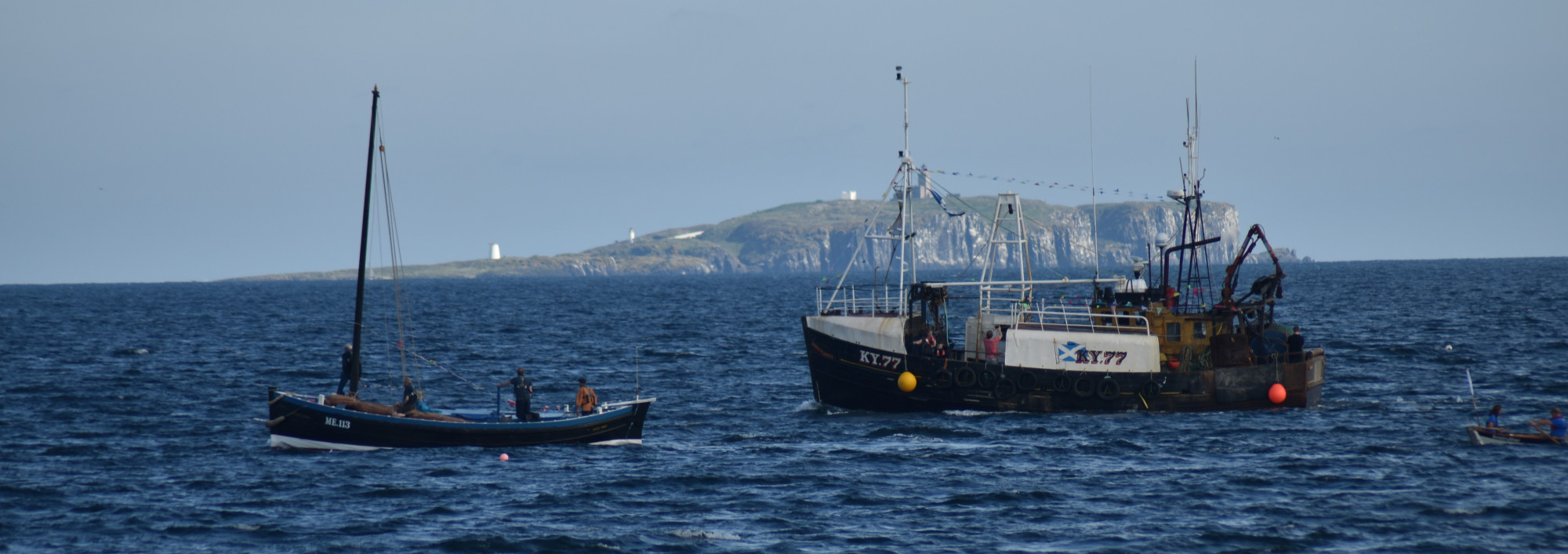

The Cellardyke Echo – 16/8/2018

1851

TO HARBOUR CONTRACTORS.

THE HONOURABLE the COMMISSIONERS of the BOARD of FISHERIES are ready to receive Offers for the execution of QUAY WALL, and the EXCAVATION of ROCK at the HARBOUR CELLARDYKE, in FIFESHIRE.

The Plan and Specification the Works may be seen on application to Mr Fowler. Cellardyke or to Messrs’ Stevenson, Civil Engineers, Edinburgh, the Engineers to the Board.

Sealed Tenders, marked “for Cellardyke Harbour Works,” may be sent to the Honourable B. F. Primrose, Secretary the Board, Royal Institution, Edinburgh, on or before the first of September next. Satisfactory security will be required, and the lowest offer not necessarily to be accepted. Board of Fisheries, Edinburgh, August 1851.

1855

A Fishing Boat Capsized, and Four Lives Lost.- It is our painful duty to have to record another lamentable occurrence, accompanied with loss of life, connection with the fishing. On Monday night about eight o’clock, a boat belonging to this place, the Venus,  left the “Auld Haikes’ to proceed homeward with between seventy and eighty crans of herring on board. A strong head wind was blowing at the time. The crew comprised the following individuals, viz., Adam Reid, senior, belonging to Cellardyke, and his two sons, Adam and William, the latter boy about eight years of age ; Kenneth McLeod, Isle of Sky ; James Malcolm, Dundee ; and David Laing from Arncroach in this district, half-deals-men. Adam Reid, senior, was skipper of the boat. Betwixt nine and ten o’clock, when off Crail the boat was struck by two tremendous seas in succession, which capsized her, but she did not sink. The crew clung to different parts of the unfortunate vessel for about an hour, when the skipper and Kenneth McLeod were washed off. The other three men continued to hang on by the wreck for nearly other two hours—the elder brother Reid nobly supporting the poor young boy, his brother—when at last their cries attracted the attention the crew of a St Monance boat, under the charge of William Mathers, who immediately put to their assistance, and when just about so near to be able to give them relief James Malcolm was washed off, and the young boy had ceased to exist. David Laing and Adam Reid, junior, had ropes attached to their persons and were hauled on board, the latter taking along with him the lifeless body of his brother. They were conveyed to Anstruther with all the speed that contrary wind would allow, and the two men saved are now recovering. We believe that the crew of the ill-fated boat had some misgivings, before leaving the “Auld Haikes,” that their cargo was too heavy to allow them to get home with ease, owing to the strong gale.

1856

Number boats fishing at each station: Anstruther and Cellardyke, 133; Pittenweem, S3; 8t Monance. 54; Crail, 10; Largo, 7; Buckhaven, 97 ; besides a few strangers who come here frequently, but those of the two latter places are still fishing Dunbar except on Saturdays when they return home with that day’s catch.

The following is the result of the fishing at this station during the past week—including Anstruther, Cellardyke, Pittenweem, St Monance, and Crail;

July        29, Boats out,    247;       highest. 3;          average,              ¼

30                         247;                       5                                         ¼           

31                          247                       15                                         1

August 1                             247                       18                                         3

2                            248                       31                                         4

 Average for the season, 10 ¼ crans.

1859

The stimulus imparted to fisheries by the rapidity of railways laying the markets 0f all the large towns open to the coasts for the supply of fresh fish, has raised an urgent demand for deep water harbours,-so that the boats may get in at any time of tide to deliver their catch, and which are also most needful t0 the safety of the fishermen, who, as yet, have no ports of refuge that can be taken at low water. These considerations have stirred the towns of Anstruther and Cellardyke to unite their common interest, and to move the Board of Fisheries to co-operate with them in erecting a deep-water harbour there. Before the fishermen at Cellardyke consented to waive their claim for a separate harbour, the site of Craig-noon, near at hand, had been fixed upon by them, and surveyed at their request.; but though possessed of some capabilities, it gave no promise of a harbour .equal in convenience or accessibility to that of Anstruther improved, and it perhaps owing to the results of the survey, that the parties saw that their real interests lay, not in moving for separate harbours, and thus frittering away their money, but in applying extensive improvements to the harbour of Anstruther, which’ could be thus made to serve both towns, and a populous fishing neighbourhood besides.

Accordingly, an enlargement of Anstruther Harbour, with the designation given to it of the Union, Harbour, has been planned by Messrs. Stevenson, the engineers of the Board, and its design has met with general satisfaction and approval.

The erection of a harbour of this description at Anstruther has been recommended by the Harbour of Refuge Commission; but, again, the funds are a wanting for its execution. Its estimated cost is £30,000, a large sum to raise; nevertheless, there appear to be means available for effecting a loan, which, with assistance from the Board of Fisheries, may, at no very distant day, enable this work to be executed.

The Cellardyke Echo – 8/8/2018

1838

Herring-Fishing.—For these last 4 or 5 days a considerable number of boats from this and the adjacent ports of Pittenweem, St Monance, and Cellardyke, have been prosecuting the herring-fishing in the Firth of Forth ; and, from the success they have hitherto experienced, we are led anticipate a more abundant fishing than a cadger drove. We have occasionally seen several boats with upwards of a couple of crans, and some with 5 or 6, and, taking them all in all, we have no hesitation in saying that the Forth fishing, so far as it has gone, has been a more remunerating concern for the fishermen than their friends have met with, by all accounts we can learn, at the different fishing stations in the Moray Firth—a good many quantities of herrings having been disposed of here, at 28s. and 30s. per barrel; and the lowest price of which we have heard having been offered being 24s., and precisely double the highest prices obtained at the north country fishing this season, by boats from Cellardyke. The quality of the fish hitherto taken is decidedly of the most superior order; and we have seen on very few occasions such an extra demand for fish, and such a general desire to make the supply equal to the demand, no fewer than from 70 to 80 boats having this night been counted in the offing the trade. We wish them all cordial success.

A couple of days later higher landings and prices drop

CELLARDYKE, August 7.-There has been a good fishing this morning. Upwards of 100 boats are engaged, and some brought in as high as twenty crans. The cadgers are paying 16s. per cran, and the curers 14s. to 15s. Ten and twelve crans to a boat was a general take this morning.

1839

The previous year’s summer drave had been unprecedented.. (reports appearing in the paper a week after the events)

Cellardyke, Tuesday, July 30—About 80 boats set their nets last night, and the returns this morning are from one to seven crans. The fishing ground about half way between the Isle of May and the Fife shore. Prices 20s per cran.—3lst July. Between and 100 boats compose the fleet this morning. The fishing has been successful for the early period of the season, many boats having taken 12 crans, which they have disposed of at per cran. The fishing has a most promising appearance, on account of the superior quality of the Frith herrings. The fish curers are begun to purchase cure at the above price.

1841

A boat from Broughty ferry, to prosecute the herring fishing , arrived at Eyemouth on Wednesday, bringing along with her a fleet of sixteen herring-nets , which were found drifting in the Cove Bay , with about a fathom of swing attached to them. The letters on the bladders are S.T.J.M, and J .C with C.D. below each name, supposed to be for Cellardyke. How this misfortune has happened none can tell but it is generally supposed that some vessel has run foul of the boat, and the safety of the men is much feared.

1842

ANSTRUTHER, The Lammas herring fishing commenced along the coasts of Fife on Tuesday morning, when appearances were very favourable. Although the first trial for the season, it is certain there is abundance of fish on the coast, from the quantity taken by each boat bringing in less or more, than a few hundreds of herrings to three crans, and the quality is very superior. Considerable preparations are being made; but a number of stations are still to let. The Buckhaven boats made their appearance on Monday evening at the fishing ground. There are sixty boats from Cellardyke.

The Cellardyke Echo – 1/8/2018

1901

At Anstruther Burgh Court Monday, Thos. Murray, jun., fisherman. Shore Street, Cellardyke, was fined 15s, or 14 days, for breach of the peace committed in Shore Street on Saturday evening.

1905

A property in Tolbooth Wynd, Cellardyke, consisting of house, shop, and eight stalled stable, has been purchased by Mr George Kirkcaldy, butcher, for £713.

An Anstruther memorial.-there has just been erected in Shore Street, Anstruther on a  site at the foot of the  West Pier, fronting the harbour, a granite fountain to the memory of Mr S. Williamson, some time M.P. for the St Andrews Burghs, who was born at Cellardyke in 1827, and died at Copley, Cheshire, in 1903. The fountain has been put up by Archibald Williamson, Liverpool, as a memorial to his father.

1906

Crew Landed at Aberdeen

The steamer St Ninian, belonging to the North of Scotland Steam Navigation Company arrived in Aberdour last Friday with five members of the crew of fishing boat Puritan, of St Monance, which was wrecked on a reef of rocks off Green Holm, near Lerwick, during the severe storm about ten days ago. Those who were landed were James Wood skipper and owner the boat, St Monance; David Wood, 16 years, his son; Wm. Davidson, St Monance ; Thomas Swankey, Arbroath ; Patrick Rath, native of Ireland. Two of the members of the crew—Thomas Guthrie, St Monance who was badly injured; and Robert Smith, Arbroath left Lerwick for their respective homes several days ago. The crew of the Puritan had an exciting experience, and were in an exhausted condition when rescued by the steam drifter Vanguard 111., of Cellardyke (Mr Martin Gardener, skipper). The unfortunate men were taken to the Sailors’ Home on their arrival Aberdeen, and were provided with railway tickets to enable them to proceed to their homes.

1911

The cry in this district, like several other places in Scotland ‘this exceptionally dry season, is “More water.” In Pittenweem and the Anstruthers, where they have a joint supply, it has been agreed to get the old bore opened and pumping operations commenced. In Cellardyke they have had to resort opening several old wells which used to supply the community, but which have been closed since the present water supply was introduced. It is to be hoped that the present experience will the means the local authorities, once and for all, seriously facing the question of having an adequate supply, either jointly or severally, of good water, although there may be the usual grumbling by the discontented taxpayer.

1913

Mr Robert Ray, B.Sc. (St Andrews), son of the Rev. Mr Ray, the Manse, Cellardyke, who for the past year has been working on the Scientific Staff of the English Board of Agriculture and Fisheries, has just been appointed to the post of lecturer in Zoology in the University of South Africa, Cape Town. Besides taking high places other subjects, Mr Ray was doable medallist in the honour’s class in Zoology in St Andrews University. Recently he was awarded scholarship of £100 by the Carnegie Trustees to assist him the promotion of his research work in Liverpool. Mr Ray leaves for Cape Town about the middle of August to take up his new duties in the University there.

1914

The Journeys of Crabs

 The Dove Marine Laboratory, Cullercoats , Northumberland , has achieved a great many interesting results in its constant investigations of marine life , carried out under the able guidance of Professor Meek . The report of his work for the year ending June 30, 1913 , contains a most interesting account of an experiment in the migration of crabs , carried out over a period of three years 1902-1905 . About 800 crabs were marked and liberated, and after a lapse of two years a fairly accurate estimate of their movements was obtained, showing that the females moved far afield, invariably northwards ; while the males showed little tendency to move far in any direction , …… . The longest journey was performed by a female crab, which was captured in the Moray Firth, about 150 miles from home; two others were found near Stonehaven and Cellardyke respectively , and a number at St Abb’s . A mile a day was the maximum rate of progression, the average being about half a mile.

The Cellardyke Echo – 25/7/2018

1900

Anstruther and Cellardyke have this vear been favoured with larger share of visitors than on previous years. During last week there were large numbers from Glasgow, and this week again Dundee and Edinburgh folks are to seen knocking round in even larger numbers.

1901

Mr Alexander Black, manufacturer, Cellardyke, has been appointed Provost of Kilrenny in room of Provost Thomson, resigned.

While the boat Venus Star, Cellardyke was some 40 miles E.N.E of Peterhead on Thursday evening, making for Fraserburgh, a carrier pigeon came aboard the craft, evidently in an exhausted condition. The bird had a rubber ring on its leg marked R 38 while its wing was stamped with the figure 4. The bird is now possession of the skipper of the boat, who is at present located here (Fraserburgh). It is assumed that the pigeon one those that took part in the recent Lerwick London race.

Fatal Accidents Enquiry. Monday an enquiry was held under the Fatal Accidents Enquiry Act, into the cause of the death of Thomas Reid, fisherman, Cellardyke, who was drowned on June last near the Brethren Rocks while on the passage from Lerwick to Cullivoe, off the boat Prospects Ahead, KY 1656. ……… William Sutherland deponed that he was 33 years of age, lived at John Street, Cellardyke, and was skipper of the boat Prospects Ahead, KY.1656. She was a first-class decked fishing boat, 31 tons burden, and 49 feet over stems. They had been engaged at the early herring fishing this year at Shetland, and left Cellardyke on 3rd June for Cullivoe. They carried no small boat, and had no lifebuoys on board. On their way to Cullivoe they passed through Lerwick harbour, where they arrived about on the morning of the 5th June. They left at noon of the same day, but they took no small boat or lifebuoys from Lerwick. When they left the wind was SW. by S. and moderate. They had to run dead before the wind for some time, jibing the sail three or four times. After leaving Lerwick the wind increased, and when they were about1 ¼ or 1 ½  miles from the harbour they had to dip the sail to go on the starboard tack. After this had been done he ordered the sails to be set and two reefs taken in forward. After they had got the sail hoisted hand high—that was far as it could be got hand over hand, the haulyards were passed over the roller. The roller was fixed into a timber in the boat’s side. When the haulyards were put over the roller, deceased sat down on the gunwale and put his foot on a timber behind the block. Witness was inside the deck behind the deceased, and the others were sitting behind him. Deceased was on the gunwale, and while giving an extra haul on the haulyards and pulling with all his might, the haulyards slipped off the roller, were jerked out of his hand, and he went into the water. The boat was going about six knots an hour the time. Everything had been cleared up and stowed below, so there was nothing to throw to the man in the water. Witness threw the haulyards to him but that was of no use. Thomas Reid was the deceased’s name, and he was married, and 34 years of age, and the son of David Reid and Ann Burrows or Reid. They did not recover his body. The helm was put hard a-port to bring the boat to the wind, but about two minutes after the deceased went overboard he sank. Witness did not see him sinking, but he went to get a tackle and put it the sail when Alex. Johnson said to him “Ye needna care aboot it, Willie ; he’s awa,” They did not go back to the spot where the accident occurred, there being no use as the man had sunk.

By the Court—There was nothing to throw to the man in the water, and in the confusion they were all upset. There were oars on the boat’s deck they might have thrown to him, but they did not think of it at the time.

Q.—Do not fishing boats carry lifebuoys.

A. Winter boats carry lifebuoys, but summer herring fishing boats seldom do. There was nothing like a lump of cord or anything that sort about the deck that could throw in cases this kind.

Mr Fraser—Was the sail on the side the man fell over

  1. —Yes; we were pulling on the weather side, and the sail was on the port side.

Alexander Johnson deponed that he was a miner, but went to the fishing as a hired hand. He was a hand on the boat Prospects Ahead, of Cellardyke, on 5th June. After leaving Lerwick harbour on that date they were shortening sail of the Brethren rocks. After they shortened sail they had got the sail hand high, and then took the haulyards to the roller. Witness was standing behind the roller. Deceased was next the in setting up the sail the haulyards came out and he went overboard. The roller was about four inches in diameter and two inches above the deck. There was no catch on it to prevent the haulyards slipping. The roller was about five inches in length. Thomas Anderson (28), first hand on the Prospects Ahead, deponed that he resided at 25 Shore Street, Cellardyke, and along with Wm Sutherland owned the boat Thomas Reid had a share in the nets, and the rest of the crew were hired men. These men received a fifteenth share of the earnings. Reid would have got the same, and something extra for his nets. He then gave corroborative evidence as to how the accident happened. By the Court—The roller is of iron and just like the sheave of block. There was nothing it to prevent a rope slipping off. were trying to work the boat up to windward when they saw the accused had sunk, and therefore it was no further use.

Alex. Johnson (recalled) deponed that the man did not call out when he fell overboard. Witness saw him sink about two minutes from the time of his going into the water. He was about a mile and half from the boat when he sank.

The Sheriff—A mile and a half there must be something wrong there, if he was only two minutes in the water before he disappeared, and the boat going six miles an hour. He could not have been a mile and a half away.

Witness —It might have been a mile. I could not say exactly.

Q.—Did anyone else beside you see him sink ?

A.—Yes; William Sutherland.

Q.—How long did you spend looking for him

A.—l could not tell. Perhaps ten minutes or a quarter of an hour.

Q – None of you threw anything to him !

A.—No. Q, There was no small boat or lifebuoy or lifebelts !

A.—No ; there were oars about the deck, but none of us thought of throwing any

Andrew Gowans, miner, 64 Dewery Street, Methil, deponed that he was miner, but went to the herring fishing in the summer season. He gave corroborative evidence as to deceased falling overboard.

The Sheriff—How far was he from the boat when sank?

A.—About half a mile. There was nothing thrown to him, as we all lost our presence of mind in a case like that. We looked for him until he had sunk out of sight.

By Mr Fraser—The sail did not come down to the deck when the haulyards slipped off the roller, as the men held on and kept the sail up.

James Anderson, grocer’s assistant, Dove Street, Cellardyke, deponed that he was hand on the Prospects Ahead when the accident happened. He was steering the boat at the time, but owing to the mizzen sail he could not see ahead. He saw Reid being carried past the stern of the boat where he was sitting steering. The boat was travelling about six miles hour, and witness had nothing at his hand that he could throw to the man overboard. He put down the helm, and the boat came up to the wind, and she went to windward until they saw the man went down.

This concluded the evidence, and Mr Galloway addressed the jury, asking them to find a verdict in accordance with the evidence. Sheriff Moffatt then briefly addressed the jury, informing them that all they had to do was to find a verdict in terms of the prayer of the petition that deceased met with his death by accidentally falling overboard from the boat Prospects Ahead, about 11 miles from the Brethren rocks, and being drowned. In the course of his remarks he referred to these fishing boats not carrying lifebuoys. For safety, and possibly for the saving of life, there should be some lifebuoy or lifebelt, or something that would float, lying handy on the deck, which could be thrown by someone from the boat to anyone who chanced to fall into the water. There were oars on the deck of this boat, but the skipper told them they did not think of them at the time; and another of the crew said they lost their presence of mind. That was very unfortunate, but they could not be held blameworthy. The initial cause was the haulyards slipping over the end of the roller, and that could be made preventable by having something placed on the end so that they could not slip. But they—the jury—bad nothing to do with that. All they had to do was to record their opinion to how the death of the deceased Thomas Reid was caused. Without leaving the dock the .jury, through W. Dalgliesh, intimated that they found the accident had happened as stated in the Fiscal’s petition.

The Cellardyke Echo – 18/7/2018

 1805

The Duck club of Cupar, Fife, have subscribed five guineas to the wives and families of the men who were unfortunately lost off Cellardyke; and example worthy of imitation.

1829

On Saturday morning last, a Cellardyke boat caught, with only a net or two, about eight dozen of fine herrings near the Island of May. And from the quantity of herring whales, as the fishermen call them, that are presently on the coast, there is little doubt but there are also plenty of herrings, It is a matter of regret that our respectable fish-curers do not engage a number of the boats to remain here instead of going’ to the north, as it is quite notorious that the fishing here has for these some years been lost for want of timely looking after

1831

The Commissioners for the fisheries lately granted £1200 to which the fishermen contributed £500 more to improve Cellardyke, or Kilrenny Harbour.

1837

I have reported on this accident for 3 years, this week the news reach the Irish Newspapers and was reported this way (the number of 20 was not the case)

On Saturday forenoon the herring-boat Johns of Cellardyke, John Sutherland, skipper, was wrecked whilst entering the little haven on the cast-side of the Isle of May, when no fewer than twenty-one individuals met watery grave. The circumstances, given to us by our correspondent at Dunbar, who was on the spot shortly after the sad accident happened as follows:—It is customary at this season of the year, and before the boats leave the various towns on the east-coast of Fife, for the herring fishery in the north, to visit the May Island on pleasure excursion. On the morning in question, a party, to the amount of between seventy and eighty consisting men, women, and children, embarked in the Johns, and after having coasted round the west and south side of the Island, in attempting to take the little harbour for the purpose of landing, the boat from the heaviness of the swell, and narrowness of the passage, was thrown upon a rock, and the wave receding, she fell over, filled, and went down. Numbers who were nearly exhausted, were carried to the apartments of the light keeper, where, by the attention and care of the inmates which deserves great commendation, they all recovered. The survivors, with the corpses found up to the time our informant left, ware conveyed in other boats to Cellardyke, where another scene of distress would take place over which humanity must drop a tear.

1840 (although this was June 13th It was not published in the Derry Journal until July 14th)

Cellardyke. June 13.—A large shoal of herrings has been discovered between the Bell Rock and Isle of May, and the boats which have been fishing for them near the latter island have been uncommonly successful, considering the mode of fishing adopted. One boat came today with 1,000, another with 600, and a third with 400 herrings—caught upon hooks, or jiggers, as they are called. Fishing with the net will be commenced next month and, from the number of whales and sea-fowl seen at the Eastward of the May, heavy fishing is looked forward to, at no distant day

1842

A few Cellardyke boats arrived here on the 12th inst., and, since that time, others are daily coming in from the Friths of Forth and Moray. By the first of next week, general gathering will have been made,- when it is expected they will outnumber that last year considerably. Highlandmen are appearing in bands, for the purpose of hiring; and the whole place will soon assume the usual animated appearance common to this season at Wick.

A Cellardyke boat, commanded by Alex Pratt, brought on shore the highest take yesterday morning, and the skipper was led to believe that he was entitled to the highest premium awarded by the Chamber of Commerce here; but, on inquiry, found it was reserved for native crews alone, who bring the first five crans ashore prior to the 16th of July. The Chamber, by this arrangement, save their money and their honour, for is rarely carried off by native crews; and, were it not for the spur given by the arrival of strangers, our Wick fishermen would, at that date, be only talking of making a trial. If the Chamber of Commerce be desirous to encourage early fishing, they should offer their premiums indiscriminately. Competition at all times is found to be the best stimulant to exertion.

1844

On Wednesday night last week, the “Benledi” Steamer on her way from Dundee to Granton, ran down a fishing yawl, off Cellardyke harbour. The yawl was lying at anchor and three boys were fishing in it, who stood and cried to those on board the steamer when they saw that she was coming right them. No notice of them was taken, however, and the steamer struck the boat cutting her right through. One of the boys got up on the paddles, and the other two were picked by the steamer’s boat. One of them a good deal bruised, having been struck by the paddles he supposes. It is very fortunate that nothing more serious occurred.

The Cellardyke Echo – 5/7/2018

1948

“Sea Queen ” Crowned

Miss Margaret F. Donaldson, East Anstruther, was crowned “Sea Queen of Anstruther Burghs at Cellardyke Swimming Pool last night. She was elected by popular vote. The crowning ceremony, performed by Mrs Mitchell, wife of Bailie D. Mitchell, was watched by a crowd of over 3000. Provost Carstairs said it was hoped to hold an annual pageant and to develop the ceremonial side. Music was provided by the local Boys’ Brigade Pipe Band. A spectacular display of dancing was given by Dot Arlyn’s pupils.

1949

SHOP ASSISTANT WAS ANSTRUTHER’S QUEEN Miss Beatrice Brown, shop assistant, was crowned Sea Queen the united burghs 01 Anstruther on Saturday. In ceremony Cellardyke swimming pool the queen, with heralds, maids of honour, and attendants, was enthroned Miss M. Carstairs, sister of Provost W. W. Carstairs. The programme included a song-scene depicting fishers and workers of years ago. The queen was presented with a gift by Provost Carstairs, and last year’s queen, Miss Margaret Donaldson, received a box of chocolates from Mrs Mitchell. Miss Donaldson and Miss Carstairs also received bouquets, presented by Misses D Drinkwater and M. Melville. Anstruther Boy Scouts formed a guard of honour, and dances were given by pupils of Dot Arlyn, Anstruther. The ceremony was arranged by Cellardyke Improvements Association.

The Cellardyke Echo – 27/6/2018

1886

While the fishing boat Pioneer, No. 1051, was making for Aberdeen Harbour on Saturday morning, George Henderson, 32 years of age, one of the hired men, who resided at Tolbooth Wynd, Cellardyke, he was standing in the stern of the boat buttoning his jacket when he was knocked overboard by the lurching of the boat. He floated on his back for few minutes, and was rescued by the crew of an Inverness boat. Everything was done to restore animation, but without avail, Henderson expiring shortly after being taken out of the water. Henderson was a flesher to trade and was married, he leaves a widow and one child.

1887

The poor people in Cellardyke Parish Church were supplied, through the generosity of Mr Oliphant, with a sixpenny pie and a new two shilling piece. In the evening illuminations were lit at different places along the East Neuk.

1888

Arbroath

A Cellardyke boat, KY 2052, ran in, and landed 10 crans of fresh herring. They were rather small, and only realised 4s per cran.

BOAT for Sale; Carvel Built; KY.1197; Length 45 feet belonging to the late Duncan McRuvie. Apply STKPHEN BARCLAY, 17 John Street, Cellardyke, Fifeshire.

1889

…As we said last week, about a hundred sail are fishing to-day Shetland. They had a fine run, and latest advices are to the effect that Fife shoals are our coast, though there is also rumour that those pests of the sea, the dog fish, are at Balta. Little or nothing has been done by the Fife boats at Stornoway and Ireland, but all accounts agree that the prospects of the fishing were never more hopeful than they are to-day on this side of the North Sea. Thus the skipper of the Royal Diadem, of Cellardyke, reports that on the glass-like sea in the twilight of Monday, five-and-thirty miles in the offing of the Carr, he saw no fewer than fifteen whales between him and the horizon. He fished 10,000 herrings the first twinkle of the evening star, and in the second cast of his lines caught over 300 saithe.

CRICKET. The Anstruther and Cellardyke Club journeyed to Tayport to meet the Woodbank yesterday. The local men, winning the toss, sent the strangers to bat but they could make no stand against the bowling of J. H. White, H. Dickson, and J. Scott, the last wicket falling for 16 runs. The Woodbank then assumed the defensive, and summed up a total of 40 runs, of which J. Scott, J. 11. White, and W. Innes had 12, 10, and 8 respectively. A word of commendation is due to J. Black, who secured the hat trick against Tayport. Playing out time the strangers were again dismissed for 21 runs, chiefly owing the splendid bowling W. Com. The match therefore resulted in a win for the Woodbank by an innings and 3 runs.

1890

The Best Fishing Float THE PATENT CANVAS FISHING FLOAT. Manufactured only by BLACK & CO.. CELLARDYKE OILSKIN FACTORY, CELLAKDYKE, FIFE.

1891

DUNDEE INSTITUTE OF ARCHITECTURE, SCIENCE, AND ART. EXCURSION TO THE EAST OF FIFE. The first excursion for the season of the members of the above Institute took place Saturday, the places visited being Anstruther, Elie, and district. The party, which numbered about sixty, left the city by the 10.15 a.m. train for Anstruther. Beautiful weather prevailed, and the run thither was greatly enjoyed. Although somewhat hazy a comparatively good view was obtained of the estuary of the Tay. Stoppages were made at Newport, Tayport, Leuchars Junction, Guardbridge, St Andrews. Mount Melville, Stravithie, Boarhills, Kingsbarns, and Crail. At St Andrews the guide.3 for the clay, Mr David Henry, F.S.A. Scot., architect, St Andrews, and Mr D. Hay Fleming, F.S.A. Scot., St Andrews, were picked up. The train drew up at Anstruther about noon, and the party were then transferred to three brakes. Although there is scarcely a line of demarcation between them, Cellardyke and East and West Anstruther are careful about preserving their identity. The total population does not exceed 5000, but yet each burgh has its own municipality, with a Provost as guiding star. As the brakes whirled through the old-fashioned towns two these functionaries were observed in friendly confab. A hearty salutation passed between the excursionists and the civic fathers, who were then left behind to further discuss schemes for the wellbeing of the inhabitants. A drive westward for mile brought the party to Pittenweem, which contains the ruins of an Augustinian priory. On alighting, the company were received by the Rev. Lloyd, the Episcopal incumbent, who graciously did the needful…………….

1894

FISHERBMEN AND A CLOSE TIME _

MEETING AT POINT LAW.

A meeting of local fishermen and of those from other ports who are to fish this season from Aberdeen was held yesterday afternoon in the sale ring at Point Law. At the outset there was a small attendance, but the audience soon increased to between 300 and 400. Mr Archibald Macpherson, Hopeman, who was called to the chair, said the meeting had been called with a view to taking steps to prevent the recurrence of such an unsatisfactory state of matters as existed this year. What they wanted was that a close time should be fixed for the east coast, so that men who were to engage in the fishing might know exactly when to leave their homes for the ports from which they were to fish. He thought the 10th of July would be a suitable date. Some people said that such a proposal would shut many mouths, but any fisherman not able to go to the west coast herring fishing could stick to his line. Only a few fishermen and merchants made profit by the early fishing. Under existing circumstances it was a great temptation to men on the west coast, when the fishing was not successful there, to come round to the east coast. There was more necessity for a close time now than ever. If there was a close time and shorter fishing, there would be more money for the fisherman and for the curer. The Fraserburgh and Peterhead men had been ruining the industry by bringing in heavy shoals, before the fish came to maturity and were fit for human food. (Applause.)

The Chairman referred to two resolutions anent close time which were passed by the Peterhead men. These, be said, were drawn up in a selfish spirit, and solely to further their own interest.

Mr A. Cumming, Cellardyke, then moved- “That this meeting, in view of the unsatisfactory results of the early fishing when herrings are immature and prices unprofitable, would strongly recommend to the associations that steps be taken at the earliest opportunity to secure a close time for the east coast of Scotland from 1st June to 10th July.” That motion, he said, had been drawn up with a view to suiting the convenience and gaining the consent of fishermen in all east coast ports. Its observance would prevent any unnecessary expense such as had been incurred this year and in previous years. (Hear, hear).

 Mr John Flett, Lossiemouth, seconded. Mr A. Main, Burghead, supported the motion…..

CEYLOX TEA, At Is 10d per Lb. A New Tea Exceptional Value, combining most Delicate Flavour with Great Strength. SPECIALLY RECOMMENDED See Packets for Analyst’s Reports. Sold by duly appointed Agents all over the Country

LOCAL AGENTS

Anstruther JOHN S. MORRIS, Masonic Restaurant.

Cellardyke— ALEX. C. MURRAY, 28 George Street

The Cellardyke Echo – 20/6/2018

1880 ( mistake this was July)

A special meeting the Town Council of Kilrenny as the Local Authority of Cellardyke, on Friday evening. The business was of somewhat unique nature, turning on the following circumstances which had given rise, for obvious reasons, to no little comment and feeling out of doors. There is no officer of public health in the Burgh , George Watson, who so acted, having resigned some time ago—but it appeared from the statements made to the Board that Alexander Blyth, carter, James Street, had buried a cow his garden, “the animal having been slaughtered under the Act” several days ago. The question thus turned on the burying of carcases within burgh, which the members very generally condemned as fraught with danger to the public health, but in the present case it was thought inadvisable to remove the remains in their advanced state of decomposition, more particularly as the locality was a crowded one in which the interment had been made. The cow had been attacked by pleuro, and as such had been destroyed in terms of the Act by the district Inspector, James Cairns, U.S., at whose instance, according to Mr Blyth, it was buried under a well prepared layer of hot lime. The usual steps having thus been taken to establish the claim for compensation, that is, one half of the value of the animal, the sum, we believe, is to be paid in course by the burgh authorities of Kilrenny.

Fishing Boat on the rocks at Stonehaven

Early yesterday morning the fishing boat Margareta of Cellardyke (KY1565), got among the rocks at Bellman’s Heads while entering Stonehaven Harbour. The crew were bringing her up from the north, and, being unacquainted with the harbour, they steered too close inshore, and went ashore as stated. Assistance was at once rendered, and, after an interval of three quarters of an hour she was got off and beached. As she had a heavy catch of herrings on board, it was feared that the boat had sustained serious damage, but on examination it was found that only part of the keel had been grazed and a few planks on the starboard side stove in.

Peterhead Sheriff Courthouse – Baillie Will and Dr Jamieson on the bench – Joseph Walker, fisherman from Cellardyke, and skipper of the boat Delight,634 KY, was charged with having on the 13th inst, contravened the harbour bye-laws. It was asserted in the libel that when the accused was ordered by one of the berthing masters to haul his boat outside the entrance of the South Harbour in order to make passage, he first obeyed the order, but afterwards drew the boat right across the channel in such a way as to completely block up the fairway. He failed to appear, but evidence, from which it appeared that a great deal of confusion took place through the conduct of accused, was led in absence, after hearing which the Justices found the charges proven. Baillie Will, in passing sentence, said as was the first case of the kind this season they would modify the penalty, but the full penalty would be imposed the next time that similar offences came before them. Accused would have to pay a fine of,  £1 15s, failing payment of which in eight days, fourteen days’ imprisonment.

1881

The first annual meeting of the Cellardyke Fishermen’s Union –  having for its object relief in sickness and provision for old age, or to the family in the event of an accident at sea or otherwise, was held in the Free Church Hall on Saturday evening.

There was a good attendance, Mr Thomas Birrell being in the chair. The Secretary submitted the report for the year, which showed that 460 sea-going men were now enrolled as members of this Society. The Treasurer submitted a no less satisfactory statement with regard to the funds, which it is proposed to augment by means of a bazaar at the close of the Lammas fishing. The report was unanimously adopted, and the chairman, secretary, and treasurer having been continued in office, the proceedings closed with the usual votes of thanks.

Dundee – Alexander Keith, fish dealer from Cellardyke, was charged with cruelty to a horse, by working it in a loaded cart in Overgate, on 8th June, while the animal was in state of general debility, and unfit for work. The accused said he was guilty. He then stated that be bought the horse from “Willie Leaburn” that morning, and yoked it in cart to go to Lochee with 3cwt. of herring. It was a  kind o shakey on the legs, but it appeared to be all right. (Laughter.) Mr Dewar said the cart was loaded with fish, and four or five men on the cart selling the fish. The accused – There was only twa hunderweight and a half o’ herrin’, and three men and a bell on the cart. (Renewed laughter.) Baillie Perrie sentenced the accused to pay fine of 10s, with the option of seven days in prison.

After the memorable experience of last year, it is a matter of little consequence to estimate the resources of the coast in view of the coming drave. Singular as it may seem, the East of Fife has exceptional facilities in the supply, least, of herring casks. We refer to the steam machinery successfully employed by Mr Cormack, Cellardyke, and the Welch brothers at Pittenweem. These machines not only cut up the billet-wood, but dress the staves thoroughly to reduce the manual labour by one-half. Thus fifteen barrels from the rough staves was the allotted task for the week; but, with milled staves, it is just double the number. The cost, too, of this valuable auxiliary is at the rate of fourpence a barrel; but our fishcurers have not been slow to avail themselves of it, and the consequence is that our cooperages are amongst the staple industries of the shore, from which thousands of casks are annually drawn both by Scotch and English traders. As  in last year, considerable consignments have been made to Glasgow at low figure, bear, 3s 6d or less per barrel; but sales are reported this week 4s, and with the comparatively limited stock with which the trade is facing the prospects of the season on the north east coast, our merchants have every temptation to hold back in the remembrance of last year, when barrels were freely bought and sold at ten shillings a-piece, which, but for the big spate, might have been had, and ” thank ye,” as King Methven used to say, for a third of the money. An incident of those days is worth relating, a fair trader volunteered to buy a thousand barrels at a given price on Anstruther shore. “The key of my store is at your service, but at 4s 6d a-barrel,” said one worthy merchant speaking for the rest. The offer was declined in the way that only disappointed ladies can do, but within the week the same barrels were tumbling out of the store at the tune of 8s 6d each.

1882

The Free Presbytery of St Andrews met in the Free Church here, on Friday, to ordain Mr John Bruce Cellardyke, who has been appointed to the South African –Mission

MARRIAGES – At 2 St Ayles’ Crescent, Anstruther, the 16th inst., by the Rev. John Jackson, Free Church, Crail, the Rev. John Bruce, missionary of the Free Church to Pietermaritsburg, Natal, to Maggie Lothian, younger daughter of John Martin, Esq., manufacturer, Cellardyke.

The Magistrates of Kilrenny had a somewhat eventful sitting on Saturday.

Margaret Hyslop, the wife of Peter Morgan, an engine driver at the Railway Works, was charged with a breach of the peace, by using obscene and threatening language towards Jean McLeish, the wife of William Wilson, another engineman, near the Village Green of Kilrenny, on the 1st June. She pleaded not guilty, when evidence was led by the neighbours to prove the case in which the unruly member had poured out a torrent of abuse scarcely to be expected of Billingsgate far less of the peaceful hamlet of Kilrenny. The Court found the charge proven, and the panel was fined in the sum of 7s 6d.

Barbara Robertson, the wife of Peter Montidore, fisherman, was charged with assaulting Agnes Moir or Montidore, so long ago as the 6th December last. Pleading guilty, she was fined in the sum of 12s 6d.

The next case appeared to excite more general interest. This was a charge of breach of the peace, committed on the morning of the last Sabbath of May, by William Millar, carter, and Thomas Keay, fisherman, both of Cellardyke, and two young seafaring men of St Monance, named Thomas Hutt and James Reekie. The first two pleaded guilty; but the St Monance men roundly asserted their innocence, when Police Constables Sparks and Martin deponed to the charge. It appears from the evidence that for a considerable time the young sea-gallants of Monance have been in the custom of serenading the girls of Cellardyke. A collision in this way had taken place between the strangers and the young men of the town; but on the morning in question the outcry was such as to draw the Constables to the spot where the scuffle was going on. Hutt flatly denounced the evidence of Constable Sparks. ‘It is a lie, sir” for which, of course, he was sharply reproved by the bench. Notwithstanding the protestations of the two, the charge was found proven, and the four panels were each and all fined in the sum of 10s. In passing sentence, Provost Watson said that frequent complaints had been made to him about the manner in which the young fishermen of St Monance conducted themselves in these Saturday night visits, and which he regretted all the more, seeing that the fishermen of the East of Fife were as one and the same community, and that as such it became them, though in different towns, to live as neighbours and friends.

Another young fisherman of Cellardyke, Alexander Doig, pleaded guilty to making a disturbance on Saturday night, and like his companions at the bar was mulct in 10s, which, like the rest, was forthcoming in Court.

Mr Stephen Williamson, M.P, has just presented the Town Council of Kilrenny a large and valuable painting by Sydney Percy, said to have coast 150 guineas, to be hung up in the new Town Hall of Cellardyke, his native place. The hall itself, which will cost upwards £3000, is being built at the joint expense of Mr Williamson and the late Mr David Fowler of Paudurra, Loudon.

1883

Shetland Times – Mr A. Sutherland, local agent of the Royal National Lifeboat Institution has received intimation that an award of £7 has been granted to James Smith, Cellardyke, and his crew, for saving the lives five persons from the boat Jessie, of Lerwick, which was, during stormy weather, in danger off Mousa the 14th April last.

1884

Another Sudden Death in Shetland.—A telegram was received in Cellardyke on Monday announcing the death early that morning of a young woman of the town —Annie Thomson (Boyter)—at Uyea Sound, Shetland. She left with her mother the other week to fulfil herring engagement at Duthie’s station, but has seemingly succumbed to an acute attack of diabetes. Being only about seventeen, and following so close on the death of her hapless young townsman, the sad event has cast a deep gloom over the station, mingled with no little regret and sympathy, was seen by the crowd of mourners who followed her remains next day to the ancient grave-yard on the hill-side. To-day this part of Shetland is as a new discovery to most of the Fife sojourners, but it was otherwise with their fathers, if only in connection with that much-loved daughter of Anstruther, the heiress of Pittairthie, and wife of William Mouat of Garth, the castle of which is so picturesque feature in the landscape of Uyea Sound.

The Cellardyke boat Endeavour has caught a Goliath skate—seven feet in length and 5-i ft. in breadth. “We’re fast to the ground, men,” said the veteran who first began to haul the line. It took three gaffs to get the giant fish on board.

1885

TO FISHCURERS.

Sale by Public Roup, at FOOTEEE, Aberdeen, on Wednesday 15 July 1885

There will be sold on the above date, the FISHCURING STOCK belonging to THOMAS CORMACK, CELLARDYKE consisting of

500 New Pickle BARRELS.

370 New Pickle HALF BARRELS.

430 Second-h-md CARRIER BARRELS.

90 Small CARRIER BARRELS.

60 ROUSING TUBS.

700 BARREL COVERS.

3 ½ Bundles CLOTH for Covering Carriers.

5 Half Barrels of BUNGS.

50 SPALL BASKETS.

14 HERRING BASKETS

7 PAILS.

7 FARLANDS, in good order.

GUT COGS, and various other Articles.

ALSO, 1 Low CART, quite New,

SHEDS and STABLES as they now stand. Roofed with Tile.

50 New PICKLED BARRELS, as Sample of 2000.

20 New CARRIER BARRELS, as Sample of600.

To be Offered for Sale. The Roup to Commence 12 o’clock Noon. J. BONTHRON, Auctioneer. Cellardyke, 16th June, 1885

The Cellardyke Echo – 13/6/2018

1876

The School Board of Kilrenny have resolved to build a new school in Cellardyke to accommodate 225 children , and to discontinue the grant of £10 hitherto paid annually towards the expense of maintaining the school at Benerbo. The sum required to be raised by assessment was fixed at £260, or the same as last year .

Estimates in Cellardyke – The erection at once to be proceeded with a handsome range of business premises for Marr, general merchant. The designs were prepared our local architect, Thomas Brown, who is also the contractor for the mason work £398, the joiner’s estimate being in the hands Bailie John Lumsden, total cost being about £800. Mr Brown has also prepared a working plan to cost £100 of a slip at Cellardyke harbour, to facilitate the beaching the large boats. At present this is a most laborious operation, owing to the steepness of the incline, in which also the carriage wheels under the load the big boats sink every turn of the axles. The undertaking has been resolved upon by the Town Council, and the expense will met by the rents paid as boat stances on the beach, which like other vacant ground in the burgh, is in virtue of the charter granted of old by the lairds of Kilrenny—the unquestionable property of the inhabitants as part of the common good of the town.

1877

DEATH A DISTINGUISHED NATIVE Many in Fifeshire will learn with deep emotion of the death of that distinguished and native Cellardyke, Captain Alexander Rodger, the melancholy event having taken place Glasgow on Wednesday afternoon, the 6th inst. Captain Rodger had been for some time yielding to the infirmities age and to the fatigues of a busy life passed in all quarters of the globe, and it might be to the yet greater trials of household sorrow and bereavement; but about a fortnight ago he was seized with an alarming malady which from the first-aroused those fears which the sad event has only too well verified.

Let us sketch the romantic life story which has now closed in honour and respect of all. Alexander Rodger was born in old Cellardyke in 1804. He is thus about seventy-three years age, but was only ten when he was left an orphan by the loss of his father, who perished with the oldest of the household by the capsizing of his boat while at the Burntisland herring fishery on the last day the year 1814. The stricken fold, however, was not left unprotected. Heaven was near in that holiest angel of earth, a faithful and devoted mother; and great as it was, her charge was so blessed that four of her sons rose to the highest honours in their profession as master mariners in as fine ships as sailed the seas. Alexander Rodger owed little to his early opportunities.  He was one of the little crowd at the Parish School, in those days when was only the grim “ben end” of Dominie Orphit’s dwelling-house, and a few years later he was one of the crew in his brother David’s fishing boat, but like a young bird he was fretting all the time for a nobler flight, conscious of that which was in him, and longing for the wrestle and the race. For the sake of the future he at eighteen began life as a sailor on the little Dundee brig the “Ocean,” and the cramped forecastle of the Baltic-man he exchanged for the rougher service of a collier; but steel that was in him so clave through all obstacles, that when little more than twenty two he was sailing master of a square rigged ship trading to the Mediterranean. Here we must introduce an anecdote characteristic the man. The Archipelago was at this time infested with pirates and one day the brig “Hind “ was in the offing the wind fell, and she lay at the mercy of the sea wolves. Nor had the crew long to wait before the brig was in the hands of the pirates. No resistance was or could be offered, and aware this the ruffians were coolly ransacking the ship when the eye of the leader fell on Alexander Rodger’s flute as it lay in the binnacle. He made a gesture to play. It was a command not to be refused, and there and then the young Cellardyke sailor engaged the old Scottish melodies. “I believed it t was last time I would ever so, and played accordingly,” said the gallant narrator. But such was the influence the music on the desperadoes that after caressing the minstrel they quitted the ship without any molestation to crew or cargo. Subsequently Captain Rodger was in command on voyages to all parts the world, in the course of which his ship was the first to sail from Glasgow to Australia—an incident the time attracted much attention as an extraordinary era in the navigation of the Clyde. About this period also his name was honourably associated with an important discovery which made in the Indian seas. He was homeward bound on his own ship the “Helen,” when one evening the topsails flapped the fitful breeze, though the vessel rolled like a drunken man in the swell of the recent storm – consternation fell on all on board as the cry rose “the ship is on the reef.” The charts showed a clear and open sea, but the masts quivered with the crash, and the false keel was floating alongside, when the vessel providentially swung from the rock, which, like a true sailor, her captain accurately surveyed, and “Rodger’s Rock.” it is called, is now shorn of its terrors in every chart the Indian seas.

About seven and twenty years ago the state his health induced him quit the sea, but his energy was not to be tamed or subdued. The country was ringing with the gold fields Australia, and Captain Rodger was first perhaps to organise an association from Britain to open the treasures of the colony.  It was composed of the flower of Cellardyke who went out on Captain Rodger’s charge, and that eventful summer day will not soon be forgotten when, with mothers and sweethearts weeping on the oil pier, but with the Xantbo’s” colours fluttering proudly and the cheer of the brave young hearts rising high and long In the sunny air, the gallant adventurers sailed from Anstruther harbour to enter on the distant expedition which did great honour to the Captain’s head and heart. He returned, however, so far disappointed;  it was seen that the harvest had been exaggerated, but almost on stepping ashore the old country he became the pioneer one the most magnificent enterprises of the times. This was the establishment of what were called the China tea clippers, these noble ocean racers which made the British flag peerless all waters. His own ships were like household words either side the Atlantic; need we mention such favourites as the Kate Kierny, the Taeping, the Lahloo.

But, however surrounded success as merchant and ship-owner, Captain Rodger never forgot the home and friends of his youth.  On the Contrary, in his unwearied efforts to promote the well-being of the inhabitants- the public bleaching green, the new wintering berths for the boats, the improved harbour and fairway, are understood to have cost over a thousand pounds, which he raised with no other object than to do good to his native community- Year after year his generous hand gladdened the hearts of the old and unfortunate by his Christmas dinners; but in a thousand ways besides he fulfilled the holy maxim of not allowing the sun to shine upon his charity.

Captain Rodger has stood by the open grave of his venerable partner, and all his promising sons have one after another gone before him to ‘the narrow house’ but he is survived by three married and one unmarried  daughter, whose sorrow is to-day largely and sincerely shared by very many hearts on the shores of the Forth.

1878

Sale of Fish curing Premises.—We understand that the well-known fish curing premises in Cellardyke erected by the late Bailie Crawford, and presently occupied by “the father of the trade” Mr James Watson, have just been purchased by private bargain by Mr Robert Melville, whose premises, as our readers may remember, was bought some time ago in a similar way by Mr Andrew Mitchell, draper. The property opens from the street, and extends to the remarkable creek of Craignoon, which at a trifling outlay could be made perhaps the most accessible landing-place in all states of the tide on the coast, so that in leading feature the premises offer unequalled facilities for the interesting and varied speculations in the season of net and line and creel, which mark the fish curing enterprise of to-day. If rumour to be believed, the property, with the two front houses, have changed hands at the price of £800.

1879

Shetland – All the south country boats have now left, the two Cellardyke boats being the last and leaving this week. They have been very successful, we understand, having caught between eight and nine hundred cwt. of market fish each, besides halibut, skate, roes, livers, &c., and their earnings will amount to over £300 per boat, for nine week’s fishing.

The Cellardyke fishing craft, the “Refuge,” was running before the breeze, when one the crew, Mr Alex. Rodger, son-in-law of Provost Watson, while duty at the tack, was thrown overboard by the jibbing of the sail. Providentially, Mr Rodger retained his presence of mind, and at once struck out for a piece of lumber wood which one of his boat mates threw as the lively craft darted on her course. It was a painful and exciting interval, as the boat had to be worked to windward, the poor mariner all the while clutching for life to the piece of driftwood; but eventually, though not till the lapse of about thirty minutes, the “Refuge,” as she indeed proved, ranged alongside, when he was caught and saved by a friendly hand. Notwithstanding his long immersion, a little rest – thanks the comfort and convenience of the cabin with which the deep-sea boats are now provided—he was soon restored to the active duties of the fishing cruise.

The Cellardyke Echo – 5/6/2018

1869

A Justice of Peace Small Debt Court was held here on Wednesday—Provost Todd and William Murray, Esq., on the bench ; John Smith, Esq., being assessor. ……… the Court was principally taken by the objections urged in two of the five cases the instance of David Walls, merchant, Anstruther. In one of these the pursuer sued John Montedore, fisherman, Cellardyke, for the sum of 17s 4d, being account for alum, furnace fittings, &e., supplied in 1867. Mrs Montedore appeared and objected the account on the ground that she had paid several of the articles, as in the case of the alum. She admitted she had no receipt, but there were certain anomalies on the face of the account which she held prove the payment. The price of alum she said in 1867 was 1 ½d  per lb., and not 1d, as charged by Mr Walls, who was thus giving her a benefit she could not understand, and besides this evident mistake the pursuer had rendered her accounts subsequently, without, however, these disputed articles being included. She produced receipts for these accounts, which had reference to transactions in I868. The defender himself also appeared in Court, and denied having receipted other items marked in the account. Mr Murray asked the pursuer to explain the irregularity in not including the articles now disputed in subsequent accounts, when Mr Walls stated in reply that he had reminded Mrs Montedore of them shortly after they had been got when she came to settle her account, but that she had then disputed having got them. He had then told her to investigate the matter, and had done the same himself, when he found that he was quite right. Mr Murray said that in the absence of any receipt the Court had no other course open than to leave the account to the oath of the pursuer. At the request of the defender Mr Walls was then sworn, and having deponed to the correctness of the various items, the account was allowed in foil, with expenses. On the decision being given against him, the defender at once paid the account in Court.

An important improvement is about to be made on Cellardyke harbour by the removal of some dangerous sunk rocks from the Fairway, at the instance of Captain Alexander Rodger of Glasgow, who on so many former occasions  exerted himself for the good of his native town. Last year, through the same kindly interest, Mr Pottinger, boatbuilder, was employed, and not without success, in removing some formidable obstructions, but other rocks, familiarly known as the “inner and outer buss,” being all but submerged low water of spring tides, it was found impossible to reach them effectually without the aid of the diving apparatus. With this view Mr David Murray, the well-known merchant, communicated with an experienced diver in Greenock, who came through to Cellardyke about the beginning of the year, and personally examined the rocks, and their removal being found practicable. Captain Rodger made arrangements for this being done in June, and accordingly the diver with his assistant, arrived here on Thursday night to begin the work. The result of these operations will not fail to confer incalculable benefit on the fishermen of Cellardyke, as it will give free and safe access to their harbour, which is likely to be more than ever resorted to. is seldom that we find so much practical benevolence and public spirit exhibited as in the case of Captain Rodger.

1870

Alleged Theft of Timber – Last Friday, before Sheriff Bell, Joseph Walker and James Walker, fishermen, Cellardyke, were charged with stealing larch fir, measuring forty feet in length, from a plantation in the parish of Kingsbarns. From an explanation made by Mr Davidson, it appeared that they had been in the habit of using the wood in the plantation for great number of years back, and had never been interfered with. They were dismissed

New Free Church.- The handsome new hall or church in connection with the Free Church Mission in Cellardyke is now so well advanced in the joiner and plaster work that it is expected to be opened the 17th of next month or previous to the fishermen sailing for the herring fishing in the north. The south gable or street elevation of the new edifice is a fine specimen of early English architecture, and in its elevated and conspicuous situation it has the merit of being a great ornament to the town well as of supplying long felt want for the moral and religious instruction of the community. We understand that the subscriptions now amount to £213, which, with the £200, the purchase price by Messrs Sharp & Murray for the old hall, will raise the fund to within about of the cost of the new building, but it is hoped that local benevolence and the liberality of Christian friends will ere long remove all encumbrance.

1872

Boatbuilding.- lt is cheering to observe in the prevailing dullness of local trade, the activity of the boatbuilders, who, like the coopers, are straining every nerve anticipate the fast approaching “herring harvest” of Lammas. From Cellardyke to St Monance the carpenter’s hammer is ringing as merrily we have heard it for many long years, and in some cases, like their neighbours, ” the barrel weavers,” the men are working extra hours in order that the new boats contracted for may be launched by the given time. Mr William Jarvis of Anstruther, has already taken rank as one of the most successful boatbuilders on the coast of Scotland, but in his yard, in the others, the boats turned out this season, are all very much after the same type and size. The carvel boat, so popular in Buckhaven, is still a stranger in the East of Fife, but many skippers talk very favourably of this description of build, which only require a beginning some say to find general favour. It is curious, we may here remark, to observe the ever recurring changes which take place in the systems of fishing. About ten years ago our fisherman vied with each other in the size of their boats, and at one time it seemed as if the era of fishing smacks and luggers was actually at the door ; and some people, indeed, wiser than the rest of the world, went so far as to build a model craft—the princess of the fleet be—but of late years the big boats have gone out of repute, for the best of all reasons that they “would not pay,” and now-a-days the favourite boat is one that can be employed both for inshore and outshore fishing. We cannot better illustrate the particular class of boat best adapted to the opinions or tastes of our East of Fife fishermen than by giving the measurements of a very fine specimen now being built by Mr Alexander Cunningham of Cellardyke, whose ingenuity has done so to perfect our deep sea going boats. The new boat is 44 feet in length and 16 in breadth, and over 7 in depth, and will cost somewhere about £2 10s a foot. This boat is in all respects fair representative of her class, as she is being built for an enterprising young fisherman with a view to prosecute the herring fishing the coast f Suffolk, and in all probability will remain afloat all the year through, wherein, in fact, is the chief secret of profit-yielding fishing boat of the present day.

1873

CELLARDYKE. Numbering the Houses.—The Police Commissioners are about to take steps to have the houses numbered, so that every residence may be readily traced out and recognised in whatever part of our long and somewhat intricate streets it may situated. Dr Robert Chambers, in his interesting account of Buckhaven saw it in 1833, tells us that there were then 160 families in the village, but with only about a dozen surnames. ……… In Cellardyke, there is also curious singularity names. For instances, in the list of voters for last year there were seven James Watsons, six William and five David Watsons, and five James Smiths; but here the custom of the place is more kindly than the method referred to by Dr Chambers, as it is usual to add the wives’ name by way of distinction, though no little trouble, inconvenience, and, we may add, vexation, will be saved by the houses being numbered, as agreed to by the Police Commissioners.

1875

William Pattie, carter, Cellardyke, appeared the bar of the Burgh Court on Monday – all the Magistrates being on the bench – charged with the contravention of the sweeping 251st clause of the Lindsay Act, In so far that he had kept two or more pigs and a quantity of dung in the rear of his house in John Street after being warned, on the 17th ultimo, to remove the nuisance. The panel pleaded guilty to having the pigs in his back yard, bat denied the charge with regard to the dung, and also complained in strong terms of having been “singled out amongst many offenders for prosecution” The Magistrates sentenced him to the mitigated penalty 15s, or 15 days’ imprisonment and ordered him at the same time have the pigs removed by Saturday.