The Cellardyke Echo – 30/11/23 – Issue 420

1870

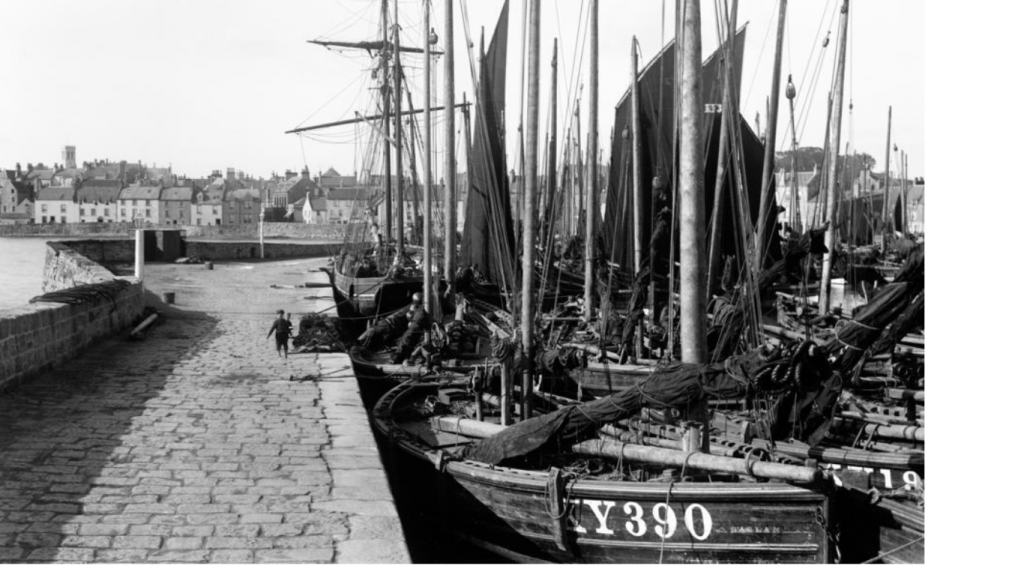
Boatbuilding – The success of so many local crews at the herring fishing on the Suffolk coast is encouraging our boat builders to speculate the hope of better times. There are five builders between St Monance and Cellardyke, but the trade is so unprecedently dull that not a single boat at present being built to order, though in three of the yards hulls are being constructed on sale. At first sight this may seem hazardous work, considering the different opinions and different fishings on the coast, but the experience of the last year or two has proved that there is seldom much difficulty in finding owner for a good boat of about 45 feet long, as boats of this class can be conveniently employed all the year through. The hull of a fishing boat, including an outfit oars, masts, &c., may said to cost about £2 10s per foot, though this price is seldom exactly adhered to in the present keen competition of the trade, or as it sometimes happens, from the peculiar conditions attached to the order. It is curious to observe the wide difference of opinion which a few years may bring about. Less than six or seven years ago, so much were the boats increasing in size that practical men were convinced that a new era was at hand, when the deep sea lugger would take the place of the ordinary fishing boat, and local readers will remember how strongly this idea was by the promoters of the Anstruther Union Harbour. Experience, however, has in the meantime settled the question, and boats on a somewhat smaller scale than the models of some half a dozen years ago are now preferred as being by far the most convenient and profitable. Still, many substantial improvements have been carried out on boats of a recent build. In every case they are now provided with cabins and nearly decked, and from the very general favour with which the flush” deck system, so successfully introduced by the ingenious Cellardyke builder, Mr Alex. Cunningham, is being regarded by our fishermen, there is good reason to anticipate that it will ere long be the rule with the first-class boats of this coast.

The other day one of “the little daughters of Cellardyke ran breathlessly into the house, which, the way, is situated in the very centre of the town, and next to the shore, with the eager cry—” Eh, mither, Kirsty Rodger’s hen is in oor cellar.” As the said hen was decidedly of a truant character, an order was forthwith given to secure the cellar door, which was as quickly obeyed —a quick footed messenger being the same time sent with the tidings to the worthy neighbour in question. What, however, was the astonishment of all interested, going to the cellar, to find no hen or any other domestic bird, but a fine partridge, which, singular enough, had become effectually “caged” in this out-of-the-way retreat. Suffice it to say that this “bird of the wilderness” never returned thither again.

1871

“THE STEAM AND IRON SHOEMAKER” IN CELLARDYKE. (By our East Neuk Rambler.) There is a story told of the good and great Bishop Kennedy, of St Andrews—so remarkable for his princely hospitality—that one day his chamberlain took upon him to remonstrate with his lordship on the folly of so wasting his fortune, and concluded offering to make out a list of the persons who might dine at pleasure at the Bishop’s table.

What names would your lordship wish me to put down then asked the chamberlain.

“Begin with Fife and Angus,” was the laconic reply of the Bishop, meaning those counties, ” and as many more as you please !”

It was this large-hearted prelate who built the fishing town of Cellardyke, that his table might be better plenished with fish than when his boats sailed from the tempestuous bay of St Andrews; and we all know how well, through the blessing of the good Bishop and the industry of the’ people, it has risen, and is rising, into prosperity and fame. Many one during the last years that the town has existed has gone the errand of the famous cobbler, Tarn the Gallanter, of whom it is recorded—

” Fu’ aft he gaed to Cellardyke,

To get a caller skate to pike.”

But our concern in the meantime is not with Cellardyke as a great fish mart, but the seat of certain manufactures which are destined to a new celebrity.

One these—the extensive boot and shoe manufactory Mr Gilchrist —has just been rendered singularly interesting by the introduction of that wonderful contrivance, “The Blake Sole Sewing Machine.” The old monks devoutly loved the fish creels of Cellardyke; but what would the good Bishop Kennedy have thought if he had been told that his fisher town would one day boast a machine that within ten hours could furnish shoes for a little army of six hundred men, and yet, extraordinary as it might appear, this is simply the fact as to what the “sole sewer” can accomplish in the hands of an experienced and dexterous operator.

About midsummer we had occasion notice some interesting things about Mr Gilchrist’s establishment, but within the last few weeks his premises have been considerably enlarged to suit his rapidly increasing wholesale business. A spacious gallery has been erected over the long range of workshops, which may be described as the ” machine room” of this wonderful factory. Here some eight or nine sewing machines work away as busy grasshoppers in autumn, in stitching together and binding the “uppers” of boots and shoes, though, of course, the “admired of all admirers” the beautiful American invention for sewing the soles. It is simply impossible to describe this eminently ingenious contrivance, which is, perhaps, the most complicated and elaborate machine at present in use. It consists of no fewer than 265 pieces, but we cannot illustrate their indefinite and complex arrangement better than the following little anecdote;- Mr Gilchrist has a singular aptitude for mechanics, but when visiting— many others have done—the curious machine, we were struck by the close and rivetted look on his shrewd and expressive Scottish countenance. “I can never examine it,” said he, ” without noticing some new and unexpected movement unthought of before.” The working principle, however, may admit of this general description. The boot or shoe, after the sole and upper has been fastened together, is withdrawn from the last and is then put upon a horn-like projection, which, besides serving the place of the human hand, also contains the sewing thread, which is kept saturated with ” wax “or rosin.” The needle, which is barbed like a crotchet pin, pierces through the soles and brings up the bight of the thread which is thrust forward by a tongue-like slide, so to embrace the next movement of the needle, when as the thread is a second time drawn out of the horn, loop formed, and as two-fold action the machine once presses the leather and tightens the stitch—the result a seam of extraordinary strength and durability, and of no less neatness, as the loop is simultaneously with the stitching concealed in a groove channel cut in the sole. So quickly is this done, and so readily does the machine accommodate itself either to the thin waist or to the thick forepart that the sewing on of the sole of a stout walking boot is done little more than half a minute.

This magic-working invention is gradually spreading over the country, and we believe that though for the first time introduced into Fifeshire it is the seventh in Scotland. It costs about £100, but more considerable still, the manufacturers using it have to pay royalty of fivepence for every one thousand stitches, or fully more than penny on every pair of shoes, which is registered much in the same way as an ordinary gas-meter.

Mr Gilchrist’s enterprise, however, has not stopped here, for a powerful machine has also been fitted up in his establishment, which, while working on the principle of an ordinary sewing machine, can stitch with waxed or rosined thread, and will this way be serviceable for the heaviest class work. There is little poetry in a shoemaker’s shop, but the story of the iron handed sewer is quite a romance.

One evening a little engineer of the name of McKay —Scottish in name, but still more Scottish features and character—was sitting by his cheerful fireside in the city of Boston, when, as he ate his frugal supper, his eye fell on his wife busy with the crotchet needle. Nothing, we venture to say, is more common on either side of the Atlantic, and nothing as a rule excites so little attention. Not so, however, with the little engineer. A thought flashed within him like the birth a new instinct. He had often wondered that in age of universal progress the shoemaker still sweated at his awl, and how living men could always hold on to the things of the dead past; but he believed he could bring about a new era in shoemaking, just as it had been done in cotton spinning, and so he worked on, day and night, that the world might see and believe him. It was, however, as a man seeking treasure, silently and alone but at times his task would seem too great for him, when he would cast his models away, and try to be again the careless and happy craftsman that he had been in other years. The old thought, however, would come back, like the memory of our first love, and with hand shaking with hope and fear, he would work with new earnestness on the grand problem he had set himself to solve; and thus twenty long years had passed on—weary years of heroic but fruitless endeavour—of ruined hopes and blighted fortune—when, just as his heart had well nigh fainted—suddenly as a light at midnight —his triumph came! The neighbours heard wild cry the crazy man they thought had died a suicide, and, true enough, they found him senseless on the floor. But he had only fainted; the joy of the moment had been too great for him when, the last trial ended, his machine had fulfilled its work, and what he had so long sown in the cold and the rain, had strangely, and in the end yielded as it were the hope and joy of harvest. And it all came to pass, for the merits of the invention were so clear that capitalists at once came forward, and we understand that there are at this day about 1000 of these machines at work in America, and about 300 in Britain.

Steam power has been for some months employed in Mr Gilchrist s establishment, and no difficulty intervened in applying it as in the case of the many other machines—the sewing, the sole cutting, and sole beating, and edge dressing apparatus—to the propulsion of the new interesting comer. There are at present about fifty persons employed in Mr Gilchrist’s boot and shoe manufactory ; but, notwithstanding the large extent to which machinery is used, and here it has reached a degree of efficiency not exceeded Scotland—the reputation of the establishment is sustaining itself so well despite the keen competition of the times, that instead of lessening the demand for manual labour, it has increased it, or to use a favourite maxim of its spirited proprietor, ‘”Every improvement is the father of its own success, and, as rule, machinery will be found to open a far larger market in one direction than it closes in another, so far as steady and attentive workmen are concerned. And this appears to be simply the fact in Cellardyke, as every new machine followed by an increase in the number of hands.

“Preserve’s a’, whaur’s the feet come fae to wear so mony shoon,” exclaimed old Lizzie, as she stood behind her little counter, and rubbed her spectacles in wonder over the news of the machine, and while the forty or fifty workpeople were leaving the premises at dinner time. These Cellardyke made boots and shoes, however, are sent by thousands of pairs to all parts of Scotland, and also to Australia; but the following genuine little anecdote will show the vast growth in the demand for shoes even In the home market.

James Moncreiff, the laird Sauchope, was the greatest man in the world—that is, in the thinking of the good folks of Crail-and such was his ascendancy, even in the Council, that when a doubtful point came to the vote, the burgh dignitaries would do so in the very convenient remark, ” I’ll just say as Sauchie says.” It so happened that this great man had six daughters, one of whom was a sort of pet with poor ill-fated Lady Mary Hay, the first wife of General Scott of Balcomie. The little maiden was one day playing by the roadside, when Lady Mary stopped her carriage and took her favourite to the castle. “Awa’to Balcomie!” cried the Lady of Sauchope, when she heard of the incident, and sweating with mortified pride and vexation, “Awa’ to Balcomie, and the lassie barefuted! Mysie Somers, rin for gudesake to the soutar’s and bring her shoon, dune or no dune.” The squire s daughter had only one pair of shoes, and these being at the shoemaker’s for repair she was consequently barefooted when taken up the noble lady of Balcomie; but we all know how much the world has changed since then, when the poorest of the land can now boast a shift o’ shoon,” or what even a squire’s daughter could not boast of, “a pair aff an’ pair on.”

The Loss of the Taeping, -On Monday Provost Martin received a telegram from Alex Rodger Esq, Glasgow, intimating the welcome intelligence that the boat containing the remainder of the crew of the “Taeping” had turned up all safe. A lad from Cellardyke named John Watson, son of Mr James Watson (Salter) , was onboard the “Taeping” at the time of her loss, and some anxiety had been felt by his relatives as to his fate, which has been dispelled by the receipt of the telegram above mentioned

IMPORTATION OF HERRINGS.— Another two cargoes of herrings from Yarmouth were brought into the harbour yesterday. These are consigned to Messrs Sharp & Murray, Mr Cormack, and Mr Ritchie, Cellardyke; and Provost Todd, Bailie Bonthron, and Bailie J. T. Darsie, Anstruther. Another vessel with a cargo of herrings is expected to arrive to-day.

1872

With his accustomed liberality, Stephen Williamson. Esq., of Copley, Cheshire, has forwarded upwards of 80 pairs of blankets for distribution among poor persons in Anstruther and Cellardyke, and also the handsome sum of £20 to be expended in providing cools to the poor. Such seasonable gifts evince the thoughtfulness and feeling-heart of the donor towards those who are in humble circumstances, and his conduct is worthy of all praise.

IMPORTATION OF HERRINGS.—As yet only one cargo of herrings has arrived here from Yarmouth. It consisted of 440 barrels, consigned to Bailie Bonthron, Anstruther, and Mr Cormack, Cellardyke. Two other vessels were on their way with cargoes, but they were both compelled to take refuge from the storm, one of them running to Granton, and the other—the Blossom—to Aberdeen. The latter has received some damage.

The herring-fishing fleet of the East Neuk has among its ” sons of the sea” not a few daring fellows. When at the herring fishing campaign at Yarmouth the other day, John Watson, belonging to Cellardyke, in the East of Fife, actually climbed up the high column of Nelson’s Monument there, which is 140 feet high, and kissed the cheek of the statue of Britannia on the top of the monument

PUPIL TEACHER. WANTED, a Well-Educated GIRL of about 16, Pupil Teacher. Apply to Miss Law, Schoolhouse, Cellardyke.

1873

RETURN OF BOATS FROM THE ENGLISH FISHING.-

With the exception of three detained at Grimsby by contrary winds, the Cellardyke boats have now all returned from Yarmouth and Lowestoft, where during the past two months they have been prosecuting the herring fishing. As a rule their labours have been attended with great success. The best fished boat is that of Skipper George  (this was James Brunton with the Jessies, thought to be the largest sum earned by a Scottish fisherman at Yarmouth to that point) Brunton, who has realised upwards of £420, while Skipper Andrew Henderson comes next with upwards of £400. Many of the others have above £200 and £300, while comparatively few have below the former sum. The lowest we have heard is £130, which will but indifferently remunerate the crew for their work. The expenses are estimated at between £40 and £85, and the most successful crews have thus a handsome return.

1874

During the past two months upwards of fifty Cellardyke crews have been prosecuting the herring fishing at Yarmouth and Lowestoft, and last week the whole of these, with two exceptions, have arrived at Anstruther These craft have again largely participated in the success which has attended the fishing at the ports mentioned, and at Lowestoft one of the Cellardyke crews received about £300, being the largest sum realised among the Scotch crews fishing there. Another crew netted £330 at Yarmouth, and the others received for their two months labours, sums ranging from £250 down to £139.

The boatbuilding trade just now is unusually brisk consequent on several fishermen having sold their boats while at the South. This week Mr Jarvis launched a fine new carvel built boat for Mr J. Adam St Monance, being the first one of that kind built in Anstruther, and today he is to launch a clinker-built one for Skipper T. Bett, Cellardyke. The fishermen appear to be favourably impressed with the carvel-built boats, Mr Jarvis having orders for no less than three, one of which is already commenced, to be owned by Skippers Barclay and Rodger, while the other two are for Skippers George Barclay and James Smith (Hamilton.)

The Cellardyke Echo – 23/11/23 – Issue 419

1895

Death of an Old Residenter. —On Monday morning there passed away one of the oldest residenters of Cellardyke, in the removal by death of George Taylor, baker. Deceased, who had exceeded the fourscore, was a native of Crail; but has resided in Cellardyke for over 50 years. Coming from Crail, where he served his apprenticeship, he was for a short time employed as a journeyman in Anstruther, and thereafter he entered the employment Mr Hutchison, baker, here, whose daughter he married, and eventually succeeded Mr Hutchison in the business, which he continued to conduct successfully for long period. Latterly, however, owing to depression in the fishing industry and competition, his trade decreased. Still he continued to plod away. Deceased was a great favourite with the young folks, for whom he always had a kindly word. He was a devoted member of the U.P. Church, Anstruther.

Turnip Stealing.— Before Provost Martin Cellardyke Police Court on Saturday three young boys pled guilty to stealing turnips from a field near the Infant School belonging to Mr Hutton, farmer, Kilrenny Mill. Accused were let off on the recognisances of their parents to come up for sentence within the next six months if they did not behave themselves during that period, and were ordered to pay 1s 6d of costs each.

1897

The Late Provost Martin’s Gift to the Forth Street Hall – Mrs Martin, St Ayles Crescent, Anstruther, has handed over to the Trustees of the Forth Street Hall, the sum of £100 left by her late husband to this hall and Sunday school.

ln the Town Clerk’s office, Anstruther, on Wednesday afternoon the property at 21 and 23 John Street, consisting of a shop, house, and garden was exposed for sale at the low upset price of £130, but no offers were made and the sale stood adjourned.

A Warrant for Apprehension –  At the Burgh Court on Monday, the case against Thomas Murray Junior was called but he failed to appear. Sergeant Anderson said he had cautioned Murray to appear. The Fiscal applied for a warrant for apprehension, which was granted by the Magistrates. It was understood that the warrant would not be put in force if Murray consented to come to next court.

1898

FOOTBALL NOTES. It was too great a new departure that a large crowd assembled in the Waid Park on Saturday afternoon. Three teams from Cellardyke and two from Anstruther were the competitors in a seven a-side competition for the Mitchell Cup. The teams were soon drawn, and the first to take the field were the Little Blues and Primrose, Cellardyke. After a pretty even ten minutes the Primrose had to retire beaten by a point. Anstruther Thistle then came on the field to take up the cudgels against Rodger Street. This tie was well fought by both teams. Each goal in turn was visited, but it was only after Bonthron put in a goal after a long run down the field that the Winner was decided. Result : —Anstruther Thistle 1 goal 1 point, and Rodger Street nil. The Little Blues once again turned out to do battle against the Waid United. They were not so fortunate in this game, and retired owning defeat by 4 goals to nothing. This left the two Anstruther teams to fight it out themselves, and after entirely one-sided game the United retired victors by 4 goals 4 points to nothing. In this match, Darsie as centre did most of the forward work though ably supported by Crieff and Jamieson. A. Duncan at half back proved himself a treasure, and the way in which he kept feeding his forwards could have taught many a half hack a lesson. T. Birrell and J. Thomson at back were a sturdy defence, so much so that their goalkeeper, John Anderson, never got a kick the whole match.

Cellardyke Harbour.—Provost Watson (Cupar), at meeting of Town Council, intimated a communication had been received from the Provost of Cellardyke as to the rebuilding of Cellardyke Harbour, which had been damaged in the recent storm. As a Corporation they could do nothing in the matter, but he recommended the “cause”  to any philanthropic, good-hearted individuals as worthy one for contributing to.

EAST FIFE FISHERMEN AND SEINE NETS. PETITION TO SECRETARY FOR SCOTLAND. The fishermen of Cellardyke, Pittenweem, and St Monans who were at present engaged in the seine or circle net fishing in the Firth of Forth have got up petitions to the Secretary of Scotland protesting against the bye-law issued by the fishery Board for Scotland prohibiting the method of fishing. The petitions are being numerously signed, and the petitioners deny that this mode of fishing has any detrimental effect on the spawn of any other fish, that it results in the destruction of gear. On the contrary, they assert that large quantities plaice and brill are being landed, which are not caught by the lines. The fishermen, with boats, who have embarked in this fishing have spent about £5 each on gear, and this would be rendered useless were the fishing prohibited. Besides, the fishing is affording a good livelihood to men who cannot prosecute the deep sea fishing.

Seine Net Fishing Stopped. —Considerable excitement was caused on Tuesday by cruiser of the Fishery Board steaming among a score or more boats engaged at seine net fishing in the Firth of Forth, off Anstruther, and ordering the fishermen to stop fishing or the gear would be taken. The fishermen remonstrated, and said that the prohibition time did not come into force until next Tuesday, but the Captain said his orders were peremptory to stop fishing at once. The fishermen reluctantly stopped fishing and returned to the harbour.

1899

CELLARDYKE Property for Sale—ln the writing chambers of Mr Murray, solicitor, Anstruther, on Saturday, a dwelling house and yard at 23 George Street, Cellardyke, was exposed for sale. The upset price was £106, and after a spirited competition, the property was knocked down to Mr Alex Caird Murray, grocer, for £162.

FIFESHIRE. DESIRABLE PROPERTIES, including DWELLING HOUSE and FISHCURING PREMISES, CELLARDYKE FOR SALE. There will be Sold by Public Roup (in virtue of the powers contained in Bond and Disposition in Security,) within the TOWN HALL, CELLARDYKE, on TUESDAY, 21st November 1899, at Two o’clock Afternoon, in One or Two Lots. (I.) That Commodious DWELLING HOUSE, GARDEN and OFFICES, and (2.) the WOODN YARD, SAW-MILL, and extensive FISHCURING PREMISES with the machinery of the Saw-mill, including Steam power, all situated as the East End of Cellardyke, and presently occupied by MR THOMAS COMMACK, and others. For further particulars apply to Messrs JAMIESON & GUTHRIE, Solicitors, Anstruther, in whose hands are the Title Deeds and Articles of Roup.

The properties at the east end of Cellardyke, including house and fishcuring premises, were exposed for sale by public roup in the Town Hall, Cellardyke, on Tuesday afternoon. The upset price was £600, but no offer was made, and the sale was adjourned.

Yarmouth drave has never in its history panned out so well. St Monans and Cellardyke boats have amongst the Forth contingent lifted the plums. Three are credited with about £900, others with £800, and so down till we come to £350. One calculator we notice places the average for the season over the Fife boats at £550, and this, we believe, is a moderate computation.

DEATH OF A CELLARDYKE MAN IN NEW ZEALAND. The Akaroa Mail of October 3rd, has the following on the late Mr Donald McKay, who worked in Cellardyke many years ago as a cooper, and who was married to a Cellardyke woman:—We very much regret to record the death of one of the oldest and most esteemed residents on the Peninsula, Mr Donald McKay, formerly of Pigeon Bay, who has latterly resided in Akaroa. Mr McKay landed in Lyttelton in September, 1859, from the ship Cresswell, after a rather long passage from London. With Mr McKay started his wife and seven children, but one son died on the passage. Immediately after his arrival he went to Pigeon Bay, where he worked for some months carpentering, putting up the main school at Pigeon Bay, where Mr Hay’s old garden once stood—a place now covered with clay from the great slip. He also took several contracts on the plains, and tried the Otago diggings. In 1860 he took up some land at the head of the valley, on the mail road to Akaroa and Christchurch. It was all dense bush at that time, and it was some years before much progress was made with clearing. As soon as a little progress was made potatoes, etc., were sown, and a good crop of wheat was grown in 1862 at the back of where Mr Geo. McKay’s house now stands. In this place the bush has now made a second growth, and where the wheat was reaped there is now comparatively big timber. As years went on he added section after section to the original 25 acres till there were some 320 acres in all. The principal work done at this time was in the posts and rails, firewood, etc., but as the land was cleared stock were accumulated, and very soon there was a flourishing dairy, but Mr McKay was not learned in stock, having been a cooper in his youth and sailed several voyages to India and elsewhere. All this time the adding to the farm was going on, the family were up, and soon were able to give substantial help. – He never became a member of any of the local bodies, but went on improving his farm whilst his family got gradually settled. One great fancy Mr McKay had was the keeping of trout. At the top of the land were two shallow lakes, which he damned so as to make really good fish ponds, eighteen feet deep. He then procured some trout ova, and had a regular hatching apparatus at the house, his labours being most successful. He left the farm about eight years ago in the hands of his eldest son, Mr George McKay, and came with his wife to reside at Akaroa, where he has since enjoyed a very peaceful existence, being blessed with good health. He was in his usual state till Sunday morning, when he died suddenly in bed from failure of the heart’s action. Mr McKay had eight children in all, seven of whom are alive.

Superstition

Changing the Luck. The wife of a Cellardyke skipper with whom I acquainted once told me that she caught the wife of another skipper one washing morning taking the first jug of hot water from the boiler- “I kent fine what she was after” said my friend “She wantit oor Jamie’s luck. He had been daen weel a’ the season an’ her man had naething; but I made her put back the water.” This was young, wife, fairly intelligent and when at school had passed the preliminary examination for pupil teacher.

The Cellardyke Echo – 16/11/2023 – Issue 418

1890

ANSTRUTHER. Two East or Fife Fishermen Drowned. The Fife fishing fleet was caught in the gale on the coast of Norfolk at the end of the week. Several boats were in fearful peril on the banks, where the surf was running mountains high. They escaped by a miracle, but the St Monance veteran. James Fyall, was swept overboard from the “Star of Bethlehem,” of Cellardyke, and drowned. He was 64 years of age, and leaves a widow and grown-up family. A second fatality occurred in the ease of another Cellardyke boat, the “Venus Star.” The ill-fated fisherman was Mr (William) Montadore, a native of France. He was in the prime of life, and leaves a widow and three children. Eight East of Fife fishermen have been lost this autumn in the seas off Yarmouth.

CELLARDYKE. TUNKS’ PATENT CONTINUOUS OVENS.—Messrs Black & Son have this week had fitted up in their bakehouse in James Street, Cellardyke, one of G. S. Tunks’ & Co’s of Cardiff patent continuous ovens with two decks. Since the patent was taken out these ovens have become very popular especially in England and Ireland. They are of two decks and the merit claimed for them is that the flues, which communicate the direct heat are so arranged that they are entirely under the control of the baker. The heat can be increased or diminished as desired in any part or over the whole of the oven chamber. The ovens just fitted up Cellardyke are 8 feet by 6, inside measurement, and have a glazed brick front, which gives a tidy appearance to everything. The furnace is at the side, and the heat is so evenly diffused that the top oven can be made hotter than the bottom one, although the fire is underneath the latter. This is caused by a damper being opened which admits of the heat being sent to any extent to the top away from the bottom, and vice versa. Heat indicators are placed on each side of the ovens, so that the worker can understand at a glance the amount of heat in the ovens. The new ovens save a great deal of time, labour, and fuel, and are easily worked. No scuffling is required, and they are thus always very clean. The new ovens will enable the Messrs Black to more fully meet the increasing demand for their ship and boat’s biscuits from the north. It may be mentioned that Tunks’ & Co. are the only people who have obtained permission to build an oven in the coming Glasgow Exhibition.

1891

MAN FOUND DEAD IN FIFESHIRE. Last night the body of a man was found lying among the rocks the shore between Cellardyke and Crail . The body was dressed in brown and black tweed trousers, tweed vest, and on the feet Wellington boots. On the stockings were the initials “T. S. L.” while in one of the pockets was copy of Scott’s “Essays on Religion,” with a label on the inside page, “Markinch Parish Library, No. 29.” The Markinch authorities have been communicated with lead to the identification.

 The body was later identified as James Simson Thomson (27) a labourer of Tayport.

ANDREW BROWN, Cooper, 77 George Street, CELLARDYKE, takes this opportunity of thanking the public for their patronage in the past. and begs to intimate that all Orders for TUBS. KITS, &c, will have his best attention. Prices moderate, and Repairs speedily Executed.

1892

BOYS’ BRIGADE.—On Monday evening, a branch of the Boys Brigade was opened in Cellardyke for the season. About 40 boys were enrolled, the officers being Captain George Black, Lieutenants A. Watson, R. G. Thomson, and A. Black. It is intended to form flute band in connection with the brigade.

EAST OF FIFE FISHING REPORT. So far as is yet apparent the lines are not the means through which the fishermen are to earn a fair livelihood. They are plied incessantly from week’s end to week’s end, but the fish are not found in sufficient quantities to make it pay. On Friday the whole take of the Cellardyke crews barely totalled half-a-dozen boxes, and in some cases the shot was carried home strung on their fingers. A rumour of a large shoal being met with about 15 miles off caused the crews to shoot there, but less fish could not have been caught anywhere. ……………….The Yarmouth and Lowestoft boats are expected; to arrive with every tide, as advices of their sailing are to hand. ………. Skipper Cameron, St Monance, may now be said .to stand as the king fisher of the Fife fleet with about £300 for the season. His two neighbours, the Amaranth and Glengarry, are credited with £200 and £190, and several others come close upon them. The Cellardyke crews have not been so fortunate, and as a rule they are far behind their western neighbours. The Carmi with some £200, the Comfort, Jeanie Wood, and the Lavina with £170 may be cited as leading at this port. ………. Several Cellardyke boats are reported to have sailed for Yarmouth from Lowestoft, but little definite word is to hand. It is thought that, if the fish continue to be got, they should stay till December………… The Cellardyke yawls at Islay are doing very well when the weather permits. The Eva Anstruther, Skipper Martin Gardiner, made two hauls one night which landed about 100 baskets, and the Diadem had 15. This was, however, the first for the week, and the price was thus high, from 18s to 20s. The coast is full of danger, and it is only occasionally that the yawls manage out. The crafts’ are also found to be rather small in which they presently face the Atlantic, but the shore is of such a nature that large boats could not be worked in and out.

Thomas Scott, 81 George Street, Cellardyke will dispose of 8 singer sewing machines, for heavy work, Cheap

1893

SUDDEN DEATH OF MR DAVID MURRAY, ANSTRUTHER.

 A telegram from Yarmouth on Wednesday forenoon received by the Rev. Mr McAlpine announced the death of this widely-known gentleman, and stated that deceased had been found dead in bed. The intimation was startling as it was unexpected, and excited the deepest expressions of surprise on all sides. The sincerest sympathy is felt with Mrs Murray and her daughter in their sudden and sore bereavement. Letters from Mr Murray on the preceding day had been received regarding business arrangements, and contained not the slightest intimation that he felt in any way out of his usual health. Mr Murray was a native Cellardyke, where his father and grandfather occupied positions of honour in the burgh, and were long the leading spirits. While barely out of his teens, Mr Murray, one of the most strapping fishermen the port, along with fifteen companions, emigrated to Australia, where the fame of the gold fields was then leading all. They soon saw that it was not altogether so remunerative, and Mr Murray returned to the coast. Here he ultimately became captain of one of the smartest schooners in the lightering trade. His energy and perseverance soon gained the confidence of the leading merchants, so that the vessel was almost in constant commission to lighter their ocean packets. But a terrible misfortune gave new turn to his destiny. The schooner was lying at anchor in the river, when a careless steersman caused collision. Murray so far averted the peril of the night, but his leg was so crushed that it had to be taken off below the knee. With indomitable spirit he turned to a new sphere, and was soon managing partner in store. He was a second time laid aside by the fretting of the wound, and had to return to Scotland. Not long after his return, Mr Fowler one night sent for him and announced his intention of retiring. Mr Murray was overwhelmed for the moment, but he soon proceeded to realise the expectations which Mr Fowler had formed of his future. He associated himself with Mr George Sharp, at that time accountant in the Clydesdale Bank. The latter acted as resident partner, while Murray attended to the buying. In this connection he became one of the most familiar visitors at and Aberdeen. He showed himself shrewd and far-seeing man of business. This was shown nowhere so clearly in the success which long attended his supervision of the net factory, of which he was also managing partner. His practical knowledge of this department enabled them to keep well in touch with the times, and in the end overcame all attempts many of the leading houses which then directed their attention to crushing out all competition. For many years the firm was the most extensive employers of labour in the district, sixty and eighty people being in their pay as net and oil workers, while the fish-curing and general merchant departments employed many others. All along the East Coast their names were like household words for the superiority of their sea-gear and outfit. Their fame was also spread in Australia, where their cases of preserved herring were paraded luxuries, and familiar to every settler. Thus their business increased in every direction, until a series of reverses were sustained. The firm was restarted, and were fast regaining their name, when in 1891 Mr Sharp was suddenly called. It will be remembered that, although ailing for some time, Mr Sharp was on the pier in the forenoon. In the evening while at supper he was taken unwell and died within a few hours. Mr Murray then dropped the net factory and merchant’s shop, continuing the fishcuring business. He had premises at Anstruther, Aberdeen, and Yarmouth, and bought large supplies at the latter ports. His long experience enabled him to take foremost place in the trade, and was in the midst of this work that he was cut off. Mr Murray was in his sixty-first year. With the exception of intermittent pains in his injured leg, he was rarely indisposed. He was an ardent Liberal, and a lifelong friend of Mr Stephen Williamson, M.P., and during his contests in the burghs was untiring in forwarding his interests. He was twice married, and his first wife had one daughter, for whom and Mrs Murray the deepest sympathy is being felt. Mr Murray is to be interred in Kilrenny Churchyard on Monday, where he will rest beside the kindred dust of many generations.

1894

Yarmouth – A KY. lugger, the Reliance, No. 502, brought in the highest result of a night’s fishing of any during the present season. She had 12 lasts on board, and her cargo realised nearly £100. several other Scotchmen earned £40, £50 and £60, by one night’s work.

The boats return from Yarmouth and Lowestoft.

…One or two neighbours intended to observe Sunday ashore, but the sight of first one town man and then another leaving the Yar, and the specks on. the horizon which were known to the Lowestoft boats flitting by caused the whole fleet to follow suit. The wind has seldom been so favourable, and several smart passages were made. The mainsail was set at Yarmouth, and never a rope was touched till it was lowered at Anstruther harbour, we were told by one skipper. Home was made Tuesday or Wednesday, but there is one boat yet to come-, This is the Concord, which will stay another three or more weeks in the hope of, retrieving the fortunes, the earnings so far being just sufficient to cover expenses. Taking the fishing all over, it may set down as the best in recent years. The average for the score of Fife boats is returned at £150, the leaders being Isabellas, the Reliance, the Smiling Morn, and the Bon-Accord —the first with £220, and the others about £150. The other end contains some at £60 or £80.

The tidings from Islay are again far from encouraging. Not only the weather been against operations, but the herring have so frequently foiled the crews that many will fail to clear expenses. Already the squadron is breaking up, one or two Cellardyke yawls having left on Monday, while those from the neighbouring mainland have packed up for the final run home. The silver cup will remain a month longer, but Skipper Watson’s townsmen hope by that time to be safely at home. This yawl is the only representative from the east which has done much, the average earnings being far below the anticipations of the opening weeks.

The Cellardyke Echo – 9/11/2023 – Issue 414

1900

Downings Bay , County Donegal –  Our fishing began about the middle of August, but it was well on into September before there were any heavy catches. The fleet comprises about thirty-four large boats, three of which belong to local men and three come from Cellardyke; the rest are the property of the Congested Districts Board. Before going any further I may say that it was the Cellardyke fishermen who first introduced this class of boat into this bay. Alex. Pratt and William Watson. both belonging to Cellardyke, brought their own boats to Downing, six years ago, and have fished there each year steadily since, and both have had no cause to regret coming, as they have each done well. Owing to the scarcity of herring on the Scotch coast this year prices at Downing’s have been very high, ranging from 28s to 35s per cran and 0n several  occasions they have gone as high as 36s.

COLLISIONS AND CONGESTION AT YARMOUTH

Partly owing to the extreme congestion of Yarmouth Harbour, consequent upon the presence of over 400 Scottish herring boats, some mishaps have occurred to a few local craft, which has kept them in the repairers’ hands during the chief part of last week. The Anstruther steam liner, Isle of May, manned by a Buckhaven crew collided with the Montrose boat Mon Ami, the latter having her gunwale smashed up and deck started. The Camellia, of Montrose, in entering the harbour collided with the North Pier, smashing her stem, and the Vesper, of Cellardyke, in dropping up the harbour came into contact with the foreign brigantine Cvon Platen, and took a good deal of damage, for which she went into dry dock. Fortunately, there has this year been no serious losses of nets, as there was last year. Considering the boats are lying four and five deep on either side of the river, and that tugs come in and takeout strings of six and seven fishing boats at a time, the wonder is that accidents are so few.

1901

ALTERING PLANS OF NEW PREMISES WITHOUT PERMISSION.— ( This is John Martin & Co’s Factory Later known as Carstairs’ on East Forth Street)

Mr. H. Elliot attended at Cellardyke Town Council on Tuesday night, and reported that there had been an alteration on the plans of Mr Leslie’s new factory. An erection was being made on the east side to apparently be used as washing houses.

The Provost —His attention has been called to this several times and he knows he has no right to alter the original plans passed before asking the sanction of the Council.

Bailie Williamson—They seem to put the Council aside and do what they like.

Bailie Butters—Can we do anything.

The Provost— We can take action if we chose.

The Clerk— According to the Act he has rendered himself liable to a penalty of £5. and the Council can order him to take down the building if they care

Bailie Williamson —According to the plan the whole front portion was to be built of brick but it is mostly of wood, and no plan was submitted about that alteration. After some further discussion the Clerk h instructed to demand an explanation from Mr Leslie.

1902

Disastrous Fire in Cellardyke

The usually quiet fishing village of Cellardyke was the scene of unusual alarm on Saturday forenoon through the burning of one of the largest business premises the place, with almost the whole stock. The premises alluded to are those owned occupied by the old-established firm of Messrs John Martin & Company, oilskin manufacturers, and were almost new, having only been occupied for about six months. They were situated about the centre of East Forth Street, and were in close proximity to dwelling-houses and the Forth Street Hall. Being partly built of brick and the larger pact wood, with galvanised iron roof, combined with the inflammable nature of the material manufactured, the premises were soon wholly in blaze, causing consternation amongst the neighbouring occupants. The fire broke out about 10 o’clock forenoon through some oil boiling over. After the alarm was raised the Cellardyke and Anstruther firehoses were put into operation, but it was soon evident that save the factory impossible, and the efforts of the numerous willing workers were directed to saving the front shop, office, and the adjoining properties.  During this period the fire assumed so alarming proportions that it was thought advisable to wire for the assistance the Andrews Fire Brigade. Meanwhile the neighbouring tenants, assisted numerous staff, commenced emptying the houses, and this they did not do in careful fashion, much of the furniture, crockery, clothing, etc., being ruined in the removal. The scene during this period was almost indescribable. The hoses, however, continued to play, and in about an hours’ time it was evident that the further spread of the flame had been prevented. Soon after this, the St Andrews Brigade arrived; but their services were not required. The damage, which included the factory, with the valuable machinery, large stock, etc., amounts about £5000, and is, we understand, only partially insured.

1903

CELLARDYKE HARBOUR EXTENSION. Another Appeal to Fishery Board.

Kilrenny Town Council at a meeting last night, resolved to make another appeal to the Fishery Board for Scotland to give further grant with which to complete the reconstruction of Cellardyke Harbour. The Board contributed £1300, and the amount contributed was £537 8s, making total expenditure of £1837. But in order to insure and the safety of the craft, it has been resolved to add small jetty the length of the east pier. The estimated cost of this fully £300. and the Fishery Board is be asked contribute the sum. The Clerk was instructed to draw up a memorial, and ask H. Watson, banker, Anstruther, member of the Board, to support it, the view being urged that were this extension grained the harbour would greatly relieve the congestion m Anstruther Harbour during winter fishing, as many of the smaller class of boats would likely go to Cellardyke.

DESIRABLE GENERAL MERCHANT’S BUSINESS FOR SALE. For Sale by Private Bargain, that Excellent and Old-Established DRAPERY, GROCERY, and FISHING GEAR BUSINESS, so long carried on by MESSRS SHARP & MURRAY, and latterly by the now deceased Mr THOMAS SCOTT, at 83 George Street, Cellardyke. The Shop, Dwelling House, and other Premises, which are very commodious, are adjacent to the Harbour, which has recently been re-constructed, and may be either Let or Sold. The Stock will require to be taken over at Mutual Valuation. For further particulars apply to Jamieson & Guthrie, Solicitors, Anstruther, with whom Offers may be lodged on or before 1st December

THE STREET WELLS. A complaint was made about a street well in John Street, and on the suggestion of Mr Marr the Streets Committee were entrusted with powers to consider the advisability of removing these wells in Cellardyke if they were considered a nuisance.

The Cellardyke Echo – 2/11/2023 – Issue 413

1885

MR WILLIAMSON, M.P., AT CELLARDYKE AND PITTENWEEM. HE PROMISES TO ASK RE-ELECTION IN EVENT OF A GOVERNMENT DISESTABLISHMENT BILL.

On Tuesday night Mr Williamson, in pursuance of his candidature of the St Andrews Burghs, addressed crowded meetings in Cellardyke and Pittenweem Town Halls. After referring to several local questions, Mr Williamson proceeded to explain his attitude the Church question, regarding which he was to be opposed. He had always been in favour of religious equality, and therefore of the separation of the Church from the State. (Applause and hisses.) He would like this vexed question settled, believing, as he did, that they would have no religious, social, or political peace until then; but he had never been an agitator or desired to rush at it hammer and tongs, in season and out of season. He had been grossly misrepresented, both in the pulpit and on the platform, for declaring that only the Government could deal with the question, and that the time for bringing in a Bill must be left to the judgment of the Government. He would discourage any private Member dealing with it; but if an abstract resolution, which was only expression of opinion, was moved on disestablishment in the next session he frankly told them he would support it. (Applause and hisses.) He did not, however, believe that the Government would bring in Bill for disestablishment during the next Parliament, as there would be too much other legislative work to accomplish; but if the Government did so he would resign his seat if asked by a majority of the electors to do so by requisition honestly got up and signed without undue pressure.

The other morning he had a conversation with Principal Tulloch at Andrews, and he (the Principal) then expressed himself to the effect that he thought the proposal was very reasonable, and regretted that he (Mr Williamson) had not given expression to the proposal when he spoke at Cupar lately. But he replied that it was not for him to effusively placard the walls with all the details of his opinions upon this question, but it was for the electors to ask him his opinions. He could not understand why electors were so alarmed at his views or why he should be subjected to such gross misrepresentations of his views.

The parish minister of Kilrenny had said that he was in favour of converting the Church into a place for storing herring barrels or fishing gear. (Laughter.) Were simple-minded fishermen to be taken in by nonsense of that sort He told them that he would sooner cut off his right hand than vote for a Bill to do that; but nobody would ever propose anything so unreasonable. It was a monstrous idea to accuse him of anything so horrible and base. (Applause.) He did not expect gratitude for the services he had rendered during the past six years to his constituents, but he did expect courteous treatment, and that, he ventured to say, had not been extended to him by many of whom he could have expected better things. (Applause and hisses.) He knew that freedom of election had been largely interfered with in St Andrews and other burghs. Kirk-Sessions had transformed themselves into Political Associations, the Tories being at the bottom of it. (Applause and hisses.) A paper was largely signed addressed to him St Andrews, but left blank in other places. It was in the form of a pledge, designed, or at least calculated, to operate adversely on the freedom secured by the Ballot Act. Instead of being brought to him, it was submitted to Sir Robert Anstruther to induce him to oppose his election. Many signed it without knowing its import; others because they thought it had no political significance; and others because they believed it was to be presented to him as giving faithful representation of the opinions of Churchmen. Sir Robert had now agreed to stand on account of it, and because of a subsequent requisition well. He held that if there had not been infringement of the Corrupt Practices Acts there had been very near approach to it. (Applause and hisses.) He asked them to be strong and robust Liberals, and to remember that under the Ballot Act their just rights and liberties were preserved. (Applause.) In both places votes of confidence in Mr Williamson were vigorously carried, amid loud applause and hisses.

NEW BAKING ESTABLISHMENT. THOMAS SWINTON, BARER, CELLARDYKE, respectfully informs the Public of that place and District, that he has now Opened that Shop, 25 Shore Street, Cellardyke, so long tenanted by Mr Alex. Donaldson, where he intends to carry on the Business of a BAKER in all its various branches. T. S. trusts that, by bestowing careful attention on his business, and selling Goods of the finest quality, he may receive a share of public support.

1886

CELLARDYKE. SALE OF PROPERTY.—The fine corner shop and dwelling house in Rodger Street, so well suited for a general store, have just been acquired by Mr David Pratt, merchant, from the builder, Mr James Henderson, for fully £500.

GIVING UP BUSINESS. DAVID R. CUNNINGHAM, DRAPER, 54 JAMES STREET, CELLARDYKE, EGS to announce to his Friends and the 1/ Public generally that, owing to his going abroad, he intends GIVING UP BUSINESS in CELLARDYKE, and has commenced a CLEARING SALE. He will clear out his Whole Stock of GENERAL DRAPERY GOODS at from 20 to 30 per cent, below former prices. AN EARLY CALL IS SOLICITED. READY CASH

1887

THE FISHING AT THE SOUTH.—Notwithstanding the severe weather, the Cellardyke boats have, on the whole done exceedingly well this week, and the telegrams to hand have been the bearers of good news so far as splendid shots and prices are concerned. The fishing up to the present will be the best for some years, and a good number of the crews have from £100 to £200. There has, however, been a great deal of destruction to gear, and this week several new nets have been sent to Yarmouth and Lowestoft by the train. It will likely be another fortnight yet ere the boats leave for home, and should moderately good weather prevail, a successful fishing is anticipated.

APPRENTICE WANTED for the TRADE. Apply JOHN BUTTERS, Merchant, Cellardyke.

A Singular Adventure – The Melbourne Mail has just brought some interesting details to the East of Fife. This is especially the case with regard to that Robinson Crusoe of our day — Captain Alex. Cunningham, late of Anstruther who, with no one so much as to turn the grindstone or blow the bellows, built and launched the tidy little trader of 70 tons, which he now navigates all alone between Swan River and the city. The little smack sailed with as many loads of timber on the 24th September. “You ought to wear a life-belt,” said’ an old Cellardyke acquaintance. William Doig to the Captain. A joyous laugh was the only answer as the mainsail filled to the breeze, and so, like a bird on the wing, the little craft flew on the moonlight sea till by-and-by the treacherous calm was succeeded by a dreadful typhoon. But the presence of mind, as well as ingenuity, of the Captain did not forsake him. His anchors were only the sport of the storm, but he prepared a novel kind of drag by fastening iron bolts into so many lengths of chain so as to hold like birds’ claws on the bottom. But where is the human arm that can fight the hurricane? And so the Captain could only wait, as the brave man waits for his doom, till he was so far roused by the clang of the breakers on the reef. He tried, as sailors say, first to stay and then to wear, but the canvas flew like gossamer out of the bolt ropes. Another lurch and the surf hissed in his ear. He turned to gaze for the last time on sea and sky, when— No !— Yes !— there, under lee of the mainsail on the starboard side, was the red buoy on Coles Bank. It was far to windward, but I can at least try, he thought, and so with an energy born of despair he threw his grapnel. A wild cheer almost escaped his lips, for singular to tell one of the claws had caught the iron ring in the neck of the buoy which, scarce breathing the while with his critical task, he drew so near as to fasten the smack securely with hawser and chain. But a new terror flashed on his mind. Was it possible that the mooring of the buoy could stand the fearful ordeal to which they were now exposed and so as one on the brink of the grave, with the spindrift flying in drenching showers over his head he waited for hours till, providentially, the gale blowing past, he recovered his tackle, and bore away on the voyage. But this is not all. He arrived in such a fortunate turn of the market as to sell his cargo at the profit of 100 per cent.

FISHERMAN’S FUNERAL IN FIFESHIRE. An understanding having been come to with the Railway Company to remove the remains of the unfortunate skipper, John Black, to Buckie with the train at half the usual expense, viz., about four guineas, the seafaring men of Cellardyke united in paying the last tribute of respect. Though some 430 men are in the meantime fishing at Yarmouth and Lowestoft, scarcely fewer than 150, from the stripling who yesterday made his first trip to sea to the veteran bent and battered with the storms of three score and ten, assembled between eight and nine a.m. yesterday on the west pier. On the coffin, which was in varnished oak, being landed from the boat Jubilee, it was touching to see so many sad and subdued faces falling in four and four into the procession, which, with slow and solemn step, walked by the Cross and the Waid Academy to the railway platform, where the melancholy burden was rested till the arrival of the first down train (9.20) for St Andrews and the north, every corner, we ought to say, being crowded with sympathising neighbours, as you could hear the stifled sob, many being all the way from Pittenweem well as Cellardyke. One of the skippers, with the cousin of the ill-fated mariner, left by the same train for Buckie, which has had its own share of calamities of late. In particular, only Saturday week a fine young man in his 23d year, Peter Hay, one of the crew the boat Maggie and Jane, was lost the River Yar, with none to give a helping hand, or even to hear his drowning cry, he perished in the night.

1888

The Scottish Mussel and Bait Reds Commission

To-day, the Mussel and Bait Commission met in the Fishermen’s Hall, Newhaven. The Right Hon. Edward Marjoribanks, M.P., presided, and the other Commissioners were also present. The first witness examined was James Smith, Cellardyke, a fisherman, who said fishermen now experienced much greater difficulty in getting bait supplies than formerly. He thought the Government should take the mussel beds into their own hands—in the Clyde, for instance, which was a proper nursery for them. It would be much better for the fishing population if this were done, because a great many good beds had been destroyed by carelessness. As a case in point, he instanced the beds at the Eden. He did not wholly attribute the decrease of line-fishing to the scarcity of bait, although the price of it now was three times as much as it used to be.

Death of A Fife Heroine,—Another sleeper was laid in the beautiful churchyard of Kilrenny on Tuesday in the silver haired widow of Cellardyke, Mrs Elizabeth Henderson or Wilson, verging on if not over fourscore and ten. Few have done so much to sweeten the little circle around them as one who was in no idle phrase heroine in humble life. She was a native of Burntisland, not the bustling coal port it is today, but with its grass grown High Street little if at all altered since it rang with the iron tread of Cromwell, Kinghorn was the principal ferry, but boats or pinnaces were now employed—that is, if hire was to be got at Burntisland. So it is that her father was led by an errand to the pier that night he stumbled and fell in the darkness. No one heard his drowning cry, but it cut as it were the sheaf knot that held together his little household. Thus in the mysterious ways of Heaven Lizzie was led along the old coast road with hardly a bridge with the carrier’s cart every now and then sinking to the axle tree, as it was some eighty years ago, to her relatives in Cellardyke. Here in the unwinding thread of destiny she espoused the stalwart crofter who by and-by like so many others left the russet muir of Dunino to gather the harvest of the seas till smitten down in the morning of his days. The unfledged nest was not more desolate than the widow and her little ones, but she did not sit down to weep and repine. No, for, stooping to the burden, she with her back creel trudged for years from farm to farm in sunshine and rain to supply eggs and butter, or on the errand entrusted to-day to the rural postman. was a hand-to-hand conflict, with as little time for rest or leisure as in the castaway bailing for life in the rising gale, but she was content enough for her that from day to day strength was given for the journey, and that He was faithful whose promise to the widow and the fatherless faileth never. It is the poor that help the poor, as we all know ; but this was never so beautifully, so sublimely true, as in the story of Lizzie Henderson. In those dismal days in Cellardyke during the autumn of 1849, when cholera so raged that no one could tell who was to be the next victim, the late Dr Black had such confidence in her kindness and experience that she followed him like a shadow in his mission of mercy, and once and again she put forth her hand to assist the dead and the dying when the relatives had fled in terror from the spot. More than one priceless secret has died with her to the care of this and that malady. She treated sprains, &c., by a kind of sleight of hand, and there was touch of healing in her tongue which brought relief when the case had defied the most skilful and accomplished scientist. It is seldom that the pilgrimage is so long extended, but she was patient and cheerful, indeed, it was with her with the sailor on the deep, the star only grew brighter and brighter with the shadows of the night till the end came, it will sooner or later come to all. Mrs Wilson was the mother of seven children. Once and again, she saw her loved ones fade like the blossom before the north wind, but she was spared, like the matron old, to have twenty-four grandchildren, and no fewer than fifty-one great grandchildren

1889

LEAVING FOR AUSTRALIA.—On Wednesday, Mr James Cunningham, fisherman, Cellardyke, his family, and his son-in-law, Henry Gardiner, left Anstruther station for Australia. A large number of their friends turned out to bid them farewell. Among those present were Provost Martin, Messrs H. Brown, D. Black, C. Carstairs, J. McLeod, and the other teachers at present at home of Forth Street Hall Sunday School. Previous to the train starting, the hymn ” God be with you till we meet again,” was heartily sung. Mr Cunningham replied, and thanked them for turning out to wish him and his family good-bye. He sincerely re-echoed the wish of the hymn just sung.

The Cellardyke Echo – 27/10/23 – Issue 412

1880

Cellardyke Fisherman Drowned at Sea.— The melancholy tidings were received on Monday evening by the Rev. Mr Anderson, minister of the parish, that William Anderson, one of the crew of the Cellardyke boat Venus had been drowned about twilight, in the act of shipping the side-lights, on the Yorkshire coast The Venus, which belongs to his father-in-law, Skipper Peter Murray, had been stationed for some weeks at Scarborough, but, like the rest of the local squadron, now that the herring fishing over, was on the homeward run when she was overtaken by one of the fitful gusts of wind and rain which marked the weather of Monday. It was in one of those squalls that the poor fisherman was swept from the deck into the boiling sea. Everything was done for his rescue, but he was scarce seen ere he sank into a watery grave. He leaves a widow and four children to mourn his loss. The present calamity makes the sixth man belonging to Cellardyke who has been washed overboard and drowned in the course of the present year.

A Bailie Court was held in Cellardyke on Wednesday—all the Magistrates on the bench. An urchin, named Robert Scott, was charged with pelting Hector, imbecile, with stones Sabbath day; but, like a similar charge against his father, the case broke down for want of proof. -Three youths, William Watson, James Salter, and George Brown, were then accused under the Lindsay Act, with damaging the crops on the farm of Kilrenny Mill. They pleaded not guilty, but on the evidence of Overseer Clark and Daniel Ross, they were convicted and fined in the sum of 2s each.— William Duncan, merchant, was next charged under the clauses of the same Act, with keeping a dangerous dog, in so far that it inflicted a severe bite on an orphan boy, named Andrew Brown. Duncan admitted that this was the second time the dog had bitten a passer-by. It would have been destroyed on the first occasion, but it was very useful, and had been carefully fastened up till in his absence had been allowed to escape to the street when it attacked the boy. He was fined in the mitigated penalty of 7s 6d

1881

UNRULY COOPERS – at the Bailie Court of Kilrenny on Friday— Provost Watson presiding—four coopers employed in Cellardyke, George Lawson, David Dun, John McLeod, and William Blyth were charged with assaulting Mr David Muir, fisherman, at the harbour head on the evening of Saturday week, and also with a breach the peace at the same time and place. All the panels appeared except Blyth who is in the meantime at Yarmouth. They pleaded not guilty, but the evidence of several of the neighbours brought home the charge in the opinion of the court, and they were each fined 7s 6d, or ten days in jail.

BOOTS  BOOTS BOOTS

ROBERT GRAY has OPENED that New Shop, at No. 3 Shore Street, Cellardyke, with a large and varied Stock of BOOTS and SHOES, such as will give every satisfaction to the Public in fit and wear. R G. begs to thank the Public of Cellardyke and surrounding district for the past support he has received during the past two years, and still hopes, by strict attention to all orders entrusted to him, to merit a share of public patronage.

1882

Escape of a Fife Crew. —One of the most remarkable instances of special Providence, to use a favourite phrase of the coast, occurred last week to the Cellardyke boat, Ivanhoe, Geo. Fowler, master, while on the voyage from Scarborough. Their errand over on the herring sea, the crew had put to sea on Tuesday night, and were bowling along, with jib and foresail boomed out, as the sailors say, before the south-west wind, when, about two next morning, those on deck saw red light within bow shot bearing right upon them. The night, by reason of the fog, was as black as the grave, and thus the stranger—a big barque, under full sail—was all unperceived upon them. A vigilant hand, David Meldrum, held the tiller, but not an instant was left to act, or even consider what to do, when her head gear was entangled with the boat. The foremast brushed clear by a hand breadth, but the mizzen was caught by the big bowsprit, and was next moment hurled into the sea. It so far. however, averted the collision, though the winch and part of the rail was wrenched away, but otherwise the boat was safe —delivered as by a miracle from the very jaws of destruction. The escape of three of the crew was exceptionally so. The boat-hook, acting boom, was thrown like a spear from the hand of giant against the shoulder of a veteran fisher. George Smith, while, as the mizzen mast crashed over the gunwale, it struck full on the steersman, who also received a severe blow in the fall of the winch. A landsman, named John Ramsay, was also thrown into the sea, and his escape was, perhaps, the most providential of all, for, unable to save himself, he must have become the prey of the hungry waves, but as he rose to the surface, the broken mast floated to his arm, and on this he rested like a life buoy till he was sometime after casually seen in the “water burn,” when he was dragged into the boat. In the meantime it was the impression on board that the shoulder of their comrade was dislocated or broken, and that David Meldrum had received mortal hurt; but for while their every outcry and effort was to obtain assistance from the barque. It was all in vain, however, for deaf to every call, and with that heartless barbarity which unfortunately has only too many parallels in the story of the sea, the stranger never once changed his course, but held under full sail as before. In the darkness and agitation of the hour our fishermen failed to identify the barque, but, so far as could be made out, she seemed to be a foreigner, making probably for English coal port. The Ivanhoe reached Anstruther harbour some thirty six hours after the collision, when no time was lost in obtaining assistance for the injured men. Fortunately, in neither case was there any bones broken, and David Meldrum, for whose condition so much uneasiness was felt, is, we are glad to say from latest accounts, doing as well as can be hoped for. We understand that the authorities are investigating the matter with view of bringing the sea miscreant to justice.

1883

International Fisheries Exhibition

Messrs Sharp & Murray, Cellardyke, have carried off the gold medal for herring nets, also gold medal for collection of sea fishing gear. In the special prize list this firm has also gained the £5 prize for collection of long line gear.

THE ROYAL HANDBELL RINGERS.—This company gave one of their delightful entertainments in Cellardyke Town Hall on Tuesday evening. Coming from Perth and going to Galashiels, the drawings of the night—some £10—would leave little, if any, margin over the expenses of the journey, though the authorities were, considerate as to accept just one-half of the usual fee for the Hall.

One of the’ Cellardyke boats was so fairly within the grasp of the whirlwind that the brave crew never again expected to see the morning light. In this terrible situation, the Skipper took his last farewell, as he thought, of his young son, sheltering in the cabin. Who will tell the tenderness of such an embrace, or the earnestness of the cry, ” Lord, help us, we perish,” nor let us forget the fervent prayer, as on that same night, for the dear ones at home. A providential escape was also made by Skipper John Bett. of the “Alice,” of Cellardyke. While pulling in the nets, a big wave rose, hissing over the gunwale, and smote him from the one end the boat to the other; but this did not end the perils of the night, for in the act of tacking, he was thrown by the tiller into the sea, from which he was snatched as from the brink of the grave, though so greatly crushed that he had to be taken to the hospital. This is a small whitewashed building, but it has been, or is being, like the house of the Good Samaritan to more than one of hardy fishers in the day of misfortune. It is likewise pleasing to notice the sympathy felt on all sides in Yarmouth for the safety of the ” Seven Brothers,” of Cellardyke, and also for William Lindsay and his crew, who were detained at sea in consequence of their nets fouling with an English or French drift till Friday forenoon, or four days after the storm, during which their long absence had given rise to the meet indescribable alarm, if not despair.

1884

SALE OF GROCERS STOCK AND UTENSILS. To be SOLD by Public Roup, upon WEDNESDAY, 22d October 1884, THE WHOLE STOCK of GROCERIES, &c., belonging to David Corstorphine, 38 John Street, Cellardyke, including Tea, Sugar, Soap, Confections, Baskets, Stock Chests, Beams, Scales, and Weights, 2-Wheeled Barrow, Counter 9 ft. by 2i (little used), Water Casks, etc., etc. The Roup will commence at 2 p.m. J. BONTHRON, Auctioneer. Cellardyke, 14th Oct. 1884.

TO LET, that SHOP in CELLARDYKE, presently occupied by David Corstorphine (situated in centre of town), where a good trade has been done for past 25 years. Entry Free till term. Present tenant going abroad. Apply Watson, 40 John Street, Cellardyke.

NOTICE. —All Parties having Claims against DAVID CORSTORPHINE 38 John Street, Cellardyke, are requested to hand same to him  and all Parties indebted to him are requested to make payment within 14 days from this date. Cellardyke, 23d Oct. 1884

AN UNSUCCESSFUL FISHER. George Carstairs, fisherman, Cellardyke, was sued by Messrs Duncan & Black, for the sum of £9 0s 10 ½d for nets which had been supplied to him. In answer to the Sheriff he said that he had never succeeded in the fishing since he got the nets from them, and therefore he was not able to pay them. He did not dispute he was owing the money, but he had now to take a day’s labour wherever he could get it in order to keep his wife and children. The Sheriff—Well, but you must try and make some arrangement with the pursuers as to payment. Decree with expenses.

HERRING NETS.-It gives a pleasing idea of the unslackened energy in the herring trade that Messrs Duncan & Black’s net factory in Cellardyke is busy, in the meantime, by night as well as by day. There are at present 16 machines in motion, hitherto, as elsewhere, by the fair sisters of the coast; but in the course of the week a party of young men arrived by rail to work the night shift, so as to enable the spirited firm to overtake the orders thus early in hand.

KILRENNY. A PLEA FOR THE TEETOTALLERS .—At the Burgh Court on Saturday, before Provost Skinner and Bailie Smith, a wandering cork -cutter, named David Bain, was charged, under the Lindsay Act, with having been drunk and disorderly, especially in using obscene and abusive language to Mrs Sarah Woodward or Watterston, of the Cellardyke café, on the previous night. Pleading guilty with a rueful look, he was fined is 7/ 6d, with the option of 7 days’ imprisonment.

A DISORDERLY FISHERMAN. —At another diet of the above Court, Alexander Jack, fisherman, Cellardyke, was also charged with committing a breach of the peace, in so far as upon Saturday the 18th October he did conduct himself in a riotous, drunken, and disorderly manner in East Green Street, by cursing and swearing, and using obscene, abusive, and threatening language towards John Porter, railway agent. The panel pleaded guilty, remarking, “I never did any harm to John Porter or lifted my hand to any man in my life.” He was fined 10s 6d, or 10 days’ imprisonment in Cupar

The Cellardyke Echo – 19/10/23 – Issue 411

1940

WIFE DIED FROM SHOCK, Lost overboard in the Firth of Forth’ two months ago, the body of Mr. Alexander McRuvie (32), of Dove Street, Cellardyke, Fife, has been recovered. His wife (27), who never got over the shock of the news of his loss, died a fortnight ago in Edinburgh Infirmary. When McRuvie was swept off his ship the skipper made a gallant attempt to save him, and was himself saved by another vessel,

ANSTRUTHER. – AWARDED VELLUM.—Thomas Anderson, aged 49, Craigaven, Williamson Place, Cellardyke, has been awarded the vellum the Royal Humane Society. Anderson, along with James Watson Bett, aged 32, 36 Forth Street, Cellardyke, who attempted, on 22nd August, to save Alexander McRuvie, aged 32, from drowning in the Firth Forth at Wemyss.

1942

Fife Joiner Electrocuted at work

A fatal accident inquiry into the death on September 10 of John Gardner (27), joiner, 22 Rodger Street, Cellardyke, Anstruther, was heard at Cupar Sheriff Court to-day. Gardener was employed by Walter Reekie, boat builder, at the boat building yard, Harbour Head, Anstruther, to do odd joinering jobs and mending cables for electric drills. Alexander Stevenson, apprentice ship wright, 24 West Forth Street, Cellardyke, Anstruther, employed in the same yard said that when handling an electric drill earlier in the day of Gardner’s death he received a slight shock and reported the matter to the foreman. Later Stevenson saw Gardner with the same drill on his way to the switchboard, presumably to test it. He (Stevenson) and two other men to whom he was talking then heard Gardner shouting, “Put off. Put it off.” He was standing,’ drill in hand, apparently unable to let it go. Stevenson rushed across and switched off the power. Thomas Melville Parker, foreman, said that when it was reported to him that something was wrong with the drill, he instructed a qualified electrician to repair it. He saw Gardner in the yard with the drill in his hand, and it had not been repaired. Gardner said that there was nothing wrong with the machine, only the cables were needing repaired. Parker told him to obtain new cables from the store and join them to the drill. Thomas Chalmers Hunter, electrical engineer, Fife Electric Power Co., said that when he examined the drill, which carried 250 volts., after the accident saw the wires had been incorrectly joined, allowing the current to flow direct to the body of any person holding the drill. This, in his opinion, was the cause of the death. . Dr M. D. Armour, Crichton House. West Anstruther, said he found death was due to an electric shock. Sheriff More returned a formal verdict of accidental death.

1943

CAPTAIN WILLIAM SMITH KEAY, of the Merchant Navy, has been awarded the O.B. E. for gallantry and skill in saving his ship when it was continuously bombed during the North African landings last November. Thus he makes good in his second war. In the last one he held the rank of Lieutenant in the Royal Naval Reserve. A fisherman’s son. who began his working life as a boat-builder. Captain Keay is a native of Cellardyke, Fife, and now has his home in neighbouring Pittenweem.

O.B. E. FOR A FIFE CAPTAIN The London Gazette of Tuesday announced the award of the 0.B. E. Captain William Smith Keay, Fernlea, Pittenweem, Fife, whose vessel, almost continuously attacked enemy aircraft while serving on the North African coast, put up a “magnificent defence.” One attacker was shot into the sea. but the ship was hit by torpedo in one of the holds, which contained a large quantity of petrol. The master, after examining the damage, decided that the ship could be saved, and orders were given for the extinction of ail fires on board to minimise the risk of the petrol catching fire. “Captain Keay,” adds the citation, displayed courage and seamanship of a high order, and it was due to his determination and skill that the damaged vessel was brought to port safely without assistance.” Captain Keay, who is a son of the late and Mrs Andrew Keay, Cellardyke. Anstruther. took part in the North African landings in November of last year. IT was on his second passage out to North Africa that his vessel was the subject heavy bombardment from the air. An aerial torpedo practically tore the side out of his vessel. He has been at sea since his youth, and during the last war held the rank of Lieut, in the R.N.R

1944

Intimation has been received by Mrs Wallace. 67 John Street, Cellardyke, that her son, Sig. Adam Wallace, has been posted missing. He was a signaller the Airborne Division which made the landing at Arnhem. Educated at Waid Academy, Anstruther, Sig Wallace entered the service of the Clydesdale Bank at Falkirk. He came to the Grangemouth office of the bank in 1937, where he was employed as clerk for two years. When he was called up in 1940, he was in the Dunoon branch of the bank. While at Grangemouth, Signaller Wallace served as an officer in the local company of the Life Boys. He was a keen member of the Men’s, Own Brotherhood, and was also a prominent figure in the Y.M.C.A. Boys’ Club.

1946

CHAIRS—FROM “CHAR” CHAT A steady flow of non-utility furniture is now coming from a factory in Cellardyke, Anstruther, founded as a result of a chat over cup of ” char.” Two naval officers, Lieutenant D. P. Appleby, of Ipswich, and Lieutenant Commander P. Branch, of London, were discussing post-war plans with Mr J. Brown, of Cellardyke, a civilian employee at Crail Royal Naval Air Station. As they sipped their tea one of them suggested that they should extend their war-time co-operation into a peace-time partnership in furniture-making. None of them had any previous experience of this type of work. Demobbed this year, the two ex-officers and Mr Brown took over a disused net factory in Cellardyke. Mr Branch, engineer before the war, drew up plans for machinery they needed. With the help of local blacksmiths it was produced. Now the only limitations on the output of the ten employees are the B.O. T. restrictions on quantity and variety.

1947

Graduates – B.D.S.—Charles Alexander Smith, L.D.S., Anstruther. B.Sc. (Engineering) Robert Gardner Stevenson, Cellardyke.

1948

Dead whaling man – inquest adjourned

When James Fleming, a young seaman from s.s Southern Larkspur, a whaling vessel which was berthed at South Shields, visited his father on another ship of the whaling fleet lying at Newcastle yesterday, he entered his cabin to find his father dead.

When the fleet left the Tyne at mid-day today, James did not sail with it.

The dead man, James Elder Fleming, aged 42, a pump man aboard the Southern Harvester, lived at Shore Street, Cellardyke, Fifeshire.

The police are conducting investigations and it is believed that the man died after inhaling chlorine vapour from a fluid used for cleaning clothing.

At the inquest held in Newcastle this morning, only, evidence of identification was heard before the hearing was adjourned to enable an analysis to be made of the cleaning fluid.

1950

Merchant Navy Passes – Skipper Fishing Full – George Barclay, Cellardyke.

1951

Logan Martin Church. The Woman’s Guild began the session week with a Dedication meeting. On Monday of this week, there was good turn out of members to welcome the speaker. Miss Pratt, from Cellardyke. Mrs Muir presided, and after the opening devotions she introduced the speaker, wlio.se subject was “Scotland.*’ Many interesting and delightful details were given life in the olden days. Customs, clothes and ways living were discussed. Special reference was made Fife and the part it had played in the story of our country. At the close Miss Pratt was cordially thanked for her very interesting address. Tea hostess for the evening was the vice-president, Mrs Ramsay.

1952

EXECUTRY NOTICE. All Parties having CLAIMS against the Estate of the late Provost WILLIAM WATSON CARS AIRS, O.B.E. J.P., who resided at 18 West Forth Street, Cellardyke. Anstruther. Fife, are requested to lodge the same with the Subscribers within Ten Days from this date. All Parties INDEBTBD to the Deceased are requested make Payment within the same period.

LOOKING over a souvenir booklet issued for the jubilee celebrations of the municipality of Quirindi, a town of 3000 Inhabitants situated nearly 250 miles from Sydney. Australia. one feature interested me specially It is the story of the A.l Bakery founded in 1917 by Mr James R Taylor. who was a classmate of mine at school. Cellardyke people will note that he has perpetuated in the name of his bakery the once well-known “Al. Biscuits” made by the local firm of Black, with which he served his apprenticeship. Along with the booklet comes a picture of the Quirindi rink which won this year’s New South Wales Bowling Championship at Sydney; and one of the four players is my old friend. Jimmy Taylor. Congratulations!

1953

A new professor JOHN DICK, Oxford, the newly appointed Professor of Engineering at Dundee Universitv College, comes of a well-known Fife family. He was born in Cellardyke and is former pupil of Waid Academy, Anstruther. From there he went to Glasgow University, where he graduated with first class honours in electrical engineering and in mechanical engineering.

St Monance CONGREGATIONAL GUILD At the meeting on Monday night Mrs Robertson presided and welcomed a visiting party from Cellardyke. Mrs Motion. guest speaker, gave an inspiring address. Mrs Thomson and Mrs Myles rendered duets. Mrs J. Gourlay presided at the organ. and tea was served by the committee

1954

6th Oct

Married on Saturday, Miss Agnes A. Christie, of 26 Rodger Street, Cellardyke; Anstruther, who was married in Cellardyke Parish Church to Mr James S. Robertson, of Maud. Aberdeenshire. The bride is secretary at the Waid Academy, Anstruther. And is a former Anstruther Sea Queen. The bridegroom is in the R.A.F., stationed in Cornwall.

BACK home from holiday to Canada and America. Mr and Mrs Martin Gardner 29 James Street, Cellardyke, are busy telling Cellardyke folk about Cellardyke folk! For in the course of their tour they met an amazing amount of exiles, and reunions were numerous and happy.

The “Kent faces ” began at Quebec for Mr and Mrs Gardner, who were accompanied by Miss Watson, Cellardyke, who was going to visit her sister, for there was Captain Reekie of Anstruther who was in port with his ship the ” Begonia “.

In Montreal they met Mr Robert Swinton and Mr William Swinton, both of Cellardyke, and also Mrs Cruickshank,. formerly Miss Betty Brown whose father was the minister the Baptist Church.

At Toronto they were greeted by Mr Tom Martin and also by Mr and Mrs Joseph Boyter (Jessie Bett.) They also met Mr Alex Martin and Mn Kember who Miss Elisabeth Marr. The Misses. Herd added to the exiles in Toronto.

Off to Hamilton, Ontario, and there Mr and Mrs Gardner were greeted by Mr and Mrs Wilson Brunton, now about seventy years old who visited Cellardyke six years ago. And again there was a reunion. Among those encountered ware Lil Gardner. now Mrs John Watson. wife of a Cellardyke man, Bella and Barbara Hodge, who are now Mrs William Brown and Mrs James Brown, Miss Bessie Hodge and Miss Lizzie Hodge, who is a cousin of the three sisters.

Others whom they met included Mr and Mrs George Tarvit, Cellardyke, and Mr Johnnie Wood guided Mr and Mrs Gardner very efficiently.

At Lake Erie there were more Fifers. There the Gardners met and chatted with Mr and Mrs Robert Davidson. Mrs Davidson used to be Miss Janet Gardner. One of the oldest of the emigrants whom they met their on travels was Mrs Alex. Brown, better known probably to the older people of Cellardyke, as Kate Davidson. She is now about 80 years of age. With her they met her daughter. Mrs Dunn, formerly Maggie Brown. and her husband who hails from Pittenweem. They also met Kate’s niece, Miss Margaret Davidson. There was an exchange of greetings between the Gardners and Mr George Ingram, his sister Annie and her husband Alex. Wood and Mr William Tarvit.

A few miles from Port Dover is Simcoe where they paid a visit to meet Mr and Mrs James Reekie, formerly of Rodger Street. Cellardyke. After eight days at Gloucester the Gardners moved on to Lynn where they met Mr and Mrs Roberts, the uncle and aunt of Mr. James Corson; and then they went to Boston to me Mr Alex. Tawse, formerly of Cellardyke, but he and him wife happened to be away on holiday at the time and they were missed. The next stage of their journey took them to New Jersey where they spent a night with Mr Charles Swinton. Mr and Mrs Gardner then returned to Montreal, ‘their holiday finished.

COIN FOR LUCK Most of the boats have now left for the herring fishing at Great Yarmouth. The departure of the drifters was marked with the usual custom of distributing biscuits to the spectators who in turn threw coins on the deck for luck when the boats were leaving the harbour. So far there is no report of the fishing by the local boats from Yarmouth. The “Irene Julia,” skipper James Bett, Cellardyke, leaves this week for the fishing grounds and the crow are at present busy getting nets and gear in order.

The Cellardyke Echo – 12/10/2023 – Issue 410

1930

THE DRIFTERS DEPART FOR YARMOUTH By Mrs A. R. ROWLANDS

A Memorable Morning at Anstruther

The Rite of the “Bakes”

Mrs Rowlands’ shop at Cellardyke harbour, with the Manx Fairy being built in the foreground

Cellardyke Six a.m. and a fine autumn morning. A faint foreshadowing of dawn is in the sky; a keen “caller wind blows from the sea, which as yet rolls darkly under dusky clouds; the “May Light” blinks monotonously as if weary of its long night’s vigil; cheerful window lights and shadows moving across the brightness proclaim that the town has already wakened to activity.

Along the narrow streets speed hurrying footsteps, some heavy and regular, others quick and uncertain, all going in the same direction “wast to Anster.”

At this hour of the morning the little town presents a “Monday morning” appearance, and seems resentful of this unusual disturbance and reluctant to emerge from its Sabbath calm into weekday bustle. Little lights gleam windows of bakers’ shops, through the lighted doorways of which glide hurrying figures carrying in their gathered aprons something which suggests “baps for the breakfast.”

As we approach the quay, signs of activity become more pronounced, and on proceeding down the busy pier, the “caller” wind blows keener, and the lowering morning sky causes many to prophesy rain.

Threatening showers and cold breezes are, however, soon forgotten, for we are now in the midst of the laughing, jolly crowd who have come ” doon tae see the boats gaun aff tae Yarmouth.”

Side by side and bow to stern they lie, smoke already ascending lazily from their funnels. In the surrounding atmosphere there lingers a hot pungent smell redolent of engines.

The “Bakes”

At the quay side are gathered little groups of relatives, friends, and interested spectators. Merry talk and laughter abound as greetings and farewells are exchanged.

“Been gettin’ a drap engine ile, Tam?” slyly queries a bystander, as visitor slips cautiously from the direction of a boat’s cabin.

“Aye,” was the reply, and with a meaning glance at his questioner, “There’s a drap left in the ‘ poorie ‘ yet.”

The skippers of the various vessels have now arrived, and with looks expressing a consciousness of their responsibility, board their respective drifters.

Excitement now runs high, the great event of the morning approaches as members of the crews appear with boxes or bags filled with ship’s biscuits or “bakes.” which they distribute with lavish hands among the sightseers.

It is considered strict etiquette to accept the proffered “bakes”; to refuse would not only be breach of good manners, but would also “bring bad luck tae the boat.”

“Tak’ up a’ thae bits,” shoutsa  commanding female voice, as the owner points to some fragments still remaining in a box.

A shrug of the shoulders and a toss of the head is the only reply, as one of the younger members of the company deliberately turns her back on the box and its contents.

“A weel, if ye’re sae prood an’ mimmoo’d, yer mither’ll tak’ them, ma lass,” retorts the speaker, as she promptly empties the fragments into the capacious bag purposely brought for the “bakes.”

In the Cabin

A tall, blue-jerseyed fisherman now appears on the deck of one of the nearest vessels, and making a megaphone of his two hands, roars through them in stentorian tones. “A’ the weemen are wanted doon here.”

“Wha’s gaun first?” the female portion of the crowd gaze a little shyly at each other, and for a few seconds no one makes amove.

“A weel, I’m gaun, come wha likes,” shouts one brisk dame as she ‘ loups ‘ actively aboard the boat. With much screaming and laughter, other bold spirits follow suit, although many are glad of the aid of strong masculine hands to aid in their descent from the pier to the drifter.

A short tour of inspection of the ship deck is made, and a hasty glance cast into the cook’s galley. An invitation to “gang doon and see the engine is hastily refused after a look at the perpendicular stair leading to the interior of the vessel.

Sounds of revelry are heard from below, and the skipper’s loud tones demanding “Whaur are ye?” lead you to descend slowly and fearfully, groping your way down the ladder, at the bottom of which is the entrance to the cabin, now filled with a hilarious gathering.

According to time-honoured custom, you ” toast the boat,” expressing your wish for a safe journey and ” a guid fishin’,” and with a sigh of relief, for it is hot downstairs, you creep cannily to the “upper air.”

The Clang of Engines

After farewells, the pier is once more reached, and a move is made for a coign of vantage from which to observe the initial stages of the drifters’ departure.

As we observe the congestion of the vessels in the small harbour, we wonder how they can be manoeuvred out into the open safety.

The clang of engines now fills the air, as one boat slowly moves out of its position. Orders are shouted, and the crew rushes backwards and forwards hauling mysterious ropes. Now we perceive the use of those pieces of wood called ” fenders,” which are slung over the sides of the boat to prevent her grating either against the pier or the side of another vessel.

” Ease ‘er aff,” shouts the man at the wheel, the drifter negotiates the narrow and difficult corner of the opening leading from the inner to the outer harbour.

As she glides gracefully into open water the sun breaking suddenly through the dense clouds, sends a dazzling ray of sunshine athwart her bow, and turns her path into a sunlit way—an omen of good luck for the Yarmouth fishing.

Lucky Pennies

One by one the boats muster into line and swing through the narrow opening, and in their transit a shower of “lucky pennies ” is skilfully thrown on the decks by the many well-wishers on the pier.

“Pick them up, pick them up,” is the injunction cried to the passing crews the coins rattle down. Let uninitiated folk however, take careful aim and select the correct moment for throwing, otherwise not the drifter, but the omnivorous harbour will receive “the luck.

“D’ye see daddy?” cries the young mother, holding baby up as the boat passes. “Daddy” meanwhile waves a hand in farewell, and his eyes strain back as long they can see the familiar forms of those left behind.

A further rush is now made to “the pint o’ the pier,” from which point of vantage we shout our final messages and farewells. Soon the loud blowing of sirens drowns our voices, and we content ourselves with waving handkerchiefs, scarves, or whatever conspicuous object we have at hand.

Jimmy Brunton’s Lasher KY25 prepares to leave for Yarmouth

A vigorous response is waved from the departing boats, and soon a few dim specks on the horizon are all that is visible of our fishing fleet, which will in few minutes disappear “ahint the  May”

Townwards once more we turn our faces. Shivering in the air, which has suddenly become cold, we hastily patter over the cobbles homewards to our daily tasks.

Stir and bustle of departure is over, and the streets seem strangely quiet. Without the vigorous gaiety and activity of our blue-clad fishermen it’s a “toom toon.”

The Cellardyke Echo – 5/10/23 – Issue 409

1915

CELLARDYKE. Wounded in France. – Other too cases of local fellows wounded during the course of the recent advance hate been reported. These are William Mathers, of the 4th Black Watch, and William Thomson, both are making good progress.

KILRENNY. Wounded by a Prisoner. Information has come to Mr and Mrs McKane, Cornceres, that their son, George, 4th Black Watch, has again been wounded. McKane had not long got back to France after recovering from a previous wound, when he took part in the recent fighting. He came out of the advance unscathed, but while taking a German prisoner back to the British lines, the German shot him with a revolver. The wound, however, was not fatal, and McKane is making good progress.

1916

MR RAY’S FAREWELL TO CELLARDYKE. Previous to leaving to be inducted to the pastorate of St James’ Parish Church, Portobello, the Rev. James Ray, M.A.. preached his farewell sermon Cellardyke Parish Church last Sunday forenoon. There was a large and representative congregation.

Parish Church.—ln accordance with his appointment by the Presbytery of St Andrews, the Rev. Mr Munn, Forgan, occupied the pulpit of Cellardyke Parish Church on Sunday, and formally declared the charge vacant.

Flounder Net Fishing.—As a living cannot meantime be made (says the “Fishing News”) at the small line fishing in the Firth of Forth, motor yawls belonging to Cellardyke, St Monans, Pittenweem, and Buckhaven have removed to Aberdeen to engage in flounder net fishing. Unfortunately, however, weather conditions lately have not been very favourable for this method of fishing, which cannot be followed when any swell is running. Nevertheless, some good hits have been made this week. Shots have realised as much as £4O, but have also fallen as low as £1.

The Stranded Steamer. The steamer Streathan, which went ashore opposite Kilrenny Mill, Cellardyke, while on a voyage from the Tyne to Leith, a fortnight ago, still lies high and dry on the rocks. She has been lightened considerably by the discharging of a large quantity of coal, while some of the rock on which she rests has been removed. With a recurrence to high tides this week, should the weather remain favourable, it is hoped that she may yet be got off within the next few days.

1922

Cellardyke Man’s Promotion – Mr John G Moncrieff, son of Mr and Mrs  W Moncrieff, George Street Cellardyke, has been promoted manager of Richard’s Audit Company, Windsor Ontario, Canada,

Mr Moncrieff served his apprenticeship in Anstruther and emigrated to Canada in 1912. Two years ago he joined the service of his present employer.

1923

HERRING FISHING CRISIS. Cellardyke Takes Action. Cellardyke fishermen have formed a committee to act in co-operation with Mr J. Duncan Millar, M.P. for East Fife, during the crisis in the herring fishing industry. The committee have drawn statement urging— Immediate Government aid. Inquiry into the destruction herring the sprat fishers the Firth of and Firth of Forth; and Better supervision of trawling on the East Coast. The committee maintain that sprat fishers are destroying tons of young herring which, if they were allowed to reach maturity, would leave the shallow waters for deeper waters, and the winter herring fishing at Anstruther would revive.

ANSTRUTHER HERRING DEAL. The steam drifter White Queen (Skipper Moncrieff, Cellardyke) arrived at Anstruther on Saturday with cran of herring. The catch had first of all been taken to Hartlepool, and was purchased over the ‘phone by Messrs R. Melville & Sons, Cellardyke, £1 per cran.

1924

FIFE FISHERMAN MISSING From Herring Fleet at Yarmouth. Photo is of. George Corstorphine, 57 George Street, Cellardyke, who has been missing since Saturday night from the steam drifter Mace at Yarmouth, where most of the East of Fife fleet is engaged in the herring fishing. Corstorphine, who is 34 years of age, and married with a family of two, was employed as a fisherman on the steam drifter Mace, skippered by Mr Martin Gardiner, Cellardyke. The Mace left Anstruther about a fortnight ago and had been working its way south. The missing man is a son of Mr and Mrs George Corstorphine, 47 John Street, Cellardyke

SLANDER CASE IN CELLARDYKE. fruiterer Sues a Fisherman. ” May God strike me deaf, dumb, and blind if I was the thief,” said Alexander Smith, lately fruiterer, 45 James Street, Cellardyke; in Cupar Sheriff Court to-day, during the course of his proof in his slander action for £250 against James Brunton, fisherman, 59 James Street, Cellardyke. The pursuer, who was 58 years of age, stated in the witness’ box that he was accused by the defender of stealing certain stores consisting of tinned meat, tinned milk, &c., from his boat, the Lasher, while it was lying in Anstruther Harbour. The defender denied that he had made an actual accusation against the pursuer, but stated that he had suspicions which he communicated to him. In consequence of the stories that had gone about pursuer’s fruiterer’s business fell off from something like 20s to 25s per  day to about 8s per day.

In answer to Sheriff Dudley Stuart, the defender said he did not believe the pursuer’s denial.

The Sheriff—Do you believe it now ?

I do not believe yet.

The Sheriff —You know now that he did steal these things from your boat?

I am not sure, you know. All the proof I have is that I got the empty tins on the beach opposite pursuer’s house.

The Sheriff —It seems to at all events there is no doubt whatever that you conveyed to him you were accusing him of stealing these things from the boat?—

l never accused him.

The Sheriff —You come here and say that you have proof that did it? —

That is all the proof.

The Sheriff—You think it is enough?

l thought it was enough at the time.

The Sheriff —Do you still think so?

You people know better about law than I do, and I thought it was enough.

The Sheriff —You have taken a risk. If you are going to accuse a man of theft who says he knows nothing about your property and didn’t take it, you have to prove it.

The Defender —I put the case into the hands of the police at home, but nothing was done.

The Sheriff —Didn’t that make you a little cautious in the matter?—

l told the fiscal if there was nothing to be done he would just have to let it drop.

The Sheriff —You didn’t let it drop yourself, and that is why you are here to-day. You persisted accusing him.

The Sheriff —Your proof is that certain empty tins similar to the tins you had on board your boat were found upon the beach front his house? —

Yes.

The Sheriff —That is the whole story. You think that enough?

Defender —I thought it was enough.

The Sheriff —Do you still think so? —

Yes.

The Sheriff—That’s just the question. After hearing the agents his Lordship made avizandum.

Later in the Month

CELLARDYKE SLANDER ACTION. Fisherman Has to Pay £20. Judgment was given in Cupar Sheriff Court this afternoon by Sheriff Dudley Stuart in the slander action for £250 raised by Alexander Smith, sometime labourer, 45 James Street, Cellardyke, against James Brunton, fisherman, 59 James Street’ Cellardyke. His Lordship found in fact that the defender, who was skipper of the steam drifter Lasher brought her into Anstruther Harbour on 23d March last, and on the following day it was reported to him that certain stores had been stolen from the vessel. On the 2nd April the defender spoke to the pursuer about the theft of the stores, and said —” If you have stolen them or know anything about them I will give you 24 hours to put them back or give me £2.” the following day the defender called at the pursuer’s house, and said he had come to speak him and that that was the last chance, and he also mentioned that he had proof. The defender meant and the pursuer understood that the defender was accusing him of having stolen stores from the vessel. That accusation was slanderous, and must be presumed untrue. His Lordship found in law that the defender was liable to the pursuer of said slander, and assessed the damages at £20. Pursuer’s claim, he observed, was extravagantly stated. For the pursuer, Mr H. B. Middleton. Leven, and for defender, Mr T. W. Davidson, Cupar.

The Cellardyke Echo – 28/9/23 – Issue 408

1910

Anstruther has at last got another football club started. It is not the resurrection of the old and famous Rangers, but a new club, “Anstruther Mercantile.” After many trials and rebuff, a pitch has been secured from Mr Blyth, Cellardyke, opposite the residence of Rev. Mr Rae. It is the pitch of the now long defunct “K.Y.”, and is an admirable one. The first practice games were indulged in yesterday, and it is expected that a match will be arranged for next week.

1911

Kilrenny School Board have appointed Miss Euphemia Gardner, Cellardyke, as assistant teacher in Kilrenny School at a salary of £55 per annum, in succession to Miss Forsyth, who has accepted a position in Leven school.

Mr James Pratt, Cellardyke, sustained a serious accident on Tuesday forenoon, while working on board the drifter Glencona. He fell from the wheelhouse to the deck, broke his arm in two places, and was badly out about the head. He was taken home in an unconscious condition, but has since improved slightly.

Information was received in Anstrnther on Tuesday by Mr Thomas Cunningham, of the death by drowning of William Duncan, fisherman Ferryden, who is married to a Cellardyke woman. Rev Mr Ray was asked to break the sad news to the mother of Mrs Duncan. Deceased was oh board, a motor boat, and sailed from Hartlepool on Monday, and it is supposed he was washed overboard on Tuesday morning. From additional information received, it appears that Duncan who was sailing the boat Annie Mearns, was standing for’ard in the boat when he was struck by the sail and knocked overboard. The motor was flying before a rather stiff breeze at the time, and before the distance to the spot where Duncan fell had bun retraced all signs of him were gone. The body was not recovered. The Annie Mearns reached Montrose yesterday.

1912

WASHED BY THE SEA. A wine bottle, tightly corked, with a paper inside, has been washed up from the sea and found on the beach at by Mr T. Whylie during the week. The paper is in good state of preservation, and contained the following: list of names ” Peter Murray. Peter Carstairs, William Smith, Tom Tarvitt, George Tarvitt, James Barclay. Angus McRay James Murray, Harry Seely, James Smith. 41,’ James, Street, Cellardyke, Fifeshire, Scotland; the crew of the Venus. August 16th”

LOST, between Kilrenny and Anstruther, a Black Rubber COAT. Finder please return to T. Swinton, Cellardyke.

1914

When the appeal for recruits was first made, the fishermen in this district were criticised in several quarters for not coming forward and offering themselves to the Army recruiting authorities, many critics overlooking the fact that the men were willing and even eager to join the Naval Reserve or the Navy itself if the chance offered. As a result of the meeting held in Cellardyke by Mr H. T. Anstruther, several young men indicated their willingness to join the Naval Reserve, and this week they have been called up to Portsmouth for service. that There is no doubt, if the fishermen are given a suitable opening, they will readily join any branch of the Naval service, and should the call for recruits for the Navy be issued, it will be heartily responded to by the fishermen in this district, who, as has already been stated, are prepared to give themselves to a branch of the national service for which their calling has eminently fitted them.

1915

STRETCHER-BEARERS’ PLUCK. Captain C. H. Maxwell, of the 1/7th Black Watch, arrived home on Friday from France on sick leave. In conversation with a representative of the “East of Fife Record,” the Captain was full of regard and admiration for the bearing and conduct of his men “No words,” he said, “can fully describe the readiness and gallantry of the boys from the East of Fife in tackling the business in hand. What little grumbling there was, took place at the start of the campaign, but with the realities of their duty before them, they quickly reached a state of discipline that enables them to stand any amount of exhaustion and hardship without grumbling. Their soldierly appearance is all that their mothers and fathers could desire; they are as physically fit as it is for men to be. They stand up well to long route marches and lengthy periods of duty in the trenches, and even when they come back to the billets there is plenty of work.

“From the billets, we often march three -or four miles out, and construct trenches under the supervision of the Royal Engineers, who seem to be better pleased to have the men of the 1/7th Black Watch working for them than any ether Battalion”. “And what do the men occupy their leisure hours with?” I asked our representative. “Leisure hours!” and the Captain smiled, “I don’t remember having any leisure hours for a long time. Even while in billets, there is plenty of work to keep us occupied.

“To a great extent the trench warfare is carried on by aerial torpedoes and trench mortars, whose bark is a great deal worse than their bite. These missiles are filled with high explosives, and certainly kick up a great row, but the nerves of our fellows are proof against that. While at work in the trenches, they see those mortars coming, and dodge to the right or left before they explode, afterwards calmly resuming their work and conversation as if nothing had happened. That is the stage they have got to now. “I would like to emphasise that the dangers of the trench work are very much over-estimated by relatives at home. We have done long spells in the trenches with few or no casualties, and in many cases casualties that have occurred have been due to the carelessness of the soldiers themselves in not exercising proper caution.

 ” Our boys are a cheery lot, and great on music. Both in the trenches and on the march, the voices of the Anstruther and Cellardyke boys can be depended on to strike up a tune, which is lustily taken up by the whole Company. It is a cheery sound, and keeps up our spirits wonderfully. – “Apart from their work,” continued the Captain, “the thoughts of the men are all concentrated on leave. There are always three drawn for leave every week, and the hope of everyone is that it will be his turn next. “Those at home can hardly estimate the keen pleasure the receipt of the parcels gives the men. The knowledge that the home folks are thinking about us keeps us cheerier than even good news about the war, and certainly the men deserve the best you can send. Very few complaints are heard about parcels not being delivered. It is a point of honour with everybody to see that the parcels are delivered to the men they are intended for. “On the other hand, about the only thing that makes our fellows sick at heart and discouraged is the news that work people are striking for some paltry advance in wages. When they heard about the Welsh miners, the common wish of the Battalion was that they should be sent home to quell the strike, and the thought that some slackers are told to take 30 hours to do an eight hours’ job at munition works is worse than all the frightfulness the Germans can employ.

“A word of praise must  also be given to our two local stretcher-bearers, Drummer Harry Bowman, Cellardyke, and Drummer Robert Hughes, Pittenweem. The doctors could not compliment them enough on their work, not only for – the prompt attention they gave to the wounded, but in carrying them to safety over open ground under heavy fire, and returning at once to carry more wounded, sometimes through miles of trenches packed with soldiers. They would work until they were fit to drop, and were always ready when called upon.” So far as casualties are concerned, the Company has been pretty fortunate for some time, but the lord lads still miss their two brave comrades (William Watson and Alex. Robb), who fell in May last. Before leaving, Captain Maxwell intimated to our representative his intention of personally visiting the parents and relatives of his men in this district, a kindly thought which will be much appreciated by all.

Local Man Wounded. – – News came to hand yesterday that Colour-Sergeant George Moncrieff, 4th Black Watch, has been severely wounded during the fighting on Saturday by shell fire. Colour-Sergeant Moncrieff, who served his apprenticeship with Messrs Guthrie & Maxwell, solicitors, Anstruther, was in Tal-tal, Chili, in the employment of Messrs Balfour, Williamson A: Co., shipping agents, when the war broke out, and came home to volunteer. His parents reside in West Forth Street. Many friends in the town will anxiously hope that the Colour-Sergeant’s wound may not prove so severe es the brief notification indicates.