
The Cellardyke Echo – 17/02/2022 – ISSUE 327

DAVID TOD B.E.M.

On Monday 14th February the family of David Tod announced his passing peacefully in St Andrews Hospital.

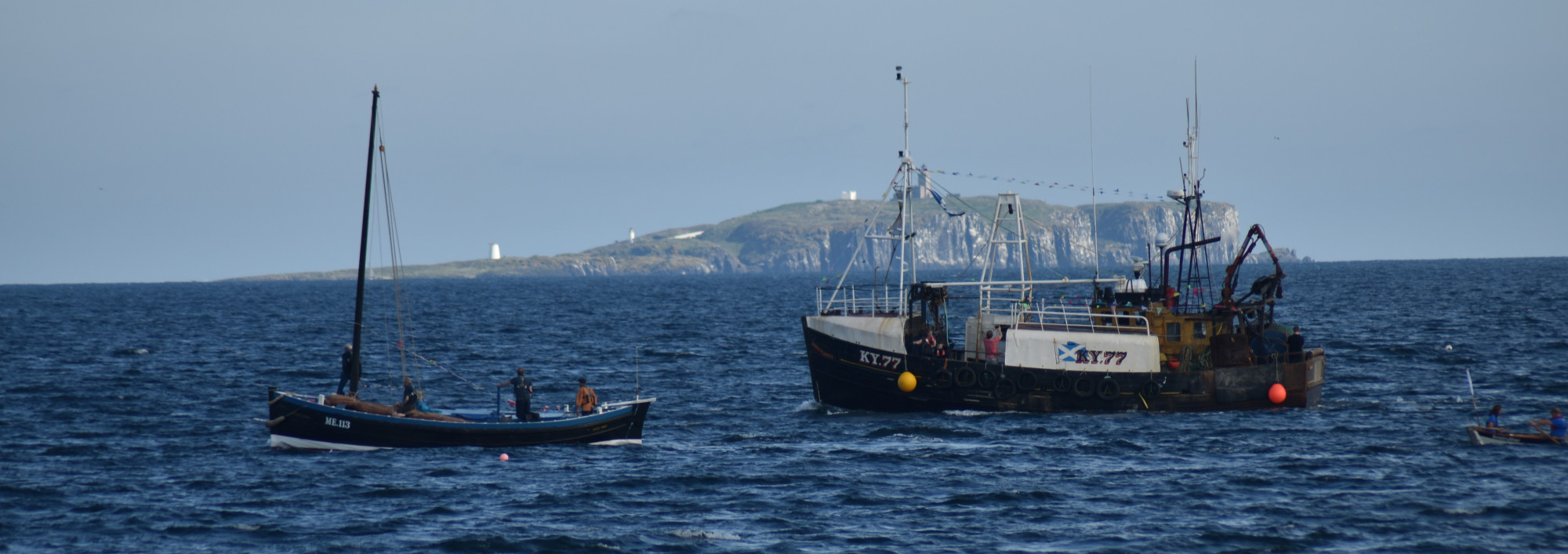
Davie never hit the headlines as one of the high profile, high grossing whitefish skippers of the 70’s and 80’s, but through his work he significantly changed the fishing industry.

Davie was born and brought up in Pittenweem. When he left school he decided not go into his family bakery but spent a year at the prawns out of Pittenweem aboard the Ocean Queen. From there he took up an apprenticeship at Smith Brothers Engineering Co. of Anstruther.

He found himself in a very forward, practical thinking company. Smith Bros had developed a potato harvester in the 50’s that is still the basis of modern harvesting machines,  and for the fishing industry, they specialised in the  “down drive” gearing mechanism that connected winches and coilers to the engine. Smith’s also built winches and wheelhouses for James N Millers of St Monans and other yards. Working out the best way of doing things and using technology to make it easier was the perfect environment for Davies practical mind.

When his time was served Davie decided to go back to the fishing, and whilst on holiday in Essex he came across a small transom sterned vessel in a creek that was up for sale. Having located the owner he was ferried out to the boat across the mud on the owner’s back! The deal was done and David purchased the Your Lynn and brought it back to Pittenweem (navigating part of the way with a road map!). The boat was different from the traditional East Neuk fishing boat of the time and had been somewhat neglected. Some of the old worthies believed that nothing would be made of it. Davie set about completely re-rigging it, changing the layout to make it into an efficient stern trawler and very soon proved the naesayers wrong and this smart blue and white boat became the first of several remarkable vessels in the “Toddy” fleet.

When he came to replace the Your Lynn grant aid was available from the White Fish Authority and as an ambitious young skipper he decided to take a risk on a new build. Due to his engineering background there was no question, this boat had to be made of steel. There were several yards that could have built the boat he wanted. Davie eventually placed the very first order with the new Campbeltown shipyard, for a 49ft vessel. The design was Campbeltown’s but there were many heated arguments and discussions about the significant changes to the standard design Davie insisted on to get the boat he wanted. 

The St Adrian was launched in May 1970, christened by Margaret Tod, Davie’s wife. It was the second vessel launched by the shipyard, David always insisted his should have been the first but the Crimson Arrow which had been launched a few weeks before was part funded by the Highlands and Islands Development Board.  It was a political decision to focus on the investment in the rural areas of Scotland by the HIDB.

David had designed the St Adrian so that it could be worked single handed (although he never did). His innovations included the wires being brought overhead from the winch leading back to the gantry of which the aft gallows were a part. He was also the first to use hydraulic guiding on gear with an early hydraulic winch. These innovations were developed in conjunction with Dr. Norman Kerr of the Sea Fish Authority. However the most significant piece of equipment introduced on this boat would revolutionise fishing practice in the UK.

David initially thought of having two winches, the second one to bring the sweeps in, but then with more consideration he realised by adding in bigger flanges that would enable him to bring the net in as well.  He commisioned Smith Bros to build the altered winch to his plans. The St Adrian was the first UK vessel to have a net drum. Now every modern trawler and seiner in the UK carries a net drum, this saved labour and created more deck space.  Innovations like this and the overhead wires no doubt have saved many lives and prevented some horrible accidents that happened all too frequently in the UK’s most dangerous Industry.

The St Adrian was very successful vessel fishing prawns mainly on the East coast, and over the next few years Davie also invested in other vessels and skippers, often boats that were seen ahead of their time, sometimes these partnerships worked out, other times they didn’t.

When he came to build another new vessel he comissioned GL Watson to develop his design. He enquired with Campbeltown and other shipyards about building it for him, but as it was a one off and these yards were now focussing on the classic 80 and 90 footer standard designs he found no takers. He eventually came across a small yard in Old Kilpatrick on the Clyde and construction began. Things he learned and adapted from the first St Adrian were built into the second vessel of that name. The wheelhouse was positioned in the middle of the boat but offset. With two net drums he pioneered the twin rig, working with the Sea Fish Authority at their tanks in Hull, and then some trials in the Firth of Forth.

This vessel was a small ¾ shelterdecked vessel totally unique in design and could not be described as traditionally a good looking vessel. However as a working boat it was rigged up as the perfect tool and a good sea boat.  After trials with the Sea Fish were over Davie lost a net on a wreck and gave up twin rigging, as it was “impossible to afford to keep pioneering new ideas and make a living” however there were lots of other small ideas he developed to make working life safer or easier.

With this vessel he was well known at the prawns on the East and West Coast of Scotland.

David decided to come ashore when Millars of Crail, the Marine engineering and fabrication company came up for sale and he sold the St Adrian 11.  He successfully converted and improved many fishing vessels, adding in shelterdecks, new layouts and even desigining and building a small steel transom stern conversion for the wooden Forth Ranger. This facility also helped him maintain and improve his own fleet and enabled the classic Tod thought behind the fit out of a ferro concrete yacht hull he had purchased from the middle of a field in England.

When David’s eldest son, Andrew,  a joiner, wanted to go full time fishing not just at the creels in the summer it coincided with St Adrian II  appearing back on the market, and they brought the boat back to Pittenweem. His younger son David was an engineer and when he wished to go to the fishing, they purchased a steel hull, towed it to Anstruther, and lifted her out, Davie then set about reducing its length and created another superbly efficient small trawler, the Crusader.

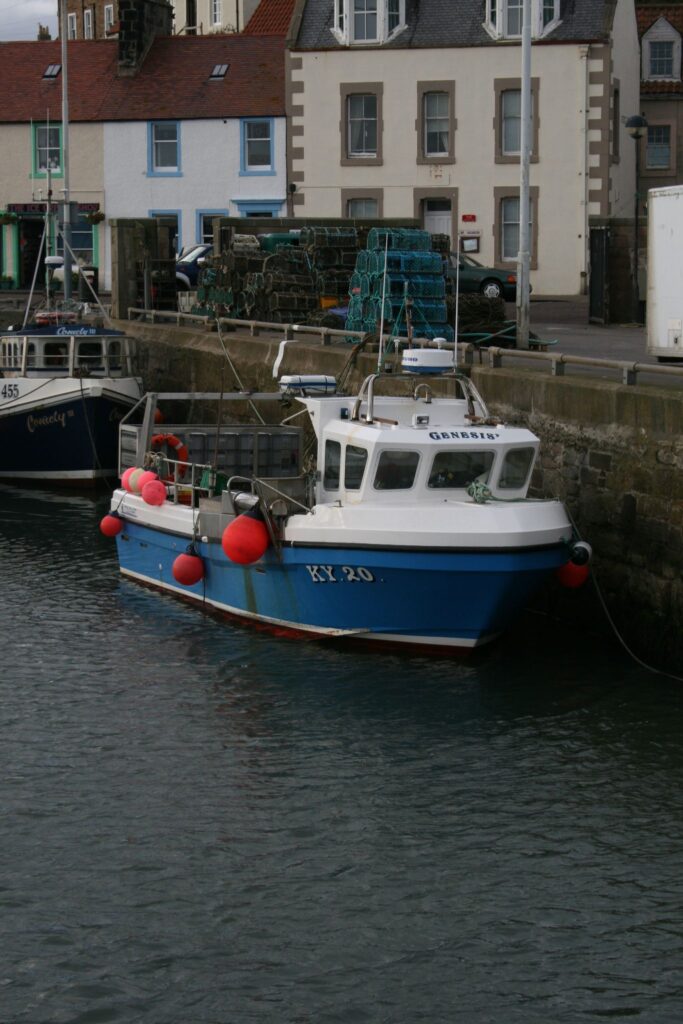
The second St Adrian was sold on when Andrew decided to build his first fast creel boat the Genesis.

The last of Davie’s fleet to be named St Adrian had been a Fleetwood registered steel trawler called the Lady Mabs, it had gone ashore in thick fog at St Monans right at the time he purchased Millers of Crail. Davie acquired the wreck and went about his usual upgrades and conversion. For many years this vessel fished out of Pittenweem until the Geordie and Henry decided to retire. It was sold on to Fraserburgh renamed the Alta and has just recently been cut up in Macduff.  The first St Adrian is currently called the Radiant Star, FR Reg and is nowundergoing refit in St Monans, and the St Adrian II still works on the west coast.
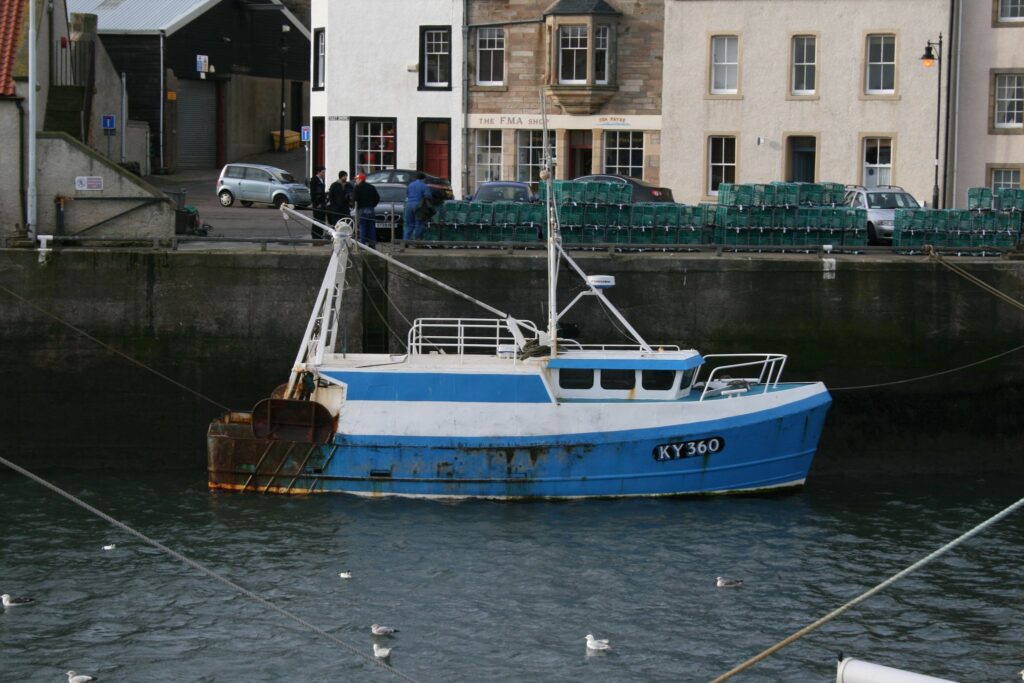
Andrew continues to work a fast creel boat, the Genises and David Jnr still Skippers the Crusader fishing for prawns from Pittenweem,  both vessels well maintained as David Snr had done before them and still recognisable in the smart Tod Blue and white colours.

Davie’s influence and work has spread much wider that the working fleet.

Billy Hughes BEM retired manager of the FMA Pittenweem, said that when David was President of the organisation “ They had a very close working relationship, they each would have ideas and strong opinions but it was rare that they would disagree, they would talk though things and what resulted was always for the benefit of the fishing industry and the East Neuk of Fife.” 

Members of the local Community Council have also paid tribute to his chairmanship and stewardship of that organisation. He chaired many other groups including the Fife Harbours committee.

He has been involved with the Scottish Fisheries Musuem since it opened in 1969. As volunteer, Trustee, Chairman and Vice President. He has driven forward expansion and development, solved multiple practical issues in the rambling complex of old buildings. He has overseen all the technical challenges round restoring and sailing the Reaper, the musuem’s 1903 flagship sailing lugger and other boats in the fleet, ensuring that that small independant musuem has a collection of national significance. One of the most remakable feats was installing the 78ft zulu Research LK 62 into a museum gallery. He had rescued the hull from being destroyed after a storm,  protected it by building a steel frame round it and almost single handedly manouevering it across the main road and into the musuem.

Always thinking about how the museum could thrive and survive Davie knew that the community had to be rooted in all aspects of the Museum. The formation of specialist interest clubs affiliated to the museum was another of his plans and a way to achieve this.

In 1985 the Reaper had just completed it’s first phase of restoration and sails had been designed and delivered, but there was no crew. His newly formed SFM Boats Club started a programme of outreach that has seen the boat visit venues from Portsmouth to Lerwick, encouraging many volunteer crew on adventures,  Davie frequently skippered the vessel when not working at sea while retired fishermen skippered the vessel on the longer trips. This club has introduced Scottish fishing heritage to over 180 000 visitors from 120 countries including many organised school parties.

Another passion was model boat building, he was a very skilled modeler both from scratch and working with cast hulls. The second club he formed was the SFM Model Boats Club in 2008 and as chair of that it became a thriving group. Many of the models were remote control and they sailed them at various venues. When Davie became ill in the last couple of years unable to go long distances with his models, a few of the club (under his supervision) built a large pond in his back yard and they met on Sunday mornings to sail their boats. This happened each week until the time he went into hospital towards the end of 2021.

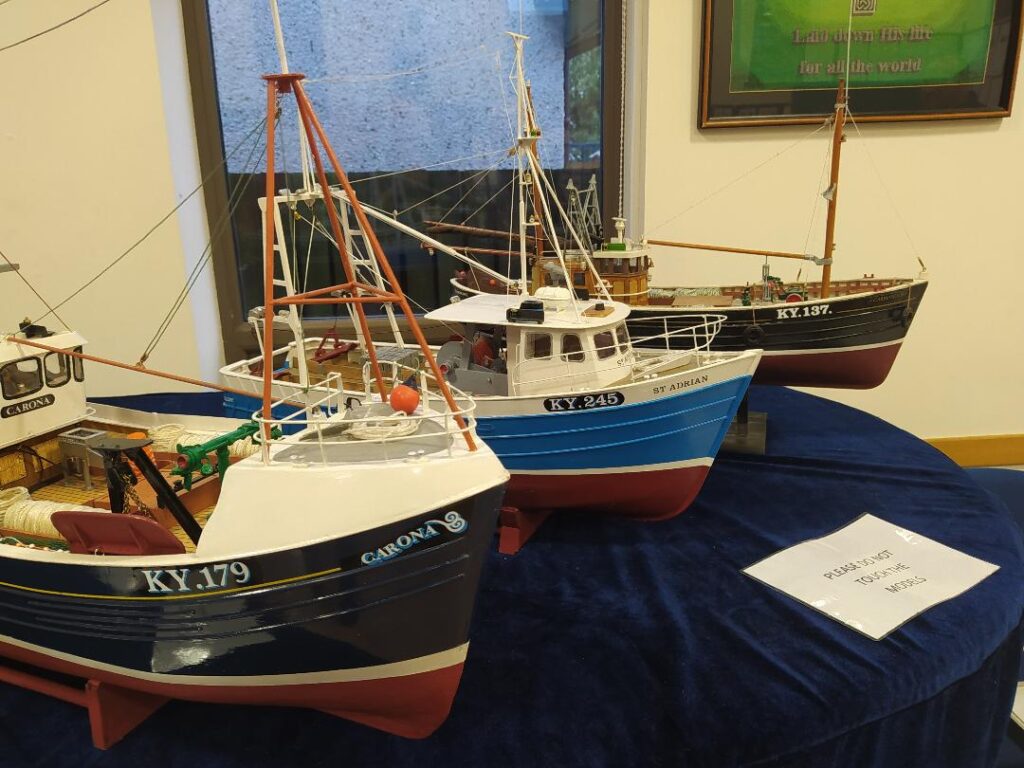
He built a wide range of models, one each of his own and son’s fishing boats and his yacht, steam drifter and modern fishing vessels. One of the last models he completed was a planked scale model of the 1937 Manx Beauty, a local restoration project that he was technical advisor to. He donated it to be used for talks and school visits to show the ambition and end product of the project.

Undeniably one of his visions and achievements that has had the greatest impact was his project developed through the Scottish Fisheries Museum to re-establish small scale boat building in towns and villages round the coast. His plan was to create a wooden vessel in kit form that could be constructed by communities and help re introduce them to the skills and put them back in contact with the sea.

The idea was developed with the Museum and Alec Jordan (Jordan Boats) who had the CNC equipment to be able to do this. The first prototype was a small vessel that they saw did not meet the requirements or be aspirational enough to inspire communities to take part.

Alec Jordan also had a vision for community racing of vessels, his business was based in East Wemyss where miners of Fife used to run very popular regattas. With rowing enthusiast Robbie Wightman of North Berwick the idea of a vessel suitable for competitive coastal rowing was developed. A grant from Museums and Galleries Scotland was secured and the Museum commissioned Ian Oughtred to design a rowing skiff based on the Fair Isle yoal of Shetland, a 22ft open boat with excellent sea going capabilities.

The design was christened the St Ayles Skiff named after the area the Museum buildings are housed in. Clubs were formed in Anstruther, North Berwick and Port Seton  and the first regatta was held at Anstruther in 2010, The Scottish Coastal rowing movement was born. Driven at the start by David, Robbie and Alec the passion and efforts of many individuals, communities and clubs has made this sport grow at an incredible rate. At that first regatta a national committee was formed to oversee the sport, Scottish Coastal Rowing Association. David served on this, and in his usual way supported the whole movement as well as local clubs on all levels, from practical help and advice.

There are currently 213 vessels registered in UK, 21 in the USA/Canada, 18 in Australia/ New Zealand, and many others in the UK and Europe currently under construction. Some being built as a part of school courses and others by regenerative groups as well as town enthusiasts.

Covid put a halt to the regular regattas, however rowing to pre covid levels is returning, when, weather permitting, hundreds if not thousands of people are now involved rowing Skiffs for pleasure and competitively.

This year the fourth World Championships, Skiffieworlds 2022 will be held in Holland. The first was in Ullapool, the second in Strangford Lough, Northern Ireland. The third was in Stranraer in 2019 and attended by more than 30,000 spectators.  Featuring over 1500 rowers, the economic impact on the area of the event has been independently assessed at over £3.5million. Davie was particularly proud of the Anstruther womens teams, but also showed his support for the whole sport by making a three week trip, sailing his yacht Braveheart to Strangford Lough for the 2016 Skiffieworlds.

The UK is an island nation, the number of people working on the seas has plumeted, maritime skills, traditions and seafaring skills are disappearing. The impact of the coastal rowing movement is remarkable and cannot be overstated. Alongside from the obvious health and community bonding benefits, this movement has put people back in touch with the seas, learing about tides, wind over water, swell and the skills to safely cox and row an open boat in all kinds of weather.

There is now an International committee to take the movement into it’s next phase.  This phenomena  continues to grow and thrive. Davie was very proud of what communities have achieved from the seed he planted and help steer.

For the past 40 years David Tod lived in Cellardyke, with a panoramic view of the Firth of Forth, some of his model boats are proudly displayed in the windows. Margaret and Davie were a solid devoted couple, not only did she keep the books for all the boats, but she kept Davie in tow from going over the top with some of his more off the wall ideas. They had a good group of friends who they met regularly with especially in retirement.  Davie and Isa Smith,  Jim and Sheena Tarvit and the Tods would meet at the chippy each Thursday evening, and then Davie and Margaret would head up to Peter and Ruth Murrays to round off the evening.

They both loved the view from Pickford Cresc but for Margaret it was a huge part of her life, she would anxiously look out for the boats coming  home. When the boys were young, after seeing the St Adrian pass the window she would pile the boys into the car and take them to sit and watch the boat come in the harbour mouth in Pittenweem. Not waiting for Davie to land the catch or red up, she would head home knowing her man was safe. When the boys got their own boats, she’d watch out for them too. They were a very close couple and her loss just over three years ago had a huge impact on Davie. He had been diagnosed with kidney failure prior to that and has been on dialysis three times a week since then. He was admitted to hospital on 22nd Dec and passed away on Monday 14th February.

Davie was a practical thinker, a solver of problems. If you met him face to face, he was blunt, he knew how he wanted things to be done and you needed to stand up to him, but if you had a sensible point he would listen.

On the face of it most people would not describe David Tod as a passionate man, but in his actions he had a deep down passion for Scottish Fishing industry and it’s heritage and encouraging individuals, groups and communities to achieve the best they could. He was not just a man of vision this was backed up by a practical side and unlike many who just come up with ideas he had the tools to achieve his goals. Davie has created an impressive legacy in almost everything he touched.

He was at ease in any company, a straighforward straight talking fisherman when he needed to be, and a fun cheeky guy when dealing with overwhelmingly female committee of the Anster rowing club.

As a friend, technical advisor, and the man who supported and mentored me as  a 19 year old Curator of the Scottish Fisheries Muesum in the 1980s Davie will be sorely missed.

David was awared the British Empire Medal in June 2017 for services to Preserving the Heritage of the Scottish Fishing Industry.

He is survived by two sons, Andrew and David their wives, Lorainne and Janice and four grandchildren.
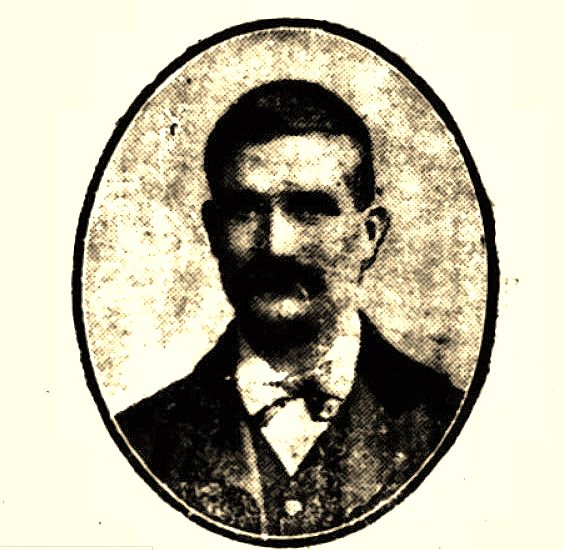
The Cellardyke Echo – 10/02/2022 – Issue 326

1870

WINTER HERRING FISHING. We are sorry to note the continued unsuccess of the fishing up to this date. The extreme stormy weather which has prevailed since Saturday up till yesterday has prevented all fishing operations, and the only additions we have to make this week are the takes of Friday and Saturday last, which amount to 340 crans. This only brings the season’s catch up to 693 crans, which is a serious falling off as compared with former years, there being at this time last year about 5000 crans. The weather having cleared up on Wednesday, the fishermen again prepared to go to sea, but none of the boats went out until Thursday morning. This continued dullness in the trade is much to be regretted, as there are a great number of buyers on the ground, and the prices are good.

The two boats which came in yesterday morning with about seven crans each, sold their fish at the extraordinary high price of 60s. per cran – a figure scarcely ever realised before, even in a winter herring fishing.

The undernoted a statement of the catch at Anstruther and Cellardyke for the week ending yesterday (Thursday) :

Boats out.          Highest.              Total crans         Prices.

Friday,                 90                         10                          180                        46s. to 52s.

Saturday,            65                         10                          160                        52s. to 55s.

Tuesday,             Stormy. No boats out.

Wednesday,       Stormy. No boats out.

Thursday,.          2                            7                            13                          60s. to —?s.

Total for the week           353

Previous Week,                  340

Total for the season,      693

At same date last year   5535

Do. year 1868.                  2330

Do. year 1867,                  1655

D0. year 1866,                  1410

1871

Man Drowned at Sea.

A dark gloom was thrown over this neighbourhood on Wednesday forenoon by the distressing rumour that Robert Drummond, one of the crew of the herring boat Elizabeth of Cellardyke (skipper Alex. Tarvit), had been drowned at sea. It appears that the boat was tacking towards the shore, when, as she was lying nearly becalmed after one of those passing gusts peculiar to light westerly winds, a flap of the sail had knocked the unfortunate man overboard. Instant efforts were made by Skipper Tarvit and the rest of the crew to save him ; but though the poor sufferer was so near the boat that the former touched him three times with his hand, and though three other boats were within hail of the fatal spot, yet notwithstanding all that could be done the luckless man sank into watery grave. Drummond, who was about forty years age, was a particularly strong and robust man, and, with the exception of the herring fishery, was usually employed a field labourer. He leaves a widow and seven young children helpless and unprovided for, and altogether seldom has there been as claimant an appeal to public sympathy and benevolence as in the present case. The calm weather had kept the boats long at sea, and the poor widow and her family were wearying, though by no means in alarm, for the well-known footstep, when the Rev. Cameron, the minister the parish, called to break the melancholy intelligence.

1873

A Saturday Night Spree.”—At Burgh Court held here on Saturday—Provost Todd and Bailie Bonthrone on the bench—Robert Anderson and David Wood, two young fishermen residing in Cellardyke, pleaded guilty to having committed breach of the peace by being drunk and disorderly opposite to the Salutation Inn towards midnight on Saturday week. It appears that the former panel had been taken into custody by the policeman and lodged in the lock up, but the circumstances of the case were of such a mitigated nature as to induce the Magistrates to impose the nominal penalty of fine of 5s.

Encouragement to Sabbath School Teachers. —On Thursday last, the Australian mail was the medium of bringing a most interesting and valuable gift to three well-known and much respected Sabbath School teachers in Cellardyke—namely, the venerable postmaster, Mr Thomas Brown, and his old associates in the same sacred task, Mr Thomas Cunningham and Mr William Watson, who each received a letter with a cheque for £10, as a token grateful remembrance and affectionate esteem for their labours in the Sabbath School which he attended in the years of his ” boyhood”, from Mr Alex. Watson, native of Cellardyke, and sometime ironmonger in Anstruther, but who emigrated about twenty years ago to Australia, where he has latterly been very successful at the gold mines.

1874

Brotherhood of the Sea.—One dark and stormy night some weeks ago, the boat of skipper Charles Carstairs of Cellardyke, was at the drift fishing, large sea going steamer ran foul of the gear and the rope, parting some eight or nine of the nets, which were carried away by the current and could not be found. This was a heavy loss, but such the everyday experience of the hardy fisher, though fortunately, in this case, the nets came the way of honest neighbours. These were the crew of the Cockenzie boat owned by Messrs Thomas Donaldson and Robert Johnstone, who took the nets on shore, and spread them as carefully the green as if they had been their own; but what is still more to their praise, they declined to take fee or reward for their trouble, on the missing gear being claimed the Cellardyke owners. A case like this may well lead to the reflection of how much ill-will and mischief at sea would be avoided, if sea-faring men would everywhere do, as in this instance, as they would like to be done by.

The Cellardyke Echo – 04/02/2022 – Issue 325

1862

Serious Accident.—On Monday, young woman belonging to Cellardyke, while crossing the street, was knocked over by a cart, laden with nets, which was passing at the time. The shaft of the cart struck the young woman in the breast, and before the cart could be stopped, one of the wheels had passed over her shoulder and legs. After medical aid had been procured, it was found that the injuries she had received, were not of so serious a nature as was at first suspected—one of her legs being broke, but not otherwise seriously injured. She is now in a fair way to recovery.

Early on Friday morning last, as the crew of one of the Cellardyke fishing-boats were in the act of drawing their nets at the fishing-ground, one of them observed the mast to be failing down. He at once gave the alarm, and his companions that could averted from the stroke, one, named Watson, seated in the stern, being unable to remove in time. It consequently fell upon him, crushing him severely. He was immediately brought into harbour, and conveyed to his home at Cellardyke. Dr Macarthur was forthwith in attendance, who pronounced him to have received some severe internal injuries. He at present lies in a very precarious state. The accident was caused by the pin or wedge of the hasp which keeps the mast in its position having come out by the rolling of the boat.

1864

A few days since, one pound bank note was circulation here, which had the following quaint couplet written its back :- You came me time of need, But off you went with railway speed.”

Cupar – The fortnightly Debt Court was held here Thursday—Sheriff Taylor presiding. There were only about a dozen cases on the roll, none of which possessed any points of interest or importance. The only case worth noticing was that of Hatch v. Skinner, which the pursuer sued the defender, who is a grocer in Cellardyke, for £8 15s, being the price a quantity of soap which, it was alleged, had been bought by the defender. The defence was that the soap was not according sample, and such that the defender could not sell—some of his customers returning it to him, after having purchased it.  A correspondence had taken place between the pursuer and the defender, from which it appeared, that the defender had threatened to send it back to the pursuer, and in reply the pursuer stated that, in order to settle the dispute, he would take back the soap if was put free on board the steamer for Leith. The soap had accordingly been returned to the defender, who at same time sent a post-office order the pursuer for 12s 5d, being the value of what he had used. The pursuer’s agent contended that ‘free on board the steamer” meant that the goods were to be sent on  to pursuer carriage paid, but the Sheriff considered the plain meaning of the words was simply that the goods were to be put on board free of all expense and that then pursuer was responsible. He did not think they could mean that the carriage through to the pursuer was to be paid by the defender. The Sheriff seemed prepared to give judgment in favour of the defender, but on the motion of the pursuer’s agent, who undertook to pay the defender expenses to Cupar, the case was remitted to the Small Debt Court at Colinsburgh. Mr C. Welch, writer, Cupar, as agent in this case for the pursuer, and Mr T Davidson for the defender.

The Herring Fishing.—Although have now entered on what, former years, has generally proved the most productive part of the season, little or no improvement has yet taken place, either to the results or prospects of the fishing on the Fife coast. On Tuesday and Friday last week several crews had cheering measure of success, but this was very far from being general. Since then, although the weather has continued favourable, little or nothing has been done—the highest takes only amounting to one or two crans. At the present date (Tuesday) the total quantity landed here and Cellardyke may be stated at about 2000 crans, which, although somewhat of increase as compared with last year, is still considerably under an average fishing. Owing to the limited supply the demand has again become more active —prices, in consequence, having again advanced to 35s and 37s per cran.

1865

Meeting of Fishermen.

On Friday evening last, a meeting of the fishermen of Cellardyke was convened by the town crier, and held in the Female School there. Nearly all the fishermen attended, and Mr Alexander Tarvit was elected to the chair, on taking which he stated that the meeting had been called to consider the advisability of having a suitable boat or coble stationed at Anstruther harbour to be ready for use in the event of any emergency. All present appeared to concur in the desirableness of the project, and it was all but unanimously agreed that the sum of 2s should be weekly contributed by each boat now prosecuting the herring fishing, the sum being continued for three weeks, when a total sum of about £18 would be collected — the estimate expense of the boat.

A committee was appointed to meet with the Commissioners of the Union and Harbour as to the obtaining of a proper place to deposit the boat when not required, and also to solicit them to use their best exertions to have a Manby Apparatus Station at Anstruther – a suggestion which, by the way, we earnestly urged a few weeks ago. In the course of the proceedings, the present by no means unreasonable dissatisfaction of the fishermen, was manifested at the ruinous state of the Anstruther Harbour works. The business then terminated with a vote of thanks to the Chairman. We cannot conclude this notice without expressing our sincere admiration of the praiseworthy spirit of self-help which on this, as indeed on all other occasions, so eminently distinguishes our fishermen; and we earnestly hope that their exemplary conduct will be appreciated as it ought to be by the Union and Harbour Commissioners, and that every encouragement and support will be afforded for the successful carrying out of these most desirable schemes.

1866

Anstruther Presentation. —On Monday evening, a number of the friends of Mr Allan Johnston met and presented him, on the occasion of his leaving the service the East of Fife Railway Co. as goods porter here, with elegant silver guard and a purse of money, which had been subscribed for the fishcurers and merchants of Anstruther and Cellardyke mark of their appreciation and regard for his uniform attention and civility. Mr Brown, coal merchant, presented the gifts in a few sensible remarks, which Mr Johnston suitably acknowledged.

Assault and Breach of the Peace. —A Burgh Court was held here on Saturday-Provost Todd and Bailie Brown on the bench—when the following cases were disposed:- of James Walker, fisherman, Cellardyke, was charged with having committed a breach of the peace, by quarrelling and fighting with Robert Gardener, another Cellardyke fisherman, in Shore Street, on the 25th December last; and also with having committed an assault on the said Robert Gardener, in the Eastgreen, on the same evening. The panel pleaded guilty the breach of the peace, but not the assault, when five witnesses were called and examined for the prosecution, and two for the defence. After hearing the evidence, the bench found the charge clearly proven, and sentenced Walker to a fine of 21s or twenty one days’ imprisonment in Cupar Jail. The before-mentioned Robert Gardener was then charged with having committed a breach of the peace at the same time and place, and having pleaded guilty as indicted, he was sentenced to a fine of 10s 6d, or ten days’ imprisonment in Cupar Jail. Both fines were paid.

Sad News. —The distressing intelligence has this week been received of the death, at Shanghai, of dysentery, on the 9th August, of fine young man, belonging to this place, of the name of Alex. Smith, son of Captain Wm. Smith, of Cellardyke. The unfortunate young man was a seaman on board the ship Neville, of Liverpool, which was then lying in port. The deceased was of quiet, kindly disposition and bore an excellent character; and the intelligence of his death has been received here with sincere sorrow and regret.

1868

The Great Ocean Race of 1868.

The homeward race of the magnificent China clippers will this year be as intensely and widely interesting as on any previous occasion. Indeed, we would almost warranted in anticipating that it will far exceed anything that has gone before it, as several splendid additions have been made to this already world-renowned fleet, which has given a prestige to the British mercantile navy, that leaves foreign competition out of the question. Already the national mind may be said to have been startled by the news from the Far East with regard to the performances of two of the ships which are doubtless to hold leading place in the coming contest. The clippers to which we allude, are the Lahloo, owned by Alexander Roger, Esq., of Glasgow, and commanded by Capt. John Smith, of Anstruther, and the Spindrift, the property of James Findlay, Esq.. Kilbirnie, the owner the celebrated Taeping, Serica, and Taitsing. Both ships may be fitly described as perfect specimens their class, having been specially built, as rivals for the China tea trade, in the Clyde last summer. They went round in August to load for Shaughae, but the Spindrift was enabled to leave port three days before her rival. “A stern chase is a long chase,” according to the-old saying, but notwithstanding this immense disadvantage in beginning the race, Captain Smith skilfully trimmed the sails of his gallant craft the wayward breeze,  and so ably piloted his course over the trackless deep, that the Lahloo reached her destination as soon as the Spindrift – the goal, we have said, being Shanghae, where they will both load the first teas of the season, and then start on the homeward passage for London. It will thus be seen that the Lahloo beat the Spindrift by three days, which is a feat certainly to be boasted of, the latter ship was built on entirely new principles, which led her owner confidently to anticipate that she would beat I everything afloat; but in the first instance, as we have shown, she has more than found her match in the Lahloo. From the fact that both the owner and the commander of the last mentioned ship are connected with the East of Fife—Alexander Rodger, Esq., being native of Cellardyke, and Captain Smith native of Anstruther—gives not only general but almost an individual interest to the homeward passage of the clippers.

1869

Accident.—On Wednesday, as Mr James Rodger, blacksmith, Cellardyke, and a party of men were lifting a large crab-winch from a” boggie” which had just brought it to his smithy door, the machine, from there not being strength enough at hand, fell over upon Mr Rodger, crushing him to the wall in most alarming manner. An instant effort was made for his release, when it was found that his left leg had been broken and the right one severely bruised, but are glad to learn that through the surgical skill of Dr Macarthur Mr Rodger is in a fair way recovery.

Tombstone.- A curious old gravestone has just turned in the churchyard of Kilrenny, where it has lain for many years, hidden beneath an accumulated mass of earth and herbage. Notwithstanding the neglect and rough usage with which the stone has been treated, both the sculpture and the inscription upon it are still in good preservation. On the upper part of the monument, a stately frigate, with courses and topsails set, and colours flying at mizzen-mast head, is seen running before the wind, while the waves are circling all around her. The prow and poop of the ancient ship rise high out of the sea, like some Dutch galliot of the present day, but the figure which has been doubtless designed as a symbol of a useful and prosperous life has been cut with considerable care and fidelity. Beneath this is the inscription, which runs as follows:— “Here lyes the corps of ane honest and vertuous man, James Brown, spouse to Agnis Foord, sometime a Bailie in Kilrenny; departed this life on December 22, 1673, and of his age 62.” On the lower part of the table those stern emblems of mortality, the skull and cross-bones, have been chiselled with great precision ; but have stated, neither the character of the worthy magistrate it commemorates, nor the quaintness of its device, has preserved the tombstone from contumely and insult. Originally the gravestone stood on four pillars, near Cardinal Beaton’s tomb, where it now lies on the grass, but many years ago it was put over the grave of an old inhabitant of Cellardyke, where it had continued to be until the grave was reopened the other day for one of her family. A tradition exists amongst some of the old inhabitants of Cellardyke that this stone records the wreck of a large three masted vessel amongst the rocks the east end of Cellardyke, when several of the sailors were drowned; but there is nothing about the monument itself to confirm or countenance such a legend. In Kilrenny churchyard there are many interesting monuments of antiquity, such as the curious relic we have just adverted to and the remarkable epitaph on Mr Beats’ tomb, given over to neglect, or fast mouldering to decay; but we trust that when the burying ground comes to be enlarged and improved—as there is now early prospect—some steps will be taken for their better preservation.

The Cellardyke Echo – 27/01/2022 – Issue 324

1930

NEW TYPE OF FISHING BOAT. –

Bailie W. W. Carstairs, Cellardyke, recently constructed two special motor “bauldies” as an experiment, and the results of fishing tests have proved very satisfactory. His object was to construct a vessel which would be within the reach of owner fishermen so far as capital outlay was concerned, and would at the same time bring in a reasonable remuneration for the other fishermen. Each boat is fitted with wireless, is provided with small boat, and is lit throughout by electricity. Another novel feature is a high-power electric searchlight. The running costs of these new boats is about £1 per 100 miles. As the construction of these boats cost much less than the old style steam drifter and a great saving in running expenses is effected, they  may adopted as a new type of fishing, boat. Mr Adamson, The Secretary of State for Scotland, is taking interest in the experiments. The two new boats have been named the “Winaway” and the “Onaway.” The latter was at Yarmouth when so much gear was lost, and proved herself a most sea-worthy boat, She came into harbour drier than any drifter, and had it not been for her special electric searchlight she might have lost her whole fleet of nets.

SUBJECTS AT No. 6 DOVE STREET, CELLARDVKE, FOR SALE.

For Sale, by Public Roup, by Warrant of the Sheriff, in an Application for Division and Sale, within THE COUNCIL CHAMBER, ANSTRUTHER EASTER, on WEDNESDAY, the 29th Day January 1930, at two o’clock in the afternoon.

That tenement of dwelling houses, with Pertinents, situated at No. 6 DOVE STREET, Cellardyke, and occupied Mary Gourlay, Alexander. McRuvie, and George Gardner. Rental, £16 15s. Feu Duty Nominal.

REDUCED UPSET PRICE, £125. Further particulars may be obtained from D. &, A. COOK, Solicitors, Anstruther, who hold the Title Deeds and Articles of Roup.

W. S. BONTHRON, Auctioneer. Anstruther. 9th  January 1930.

1931

CELLARDYKE GOLFER’S SUCCESS IN AMERICA.

A well-known Cellardyke golfer, John C Watson, now professional with Erskine Club, Southbend, U.S.A., was placed fourth in the recent Fort Lauderdale open tournament.

Watson’s 216 was only three strokes more than the winner. Johnny Farrell and Willie Klein tied for second place with cards of 214 each.

1932

STAFF DANCE AT ANSTRUTHER. The staff of Gardner’s Motor Service, Anstruther, held their annual dinner and dance in Cellardyke Town Hall. A company of  70 sat down to an excellent dinner purveyed Mr G. M. Birrell. Anstruther.

Songs were rendered Mrs Gowans.  St Monance; Miss Keay; Messrs Henry Gibbon and J. Smith. A comic recital was given by Messrs George Gardner, T. Allan, A. Clark, and J. Smith. Mr John Mackay delighted the company with the Highland Fling. The accompanists were Mrs Gowans, St Monance, and Mr Jackson, Crail, and the M.C.s were Mr W. Brown. Pittenweem, and Mr J. Stewart, St Monance.

1933

CELLARDYKE BAZAAR.

Cellardyke Improvements Committee held a bazaar in Anstruther Town Hall with view to raising funds to defray the cost of the new bathing and model-yachting pond at Cellardyke. Over £450 was realised.

Provost Carstairs declared the bazaar open. He suggested that the pond should be given a distinctive name, such the “Cardinal Steps Bathing Pond.” The stallholders were:—Mrs Anderson, Mrs Boyter, Mrs Butters, Miss Smith, Airs Maxwell, Mrs Wilson, Mrs Fortune, Mrs Gardner, Mrs Bett, Mrs Mitchell, Mrs Watson, Miss Isa Henderson, and Mrs Birrell. Mrs Hosie and Mrs Swinton supervised the tea arrangements, and Messrs John Harrow and James Laing were in charge of the amusements.

1934

Burns Celebration at Cellardyke

Anstruther and Cellardyke Burns Club held their annual supper in the reading room, Cellardyke. Mr H C Maxwell presided.

“The Immortal Memory” was proposed by Mr W Wishart Thomson rector of the Waid Academy. Other toasts included:- “Town and Trade£ Provost Lawson, Pittenweem, reply ex Provost Readdie and Mr Sutherland; “The Lassies” Mr J W Diack, reply Mr J Russell; “Kindred Clubs” Mr J Hunter, reply by Mr J Bruce, Pittenweem.

Community singing was led by Mr W R Small at the piano, Solos were rendered by Messrs Nicholson, Hodge, Jack, Riddel, Morrison, David reid and Andrew Black, and a trio was given by Messrs Riddel, Hodge and Jack. The following contributed recitations;- Messrs Tawse, J Y Hunter, Leslie Brown, Tait. Philip Anderson, R Bruce and Hodge, ex-Provost Readdie and Baillie Simpson.

Town Hall Heating. Bailie Mitchell at Anstruther Town Council moved that a proper heating system be installed in Cellardyke Town Hall. Provost Carstairs favoured the proposal, and suggested that a radiator should put into the reading-room. The matter was deferred. A letter was received from Cellardyke Ratepayers’ Association advising the Council consider the cleaning of the beaches Cellardyke and Anstruther. This was deferred to committee for consideration. On the suggestion of Councillor McAuslin it was agreed to consider the question of procuring covered carts for the collection of street refuse.

1935

OFFICIAL NOTICE-PROPOSAL TO CHANGE A SHIPS NAME.

I, JOHN THOMAS GRAHAM, Jun., of Thordisa. Anstruther, HEREBY GIVE NOTICE, That, in consequence Change Ownership, have applied to the Board Trade, under section 47 of the Merchant Shipping Act, 1894, in respect my Ship, “CAMPANULA,’ of Kirkcaldy (official number 131873, of gross tonnage 95.97 tons, of register tonnage 37.31 tons), heretofore owned by John Thomas Graham and James Bruce Graham, North-Eastern Railway Buildings, Hartlepool; John Thomas Graham, jun., Thordisa, Anstruther; and George  Doig of 7 George Street, Cellardyke, for Permission to CHANGE HER NAME  to “MEMORIA,” to be Registered in the said new name the port of Kirkcaldy owned myself and others. Any OBJECTIONS to the proposed Change Name must be sent the Registrar General Shipping and Seamen, Tower Hill, E.C.3, within Seven Days from the appearance of this advertisement. Dated at Anstruther this 26th day of January 1935.

M.P. AT CELLARDYKE SOCIAL. A social organised by the Cardinal’s Steps Swimming Club was held in Cellardyke Town Hall, when an addresses were given Provost W. W. Carstairs and Mr J. Henderson Stewart, M.P.

Mr MacIntyre presided, and a programme was sustained by Mrs Henderson Stewart, Provost Carstairs, Mrs Myles, Mrs Scott, Messrs M. Sutherland, Weir, Jack, Higgins. Dances were given by the Misses Muir, Nessie and Elsie Wallace. The accompanists were Miss Smith, Miss Lawson and W. R. Small.

1936

Miss N. S. Oliphant, Mayview, Anstruther, has been presented by the Guild of the Church of Scotland with their long service medal and certificate, granted only to those who have served long in an official capacity in the woman’s guild. Miss Oliphant became secretary of the newly-formed branch of the woman’s guild in Cellardyke Church in 1883, and served in that capacity without a break until last year, when, owing to failing health, she resigned. In addition, she was secretary to the Presbyterial Auxiliary of the Women’s Association for Foreign Missions for 19 years. She has also given service as trustee and manager of Cellardyke Church, the first woman to occupy this position. The presentation was of a private nature owing to Miss Oliphant’s illness.

East Fife Model Sailing Club held whist drive and dance in Cellardyke Town Hall. At whist 29 tables were occupied. Councillor Laing was cardmaster, and prizes were presented to the following by Mrs D. C. Wilson:—Ladies —1 Mrs James Watson, 2 Mrs Tom Melville, Mrs James Scott; consolation, Mrs Jeannie Stewart; longest fitter, Miss B. Watson. Gentlemen William Smith, Robert Watson. Peter Muir; consolation, James Aitken; longest sitter, John Murray.

CYCLIST PITCHED OVER HARBOUR BULWARK CELLARDYKE GROCER’S INJURIES. Peter Penman, grocer. Cellardyke Shore Street. Anstruther, was admitted to Dundee Royal Infirmary with a fractured thigh sustained in accident at Cellardyke.

He was cycling down the steep gradient from Dove Street to Shore Street when swerved to avoid a collision with car. He struck the dike of the bulwark of Cellardyke harbour, and was pitched over -the dike, falling to the stone surface below. The driver of the car conveyed Penman home, and after attention by Dr M. D. S. Armour was removed by ambulance to the infirmary.

1937

CELLARDYKE S BABY SEAL A baby seal has been captured by Mr G. Corstorphine. John Street, Cellardyke.  Mr Corstorphine was walking the rocks at. Cellardyke when found the grey-white baby seal. When approached the animal showed fight, but he managed to capture it and carry it home in basket. He communicated with the Zoological Society authorities in Edinburgh. Mr Corstorphine has been feeding it herring.

A baby seal found on the shore at Cellardyke was taken to the Zoo at Murrayfield. The seal was found disporting itself in a hollow on the shore.

SEAL DIES IN MOTOR CAR The seal which was captured last week by Mr G. Corstorphine, John Street, Cellardyke, has died 0n its way to the Zoological Gardens at Edinburgh. A motorist took the seal in the back of his car to the Zoo. He crossed the ferry, and arrived at the Lothian side with the seal very much alive. When he arrived at the gates of the Zoo he looked into the back of the car found that his charge had died. The Zoo officials told him that the foundling had died of starvation. It had been fed on herring, but it was incapable of digesting anything beyond milk. They pointed out to him that it was well-nigh impossible to keep a seal in captivity, although at Edinburgh they tried many times.

1938

FLYING FAIR-LEAD KILLS FISHER

JURY’S VERDICT ON ANSTRUTHER MISHAP

 A fatal accident on a Steam Drifter in Anstruther Harbour last month was subject of an inquiry before Hon Sheriff A. E. Grosset and jury.

William McBain (32), fisherman 32 Shore Street, Cellardyke, died 0n December? from a broken neck. He was struck on the head by a fair-lead, which broke while he was working on the drifter Twinkling Star

The jury returned a formal verdict

Evidence of crew and harbourmaster was to the effect that the drifter, lying with stern to the mouth of the harbour, was manoeuvred so that it might leave first. A four-inch rope was passed round the fair-lead and attached breadwinner.  The strain, however, was so great that a 12lb. piece of the fairlead broke off.  At first it was thought that the rope had broken, but later the broken lead was found on the deck about 16 feet away.

McBain dropped at the feet of his mate who did not know what had happened to him. He was taken ashore and examined it was found he had been killed instantaneously.

1939

At a speech by the Convenor of Fife County Council on the industries of the county…

….Another industry was the making of waterproofs in Cellardyke by Martin Co., whose products were worn and borne Commander Amundsen when, some ten years ago, flew from Alaska to Spitsbergen.

Broughty Lifeboat

Broughty Ferry motor lifeboat had to make a trip to the Abertay Lightship to take off Mr Thomas Wilson, Cellardyke, a member of the crew, whose wife was seriously ill. She had been ill for some time and her condition became worse at the weekend.

A relative in Cellardyke got in touch with Dundee Harbour authorities, and asked them to endeavour to convey the news to Wilson and bring him ashore if possible.

In view of the urgency of the request, the harbour management asked the R.N.L.I. for the services of the lifeboat. Without firing the gun, which is the usual signal for launching, a crew of six men was quickly collected, with Coxswain James Coull in command and John Grieve as motorman.

Some of the men had hastily donned oilskins over their Sunday clothes.

The lifeboat carried Mr George Watson, Fisher Street, Broughty Ferry, a harbour employee, who was called out to take Wilson’s place on the Abertay. Leaving shortly before 2 p.m.. the lifeboat was alongside the Abertay within half an hour.

Coxswain Coull said :—”We shouted our news to the Abertay, and lay off for a few minutes while Wilson got ready to leave. We had no difficulty in taking him off.” Leaving the lightship shortly before three, the lifeboat reached Newport soon after 4 p.m. and put Wilson ashore.

The trip—the first of the year—will serve as the monthly practice which has to be carried out by the lifeboat. Mr Wilson resides at 25 East Forth Street. Cellardyke, and has been employed on the Abertay for about nine months. Previously he was fireman and engineer on the Anstruther drifter Evening Star. He went to the lightship last week for a month’s spell of duty.

The Cellardyke Echo – 20/01/2022 – Issue 323

1895

 The Storm – At Cellardyke Harbour the heavy stones forming the top of the east pier were lifted out of their places and flung into the basin, leaving the pier a very precarious condition. The yards lying next the sea were flooded, and in several cases damage inflicted to cellars and walls.

ln the Town Hall on Saturday evening, the Young Men’s Christian Association gave their annual entertainment to the old women of Cellardyke There was a large attendance, and after tea suitable addresses were delivered by various gentlemen. A very pleasant evening was spent.

MEETING of FISHERMEN.

On Monday evening a meeting of fishermen was held in the Town Hall. Mr R. Montador presided over a fair attendance. The delegate to the conference at Aberdeen, Mr John Carstairs, gave a report of the proceedings and findings of the meeting. He had expressed the views of the Cellardyke fishermen, but the majority had voted in favour of the close time for the East Coast being fixed from 10th June to 10th July. He also reported the resolution in favour of a General Association of Scotch fishermen, which he considered would be of great service to the industry. His statement was approved, and he was awarded a cordial vote of thanks. Discussion ensued as to the adoption of some means for the better securing of the boats during gales in Anstruther harbour, and it was resolved to send a deputation to the Harbour Commissioners on the subject Messrs Montador, Carstairs, and T. Watson were appointed for this purpose.

The nets, fifteen in all, that were brought into Berwick by some fishing boats on Saturday afternoon have been identified the property’ of John Wood, Cellardyke, Fife.

1896

THE PRICE OF A JUMP INTO THE HARBOUR. At the Burgh Court on Monday, before Provost Anderson and Bailie Morton, Dal id Davidson, fisherman, Cellardyke, pled guilty to a breach of the peace in Rodger and Shore Streets, and leaping into the harbour to the danger of his life on New Year’s day. One previous conviction was recorded against him. The Provost in imposing a fine of is 6d or seven days, advised him to keep clear of liquor, as his foolishness on this occasion might have led to his death had not some of his friends assisted him. Fine paid.

THE PITTENWEEM AND CELLARDYKE FISHING COMPAN Y. —The directors have issued a report to the shareholders in which they regret to state that the vessel purchased by the Company called the Emerald turned out badly, and the working of it proved most unprofitable. As the shareholders may be aware, this vessel sometime after she was purchased, instead of earning any profits, continually required repairs, thus causing considerable loss to the shareholders, and the debt was always accumulating so long as she was held by the Company. After several unsuccessful attempts to sell the vessel at something like the original price, the directors agreed to dispose of her at a heavy loss, as shown by the accounts, after receiving the approval of the shareholders. Notwithstanding this loss, the directors are convinced that, in disposing of the vessel, the best course has been followed in the interests of the shareholders under the circumstances. Seeing therefore that the only vessel belonging to the Company has been sold, and looking to the state of accounts submitted, the directors recommend that the Company should now be wound up voluntarily. The directors beg to intimate therefore that an extraordinary general meeting of the Company will be held on 3rd February, immediately after the general meeting, when the following special resolution will be submitted to the meeting, viz.:—That the Pittenweem and Cellardyke Fishing Company, Limited, be wound up voluntarily, and that John Guthrie, solicitor, Anstruther, be appointed liquidator for winding up said Company. Should this resolution be carried, another meeting of the shareholders will fall to be held on a date to be fixed by the above meeting for the purposes of confirming the resolution.

CELLARDYKE. AN ASSOCIATION FOOTBALL GAME IN TACOMA. —One feature of the Christmas celebration was a game of association football between teams from the crews of the British ships Eaton Hall and Norfolk Island. As several of the men were noted players of England and Wales, strong rivalry was infused into the game, each ship claiming to have the best players. Eaton Hall won by a score of 2 to 1. Norfolk Island scored its punt in the first half, and Eaton Hall one punt in each half. Mr John Montador and Mr Alex. McRuvie, both belonging to Cellardyke, were in the Eaton Hall team.

CELEBRATION OF A DIAMOND WEDDING.–At their residence, 39 Primrose Street, Leith, on Saturday, Mr and Mrs James Doig celebrated their diamond wedding Mr Doig was a native of Cellardyke, while Mrs Doig’s father was in the Milton Mill, West Anstruther. The wedding took place at Anstruther on the 18th January 1830, the officiating minister being the Rev. James Findlay, U.P. Church, Pittenweem, the parties being described as James Doig, weaver, and Margaret, youngest daughter of John Balfour, Milton Mill. Mr and Mrs Doig received many congratulations from relatives and friends on the interesting occasion.

AN UNPROVOKED ASSAULT. —A young man, named Thomas Murray Jnr, Fisherman, was charged before Provost Martin and Bailie Thomas on Monday, with having on New Year’s day, assaulted two fishermen by striking them with his clenched fists several blows on the right eyes to the effusion of blood, and then creating a disturbance in George Street. Three previous convictions were recorded against him. The Fiscal said the assault was very cowardly and unprovoked. He first struck an old man, and when the young man went to his assistance, struck him also. He was sorry that he had so many previous convictions to bring forward against him. He was under the influence of drink, but people should not take liquor when it leads them to this. The Provost said it was most painful for the Magistrates to have a young man before them on such a charge, and with three previous convictions against him. He would be fined on this occasion. They were dealing very leniently with him to give him another chance, but he would be fined very heavily if he came before them again. He advised him to give up the drink, and turn over a new leaf.

1897

St Andrews Police Court. On Friday, before Bailie Murray, Robert Keith, fish-hawker, Cellardyke, was fined 21s, or fourteen days, for being drunk while charge of a cart in public thoroughfare.

ELIE. FISHING BOATS IN THE GALE.–The storm on Thursday caught the East of Fife boats which were engaged at the herring fishing. A number of them bore up for their own ports, but two, the James of Cellardyke and a St Monans boat made for Elie harbour under difficulties. The James had a broken yard and the other bolt a broken mast, each making the harbour under jury rig.

1898

Brothers Quarrelling.— At Cellardyke Burgh Court  on Saturday two brothers, named James and Robert Keith were charged with their brother Alexander at his own house on the 3rd inst. by striking and kicking him. After evidence had been led, the charge was found proven against Robert, and he was sentenced to pay 30s, or one mouth’s in Dundee Prison. He was taken to prison, but the fine was afterwards paid.

“Coaties” V. Bluejackets. The formation of the K.Y. team at Kilrenny has given young Cellardyke a chance s to try his foot at the game, in which at one time he had few masters. The team was originally composed of shoemakers, but the fishermen are getting places in it, and on Saturday there was quite an Anster v. Cellardyke flavour in the match—Rangers v. K.Y. It was fought out on the latter’s pitch. The Rangers had a lot of budding young players on trial They gave a fine exhibition. A pleasant game was played, ending in a draw of two goals each.

DIAMOND WEDDING CELEBRATIONS. IN CELLARDYKE.

Mr and Mrs Robert Brown, West Forth Street, Cellardyke, celebrated their diamond wedding on Wednesday evening A notice of the wedding in 1838, appears in another column. Mr Brown is a native of Fisherrow, where he was born, on 16th June 1816. When a young boy at school his father came to reside in Cellardyke, and he received the most of his education at the Parish School. He began life as a fisherman, and he helped his father, who at that time acted at what were known as “coupers” that is taking the haddocks from the Cellardyke boats, and sailing to ports up the Firth with them and disposing of them to the best advantage. The herring fishing was prosecuted with success in the Firth at that time, and the boats in use were the old open boats. Mr Brown was a very successful fisherman, and retired from the sea in 1881, 17 years ago. He ‘was first appointed to the Council in 1881, and served several terms, being twice elected one of the Magistrates. He was also one of the first Harbour Commissioners to be elected for Cellardyke by the electors. Mr Brown connected himself with the Free Church at the Disruption, and in 1845 was made an elder, an office he still continues to hold. Mrs. Brown is a native of Kingsbarns. The couple are still able to go about, and as a mark of the interesting occasion had their photographs taken by Mr Ireland on Monday afternoon. In the evening the couple entertained a number of people to tea. After partaking of this, The Rev. A. G. Macalpine, addressing Mr and Mrs Brown, said that on his own behalf, as well as that of his fellow guests, he tendered their thanks—cordial and sincere for the double honour enjoyed—the one in being invited to sit as guests at their most hospitable table, and the other in being privileged to share with them the honour of celebrating this most unique and auspicious event—their Diamond Wedding. Of course their relationship did not carry them very far among those six decades of years—but they did carry them sufficiently far back as to enable him to have a glimpse of the splendid achievement, the beautiful record, and the irreproachable character which they have been enabled to lead during these years. Speaking for himself, he was proud in being able to acknowledge that during these 13 years of their church relationship, years of Christian work, of congregational activity, and of manifold engagement, not one single look, word, or act, had ever marred their friendship, chilled their affection, or lessened their esteem. On the contrary these bonds were’ stronger, warmer, and deeper than they were years ago. In fact as his minister, he was compelled to say that never on entering his home, whether shadowed by sickness or bright with sunshine, had he met him in two moods, invariably the same, kind, sympathetic, genial, helpful, courteous. That was his experience; and he inferred that that was only a symbol of what their home had been during these 60 years. One writer of the highest order says that friendship is one heart in two bodies; and surely both of them could testify to the accuracy of this pleasing thought, Sixty years, what a history! What a memory: what a contrast! The countless blessings received, the paths—solitary and yet interlaced and combined–along which they had walked, the sore and severe trials and sure triumphs ; imminent pearls at sea, and the varied dangers ashore; the consciousness of their failures and the attainments of a closer walk with God, all voice themselves from the irrevocable past, and call for profound thanksgiving, admiring wonder, and deep humiliation. Proceeding, he continued—Sixty years ago, in the bloom of youth when you stood at the marriage altar, you, Mr Brown, with all the buoyancy and elasticity of manhood, and you, Mrs Brown, with all the beauty and simplicity and winsomeness of a young bride, when you stood at the altar you looked into the future with all its possibilities and contingencies, and joined heart and hand with your motto “Mizpah” ; but now when you look back tonight you can say “Ebenezer.” But your own thoughts, secret end sacred, we cannot intermeddle: but as your guests we combine in acknowledging the wonderful Hand of God that has been upon you, we rejoice in the beauty and integrity, of your character, and we are assured that the peacefulness of your bearing and the purity of your home, as well as the effort, so manifold, and varied, so assiduous and ungrudging, rendered in your early years have gone very far to the up-building and solidifying of tit: character in our community. I am convinced that yours is the experience of an old couple whom I knelt in the south. Both were frail and walked by the help of a staff. One day I asked the grandmother “whether she was not tired of her husband yet.” “Tired” said she with a smile smoothing her wrinkled countenance, ” We have been married for 55 years, and the honeymoon is not past yet.” And lam glad to think that Mr Brown holds the same opinion. But whether this is to be the last of our annual meetings in your hospitable home, or whether we may be honoured with an invitation to the celebration of your ruby marriage we all feel that our rejoicings are tinged with sadness and sorrow. Some are now at your Diamond wedding who were not at your golden wedding, and some were then present who are now no more. To those widows who are at their own hearths sitting under their bereavement, and were joyfully only a few months ago, walking on the edge of the sunshine of their golden wedding, we proffer our deepest condolence; to those who by growing infirmities and the burden of years are compelled to remain at home we extend our warm sympathy, and to you, clearly beloved friends, Mr and Mrs Brown, we again offer you heartiest congratulations.

Thereupon Mr Macalpine presented the aged couple with an address signed by all the office bearers of the Chalmers Memorial Church, Anstruther, and at the same time begged their acceptance of a purse and sovereigns, as a small token of the esteem and affection in which they are held by all the members of the Congregation.

Mr and Mrs Brown

Honoured Friends—We, the undersigned office bearers of the Chalmers Memorial Church, Anstruther, gladly avail ourselves of this most auspicious occasion, your diamond wedding , in presenting to you our united congratulations and best wishes.

Rarely has the happy and holy bonds of matrimony continued so long as 80 years, and therefore most exceptional must be the honour which a benign Providence has vouchsafed upon you. Consequently in your rejoicing we also joy and join you in laying our tribute of gratitude and praise at the feet of our gracious Lord and Master. Further we are impelled to say that the integrity of your character, the assiduity with which you have devoted yourself to Christian service, and the blamelessness of your lives, have endeared you, not only to ourselves and to the members of our congregation, but also to very many of your fellow-townsmen.

To you, honoured sir, we tender our deep indebtedness, for during the many years you have held office in our Church, you have ever been a safe and cautious counsellor, and a warm-hearted and generous friend.

In token of our admiration for your own and your life partners character, we have much pleasure in asking your acceptance of this address along with a purse and sovereigns, at the same time expressing a hope that the divine hand which has guided you hitherto will guide you and your wife to the close of life, and thereafter lead you to the homeland of the King.

Signed by A. Gillon Macalpine, Minister.  Elders and Deacons ( all listed)

……. Mr Macalpine said he had a further duty to discharge, viz., to present an address from the Young Men’s Guild, and one from the Band of Hope….. ( a similarly long statement).

Mr Brown rose under considerable emotion, and, in suitably acknowledging the presentations’, warmly thanked the friends for their kindness in responding to their invitation, acknowledged the goodness of God in giving him such a good wife, rehearsed some trials incidental to such a long stretch of years, and humorously referred to some experiences that led up to the happy consummation of the event which they were now commemorating.

Mr Barbour, teacher, said that he counted it a great pleasure to be present on such an occasion as the celebration of a Diamond Wedding. For Mr and Mrs Brown he had the very highest regard, and was inclined to endorse what the boy said “Robert Brown is the best man in all the town.” Ever since he came to the town he had observed Mr Brown’s character, and always it was the same, uniform and consistent. In a few choice words he warmly congratulated their friends on their Diamond Wedding, and wished them health, happiness, and years…………..

1899

ON THE LIGHTING OF CELLARDYKE WITH GAS. BY A FISHERMAN.

Some folks in our town are going stark mad,

Because they are getting light

Into their streets, and they do vow

To oppose it with all their might,

For they count it here entire abomination

For the Ballies to bring in such an expensive innovation.

For if they get such light, d’ye see,

It will set the town in such a flame,

That when they get upon the spree,

 A’ body will ken their name.

Na, na, the Cellardyke folk are no sic asses,

To brook such nasty stinking gases.

As true as I’m here, it really beats a’,

To hear their dreadful sighing;

Here, some women are roaring with rage,

And there, some old women are crying,

That they all should stick out for the good old way,

So that they might know the night from the day.

A little while now, and you’ll hear of fun,

About these terrible lamps,

For I hear of one who is strong against them,

And when he thinks of the lamps he stamps,

And vows, the first man who a light doth raise,

He’ll be his sworn enemy a’ his days.

I’m painfully affected such news for to hear

of some of the folks of Cellardyke ;

Instigators, I’ve no doubt they have,

Else they never would do the like.

But I hope soon to get better news,

And say that the Dykers have chang’d their views.

The cellardyke Echo – 13/01/2022 – Issue 322

1890

ELIE. Return Football Match.

On Saturday, the Elie United met on their ground the Bluejacket team from Cellardyke. Elie won the toss but the Bluejackets pressed them hard during the first half, scoring 3 goals to Elie nil. In the second half the game was easier played, but the Blues again carried off the goals, securing a second 3 to 0, and claimed a fourth goal. Play, on the part of the strangers particularly, was rough, and some of the Elie team had to betake themselves to bed to recruit.

1891

The Late Mr John Anderson —Mr John Anderson, of the Forth Tavern, who has been unwell for several months, died at his house on Monday morning, within four days of his 69th  year. Deceased was a native of Cellardyke, and began life as a grocer. He commenced business for himself at the Bridge 46 years ago, and used the Stenters as his bottling establishment, where he carried on a large trade. He changed from there to the harbour head 26 years ago, sometime after the erection of the new harbour had commenced. He remained theres ever since, but the expectations entertained by himself and so many others as to the prosperity of Anstruther being vastly increased by the harbour were never realised, nor from present appearances are ever likely to be. Mr Anderson kept up a life-lung correspondence with the Rev. Mr Ferrie in America, who was at one time minister of Kilconquhar, but came out at the Disruption in 1843, It was only last year that he raised a jubilee testimonial to Mr Ferris, who still lives and carries on his ministerial labours. The funeral took place on Wednesday to Kilrenny Churchyard, and was largely attended.

At Dunfermline Poultry show last week, Alex. Drysdale, Anstruther, obtained third and fourth tickets in the owl class, and at Forfar was also successful in gaining a third card. R. A. Fowler, Cellardyke, was first at Leslie in the Hamburgh class, and John Butters third at the same show with a turbit in turbit and owl class.

Anstruther harbour board – It was agreed to accept the offer of £15 by a Port Essie skipper for the deep sea boat, “John Bunyan,” KY 1197 of Cellardyke, which has been lying in the harbour since the death of the owner, and to restrict the claim to £6, paying the balance to the widow.  (Duncan McRuvie was the skipper/owner in 1889)

1892

At a special meeting of Cellardyke Parochial Board on Saturday, Dr Wilson, Elm Lodge, was appointed medical officer of the parish by 26 votes against 25 for Dr Ferguson.

THE APPOINTMENT OF A MEDICAL OFFICER – -The election of a medical officer at Cellardyke last Saturday, for the parish of Kilrenny, shows how much keen and partisan feeling can be exhibited in an appointment of this kind. People seem to have as strong feelings for their doctors as they have for their ministers, for the meeting brought out some who never take the trouble to bother themselves about the administration the Poor Law except when they have a special end to serve in the spoils of office being given to some personal friend or relative. Apart altogether, however, from the appointment which has been made, it does seem strange that when the Cellardyke members got the chance of getting a medical officer for themselves only, and not one holding the same offices in other parishes, they should not have been anxious to have stipulated for this. It is patent to all that the poor would have been better looked after by one medical gentleman confined to the parish, than by one who is the officer for three or four parishes. But apparently partisan feeling is too strong in some people to look at what is best for the interests of the poor of the parish. It is a miserable excuse, but is the only one that can be traceable from the action of the majority.

1893

CELLARDYKE. FORTH STREET HALL SUNDAY SCHOOL

The annual reunion of this school took place on Monday night—Provost Martin presiding. His remarks, full of exhortation and advice, contained also a hopeful report on the state of the school and the work. The number on the roll was 230, and the average attendance 200. The repetition of the fifty-two texts learned in the course of the year had resulted in thirty-five managing without one mistake, and thirteen failing in two. The teaching staff numbered thirty. The Young Men and Women’s Bible Class was flourishing, and an average of 70 now attended. There had been over £92 collected for mission purposes, and, taking the year altogether, it had been prosperous. The Rev. Messrs Macalpine, Anderson, and Gregory also delivered appropriate addresses, while the choir rendered sacred pieces during the evening. The usual compliments to the Chairman, kn., terminated the meeting.

A very curious incident is reported to us from the East Neuk. A young woman was proceeding along one of the streets Cellardyke on some message when a gallant, with the intention having some fun, let fly a snowball. It struck the young woman on the cheek, and she turned, no doubt, highly indignant at the insult. This was, however, speedily changed into triumphant laugh, for she found embedded amongst the snow stuck on her face silver sixpence. It is not said the thrower intended the gift.

Intimation has been received that the three inspectors, who are to take evidence of Scottish fishermen on the subject of Irish South Coast Fisheries, are to hold an inquiry in Cellardyke Town Hall, on Tuesday, 31st  instant, at 12.30 These inquiries are being held by the Irish Fisheries Inspectors in pursuance of a request of his Excellency the Lord Lieutenant of Ireland, to whom the Inspectors will report on the completion of their inquiries in Scotland on the subject of the evidence tendered by the fishermen in connection with the early herring fishing in the Irish South Coast waters, and the effect of such fishing on the Irish mackerel fishing industry. From the fishermen’s point of view these inquiries are of a very important nature.

1894

Crail New Years Day – At night a ball was carried through with great glee in the Town Hall dancing being indulged in till well on in the morning. The only other thing in the nature of an entertainment was the conduct of several fishermen, said to be from Cellardyke, who were very much the worse of drink, and made sad exhibitions of themselves on the streets, not a few being bespattered with mud, from the face downwards. One worse than his chums had evidently been interviewing the metal on the roads, and had got a poor reception, judging from the blood and dirt about him. But for this invasion the town would have been quite dull.

The steamers had gone out on Thursday, and now returned. Captain Lyall, seeing the heavy sea sweeping over the east pier, and knowing how quickly the waves would master any vessel caught broadside on, hoisted a signal for them to stand off. The Maggie Lauder was twice put to the entrance, but Skipper Sheriff eventually steered for Leith. A little later the Tennant hove in sight, and made straight for Anstruther. Although the flag might not have stopped her, the sight of the waves, which every instant rose high over the piers and rolled away to the west, showed the great danger, and Skipper Gourlay followed the example the Maggie. The shots were small, and, as they managed one trip, the earnings were not high. Only one boat came into Anstruther—the Resolute—landing fifteen crans at 13s each.

A new impetus was given to the fishing on Monday. All the boats were out, and nearly two hundred lights might have been descried between Fidra and Methil, the favoured spot at present. On the following morning fifty boats were back with the first tide. The demand for bait took away a few crans at 20s each. A fair quantity was sold at 15s to 19s. In the afternoon ten boats landed average of seven crans, and these drew 12s each. Nor did the returns of Wednesday prove less encouraging. The average was not so high, but the fishing was general. In the afternoon the wind was light and baffling, so that the task of getting out was very tedious. Only about a score managed it, they had a long tack ere they could reach the shoals. They returned well fished, but now the price had fallen to 8s. The wind was so high on Thursday that no boats left the harbour.

The liners have now a plentiful supply of bait close at hand. They have not been able to get far to sea yet, and the takes are small. The Anster Fair made a couple of trips, grossing £49, the Edith £26, the Maggie £5 for one shot, the Rob £11, the Tennant £12, and the Effort £5.

On Tuesday the Jeannie Wood, of Cellardyke, came sweeping through the inner entrance with much speed that she ran into the Lady James and damaged her stern. The schooner was not ready for sea, and so Mr Jarvis has been able to repair her ere the cargo of potatoes was completed. The damage will be within £5.

The Cellardyke Echo – 6/1/2022 – Issue 321

1916

Under will of the late Mr John Williamson, late of Claughton Grange, Birkenhead, native of Cellardyke, the sum of £200 has been left for distribution among the deserving poor and West Anstruther, Cellardyke, and Kilrenny. (The total he left was £111, 779 modern day equivalent £9,943,171.97) £20, 000 was left to Birkenhead council which eventually went to the Art Gallery and museum mentioned last week

The public school was re-opened on Tuesday.

Private N. Bowman, stretcher – bearer, 1/7th  Black Watch, arrived home from France on Saturday for a few days ‘furlough. He declares himself to be as tit as a fiddle.

Vital Statistics.-The births registered for 1915 numbered 47, the deaths 25, and the marriages 10. Of the deaths notified, 7 were between the ages of 70 and 80, and 4 between the ages of 80 and 90.

The New Year. Christmas, 1915, will be remembered chiefly on account of the wretched climatic conditions which pre vailed, and the New Year was ushered in by weather of the same disagreeable nature. On Friday forenoon, the young folks kept alive the old custom of going round for their “cakes,” and in Cellardyke in particular, the bakers and grocers had any number of these youthful “customers,” whose appetite for “penticuts” and other seasonable dainties seemed insatiable. But while the custom was fully observed, the old rhyme which used to be sung on these occasions has disappeared. So far as memory serves, it used to run something like this:-

Ma feet’s cauld, ma shoon’s thin;

Gie’s ma cakes and lat me rin.

and used to be chanted by the youngsters when going their rounds of the merchant. The district was busier on Friday than it had been for some time. A good many of the crews of patrol boats had obtained leave; there was also a fair sprinkling of soldiers also home, while natives working in other parts of the country had arrived home for a few days. The heavy rain which fell frequently throughout the day kept most folk indoors, while in the evening, when the lighting restrictions began to apply, the streets were ‘still further emptied, and it was a quiet, old year’s night, indeed. In happier days a goodly crowd could be reckoned on to patrol the streets, waiting until midnight struck before starting first footing operations, but this year the crowd were absent and first footers few and far between. The year that is gone never had so quiet passing as was the case on Friday. On New Year’s Day, a good many left the town, the traffic at the station was pretty heavy, although the weather again proved the deciding factor with many others, who elected to “keep the home fires burning,” and spend the day visiting friends in the town. Monday was also a holiday with many of the merchants. An improvement had taken place in the weather, and the morning trains to Edinburgh and Dundee ran very heavy.

SCOTTISH DRIFTERS PLAY BIG PART IN GUARDING OF CROSSCHANNEL ROUTE.

………………..” Scottish Drifters and Mine-Sweepers. ” Aye, there’s plenty Scotch drifters here, sir,” replied brawny, sandy-bearded son of the sea to a naval officer who sought to gratify a desire I had expressed to visit some of the many trawlers and drifters in the Dover command. Their task is the hazardous one of clearing our sea routes of the mine peril and setting traps for bigger fish than the hardy toilers of the deep ever dreamt of the piping days of peace. Of the many branches of the fighting service none have greater achievements to their credit or won higher admiration. A great proportion of the heroes who man this type of craft hail from the fishing villages and towns on the East Coast. Scotland has brilliant record both in respect of the numbers and the sterling qualities of the men she has contributed for this special work.

“Do you belong to one of the Scotch boats?” asked my gold-braided guide.

“I’m fae Pittenweem, sir,” said the fisherman proudly.

We were standing on the quay at particular corner of the dock, which, with its forest of masts and spars, in some respects resembled the familiar scenes at big trawling port. But the fish odour was absent. Sandy and Tam themselves have undergone a complete transformation. Mine-sweeper “in letters of gold adorns many of the caps, while the skippers of the little craft have blossomed out into regular “brass bounders.” The naval badge, with its silver anchor, laurel leaves, and golden crown, adorns the caps they wear jauntily on the head, and some of the gallant skippers are now to be seen with the broad gold braid on their uniform distinguishes them as commissioned officers in His Majesty’s Navy.

A Renowned Fishing Village.

My guide made several futile attempts to grasp the name of Sandy’s native village. The skipper’s astonishment became more and more marked as each repetition of Pittenweem” met with no comprehensive response. Ultimately I relieved an embarrassing situation by explaining that Sandy hailed from one of the renowned fishing villages in the Kingdom of Fife, and expressing the wish that he would show us over his lugger. With true Scottish caution the skipper first satisfied himself as to my credentials.

Then, walking from deck to deck of the drifters moored abreast, we ultimately arrived on the Azrael, of Pittenweem, a spick-and-span little craft with the White Ensign flying proudly from the masthead. On the deck were appurtenances for the catching of hostile submarines and the laying of mines. It is inexpedient at the moment to describe the various methods adopted by the drifters and mine-sweepers in connection with their work. Suffice it say that they lack neither ingenuity nor imagination. Obligations of secrecy also prevent any details being given as to their success. The full history of their work must remain a closed book till the war is ended.

The life of those brave and daring crews who keep watch and ward in the Channel, clear our sea routes of the mine peril, and distinguish themselves in the strafing of enemy under-water craft is full of thrills, and of deeds of heroism and self-sacrifice.

“They are great men,” remarked a lieutenant of one of the drifter patrols, “They handle the things if they were lumps of coal, and they stick at nothing.”

Arbroath and Cellardyke Boats.

“That’s the Violet 11., of Cellardyke, Iyin’ there.” said the skipper, pointing to another craft. “It wis mentioned in despatches for observation work aff Zeebrugge. The Calceolaria is anither o’ the boats fae Pittenweem. That boat at the ither side o’ the dock belangs tae Arbroath, the Good Friend. Her crew had a share o’ the prize-money an English boat in her diveesion got fur catchin’ a German submarine in the nets. If a boat in diveesion_ catches a submarine, the money that boat’s crew git is divided amang a’ the ithers in the diveesion.”

I asked the skipper if he was not longing to get back to Pittenweem. “I wis there; last week, but,” he added, determinedly, “maun see this thing through tae the feenish afore tak’ tae the fishin’ again.”

The spirit of the Pittenweem skipper is that which animates the whole of those brave fishermen who are now playing noble part in the work of the Dover Patrol. “Have you a copy of Burns to read in the cabin?” asked a Scot who accompanied me. “Na,” laughingly replied the skipper. “We dinna git much time for readin’. Six hoors on an’ aff.” As we parted my friend assured Sandy that at any rate the deficiency in the cabin library so far as the works of the National Bard were concerned would be made good immediately on his return to town.

1917

DEATH OF FORMER ANSTRUTHER HARBOURMASTER. One of the oldest and best known fishermen on the East Coast was Mr Martin Gardner, Cellardyke, who has just died at the age of 82. Throughout his life he had been closely associated with the fishing industry. He manifested a keen interest in public affairs, being for some time a member of Kilrenny Town Council, and till quite recently also member of the Parish Council. He was also for a time Harbourmaster at Anstruther. He was the oldest elder in Cellardyke Parish Church, and was also one of the oldest members of the St Ayles Lodge (No 95) of Freemasons

The Cellardyke Echo – 30/12/2021 – Issue 320

1915

Mr Robert Ray, son of the Rev James Ray, has just returned from South Africa. It is his intention to offer his services in some capacity to the authorities.

It is now generally known that one of our local drifters, operating in the Mediterranean, was instrumental in saving the lives of 390 of the passengers on board the emigrant ship Ancona, torpedoed by the Austrians.

Information came to the town on Friday that Private James Dick, 1/7th Black Watch, had been severely wounded while coming out of the trenches recently. He is now lying at the Base Hospital. Private Dick is the son of Mr John  Dick, fishermen, Urquhart Wynd.

Cellardyke Native’s Career

LIFE STORY OF THE LATE MR JOHN WILLIAMSON.

Last week we briefly commented on the death of Mr John Williamson, J.P., and the following sketch of his career is taken from a current issue of the “Journal of Commerce,” Liverpool;

A familiar figure in Liverpool shipping circles has been removed by the death of Mr John Williamson, J.P., of Claughton, Grange, Birkenhead, after a lengthy illness extending about twelve months. Mr Williamson was a prominent shipowner, having established the sailing-ship firm of Williamson, Milligan & Co., which, some 30 years ago, was one of the largest sailing-ship owning firms in the country. He was. also an ex-director and deputy Chairman of the Cunard Line, an ex-member of the Mersey Docks and Harbour Board, and closely associated with the numerous associations and institutions which are working for, and interested in, the development and progress of the shipping trade of the port. Mr Williamson was of a very kindly and genial disposition, and his philanthropy was very bountiful, but of such a character that none but himself knew to what a great extent it reached. He was a most conspicuous figure; on account of an accident which befell him when 14 years of age he was lame for the remainder of his life, and had to depend on crutches. It appears that while on visit to his grandfather’s house, boylike, he was climbing up a flagpole apparently depending upon the flag halyards for his support when, unfortunately these carried away and he came down to the ground from a good distance, so severely injuring his knee that he was maimed for life. He, however, did not allow this physical disability to hamper him in his career, for, being blessed with a strong measure of determination and energy he devoted himself ungrudgingly to business, and so successful did he become that he secured many of the prominent positions which it is possible for the shipowner and merchant to occupy.

The deceased gentleman was born at Cellardyke, and, like his brother, the late Mr Stephen Williamson, was educated at the Anstruther Burgh School and Madras College, St Andrews. Their grandfather was a shipowner, farmer, and maltster. Their father at first followed the sea, and eventually commanded a brig belonging to his father, but afterwards settled ashore as a shipowner.

Mr Williamson came to Liverpool in 1849 and began his business life at 20 years of age. He could look back on a long career of active and successful work, his most notable work, in addition to tint connected with his own firm of Messrs Williamson, Milligan & Co., shipowners and merchants, of Preeson’s Row, Liverpool, of which he was the founder in connection with the late Mr W. C. A. Milligan (which has been some years extinct,) and Milligan & Wilson, of Buenos Ayres, was a director and deputy-chairman of the Cunard Line. It was in this connection that he was better known in shipping circles of Liverpool. He became a director of the Cunard Line at its formation as a public concern in 1880, and remained on the directorate until 1902. During his long association with the Cunard Company, Mr Williamson witnessed many changes in ship construction. The evolution of the steamship while he was on the board covered the building of such giants in their day as the Semis, Umbria, Campania, Saxonia, Ivernia, as well as the laying down of the Coronia. Carmania, and the preparation for the plans of the Lusitania and Mauretania. When leaving the directorate after 23 years’ indefatigable and useful service he was, with the exception of Mr Beavan, the only one who had held office in that capacity from the company’s formation. On his retirement, he was presented with a beautiful silver gilt bowl by his co-directors and a massive silver-plated loving cup with double handles mounted on an ebony stand, the cup hearing the following inscription : “Presented to Mr John Williamson, J.P., on his retirement from the board of the Cunard Company after upwards of 22 years’ close association with the management of the Company, by the undermentioned heads of departments and Commanders of Cunard ships, etc., as a small but very sincere token of their esteem and affection.—December 31, 1902.”

Mr Williamson was elected a member of the Mersey Docks and Harbour Board in 1878, and served on the Warehouse, Traffic, Pilotage, Marine, and the Docks and Quays Committees, and was Chairman of the Special Committee which was appointed to inquire into railway charges. He did not seek re-election in 1889. During his association with the Dock Board he took a leading part in connection with the dredging of the bar and other important matters vital to the interests of the port He was a member of the Committee of the Liverpool Shipowners’ Association for a long time and it’s Chairman for some years. Mr Williamson was a member of the Committee of the Shipowners’ Mutual Indemnity Association, and was one of the leading founders of the Association, and was one of its Chairmen.

On his retirement, he was the recipient of a handsome silver cup as a mark of the esteem and respect of his colleagues. He was also a member of the Committee of the Chamber of Shipping of the United Kingdom from its commencement, and one of the leading founders; was its first Vice-President, and the second year its President. On that occasion, and for many years after, he submitted statistical tables bearing on the relation of tonnage to exports and imports, which were so much appreciated by the Chamber that they appointed him a member for life—the only such honour conferred by the Chamber.

For many years he was on the Committee of Lloyd’s Register of Shipping, London and Liverpool, and for some time the Chairman of the Liverpool Underwriters’ Association, and was honorary secretary to the Committee of inquiry into the condition of the merchant seamen from 1870 to 1880, when its labours ceased after accomplishing good and useful work. Mr Williamson was also on the Committee of the school ship Conway for a long period, and for some its Chairman, and also on the Marine Board for some time. Mr Williamson was a director of the Standard Marine Insurance Company, since its formation, and for many years its Chairman, and was a director for some years of the Asiatic and Eastern Steamship Company. Besides, he acted in connection with many other associations and committees, in deputations to Board of Trade, Admiralty, etc. In public and private life he was an indefatigable worker, and his life was a useful and valuable one to the community. He had resided in Birkenhead from 1850, and was perhaps the oldest ferry contractor at Woodside. He was for some time one of the Birkenhead Commissioners, but did not enter the Council on the incorporation of the borough. He was one of the first batch of Magistrates appointed, and always took a hearty interest in the affairs of the borough, having been presented to His Majesty the King in March, 1914. He was about 40 years on the Committee of the Schools of Science and Art, and for a long time its Chairman, and took a prominent part in getting the Corporation to take over the schools and work them; the result justified this action. He was also for a long period on the Committee of the Albert Memorial Industrial Schools. It was one of Mr Williamson’s usual and daily customs not to take luncheon, but to abstain from food from the time he partook of breakfast until dinner in the evening. He was a moderate smoker and a temperate man, but not a teetotaller. Mr Williamson was probably one of the oldest subscribers to “The East of Fife Record.” He leaves one surviving son.

The Cellardyke Echo – 23/12/21 – Issue 319

1910

FOR SALE, By Private Bargain,

Steam Drifter WHITE CROSS KY 571. Built at Anstruther …. after Lloyds’ Special Survey. Length 90 feet: Beam 19 ft. 2ins, Depth 9 ft. 7 ins. Compound surface condensing Engine. Cylinders14x 29 x20 stroke.

New Boiler and Casing 1907.

This vessel is in very good order, and is presently lying in Alloa. Private Offers to be lodged with W. S. BONTHRON. Anstruther, on or before 14th Jan., 1911.

THE BOAT, HENRY REID, KY. 657, for Sale. Apply D. BOYTER or THOMAS REID, Shore Street, Cellardyke.

One hundred and fifty fishermen are at present attending the Fife Committee’s navigation classes at Anstruther Cellardyke, and St Monans. The teachers are supplied by the Dundee Technical Institute.

A distressing case of suicide was brought to light on Tuesday morning at West Forth Street, Cellardyke, when James Watson (51), fisherman, was found dead in a loft or garret, hanging from one of the rafters. It seems that Watson’s nonappearance at breakfast roused alarm in his household, and a search was made for him. It was noticed that the key of the loft was missing, and his son-in-law entering it found the unfortunate man’s suspended from the rafters. Medical aid was called, but life had been extinct for several hours.

1911

Sale of Steam Drifter

The steam drifter Scot, WK. 608, belonging to Messrs George and David Cormack, has just been sold to Henry Bett, fisherman. Cellardyke. Fifeshire. The Scot was built for the Messrs Cormack by the Smith Dock Cov., North Shields, in 1893. The new owner, Mr Bett, already owns the K.Y. steamer Breadwinner. The Scot was taken to Anstruther on Wednesday.  ( incorrect build date it was 1903)

PARISH COUNCIL.—Rev. Mr Ray and Messrs Leslie and Barbour were the members present at a meeting of the Parish Council held last Friday. On the motion of Mr Barbour, seconded by Mr Leslie, Mr Ray was appointed Chairman for the ensuing year. Mr Ray thanked the members for his re-appointment, and said he would, as before, do what he could for the interest of the town. The various committees were then appointed. Reporting on the conference held with East Anstruther Parish Council, the Chairman stated that they had a very pleasant talk with the Anstruther members on the subject of a joint purchase for vagrants, and, as was already known, it was unanimously agreed that each Council should provide a room in their own Parish, the room in Anstruther to serve males, and the room in Cellardyke for females, the expense to be borne equally by the two Councils. West Anstruther had been asked to join in the scheme, but he understood that they had refused to do so. The next thing for the Council to do was to consider the question of renting a house suitable for their purpose. Mr Ray mentioned two properties, one James Street and one in West Forth Street, either of which might be adapted to suit the Council’s requirements. On the suggestion of Mr Barbour, it was agreed to leave the matter in the hands of a committee, with full powers to obtain a lease of the property thought most suitable. It was agreed to make the usual distribution of coal to the poor.

1912

At a meeting Cellardyke Fishermen’s Benefit Society the following were elected Directors Messrs Robert Murray, James Martin. Leslie Henderson, William Sutherland, Thomas Murray. John Carstairs, and John Murray. The treasurer reported that the funds on hand amounted to £1426, while the membership stood at 118.

Fife Fishermen and Herring Trawling.—Mr Bertram Dunbar, Secretary of the East Coast Fisheries Association, addressed a large meeting of Cellardyke fishermen on the question of trawling for herring. He pointed out that after pegging away at the Government, the Association had at last got a Departmental Committee to inquire into the latest development of the destructive trawl. Trawling for herring was a monstrous evil which was threatening the herring fishing with absolute ruin. Not only were large quantities of immature herring destroyed by the trawl, but this murderous form of fishing also destroyed the herring spawning grounds, and did incalculable injury to the herring. The only remedy was total prohibition, and this could only be done satisfactorily by international agreement. The Government should be pressed to call an urgent conference of the Powers, arid by unanimous agreement take immediate steps to stop the barbarous trawling for herring. Mr Martin Gardner, Cellardyke, suggested to ask every skipper to hand in the names of his crew for membership of the Association, and this suggestion was unanimously agreed to.

PRESENTATION TO CELLARDYKE FISHERMAN.

On Friday afternoon Robert McRuvie was presented with the Royal Humane Society’s Parchment in recognition of him bravery in saving life of a little boy, Alexander Pattie, on first August last.

Provost Black presided over a well-attended meeting held in the Council Chamber. Bailies Butters and Marr, Rev James Ray, Rev. A N Scott, Mr C. H. Maxwell and others were present.

The Provost said he was very pleased to see a good turn out to do honour to one of their fellow townsmen. He was sure he spoke the minds of all when he said they were very prowd of Mr McRuvie. (Applause) It was often asserted that the spirit of bravery and of daring was passing away, that the present generations was not so brave as former generations. He had had on occasions before to present similar diplomas to different men, and he for one believed that the present generation was as reedy to do brave deeds as any previous generation. He believed Mr McRuvie was a descendant of old Malcolm McRuvie who fought in the battle of Trafalgar, and they found that he had been as ready to risk his life as was his forefather. (Applause.) The Provost then recalled the facts of the rescue effect, by Mr McRuvie, how he jumped into the water with his heavy sea boots on and pulled out the little boy. There was 12 feet of water at the time, and but for Mr McRuvie’s prompt action there was no doubt but that the lad would have been drowned. The Provost then read the Parchment, and in handing it over said that should the occasion again arise, Mr McRuvie would be found ready. (Applause.)

Mr McRuvie said he was not accustomed to public speaking, but be wished to thank the Sergeant of Police for forwarding the report to the proper authorities. (Applause.)

Rev. Mr Ray, in response to an invitation by the Provost, said he was very pleased to be present and to know that another Cellardyke man had proved himself a brave man. He desired to associate himself with all that the Provost had said. Mr McRuvie had done honour to himself and honour to Cellardyke, and as Minister of Cellardyke he felt that some of the honour had fallen upon him. He therefore congratulated Mr McRuvie on having saved a child’s life. He thought it very desirable that every fisherman should be able to swim. Some time ago there was a little talk about the institution of a swimming bath, but as he was not a member of the School Board he did not know whether anything had been done. He thought it would be an excellent thing to have a swimming pond if it were at all practicable, it would be a very good thing for children to learn the art of swimming. He had no doubt that many valuable lives would have been saved in the past had swimming been taught to fishermen. He again congratulated Mr McRuvie and hoped they would always find men in Cellardyke ready to risk their lives to save the lives of others. (Applause.)

The Provost also agreed with Mr Ray that every fisherman should learn to swim. He considered that the provision of a bathing pond could be easily carried out. He then called upon Mr Noble Scott.

Rev. Mr Noble Scott said he thought It was an occasion for shouting rather than for speaking. Such an occasion as this kindled enthusiasm and gladdened the heart. He congratulated Mr McRuvie but was sure that had he been accustomed to public speaking, he would have be to the first to say that many another man in Cellardyke would have done the same. (Applause.) He considered that any lad could learn to swim very easily. They had the whole sea at their doors and the art could be so easily acquired. He know of no better exercise and pleasure than swimming, and was proud to say he was once able to save the life of the man who had taught him to swim. As he had said, he thought the occasion more fitting for a shout than for a speech, and if the Provost called for three cheers he would join in heartily. (Applause.)

On the call of the Provost, three very hearty cheers were given for Mr McRuvie, and a similar compliment was paid to the Provost for presiding.

1913

The Merchants of Cellardyke will observe THURSDAY and FRIDAY 1st and 2nd January, as New Year’s Holidays.

To he sold by public roup at the Middle Pier Anstruther, on Saturday first, 20th December, the following fishing gear belonging to the late Mr THOMAS TARVIT. Cellardyke:—10 White Nets, 5 Lines, and 1 Bait Net. Sale to commence at 2 o’clock afternoon. W. S. BONTHRON, Auctioneer.

1914

MR DAVID PRATT, son of Mr Alex. Pratt, Ellice Street, has just received his commission as Second Lieutenant in the H.L.I., and proceeds south this week. Mr Pratt has been a couple of years attached to the O.T.C. of St. Andreas University.

Grocer Fined

With his face terribly bruised, and so frail that he had to be assisted to stand from the dock when he appeared before Sherriff Armour-Hannay is Cupar Sheriff Court, on Tuesday. Walter Myles grocer, 26 John Street, Cellardyke, did not appear capable of doing any one much injury; the charge him was that on the 19th December he assaulted Isabella Foster, outworker, residing at 26 John Street, by striking her several blows on the head, face, and body with a hearth brush, to the effusion of blood, and further, that he committed a breach of the peace. Accused tendered a plea of guilty, and Sheriff Armour Hannay assessed the penalty at £2 or 20 days. The fine was paid.

NIGHT FISHING AT YARMOUTH. CELLARDYKE AND NORTH FISHER- MEN AT LAW.

In Peterhead Sheriff Court, on Friday, before Sheriff Laing, proof was heard in an action at the instance of James Muir (Keay), Fowler Street, Cellardyke, registered owner of the steam herring drifter Innergellie, KY 604; John Muir, Shore Street; George Keay (Reid), Shore Street ; David Corstorphine, Dove Street ; George Smith, Fowler Street; and William Mair, James Street ; all of Cellardyke ; and Alexander Reekie, fisherman, St Monans ; against Andrew Whyte, Alexander Stephen Whyte, Andrew Whyte, jun., and Robert Whyte, all of 17 Fredrick Street, Inverallochy, registered owners of the steam herring drifter Resolute, FR 556, for the recovery of £24 2s  1d, being the damage done to the pursuer’s boat at Yarmouth on October 15, 1913, through the alleged negligence and recklessness of those on board the defenders’ vessel. The defenders admitted liability for the damage to the boat, but objected to pay the pursuers the sum of £8 1s 6d, being the estimated loss arising through the detention of the pursuers’ boat in the harbour through the collision.

The Pursuers’ Evidence.

James Muir (Keay), skipper of the Innergellie, said he was the sole owner of that boat. He had been engaged in the English fishing of 1913. He had gone to that fishing for over forty years. On the morning of October 15, they arrived at Yarmouth harbour with a shot of 51 crans. When they were berthed, the defenders’ vessel Resolute ran into them shortly after 7 o’clock a.m. He sent for Alexander Farquharson, insurance surveyor, and he, along with another surveyor, came made a survey of the damage. It was then arranged that the drifter should be temporarily repaired, and he got carpenters for this purpose and the boat was docked. When the carpenters came on board he asked them when they would be finished, but they could not give an answer. They finished about 6.30 p.m., and when they left the crew had to clear away all the rubbish both on the deck and in the hold. The damage affected the fish hold. If they had been wanting to get to sea that night, it would have been between 9 and 10 o’clock before they could have left. It was a dull, cloudy night, but the moon was full. He never shot his nets after dark at Yarmouth, because he ran a risk of damaging another boat’s nets and losing his own. There was a record fleet down at Yarmouth that year. There was little chance of getting a berth going out in the middle of the night, and they went out at 6 o’clock next morning, and found that the boats were hauling their nets with plenty of herrings.

Cross-examined by Mr Masson, pursuer said the night in question was not a clear night. The cost of the temporary repairs was £3 15s. He never went to sea after 4 p.m. but he might have gone if he had been clear at that hour.

Alexander Farquharson, marine surveyor. Aberdeen, who is in the employment of the United Scottish Herring Drifter Insurance Company, said he had surveyed the damage and had ordered the temporary repairs. The fishermen could not have “redd” their nets while the repairs were going on, but they could have had steam up. Pursuers used all expedition to get the repairs executed.

In cross-examination, he said it was the case that Scottish boats went to see after midnight on Sunday.

George Keay (Reid), one of the pursuers, said they got Mr Farquharson, surveyor, and Mr Grier, another surveyor, to survey the damage done, and the Innergellie was docked and the repairs commenced that forenoon. After they had finished at 6.30 p.m., the crew had everything to put in order. It was their custom never to go to sea while it was dark at Yarmouth, as it was almost impossible to get a berth at daylight.

William S. Bonthron, Anstruther, fishsalesmen to pursuer, said the custom for the boats he had charge of at Yarmouth was not to proceed to sea in the dark. The fishing at Yarmouth was very congested, and if a boat went out in the dark it would have difficulty in securing a berth and ran the risk of losing its own nets and destroying others. If a boat was prevented from going to sea from 6.30 to 10 o’clock, it lost the daylight fishing, and had a chance of losing the night fishing. John Muir, one of the pursuers, and son of the first witness, also gave evidence of a corroborative nature. Thomas Milne, skipper of the Peterhead drifter Caledonia, and James Strachan, skipper of the Peterhead drifter E. J. M., said it was not the usual custom from their experience for Scottish boats to go to sea after dark, although some of them did risk it. William Strachan, skipper of the Peterhead drifter W. J. R., having given evidence, the defence was then submitted.

The Defenders’ Case.

Andrew Whyte, one of the defenders, and skipper of the Resolute, said he was in charge of the Resolute during the English fishing season of 1913, and he was on board when the Resolute collided with the Innergellie. They went to sea that day about 12 o’clock, and came in next morning with a shot of fish. There were no particular hours for going to sea at Yarmouth, They went out at all hours of the day and night. Assuming that the Innergellie was ready for sea between 6 and 8 o’clock p.m., there was nothing to prevent her going to sea that night. There was no risk that he knew’ of. He was not sure if Scottish’ boats went to sea on Sunday night, but they went early on Monday morning, sometimes shortly after midnight. The reason was because Scottish people always kept the Sabbath day. He saw the Innergellie immediately after the damage. The gun-wale was broken in, and on the other side some planking was damaged, but the planking of the ship itself was not damaged. In his opinion, if it had been his vessel, he would have been ready for sea in a few hours. He would have made ready his nets, and cleared away the shavings as he went to sea. There was no excuse for remaining in the harbour. His experience was that there was as much congestion at Yarmouth fishing grounds during the day as at night.

Cross-examined by Mr Troup, witness said it was nearly as dangerous shooting nets in daylight as in dark.

James Burnett, Fraserburgh, skipper of the steam drifter Clara Buchan, of Fraserburgh, said he frequently went out on Monday morning after midnight, and returned the same day with fish. If the weather was favourable, and everything clear, boats often left for the fishing grounds in the evening. They could shoot their nets in the dark.

John Cow, 11 Maiden Street, Peterhead, said there was no difficulty for a boat leaving Yarmouth about 7 or 8 o’clock to go to the fishing assuming that the sky was clear. If a vessel went to sea at that hour she could shoot her nets that night. There might be a difficulty about getting a berth, but one could be got according to the manner the tide affected the rest of the fleet.

John Masson, 16 Commerce Street. Fraserburgh, gave corroborative evidence, and John Hugh Cow, Peterhead, was held as concurring with John Cow. The case was adjourned until the evidence of Captain John George Bammant, Harbourmaster, Yarmouth, for the defenders, and Captain John H. Smith, fish wharf-master, Yarmouth, for the pursuers, could be taken on commission at Yarmouth. The agents were:—For the Pursuers. Mr D. Troup, Peterhead: for the Defenders, Mr C. G. Masson. Peterhead.

The Cellardyke Echo – 16/12/21 – Issue 318

1860

John Gilchrist has on hand a Quantity of Prime Salt beef  which he will sell at 5 ½ d to 6d per lb,

John Gilchrist has to hand a large lot of Gutta Percha boots which he will sell cheap,  Ladie’s Balmorals from 4s 6d men’s Bluchers from 6s

Opening of the Free Church Hall Cellardyke

The Free Church Hall – this building erected by adherants of the Free Church here for holding their Sabbath school and other religious  meetings, is now about finished, and will be formally opened by a social meeting on Wednesday evening first, conditionally on the boats not going to sea that evening. The Building is a large one, divided into two compartments the larger one being seated to hold 250, and the smaller one 150, Both externally and internally the building is as plain and unadorned as could be. There being no windows in the side of the building, it has rather a dull and heavy appearance; but has been erected more for utility than ornament, and everythiung being strongly and substantially built, we have no doubt it will fully answer the purposes for which it is intended. The lighting is principally from windows in the roof, and the entrance to the whole building is by a single door of ratehr small dimensions for so large a building. The approaches to it are being all newly repaired and gravelled and everything will be done to make it complete and comfortable as possible.

Advert,

A social meeting in connection with the Sabbath School, will be held in the hall on the evening of Wednesday next, the 19th *inst when the

Rev Alex Gregory, Rev J C Brown, Rev John Fisher, Mr Munro missionary, St Andrews and others are expected to take part in the proceedings..

Doors open at half past six o clock, chair to be taken at seven o clock. A service of fruit will be given at the door on entrance.

Tickets 6d each to be had as Messrs Sharp and Murray’s , D Black’s, J Gilchrist’s and J Martin’s Cellardyke, and at the Record Office and Mr Graham’s bookseller Anstruther.

*If however the boats be at sea on that day, the meeting will necessarily  have to be postponed to another night, and , if so, due notice will be given in Anstruther and Cellardyke

22 December 1860

Opening of the Free Church Hall

This new meeting house at the east end of Cellardyke, erected by the adherents of the  Free Church for holding their Sabbath school and other meetings religious and social description, was opened by a fruit soiree. There was a very good attendance considering the stormy state of the weather, the front and largest compartment of the building ( which is separated from the other by a sliding partition, thereby converting the whole , when required, into one, by the removal of the slides )  being quite full and the other about half filled. The Rev A Gregory, took the chair and commenced the proceedings by giving out the 100th Psalm to be sung, after which Mr Thomas Cunningham offered up prayer.

 Mr Gregory then briefly narrated the steps which had led to the erection of the building, which, though a plain one, was very suitable for the object in view; the necessity there was for it, the parties who had been instrumental in carrying the work through, and the object for which it was designed. He paid a high tribute to Mr John Martin, who had not only been the designer, but also the architect and inspector while in course of erection; and though the building was wholly under the direction and belonged to the Free Church, yet he was confident they would ever be ready to afford the use of it to other parties and denominations for meetings when their object was to promote the civil or religious welfare of the community, He then called on Mr Martin, who, in a very neat and fervent address, spoke of the disadvantages at which the large Sabbath school classed at Cellardyke were placed by not having a building large enough for their Sabbath evening meetings. So many assembled in their place of meeting that often standing room was difficult to be had, and this led the teachers to devise some other means for their better accommodation. The late revival in the place had also forced the subject on their consideration as there was no church in the town or other place large enough to contain the numbers who attended; and the building would stand as memorial to future generations of the outpouring of the Holy spirit which had lately taken place among them. The Sabbath school teachers accordingly took steps to meet the want, and having gone energetically about it, they had at last succeeded in erecting the building in which they were now assembled. He then mentioned the parties who had liberally aided them, both by donations and the carting of stones; and stated that then building had been erected at a cost of about £270, all of which with the exception of a few pounds , had been subscribed, and the building consequently free from any debt. He then addressed parents as to their duty in sending their children to the Sabbath school, and their duties in relation to their spiritual interests. Mr Martin in the course of his address was loudly applauded.

 The Chairman, after a portion of another Psalm had been sung, called Mr Fowler to the platform to address the meeting who briefly congratulated the Free Church brethren on the completion of their place of meeting. He said he had very often seen and felt the want of a sufficiently large building for their meetings, and he could now only express the gratification he felt at being present at the opening of which he hoped would meet their necessities.

The rev Mr Fisher then gave an address on the benefits arising from Sabbath Schools, the duties of both teachers and parents in regard to them; and the encouragement teachers had to preserve in the good work, notwithstanding the many discouragements they met with.

The Rev J.C. Brown of the Baptist Church followed with a lengthened address, first in regard to the different Christian denominations all working together for the same end, the salvation of men and good souls, which he compared to the building in which they were now met, which, though divided by sliding partition into two places, they only had to remove the sides and it became one meeting. Such he said would be the case when the great harvest of the world would be gathered in. they all associated in this world according as each party thought right, but then they would all be gathered in one assembly and all participate in the same heaven. He then spoke at some length in regard to Sabbath schools and the great good they had accomplished; and narrated some interesting anecdotes to the young as to their conduct to their teachers. He concluded by expressing his great pleasure at being permitted to take part in the present proceedings.

Mr Munro , Missionary, St Andrews was to have been present to give an address, but, the stormy state of the weather prevented his being able to reach the place on that evening.

Mr Thomas Cunningham then gave a short address after which the benediction was pronounced, and the meeting separated.

1861

Cellardyke Fishing boats at St Andrews

Thirteen fishing boats belonging to Cellardyke and vicinity having on Thursday, last week, been overtaken by a strong southerly gale, were obliged to make for this harbour for safety in the afternoon of the same day. Only three of these reached the harbour, on account of the lowness of the tide and the darkness was just setting in. However the others got anchored safely at the pierhead. An accident occurred to one of the fishermen by which he had one of his thigh joints dislocated. One of the three which got within the harbour having been moored alongside a schooner, the fishermen obliged to board her in order to get on shore, and one of them in the act of crossing the deck in the dark, the hatchway not being covered, fell though it into the hold, and thereby sustained so serious and injury. Immediate assistance was rendered to the poor sufferer and medical aid procured with the least possible delay, and he was in such a favourable position as to warrant removal to his own home on the coast on Saturday.

In the different towns spirited efforts have been made in the organisation of instrumental bands. Within the last week or two such bands have been formed in Cellardyke and Crail. As yet their members perform only on the flute; but there is little doubt, from the zeal and attention they are evincing, that they will ere long qualified for the using of more effective and powerful instruments. In the former place, were the interest of the fishermen to continue, such movement is most likely succeed, as they are not affected by those fluctuations in trade, nor the other inducements to removal, which have been the cause the up-breaking of most of the bands in this district. Here our Volunteer Brass Band still continue to devote themselves with unremitting attention to improvement; and, although unassisted for several months past by teacher, such is the proficiency that they have acquired that they are generally admitted—alike in appearance and performance—to be unsurpassed, if equalled, any others in the county.

1862

In reference to improved means of fishing, we may here add that this week one of the Cellardyke boats was purchased and despatched to England for the purpose of being used as a model for others, which are to be constructed of iron, for the fishermen on the English coast.

Sale of Property.—On Saturday last, old tenement, with garden attached, situated the back Cellardyke, was exposed for sale in the Town Hall here. Being well adapted for building stances, for which in the crowded state of that town there is great demand, considerable degree of general interest was evinced on the occasion. The competition, however, was rather dull, and after few had been made, the property was knocked down to George Sharp, at the upset price of £220. may here mention, that in Cellardyke, where the want adequate house accommodation has been long and loudly complained of, a scheme being carried out which will to a great extent ameliorate the evil. In the course of the present year, a number of public spirited gentlemen in the locality, who were mainly induced to move iv the matter from philanthropic motives, formed themselves into a building society. They shortly afterwards purchased small field at the back of town, on which they are now to erect number commodious dwelling-houses, according to plans specially prepared by experienced architect.

(This was later to become Ellice Street)

1863

CELLARDYKE, MELANCHOLY ACCIDENT AT SEA.- Early on Monday morning, one of our fishing boats was proceeding the fishing ground, being long way out sea, when, preparatory to casting their lines, the fishermen proceeded trim the sails. One of them, named Gellatly, promising and exemplary young man, had hold of the rope which was attached to the top the mast, and was the act of tightening it, when some piece of wood on which he stood at the time slipped from under him, and he fell backwards into the sea, at the same time losing hold the rope. Every effort was made by his fellow fishermen to give aid, but he never again rose the surface of the water, and no trace of his body could be found, though the boat remained near the spot for a considerable time. The boat then set sail for Crail without casting their lines, and the fishermen proceeded to Cellardyke to convey the melancholy tidings to Gellatly’s parents.

1864

Buckie, 10th Dec.—The fishermen of Cellardyke, in their letter to Mr John Caldwell, Fishery Officer here, which enclosed the munificent sum of £37 35., as their contribution to the fund for the destitute widows and fatherless children, expressed the desire that this testimony of their sympathy made known to their brother fishermen in Buckie and Portessie, not, however, with the view of acquainting their friends here of the amount of substantial aid they sent, but rather as an indication of the friendly feeling entertained by them at Cellardyke towards their own class here, and in hope that such an expression of kindly friendship on their part might tend to form and establish that brotherly feeling which is so desirable, and which ought, as fishermen, to exist between them. The Cellardyke people, in the most Christian spirit, wished that the ties of the purest brotherhood should unite them to the people here; and they, moreover, hoped that whenever a Buckie boat was met by them, there might be no petty jealousies or hatred, but a mutual flow of truest friendship. For the purpose of carrying out this wish, public meetings of fishermen were held, this week, both in Buckie and Portessie, when members of committee for the fund addressed them, and read report of the meeting in Cellardyke, and also letters from Mr Cunningham there. It need not be stated how highly gratified our fishermen were to hear these warm sentiments of their friends in the south; and it was very evident that its announcement had the desired effect. Due mention was also made of other fishing towns, which were not forgetful of the cause of the widow and fatherless in this place; nor was it overlooked to remark how much sympathy had been shown by all classes, high and low, in different parts of the country.

SUPPER. On Wednesday evening, Mr David Black, baker, Cellardyke, the leader of psalmody in the Free Church here, entertained the members of the choir, to the number of twenty-two, to an excellent and substantial supper. After full justice had been done to the good things so kindly and liberally provided, the evening was pleasantly passed with song and sentiment, the only regret being the rapid flight of the ” winged hours,” which brought parting time when enjoyment was fullest, although the recollection of the happy meeting will, we hope, ever remain a link of union between the worthy host and his interesting guests.