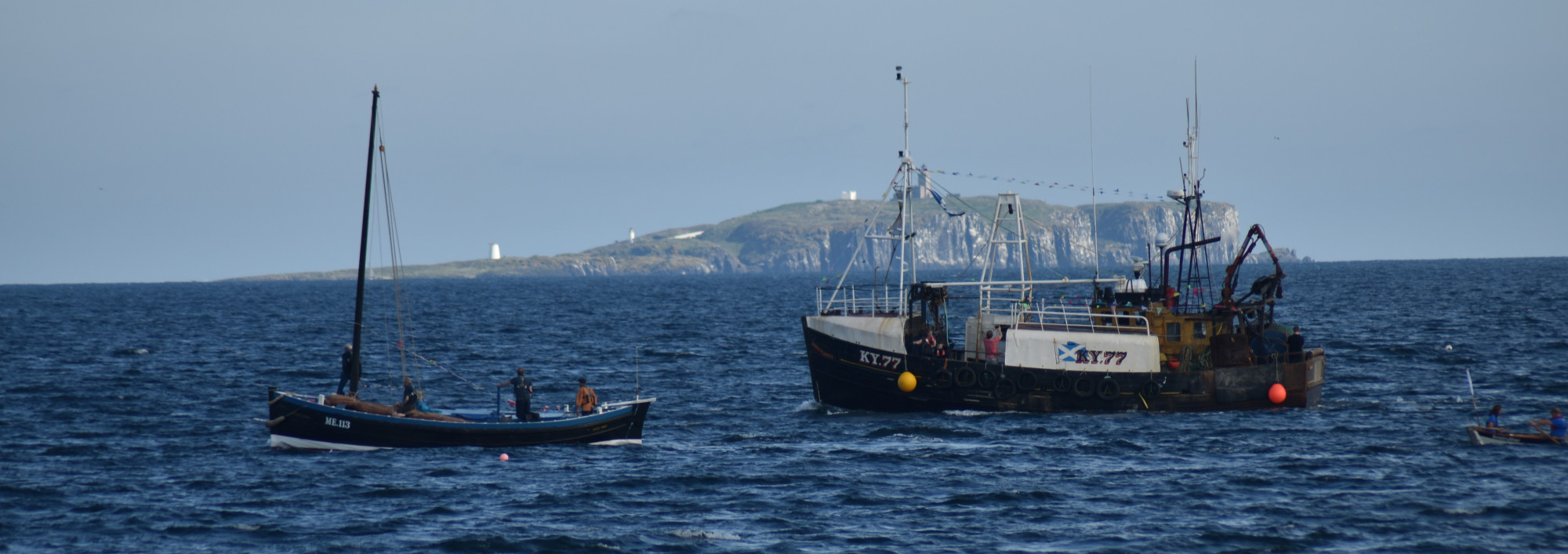
The Cellardyke Echo – 09/12/21 – Issue 317

1875

Throughout the whole of Fifeshire a feeling of the deepest sympathy has been aroused for the widows and children of the St Monance and Cellardyke fishermen who lost their lives during the recent terrible gale the English coast. Altogether thirty-seven fishermen belonging to these villages have met with a watery grave, and fully one hundred dependents have been at one blow deprived of their breadwinners. Sir Robert Anstruther, the member for the county, has been energetic in his endeavours to bring the case, of these poor people before the country, and subscriptions amounting to well-nigh L.2000 have already, we understand, been received. In addition this, subscription sheets have now been opened in various spinning-mills, factories and other public works in our own district—we hope also throughout the whole county—while at several of our churches special collections in aid the helpless and bereaved families will made to-morrow. With these remarks we need hardly add that look hopefully forward to the appeal now being made to the public, convinced that it will result in the provision something substantial for the many wives and bairns who have at one blow been made widows and orphans.

1876

CELLARDYKE. APPLICATION FOR ALIMENT UNDER TUE ACT GRACE.—Walter Myles, carter, Cellardyke, appeared before Sheriff Beatson Bell at Cupar on Tuesday as an applicant for aliment under the Act of Grace. Mr Jamieson appeared for the petitioner, and Mr Davidson for the incarcerating creditor. Interrogated by Mr Jamieson, the petitioner deposed that he was not able to keep himself in prison or pay the debt (£9 6s 3d) for which he was incarcerated. By Mr Davidson —He was at the herring fishing this season at Aberdeen as a half-dealsman and returned in September. He got £9 for his half-deal. He never had a horse and cart of his own, but had worked at the harbour for 5d an hour, and had got 10s in a fortnight. Mr Davidson stated that the debt was an affiliation case. By the Sheriff—Part of the £9 was spent in drink. The Sheriff—What did you do with the rest of it? Petitioner—l just threw it away—lots of the neighbours got some of it in drink. The Sheriff —Both these statements can’t be true, and unless you make a clean breast of it I won’t give you aliment. You know the consequences are sometimes serious when a man disposes of money to defraud his creditors. Petitioner— I have got no money to dispose of. The Sheriff —What did you do with the £1 10s ? Petitioner —lt went the same way. The Sheriff refused the application in hoc statu, remarking that the petitioner would certainly never get cessio until he had made a more clear statement.

The rapidly increasing population of Cellardyke has again led to a pressing want of house accommodation, definite arrangements have only to be come  to with Admiral Bethune the superior of Kilrenny, for feuing the one field in the south west corner of the Barony, where an airy new street of commodious fisher homes would be at once proceeded with. These feus are still talked at the rate £26 the acre, but without any casualties or feudal burthens, the impost of which so astonished the canny folks of Anst’er some twenty years ago ; and then it is also to be remembered that the new street will boast perhaps the most sunny and beautiful elevation in all the neighbourhood, with every household convenience in the way of area and garden. As an index to the lasting demand for sites, we may observe that the old tenement belonging to the late Mrs James Brown at the jetty has just been purchased as a building stance by Skipper Henry Reid for the sum £120. This time-worn edifice, we may remark, was often five six times exposed to public auction, and, curious enough, £200 was one day offered and refused, though as in other cases the purchase price accepted in the end far exceeds the charge for the new feus.

Shortly after seven o ‘ clock last night one of the Cellardyke fishing boats attempted to enter the new harbour , Anstruther , when the tide was low , and being struck by a wave was knocked up against the west breakwater . There are no lights near the new harbour except one , which forms the guide to the entrance , and in the darkness a fisherman who was throwing a  rope to the men in the boat fell over on to the rocks, and had to be conveyed home injured . All the crew consisting of young men were saved. Nearly the whole of the Cellardyke fishermen and a large number of women assembled on the occasion, and were all loud in their condemnation of the unsafe condition of the new entrance, although some acknowledged that it was foolhardy to attempt to enter the harbour at low tide and in darkness.

( at this point the old harbour entrance on the west pier was still open)

1877

The screw steamer Anna, of Leith, which stranded some time ago near Randerston Castle, but floated into Anstruther harbour, was sold as she lay by the pier by public roup, on Thursday afternoon. The vessel insured for £900, and our townsman. Mr Jarvis, shipbuilder, is said to have received £200 for her salvage but on being offered for sale the upset price had to be reduced from £700 to £50 before any offer was made, when, after a small “skirmish.” the steamer was knocked down to Mr James Skinner, merchant, Cellardyke, for £62. The Anna is an old foreign brig, but though sadly crippled in the hull by her late awkward berth, her machinery is understood to be in serviceable condition.

1878

CELLARDYKE. ENTERTAINMENT TO STRANGER FISHERMEN.-The presence of a large number of fishermen, belonging to the Moray Firth, who had put in here for shelter while on their voyage from the south fishing, led one or two of our own skippers to put their heads together, and the result was that all the strangers, to the number of nearly 130, were invited last Thursday evening to a friendly meeting in the Free Church Hall. Ex-Provost Martin occupied the chair, and after a substantial service of tea had been provided, addresses were delivered by several of those present, and heartfelt thanks expressed fur the accomplishment in safety of the voyage from Yarmouth and Lowestoft of both local and stranger crews. The meeting was a most enjoyable one, and the Moray Firth men were loud in their praises of the kindness and sympathy which had promoted the welcome invitation they had received.

Hairbreadth Escape of a Fishing Craft.—Last Wednesday morning, as the white fishing fleet were weathering the Forth, they were beset by what described as the most bewildering fog of recent years. One of the Cellardyke boats in particular had most providential escape. This was the “Abeana,” Adam Watson, master, which was standing in on the port tack with foresail and mizzen spread full to the land breeze, when a passing rift in the cloud disclosed the white breakers immediately under the weather bow. The cry, “hard up,” had been scarcely given when the boat struck with headlong force on a towering rock. The boom snapped like a dry reed, and the stem was crushed into splinter wood by the collision, which for the moment overpowered the stoutest heart; but taking courage from the fact that the boat was making little or no water the crew pushed from the rock, which proved to be the gullet on the south-east side of the Isle of May, known as ” Willies Hole.” Deliverance from such peril might well be regarded as the act of Heaven, and with thankful hearts Skipper Watson and his crew bore up for the shore, which they gained before daylight. On examining the damage stem and keel told unmistakably of the extreme hazard which had been encountered, and which, but for the fidelity of the builder, must have ended in the loss of the boat, if not of the precious lives of her crew.

1879

The arrival of so many boats from the south has made the fortnight an eventful one, but we must not forgot the home coming, the other day, of another splendid addition to our deep sea fleet. This is the “Favourite” of Anstruther, owned by skipper John Watson, and just turned out from far famed Fraserburgh building yard of Mr Weatherhead. “I’ve come haime in the fleein boat” exclaimed a hardy fisher the other day, exulting with a seaman’s pride in the matchless speed of a darling craft; and built on the same noble lines and with the same handsome sheer, we have no doubt that the new clipper will be worthy of her consorts already sent us by Mr Weatherhead, and prove at the same time a source of honest pride and satisfaction to her gallant owner and his crew.

Wick, December 10.—The fishing both of flat fish and haddocks is extremely light. On Saturday the two or three trawlers sea landed from five to ten cwts. of trawled fish….. We learn that a number of Cellardyke boats have been engaged to fish from this station by local fishcurers.

The Cellardyke Echo – 02/12/2021 – Issue 316

1870

Coals for the Poor. – At a meeting of the Parochial Board of Kilrenny held Wednesday last, it was agreed to distribute half ton of coals to each of the registered poor of the parish, about the end of the year.

The Fishing.- Our boats have all except four returned from the Yarmouth fishing, twenty-five in number, and although the success has been varied upon the whole, our fishermen have made very good thing of it. A good many have grossed £350 or upwards, and perhaps £250 may be taken as an average. It is likely that the result will induce good many more to try their luck, in that quarter next season.

Discussion over water in Anstruther –

….Mr Graham, in speaking of the well at the foot of Haddfoot Wynd, said a good deal of money had been expended and trouble taken in regard to it both by the people in the neighbourhood and the Cellardyke fishermen. About 22 or 23 years ago Mr Peebles’ father and Mr Donaldson started a subscription for laying down that pipe, and ever since that time no public body had taken any interest in it. He did not believe in boring for water in the front street, because if their fishing seasons were to come back as they were some 15 or 20 years ago, the ground would get saturated with salt and brine, and the water would be certain to get contaminated by surface impurities.

1871

WANTED immediately, as a SAWMILLER, an Active, Steady Workman, who thoroughly understands his Business. Apply to, T. CORMACK, Cellardyke Sawmills.

From what we hear, there seems to have been some dispute between the Scotch and English fishermen. The Englishmen are in the habit of not hauling their nets until daylight, while the Cellardyke and other Scotch fishermen haul them as soon as they ascertain there are herrings in the nets. As the helms of the Scotch boats are made straight down, a slight space being left between it and the stern of the boat, they caught the nets of the English boats, and sometimes tore them. This led, it is said, to some retaliation on the part of the Englishmen, and hence the dispute. The most of the boats that have returned will prosecute the haddock fishing for a month or six weeks previous to the commencement of the winter herring fishing.

HERRINGS FROM THE CLYDE.—A large quantity of herrings have arrived per rail from the Clyde this week, several of the curers, including Provost Todd, Bailie J. T. Darsie, Bailie Bonthron, and Mr Cormack of Cellardyke, having had agents through at Greenock. The fishing there in the beginning of the week was very successful, and prices one day were as low as 14s. per cran. The herrings, which are large in size and of excellent quality, are being made into reds.

A very sudden death took place here on Wednesday. Mrs George Barclay, after going about as usual all day, complained of a pain in her side. Shortly after eight o’clock, and on the advice of her husband, she went to bed. About ten o’clock Mr Barclay thought he heard a groan, and on going to the bedside he found his wife dead. Medical assistance was at once called in, but life was quite extinct. The cause is said to have been paralysis. Mrs Barclay, who was a very exemplary wife and mother, was about 62 years of age, and has left a large family who are all grown up.

THE MORTALITY. —The cold raw weather we have experienced during the past fortnight is telling severely on persons in delicate health, and the ” Shadow fear’d of man,” as death has been called, has been making its appearance in our midst this week oftener than usual, and filling the air with ” farewells to the dying and mournings for the dead.” The death of Miss Christian F. Marr, youngest daughter of Mr John Marr, is a peculiarly affliction, and has called forth the sympathy of the community. The ruthless hand of death has been busy in Mr Mars’s family during the past few years. First, his second son, a very promising young man, died three years ago; then followed a daughter in the beginning of the year ; and now another daughter has been taken away, leaving to their bereaved parents only the consolation that

“These same afflictions

Not from the ground arise.

But oftentimes celestial benedictions

Assume this dark disguise.”

1873

HADDOCK FISHING Cellardyke,. Sir,  -As the “Wick Fisher” in yesterday’s Scotsman thanks us for information anent haddock fishing, and asks other questions, we, with your permission, beg to reply. But, to begin with, we have a strong suspicion that he is not a “thorough-bred, ” as his lingo betrays him – for whoever heard, from Tweed to John o’ Groat’s, any fisher speak of a “haddock voyage.” No, Sir, he smells strongly of leather, and he seems more a theorist than a practical fisherman, as he dives too much for us into the long-talked-of theory of over-fishing, a subject that we will not discuss with him.

“All of us,” he says, gives us credit for being crack fishermen. Well, this is something even from him; but we are not proud of it, as our grandfathers earned this in old Wick, when they used to go there in very small open boats, carrying only 15 nets, while 20 to 30 crans of herrings was quite their cargo. This was what he likely calls the olden time, and before he or Pulteney harbour was made. The only harbour then was up the Burn. and where likely he and his brethren wish it was still; from then to this we have slowly, but surely, been making progress, advancing with the times, stepping from boat to boat – not jumping – until we have reached (now ten years ago) the large decked boat. Correspondingly, we have added to our lengths of line, but not ten times more as he supposes, but only three times more; and as to going out forty to sixty miles for haddocks we have done so thirty years previous to the decked boat era in open boats, but only in the summer season; and now, following up, we venture there in the winter season, and find haddocks as plentiful as we did in the summer season.

We are glad that the “Wick Fisher” admits his ignorance in being willing to learn to haul lines on rough ground, but that is a small part in successful haddock fishing. The wives and families are also to train in line baiting – a most essential part. And we know that Wick Is poor indeed in line baiters, and we venture an opinion that it will be some time yet before successful haddock fishing will be carried on as here, notwithstanding their costly £100, 000 breakwater. And now, to finish up, would it surprise him to know that as all our boats are home from the Yarmouth herring fishing, making our haddock fleet now of sixty decked boats, we could, with our combined lengths of line, stretch from the Isle of May to the Naze of Norway-there? Well might he exclaim, ” Och …. boy , that’s ‘ prodigious . ‘ “—I am, &c. A CELLARDYKE FISHER ?

1874

Two of the Cellardyke fishing boats, belonging to Skippers Alex. Brown and David Wilson, left Yarmouth on Saturday, and considerable anxiety was felt as to the safety of the crews. On Monday, however, a telegram was received that the former had taken refuge in Hartlepool, and on Tuesday morning Skipper David Wilson entered the harbour, having been out during the whole of the gale. The storm had overtaken them on Sunday, and deeming it impossible to gain any harbour, the crew determined to face it out. Their boat is fortunately a full-decked one, or it would undoubtedly have been swamped; but even with this protection it is marvellous that they were able to escape without damage. Frequently they were compelled to lay the boat to, and on one occasion one of the crew was swept overboard by a heavy sea. Providentially he caught hold of some of the halyards as he was carried away, and his companions at once pulled him on board again. The attention of the whole of the crew was continually devoted to securing their safety, until they were not far from the May Island, by which time the weather had moderated.

There would appear to obvious improvement day by day in the sanitary condition of the neighbourhood.  Scarlatina, there reason to trust, is on the eve taking its departure, but three fatal cases have been reported in Cellardyke during the last nine days. One of these was a fine girl of three summers, the child of Mr James Dick, fisherman, Cellardyke, who died on Friday; another was a son of Robert Thomson’s, whose sufferings closed on the following day in his sixth year; and the third victim was a promising boy about thirteen years age, who was reft from the household of John Dickson. But while the young blossoms are falling thus thickly as the green leaves are withered in a night in the beauty of the spring time, the old familiar faces who have been with us like the ancient trees by the wayside, are also fast yielding to the inevitable autumn. On Tuesday evening a venerable widow, Alison Brown, the relict of John Smith, died at West Anstruther, in her eighty-fourth year, and on Thursday morning Mr Robert Cunningham, the oldest fisherman in Cellardyke, breathed his last at the ripe old age of eighty-nine.

The Cellardyke Echo – 25/11/21 – Issue 315

1825

The sloop Industrious Mary which lately struck the Carr rock, and went to the bottom, has by great exertions, been weighed by a few boats from Cellardyke, and taken to Crail Harbour, where she now lies to be repaired. The Cargo is all lost, a subscription is begun behoof the owner.

1848

FATAL ACCIDENT OFF THE FIFESHIRE COAST

Cellardyke, which has of late years suffered much from accidents by sea, has again been plunged into a state of extreme grief by the loss of another bout with eight of a crew. Friday morning was very stormy, the wind prevailing from the north-east. The crews as usual proceeded to sea, but the storm increasing, the crews returned without attempting to work lines. It is reported that one crew observed some floating material of a wreck, but took no notice at the time until night came on, and the unfortunate crew not returning excited alarm. It is supposed that they had suffered a few miles east of the May Island. Conjecture will be afloat, of course, and people will be busy. The gale was heavy, but whether the boat had been overset in a squall, or some other unforeseen accident happened the boat, none can say. One of the sufferers was saved, about six years ago, when all the crew were drowned. This dreadful calamity has thrown six widows and twenty-seven fatherless children to the care of the benevolent.  (The boat was the “John and Mary”)

The fishermen of Cellardyke are last bestirring themselves. The stereotype character which a well-known writer attributes to this class appears to breaking up in the “East Neuk” by the calamitous event of the 3rd instant, whereby twenty-eight of their townspeople have been deprived of their natural protectors, they are now throwing aside their past indifference to the dreary future in reserve for their dependents in the event being overtaken by a similar fate. In London there is a society, The Shipwrecked Fishermen and Mariners’ Benevolent Society,” membership to which constituted annual payment of half-a-crown. Should a fisherman, being member, have his boat or gear damaged, a certain small sum is paid him in name of repairs, or if he should himself lost, a sum, varying from five to ten guineas, is paid to his family. Although conditions more favourable could scarcely be invented, and although the society, for years, has had an agent the spot, yet, at the time the above catastrophe occurred, out of our adult population of about three hundred, only two fishermen were enrolled members. A few benevolent individuals resolved to make an effort to awaken the fishermen to the advantages held out by the society, and for that purpose secured the services of the clergymen of the neighbourhood for a public meeting of the inhabitants. This meeting, which was numerously attended, was held in the Infant School-room on the 9th inst,, and although there was more speaking over and at the audience than with them, its result was gratifying. An auxiliary to the parent society was organised with staff of working officials; before the meeting broke up sixty-five fishermen had enrolled themselves members. There is room for a wider extension of the society, and no reason why every adult in should not be entitled to the privileges of a member. Whether the fact originates from their class feelings, from the limited/range to which they confine their ideas, or from the ever-awake selfishness lest fate should make them benefactors rather than their families recipients of the society’s beneficence, there are none more jealous of being taken advantage than they. And were it not that strong faith may be placed In the staff of the auxiliary, fears might be entertained lest this promising appearance should prove but a mere periodical ebullition of a feeling which will die away, and exhibit the same symptoms on the recurrence of a similar calamity. This being the first seamen’s meeting we had the’ opportunity of attending, we had much pleasure in finding it formally conducted and more orderly than many landsmen’s. And while the eye occasionally rested on one (as will in all similar meetings) who seemed a walking argument for the repeal of the soap duty, and on another whose unkempt locks and bearded cheeks were rather hirsute, yet, as a whole, we have seldom seen a roomful of men whose clean appearance and respectful demeanour, and whose brawny, well-knit muscular frames, made them favourable specimens of humanity. Gratifying as was that meeting, was our happiness on the following evening to attend another in the Town Hall, which, from the promising hopes it excites, is more interesting still: the first annual meeting of the Cellardyke and Kilrenny Savings’ Bank. As stated in the director’s report, during the forty-seven weeks of its existence, deposits had been paid to the extent of £442, and the balance then outstanding due depositors was £386. And to show its working, it was stated that 106 of the accounts, the balance under £5. There no class in our county on whom banks for savings have stronger claims than on our fishermen. There are many amongst them who can bear comparison with those other trades; yet it may be said of them in general, that the uncertainty of their earnings, their dangerous, laborious, and incessant occupation, have called into exercise habits of the most reckless improvidence and wastefulness, which have acted, as naturally they must, on their moral and intellectual natures. And we fully adopt the words of the directors’ report, maintaining that the bank “has claims on the community, from the more elevated ideas of comfort it is calculated to excite, and the habits of prudent forethought, economy, and independence it will naturally foster and maintain.” Cellardyke, with a labouring population of about 1600, has been stated annually to squander from £1800 to £2ooo in tobacco and whisky. Looking at the sanitary condition of the place, its ill-ventilated houses and densely packed population, its miserable sewerage, although washed the sea, its uneven streets with (at certain seasons) their stagnant pools and heaps of putrescence, and the consequent domestic discomfort and frequent fevers and sicknesses of its inhabitants, one cannot help wondering at so expensive a purchase of misery, and concluding that there is urgent necessity for a Savings’ Bank to gather up, and if possible to retain from working mischief, the loose sixpences of its improvident inhabitants. We understand the funds of the institution are lodged in the chartered Branch Bank at Anstruther, and every confidence may be reposed in the directors of the Savings’ Bank : Mr Murray, chief magistrate of East Anstruther, being one of them, and Mr Fowler, the active and benevolent chief magistrate of Cellardyke, chairman. Steps are being taken to entitle it to the provisions of the Act of Parliament anent Savings’ Banks.

John Smith, master and owner of the boat, left a widow and four children, the eldest five years, the youngest seven months.

James Fleming, left a widow pregnant, besides seven children from two to sixteen years old. Henry Reid left a widow and seven children, five of whom are under fourteen years, the youngest being born on the same morning on which the father perished.

Thomas Fleming, left a widow and six children, four whom are from nine to sixteen years old. A son Thomas Fleming perished along with his father.

James Dick, left widow and two children, eldest five years.

David Birrell left a widow, supposed to be pregnant.

James Dickson, unmarried.

1849

NOTICE IS HEREBY GIVEN, That virtue of the Powers contained an Act passed in the Third and Fourth Years of King William the Fourth, intituled “Act to enable Burghs in Scotland establish a General System of Police,” the Occupiers of Premises of that part of the Burgh of Kilrenny, called Cellardyke, of the real Yearly Rent or Value of Ten Pounds and upwards, are hereby required to meet upon Wednesday the 29th current at  twelve the Clock, within the Town hall in this Burgh, for purpose of Electing One Commissioner in the place of one going out of Office, in terms of said Act.

JAMES FOWLER, Chief Manager. Cellardyke, Nov. 19, 1849.

Queen’s and Lord Treasurers Remembrancer’s Office, Exchequer Chambers, Edinburgh, 12th Nov 1849.

Notice hereby given—That William Thomson, residing in Cellardyke, in the Parish of Kilrenny and County Fife, has applied to the Right Honourable the Lords Commissioners of Her Majesty’s Treasury for a Gift of the Estate of Alexia Martha Muir Alexander, otherwise Martha Alexander, who resided in Cellardyke aforesaid, deceased, which Estates has fallen to Her Majesty as Ultima ….

The Cellardyke Echo – 18/11/2021 – Issue 314

1895

Turnip Stealing.— Before Provost Martin Cellardyke Police Court on Saturday three young boys pled guilty to stealing turnips from a held near the Infant School belonging to Mr Hutton, farmer, Kilrenny Mill. Accused were let off on the recognisances of their parents to come up for sentence within the next six months if they did not behave themselves during that period, and were ordered to pay Is 6d of costs each

The publishers of the `Free Press,’ Aberdeen have issued the above useful almanac for 1896. As usual it contains a great deal of needful information to fishermen and seamen, and every care has been taken to secure accuracy. Tide tables are given for Aberdeen, Yarmouth, Shields, Hartlepool, and a number of other ports, while the information as to the dues, depth of water, and lights at all the various harbours must prove of great advantage to all who require to know these different points. A list of Scotch vessels, when built, the tonnage and the names of the owners and masters is given, as well as the list of the fishing boats in Scotland, with the names of the owner or master, and the length of keel is printed at the end of the book. Thus under Anstruther and Cellardyke the names of 130 boats, eight steam liners, and the S.S. Faith are given. The St Adrian and East Neuk are not included. In Pittenweem there are 42 boats, and in St Monans 69. The almanac should meet with a ready sale from those interested.

1896

A meeting of fishermen and others was held in Cellardyke on Saturday, to ask the Harbour Commissioners to arrange for the opening of the Anstruther harbour during the winter herring fishing. A deputation was appointed to wait on the Harbour Commissioners, which they did on Monday, and received the promise that everything possible would be done to meet the necessities of the case. Arrangements have since been made whereby the improvements at the harbour will be discontinued before the commencement of the winter herring fishing. The same gentlemen were instructed to inquire into the new scale of dues and charges to be made by the Provisional Order, and to report.

Several cues of scarlet fever are reported this week in Anstruther and Cellardyke, but the fever fortunately is of a mild type, and none of the casts are serious.

Kilrenny Parish Council

THE LIABILITY OF SONS TO PAY FOR THEIR PARENT’S. The Inspector reported that he had called upon the son of one old woman to refund the money the Council had paid out for attendance to his mother, but he had refused on the ground that he was unable to do so. Since the claim had been made she had stopped the woman, who had attended her. Rev. Mr Ray considered that the Council should have made it plain to this woman that her son was liable for any expense incurred in attendance upon her and her husband. He did not know the son, but he did not like to approve of this application to the son, because they had gratuitously given this attendance to his mother. The Chairman It is a principle we have acted upon all along both in this Council and in the old Parochial Board, that when relief was given to any person, and any of the family able to pay, that, we fall back upon them for the expense. Rev. Mr Ray—l understand that that has been done, but in this case, I was informed that the son had made very little at the drave, and quite unable to pay. The Chairman-Supposing he had done well at the drave, is it not fair that he should, try and help his parents. Rev. Mr Ray—Decidedly, I think we should try and make it plainer to Cellardyke young men that it is their duty to look after their parents, and that in future when we give attendance to old people we will apply to them for payment. Mr Martin Gardner – I don’t see why any old body should not be looked after even if the son is not responsible for the repayment of the money, for there are some in Cellardyke who don’t care where their parents sink or swim. Mr Marr- It is only by taking action like this that we can bring them to their senses. It was then agreed to press for the money from the son. Mr Marr reported that he had seen the fisherman whose wife was in the asylum, and pointed out the necessity for him contributing more than 3s weekly towards her maintenance. He promised to pay 4s and 5s if he was able. The Inspector said the fisherman had also called on him, and agreed to pay 4s per week during the present time when the liners were at their worst, but during the rest of the year he would try and make up the sum to 5s per week. The offer was accepted.

THE NESS FISHING COMPANY. The first general meeting of shareholders in this company was held in the Council Chamber on Tuesday evening. There was a good attendance of local shareholders, including Bailie Darsiet, Messrs Andrew Wilson, Alex Marr, William Bayne, W S. Bonthron, Thomas Cunningham, A. C. Mackintosh, H. Watson, and others. Mr John Marr was on the motion of Bailie Darsie, called to the chair. Mr Mackintosh produced Memorandum of Association and the Certificate of Incorporation and the agreement with Hall Russell & Coy., Aberdeen, to build a combined liner and trawler for the Company, the details of which have already been described in our columns, at a cost of £3.305. The boat is to he named the Fife Ness It was agreed that the number of directors be nine, and the following gentlemen are unanimously elected :—Stephen Williamson, George Darsie, John Irvine. Aberdeen, Alex Marr, Cellardyke, A. C. Mackintosh W. S. Bonthron, John Marr, Wm. McLaren, Innergellie. Wm Payne. Mr Cunningham, Harbour Head, was appointed manager of the Company, Mr H. Watson, the auditor. At a meeting of Directors held afterwards, Mr John Marr appointed Chairman of the Company, and the payments of calls were arranged, which payable at the National Bank of Scotland, Anstruther, Cellardyke, and Pittenweem.

THE BAY FISHING COMPANY LIMITED. —The first general meeting of the shareholders of this company was held in the Council Chamber on Tuesday evening. Mr Alexander Marr, Cellardyke, presided over a large attendance of local subscribers, including Ballie Darsie. Messrs John Marr, Andrew Wilson, Philip Anderson, John Bett, Robert Heugh. W. S. Bonthron, Henry Watson, Thomas Cunningham, A. C. Mackintosh. Henry Bett, William Lothian, Alexander Lothian, Donald Fraser, Robert Murray, David Wilson, &c. Mr Mackintosh laid on the table for inspection by the shareholders a copy of the memorandum of association and the certificate by incorporation of the company. The agreement with the Dundee Shipbuilders Company was produced to build a steel boat, the dimensions of which we have already described, at a cost of £2980. It is expected the boat will be ready for sea by the beginning of March. Mr Bonthron reported on behalf of the Committee that they had seen Mr Jarvis, and had all but closed a contract with him for a wooden boat at the cost of £2550 to be ready for sea by the first of September. The Dundee built boat is to be named the Largo Bay, and the boat to be built by Mr Jarvis the Mill Bay. The following gentlemen were appointed Directors of the Company: Messrs Stephen Williamson, George Darsie, Wm. McLaren, Innergellie; John Bett, John Blair, W. S. Bonthron, A. C. Mackintosh, Alex. Mum and Philip Anderson. Mr Thomas Cunningham was elected Manager of the Company, and Sir H. Watson, the Auditor. At a meeting of directors afterwards held Bailie George Darsie was unanimously appointed Chairman of the Company, and the dates of payment of calls were arranged, which are payable at the National Bank of Scotland Limited, Anstruther, Cellardyke, or Pittenweem.

(the wooden  boat in the end was  not called Mill Bay but Rothesay Bay, launched September 1897)

1897

The Anstruther and Cellardyke Gas Company are to take in estimates for the erection of a new gasometer at their works East Green, in order to be able to store more gas, in view of the increased consumption of recent years.

A number of Cellardyke boats have arrived home from the fishing at Yarmouth and Lowestoft. The earnings of the crews range from £150 to £400

THE FACTORY ACT AND THE FISH TRADE. The concessions which the authorities have at last made the fish trade shows the absurdity of making a hard and fast rule in all trades for the administration of the Factory Acts. The rules in regard to the hours of working for young persons and females have had to be relaxed in order that one important part of the food supply of the country might not be lost or rendered useless by exactions which many still regard as grandmotherly legislation. The Acts, in the fish as well as other trades, press very hardly, and there should be some relaxity in special cases, where the conditions of employment are not at all onerous or prejudicial to health. For the fixed rules an opportunity should be afforded employers to change the hours of employment with the sanction of the Inspectors to suit the exigencies of the trades from time to time as required. Those who are in this position should follow the example of the trade, and ask for an alteration in the rules to suit their business.

A WARRANT FOR APPREHENSION. — At the Burgh Court on Monday, the case against Thomas Murray, junior, fisherman, Cellardyke, was called but he failed to appear. Sergeant Anderson said he had cautioned Murray to appear. The Fiscal applied for a warrant of apprehension which was granted by the Magistrates. It was understood that the warrant would not be put in force if Murray consented to come to next Court.

1898

On Saturday night at nine o’clock, while Agnes Ritchie, net factory worker, Rodger Street, Cellardyke, was returning home from Pittenweem, she met with a severe accident. Just as she turned the Buckie House corner, a large black dog came running along the pavement at a great speed, and before she could get out of the way, it collided with her, knocking her down. She fell on the concrete, breaking her right collar bone, and the right side of her head was cut and bruised. She was assisted into Mr Robert Pratt’s house by her sister and Mr John G. Gray, who happened to be passing at the time. Dr Ferguson as sent for, and dressed the wounds, after which she was conveyed home. She is progressing very favourably since then.

On Friday morning, Mrs Peter Murray, Rodger Street, while going about her usual household duties, took a shock of paralysis, from which she died in about two hours. She was 52 years of age.

Derelicts and Wreckage

Calais, Oct. 27.—0n the 22nd inst. a French smack picked up, to the NS of Cromer, about 20 fishing nets, much damaged, 20 floats for supporting the nets, 3 hawsers of 50 fathoms length, each in good condition. This property is marked Black and Co., Patent Cellardyke, Fife,” and is in the possession of the marine authorities at this port.

DIAMOND WEDDING AT CELLARDYKE. The Weekly News Old Folks’ Competition was the means of revealing many wonderful records of married life, but a modesty which old people maintain is unknown to younger folks, kept Mr and Mrs Davidson, Cellardyke, from taking the place in it in their length of wedded life entitled them to.

They were married on the 16th November, 1838, and thus yesterday (Wednesday) celebrated the sixtieth anniversary of their nuptials. Hearty and numerous were the congratulations that poured in upon the aged and happy couple. Friends vied with each other in their friendly remembrances of the anniversary. Gifts from the family were also handed in. The couple received their friends with cordial hospitality, and pleasant little gatherings were held in home daring the week. They are a couple typical of Scottish life, warmly affectionate, God-fearing, and industrious. Born and brought up in Cellardyke, they have spent their days within its bounds, save, of course, the absence at the fishing from other ports, or in the old days when in the mansion house near Colinsburgh Mrs Davidson acted as maid. They were married in the same street as their present house by the late Rev. Mr Dickson, the parish minister. Eleven children blessed the household but of these only four are alive, some resting in far-off lands.

There are thirty-three grandchildren alive and seven great-grandchildren. Mr and Mrs Davidson are hale and hearty. Mr Davidson carries his eighty-three years lightly, and his wife, two years his junior, is able to move about her household duties. They have an interesting life story. For sixty years Mr Davidson prosecuted the fishing. He has seen complete revolutions in the industry – methods, boats, and resorts. As a hauflin he worked in the 30-feet crafts that then represented the best and biggest of the fleet. Today the boats exceed 60 feet. He has seen the reform in the outfit, the introduction of steam, and the changed feelings with which the fishermen now regard it. Herring was then, as now, the chief part of the fishing, but as he tells, the men now follow it round in whole coast from north to south. The haddocks held a second, but important, place in the life of the fishermen: in the ‘forties they were followed ten to twenty miles to sea in the small open boats: now in season it is an everyday trip half-way to Norway in pursuit of the cod, with mileages of line that would have served four or five of the old-time crews. But on that theme Mr Davidson’s, reminiscences are well-nigh inexhaustible.

During his lifetime at sea narrow escapes were inevitable, and four of these, where the boat was mercifully spared by the Higher Hand, are ineffaceably impressed on his memory. One of these dates back to the year ‘60 when Skipper Bett’s boat was swamped by a heavy sea. but kept up. Next, in Yarmouth River, he was sinking tor the third time when succour reached him. Again, five miles east of the Carr, the boat was filled and momentarily expected to go down, and nearer home, one day when running for Anstruther Harbour, the craft had a miraculous escape from going to pieces on the Beacon. But vividly, and still as if yesterday, will ever be before his mind’s eye the terrible scene at the May Island when, on the 1st July, 1837, no fewer than thirteen women and children perished within a stone’s throw of the shore. He was one of the young men who, in accordance with the time-honoured custom, manned a drave boat to give friends and neighbours a holiday on the island. It was a Saturday morning, a glorious day, when five boats set out from Cellardyke Pier, each crowded with excursionists. The “Johns,” the admiral of the fleet, carried sixty-five souls. This and that consort took other creeks, but the “Johns” was steered for the little pier at Kirkonhaven. All were preparing to land, but at the moment a wild plunge and a deafening crash heralds the fact that the doomed boat had been washed by the surf upon the skerry. All was confusion and terror; women and children shrieked in despair, but already brave men had seen the one chance, and firm feet bearing precious burdens were leaping the chasm as the boat lay with the gunwale to the sloping skerry. A panic seized the remnant, and pushing to the higher gunwale, they sent the boat reeling from her perch, when she sank like a stone leaving a frantic mass of women children clinging to each other with the grasp at death.

Mr Davidson says but little of his own share in what followed, but happily others can tell the story. Of the brave men who plunged again and again to the rescue, returning with a struggling woman or child, he was conspicuous; his work was not over so long as a head or hand could be seen above the water. As the bodies were recovered, for all floated again, he was also active. One by one the corpses were carried up the beach, but one– was it instinct? caught his eye ” This woman’s no’ dead,” he declared and setting to work, he eventually had the pleasure of seeing her look up and recognise him. His work amongst the rescued was highly recommended by Dr Goodsir. This was the ending of a once favourite holiday trip.

1899

The Cellardyke boats which have been fishing at Yarmouth and Lowestoft returned home on Thursday and Friday after the most successful season in the history of the South fishing. Twenty-four boats were engaged, and the average shot is considerably over £600, the highest yet on record. The best boats had fully £900, and the most, between £500 and £600; some to £700 and £800, and the lowest £300. It is computed that the boats have brought home fully £10 000 from the South.

(£10 000 would be the equivalent of £1 349 541 today –  the lowest earning £40k the Highest £135K)

Changing the Luck – The wife of a Cellardyke skipper with whom I acquainted once told me that she caught the wife of another skipper one washing morning taking the first jug of hot water from the boiler“ I kent fine what she was after” said my friend “She wantit oor Jamie’s luck. He had been daein weel a’ the season an’ her man had naething; but I made her put back the water.” This was young, wife, fairly intelligent and when at school had passed the preliminary examination for pupil teacher.

The Cellardyke Echo – 11/11/2021 – Issue 313

1890

Intelligence was received Anstruther on Saturday night stating that William Montadore, one of the crew of the Cellardyke fishing boat Venus Star, fishing at Lowestoft, was washed overboard and drowned in the storm at an early hour of Friday morning. He leaves a widow and family. He is the eighth East of Fife fisherman who has been lost within fortnight at the English fishing.

Anstruther Harbour – some employment has this week been got at the harbour by the arrival of the schooner Johanna from Mandel with a cargo of staves for Mr Cormack, Cellardyke. As showing the inconvenience arising from the want of a customhouse officer the captain and crew had to lie idle nearly a whole day before they could begin to discharge, and work was only commenced on Tuesday forenoon after the arrival of the officer from Methil. The board of trade should see that this annoyance is not suffered in future by making better arrangements for the discharge of cargoes from foreign vessels.

Baking Enterprise – A long step advance has just been made by the energetic Cellardyke bakers, Messrs Black Son, by the introduction of the patent decker oven in conjunction with their steam machines. This oven is unique. It embraces an upper and lower chamber of tire bricks, eight feet by six. The furnace, situated at the right angle, is seven times heated, as it were, with coke, which issues by three streams into a lake of living fire, if we may use the simile, between the two chambers, which are thus bathed all round with continuous flow or current from the moment it leaves the furnace till escapes into the air. The bricks are such excellent conductors of heat that the loaves or biscuit are baked in third less time than in the ordinary ovens, while the chambers are, of course, entirely free from the smoke, &c., which renders it expedient to use the primitive implement known as the scuffle. To this end the sides are encrusted with a kind of porcelain, which glitters like white glass—in fine, the patentee has done as much for the economy of the bakehouse as the inventor of the hot blast in the furnaces of the West. The effectiveness of the oven will be of special value to the Messrs Black their large orders for biscuit in the fishing season to all parts of Scotland. Some years ago Mr Black made series of ingenious experiments which was enabled to utilise his steam engine in the stirring, kneading, cutting out of the biscuit, so that the oven now bridges over the last difficulty in the way of the firm. The oven, which is patented in Cardiff, is the first of the kind in the East of Fife.

1891

MAN FOUND DEAD IN FIFESHIRE. Last night the body of a man was found lying among the rocks the shore between Cellardyke and The body was dressed in brown and black tweed trousers, tweed vest, and on the feet Wellington boots. On the stockings were the initials 44 T. S. L.” while in one of the pockets was copy of Scott’s 44 on Religion,” with a label on the inside page, 44 Markinch Parish Library, No. 29.” The Markinch authorities have been communicated with lead to the identification.

In the course of the forenoon, a telegram arrived announcing the loss of a Fisherrow boat with seven of a crew drowned, Walter Brown, the skipper, being a nephew of Mr Robert Brown, Cellardyke. Further on, another telegram came to hand, stating that a Hopeman boat had been lost with five men. These sad news did not tend to allay the anxiety, and wires were sent off to Yarmouth asking if all the Cellardyke boats had returned. Reassuring messages came back in the case of some, but in the evening about a dozen boats were still unaccounted for. Yesterday forenoon, however, the number had been reduced to six, and by the afternoon, to four. In the evening, up to seven. o’clock, all the boats had arrived in Yarmouth but one, Rob the Ranter, Skipper Henry Rett, Cellardyke, and it was considered that intelligence would come to hand about it to-day.

Read more about the Fisherrow boat on a Fisheries Museum post today

https://www.facebook.com/scotfishmuseum/photos/a.195038610510745/5061688580512366

1892

CELLARDYKE, DISTURBING THE SALVATION ARMY – At East Anstruther Burgh Court on Friday David Davidson, fisherman, Cellardyke, was charged with creating a breach of the peace by swearing and shouting at the Cross Shore Street, on the 28th October. Two previous convictions were recorded against him. He pled guilty. The Fiscal stated that accused had interrupted an open-air meeting, and when the Salvation Army marched to the ” Fort ” he followed and renewed his swearing, &c. Davidson said that he had been attracted to the spot by the singing when a minister said, “Let us pray for a drunken brother,” which vexed him. After further remarks, he became so rambling that Provost Anderson called him to order. In passing sentence, the Provost said that as the other convictions were dated several years ago they would not be emoted. The fine was 7s 6d, or days.. Davidson loudly declared his inability to pay, and was again warned. The money was subscribed by friends in court.

At Kilrenny Burgh Court Alexander Keith, labourer, Cellardyke, was charged before Provost Martin and Bailies Thomson and Williamson with creating a breach of the peace and assaulting Thomas Brown, fisherman, in his own house on the 28th alt. Four previous convictions were aloe produced Keith pled guilty. There had been a family quarrel, and he had gone to his father in law’s house and committed the assault. He was fined 10s.

1893

THE LATE MR DAVID MURRAY. ( The Scotsman)

Yesterday morning intelligence reached Anstruther from Yarmouth of the sudden death of Mr David Murray, of the firm of Murray & Co., fishcurers Anstruther, Aberdeen, and Yarmouth. Deceased was bred as a fisherman, but in 1852 he, along with many others from Cellardyke, went out to the Australian goldfields, and being unsuccessful he entered the coastguard service at Williamsburgh, near Ballarat. He afterwards became captain and part owner of a small trading vessel, but owing to an accident, by which he lost one of his legs, he was ordered home. He started in partnership with the late Bailie Sharp the business of fishcurer, oilskin and net manufacturers, and ere long their trade became one of the largest in Scotland, with connections in Aberdeen , Shetland , Yarmouth , and various parts of Australia , to which they exported large quantities of dried and tinned fish every year . The business continued very prosperous until 1884, when, owing to the large bounties paid to the fishermen at the North, and the failure of the fishing, the firm were compelled to become bankrupt They were soon re-established again ; and went on until last year , when on the death of Ballie Sharp Mr Murray took the business into his own hands. Mr Murray was one oi the best known fishcurers in the North of Scotland. Mr Murray was sixty years of age, and has left a widow and one daughter.

SUDDEN DEATH OF MR DAVID MURRAY, ANSTRUTHER. (Courier)

 A telegram from Yarmouth on Wednesday forenoon received by the Rev. Mr McAlpine announced the death of this widely-known gentleman, and stated that deceased had been found dead in bed. The intimation was startling as it was unexpected, and excited the deepest expressions of surprise on all sides. The sincerest sympathy is felt with Mrs Murray and her daughter in their sudden and sore bereavement. Letters from Mr Murray on the preceding day had been received regarding business arrangements, and contained not the slightest intimation that he felt in any way out of his usual health. Mr Murray was a native Cellardyke, where his father and grandfather occupied positions of honour in the burgh, and were long the lending spirits. While barely out of his teens, Mr Murray, one of the most strapping fishermen the port, along with fifteen companions, emigrated to Australia, where the fame of the gold fields was then leading all. They soon saw that it was not altogether so remunerative, and Mr Murray returned to the coast. Here he ultimately became captain of one of the smartest schooners in the lightering trade. His energy and perseverance soon gained the confidence of the leading merchants, so that the vessel was almost in constant commission to lighter their ocean packets. But a terrible misfortune gave new turn to his destiny. The schooner was lying at anchor in the river, when a careless steersman caused collision. Murray so far averted the peril of the night, but his leg was so crushed that it had to be taken off below the knee. With indomitable spirit he turned to a new sphere, and was soon managing partner in store. He was a second time laid aside by the fretting of the wound, and had to return to Scotland. Not long after his return, Mr Fowler one night sent for him and announced his intention of retiring. Mr Murray was overwhelmed for the moment, but he soon proceeded to realise the expectations which Mr Fowler had formed of his future. He associated himself with Mr George Sharp, at that time accountant in the Clydesdale Bank. The latter acted as resident partner, while Murray attended to the buying. In this connection he became one of the most familiar visitors at and Aberdeen. He showed himself shrewd and far-seeing man of business. This was shown nowhere so clearly in the success which long attended his supervision of the net factory, of which he was also managing partner. His practical knowledge of this department enabled them to keep well in touch with the times, and in the end overcame all attempts many of the leading houses which then directed their attention to crushing out all competition. For many years the firm was the most extensive employers of labour in the district, sixty and eighty people being in their pay as net and oil workers, while the fish-curing and general merchant departments employed many others. All along the East Coast their names were like household words for the superiority of their sea-gear and outfit. Their fame was also spread in Australia, where their cases of preserved herring were paraded luxuries, and familiar to every settler. Thus their business increased in every direction, until a series of reverses were sustained. The firm was restarted, and were fast regaining their name, when in 1891 Mr Sharp was suddenly called. It will be remembered that, although ailing for some time, Mr Sharp was on the pier in the forenoon. In the evening while at supper he was taken unwell and died within a few hours. Mr Murray then dropped the net factory and merchant’s shop, continuing the fishcuring business. He had premises at Anstruther, Aberdeen, and Yarmouth, and bought large supplies at the latter ports. His long experience enabled him to take foremost place in the trade, and was in the midst of this work that he was cut off. Mr Murray was in his sixty-first year. With the exception of intermittent pains in his injured leg, he was rarely indisposed. He was an ardent Liberal, and a lifelong friend of Mr Stephen Williamson, M.P., and during his contests in the burghs was untiring in forwarding his interests. He was twice married, and his first wife had one daughter, for whom and Mrs Murray the deepest sympathy is being felt. Mr Murray is to be interred in Kilrenny Churchyard on Monday, where he will rest beside the kindred dust of many generations.

It would be an insult to the Cellardyke and other fishermen to suppose that any or many of them entertain the very absurd notions of Skipper Adam Reid as to the payment of their debts. This skipper has been the ” king fisher” of Cellardyke for two Lammas draves in succession This year alone it is commonly rumoured that he had upwards of £200 for his own share, besides selling his boat to considerable advantage. He has given orders for a new boat to be built at a cost of £300 or £400, and yet he objects to pay an account of £5 which he admits to be correct, and puts the Harbour Commissioners to the trouble of getting decree against him in the Sheriff Small Debt Court. With rare magnanimity he offers to get clear of his debt by paying £3 provided be receives a full discharge for the £5. He generously lodges the 60s in the hands of the Clerk of the Commission on this condition, and coolly gives the order that if his terms are not complied with the money is to be returned forthwith. The Commissioners seemed to be much taken aback at the amazing effrontery of the man, and it was some time ere several of them found their tongues. But one and all were unanimous in insisting on full payment being made, and the usual steps taken at once to enforce immediate payment of the debt and the expenses incurred. It is only right and honest that action of this character should be taken. The Commissioners cannot allow themselves to be defied by a man who seems to have very crude ideas as to the payment of his just debts. The Commissioners would be acting dishonestly if they exhibited the least leniency to him. He has no valid excuse whatever for declining to pay, and his case must be made a salutary lesson to himself and others that they cannot be permitted to go on incurring liability in connection with the harbour, and then shirking the fulfilment of their obligations. By a display of firmness at this time, the Commissioners will not only recover the amount due and their expenses, but also administer a telling rebuke to people who, with empty-headed bravado, sometimes boast of their ability to escape the payment of the harbour dues and rates.

(£200 in 1893 is the equivalent of approx. £26,790 today)

1894

A Cellardyke boat, the Reliance, had nearly £100 for one shot of herrings at Yarmouth last week, the quantity landed being 12 lasts. (Adam Reid was Skipper)

The Cellardyke Echo – 4/11/2021 – Issue 312

1875

JOHN GILCHRIST begs to intimate to the Inhabitants of the district that, having resolved to discontinue the Grocery department of his Business, he disposed of the Cellardyke Business to Mr JOHN BUTTERS and of the Anstruther Business to Mr CHAS. ROBERTSON; and as both of these persons have been a number of years in his employment, he can confidently recommend them as having a thorough knowledge of their business. He trusts that his old customers will give them as liberal a share of their patronage as he himself so long enjoyed.

J. G. is still keeping on the Boots and Shoe Department in his present Shop usual in Cellardyke.

JOHN BUTTERS, with reference to the above, begs to intimate that, as he is resolved to keep a FRESH and WELL-SELECTED STOCK of GROCERIES, IRONMONOGERY, &c., and to Sell on a Small Ready-Money Profit, he trusts to merit that support so long enjoyed by Mr Gilchrist, Cellardyke, 4th November 1875.

POLICE CONSTABLE GORDON is to remove from Cellardyke next week to join the force in Kirkcaldy. He petitioned for a removal on account of being frequently subjected to attacks from some persons when going his rounds late at night. Police-constable Black has been removed from Dunfermline to Anstruther; and a constable for Cellardyke is to be appointed in a few days.

1876

On Saturday morning a married woman named Leslie, wife of Wm. Leslie, John Street, and Cellardyke committed suicide by hanging herself. It appears that about nine o’clock Mrs Leslie had gone to the back premises, and on her daughter going to feed the hens, she was horrified to see the body of her mother suspended from the roof of the henhouse. Her father had been confined to bed by illness for some days, but on hearing the sad news he immediately rose and had the body conveyed into the house, but by that time life was found to be quite extinct. Mr Leslie is well known and respected in the district, and much sympathy is felt for him in his affliction.

1877

THE Cellardyke boats fishing at Lowestoft and Yarmouth are all expected home before the end of this month. So far as we can learn, the crews have not been so successful as last year, the highest reported being Skipper George Barclay with £200.

Marriage

At St Paul’s Presbyterian Church, Westbourne Grove Terrace, London, on the 10th ultimo. by the Rev. Dr Morison, JAMES ROBERT CORPE, of Moonta, Sooth Australia, to THOMASINA HUGHES ROBERTSON, of No. 3 St Stephen’s Square, Westbourne Park, and only daughter of Captain Robertson, Cellardyke. and niece of W. W. Hughes, Esq., Wallaroo, South Australia.

1878

The herring fishing at Lowestoft and Yarmouth this season is being attended with melancholy accidents to some of our local fishermen. Only a fortnight ago we reported the drowning off Lowestoft of Andrew Lyall, a native of Cellardyke, and this week we have to add other two to the list of those who have lost their lives since the boats left here in the end of September……

Distressing intelligence was received in the end of the week that Anstruther sailor, named John Duff one of the crew of the Cellardyke herring boat belonging to James-Tarvit, now fishing at Yarmouth, had been accidentally drowned in the river. The unfortunate man was last seen alive on Monday week, when there is every reason to believe that while walking along the quay – a stranger the darkness – he had stumbled into the water when no one was near. Failing to return, the crew instituted search far and near, but his disappearance remained a mystery till Thursday, when an urchin fishing in the river dragged his lifeless body the surface in pulling home his line. John Duff was about forty-five years of age, and has left a widow West Anstruther to bewail loss.

Yesterday a telegram was received at Anstruther intimating that Alexander Watson, owner and master of the Cellardyke fishing boat Star, had that morning been washed overboard and drowned off Lowestoft. The deceased, who was about 50 years of age, leaves widow and five young children. This the third Cellardyke fisherman drowned since the boats left Anstruther for Lowestoft and Yarmouth six weeks ago.

Same incident

Scotch Fisherman Drowned.— Alexander Watson, aged 42, while steering near Corton sands Tuesday morning, was washed overboard by a heavy sea. Efforts were made by the crew to rescue the unfortunate man (who swam for some time), but without success. The deceased, who has left widow and family, belonged to Cellardyke, and was master the fishing boat Polar Star. Five pounds reward is offered for the recovery and delivery of the body Lowestoft. ( Reports were that he was knocked over board by the tiller)

1879

BOOT AND SHOEMAKING. RAMSAY & MOTION RESPECTFULLY intimate to the Inhabitants of CELLARDYKE and Neighbourhood that they have commenced the above BUSINESS in all its Branches, in 39 GEORGE STREET, CELLARDYKE, Where by strict attention to Business, and Moderate Charges, they trust to merit a share of Public Favour.

ENGAGEMENTS FOR CRAB AND LOBSTER FISHERY. —Thus early contracts are being entered into between fisher and merchant for the ensuing crab and lobster season. The last had not been an unprofitable one to the latter, at least we may infer so front the advance in prices. Mr Robert Melville, of Cellardyke, who holds a leading place on the piers of Crail, has engaged his crews there as follows : Crab or partans, 1s 10d a dozen; lobsters, 1s each till, and 6d after, the 15th of May, with a sovereign for “aries.” Mr Commack, on the other hand, alters the conditions, so as to allow 2s the dozen for crab; but he follows Mr Melville in the figure for lobsters, and merely gives a shilling or two by way of earnest money. Several of our local fishers, we hear, are holding back; but the above rates will presumably be the staple price of the season in the East Neuk of Fife.

(according to one inflation calculator 1 shilling per lobster is about £6.53 today)

The Cellardyke Echo – 29/10/21 – Issue 311

1870

THE LOSS OF THE SLOOP “THE WATSONS.”— The following letter regarding the loss of this vessel appeared in Tuesday’s ” Scotsman” :- -” Sir, I take notice of this day week’s ” Scotsman” about the wreck of the Watsons of Thurso, which was wrecked between Anstruther and Crail. We were bound from Shields to St Andrews, laden with coal. We got the length of the May Island, when the gale overtook us. We lost our canvas, and drove abreast of Caiplie farm-house. A Cellardyke fisherman observed the smack -one hour before we struck. They say the Anstruther lifeboat was in readiness. Could she not have come a distance of two miles in one hour, and have saved all the crew of the ill-fated vessel?—l am the only survivor of the crew,— JOHN BLACKIE, Leith.” [It is almost necessary to say that had the lifeboat been of any use at the spot where ” The Watsons” went ashore, an attempt would have been made to have taken her there. Instead of there being an hour to spare after the lifeboat was in readiness, it was hardly that time from the vessel being seen by a fisherman at the east end of Cellardyke and her being ashore; and the fisherman had to come to Anstruther and give the alarm, so that by the time the lifeboat was in readiness it was impossible to reach the vessel before she was among the rocks, where the lifeboat would have been of no use.

1871

Anstruther New Town HALL.—This building is now rapidly progressing towards completion. …………….In alluding to the town hall, it may not be out of place to refer to a suggestion which has been made regarding the space of ground between the new town hall and the brewery. A movement is said to be making at present to provide a more suitable lock-up than the damp and unhealthy one below the town hall of West Anstruther. Now, at very little expense, a lock-up could be erected on the space of ground above alluded to. It would be a most fitting and central place for such an adjunct to the town hall and the courts of justice which may be held in it. The present lock-up serves for the three burghs of East and West Anstruther and Kilrenny; and West Anstruther is rather distant at any rate from Cellardyke, from whence sometimes a good many offenders against law have to be conveyed. Towards the expense of erection, which would be very little, the three burghs and the county would contribute; and it would be as well to get the thing done now while the new town hall is building. Two walls and a roof is all that would be required. The suggestion is worth taking note of by our civic authorities.

CELLARDYKE. STABLE ON FIRE.-

About eight o’clock on Wednesday night, a fire broke out in a stable occupied by Mr Alex. Myles, it appears that a boy had gone in to supper the horse, and while doing so had laid the lantern on the floor, when by some means or other the straw got ignited. The alarm was at once given, and in a few minutes a large number of persons turned out, by whose assistance a part of the roof was taken off, and the fire soon subdued. The horse was got out of the stable immediately after the fire commenced, but some pigs which were also in it received a slight scorching. The stable, which was insured, is not very seriously damaged.

TOTAL LOSS OF THE CLIPPER SHIP TAEPING.

Intelligence has reached Liverpool, by telegraph, from Hong Kong, of the total loss of the celebrated China tea clipper ship Taeping, for many years the favourite ship in the great race from China. Crushed out of the tea freights to England, in consequence of the competition of steamers via the Suez Canal, even the celebrated clippers have been forced to take “cross freights” and at the time of her loss the Taeping was going from Amoy to New York, with a full cargo of tea. She is reported lost on Lord Reef—a dangerous reef in the China Seas. The master and 11 men had been landed at Saigon; remainder of crew (officers and 13 men) missing. Her Majesty’s ship Teaser had left Saigon to look for them, and to see if any cargo could be saved. The Taeping was a composite ship of 767 tons, was built by Steele, of Greenock, in 1863, and owned by Rodger & Co., of Glasgow. She was built to almost faultless lines, and her dimensions, according to official returns, were :—Length, 183 ft. 7in. ; breadth, 31ft. lin. ; and depth, 19ft. 9itt. She was commanded by Captain J. Dowdy, who has commanded her since 1867. We understand that a telegram was received in Cellardyke on Wednesday from Alex. Rodger, Esq., Glasgow stating that of the three boats in which the crew of the Taeping had taken refuge, one had arrived at Saigon and the other at Batavia. A young lad named John Watson, son of Mr James Watson (Salter), formed one of the crew, and as it is not known whether he is in any of the boats which have turned up or in the one still missing, some anxiety is naturally felt for his safety.

1872

Cellardyke Fishing Boat ashore at Yarmouth

Last Thursday afternoon, as the fishing bout belonging to Skipper Robert Keay, of Cellardyke, was proceeding to sea with a strong breeze blowing, she struck the ground at the side of the river. Fearing that they were in danger, the sail was let go, and the boat made fast to the side of the quay. The crew then made fast thick ropes aft and forward to the shore, in order to keep the boat from being driven down by the tide, which runs very fast. While in this position, one of the beachmen let go the stern rope, and immediately ran off, and the boat then went down the river until she went on shore at the north bank. The sea was running pretty high at the time, and breaking over the boat; which soon filled with water. The assistance of other Scotch fishermen at present at Yarmouth was obtained, and the boat hauled up as far as possible, but it was not until four o’clock next morning that she was got up at the back of the quay, with her ‘ gibber strikes’ split, and her bilge ropes off. It is to be hoped that the beachman who played the dastardly trick to the crew will be discovered, and receive the reward he so richly deserves.

1874

The intelligence from Yarmouth and Lowestoft is to the effect that only a few of the Cellardyke crews have fished well, and that the majority have not been so successful as they were last year. The fleet is expected home before the end of next month.

THE PREVALENCE OF SCARLET FEVER.

The Chairman said he had to report a very strong exercise of authority as an individual member of the Board, and it would be for them to approve or disapprove of what had been done. It was pretty well known that scarlatina was prevalent to a considerable extent in Cellardyke, and it had occurred to him that it might be a question to be seriously considered whether under the circumstances it would not be a proper thing temporarily to close the schools. He had taken counsel with Dr Macarther, and, as that gentleman had approved of the suggestion, he (the Chairman), taking the whole responsibility upon himself, and deeming the matter urgent, had gone round and shut up the schools on last Tuesday afternoon. He had not felt any hesitation in his own mind as to the propriety of the step. He had called upon a great many of the families where the fever prevailed, and in nearly every case the parents attributed the infection to have been caught at the schools. They all knew the great danger that might occur in that way, and that one child, carrying the infection in his or her clothes, might spread disease in 50 families ; and it was only as a sanitary precaution that he had taken the liberty of ordering the schools to be closed. He knew there was to be a meeting of the Board in the end of the week, and at the worst, if they disapproved of what he had done, it was only the loss of two or three days.

Rev. Mr Smith did not think the fever would be stamped out any quicker by the closing of the schools. In a place like Cellardyke, they could not keep the children out of each other’s houses, and he knew many cases where be supposed fever turned out to be only a cold from which the children recovered in a day or two. He thought it was too much, even for a Chairman, to shut the schools on his own responsibility, because there were several things to be taken into consideration. Miss England, for instance, would lose the week’s school fees. There was only a third of the scholars at the Infant School away, and it Dr Macarthur thought it was right to close the schools, he should have given the same advice in Anstruther. There were as many pupils in proportion absent front the East School in Anstruther, and he knew that the teacher there had told the Dr that he had given instructions that in those families where the fever had broken out the other children should remain away, and that plan Dr Macarthur had approved of.

The Chairman said he had consulted none of the other members of the Board on the subject, and be took the whole responsibility upon himself. If it was a proper thing to do, he considered the sooner it was done the better. Mr Oliphant said he took a very different view from that of Mr Smith. He had had occasion more than once to consult Dr Bonthrone about these matters, and his advice was that when any skin disease, whether small-pox or scarlet fever, broke out, the proper plan to adopt was to shut the schools at once, not only on account of those who had taken it, but also as a measure of precaution against those who had recovered and were able to go back to school, because for a fortnight or three weeks afterwards they were more apt to spread the disease than when confined to bed. He certainly thought the schools should be closed, and was very glad when he heard what the Chairman had done. It might be an excess of power on his part–he did not doubt that—but still it had been done as a precautionary measure, and he believed the fever would be more readily stamped out than by keeping the schools open.

There was another consideration, which, though not immediately before the Board, ought to be kept in view. If they allowed the schools to remain open, attended probably by only one half the usual number, it would reduce the average attendance, and consequently the emoluments of the Board, besides lowering the character of the teachers. For his own part, he thought the schools should always be shut when skin disease was prevalent, and probably the churches also. (A laugh.)

Rev. G. Smith said there must be a certain number of attendances, and they would lose the capitation grant if the schools were to remain shut, which would amount to as much as the loss on account of the reduced average attendance. He would like to know if the schools were to remain shut in the event of the epidemic continuing six months. In Buckhaven the fever had been prevalent for the last twelve months, and the schools there had continued open.

Mr Oliphant said Mr Smith was arguing very admirably in favour of the Chairman’s action, because if the schools there had been closed, the disease would in all probability have been stamped’ out long ago.

Rev. Mr Smith—That has to be tried.

Mr Oliphant—Better to try it than allow the fever to spread.

Rev. Mr Smith said although the fever was raging in Glasgow the schools there were not shut, and he never heard of schools being closed for an epidemic except in one case, where measles had reduced the attendance to about 20

The Chairman said he was extensively acquainted with schools elsewhere, and it has been the universal practice to close the schools. In the case of measles, if one child took them, nearly the whole of the scholars were sure to be ill in a few days.

Rev. Mr Smith said he never heard of that practice being adopted.

The Chairman said he saw Dr Macarthur on the previous evening, who had informed him that there was no use in having the schools closed for less than a fortnight. That was not the only means for checking the epidemic, but it was one very obvious means, and within their power. The sanitary condition of Cellardyke was far from being what was desirable, and he had taken the step under a very strong sense of duty, to the safety of the community. Although it seemed not to have been the practice in the district, to his mind he keeping open of the schools appeared to be an indirect way of spreading disease and death in the community.

Rev. Mr Grant said he had no doubt the Chairman acted from the best motives in shutting the schools. The question came to be, was it the best plan to cause the epidemic to abate!

Mr Oliphant said the only complaint be had heard with reference to the closing of the schools was that the parents could not send their children to school immediately after they had recovered, which was the worst time they could do so.

The Chairman instanced the case of a child which was at school on the Thursday and died on the following Tuesday, and said that they did not know when the disease was hanging over the children. Pupils sitting crushed up in a close school for several hours were far more apt to catch the infection than by merely being beside one who had the disease for a few minutes in the open air. One thing he might point out, and that was where schools were shut up for an epidemic, it was reckoned as if there had been a regular attendance, so that there was no danger of losing the capitation grant. But really for the sake of putting a few shillings into Miss England’s, or Any other teacher’s pocket, it was not worthwhile risking the health of the community. None of them had any desire to abut the schools unless it were absolutely necessary.

Rev. Mr Grant said he thought the Board should suffer the loss, and not the teachers.

The Chairman then said they could approve or disapprove of his conduct.

Rev. Mr Grant said they had nothing to do with what the Chairman had done, and the question to be settled was whether or not the schools should continue closed.

Mr Oliphant said it was a common thing in Presbyteries and other courts, when a moderator had called a special meeting or done some unusual thing, for him to submit his conduct for approval or disapproval.

The Chairman had done something beyond; the ordinary power, and he now said, ‘ I wish you either to approve or disapprove of what I have done, and act accordingly.’ (A laugh.) There was not the least doubt that was the ordinary mode of procedure, although some reverend gentlemen might laugh because they did not know better.

Rev. Mr Smith said he thought the teachers had no right to close the schools on the authority of one member of the Board. It was a dereliction of duty on their part, and if a teacher knew his place, he would not do it. Even in the days of parish schools, a teacher would not have done so, even for the parish minister.

The Chairman said the practice was entirely different whatever the law might have been.

Rev. Mr Smith-Then the teachers did not know their place.

Mr Oliphant-According to that, the teachers must be all very ignorant and Mr Smith very learned.

Rev. Mr Smith—We don’t want any of that, Mr Oliphant.

Mr Oliphant said he would move that they approve of what had been done, and that it be remitted to the Chairman to consult Dr Macarthur as to when the schools should be re-opened.

Mr Gray seconded the motion.

The Clerk asked if there was any countermotion.

Rev. Mr Grant said it was no use to move an amendment they all approved of the Chairman’s motives. He did not say they liked his stretch of power. The motion was then agreed to, and after passing some accounts, the Board adjourned.

The Cellardyke Echo – 21/20/21 – Issue 310

1896

The K.Y. Boot. Factory.—A meeting of the directors of this new Limited Company was held in Anstruther last week. Mr James Leslie presided, and the others present were Messrs Butters, Dunsire, W. Bonthron, Black, Largoward; Robertson, St Monance; James Mackintosh, senr., Dundee ; and Mr W. T Ketchen, Buckhaven. It was decided to purchase the property in West Forth Street, Cellardyke, belonging to Mr John Ritchie, recently used as an aerated water manufacture, at a cost of £200. The premises are to be altered by Mr John Clark, Cellardyke, and operations are to commence in a few weeks to the leather trade by Mr Smith, Colinsburgh, one of the joint managers. The place is expected to be ready for the boot manufacturing in January next, the alterations being completed then, and ready for the machinery. The new factory is expected to give employment to upwards of 50 people.

Last night the employees of Messrs  Martin & Co, Cellardyke„ were entertained to supper the occasion of the marriage of Mr James Leslie with Miss Agnes Bruce. A very enjoyable evening was spent by the company.

QUARREL AMONG RELATIVES. —At a Burgh Court on Monday morning, before Provost Mar tin, Alexander Keith, carter, was charged with having on Wednesday, 7th ult., in James Street, used abusive and insulting language towards you Mrs Mary Elder or Blyth, wife of William Blyth, cooper, and then conduct himself in a noisy and outrageous manner. He pled not guilty. The evidence of Blyth and his wife was to the effect that they were going up the Vennel when accused, who they said was the worse of drink, made use of bad language to them. He spoke twice before they paid any attention to him. The language used was very disgraceful, and not fit to repeat. In answer to accused, Mrs Blyth refused to repeat the words as they were very indecent. Blyth denied that his wife spoke before accused. For the defence, Alexander Myles and Mrs Brown said they heard no noise the occasion in question, and knew nothing about the disturbance. Mrs Matters said she heard a great noise in the Vennel, she went and saw it was Mrs Blyth who was cursing and swearing. It was very indecent language. He heard accused say that Mrs Blyth was a very mean woman to try and egg up any woman against her husband, but she never heard what took place to begin with. The noise lasted a considerable time, and was a too common occurrence between the parties. In reply to the Fiscal, she said she did not hear the beginning or the end of the quarrel but the language was unfit to be used by a mother of a family. The Fiscal submitted he had proved his case. The Blyths had been much annoyed. He did not excuse the bad language used by Mrs Blyth, but it was only natural that she should retaliate when roused. Keith said he had been more annoyed with that woman than by any other body. He had often to rise his bed on a Sunday morning, because if his children went out to the Sunday School or the Church she was always making a fool of them. He had to put her out of the house, but in five minutes she would be back again. If they paid attention to her they would never be off the bench. He meddled with nobody, but she meddled with everybody. The Provost said it was very difficult for him to make up his mind. It seemed that both sides had been misbehaving but accused had certainly no right to do what he, did. He was very loth to convict, but be had been there so often before.

The Fiscal—There with 12 previous convictions. Accused—lt is a long time ago, and I have been behaving myself since. The Provost —I am very glad to hear that, and I will only make the fine 5s. There have been faults on both sides, but these previous convictions are very serious. The Accused—I want her to keep her eyes off my bairns, and I will bring her up as well. The Provost—You are not to take the law into your own hands, and I hope you both will learn to behave better in the future.

WARNING TO CARTERs. —Before Provost Martin on Monday, Alexander Pattie, carter, Cellardyke, was charged with having on Tuesday, the 20th instant, in School Anstruther, left three carts standing un-yoked on the south side of the road, and caused an obstruction to the public thorough-fare. Accused said he was guilty of his carts standing, but, there were other people who left the carts without wheels, and there was more danger from them than from carts standing on wheels. The Fiscal said the law laid it down as a contravention of the Burgh Police Act. Accused could scarcely plead ignorance as there was a similar case in Court about six months ago or so. The police were quite right in bringing up the case, because if an accident were to happen they might be charged with neglect of duty. He had therefore no option but to bring up the case, but he had no wish to ask for the full penalty. He wished it, however, made known that such a practice was against the law. Accused asked where were they to put the carts. The Provost said the Magistrates had been exceedingly annoyed with carters putting their carts down on the streets. If this was allowed to go on, the fishermen may lay down their gear on the streets. Accused—And so they do. The Provost said the Magistrates were determined to put a stop to this practice. The public thoroughfare was not a place to put down carts, and the carters must provide places for their carts. Anybody might come along in the dark, and might get themselves injured, and it would be the worse for them. He did not want to put a heavy fine on him, but he would have to pay 2s 6d. He hoped it would be a warning to all the carters not to leave their carts on the streets. If other cases came up they would be more severely dealt with. The fine was 2s 6d, David and George Pattie, carters, were charged with a similar offence-in East Forth Street on Tuesday, the 20th instant. David said he was guilty of the carts standing but not on the thorough-, and George pled not guilty. The evidence of the police showed that the carts stood the whole night, and that they received many complaints about them. George Pattie said he was only a servant and the carts did not belong to him, he drove them. The Provost repeated his former remarks, and imposed a fine of 2s 6d or three days. David Pattie asked if they were to take up their carts to the Commontry or where were they to put them. The Provost – You must find a place for yourselves, but you must take them off the street.

1897

At the Burgh Court on Monday, before Bailie Dairsie and Morton, Alexander Murray, fireman, Cellardyke, was charged with having in East Green on Saturday, 9th inst, committed a breach of the peace. He pled not guilty. Several witnesses spoke to the offence, and he was fined 7s 6d or 7 days.

SERIOUS CHARGE AGAINST A FISHERMAN. The charge against Joseph Ritchie, fisherman. Cellardyke, was called but he failed to appear. Sergeant Anderson testified that he left a citation at accused’s house on Friday evening. The Fiscal—l understand this man is at sea. He is charged with a very serious assault, and I ask for a warrant to apprehend him as soon as he comes ashore. The Sergeant will be judicious in enforcing it, for if he promises to be here next Monday he will not enforce it, but I want the power to arrest if necessary. The warrant was granted, and the trial fixed for Monday, at eleven o’clock.

ASSAULT WITH A BOTTLE. Alex Muir, fisherman, Cellardyke, was next charged with having on Saturday, 9th October, in High Street, assaulted John Doig, fisherman, by striking him with a bottle on the forehead. whereby it was cut to the effusion of blood, and also with challenging him to fight, and behaving in a drunken and disorderly manner. He pled not guilty.

John Doig said he met accused on the night in question at the Bridge. He had a half bottle of whisky with him, and asked witness to come and get a ‘souk” of it. He did not want it, but as accused roared to him several times he put the bottle to his lips to please him. He handed the bottle back again. Wallace, another fisherman, came up and gave him a push, and accused at once loosened his waistcoat and wanted him to fight. With the bottle in his hand he aimed at him several times. He dodged him, but the third time he was struck on the left eyebrow. It began to bleed, but it was not much, and nothing worth speaking about. He ran east, and met Robert Drummond, who advised him not to speak to Muir. But he went back and accused began to call him names. The only taunt he made in reply was to speak about his nose. The police came up and advised him to go home which he did. They gave the advice to accused. There was no noise, and the crowd was gathered before that. In cross-examination, witness said that it was Wallace who broke the bottle after he had been struck.

Robert Drummond, slater, said the disturbance took place near the National Bank. He met Doig who said that accused had struck him with a bottle. He went up to Muir, but he was called bad names by him. There was a considerable crowd and a great deal of bad language. Sergeant Anderson said Constable Clydesdale and he met Doig along with Drummond. Doig complained that Muir had struck him with a bottle or a tumbler, and his left eye was slightly cut..

 He charged Muir with the assault. He was much the worse of drink, and cursed and swore. This was corroborated by Constable Clydesdale. For the defence, John Wallace. Fisherman, Anstruther, deponed that accused did not challenge Doig to fight. It was the very opposite way about, and Doig took off his waistcoat and wanted to fight with accused. In cross-examination witness said that the bottle of whisky belonged to his brother. Doig handed the bottle to his brother who said had he known it was Doig he would not have got a drop of it. There was no swearing at that time, but afterwards. Six or seven were present.

The Fiscal said as regards the assault be had only one direct witness, but there was strong circumstantial evidence about it, because Doig told Drummond and police about it shortly after. But the breach of the peace had keen proven. Accused—lt was Doig who wanted to fight me, as he had punished some boys in a field that day and then said he would have a fight with somebody that night. The Provost—We have no evidence, and we cannot accept it. The proof is not very strong that you struck Doig, and we think it is not proven, but you are clearly guilty of breach of the peace, and you are fined 15s or 10 days. Fine paid.

1898

At the end of last week and on Sunday large numbers of people visited the shore and harbour of Cellardyke, and inspected the ravages made by the storm. The damage was greater than the most of the people believed possible, and on every hand expressions of sympathy were heard on account of the heavy loss.

Public FUNERAL.—The remains the stranger young man found on the beach last Thursday were interred in Kilrenny Churchyard on Saturday morning. Every respect had been paid to the body, Mrs Martin Gardiner kindly supplying skirts and winding sheet. The funeral was a public one, and was attended by the Provost, Magistrates, and Town Council, and by a large number of fishermen, who walked four abreast. At the grave, the Rev. Mr Ray conducted a short impressive service, while the pall-bearers were the Provost and Magistrates, and the captain and crew of the Speculator. Nothing as yet has been discovered to lead to the identification of the body.

1899

On Tuesday forenoon, while Dr Flaxman’s machine was being driven along George Street, something startled the horse, and it fell, bringing the machine down. The Doctor’s assistant and the driver were thrown out, but escaped without any injury. The trams of the machine were broken, but the horse sustained no hurt.

A SPLENDID HAUL – A telegram was received yesterday, that the Cellardyke boat, Vanguard, landed at the south 100 crans of herrings, which sold at 24s per cran, making a total sum of £120.

The Cellardyke Echo – 15/20/2021 – Issue 309

1890

Anstruther Harbour Commissioners – The Clerk reported that he had written to the several parties about their boats lying on the harbour as wrecks, and warning them if they were not removed within seven days they would be sold by the commissioners. A letter had been received from Thomas Elder, Pittenweem, saying he was very sorry to have a boat lying in Anstruther as a wreck, and that they must make the best of her. As for the £5 of rate due he was unable to pay them. The Clerk further reported that a letter had also been sent to William Gardner Cellardyke, who was at the south, but no reply had been received from him. It was agreed to dispose of the two boats by auction.

During the week two Cellardyke boats have arrived from Scarborough, where they have had very fair fishing. A steam liner has been fitted sip for a Cellardyke skipper to fish in the North Sea with ink bait for big fish. A quantity of ling and cod were landed yesterday, and sold at good prices. The crews who have been at Scarborough are to prosecute the haddock fishing.

1891

About six o’clock on Wednesday morning, as Charles Tulloch, labourer, residing in Lodge Walk, was walking along the south bank of the River Dee, he discovered the dead body of a man lying in foot of water about fifty yards south of the Victoria Bridge. The body was at once removed to the Police Office, Torry, where it was identified as that of David Corstorphine (50), a fisherman belonging to Cellardyke. The previous night the unfortunate man had been in town along with some companions, and it is supposed he had been returning to his lodgings at Torry along the river bank, when owing the slippery nature of the ground he had missed his footing and fallen in, and bad been unable to extricate himself from the mud. The deceased came to town about a fortnight ago, and had been engaged as a fisherman on board steam fishing boat. Robertson, on examining the body, found that life had been extinct for some hours.

H.R.H. Princess Louise while on her way to Kellie Castle on Friday, stopped at Anstruther for some time, and visited some of the principal places of Interest. The party attracted little attention, and although many inquiring glances were cast at them, they were not recognised. They visited a local watchmaker’s, and purchased a watch on account of the interesting story attached to it. A native of Cellardyke acted as steward on Lord Nelson’s flagship. Something went wrong with the galley-clock, and Nelson gave him this watch to keep things right. It has remained in the family for some time, but came Into Mr Lumsden’s possession latterly, and in answer to the inquiries of the party, he produced it, and they eagerly bought it.

1892

Early on Sunday morning the joists of a house in James Street, Cellardyke, were found to be on fire. The brigade was called out, and the flames extinguished without difficulty. A neighbouring chimney had been on fire the preceding night, and the flames had smouldered till the smoke alarmed the inmates. Little damage was done.

Although this is Pittenweem It relates to Cellardyke Families

On Tuesday morning, Mr Robert Williamson, late senior partner of the arm of R. Williamson Son, plasterers died at his residence at Croft Cottage’.  Deceased, who mime from Kennoway over 30 years ago, started business here, and soon gained a wide connection even beyond this district, retiring a few years ago in favour of his second son, Treasurer Williamson, while his third son, Bailie Williamson, Cellardyke, carries on a similar business there. On the 2nd of this month he passed his 88th year, while had he lived another day he would along with his wife, who survives him, have attained the 60th year of married life. Along with his widow be has left five sons and three daughters.

At the Anstruther Burgh Court on Monday—all the magistrates on the bench—David Ross, fish cadger, Cellardyke, was charged with committing a breach of the peace and assaulting both Police Sergeant Gold and P.-C. Wright at the harbour head. He pled guilty, and after a few remarks on the frequency with which the police were assaulted while in the discharge of their duty, he was fined 12s 6d or 14 days.

1893

PRIMINTAITION AT ADELAIDE -The employees of Messrs D. & J. Fowler last month pre-presented Mr Peter Sharp, a native of Cellardyke, whose connection with the firm extending over a period of 27 years has just been severed by his entering into business on his own account, with a handsome tea and coffee service as a parting gift.

1894

THE FISHING AT ISLAY – The weather being fine all last week the boats were permitted to be at sea every night. On Tuesday the fishing was light, but on Wednesday and Thursday the takes were moderate. Some of the Moray Firth boats had as high as from 60 to 70 baskets a shot. A few of the Cellardyke boats had also good takes, the highest being the Silver Cup, Skipper William Watson, who had 90 baskets., and the Beautiful Star next with 60 baskets for the week. The fishing on Saturday was entirely blank. The prices during the week ranged from 1s 6d to 4s 6d per basket.

The Anstruther Harbour Commission Committee reported that they had examined the surface of the east and middle piers, and recommended that estimates be taken from Mr Williamson Cellardyke, for the work. The Treasurer mentioned that Mr Williamson had called on him and said there was so little to do to the east pier that it was not worth an estimate. The work had been done. He had received an estimate from him as to the work on the middle pier in front of the harbourmaster’s office. He offered to dig out from the surface nine feet, put a bottom of broken stones five feet, and fill the rest with cement with granite top at the rate of 3s 4d per yard, and to uphold the work for six months. The estimate accepted. The Clerk reported that the work taking down the old house at the top of the east pier and rebuilding the wall was approaching completion.

West Anstruther

The work of laying the concrete in the Town Hall footpath is in course of being completed by Bailie Williamson, Cellardyke, and will be finished this week. In order to make the improvement more complete, the heritors have this week consented to extend the enclosed railing at the church on to the church yard gate, and have given a donation of £3 towards the expense. The result will now be a nice foot pavement from the south side of the Bridge on to the Town Hail corner, and people will be able to walk on both sides of the street in comfort.

The Cellardyke Echo – 7/10/2021 – Issue 308

First thing I would like to do this week is share the photograph of a fantastic jug, still in the Watson’s family possession. Sent to me by Stan Rae Son of Ena Rae ( nee Watson)

Success to the Duke and her jolly crew and long may she be able the ocean to plough
William Watson and Mary Galloway 1836

William Watson was the famous “Water Willie”

On  24th Feb 1800,  The boat  he was a crew member of was washed into the Skellie Point near Cellardyke harbour mouth. 

According to Harry Watson’s research  “ the crowd on the pier could only watch helplessly as the boat was crushed on the rocks, and the crew one by one disappeared into the sea. ‘I see’t noo’, cried an eyewitness sixty years later. ‘ The cry’s in my lug yet’ wept another even later Only one man escaped the maelstrom”

Philip Anderson, Leslie Brown, William Muir, Thomas Fowler, Thomas Smith, Andrew Robertson and Thomas Chrighton were all lost.

Willie was the only one able to swim ashore, the rest died within sight of the crowd on shore.

He was later to have said “I felt as if I had walked on the water”  into the bosom of his wife (hence the name Water Willie). It was said that she had rushed into the water to help pull him in.

This jug was obviously intended to be given to the skipper of a Fisherrow boat the Duke of Buccleugh.  Whether it was one of several or whether it never made it to its intended recipient it matters not as it has survived since 1836 and is a fantastic artefact for the family.

The Cellardyke Echo

1860

CELLARDYKE PRESENTATION.—On Friday evening last, at the close of the prayer meeting, the Rev. John D. Fisher, who has been labouring here with much acceptance during the time of religious awakening, was presented by the Rev. Mr Gregory, in name of the community, with a purse of thirty sovereigns, and also from his Bible class with a beautiful pocket Bible and a gold chain. Mr Gregory, in presenting these gifts, had very much pleasure in doing so. It was peculiarly gratifying to him. During the time of spiritual anxiety, he was quite unable to overtake the duties of his congregation, so many seeking spiritual advice and direction. He had happily obtained the able services of Mr Fisher, and they all knew how faithfully and diligently Mr Fisher had discharged these duties, not only to his own congregation, but to all with whom he had come in contact.

1861

Coast Guard Volunteers. The fishermen of Cellardyke, Pittenweem, and St Monance, enrolled in this naval force to the number of 80 90, left this port on Tuesday by the Leith and Anstruther steamer Forth for Leith, to undergo a month’s drill on board H.M.S. Edinburgh, lying in Queensferry Roads.

The white fishing – A partial commencement of the haddock fishing was made by two Cellardyke boats on Tuesday, when they returned with about forty five dozen each—one-fourth of which were full -sized marketable fish.

Cupar small debt court

David Reid, Cellardyke, v. Alex. Christie, Inspector of Poor for the Parish of Ferry-Port-on- Craig. The case, as stated by Mr Nicholson for Reid, was as follows:—The father of the pursuer died about years ago, when he was only about years of age. The father was possessed of a house, which on his death fell to be the property the pursuer, as eldest son. The pursuer had supported his mother and the rest of the family, and acted as head of the house in every respect. He also purchased at different times various articles of household furniture with his own money, which were placed in the house occupied by his mother, with whom he resided. About 10 years ago his mother was married to James Simpson, who brought no furniture of any kind the house. Simpson had subsequently to his marriage got considerably into debt, and in course of this year a poinding was executed at the instance of Mr Christie, the defender, and the furniture the house, consisting of the articles purchased by pursuer, were sold by public roup, on the footing that they belonged to Simpson as reputed owner. These were re-purchased by a sister of the pursuer’s, who furnished her with money for the purpose. Mr Farmer, for the defender, disputed the pursuer’s right to the house, and evidence was adduced to show that the articles in the house, as well the house itself, belonged to David Reid. At the close the Sheriff held it clearly proven that neither house nor furniture was the property of Simpson, but of the pursuer, and he decerned in favour of pursuer to the extent of £1 9s 6d. being the amount paid David Reid in re-purchasing the furniture, with expenses.

1862

Naval Coast Volunteers.—On Saturday last, the Coast Volunteers belonging to the fishing towns of the East of Fife, embarked here for Leith on their way to join the training ship Menai, now lying off Queensferry. By the terms of enrolment, a month’s attendance is required at drill the course of the year; and as the present is the least productive period of the fishing, it has been preferred for this purpose. They numbered about seventy altogether— forty being from Cellardyke, and the remainder from Pittenweem and St Monance. Their appearance was highly creditable to their respective communities, they were all active, spirited young men.

1864

CELLARDYKE. Concert.—On Friday evening, a concert of vocal and instrumental music, under the patronage of the officers of the 3d Fifeshire Rifles, was given in the Female schoolroom here, by and for the benefit of the brass band of that corps. Besides the band, who acquitted themselves in admirable style, in a number of popular tunes, Mr Alexander Hay, and other amateurs also took part in the proceedings. Mr Hay sung with his usual taste and spirit several patriotic and sentimental songs, while the humorous element of the entertainment was contributed by Mr Gr. Thomson, who ably sustained, on this occasion, his wide repute as a comic singer and ventriloquist. Mr G. Butters also gave in a creditable style a number of select recitations. The various pieces were, all cases, much enjoyed and applauded by the audience, which, however, was less numerous than the merits of tie entertainment deserved.

CELLARDYKE. Matrimonial. —Not the least of the many gratifying consequences of the late prosperous herring fishing are the numerous marriages which are going off amongst us. Besides those which have been already celebrated or proclaimed, the gossips, who have thus a busy time of it, enumerate a number of others, which are likely to come off at no distant date. Amongst our fishermen the opinions of Malthus are as little respected as they are known, for in most cases they enter into the circle of matrimony before they have well passed the threshold of manhood. These marriages, however, can be neither called improvident nor imprudent, every fisherman must needs have someone to bait his lines, or take oversight of his gear, and who, of course, can do this well, because who has so much interest in doing it as the partner of his fortunes ? This circumstance also explains why fishermen so seldom go without their own community to select a wife, although, it must be confessed, there are but few inducements to a contrary course, as far as Cellardyke is concerned, for, besides their invaluable expertness and experience, more blooming, strapping damsels, or warmer, truer hearts to cheer partner through the toils and storms of the voyage of life, are not to be found than those who usually fall to the lot of our dautless sons of Neptune.

On Saturday last the following properties were exposed for public auction in the Town Hall here. The first offered was a tenement and garden, situated at the Braehead , recently possessed by Thomas Riebairn, which was exposed at the upset price of £100, and sold without competition for that sum to Mr John Montadore. The  second subject was a property belong to Mr James Corstorphine which was purchased bv Mr William Grubb tailor, for £50, being an advance of £10 on reduced upset price. The next succession was the house which was recently burned, situated near the Town Hall, and to which the garden is also attached. It was first exposed at the upset price of £130, but no offers were made until it had been reduced to £105 after which a spirited competition ensued up to £122, at which sum it was knocked down to Mr James Fervit ( Probable Tarvet)  fisherman.